

The DOI matches its Crossref record; 158 of the 158 references it cites were found in a registry or an index.
Mesenchymal stem cell-derived exosomes in cancer therapy resistance: recent advances and therapeutic potential
Open accessAbstract
Mesenchymal stem cells (MSCs) are multipotent stromal cells that can be obtained from various human tissues and organs. They can differentiate into a wide range of cell types, including osteoblasts, adipocytes and chondrocytes, thus exhibiting great potential in regenerative medicine. Numerous studies have indicated that MSCs play critical roles in cancer biology. The crosstalk between tumour cells and MSCs has been found to regulate many tumour behaviours, such as proliferation, metastasis and epithelial-mesenchymal transition (EMT). Multiple lines of evidence have demonstrated that MSCs can secrete exosomes that can modulate the tumour microenvironment and play important roles in tumour development. Notably, very recent works have shown that mesenchymal stem cell-derived exosomes (MSC-derived exosomes) are critically involved in cancer resistance to chemotherapy agents, targeted-therapy drugs, radiotherapy and immunotherapy. In this review, we systematically summarized the emerging roles and detailed molecular mechanisms of MSC-derived exosomes in mediating cancer therapy resistance, thus providing novel insights into the clinical applications of MSC-derived exosomes in cancer management.
Overview
The claims and statistics of this paper haven’t been checked yet.
Run the check — free, no account needed. It reads the open-access text and checks the sources it cites.
Integrity signals
Registry
Cites
Statistics
Figures
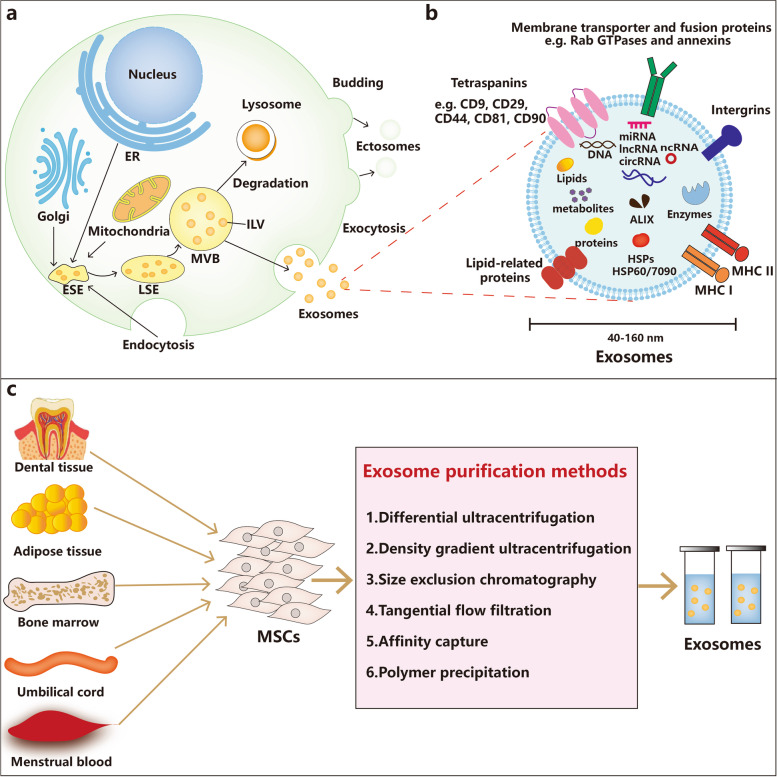
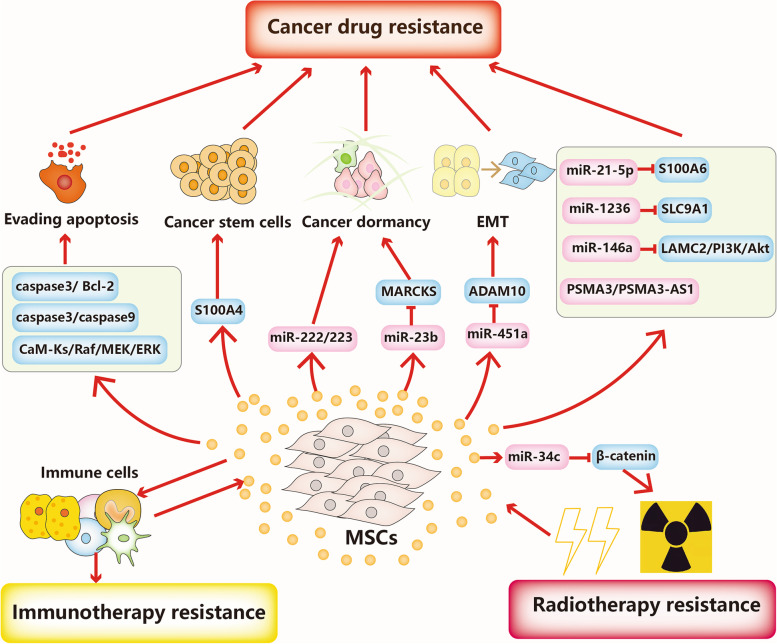
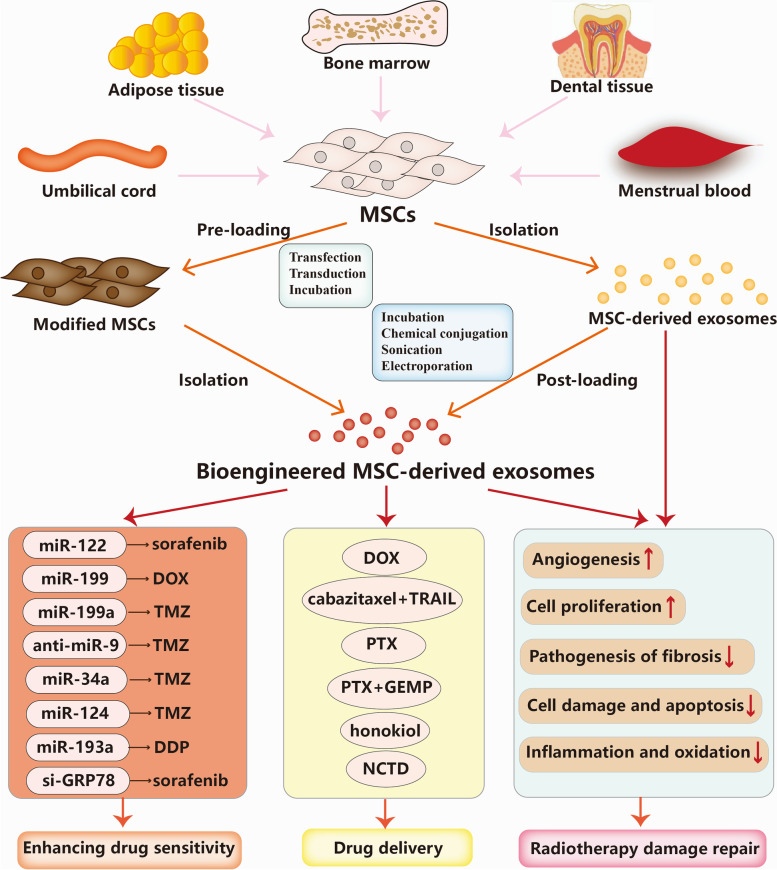
Verification
Claims the paper makes
The claims and statistics of this paper haven’t been checked yet.
Run the check — free, no account needed. It reads the open-access text and checks the sources it cites.
Claims other papers make about this one
Each is checked against this paper’s own text: does it say what the citing paper says it does?
The cited source says what the claim attributes to it.
In the citing paper
“The cross-communication between MSC and cancer cells plays a crucial role in the development of multiple aspects of cancer including tumor growth, metastasis, and epithelial-to-mesenchymal transition [16].”
From Mesenchymal Stem/Stromal Cells: Immunomodulatory and Bone Regeneration Potential after Tumor Excision in Osteosarcoma Patients (2023) · cites this paper as [16]
The cited source says what the claim attributes to it.
In the citing paper
“MSC-derived small extracellular vesicles (MsEVs) deliver both the lipid membrane and cytoplasmic components from MSCs, demonstrating a natural tumor-homing effect. This makes them well-suited as drug transport systems for cancer treatment [238, 239].”
From Emerging role of exosomes in cancer therapy: progress and challenges (2025) · cites this paper as [238]
Self-check
Percentages, sums and reported differences re-computed from the paper’s own numbers.
The self-check needs the paper’s full text.
Citations
Cites
1 retracted
Wang, B., Wu, Z.-H., Lou, P.-Y., Chai, C., Han, S., Ning, J.-F., & Li, M. (2019) · Cellular Oncology · doi:10.1007/s13402-019-00461-z · Cited by 54
RetractedSiegel, R. L., Miller, K. D., & Jemal, A. (2020) · CA: A Cancer Journal for Clinicians · doi:10.3322/caac.21590 · Cited by 20,444
Théry, C., Witwer, K. W., Aikawa, E., Alcaraz, M. J., Anderson, J. D., Andriantsitohaina, R., Antoniou, A., Arab, T., Archer, F., Atkin‐Smith, G. K., et al. (2018) · Journal of Extracellular Vesicles · doi:10.1080/20013078.2018.1535750 · Cited by 11,099
The biology , function , and biomedical applications of exosomes
Kalluri, R., & LeBleu, V. S. (2020) · Science · doi:10.1126/science.aau6977 · Cited by 10,770
Bang, Y.-J., Van Cutsem, E., Feyereislova, A., Chung, H. C., Shen, L., Sawaki, A., Lordick, F., Ohtsu, A., Omuro, Y., Satoh, T., et al. (2010) · The Lancet · doi:10.1016/s0140-6736(10)61121-x · Cited by 7,302
Mismatch repair deficiency predicts response of solid tumors to PD-1 blockade
Le, D. T., Durham, J. N., Smith, K. N., Wang, H., Bartlett, B. R., Aulakh, L. K., Lu, S., Kemberling, H., Wilt, C., Luber, B. S., et al. (2017) · Science · doi:10.1126/science.aan6733 · Cited by 6,645
Isolation and Characterization of Exosomes from Cell Culture Supernatants and Biological Fluids
Théry, C., Amigorena, S., Raposo, G., & Clayton, A. (2006) · Current Protocols in Cell Biology · doi:10.1002/0471143030.cb0322s30 · Cited by 5,766
Primary, Adaptive, and Acquired Resistance to Cancer Immunotherapy
Sharma, P., Hu-Lieskovan, S., Wargo, J. A., & Ribas, A. (2017) · Cell · doi:10.1016/j.cell.2017.01.017 · Cited by 5,588
Exosomes: composition, biogenesis and function
Théry, C., Zitvogel, L., & Amigorena, S. (2002) · Nature reviews. Immunology · doi:10.1038/nri855 · Cited by 5,478
Delivery of siRNA to the mouse brain by systemic injection of targeted exosomes
Alvarez-Erviti, L., Seow, Y., Yin, H., Betts, C., Lakhal, S., & Wood, M. J. A. (2011) · Nature Biotechnology · doi:10.1038/nbt.1807 · Cited by 4,930
Cited by
Sorted by citations
Clinical applications of stem cell-derived exosomes
Tan, F., Li, X., Wang, Z., Li, J., Shahzad, K., & Zheng, J. (2024) · Signal Transduction and Targeted Therapy · doi:10.1038/s41392-023-01704-0 · Cited by 708
Emerging role of exosomes in cancer therapy: progress and challenges
Li, J., Wang, J., & Chen, Z. (2025) · Molecular Cancer · doi:10.1186/s12943-024-02215-4 · Cited by 297
Metabolic reprogramming and therapeutic resistance in primary and metastatic breast cancer
Liu, S., Zhang, X., Wang, W., Li, X., Sun, X., Zhao, Y., Wang, Q., Li, Y., Hu, F., & Ren, H. (2024) · Molecular Cancer · doi:10.1186/s12943-024-02165-x · Cited by 300
Extracellular Vesicles: New Classification and Tumor Immunosuppression
Sheta, M., Taha, E. A., Lu, Y., & Eguchi, T. (2023) · Biology · doi:10.3390/biology12010110 · Cited by 221
Exosomal circular RNAs: A chief culprit in cancer chemotherapy resistance
Guo, X., Gao, C., Yang, D., & Li, S. (2023) · Drug Resistance Updates · doi:10.1016/j.drup.2023.100937 · Cited by 150
Metadata
- Authors
- Lin, Z., Wu, Y., Xu, Y., Li, G., Li, Z., & Liu, T.
- Affiliations
- Central South University (CN)
- Second Xiangya Hospital of Central South University (CN)
- Corresponding author
- Li, Zhihong
- Liu, Tang
- Venue
- Molecular Cancer
- Published
- 2022-09-13
- Volume
- 21
- Issue
- 1
- Pages
- 179-179
- ISSN
- 1476-4598 (ISSN-L)
- PMC
- PMC9468526
- OpenAlex
- W4295750964
- Cited by
- 297
- References
- 158
- Citations by year
- 2026: 50 · 2025: 115 · 2024: 81 · 2023: 48 · 2022: 2
- FWCI
- 6.40
- Type
- journal article
- Language
- en
- Open access
- gold
- doi.org
- Locations
- Molecular Cancer (publishedVersion, cc-by)
- PubMed Central (publishedVersion, cc-by)
- PubMed (publishedVersion)
- DOAJ (DOAJ: Directory of Open Access Journals) (submittedVersion, cc-by-sa)
- Funders
- National Natural Science Foundation of China (82072441, 2022JJ10095, 81871783)
- Topics
- Life Sciences › Biochemistry, Genetics and Molecular Biology › Molecular Biology › Extracellular vesicles in disease
- Life Sciences › Biochemistry, Genetics and Molecular Biology › Cell Biology › Mesenchymal stem cell research
- Health Sciences › Medicine › Oncology › Cancer Cells and Metastasis
- Keywords
- mesenchymal stem cells, exosomes, cancer therapy resistance, tumor microenvironment, chemoresistance, targeted therapy resistance, radiotherapy resistance, immunotherapy resistance, epithelial-mesenchymal transition, metastasis, regenerative medicine
- MeSH terms
- Humans, Neoplasms, Adipocytes, Exosomes, Tumor Microenvironment, Mesenchymal Stem Cells
About these checks
Registry, retraction, Cites and statistics results are computed, not judged, with one exception: a printed reference that no index lists is read once by a model before it counts as a citation error. Claims are extracted by a model and kept only when their quote appears verbatim in the text; each cited source is then checked, with a model’s help, for whether it says what the claim relies on. Those verdicts can be wrong — read the claim’s quote and the cited source before relying on one.
Statistics and arithmetic are recomputed, not judged.
Confidence bands are shown only for fields calibrated on our annotated test set. None is calibrated yet, so no band is shown.
What counts as a claim ›How we measure confidence ›How we check this ›
Are you an author, or do you see a problem with this page? Request a review
