

Advances on immunotherapy for osteosarcoma
Open accessThe DOI matches its Crossref record; 166 of the 167 references it cites were found in a registry or an index; 120 of the 174 sources its claims cite were checked for support.
Abstract
Osteosarcoma is the most common primary bone cancer in children and young adults. Limited progress has been made in improving the survival outcomes in patients with osteosarcoma over the past four decades. Especially in metastatic or recurrent osteosarcoma, the survival rate is extremely unsatisfactory. The treatment of osteosarcoma urgently needs breakthroughs. In recent years, immunotherapy has achieved good therapeutic effects in various solid tumors. Due to the low immunogenicity and immunosuppressive microenvironment of osteosarcoma, immunotherapy has not yet been approved in osteosarcoma patients. However, immune-based therapies, including immune checkpoint inhibitors, chimeric antigen receptor T cells, and bispecfic antibodies are in active clinical development. In addition, other immunotherapy strategies including modified-NK cells/macrophages, DC vaccines, and cytokines are still in the early stages of research, but they will be hot topics for future study. In this review, we showed the functions of cell components including tumor-promoting and tumor-suppressing cells in the tumor microenvironment of osteosarcoma, and summarized the preclinical and clinical research results of various immunotherapy strategies in osteosarcoma, hoping to provide new ideas for future research in this field.
Overview
CoChat Summary
TL;DR
This review summarizes the immunosuppressive tumor microenvironment of osteosarcoma and the preclinical/clinical landscape of immunotherapies, including immune checkpoint inhibitors, CAR-modified cell therapies, vaccines, cytokines, and bispecific antibodies. It concludes that immunotherapy has not yet been approved for osteosarcoma and that single-agent approaches show limited efficacy, making biomarker-guided combination strategies the likely future direction.
Key findings
- Osteosarcoma is the most common primary bone cancer in children and young adults, with an incidence of 3–5 per million per year; about 60% of patients are 10–20 years old. Localized disease has a 5-year survival of 60–70%, but metastatic or recurrent disease has only 20–30% 5-year survival.
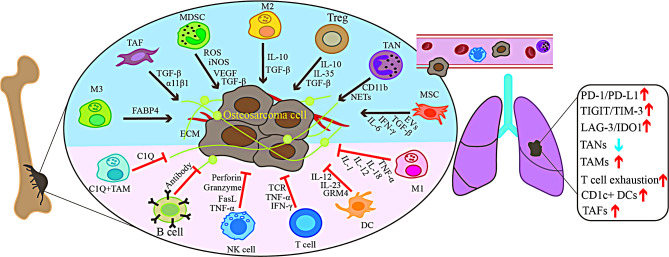
- The osteosarcoma TME is immunosuppressive: TAMs are the most abundant immune cells and account for approximately 50% of immune cells, with M2-type TAMs predominant. PD-L1 positivity was found in 13% of primary tumors, 25% of relapses, and 48% of metastases, and correlated with high T-cell infiltration.
- Clinical ICI results are limited: in SARC028, 2 (5%) of 40 bone sarcoma patients had an objective response, including 1 (5%) of 22 osteosarcoma patients; a phase II pembrolizumab trial in 12 relapsed osteosarcoma patients showed no clinical benefit; and a pembrolizumab plus cyclophosphamide trial had only one partial response.
- CAR-T and combination trials show some signals: in a HER2-CAR-T phase I/II trial of 19 patients (16 osteosarcoma), 4 of 17 evaluable patients had stable disease for 12 weeks to 14 months and median OS was 10.3 months; apatinib plus camrelizumab in 43 chemotherapy-refractory osteosarcoma patients had an ORR of 20.9% and 6-month PFS of 50.9%; MASCT-I plus camrelizumab and apatinib in 6 osteosarcoma patients had an ORR of 33.3%, DCR of 50.0%, and median PFS of 5.7 months.
Methods
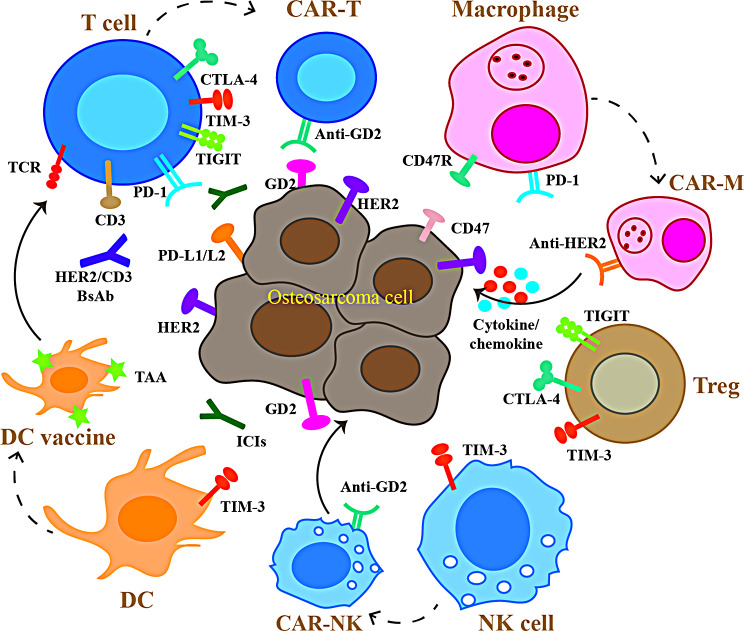
- Narrative review of the osteosarcoma immune microenvironment and immunotherapy strategies, including immune checkpoint inhibitors, CAR-T/CAR-M/CAR-NK cells, dendritic cell vaccines, cytokines, bispecific antibodies, and combination regimens.
- Synthesizes preclinical studies and clinical trial results, with tables summarizing clinical trials of ICIs, adoptive cell therapies, and bispecific antibodies in osteosarcoma.
- No primary patient cohort or new experimental data are reported; the analysis is a descriptive literature synthesis.
Limitations
- The paper states that osteosarcoma has low immunogenicity and an immunosuppressive microenvironment, immunotherapy has not yet been approved for osteosarcoma, and many strategies remain in early or preclinical stages. It also notes that single immunotherapy has a low response rate and that CAR-NK/CAR-M therapies have not made promising progress in osteosarcoma.
- Evident from the text: this is a narrative review without a systematic search strategy or quantitative meta-analysis, so selection and interpretation of cited studies may be subject to bias.
- Evident from the text: many cited clinical trials are small, include mixed sarcoma populations with only subsets of osteosarcoma patients, or are terminated, withdrawn, suspended, or have unknown status, limiting the strength of conclusions about osteosarcoma-specific efficacy.
Model-written summary. Check it against the paper before relying on it.
Integrity signals
Registry
Cites
Statistics
Figures
Verification
Claims the paper makes
107 Valid · 7 Not valid · 44 Not checked · 15 Own results and interpretations
At least one cited source doesn’t support this claim or points to a different paper, and none confirmed it — see the verdicts below.
In the paper
“and is associated with adverse clinical outcomes [103]”
§ Advances on immunotherapy for osteosarcoma > Studies of CAR-modified cellular therapies for osteosarcoma > CAR-T therapy
What the sources say
- Disputedcites [103] Wang SL, et al. Prognostic significance of the expression of HER family members in primary osteosarcoma. Oncol Lett. 2018;16(2):2185–94. 30008917 PMC6036504 sourceExperimental — accuracy not yet measured
The Discussion reports HER-2 staining in 13 (22%) osteosarcoma samples but says it had no prognostic significance. Its conclusion instead links EGFR, HER-3 and HER-4 expression to unfavorable clinical outcomes. (LLM, conf=0.90)
Checked by a reasoning model — may be wrong.
plainstates an association- Asserted: passes — The authors put it forward as true.
- Checkable: passes — It can be checked against evidence.
- Load-bearing: unclear — It is unclear whether the paper’s conclusions depend on it.
- Based: passes — The paper gives a reason why it holds.
- Disputed
Some cited sources support this claim and some don’t — read each source’s verdict below.
In the paper
“Zhang et al. conducted the third-generation CAR-T cells targeting B7-H3 and proved the killing effects for tumor cells in vitro and in vivo using the patientderived xenografts (PDXs) model of osteosarcoma [116–125].”
§ Advances on immunotherapy for osteosarcoma > Studies of CAR-modified cellular therapies for osteosarcoma > B7-H3
What the sources say
- Supportedcites [116] Zhang Q, et al. B7-H3 targeted CAR-T cells show highly efficient anti-tumor function against osteosarcoma both in vitro and in vivo. BMC Cancer. 2022;22(1):1124. 36320072 10.1186/s12885-022-10229-8 PMC9628043 source
The paper’s Abstract (Results) identifies the cells as third-generation B7-H3-targeted CAR-T cells. The Conclusion reports tumor-cell killing in vitro, and the Results section on osteosarcoma PDX models reports that treated tumors shrank or disappeared in vivo. (LLM, conf=0.91)
- Not checked — no full text of the sourcecites [117] Fritsche-Guenther R, et al. De novo expression of EphA2 in osteosarcoma modulates activation of the mitogenic signalling pathway. Histopathology. 2010;57(6):836–50. 21166698 10.1111/j.1365-2559.2010.03713.x source
- Could not verifycites [118] Posthumadeboer J, et al. Surface proteomic analysis of osteosarcoma identifies EPHA2 as receptor for targeted drug delivery. Br J Cancer. 2013;109(8):2142–54. 24064975 10.1038/bjc.2013.578 PMC3798973 sourceExperimental — accuracy not yet measured
The Materials and methods section describes EPHA2-targeted adenoviral delivery in osteosarcoma cells, not B7-H3 CAR-T cells. Searches for B7-H3, third-generation CAR-T cells, and patient-derived osteosarcoma xenografts found no passage in our copy reporting the attributed experiment; the Zhang papers listed in References concern proteomics. (LLM, conf=0.78)
- Disputedcites [119] Hsu K, et al. Chimeric Antigen receptor-modified T cells targeting EphA2 for the immunotherapy of paediatric bone tumours. Cancer Gene Ther. 2021;28(3–4):321–34. 32873870 10.1038/s41417-020-00221-4 PMC8057949 sourceExperimental — accuracy not yet measured
The in vivo efficacy and osteosarcoma metastatic-model sections describe CAR T cells targeting EphA2, not B7-H3. They identify the xenografts as derived from the 143B osteosarcoma cell line, not patient-derived tumours; the abstract reports EphA2 CAR T-cell activity in vitro and in vivo. (LLM, conf=0.88)
Checked by a reasoning model — may be wrong.
- Could not verifycites [120] Campbell CL, et al. Increased expression of the interleukin-11 receptor and evidence of STAT3 activation in prostate carcinoma. Am J Pathol. 2001;158(1):25–32. 11141475 10.1016/S0002-9440(10)63940-5 PMC1850253 sourceExperimental — accuracy not yet measured
Our copy of Campbell et al. (2001, Am J Pathol) is entirely about IL-11Rα/gp130 expression and tyrosine-phosphorylated STAT3 in normal prostate, BPH and prostate carcinoma tissues and cell lines (Abstract, Immunohistochemical Analysis of Prostatic Tissues and Cell Lines, Expression of Tyrosine-Phosphorylated STAT3..., Discussion). Searches for 'B7-H3 CAR-T osteosarcoma patient-derived xenograft' and 'chimeric antigen receptor T cells third-generation costimulatory domain tumor killing' returned no passage addressing B7-H3, CAR-T constructs, osteosarcoma or PDX models; the paper neither states nor contradicts the claim, and it names no alternative source for it. (LLM, conf=0.75)
- Not checked — no full text of the sourcecites [121] Schwertschlag US, et al. Hematopoietic, immunomodulatory and epithelial effects of interleukin-11. Leukemia. 1999;13(9):1307–15. 10482979 10.1038/sj.leu.2401514 source
- Could not verifycites [122] Lewis VO, et al. The interleukin-11 receptor alpha as a candidate ligand-directed target in osteosarcoma: consistent data from cell lines, orthotopic models, and human tumor samples. Cancer Res. 2009;69(5):1995–9. 19244100 10.1158/0008-5472.CAN-08-4845 sourceExperimental — accuracy not yet measured
Our full copy of Lewis et al. (2009) is entirely about the IL-11/IL-11Ra ligand-receptor pair as a ligand-directed targeting system in osteosarcoma: the Results and Discussion sections report IL-11Ra surface expression on KRIB, OS187, Dunn-LM and K7M3 cells, CGRRAGGSC-phage internalization, systemic phage targeting in intratibial orthotopic nude-mouse tumors, and IL-11Ra staining in human primary osteosarcomas and lung metastases. Searches for 'B7-H3 CAR-T cells patient-derived xenograft' and for T-cell/immunotherapy content returned no passage mentioning B7-H3, CAR-engineered T cells, or PDX models — the in vivo work here is phage-display targeting, not cell therapy. Since our copy simply does not address the claim's subject (and does not credit it to another named work), the attribution cannot be verified from this source. (LLM, conf=0.75)
- Disputedcites [123] Huang G, et al. Genetically modified T cells targeting interleukin-11 receptor alpha-chain kill human osteosarcoma cells and induce the regression of established osteosarcoma lung metastases. Cancer Res. 2012;72(1):271–81. 22075555 10.1158/0008-5472.CAN-11-2778 PMC3833671 sourceExperimental — accuracy not yet measured
The Discussion identifies the receptor as IL-11Rα and describes a second-generation CAR, not a third-generation B7-H3 CAR. Materials and Methods (Animal model) describes mice injected with the KRIB osteosarcoma cell line, not a patient-derived xenograft; the paper does report in vitro killing and regression of lung metastases. (LLM, conf=0.90)
Checked by a reasoning model — may be wrong.
- Not checked — no full text of the sourcecites [124] Pollak M. The insulin and insulin-like growth factor receptor family in neoplasia: an update. Nat Rev Cancer. 2012;12(3):159–69. 22337149 10.1038/nrc3215 source
- Disputedcites [125] Cui B, et al. Targeting ROR1 inhibits epithelial-mesenchymal transition and metastasis. Cancer Res. 2013;73(12):3649–60. 23771907 10.1158/0008-5472.CAN-12-3832 PMC3832210 sourceExperimental — accuracy not yet measured
The Materials and Methods section (Cell culture; page unavailable) identifies the experimental cells as breast-cancer cell lines. The Results section (Silencing ROR1 Inhibits Experimental Lung And Bone Metastasis; page unavailable) describes ROR1-shRNA treatment and metastasis in mice, not B7-H3 CAR-T cells or an osteosarcoma patient-derived xenograft. (LLM, conf=0.88)
Checked by a reasoning model — may be wrong.
plainstates a cause- Asserted: passes — The authors put it forward as true.
- Checkable: passes — It can be checked against evidence.
- Load-bearing: passes — The paper’s conclusions depend on it.
- Based: passes — The paper gives a reason why it holds.
- Supported
Every source the paper cites for this claim was checked and supports it.
In the paper
“And the immunoreceptor inhibitory checkpoint marker TIGIT was highly expressed by the CD8+ T, CD4+ T, Treg and NKT cells in osteosarcoma lesions.”
§ Advances on immunotherapy for osteosarcoma > Studies of ICIs for osteosarcoma > TIM-3
What the sources say
- Supportedcites [4] Zhou Y, et al. Single-cell RNA landscape of intratumoral heterogeneity and immunosuppressive microenvironment in advanced osteosarcoma. Nat Commun. 2020;11(1):6322. 33303760 10.1038/s41467-020-20059-6 PMC7730477 source
The Discussion states that TIGIT was widely expressed in T-reg, CD8+ T, CD4+ T, and NKT cells in osteosarcoma. The Results also describe relatively high TIGIT expression in T-reg cells and widespread expression in the other three cell types. Page numbers are not provided in our copy. (LLM, conf=0.93)
plainstates an association- Asserted: passes — The authors put it forward as true.
- Checkable: passes — It can be checked against evidence.
- Load-bearing: passes — The paper’s conclusions depend on it.
- Based: passes — The paper gives a reason why it holds.
- Supported
The cited sources support only part of this claim — read each source’s verdict below.
In the paper
“The study demonstrated that ALCAM was associated with tumorigenesis in osteosarcoma [111].”
§ Advances on immunotherapy for osteosarcoma > Studies of CAR-modified cellular therapies for osteosarcoma > ALCAM
What the sources say
- Partly supportedcites [111] Federman N, et al. Enhanced growth inhibition of osteosarcoma by cytotoxic polymerized liposomal nanoparticles targeting the alcam cell surface receptor. Sarcoma. 2012;2012:p126906. 10.1155/2012/126906 PMC3447386 23024593 sourceExperimental — accuracy not yet measured
Results §3.1 reports ALCAM expression in all ten osteosarcoma specimens tested, supporting an association with osteosarcoma tumors. The Discussion §4 says the biological consequences of increased expression are difficult to gauge; the study does not demonstrate that ALCAM is involved in tumorigenesis. (LLM, conf=0.84)
boostedstates an association- Asserted: passes — The authors put it forward as true.
- Checkable: passes — It can be checked against evidence.
- Load-bearing: passes — The paper’s conclusions depend on it.
- Based: passes — The paper gives a reason why it holds.
- Partly supported
The cited sources support only part of this claim — read each source’s verdict below.
In the paper
“In vitro and in vivo osteosarcoma models demonstrated that anti-CD47 monoclonal antibody can block the CD47-SIRPα signaling pathway, thus enhancing the anti-tumor ability of macrophages [96].”
§ Advances on immunotherapy for osteosarcoma > Studies of ICIs for osteosarcoma > CD47
What the sources say
- Partly supportedcites [96] Xu JF, et al. CD47 blockade inhibits tumor progression human osteosarcoma in xenograft models. Oncotarget. 2015;6(27):23662–70. 26093091 10.18632/oncotarget.4282 PMC4695143 sourceExperimental — accuracy not yet measured
The Results section reports that anti-CD47 antibodies significantly increased macrophage phagocytosis of osteosarcoma cells in a co-culture assay. The Discussion describes enhanced macrophage phagocytosis in vivo as a possibility, not a demonstrated result; the claim overstates that part of the evidence. No page numbers are available in our copy. (LLM, conf=0.85)
boostedstates a cause- Asserted: passes — The authors put it forward as true.
- Checkable: passes — It can be checked against evidence.
- Load-bearing: passes — The paper’s conclusions depend on it.
- Based: passes — The paper gives a reason why it holds.
- Partly supported
97 more claims · 59 with their cited sources checked
Create a free account to see all 173 claims and to verify the 11 references still open.
- It may state two separate claims as one. 66
- Probably not a substantial claim. 8
Self-check
Percentages, sums and reported differences re-computed from the paper’s own numbers.
Each contradiction between two passages listed here was confirmed by an independent check.
Rated minor: it would not touch a result — a value no result rests on, a p-value that stays on the same side of the significance level, or a conflict that is clerical, resolved elsewhere in the paper, or outside its own findings.
In the paper
§ Advances on immunotherapy for osteosarcoma > Studies of ICIs for osteosarcoma > TIM-3
“NCT03359018 | Apatinib Plus Anti-PD1 Therapy in Patients With Advanced Osteosarcoma | PD-L1VEGFR | Apatinib + SHR−1210 | Completed | Phase 2”
§ Advances on immunotherapy for osteosarcoma > Combination therapy strategies > Combination of anti-PD-1/PD-L1 and anti-angiogenic treatment
“apatinib (anti-VEGFR2 inhibitor) plus camrelizumab (anti-PD-1 antibody) in patients with chemotherapy-refractory osteosarcoma (NCT03359018).”
Rated minor: it would not touch a result — a value no result rests on, a p-value that stays on the same side of the significance level, or a conflict that is clerical, resolved elsewhere in the paper, or outside its own findings.
In the paper
§ Advances on immunotherapy for osteosarcoma > Studies of CAR-modified cellular therapies for osteosarcoma > CAR-NK therapy
“T-Cell Membrane-Anchored Tumor Targeted Il12 (Attil12)- T-Cell Therapy”
§ Advances on immunotherapy for osteosarcoma > Studies of CAR-modified cellular therapies for osteosarcoma > CAR-NK therapy
“AttIL2-T cell therapy”
Rated minor: it would not touch a result — a value no result rests on, a p-value that stays on the same side of the significance level, or a conflict that is clerical, resolved elsewhere in the paper, or outside its own findings.
In the paper
§ Advances on immunotherapy for osteosarcoma > Conclusions and future directions
“other CAR-engineered adoptive cell therapies, such as CAR-NK and CAR-M, are still in the preclinical research phase.”
§ Advances on immunotherapy for osteosarcoma > Studies of CAR-modified cellular therapies for osteosarcoma > CAR-NK therapy
“NCT05703854 | CAR.70-engineered IL15-transduced Cord Blood-derived NK Cells in Conjunction With Lymphodepleting Chemotherapy for the Management of Advanced Renal Cell Carcinoma, Mesothelioma and Osteosarcoma | | CAR.70/IL15-transduced CB-derived NK cells | Recruiting | Phase 1/2”
Citations
Cites
Pembrolizumab versus Chemotherapy for PD-L1-Positive Non-Small-Cell Lung Cancer
Reck, M., Rodríguez-Abreu, D., Robinson, A. G., Hui, R., Csőszi, T., Fülöp, A., Gottfried, M., Peled, N., Tafreshi, A., Cuffe, S., et al. (2016) · New England Journal of Medicine · doi:10.1056/nejmoa1606774 · Cited by 10,089 · cited 1×
“Importantly, due to their impressive efficacy, ICIs are recommended for the treatment of several human malignancies, including melanoma [10], non-small-cell lung cancer [11], head and neck cancers [12] and so on.”
BackgroundNivolumab for Recurrent Squamous-Cell Carcinoma of the Head and Neck
Ferris, R. L., Blumenschein, G., Fayette, J., Guigay, J., Colevas, A. D., Licitra, L., Harrington, K., Kasper, S., Vokes, E. E., Even, C., et al. (2016) · New England Journal of Medicine · doi:10.1056/nejmoa1602252 · Cited by 5,101
Aran, D., Looney, A. P., Liu, L., Wu, E., Fong, V., Hsu, A., Chak, S., Naikawadi, R. P., Wolters, P. J., Abate, A. R., et al. (2019) · Nature Immunology · doi:10.1038/s41590-018-0276-y · Cited by 4,984 · cited 1×
“In addition, the M3-TAMs, actually the FABP4 + TAMs previously identified as the alveolar macrophages in the lung, were dominant in the lung metastatic osteosarcoma lesion [24].”
BackgroundInnate and adaptive immune cells in the tumor microenvironment
Gajewski, T. F., Schreiber, H., & Fu, Y.-X. (2013) · Nature Immunology · doi:10.1038/ni.2703 · Cited by 4,148 · cited 1×
“In addition, CAR-Ms promoted an inflammatory state within the TME and were capable of antigen cross-presentation to tumor-specific CD8 + T cells [135].”
BackgroundThe evolving tumor microenvironment: From cancer initiation to metastatic outgrowth
de Visser, K. E., & Joyce, J. A. (2023) · Cancer Cell · doi:10.1016/j.ccell.2023.02.016 · Cited by 4,059
Chimeric Antigen Receptor–Modified T Cells for Acute Lymphoid Leukemia
Grupp, S. A., Kalos, M., Barrett, D., Aplenc, R., Porter, D. L., Rheingold, S. R., Teachey, D. T., Chew, A., Hauck, B., Wright, J. F., et al. (2013) · New England Journal of Medicine · doi:10.1056/nejmoa1215134 · Cited by 3,509 · cited 1×
“Chimeric antigen receptor T (CAR-T) cells as an adoptive cell therapy (ACT) have showed remarkable clinical outcome in the treatment of malignant hematological tumors, such as acute lymphoblastic leukemia [13], chronic lymphocytic leukemia [14], and non-hodg-kin lymphoma [15].”
BackgroundNeutrophil extracellular traps in immunity and disease
Papayannopoulos, V. (2018) · Nature Reviews Immunology · doi:10.1038/nri.2017.105 · Cited by 3,397 · cited 1×
“Web-like chromatin structures known as neutrophil extracellular traps (NETs) plays important roles in immune protection, inflammatory and autoimmune diseases and cancer [40].”
BackgroundUse of CAR-Transduced Natural Killer Cells in CD19-Positive Lymphoid Tumors
Liu, E., Marin, D., Banerjee, P., Macapinlac, H. A., Thompson, P., Basar, R., Nassif Kerbauy, L., Overman, B., Thall, P., Kaplan, M., et al. (2020) · New England Journal of Medicine · doi:10.1056/nejmoa1910607 · Cited by 2,217 · cited 1×
“The trial in adults with chronic lymphocytic leukemia demonstrated that CAR-NK targeting CD19 are safe and effective [143].”
BackgroundMyeloid-Derived Suppressor Cells
Gabrilovich, D. I. (2017) · Cancer Immunology Research · doi:10.1158/2326-6066.cir-16-0297 · Cited by 1,882
Porter, D. L., Hwang, W.-T., Frey, N. V., Lacey, S. F., Shaw, P. A., Loren, A. W., Bagg, A., Marcucci, K. T., Shen, A., Gonzalez, V., et al. (2015) · Science Translational Medicine · doi:10.1126/scitranslmed.aac5415 · Cited by 1,729 · cited 1×
“Chimeric antigen receptor T (CAR-T) cells as an adoptive cell therapy (ACT) have showed remarkable clinical outcome in the treatment of malignant hematological tumors, such as acute lymphoblastic leukemia [13], chronic lymphocytic leukemia [14], and non-hodg-kin lymphoma [15].”
Background
Cited by
Items 101–200 of 269
The lung pre‐metastatic niche in osteosarcoma: Mechanism and therapeutic intervention
Wang, D., Liu, T., Yin, B., Chang, Y., Hyon-U, P., Zhang, Y., & Li, H. (2025) · International Journal of Cancer · doi:10.1002/ijc.70188 · Cited by 2
“80 Immune checkpoints are a class of immune-suppressive molecules expressed by immune cells that regulate the degree of immune activation, thereby preventing tissue damage and autoimmune responses caused by inflammation.”
HMGB1 and Its Signaling Pathway in Osteosarcoma: Current Advances in Targeted Therapy
Liu, Z., Wang, F., Zhou, Z., Wu, M., Huang, Q., Jiang, X., Wen, X., & Ye, L. (2025) · Current Issues in Molecular Biology · doi:10.3390/cimb47110887 · Cited by 2
“…inhibited a substantial breakthrough in the survival benefit for metastatic or recurrent patients, and even with active treatment, the 5-year survival rate is only 20% [2], suggesting that it is difficult to overcome this efficacy bottleneck by solely relying on traditional chemotherapeutic agents.”
Chen, L., Wu, H., Ren, R., Zhang, Y., Zhu, Z., Chen, X., Wang, L., Gan, X., Kang, H., Pu, H., et al. (2025) · International Immunopharmacology · doi:10.1016/j.intimp.2025.115831 · Cited by 4
Single-cell dissection of PTM-related networks reveals an immunosuppressed osteosarcoma ecosystem
Chen, J., Zhang, W., Yan, H., Chen, J., Liu, H., Zhou, X., Zhang, H., & Cheng, D. (2025) · Frontiers in Molecular Biosciences · doi:10.3389/fmolb.2025.1718941 · Cited by 5
“Aberrant phosphorylation and ubiquitination influence the stability and trafficking of immune checkpoints and costimulatory receptors, thereby modulating antigen recognition and T-cell activation thresholds (Yu and Yao, 2024).”
The synergistic role of ferroptosis in osteosarcoma immunotherapy
Tian, D., Yang, Z., Zhang, J., Yang, R., & Hao, H. (2025) · Medical Oncology · doi:10.1007/s12032-025-03196-0 · Cited by 2
“Therefore, the development of novel combinatorial regimens is imperative to improve patient outcomes [ 19 , 20].”
InfluentialArtificial intelligence in bone biology: Transforming basic research into advanced therapeutics
Li, C., Zhong, Z., Zhang, N., Yuan, S., Fang, R., Ge, F., Yan, W., Zhang, D., & Xie, D. (2026) · The Innovation Life · doi:10.59717/j.xinn-life.2026.100186 · Cited by 4
Liu, H., Wang, G., Wang, C., Hou, D., Li, S., Fan, Y., & Liu, B. (2026) · Frontiers in Immunology · doi:10.3389/fimmu.2025.1727434 · Cited by 4
Dave, P., Raval, B., Mori, D., & Dudhat, K. R. (2026) · Nano Trends · doi:10.1016/j.nwnano.2026.100182 · Cited by 12
Song, X., Tou, X., Li, L., Wang, F., Chengqun, Q., Wang, R., & Shen, J. (2026) · Journal of bone oncology · doi:10.1016/j.jbo.2026.100743 · Cited by 3
“Although the introduction of neoadjuvant and adjuvant multi ‑ agent chemotherapy combined with surgical resection has improved the 5 ‑ year survival rate for localized OS to approximately 60 – 75%, this improvement has plateaued over the past few decades [3,4].”
Advances in T cell–based immunotherapy for osteosarcoma
Zhang, K., Wang, Z., He, J., Lu, L., Wang, W., Yang, A., Xie, H., Huang, L., Huang, Y., Zhang, K., et al. (2026) · Frontiers in Immunology · doi:10.3389/fimmu.2026.1769847 · Cited by 7
Zhao, C., Tang, Y., He, Y., et al. (2026) · Bone · doi:10.1016/j.bone.2026.117832 · Cited by 2
Zou, Y., Li, T., Pan, H., Liu, J., He, J., Ju, H., Wang, W., & Zheng, X. (2026) · Frontiers in Immunology · doi:10.3389/fimmu.2026.1791263 · Cited by 3
“Malignant tumors have long posed a serious threat to human health, prompting extensive research into various therapeutic strategies, including chemotherapy (1 – 5), radiotherapy (6 – 9), phototherapy (10 – 15), and immunotherapy (16 – 19).”
Li, Z., Lin, D., Wu, L., Xu, W., Zhang, H., Zhuang, Z., Zhang, L., Chen, J., & Su, Z. (2026) · World Journal of Surgical Oncology · doi:10.1186/s12957-026-04288-5 · Cited by 7
“Over the past four decades, overall survival has largely plateaued, with early pulmonary metastasis, treatment resistance, and poor outcomes after relapse representing the major barriers to further progress [3, 4].”
Yang, B., Liu, S., Liu, B., Ye, T., Ma, X., & Song, T. (2026) · Cell Communication and Signaling · doi:10.1186/s12964-026-02883-3 · Cited by 4
Tang, J., Guo, Y., Lu, H., Fang, Y., & Chen, W. (2025) · Frontiers in Pediatrics · doi:10.3389/fped.2025.1574034 · Cited by 4
Zhang, J., & Wang, W. (2025) · Frontiers in Immunology · doi:10.3389/fimmu.2025.1566061 · Cited by 2
“About 5.2 children per million are diagnosed with OS each year (3), and patients 10 to 20 years of age account for about 60% of OS cases (4).”
InfluentialLong, C., Ma, B., Zhong, X., Zou, M., Li, K., & Liu, S. (2025) · PLoS ONE · doi:10.1371/journal.pone.0326872 · Cited by 3
Chen, X., Li, X., Zhao, H., Qu, J., Li, X., Lin, C., & Yuan, Z. (2025) · Frontiers in Pharmacology · doi:10.3389/fphar.2025.1599496 · Cited by 2
Xu, Y., Jiang, J., Hu, Z., Zhifeng, Z., & Wang, L. (2025) · Discover Oncology · doi:10.1007/s12672-025-03414-1 · Cited by 2
Wu, H., Xu, K., Liu, C., Ge, H., & Yan, J. (2025) · Frontiers in Molecular Biosciences · doi:10.3389/fmolb.2025.1608743 · Cited by 2
“Osteosarcoma is the most common primary malignant bone tumor in adolescents, marked by aggressive growth, early metastasis, and limited treatment efficacy in advanced cases (Harris and Hawkins, 2022; Yu and Yao, 2024).”
Wang, Y., Yuan, J., Guo, K., Zhang, Z., Zhu, J., Arya, S., Huang, G., Li, S., Chen, Q., Liu, X., et al. (2025) · Frontiers in Immunology · doi:10.3389/fimmu.2025.1517971 · Cited by 3
Yao, W., Du, X., Li, Z., et al. (2025) · Journal of bone oncology · doi:10.1016/j.jbo.2025.100674 · Cited by 1
“Osteosarcoma is the most common primary malignant bone tumor in children and adolescents, with approximately 60 % of cases occurring between the ages of 10 and 20 [1,2].”
Shi, Y., Cui, J., & Li, X. (2025) · Biochemical and Biophysical Research Communications · doi:10.1016/j.bbrc.2025.151640 · Cited by 1
Nanotechnology revolutionizing osteosarcoma treatment: Advances in targeted kinase inhibitors
Zhang, Y., Chao Hui, Z. H. O. U., Xie, Q., Xia, L., Li, Q., Liu, L., Lin, H., Xiong, X., Zhao, J., & Liang, W. (2025) · Nanotechnology Reviews · doi:10.1515/ntrev-2025-0147 · Cited by 1
Song, X., Chen, S., Cheng, J., Li, H., Wu, R., Yan, M., Wang, M., Li, J., Jin, A., & Wang, W. (2025) · Molecular and Cellular Probes · doi:10.1016/j.mcp.2025.102031 · Cited by 1
NFATC3 enhances osteosarcoma progression by increasing PD-L1 and CXCL2 levels
Liang, F., Tang, B., Chen, C., Meng, G., Huang, N., Xiang, J., Jian, H., Huang, Z., & Cheng, J. (2025) · Medical Oncology · doi:10.1007/s12032-025-02850-x · Cited by 1
“The occurrence of metastasis in OS patients portends a poor prognosis, with a 5-year survival rate of only 20–30% [4].”
Ding, Z., Li, Y., & Zhong, C. (2025) · ONCOLOGIE · doi:10.1515/oncologie-2025-0225 · Cited by 1
Romanko, Y. S., & Reshetov, I. V. (2025) · Siberian Journal of Oncology · doi:10.21294/1814-4861-2025-24-3-162-171 · Cited by 2
Liu, W., Xia, K., Huang, X., Wei, Z., Wei, Z., & Guo, W. (2025) · Cellular Signalling · doi:10.1016/j.cellsig.2025.112068 · Cited by 1
Meng, X., Han, Z., Yeerken, W., Wang, Z., Ma, L., & Liu, H. (2025) · Frontiers in Genetics · doi:10.3389/fgene.2025.1588581 · Cited by 1
“…BY Weihang Li, Fourth Military Medical University, China pathophysiology, tumor immunology, and genetics, long-term clinical outcomes for patients with osteosarcoma have shown no signi fi cant improvement during the past few decades (Yu and Yao, 2024; Misaghi et al., 2018; Bernthal et al., 2012).”
Yu, X., Xiong, J., Liu, H., Liu, Y., Zhou, K., Du, C., & Ai, F. (2025) · Ceramics International · doi:10.1016/j.ceramint.2025.09.344 · Cited by 1
Reich, M., Dinart, D., Bellio, H., Berchoud, J., Jean‐Denis, M., Bonneau, M., Winter, S., Brunet, M., Duong, R., Nannini, S., et al. (2025) · International Journal of Cancer · doi:10.1002/ijc.70157 · Cited by 2
In vitro characterization of OSA-424 and OSA-55: new canine models for osteosarcoma research
Zhou, H., Wang, X., Umar, T., Li, W., He, L., Feng, W., Zhang, J., Chen, N., Deng, G., & Qiu, C. (2025) · Veterinary Quarterly · doi:10.1080/01652176.2025.2567523 · Cited by 1
“In the United States, more than 10,000 cases of canine OSA are diagnosed annually (Beck et al. 2022; Yu and Yao 2024).”
Zhao, X., Wu, S., Su, X., Gao, J., Qu, L., Zhang, Y., & Zhang, Y. (2025) · Journal of Cellular Physiology · doi:10.1002/jcp.70100 · Cited by 2
Jang, P., Luo, C., Chen, M., et al. (2025) · International Journal of Biological Macromolecules · doi:10.1016/j.ijbiomac.2025.148083 · Cited by 1
Wang, Z., Zhang, S., Li, S., Zhao, G., Zhang, Y., Zhang, X., Sun, M., Lu, Y., Song, E., Quan, C., et al. (2025) · Journal of Translational Medicine · doi:10.1186/s12967-025-07238-z · Cited by 1
“The 5-year survival rate for patients with metastatic OS remains dismally low, ranging from 20 to 30% [5–7].”
Haney, S. L., & Holstein, S. A. (2025) · Cancer Reports · doi:10.1002/cnr2.70390 · Cited by 2
Hui, M., Zhang, H., Bajgai, J., Rahman, M. H., Pham, T. T., Mo, C., Cao, B., Choi, Y.-E., Kim, C.-S., & Lee, K. (2025) · Biomolecules · doi:10.3390/biom15121664 · Cited by 4
“…in surgical techniques and neoadjuvant chemotherapy enhancing survival rates for patients with localized disease, the prognosis for individuals with recurrent or metastatic OS remains dismal, with five-year survival rates persistently below 30% even with aggressive multimodal therapy [4,5].”
Rongrong, C. (2025) · Current Opinion in Pharmacology · doi:10.1016/j.coph.2025.102602 · Cited by 2
Li, D., Zhang, T., Jia, S., Yu, J., Sun, R., Yin, B., Wang, L., Bai, L., Chen, L., & Guan, S. (2026) · Journal of Magnesium and Alloys · doi:10.1016/j.jma.2025.101975 · Cited by 3
Zeng, L., Li, S., Wu, K., Bai, X., & Zhang, L. (2026) · Phytomedicine · doi:10.1016/j.phymed.2026.157860 · Cited by 1
Chen, J., Situ, Y., Cai, J., Liao, W., Jiang, D., Huang, C., Zheng, J., Peng, L., & Lin, H. (2026) · ImmunoTargets and Therapy · doi:10.2147/itt.s569823 · Cited by 1
“9 Although these drugs have a certain therapeutic effect on metastatic OS, the progression-free survival of patients is short, and the objective response rate is low.”
Li, A., Wang, S., Li, F., Xu, W., Liu, N., Xie, X., Yao, G., Liu, Z., Yan, M., & Yang, F. (2026) · iScience · doi:10.1016/j.isci.2026.114765 · Cited by 2
Unraveling syndrome-driven osteosarcoma: genetic insights and therapeutic frontiers
Zhou, Y., Wang, W., Qiu, J., Huang, J., Fu, L., & Songfeng, X. (2026) · Orphanet Journal of Rare Diseases · doi:10.1186/s13023-026-04243-3 · Cited by 2
“In recent years, targeted therapies (e.g., cabozantinib, sorafenib) and immune checkpoint inhibitors (e.g., pembrolizumab) have shown promise in specific subgroups, but their application requires individualized selection based on germline mutation profiles [14].”
Guo, W., Yin, L., Wu, Q., & Chu, J. (2026) · Antioxidants · doi:10.3390/antiox15030374 · Cited by 1
Cell–Cell Interactome-Based Pathogenesis and Therapies for Osteosarcoma
Neelam, S., Hakeem, A., Yang, Y., & Yang, S. (2026) · Cells · doi:10.3390/cells15060570 · Cited by 1
“Targeting these ncRNAs, alone or with immunotherapy, could disrupt tumor-TME interactions and improve treatment in metastatic or recurrent OS [112,113].”
Li, S., Wang, X., Jiang, M., Li, G., Xu, G., Zhang, Z., Liang, H., & Yang, F. (2026) · Journal of Medicinal Chemistry · doi:10.1021/acs.jmedchem.6c00360 · Cited by 3
Huang, X., Liu, S., Zeng, J., & Lu, S. (2026) · Journal of Orthopaedic Surgery and Research · doi:10.1186/s13018-026-06804-5 · Cited by 2
“It is known for its high aggressiveness and propensity for early metastasis [1, 2].”
Zou, K., & Wang, K. (2026) · Naunyn-Schmiedeberg s Archives of Pharmacology · doi:10.1007/s00210-026-05294-w · Cited by 1
“Immunotherapy has emerged as a transformative approach for various solid tumors, with significant therapeutic effects observed in multiple cancer types (Yu and Yao 2024).”
Nanoparticle-based mechanistic and multifunctional strategies for targeted osteosarcoma therapy
Cai, J., Yang, H., He, Z., & Wu, C. (2026) · Discover Nano · doi:10.1186/s11671-026-04566-x · Cited by 1
“To facilitate successful clinical translation, ongoing research focuses on improving the safety profiles, reproducibility, and scalability of nanoparticle formulations [86].”
Bifunctional scaffolds: strategic bridges coordinating osteosarcoma therapy and bone regeneration
Xu, N., Xu, Y., Ma, W. H., & Yang, F. (2026) · Frontiers in Bioengineering and Biotechnology · doi:10.3389/fbioe.2026.1825326 · Cited by 3
“Osteosarcoma (OS) is the most common and aggressive primary malignant tumor of the skeletal system, predominantly affecting adolescents and children, and poses a grave threat to patients’ quality of life and long-term survival (Yu and Yao, 2024; Beird et al., 2022; Chen et al., 2021).”
UBA2-High Osteosarcoma Suppresses Immune Infiltration by Autophagy-Mediated MHC-I Degradation
Yu, L., Li, M., Liu, T., Wu, J., Meng, H., Xu, W., Zhao, W., Zhu, H., Wang, Z., Guo, S., et al. (2026) · Cancer Immunology Research · doi:10.1158/2326-6066.cir-25-1321 · Cited by 2
IGF2R-Targeted Alpha Therapy of Osteosarcoma Enabled by Conjugated [ 225 Ac]Ac-Macropa-PEG 4 -IF3
Shah, S. Q., Santos‐Oliveira, R., İlem‐Özdemir, D., & Shabnam, M. (2026) · Bioconjugate Chemistry · doi:10.1021/acs.bioconjchem.6c00125 · Cited by 1
Huang, H., Dong, D., You, H., & Fu, X. (2026) · Frontiers in Immunology · doi:10.3389/fimmu.2026.1826432 · Cited by 1
“In recent years, immunotherapy has emerged as a novel treatment approach that has achieved signi fi cant success in treating various tumours by targeting and modulating the immune microenvironment (11).”
Ding, X., Chen, F., Zhou, J., & Xu, D. (2026) · Biology Direct · doi:10.1186/s13062-026-00797-1 · Cited by 1
Understanding and Overcoming Osteosarcoma Heterogeneity
Cho, S., Shelmidine, K., & Yustein, J. T. (2026) · Biomolecules · doi:10.3390/biom16060874 · Cited by 1
“Based on the improved understanding of OS heterogeneity, more recent studies have focused on rational combinational strategies including these agents [191,192].”
Extracellular vesicles in osteosarcoma: bridging resistance, immunity, and clinical translation
Mao, B., Zhang, J., An, L., & Shao, X. (2026) · Journal of bone oncology · doi:10.1016/j.jbo.2026.100777 · Cited by 4
“In osteosarcoma, conventional type 1 dendritic cell vaccines, small-molecule immune modulators, and early PD-1/CTLA-4 inhibitor trials have been conducted, but overall response rates remain low [15,32].”
Lin, R., Wu, J., Fang, R., Suo, Y., Lu, H., & Liu, Q. (2026) · Free Radical Biology and Medicine · doi:10.1016/j.freeradbiomed.2026.06.052 · Cited by 1
Li, H., Yang, B., Liu, Y., Yang, W., Yu, H., Wu, W., Mi, R., Lu, Y., Yi, H., Yuan, C., et al. (2026) · Life Sciences · doi:10.1016/j.lfs.2026.124555 · Cited by 1
Drobotun, O. V., Ternovyy, N. K., Konovalenko, S. V., & Khmel, A. V. (2025) · PAIN JOINTS SPINE · doi:10.22141/pjs.14.4.2024.436 · Cited by 1
Wang, K., Shi, C., Liu, L., Yan, H., Wang, D., Ding, M., Tong, J., He, Y., Hu, Y., Chen, C., et al. (2025) · European Journal of Medicinal Chemistry · doi:10.1016/j.ejmech.2025.117279 · Cited by 1
Zhang, Y., Liu, W., Liu, D., Li, X., Zhuang, Q., Sun, Q., Wu, X., & Li, F. (2025) · Discover Oncology · doi:10.1007/s12672-025-02273-0 · Cited by 2
“Risk stratification in OS is crucial for tailoring treatment approaches and predicting outcomes, which can improve patient outcomes and quality of life [1, 5, 6].”
Osteosarcoma Cell and Osteosarcoma Stem Cell Potent Immunogenic Bi‐Nuclear Gallium(III) Complexes
Feng, X. S., Dhandore, S., Liu, Y., Singh, K., Ortu, F., & Suntharalingam, K. (2025) · Chemistry - A European Journal · doi:10.1002/chem.202500747 · Cited by 2
The histone lysine methyltransferase NSD3 drives osteosarcomagenesis by inactivating ARID3A
Lu, J., Shao, Y. W., Saw, S., Fang, H., Song, G., Chen, Y., Tang, Q., Wood, G. A., Wang, J., Waterhouse, P. D., et al. (2025) · Cancer Letters · doi:10.1016/j.canlet.2025.218045 · Cited by 1
IL-13Rα2 Is Involved in Resistance to Doxorubicin and Survival of Osteosarcoma Patients
Karamikheirabad, M., Zhang, J., Ahn, A.-R., Park, H. S., Park, S., Moon, Y. J., Kim, K. M., & Jang, K. Y. (2024) · Pharmaceuticals · doi:10.3390/ph17111526 · Cited by 2
Principles of Immunotherapy and Novel Immunotherapeutic Agents for Pediatric Cancer Management
Morrison, Z. D., & Suliman, A. Y. (2025) · Springer eBooks · doi:10.1007/978-3-030-71113-9_39-1
Editorial: Therapeutic mechanism of osteosarcoma
Chen, S., & Wang, Y. (2025) · Frontiers in Molecular Biosciences · doi:10.3389/fmolb.2025.1597144
Luo, O., Zhou, J. Y., & Gou, F. (2025) · Journal of X-Ray Science and Technology · doi:10.1177/08953996251325092
Single‐Cell RNA Sequencing Reveals the Critical Role of SEC16B in Lung Metastasis of Osteosarcoma
Liu, S., Tang, H., Li, S., Guan, J., Cai, Y., Li, H., Yan, W., Dai, W., Xiao, D., Zou, Z., et al. (2025) · FASEB BioAdvances · doi:10.1096/fba.2024-00161 · Cited by 2
“…constrained by the short progression-free survival time and insufficient ob-jective response rate of targeted drugs, while on the other hand, immunotherapy is not yet approved for osteosarcoma patients due to the low immunogenicity of osteosarcoma and the immunosuppressive microenvironment [8, 9].”
Principles of Immunotherapy and Novel Immunotherapeutic Agents for Pediatric Cancer Management
Morrison, Z. D., & Suliman, A. Y. (2025) · Springer eBooks · doi:10.1007/978-3-031-76882-8_39
LncSNHGs: new targets in osteosarcoma
Zhang, Y., Wu, J., & Liu, J. (2025) · Cancer Gene Therapy · doi:10.1038/s41417-025-00952-2
Immunotherapy and Targeted Therapies in Sarcoma: Proposed Synergy with Combination Treatment
Watson, A., D’Amato, G. Z., Jonczak, E., Bialick, S., & Trent, J. C. (2025) · Journal of Immunotherapy and Precision Oncology · doi:10.36401/jipo-25-10 · Cited by 1
O'Donoghue, J. C., Guitián‐Caamaño, A., Boyce, M., & Freeman, F. E. (2025) · Advanced Therapeutics · doi:10.1002/adtp.202500167
Functional biomaterials meet osteosarcoma treatment
Feng, Y., Huang, H., Zhang, D., Li, Z., Peng, F., Du, H., Liu, X., Chen, L., Pan, H., Wang, N., et al. (2026) · Smart Materials in Medicine · doi:10.1016/j.smaim.2026.04.005 · Cited by 2
Tan, Y., & Gao, J. (2025) · Electronic Journal of Biotechnology · doi:10.1016/j.ejbt.2025.07.006 · Cited by 1
Advances in Surgical Management of Malignant Tumors of the Distal Tibia
Su, J., Jin, M., Shao, Z., Wang, B., & Hu, H. (2025) · Current Treatment Options in Oncology · doi:10.1007/s11864-025-01360-2
“…chemotherapy and radiotherapy, targeted therapy (e.g., anti-angiogenic small molecule inhibitors) and immunotherapy (immune checkpoint inhibi - tors, CAR-T/NK/M therapy, bispecific antibodies, dendritic cell (DC) vaccines and combinatorial therapies) [6 ] are under active investigation.”
Biomimetic Cascade-Targeting Drug Delivery System for Reversing Chemoresistance in OsteosarcomaPreprint
Li, X., Xu, S., Peng, Y., Su, Z., Wang, S., Li, A., Du, Y., Shao, Z., & Huang, X. (2025) · bioRxiv (Cold Spring Harbor Laboratory) · doi:10.1101/2025.11.04.686585
Overcoming barriers in primary bone cancer: Nanomaterial-enabled immunotherapy
Liu, Z., Fan, L., Wang, Y., Zhuo, X., & Yu, D. (2025) · Materials Today Bio · doi:10.1016/j.mtbio.2025.102530 · Cited by 2
“Meanwhile, OS is highly metastatic, it can easily spread to organs such as lungs, significantly reducing the survival rate to 20 % [14].”
Borges, R. S. D. M., da Silva, P. H. S., Pimentel, P. A. B., et al. (2025) · Frontiers in Veterinary Science · doi:10.3389/fvets.2025.1655764
Pokludová, J., Lapčík, P., Zambo, I. S., Kohoutek, J., Zapletalová, D., Múdrý, P., Adámková, D., Červinka, J., Loja, T., Lexa, M., et al. (2025) · Cancer Cell International · doi:10.1186/s12935-025-04087-0
“Unfortunately, OSA is a highly aggressive tumor, and 15–20% of newly diagnosed patients already present with metastasis, mostly in the lungs [2].”
Zhao, L., Shen, J., Zheng, X., Yuan, Q., & Ye, J. (2025) · Medicine · doi:10.1097/md.0000000000045704
“[2,3,6] This poor survival outcome underscores the urgent need for more effective therapeutic strategies.”
Pleural metastasis of bone and soft tissue sarcomas: A review
Yang, Y., Xie, L., Sun, X., Xu, J. H., & Ren, G. (2025) · Cancer Treatment and Research Communications · doi:10.1016/j.ctarc.2025.101062
Miao, H., Liu, B., Pan, X., Cheng, Z., Xue, Q., Han, D. H., Yu, Z., Zhang, L., & Bai, X. (2025) · European Journal of Pharmacology · doi:10.1016/j.ejphar.2025.178462 · Cited by 1
Wang, K., Silli, E. K., Lv, H., & Song, R. (2025) · Drug Development Research · doi:10.1002/ddr.70207 · Cited by 1
Berchenko, G. N., Morozov, A. K., Karpenko, V. Y., Shugaeva, O. B., Kolondaev, A. F., & Fedosova, N. V. (2025) · N N Priorov Journal of Traumatology and Orthopedics · doi:10.17816/vto692675
Parra, A., Palmerini, E., Laginestra, M. A., Ferrari, C., Cocchi, S., Simonetti, E., Pellegrini, E., Feo, A. D., Magagnoli, G., Frega, G., et al. (2025) · Cancers · doi:10.3390/cancers18010139
“For these reasons, in sarcoma patients, targeted therapies or immunotherapies active in other tumor types failed to provide significant survival improvement [13,14] and standard of care treatments have remained unchanged over several decades.”
Han, S., & Feng, Y. (2026) · Cancer Cell International · doi:10.1186/s12935-025-04115-z
“Osteosarcoma (OS) is the most common type of malignant bone tumour and has a relatively high incidence in both children and teenagers [46].”
Peng, X., Jiang, H., Sun, Y., Ge, J., & Luo, Z. (2026) · European journal of medical research · doi:10.1186/s40001-026-03902-2
“Relapse and/or metastasis rates exceed 30%, and the 5-year survival drops below 25% for these patients due to chemoresistance or radioresistance [10].”
Zhou, J., Guo, H., Wan, M., Xue, N., Yan, T., Zhu, Y., Hu, F., & Zhang, A. (2026) · Natural Product Communications · doi:10.1177/1934578x261418401
Perfilamiento molecular avanzado en sarcomas: claves para la práctica oncológica moderna
Monsalve, J. A. (2026) · Revista Colombiana de Hematología y Oncología · doi:10.51643/22562915.848
Gong, R., Xi-min, J., Cui, X., Sun, J.-H., Xie, W., & Zhang, Y. (2026) · Frontiers in Immunology · doi:10.3389/fimmu.2026.1735090 · Cited by 1
“Immunotherapy approaches, including CAR-modi fi ed cellular therapies and immune checkpoint inhibitors (ICIs) treatments represented by PD-L1 and CTLA-4 blockade, are now being researched for the treatment of osteosarcoma (21).”
He, G., Huang, Z., Zong, Y., Hai, Y., Zhang, J., Chen, J., & Chen, H. (2026) · Nano Today · doi:10.1016/j.nantod.2026.103008 · Cited by 2
Roles of RNA-binding proteins in macrophage function regulation and immunotherapy
Chen, J., Jiang, X., Yuan, Y., Li, C., Li, C., Zhou, Q., Wang, Q., & Bai, W. (2026) · Frontiers in Cell and Developmental Biology · doi:10.3389/fcell.2026.1771892
Rostorguev, V. E., Golubev, G. S., Galina, A. V., et al. (2026) · Innovative medicine of Kuban · doi:10.35401/2541-9897-2026-11-1-71-78
Liang, C., Guo, J., Qiao, W., & Lee, S. J. (2026) · Bioactive Materials · doi:10.1016/j.bioactmat.2026.02.020 · Cited by 10
Li, J., Wang, W., Li, L., & Yu, K. (2026) · International Journal of Genomics · doi:10.1155/ijog/9272264 · Cited by 1
Wang, Y. N., Zhang, Y., Zhang, Y., Zhao, J., Liao, J., Luo, J., Chen, M., & Peng, P. (2026) · Open Life Sciences · doi:10.1515/biol-2025-1296
“Despite its low incidence, osteosarcoma carries a high rate of disability and mortality [1].”
Duan, L. L., Zhu, H., Chen, C., & Liu, W. (2026) · Holistic Integrative Oncology · doi:10.1007/s44178-026-00226-3
Ghayda, R. A., Kalout, K., Eter, J., Abdelnour, M., Ghadieh, H. E., Azar, S. T., & Harb, F. (2026) · Technologies · doi:10.3390/technologies14030184
Wang, H., Luo, Z., Sun, H., et al. (2026) · Journal of Radiation Research and Applied Sciences · doi:10.1016/j.jrras.2026.102338
Metadata
- Authors
- Yu, S., & Yao, X.
- Affiliations
- The Affiliated Yongchuan Hospital of Chongqing Medical University (CN)
- Second Affiliated Hospital of Chongqing Medical University (CN)
- Corresponding author
- Yao, Xudong
- Venue
- Molecular Cancer
- Published
- 2024-09-09
- Volume
- 23
- Issue
- 1
- Pages
- 192-192
- ISSN
- 1476-4598 (ISSN-L)
- PMC
- PMC11382402
- OpenAlex
- W4402357381
- Cited by
- 270
- References
- 167
- Citations by year
- 2026: 126 · 2025: 136 · 2024: 7
- FWCI
- 44.96
- Type
- journal article
- Language
- en
- Open access
- gold
- doi.org
- Licence
- cc-by-nc-nd
- creativecommons.org/licenses/by-nc-nd/4.0 (tdm)
- creativecommons.org/licenses/by-nc-nd/4.0 (vor)
- Locations
- Molecular Cancer (publishedVersion, cc-by-nc-nd)
- PubMed (publishedVersion)
- PubMed Central (submittedVersion, cc-by-nc-nd)
- DOAJ (DOAJ: Directory of Open Access Journals) (submittedVersion, cc-by-sa)
- Funders
- National Natural Science Foundation of China (82203007)
- China Postdoctoral Science Foundation (2023MD744162)
- Topics
- Health Sciences › Medicine › Oncology › CAR-T cell therapy research
- Life Sciences › Immunology and Microbiology › Immunology › Immunotherapy and Immune Responses
- Life Sciences › Immunology and Microbiology › Immunology › Immune Cell Function and Interaction
- Keywords
- osteosarcoma, immunotherapy, tumor microenvironment, immune checkpoint inhibitors, chimeric antigen receptor T cells, bispecific antibodies, natural killer cells, macrophages
- MeSH terms
- Animals, Bone Neoplasms, Humans
About these checks
Registry, retraction, Cites and statistics results are computed, not judged, with one exception: a printed reference that no index lists is read once by a model before it counts as a citation error. Claims are extracted by a model and kept only when their quote appears verbatim in the text; each cited source is then checked, with a model’s help, for whether it says what the claim relies on. Those verdicts can be wrong — read the claim’s quote and the cited source before relying on one.
The claim verdicts this report counts are experimental: their accuracy is not yet measured.
A language model drew the claims from the paper on 2026-10-10, under version 3 of the claim definition (model deepseek-v4.1-flash, prompt extract-v3).
A second model labelled each claim on 2026-10-10 (model jev-1.13-20260917, definition revision gold-guideline-v0.2).
Cited sources are checked with a language model’s help (gpt-6-sol and qwen3.8-omni-flash).
Statistics and arithmetic are recomputed, not judged.
Confidence bands are shown only for fields calibrated on our annotated test set. None is calibrated yet, so no band is shown.
What counts as a claim ›How we measure confidence ›How we check this ›
Are you an author, or do you see a problem with this page? Request a review
Data sources
Bibliographic data: Semantic Scholar, OpenAlex, Crossref.
Contains information from the Semantic Scholar Academic Graph Datasets, made available under the ODC Attribution License (ODC-BY 1.0).
Semantic Scholar’s data is described in: Kinney, R., et al. (2023). The Semantic Scholar Open Data Platform. arXiv:2301.10140.
