

The DOI matches its Crossref record; 1 of the 1 references it cites were found in a registry or an index.
Citrus lemon essential oil: chemical composition, antioxidant and antimicrobial activities with its preservative effect against Listeria monocytogenes inoculated in minced beef meat
Overview
The claims and statistics of this paper haven’t been checked yet.
Run the check — free, no account needed. It reads the open-access text and checks the sources it cites.
Integrity signals
Registry
Cites
Statistics
Figures
Verification
Claims the paper makes
The claims and statistics of this paper haven’t been checked yet.
Run the check — free, no account needed. It reads the open-access text and checks the sources it cites.
Claims other papers make about this one
Each is checked against this paper’s own text: does it say what the citing paper says it does?
In the citing paper
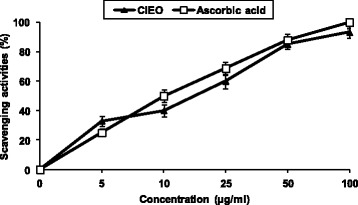
“its moderate DPPH scavenging activity may be attributed to oxygenated monoterpenes such as carvone and limonene, which have demonstrated radical scavenging activity in other studies despite not possessing aromatic hydroxyl groups [52,53].”
From Preservative Potential of Anethum graveolens Essential Oil on Fish Fillet Quality and Shelf Life During Refrigerated Storage (2025) · cites this paper as [53]
Self-check
Percentages, sums and reported differences re-computed from the paper’s own numbers.
The self-check needs the paper’s full text.
Citations
Cites
Plant Products as Antimicrobial Agents
Cowan, M. M. (1999) · Clinical Microbiology Reviews · doi:10.1128/cmr.12.4.564 · Cited by 9,043
Research works printed but not linked: 43
- Kamal GM, Anwar F, Hussain AI, Sarri N, Ashraf MY. Yield and chemical composition of Citrus essential oils as affected by drying pretreatment of peels. Inter Food Res J. 2011;18:1275–82.
- Darjazi BB. Comparison of peel oil components of grapefruit and lime (Citrus sp.). Intl J Agri Crop Sci. 2013;6:840–7.
- Mustafa NEM. Citrus essential oils: Current and prospective uses in the food industry. Recent Patents Food Nutr Agric. 2015;7:115–27. · DOI
- Ben Hsouna A, Trigui M, Ben Mansour R, Jarraya RM, Damak M, Jaoua S. Chemical composition, cytotoxicity effect and antimicrobial activity of Ceratonia siliqua essential oil with preservative effects against Listeria inoculated in minced beef meat. Int J Food Microbiol. 2011;148:66–72. · DOI
- Rahman A, Kang SC. In vitro control of food-borne and food spoilage bacteria by essential oil and ethanol extracts of Lonicera japonica Thunb. Food Chem. 2009;116:670–5. · DOI
- Cornu M, Beaufort A, Rudelle S, Laloux L, Bergis H, Miconnet N, et al. Effect of temperature, water-phase salt and phenolic contents on Listeria monocytogenes growth rates on cold-smoked salmon and evaluation of secondary models. Int J Food Microbiol. 2006;106:159–68. · DOI
- Skandamis P, Koutsoumanis K, Fasseas K, Nychas GJE. Inhibition of oregano essential oil and EDTA on E. coli O157:H7. Ita. J. Food Sci. 2001;13:55–65.
- Zheljazkov VD, Astatkie T, Jeliazkova EA, Schlegel V. Distillation time alters essential oil yield, composition, and antioxidant activity of male Juniperus scopulorum trees. J Oleo Sci. 2012;61:641–8. · DOI
- Kirby AJ, Schmidt RJ. The antioxidant activity of Chinese herbs for eczema and of placebo herbs-1. J Ethnopharmacol. 1997;56:103–8. · DOI
- Pratt DE. Natural antioxidants of soybean and other oil-seeds. In: Simic MG, Karel M, editors. Autoxidation in food and biological systems. New York: Plenum Press; 1980. p. 283–92. · DOI
- Tagg JR, McGiven AR. Assay system for bacteriocins. App Microbiol. 1971;21:943. · DOI
- Gulluce M, Sahin F, Sokmen M, Ozer H, Daferera D, Sokmen A, et al. Antimicrobial and antioxidant properties of the essential oils and methanol extract from Mentha longifolia L. ssp. longifolia. Food Chem. 2007;103:1449–56. · DOI
- Careaga M, Fernandez E, Dorantes L, Mota L, Jaramillo ME, Hernandez-Sanchez H. Antibacterial activity of Capsicum extract against Salmonella typhimurium and Pseudomonas aeruginosa inoculated in raw beef meat. Inter. J. Food Microbiol. 2003;83:331–5. · DOI
- Gill CO. A review: Intrinsic bacteria in meat. J App Bacteriol. 1979;47:367–78. · DOI
- Özyurt G, Kuley K, Balikçi E, Kaçar Ç, Gökdogan S, Etyemez M, et al. Effect of the icing with rosemary extract on the oxidative stability and biogenic amine formation in sardine (Sardinella aurita) during chilled storage. Food Bioprocess Technol. 2012;5:2777–86. · DOI
- Eymard S, Carcouet E, Rochet MJ, Dumay J, Chopin C, Genot C. Development of lipid oxidation during manufacturing of horse mackerel surimi. J Sci Food Agric. 2005;85:1750–6. · DOI
- Buege JA, Aust SD. In: Fleisher SF, Packer L, editors. Microsomal lipid peroxidation, in Biomembranes (Part C: Biological Oxidation) Methods in Enzymology. London, UK: Academic Press; 1978.
- Ahamd MM, Rehman SU, Anjum FM, Bajwa EE. Comparative physical examination of various citrus peel essential oils. Int J Agric Biol. 2006;8:186–90.
- Hossain MA, Saliha RAH, Afaf MW, Qasim AR, Jamal NS. Comparison of chemical constituents and in vitro antimicrobial activities of three brands clove essential oils from Golf region. Asian Pac J Trop Dis. 2014;4:262–8. · DOI
- Mohammed H, Saad A. Contamination of common spices in Saudi Arabia markets with potential mycotoxin-producing fungi. Saudi J Biol Sci. 2010;17:167–75. · DOI
- Tepe B, Daferera D, Sokmen A, Sokmen M, Polissiou M. Antimicrobial and antioxidant activities of the essential oil and various extracts of Salvia tomentosa Miller (Lamiaceae). Food Chem. 2005;90:333–40. · DOI
- Burits M, Asres K, Bucar F. The antioxidant activity of the essential oils of Artemisia afra, Artemisia abyssinica and Juniperusprocera. Phytother Res. 2001;15:103–8. · DOI
- Mau JL, Lai EYC, Wang NP, Chen CC, Chang CH, Chyau CC. Composition and antioxidant activity of the essential oil from Curcuma zedoaria. Food Chem. 2003;82:583–91. · DOI
- Tepe B, Donmez E, Unlu M, Candan F, Daferera D, Vardar-Unlu G, et al. Antimicrobial and antioxidative activities of the essential oils and menthanol extracts of Salvia cryptantha (MontbretetAucher ex Benth.) and Salvia multicaulis (Vahl). Food Chem. 2004;84:519–25. · DOI
- Ruberto G, Baratta MT. Antioxidant activity of selected essential oils components in two lipid model systems. Food Chem. 2000;69:167–74. · DOI
- Massadeh AM, Hayajneh WA, Shorman A, Gharaibeh MY, Al-Dabet MMA. Correlation between lead and iron in children's blood in Jordan. Toxicol Environ Chem. 2013;95:1244–55. · DOI
- Salehi P, Sonboli A, Moghadam SE. Essential oil composition and antioxidant activity of Salvia stamineaBenth. extracts. J Essen Oil Bearing Plants. 2013;16:582–7. · DOI
- Delaquis PJ, Stanich K, Girard B, Mazza G. Antimicrobial activity of individual and mixed fractions of dill, cilantro, coriander and eucalyptus essential oils. Inter J Food Microbiol. 2002;74:101–9. · DOI
- Juliano C, Mattana A, Usai M. Composition and in vitro antimicrobial activity of the essential oil of Thymus herba-barona Loisel growing wild in Sardinia. J. Essen. Oil Res. 2000;12:516–22. · DOI
- Lambert RJW, Skandamis PN, Coote P, Nychas GJE. A study of the minimum inhibitory concentration and mode of action of oregano essential oil, thymol and carvacrol. J. App. Microbiol. 2001;91:453–62. · DOI · Paper page
- Smith-Palmer A, Stewart J, Fyfe L. The potential application of plant essential oils as natural food preservatives in soft cheese. Food Microbiol. 2001;18:463–70. · DOI
- Gutierrez J, Barry-Ryan C, Bourke P. Antimicrobial activity of plant essential oils using food model media: efficacy, synergistic potential and interactions with food components. Food Microbiol. 2009;26:142–50. · DOI
- Hyldgaard M, Mygind T, Meyer RL. Essential oils in food preservation: mode of action, synergies, and interactions with food matrix components. Front Microbiol. 2012;3:12. · DOI · Paper page
- Bajpai VK, Baek KH, Kang SC. Control of Salmonella in foods by using essential oils: a review. Food Res Int. 2012;45:722–34. · DOI
- Cakir A, Kordali S, Zengin H, Izumi S, Hirata T. Composition and antifungal activity of essential oils isolated from Hypericum hyssopifolium and Hypericum heterophyllum. Flav Frag J. 2004;19:62–8. · DOI
- Filipowicz N, Kaminski M, Kurlenda J, Asztemborska M. Antibacterial and antifungal activity of juniper berry oil and its selected components. Phytother Res. 2003;17:227–31. · DOI
- Dorman HJD, Deans SG. Antimicrobial agents from plants: antibacterial activity of plant volatile oils. J App Microbiol. 2000;88:308–16. · DOI · Paper page
- Pattnaik S, Subramanyam VR, Bapaji M, Kole CR. Antibacterial and antifungal activity of aromatic constituents of essential oils. Microbios. 1997;89:39–46.
- Magiatis P, Melliou E, Skaltsouns A, Chinou IB, Mitaku S. Chemical composition and antimicrobial activity of the essential oils of Pistacia lentiscus var. chia. Planta Med. 1999;65:749–52. · DOI
- Knobloch K, Pauli A, Iberl B, Weigand H, Weis N. Antibacterial and antifungal properties of essential oil components. J Essen Oil Res. 1989;1:119–28. · DOI · Paper page
- Karabagias I, Badeka A, Kontominas MG. Shelf life extension of lamb meat using thyme or oregano essential oils and modified atmosphere packaging. Meat Sci. 2011;88:109–16. · DOI
- Safa H, Gatellier P, Lebert A, Picgirard L, Mirade PS. Effect of combined salt and animal fat reductions on physicochemical and biochemical changes during the manufacture of dry-fermented sausages. Food Bioprocess Technol. 2015;8:2109–22. · DOI
- Campo MM, Nute GR, Hughes SI, Enser M, Wood JD, Richardson RI. Flavour perception of oxidation in beef. Meat Sci. 2006;72:303–11. · DOI
Cited by
Plant-Derived Antioxidants: Significance in Skin Health and the Ageing Process
Michalak, M. (2022) · International Journal of Molecular Sciences · doi:10.3390/ijms23020585 · Cited by 460
Martínez-Abad, A., Ramos, M., Hamzaoui, M., Kohnen, S., Jiménez, A., & Garrigós, M. C. (2020) · Foods · doi:10.3390/foods9101493 · Cited by 91
Yousefi, M., Khorshidian, N., & Hosseini, H. (2020) · Frontiers in Nutrition · doi:10.3389/fnut.2020.577287 · Cited by 70
Tayel, A., Hassanin, F. S., Edris, S. N., Hamad, A., & Sabeq, I. I. (2025) · Foods · doi:10.3390/foods14091591 · Cited by 7
Metadata
- Authors
- Ben Hsouna, A., Ben Halima, N., Smaoui, S., & Hamdi, N.
- Venue
- Lipids in Health and Disease
- Published
- 2017-08-03
- Volume
- 16
- Issue
- 1
- ISSN
- 1476-511X
- PMC
- PMC5543433
- Cited by
- 254
- References
- 1
- Language
- en
About these checks
Registry, retraction, Cites and statistics results are computed, not judged, with one exception: a printed reference that no index lists is read once by a model before it counts as a citation error. Claims are extracted by a model and kept only when their quote appears verbatim in the text; each cited source is then checked, with a model’s help, for whether it says what the claim relies on. Those verdicts can be wrong — read the claim’s quote and the cited source before relying on one.
Statistics and arithmetic are recomputed, not judged.
Confidence bands are shown only for fields calibrated on our annotated test set. None is calibrated yet, so no band is shown.
What counts as a claim ›How we measure confidence ›How we check this ›
Are you an author, or do you see a problem with this page? Request a review
Data sources
Bibliographic data: Semantic Scholar, OpenAlex, Crossref.
Contains information from the Semantic Scholar Academic Graph Datasets, made available under the ODC Attribution License (ODC-BY 1.0).
Semantic Scholar’s data is described in: Kinney, R., et al. (2023). The Semantic Scholar Open Data Platform. arXiv:2301.10140.
