

The DOI matches its Crossref record; 4 of the 4 references it cites were found in a registry or an index.
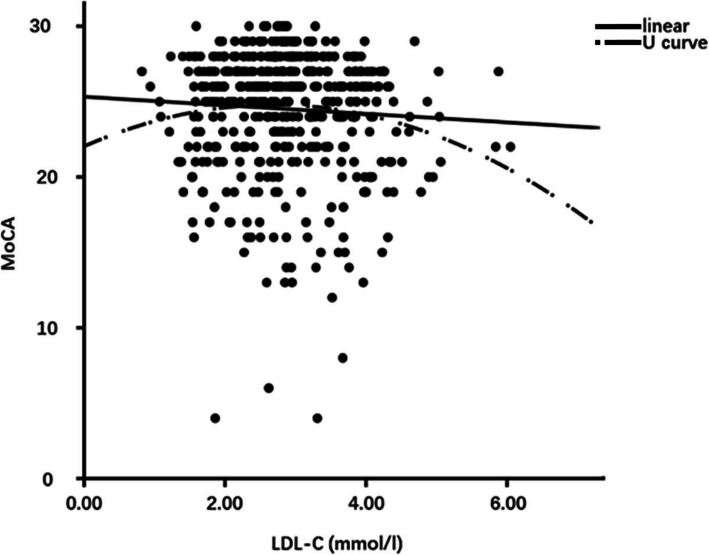
Inverted U-shaped correlation between serum low-density lipoprotein cholesterol levels and cognitive functions of patients with type 2 diabetes mellitus
Abstract
Background: Low-density lipoprotein cholesterol (LDL-C) metabolic disorder is common in individuals with diabetes. The role of LDL-C in mild cognitive impairment (MCI) remains to be explored. We aim to investigate the associations between LDL-C at different levels and details of cognition decline in patients with type 2 diabetes mellitus (T2DM). Methods: Patients with T2DM ( n = 497) were recruited. Clinical parameters and neuropsychological tests were compared between patients with MCI and controls. Goodness of fit was assessed to determine the linear or U-shaped relationship between LDL-C and cognitive function. The cut-off point of LDL-C was calculated. Correlation and regression were carried out to explore the relationship between cognitive dysfunction and LDL-C levels above and below the cut-off point. Results: Although no significant difference in LDL-C levels was detected in 235 patients with MCI, compared with 262 patients without MCI, inverted-U-shaped association was determined between LDL-C and Montreal Cognitive Assessment (MoCA). The cut-off point of LDL-C is 2.686 mmol/l. LDL-C (>2.686 mmol/l) is positively related to Trail Making Test B (TMTB) indicating executive function. LDL-C (<2.686 mmol/l) is positively associated with Clock Drawing Test (CDT) reflecting visual space function in patients with T2DM. Conclusion: Inverted U-shaped correlation was found between serum LDL-C and cognitive function in patients with T2DM. Despite that the mechanisms of different LDL-C levels involved in special cognitive dysfunctions remain incompletely clarified, excessive LDL-C damages executive function, while the deficient LDL-C impairs visual space function. Trial registration: ChiCTR-OCC-15006060 .
Overview
The claims and statistics of this paper haven’t been checked yet.
Run the check — free, no account needed. It reads the open-access text and checks the sources it cites.
Integrity signals
Registry
Cites
Statistics
Figures
Verification
Claims the paper makes
The claims and statistics of this paper haven’t been checked yet.
Run the check — free, no account needed. It reads the open-access text and checks the sources it cites.
Claims other papers make about this one
Each is checked against this paper’s own text: does it say what the citing paper says it does?
In the citing paper
“Consistent with studies linking abnormal cholesterol metabolism to cognitive decline in DM14,15, we observed cholesterol accumulation in DACI-model mice, which correlated with impaired learning and memory.”
In the citing paper
“Our previous study also found an inverted U-shaped correlation between LDL-C levels and cognitive function in patients with T2DM14, with similar U-shaped relationships observed in cardiovascular risk89,93.”
Self-check
Percentages, sums and reported differences re-computed from the paper’s own numbers.
The self-check needs the paper’s full text.
Citations
Cites
High total cholesterol levels in late life associated with a reduced risk of dementia
Mielke, M. M., Zandi, P. P., Sjögren, M., Gustafson, D., Östling, S., Steen, B., & Skoog, I. (2005) · Neurology · doi:10.1212/01.wnl.0000161870.78572.a5 · Cited by 411
Anstey, K. J., Ashby-Mitchell, K., & Peters, R. (2017) · Journal of Alzheimer’s Disease · doi:10.3233/jad-160826 · Cited by 360
Clinical and imaging features of mixed Alzheimer and vascular pathologies
Chui, H. C., & Ramirez-Gomez, L. (2015) · Alzheimer's Research & Therapy · doi:10.1186/s13195-015-0104-7 · Cited by 124
Cholesterol Biosynthesis and Uptake in Developing Neurons
Genaro-Mattos, T. C., Anderson, A., Allen, L. B., Korade, Z., & Mirnics, K. (2019) · ACS Chemical Neuroscience · doi:10.1021/acschemneuro.9b00248 · Cited by 117
Research works printed but not linked: 45
- Hussain G, Wang J, Rasul A, Anwar H, Imran A, Qasim M, et al. Role of cholesterol and sphingolipids in brain development and neurological diseases. Lipids Health Dis. 2019;18:26. · DOI
- Mauch DH, Nagler K, Schumacher S, Goritz C, Muller EC, Otto A, et al. CNS synaptogenesis promoted by glia-derived cholesterol. Science. 2001;294:1354–7. · DOI · Paper page
- Boisvert MM, Erikson GA, Shokhirev MN, Allen NJ. The aging astrocyte Transcriptome from multiple regions of the mouse brain. Cell Rep. 2018;22:269–85. · DOI · Paper page
- Greeve I, Hermans-Borgmeyer I, Brellinger C, Kasper D, Gomez-Isla T, Behl C, et al. The human DIMINUTO/DWARF1 homolog seladin-1 confers resistance to Alzheimer's disease-associated neurodegeneration and oxidative stress. J Neurosci. 2000;20:7345–52. · DOI
- Fukui K, Ferris HA, Kahn CR. Effect of cholesterol reduction on receptor signaling in neurons. J Biol Chem. 2015;290:26383–92. · DOI
- Papassotiropoulos A, Lutjohann D, Bagli M, Locatelli S, Jessen F, Buschfort R, et al. 24S-hydroxycholesterol in cerebrospinal fluid is elevated in early stages of dementia. J Psychiatr Res. 2002;36:27–32. · DOI
- Schonknecht P, Lutjohann D, Pantel J, Bardenheuer H, Hartmann T, von Bergmann K, et al. Cerebrospinal fluid 24S-hydroxycholesterol is increased in patients with Alzheimer's disease compared to healthy controls. Neurosci Lett. 2002;324:83–5. · DOI
- Leoni V, Caccia C. Oxysterols as biomarkers in neurodegenerative diseases. Chem Phys Lipids. 2011;164:515–24. · DOI
- Popp J, Lewczuk P, Kolsch H, Meichsner S, Maier W, Kornhuber J, et al. Cholesterol metabolism is associated with soluble amyloid precursor protein production in Alzheimer's disease. J Neurochem. 2012;123:310–6. · DOI
- Wang F, Jia JP. Correlation of cholesterol 24-hydroxylase and ATP-binding cassette transporter A1 polymorphisms with Alzheimer's disease. Zhonghua Yi Xue Za Zhi. 2007;87:614–8.
- Notkola IL, Sulkava R, Pekkanen J, Erkinjuntti T, Ehnholm C, Kivinen P, et al. Serum total cholesterol, apolipoprotein E epsilon 4 allele, and Alzheimer's disease. Neuroepidemiology. 1998;17:14–20. · DOI
- Xia W, Zhang B, Yang Y, Wang P, Yang Y, Wang S. Poorly controlled cholesterol is associated with cognitive impairment in T2DM: a resting-state fMRI study. Lipids Health Dis. 2015;14:47. · DOI
- Mariani E, Monastero R, Mecocci P. Mild cognitive impairment: a systematic review. J Alzheimers Dis. 2007;12:23–35. · DOI
- Bjorkhem I, Meaney S. Brain cholesterol: long secret life behind a barrier. Arterioscler Thromb Vasc Biol. 2004;24:806–15. · DOI · Paper page
- van Deijk AF, Camargo N, Timmerman J, Heistek T, Brouwers JF, Mogavero F, et al. Astrocyte lipid metabolism is critical for synapse development and function in vivo. Glia. 2017;65:670–82. · DOI · Paper page
- Butterfield DA, Mattson MP. Apolipoprotein E and oxidative stress in brain with relevance to Alzheimer's disease. Neurobiol Dis. 2020;138:104795. · DOI
- Chiang JY. Bile acid metabolism and signaling. Compr Physiol. 2013;3:1191–212. · DOI
- Pizzini A, Lunger L, Demetz E, Hilbe R, Weiss G, Ebenbichler C, et al. The role of Omega-3 fatty acids in reverse cholesterol transport: a review. Nutrients. 2017;9:1099. · DOI
- Wang SH, Huang Y, Yuan Y, Xia WQ, Wang P, Huang R. LDL receptor knock-out mice show impaired spatial cognition with hippocampal vulnerability to apoptosis and deficits in synapses. Lipids Health Dis. 2014;13:175. · DOI · Paper page
- Cai R, Han J, Sun J, Huang R, Tian S, Shen Y, et al. Effects of ABCA1 R219K polymorphism and serum lipid profiles on mild cognitive impairment in type 2 diabetes mellitus. Front Aging Neurosci. 2017;9:257. · DOI
- Suzuki R, Lee K, Jing E, Biddinger SB, McDonald JG, Montine TJ, et al. Diabetes and insulin in regulation of brain cholesterol metabolism. Cell Metab. 2010;12:567–79. · DOI · Paper page
- Saeedi P, Petersohn I, Salpea P, Malanda B, Karuranga S, Unwin N, et al. Global and regional diabetes prevalence estimates for 2019 and projections for 2030 and 2045: Results from the International Diabetes Federation Diabetes Atlas, 9(th) edition. Diabetes Res Clin Pract. 2019;157:107843. · DOI · Paper page
- Li Y, Teng D, Shi X, Qin G, Qin Y, Quan H, et al. Prevalence of diabetes recorded in mainland China using 2018 diagnostic criteria from the American Diabetes Association: national cross sectional study. BMJ. 2020;369:m997. · DOI
- Koekkoek PS, Kappelle LJ, van den Berg E, Rutten GE, Biessels GJ. Cognitive function in patients with diabetes mellitus: guidance for daily care. Lancet Neurol. 2015;14:329–40. · DOI
- McMillan JM, Mele BS, Hogan DB, Leung AA. Impact of pharmacological treatment of diabetes mellitus on dementia risk: systematic review and meta-analysis. BMJ Open Diabetes Res Care. 2018;6:e000563. · DOI · Paper page
- Dolan C, Glynn R, Lawlor B. A systematic review and Delphi study to ascertain common risk factors for type 2 diabetes mellitus and dementia and brain-related complications of diabetes in adults. Can J Diabetes. 2020;44(7):628–35. · DOI
- Portet F, Ousset PJ, Visser PJ, Frisoni GB, Nobili F, Scheltens P, et al. Mild cognitive impairment (MCI) in medical practice: a critical review of the concept and new diagnostic procedure. Report of the MCI working Group of the European Consortium on Alzheimer's disease. J Neurol Neurosurg Psychiatry. 2006;77:714–8. · DOI
- Nasreddine ZS, Phillips NA, Bedirian V, Charbonneau S, Whitehead V, Collin I, et al. The Montreal cognitive assessment, MoCA: a brief screening tool for mild cognitive impairment. J Am Geriatr Soc. 2005;53:695–9. · DOI · Paper page
- Leung JL, Lee GT, Lam YH, Chan RC, Wu JY. The use of the digit span test in screening for cognitive impairment in acute medical inpatients. Int Psychogeriatr. 2011;23:1569–74. · DOI
- Chen YL, Chen YH, Lieh-Mak F. Semantic verbal fluency deficit as a familial trait marker in schizophrenia. Psychiatry Res. 2000;95:133–48. · DOI
- Crowe SF. The differential contribution of mental tracking, cognitive flexibility, visual search, and motor speed to performance on parts a and B of the trail making test. J Clin Psychol. 1998;54:585–91. · DOI
- Wang P, Huang R, Lu S, Xia W, Cai R, Sun H, et al. RAGE and AGEs in mild cognitive impairment of diabetic patients: a cross-sectional study. PLoS One. 2016;11:e0145521. · DOI
- Tian S, Huang R, Han J, Cai R, Guo D, Lin H, et al. Increased plasma interleukin-1beta level is associated with memory deficits in type 2 diabetic patients with mild cognitive impairment. Psychoneuroendocrinology. 2018;96:148–54. · DOI
- Huang R, Tian S, Han J, Lin H, Guo D, Wang J, et al. U-shaped association between serum uric acid levels and cognitive functions in patients with type 2 diabetes: a cross-sectional study. J Alzheimers Dis. 2019;69:135–44. · DOI
- Ma S, Li S, Lv R, Hou X, Nie S, Yin Q. Prevalence of mild cognitive impairment in type 2 diabetes mellitus is associated with serum galectin-3 level. J Diabetes Investig. 2020;11(5):1295–302. · DOI
- Kivipelto M, Solomon A. Cholesterol as a risk factor for Alzheimer’s disease - epidemiological evidence. Acta Neurol Scand. 2006;114:50–7. · DOI · Paper page
- Chang CF, Liou YS, Lin TK, Ma S, Hu YR, Chen HY, et al. High exposure to statins decrease the risk of new-onset dementia a nationwide population-based longitudinal cohort study. Medicine. 2019;98:e16931. · DOI
- Chu CS, Tseng PT, Stubbs B, Chen TY, Tang CH, Li DJ, et al. Use of statins and the risk of dementia and mild cognitive impairment: a systematic review and meta-analysis. Sci Rep. 2018;8:5804. · DOI
- Lv YB, Yin ZX, Chei CL, Brasher MS, Zhang J, Kraus VB, et al. Serum cholesterol levels within the high Normal range are associated with better cognitive performance among Chinese elderly. J Nutr Health Aging. 2016;20:280–7. · DOI
- Li R, Wang TJ, Lyu PY, Liu Y, Chen WH, Fan MY, et al. Effects of plasma lipids and statins on cognitive function. Chin Med J. 2018;131:471–6. · DOI
- Solomon A, Kareholt I, Ngandu T, Wolozin B, Macdonald SW, Winblad B, et al. Serum total cholesterol, statins and cognition in non-demented elderly. Neurobiol Aging. 2009;30:1006–9. · DOI · Paper page
- Ma C, Yin Z, Zhu P, Luo J, Shi X, Gao X. Blood cholesterol in late-life and cognitive decline: a longitudinal study of the Chinese elderly. Mol Neurodegener. 2017;12:24. · DOI
- Raffaitin C, Gin H, Empana JP, Helmer C, Berr C, Tzourio C, et al. Metabolic syndrome and risk for incident Alzheimer's disease or vascular dementia: the Three-City study. Diabetes Care. 2009;32:169–74. · DOI
- Jimenez-Conde J, Biffi A, Rahman R, Kanakis A, Butler C, Sonni S, et al. Hyperlipidemia and reduced white matter hyperintensity volume in patients with ischemic stroke. Stroke. 2010;41:437–42. · DOI
- Zhang H, Huang R, Tian S, An K, Zhu W, Shi J, et al. The CC genotype of insulin-induced gene 2 rs7566605 is a protective factor of Hypercholesteremia susceptible to mild cognitive impairment, especially to the executive function of patients with type 2 diabetes mellitus. Biomed Res Int. 2020;2020:4935831.
Cited by
Sorted by citations
Niu, T., Wang, S., Zhang, H., Zhu, W., Liu, K., Zhou, X., Sun, R., Niu, D., & Yuan, Y. (2025) · Experimental & Molecular Medicine · doi:10.1038/s12276-025-01534-w · Cited by 7
Self-citation
Metadata
- Authors
- Zhang, H., Zhu, W., Niu, T., Wang, Z., An, K., Cao, W., Shi, J., & Wang, S.
- ORCID
- Wang, Shaohua
- Venue
- Lipids in Health and Disease
- Published
- 2021-09-12
- Volume
- 20
- Issue
- 1
- ISSN
- 1476-511X
- PMC
- PMC8436464
- Cited by
- 26
- References
- 4
- Language
- en
- Funders
- National Natural Science Foundation of China (81570732, 81370921)
About these checks
Registry, retraction, Cites and statistics results are computed, not judged, with one exception: a printed reference that no index lists is read once by a model before it counts as a citation error. Claims are extracted by a model and kept only when their quote appears verbatim in the text; each cited source is then checked, with a model’s help, for whether it says what the claim relies on. Those verdicts can be wrong — read the claim’s quote and the cited source before relying on one.
Statistics and arithmetic are recomputed, not judged.
Confidence bands are shown only for fields calibrated on our annotated test set. None is calibrated yet, so no band is shown.
What counts as a claim ›How we measure confidence ›How we check this ›
Are you an author, or do you see a problem with this page? Request a review
How to cite
Cite CoChat for the checks on this page, and the paper for its own findings.
- This page
- CoChat. (2026). Citation check: Inverted U-shaped correlation between serum low-density lipoprotein cholesterol levels and cognitive functions of patients with type 2 diabetes mellitus. https://app.cochat.ai/papers/10.1186/s12944-021-01534-5
- The paper
- Zhang, H., Zhu, W., Niu, T., Wang, Z., An, K., Cao, W., Shi, J., & Wang, S. (2021). Inverted U-shaped correlation between serum low-density lipoprotein cholesterol levels and cognitive functions of patients with type 2 diabetes mellitus. Lipids in Health and Disease. https://doi.org/10.1186/s12944-021-01534-5
