

The Minnesota living with heart failure questionnaire: comparison of different factor structures
Open accessThe DOI matches its Crossref record; 49 of the 49 references it cites were found in a registry or an index.
Abstract
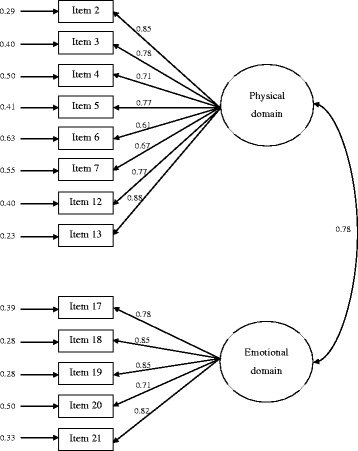
BACKGROUND: The Minnesota Living with Heart Failure Questionnaire (MLHFQ) is one of the most widely used health-related quality of life questionnaires for patients with heart failure (HF). It provides scores for two dimensions, physical and emotional, and a total score. However, there are some concerns about its factor structure and alternatives have been proposed, some including a third factor representing a social dimension. The objectives of the present study were to analyze the internal structure of the MLHFQ and the unidimensionality of the total score, and to compare the different factor structures proposed. METHODS: The MLHFQ was given to 2565 patients with HF. The structural validity of the questionnaire was assessed by confirmatory factor analysis (CFA), and Rasch analysis. These two approaches were also applied to the alternative structures proposed. RESULTS: The CFA results for the hypothesized model of two latent factors and the Rasch analysis confirmed the adequacy of the physical and emotional scales. Rasch analysis for the total score showed only two problematic items. The results of the CFA for other two-factor structures proposed were not better than the results for the original structure. The Rasch analyses applied to the different social factors yielded the best results for Munyombwe's social dimension, composed of six items. CONCLUSIONS: Our results support the validity of using the MLHFQ physical, emotional and total scores in patients with HF, for clinical practice and research. In addition, they confirmed the existence of a third factor, and we recommend the use of Munyombwe's social factor.
Overview
The claims and statistics of this paper haven’t been checked yet.
Free: it reads the open-access text and checks the first 5 claims that cite a source we can check. Create a free account to check every claim.
Integrity signals
Registry
Cites
Statistics
Figures
Verification
Claims the paper makes
The claims and statistics of this paper haven’t been checked yet.
Free: it reads the open-access text and checks the first 5 claims that cite a source we can check. Create a free account to check every claim.
Claims other papers make about this one
Each is checked against this paper’s own text: does it say what the citing paper says it does?
The check wasn’t confident either way, so it gives no verdict — never disputed.
In the citing paper
“Anxiety symptoms were assessed using the Hospital Anxiety and Depression Scale (HADS),31 a reliable and valid measure of anxiety and depressive symptoms in individuals with chronic medical conditions.32–34”
From Mindfulness, Anxiety Symptoms, and Quality of Life in Heart Failure. (2020) · cites this paper as [34]
Experimental — accuracy not yet measured
Self-check
Percentages, sums and reported differences re-computed from the paper’s own numbers.
The self-check needs the paper’s full text.
Citations
Cites
Coefficient Alpha and the Internal Structure of Tests
Cronbach, L. J. (1951) · Psychometrika · doi:10.1007/bf02310555 · Cited by 43,931
WARE, J. E., KOSINSKI, M., & KELLER, S. D. (1996) · Medical Care · doi:10.1097/00005650-199603000-00003 · Cited by 17,392
Cohen, J. (1992) · Psychological Bulletin · doi:10.1037//0033-2909.112.1.155 · Cited by 8,771
Probabilistic Models for Some Intelligence and Attainment Tests
(1961) · Information and Control · doi:10.1016/s0019-9958(61)80061-2 · Cited by 6,939
Heart Disease and Stroke Statistics—2014 Update: A Report From the American Heart Association
Go, A. S., Mozaffarian, D., Roger, V. L., Benjamin, E. J., Berry, J. D., Blaha, M. J., Dai, S., Ford, E. S., Fox, C. S., Franco, S., et al. (2014) · Circulation · doi:10.1161/01.cir.0000441139.02102.80 · Cited by 5,215
Evaluation of goodness-of-fit indices for structural equation models.
Mulaik, S. A., James, L. R., Van Alstine, J., & Bennett, N. (1989) · Psychological Bulletin · doi:10.1037//0033-2909.105.3.430 · Cited by 2,923 · cited 1×
“Regarding the CFA, the robust unweighted least squares estimator was used, and three fit indices were calculated [27–31]: the root mean square error of approximation (RMSEA), for which a value <0.”
MethodCross-Validation of Item Selection and Scoring for the SF-12 Health Survey in Nine Countries
Gandek, B., Ware, J. E., Aaronson, N. K., Apolone, G., Bjorner, J. B., Brazier, J. E., Bullinger, M., Kaasa, S., Leplege, A., Prieto, L., et al. (1998) · Journal of Clinical Epidemiology · doi:10.1016/s0895-4356(98)00109-7 · Cited by 2,907
Streiner, D. L., & Norman, G. R. (2008) · doi:10.1093/acprof:oso/9780199231881.001.0001 · Cited by 2,631
Guidelines for the diagnosis and treatment of chronic heart failure: executive summary (update 2005)
Swedberg, K., Cleland, J., Dargie, H., Drexler, H., Follath, F., Komajda, M., Tavazzi, L., Smiseth, O. A., Gavazzi, A., Haverich, A., et al. (2005) · European Heart Journal · doi:10.1093/eurheartj/ehi204 · Cited by 2,260 · cited 1×
“It affects around 2 to 3 % of the population and the prevalence increases with age, affecting as much as around 10 to 20 % of the population over 65 years old [1–3].”
BackgroundBest Test Design. Rasch Measurement.
Wright, B. D., & Stone, M. H. (1979) · Medical Entomology and Zoology · Cited by 2,125
Generic and Disease-Specific Measures in Assessing Health Status and Quality of Life
Patrick, D. L., & Deyo, R. A. (1989) · Medical Care · doi:10.1097/00005650-198903001-00018 · Cited by 1,790 · cited 1×
“Various specific HRQoL questionnaires for patients with HF have become regarded as important assessment tools in recent decades [2, 5, 11, 12].”
BackgroundReeve, B. B., Hays, R. D., Bjorner, J. B., Cook, K. F., Crane, P. K., Teresi, J. A., Thissen, D., Revicki, D. A., Weiss, D. J., Hambleton, R. K., et al. (2007) · Medical Care · doi:10.1097/01.mlr.0000250483.85507.04 · Cited by 1,491 · cited 1×
“In relation to the IRT models, we used the polytomous Rasch rating scale model because the response scales of the questionnaire are ordinal with six response options [32–35].”
MethodHealth Measurement Scales: A Practical Guide To Their Development And Use
Streiner, D. L., & Norman, G. R. (2003) · doi:10.1093/oso/9780198528470.001.0001 · Cited by 1,460
Go, A. S., Mozaffarian, D., Roger, V. L., Benjamin, E. J., Berry, J. D., Blaha, M. J., Dai, S., Ford, E. S., Fox, C. S., Franco, S., et al. (2014) · Circulation · doi:10.1161/01.cir.0000442015.53336.12 · Cited by 1,408
Patients' self-assessment of their congestive heart failure
Ts, R. (1987) · Medical Entomology and Zoology · Cited by 1,028
Rector, T. S., & Cohn, J. N. (1992) · American Heart Journal · doi:10.1016/0002-8703(92)90986-6 · Cited by 1,018 · cited 4×
“In recognition of this, improving the HRQoL has emerged as an important treatment goal [4, 9, 10].”
BackgroundMethodInfluential(1995) · PubMed · Cited by 950
Best Test Design. Rasch Measurement.
Wright, B. D., & Stone, M. H. (1979) · Cited by 612
MEASURING BEHAVIOURS AND PERCEPTIONS: RASCH ANALYSIS AS A TOOL FOR REHABILITATION RESEARCH
Tesio, L. (2003) · Journal of Rehabilitation Medicine · doi:10.1080/16501970310010448 · Cited by 335 · cited 1×
“3 indicating a good fit [38], and a principal component analysis (PCA) of the residuals.”
MethodManuel Batista-Foguet, J., Coenders, G., & Alonso, J. (2004) · Medicina Clínica · doi:10.1157/13057542 · Cited by 252
Patients' self-assessment of their congestive heart failure
Ts, R. (1987) · Medical Entomology and Zoology · Cited by 251
Garin, O., Herdman, M., Vilagut, G., Ferrer, M., Ribera, A., Rajmil, L., Valderas, J. M., Guillemin, F., Revicki, D., & Alonso, J. (2014) · Heart Failure Reviews · doi:10.1007/s10741-013-9394-7 · Cited by 209 · cited 2×
“Various specific HRQoL questionnaires for patients with HF have become regarded as important assessment tools in recent decades [2, 5, 11, 12].”
BackgroundMethodGarin, O., Ferrer, M., Pont, À., Rué, M., Kotzeva, A., Wiklund, I., Van Ganse, E., & Alonso, J. (2009) · Quality of Life Research · doi:10.1007/s11136-008-9416-4 · Cited by 194 · cited 1×
“Various specific HRQoL questionnaires for patients with HF have become regarded as important assessment tools in recent decades [2, 5, 11, 12].”
BackgroundAlla, F., Briançon, S., Guillemin, F., Juillière, Y., Mertès, P.-M., Villemot, J.-P., Zannad, F., & for the EPICAL Investigators (2002) · European Journal of Heart Failure · doi:10.1016/s1388-9842(02)00006-5 · Cited by 184 · cited 1×
“In recognition of this, improving the HRQoL has emerged as an important treatment goal [4, 9, 10].”
BackgroundSijtsma, K. (2016) · Data Archiving and Networked Services (DANS) · Cited by 170
Comparison of Quality of Life Measures in Heart Failure
Bennett, S. J., Oldridge, N. B., Eckert, G. J., Embree, J. L., Browning, S., Hou, N., Chui, M., Deer, M., & Murray, M. D. (2003) · Nursing Research · doi:10.1097/00006199-200307000-00001 · Cited by 168
Psychometric properties of the Minnesota Living with Heart Failure Questionnaire (MLHF-Q)
Middel, B., Bouma, J., de Jongste, M., van Sonderen, E., Niemeijer, M. G., & van den Heuvel, W. (2001) · Clinical Rehabilitation · doi:10.1191/026921501680425216 · Cited by 157 · cited 1×
“However, there are some concerns about its factor structure and the homogeneity of items [7, 10, 13, 17].”
BackgroundDevins, G. M., Dion, R., Pelletier, L. G., Shapiro, C. M., Abbey, S., Raiz, L. R., Binik, Y. M., McGowan, P., Kutner, N. G., Beanlands, H., et al. (2001) · Medical Care · doi:10.1097/00005650-200110000-00007 · Cited by 152 · cited 1×
“Regarding the CFA, the robust unweighted least squares estimator was used, and three fit indices were calculated [27–31]: the root mean square error of approximation (RMSEA), for which a value <0.”
MethodDiscriminant properties of commonly used quality of life measures in heart failure
Bennett, S. J., Oldridge, N., Eckert, G. J., Embree, J. L., Browning, S., Hou, N., Deer, M. M., & Murray, M. D. (2002) · Quality of Life Research · doi:10.1023/a:1015547713061 · Cited by 146 · cited 3×
“Most studies have assessed the structural validity of this questionnaire from the perspective of CTT [4, 7, 16–19, 21, 22], and more specifically, using EFA rather than CFA techniques.”
BackgroundMethodResultTesting the Psychometric Properties of the Minnesota Living With Heart Failure Questionnaire
Heo, S., Moser, D. K., Riegel, B., Hall, L. A., & Christman, N. (2005) · Nursing Research · doi:10.1097/00006199-200507000-00009 · Cited by 127 · cited 10×
“Concerning different factor structures that have been proposed [4, 7, 15, 16, 18, 21], in general, there is consensus about the emotional factor, all but one study agreeing on the constituent items [21].”
BackgroundResultInfluentialCorrelates of health-related quality of life in patients with heart failure
Westlake, C. A., Dracup, K., Creaser, J. W., Livingston, N., Heywood, J. T., Huiskes, B. L., Fonarow, G. C., & Hamilton, M. (2002) · Heart & Lung · doi:10.1067/mhl.2002.122839 · Cited by 125 · cited 1×
“The health-related quality of life (HRQoL) of patients with HF is an important outcome as it reflects the impact of HF on their daily lives [7, 8].”
BackgroundValidación de la versión española del Minnesota Living with Heart Failure Questionnaire
Garín, O., Soriano, N., Ribera, A., Ferrer, M., Pont, À., Alonso, J., & Permanyer, G. (2008) · Revista Española de Cardiología · doi:10.1157/13116652 · Cited by 118
Usefulness of bucindolol in congestive heart failure
Pollock, S. G., Lystash, J. C., Tedesco, C. L., Craddock, G. B., & Smucker, M. L. (1990) · The American Journal of Cardiology · doi:10.1016/0002-9149(90)90488-m · Cited by 107 · cited 2×
“factor structure of the questionnaire [2, 5, 7, 11, 14–20].”
BackgroundMethodA Low Back-Specific Version of the SF-36 Physical Functioning Scale
Davidson, M., Keating, J. L., & Eyres, S. (2004) · Spine · doi:10.1097/01.brs.0000103346.38557.73 · Cited by 87
Supino, P. G., BORER, J. S., Franciosa, J. A., Preibisz, J., Hochreiter, C. A., Isom, O. W., Krieger, K. H., Girardi, L. N., Bouraad, D., & Forur, L. (2008) · Journal of Cardiac Failure · doi:10.1016/j.cardfail.2008.10.003 · Cited by 80 · cited 2×
“Firstly, while some authors obtained similar factor structures to the original developers of the questionnaire [18, 22, 23], others obtained two-factor structures but disagreed on certain items [7], and various even extracted structures of three factors, with a new social subscale [4, 15, 16, 18, 21], but disagree on…”
MethodResultHo, C.-C., Clochesy, J. M., Madigan, E. A., & Liu, C.-C. (2007) · Nursing Research · doi:10.1097/01.nnr.0000299849.21935.c4 · Cited by 78 · cited 8×
“Concerning different factor structures that have been proposed [4, 7, 15, 16, 18, 21], in general, there is consensus about the emotional factor, all but one study agreeing on the constituent items [21].”
BackgroundResultInfluentialEvidence on the global measurement model of the Minnesota Living with Heart Failure Questionnaire
Garín, O., Ferrer, M., Pont, À., Wiklund, I. E., Ganse, E. H. V., Vilagut, G., Almansa, J., Ribera, A., & Alonso, J. (2013) · Quality of Life Research · doi:10.1007/s11136-013-0383-z · Cited by 73 · cited 10×
“Concerning different factor structures that have been proposed [4, 7, 15, 16, 18, 21], in general, there is consensus about the emotional factor, all but one study agreeing on the constituent items [21].”
BackgroundMethodResultInfluentialValidation of the Spanish Version of the Minnesota Living With Heart Failure Questionnaire
Garín, O., Soriano, N., Ribera, A., Ferrer, M., Pont, À., Alonso, J., & Permanyer, G. (2008) · Revista Española de Cardiología (English Edition) · doi:10.1016/s1885-5857(08)60112-7 · Cited by 70 · cited 9×
“In developed countries, the prevalence of HF is increasing due to population aging, longer survival of patients and effectiveness of secondary prevention [4, 5].”
BackgroundMethodInfluentialValidation of the Minnesota Living With Heart Failure Questionnaire in Primary Care
Rilo, J. C. N., Diez-Juárez, D. M., Blanco, A. R., Rebollo-Gutiérrez, F., Rodriguez-Martinez, A., & Rodriguez-Garcia, M. A. (2010) · Revista Española de Cardiología (English Edition) · doi:10.1016/s1885-5857(10)70276-0 · Cited by 58 · cited 7×
“Garin O, Soriano N, Ribera A, et al. Validation of the Spanish version of the Minnesota Living with Heart Failure Questionnaire.”
BackgroundMethodInfluentialQuittan, M., Wiesinger, G. F., Crevenna, R., Nuhr, M. J., Posch, M., Hülsmann, M., Müller, D., Pacher, R., & Fialka-Moser, V. (2001) · Journal of Rehabilitation Medicine · doi:10.1080/165019701750300654 · Cited by 57 · cited 1×
“In brief, HF is a common disease with a huge impact on the prognosis and lifestyle of patients and a growing challenge for health policy makers [6].”
BackgroundIRT health outcomes data analysis project: an overview and summary
Cook, K. F., Teal, C. R., Bjørner, J. B., Cella, D. F., Chang, C., Crane, P. K., Gibbons, L. E., Hays, R. D., McHorney, C. A., Ocepek‐Welikson, K., et al. (2007) · Quality of Life Research · doi:10.1007/s11136-007-9177-5 · Cited by 56
A qualitative validation of the Minnesota Living with Heart Failure Questionnaire
Hak, T., Willems, D. L., van der Wal, G., & Visser, F. C. (2004) · Quality of Life Research · doi:10.1023/b:qure.0000018487.35591.6e · Cited by 46 · cited 1×
“Another study [44] also stated that items 8, 10 and 15 were problematic, since they were not applicable to all patients.”
BackgroundAn evaluation of the Minnesota Living with Heart Failure Questionnaire using Rasch analysis
Munyombwe, T., Höfer, S., Fitzsimons, D., Thompson, D. R., Lane, D. A., Smith, K. T., & Astin, F. (2014) · Quality of Life Research · doi:10.1007/s11136-013-0617-0 · Cited by 43 · cited 9×
“[18] also found satisfactory results in the Rasch analysis applied to this dimension.”
BackgroundMethodResultInfluentialValidación del Minnesota Living With Heart Failure Questionnaire en atención primaria
Rilo, J. C. N., Diez-Juárez, D. M., Blanco, A. R., Rebollo-Gutiérrez, F., Rodríguez-Martínez, A., & Rodríguez-García, M. A. (2010) · Revista Española de Cardiología · doi:10.1016/s0300-8932(10)70268-2 · Cited by 41
Gomez, R. (2010) · Assessment · doi:10.1177/1073191110386341 · Cited by 35
Moon, J. R., Jung, Y. Y., Jeon, E., Choi, J., Hwang, J. M., & Lee, S. (2011) · Heart & Lung · doi:10.1016/j.hrtlng.2011.09.011 · Cited by 28 · cited 10×
“Concerning different factor structures that have been proposed [4, 7, 15, 16, 18, 21], in general, there is consensus about the emotional factor, all but one study agreeing on the constituent items [21].”
BackgroundResultInfluentialLambrinou, E., Kalogirou, F., Lamnisos, D., Middleton, N., Sourtzi, P., Lemonidou, C., Barberis, V. I., Avraamides, P., Christodoulou, A., Ioannides, M., et al. (2013) · Journal of Cardiopulmonary Rehabilitation and Prevention · doi:10.1097/hcr.0b013e3182930cbb · Cited by 21 · cited 8×
“Concerning different factor structures that have been proposed [4, 7, 15, 16, 18, 21], in general, there is consensus about the emotional factor, all but one study agreeing on the constituent items [21].”
BackgroundResultInfluentialKarakostas, B., & Zorgios, Y. (2008) · IGI Global eBooks · doi:10.4018/978-1-59904-968-7.ch011 · Cited by 1
(1994)
Research works printed but not linked: 2
- Muthén LK Muthén BO Mplus user’s guide (6th ed ed.) 1998 Los Angeles Muthén & Muthén
- Linacre J A User’s Guide to WINSTEP 2009 Chicago MESA Press
Cited by
Impact of Exercise Rehabilitation on Exercise Capacity and Quality-of-Life in Heart Failure
Taylor, R. S., Walker, S., Smart, N. A., Piepoli, M. F., Warren, F. C., Ciani, O., Whellan, D., O’Connor, C., Keteyian, S. J., Coats, A., et al. (2019) · Journal of the American College of Cardiology · doi:10.1016/j.jacc.2018.12.072 · Cited by 283
“To put this into context, based on an SD of 24 for MLHFQ score, this equates to a mean increase of 1.4 in MLHFQ score (i.e., a reduction in HRQoL) for an increase of 10 years in patient age, in the ExCR group compared with the control group.”
InfluentialTaylor, R. S., Walker, S., Ciani, O., Warren, F. C., Smart, N. A., Piepoli, M. F., & Davos, C. H. (2019) · Health Technology Assessment · doi:10.3310/hta23250 · Cited by 120
“Europe 9 (64) North America 5 (36) continued DOI: 10.”
BackgroundLin, C., Ganji, M. A. A., Griffiths, M. D., Bravell, M. E., Broström, A., & Pakpour, A. H. (2019) · European Journal of Cardiovascular Nursing · doi:10.1177/1474515119873648 · Cited by 109
Baert, A., Smedt, D. D., SUTTER, J. D., Bacquer, D. D., Puddu, P. E., Clays, E., & Pardaens, S. (2018) · European Journal of Preventive Cardiology · doi:10.1177/2047487318755795 · Cited by 80
“Since HRQoL comprises a mental as well as a physical component, the association with depression and NYHA class is not unexpected, making depression or depressive symptoms and a higher NYHA functional class rather redundant as a predictor for HRQoL.(34,35) Nevertheless, due to this strong association, HRQoL can be used…”
BackgroundAuld, J. P., Mudd, J. O., Gelow, J. M., Hiatt, S. O., & Lee, C. S. (2017) · The Journal of Cardiovascular Nursing · doi:10.1097/jcn.0000000000000447 · Cited by 78
“Items are rated on a 6-point scale ranging from 0 (no effect) to 5 (very much).(29)”
Background
Metadata
- Authors
- Bilbao, A., Escobar, A., García-Perez, L., Navarro, G., & Quirós, R.
- Affiliations
- Hospital de Basurto (ES)
- Corporació Sanitària Parc Taulí (ES)
- Corresponding author
- Bilbao, Amaia
- Venue
- Health and Quality of Life Outcomes
- Published
- 2016-02-17
- Volume
- 14
- Issue
- 1
- Pages
- 23-23
- ISSN
- 1477-7525 (ISSN-L)
- PMC
- PMC4756518
- OpenAlex
- W2280256245
- Cited by
- 222
- References
- 49
- Citations by year
- 2026: 20 · 2025: 36 · 2024: 34 · 2023: 26 · 2022: 22 · 2021: 17 · 2020: 30 · 2019: 18 · 2018: 13 · 2017: 5 · 2016: 1
- FWCI
- 10.17
- Type
- journal article
- Language
- en
- Open access
- gold
- doi.org
- Licence
- cc-by
- Locations
- Health and Quality of Life Outcomes (publishedVersion, cc-by)
- PubMed Central (publishedVersion, cc-by)
- PubMed (publishedVersion)
- RISalud Institutional Health Repository of Andalucía (submittedVersion, cc-by)
- Funders
- Instituto de Salud Carlos III (ES) (PS09/01129, PS09/00865, PS09/01053, PS09/01770)
- Departamento de Salud del Gobierno Vasco (2008111017)
- Topics
- Health Sciences › Medicine › Cardiology and Cardiovascular Medicine › Heart Failure Treatment and Management
- Health Sciences › Nursing › Research and Theory › Health Education and Validation
- Social Sciences › Decision Sciences › Management Science and Operations Research › Psychometric Methodologies and Testing
- Keywords
- Minnesota Living with Heart Failure Questionnaire, heart failure, health-related quality of life, factor structure, unidimensionality, Rasch analysis, confirmatory factor analysis, social dimension, questionnaire validation
- MeSH terms
- Aged, Emotions, Factor Analysis, Statistical, Female, Heart Failure, Humans, Male, Middle Aged, Physical Examination, Quality of Life, Surveys and Questionnaires, Patient Outcome Assessment
About these checks
Registry, retraction, Cites and statistics results are computed, not judged, with one exception: a printed reference that no index lists is read once by a model before it counts as a citation error. Claims are extracted by a model and kept only when their quote appears verbatim in the text; each cited source is then checked, with a model’s help, for whether it says what the claim relies on. Those verdicts can be wrong — read the claim’s quote and the cited source before relying on one.
Statistics and arithmetic are recomputed, not judged.
Confidence bands are shown only for fields calibrated on our annotated test set. None is calibrated yet, so no band is shown.
What counts as a claim ›How we measure confidence ›How we check this ›
Are you an author, or do you see a problem with this page? Request a review
Data sources
Bibliographic data: Semantic Scholar, OpenAlex, Crossref.
Contains information from the Semantic Scholar Academic Graph Datasets, made available under the ODC Attribution License (ODC-BY 1.0).
Semantic Scholar’s data is described in: Kinney, R., et al. (2023). The Semantic Scholar Open Data Platform. arXiv:2301.10140.
