

An analysis of the services provided by community health workers within an urban district in South Africa: a key contribution towards universal access to care
Open accessPublished version of a preprint
The DOI matches its Crossref record; 36 of the 36 references it cites were found in a registry or an index.
Abstract
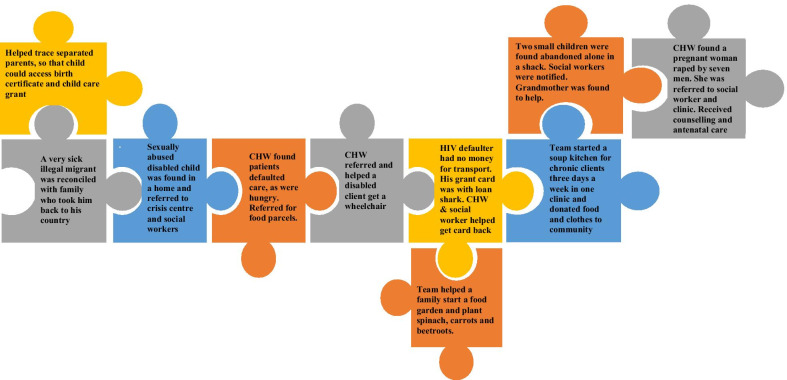
INTRODUCTION: Community health worker teams are potential game-changers in ensuring access to care in vulnerable communities. Who are they? What do they actually do? Can they help South Africa realize universal health coverage? As the proactive arm of the health services, community health workers teams provide household and community education, early screening, tracing and referrals for a range of health and social services. There is little local or global evidence on the household services provided by such teams, beyond specific disease-oriented activities such as for HIV and TB. This paper seeks to address this gap. METHODS: Descriptive secondary data analysis of community health worker team activities in the Ekurhuleni health district, South Africa covering approximately 280,000 households with 1 million people. RESULTS: Study findings illustrated that community health workers in these teams provided early screening and referrals for pregnant women and children under five. They distributed condoms and chronic medication to homes. They screened and referred for hypertension, diabetes mellitus, HIV and TB. The teams also undertook defaulter and contact tracing, the majority of which was for HIV and TB clients. Psychosocial support provided was in the form of access to social grants, access to child and gender-based violence protection services, food parcels and other services. CONCLUSION: Community health workers form the core of these teams and perform several health and psychosocial services in households and poor communities in South Africa, in addition to general health education. The teams studied provided a range of activities across many health conditions (mother and child related, HIV and TB, non-communicable diseases), as well as social services. These teams provided comprehensive care in a large-scale urban setting and can improve access to care.
Overview
The claims and statistics of this paper haven’t been checked yet.
Free: it reads the open-access text and checks the first 5 claims that cite a source we can check. Create a free account to check every claim.
Integrity signals
Registry
Cites
Statistics
Figures

Verification
Claims the paper makes
The claims and statistics of this paper haven’t been checked yet.
Free: it reads the open-access text and checks the first 5 claims that cite a source we can check. Create a free account to check every claim.
Claims other papers make about this one
Each is checked against this paper’s own text: does it say what the citing paper says it does?
The source backs part of the claim, not all of it — or backs it for a different population, condition or comparison.
In the citing paper
“In response to challenges with TB and HIV care engagement and adherence, the Department of Health has implemented and scaled up community health worker (CHW) programs to support TB and HIV care engagement (Mash et al., 2020; Thomas et al., 2021).”
From Siyakhana: A Hybrid Type 2 Effectiveness-Implementation Stepped-Wedge Trial to Reduce Stigma Towards Substance Use and Depression Among Community Health Workers in HIV/TB Care in South Africa (2025) · cites this paper as Thomas et al., 2021
Experimental — accuracy not yet measuredThe cited source says what the claim attributes to it.
In the citing paper
“CHWs conduct home visits to promote care re-engagement for individuals who have fallen out of HIV and/or TB care (Ngcobo et al., 2022; Thomas et al., 2021).”
From Siyakhana: A Hybrid Type 2 Effectiveness-Implementation Stepped-Wedge Trial to Reduce Stigma Towards Substance Use and Depression Among Community Health Workers in HIV/TB Care in South Africa (2025) · cites this paper as Thomas et al., 2021
Self-check
Percentages, sums and reported differences re-computed from the paper’s own numbers.
The self-check needs the paper’s full text.
Citations
Cites
Perry, H. B., Zulliger, R., & Rogers, M. M. (2014) · Annual Review of Public Health · doi:10.1146/annurev-publhealth-032013-182354 · Cited by 944
Macinko, J., & Harris, M. J. (2015) · New England Journal of Medicine · doi:10.1056/nejmp1501140 · Cited by 681
Who is a community health worker? – a systematic review of definitions
Olaniran, A., Smith, H., Unkels, R., Bar-Zeev, S., & van den Broek, N. (2017) · Global Health Action · doi:10.1080/16549716.2017.1272223 · Cited by 408
Jaskiewicz, W., & Tulenko, K. (2012) · Human Resources for Health · doi:10.1186/1478-4491-10-38 · Cited by 381
Strengthening health systems for universal health coverage and sustainable development
Kieny, M. P., Bekedam, H., Dovlo, D., Fitzgerald, J., Habicht, J., Harrison, G., Kluge, H., Lin, V., Menabde, N., Mirza, Z., et al. (2017) · Bulletin of the World Health Organization · doi:10.2471/blt.16.187476 · Cited by 314
Community health workers for universal health-care coverage: from fragmentation to synergy
Tulenko, K., Møgedal, S., Afzal, M. M., Frymus, D., Oshin, A., Pate, M., Quain, E., Pinel, A., Wynd, S., & Zodpey, S. (2013) · Bulletin of the World Health Organization · doi:10.2471/blt.13.118745 · Cited by 292 · cited 1×
“Low and middle-income countries are increasingly strengthening their CHW programmes, viewing this as an affordable and critical intervention in attaining universal health coverage [8, 9].”
BackgroundA brief history of South Africa's response to AIDS
Simelela, N., & Venter, F. (2014) · South African Medical Journal · doi:10.7196/samj.7700 · Cited by 203
Oni, T., Youngblood, E., Boulle, A., McGrath, N., Wilkinson, R. J., & Levitt, N. S. (2015) · BMC Infectious Diseases · doi:10.1186/s12879-015-0750-1 · Cited by 200
Primary health care in SA since 1994 and implications of the new vision for PHC re-engineering
Naledi, T. (2011) · South African Health Review · Cited by 183
van Ginneken, N., Lewin, S. A., & Berridge, V. S. (2010) · Social Science & Medicine · doi:10.1016/j.socscimed.2010.06.009 · Cited by 155
District Health Barometer 2019/20
Massyn, N., Barron, P., Day, C., Ndlovu, N., Padarath, A., & Keebine, G. (2021) · SAEON Data Centre · doi:10.15493/sarva.080420-2 · Cited by 145
dos Santos, M. M., Kruger, P., Mellors, S., Wolvaardt, G. G., & van der Ryst, E. (2014) · BMC Public Health · doi:10.1186/1471-2458-14-80 · Cited by 141
Agarwal, S., Curtis, S. L., Angeles, G., Speizer, I. S., Singh, K., & Thomas, J. C. (2019) · Human Resources for Health · doi:10.1186/s12960-019-0402-4 · Cited by 121
Kabudula, C. W., Houle, B., Collinson, M. A., Kahn, K., Gómez-Olivé, F. X., Clark, S. J., & Tollman, S. (2017) · BMC Public Health · doi:10.1186/s12889-017-4312-x · Cited by 107
Tweya, H. M., Gareta, D., Chagwera, F., Ben‐Smith, A., Mwenyemasi, J., Chiputula, F., Boxshall, M., Weigel, R., Jahn, A., Hosseinipour, M. C., et al. (2010) · Tropical Medicine & International Health · doi:10.1111/j.1365-3156.2010.02509.x · Cited by 106
Nxumalo, N., Goudge, J., & Thomas, L. (2013) · Global Health Action · doi:10.3402/gha.v6i0.19283 · Cited by 103
Self-citationThe Impact of Social Grants on Poverty Reduction in South Africa
Satumba, T., Bayat, A., & Mohamed, S. (2017) · Journal of Economics · doi:10.1080/09765239.2017.1336304 · Cited by 80
Cometto, G., & Witter, S. (2013) · Bulletin of the World Health Organization · doi:10.2471/blt.13.118810 · Cited by 79
Moosa, S., Derese, A., & Peersman, W. (2017) · Human Resources for Health · doi:10.1186/s12960-017-0183-6 · Cited by 66
Thomson, K. A., Cheti, E., & Reid, T. (2011) · Transactions of the Royal Society of Tropical Medicine and Hygiene · doi:10.1016/j.trstmh.2011.02.011 · Cited by 61
Nsibande, D., Doherty, T., Ijumba, P., Tomlinson, M., Jackson, D., Sanders, D., & Lawn, J. (2013) · BMC Health Services Research · doi:10.1186/1472-6963-13-47 · Cited by 60
McConnell, M., Ettenger, A., Rothschild, C. W., Muigai, F., & Cohen, J. (2016) · BMC Pregnancy and Childbirth · doi:10.1186/s12884-016-0914-z · Cited by 60
Ingram, M., Schachter, K. A., Sabo, S. J., Reinschmidt, K. M., Gómez, S., de Zapien, J. G., & Carvajal, S. C. (2013) · The Journal of Primary Prevention · doi:10.1007/s10935-013-0335-y · Cited by 57
Which primary care model? A qualitative analysis of ward-based outreach teams in South Africa
Marcus, T. S., Hugo, J. F. M., & Jinabhai, C. C. (2017) · African Journal of Primary Health Care & Family Medicine · doi:10.4102/phcfm.v9i1.1252 · Cited by 57
Andersen, K. L., Singh, A., Shrestha, M. K., Shah, M., Pearson, E., & Hessini, L. (2013) · Global Health Science and Practice · doi:10.9745/ghsp-d-12-00026 · Cited by 47
A Different Model — Medical Care in Cuba
Campion, E. W., & Morrissey, S. (2013) · New England Journal of Medicine · doi:10.1056/nejmp1215226 · Cited by 44
Mji, G., Braathen, S. H., Vergunst, R., Scheffler, E., Kritzinger, J., Mannan, H., Schneider, M., Swartz, L. M., & Visagie, S. J. (2017) · African Journal of Primary Health Care & Family Medicine · doi:10.4102/phcfm.v9i1.1166 · Cited by 42
Schneider, H. M., Besada, D., Sanders, D. M., Daviaud, E., & Rohde, S. S. (2018) · UWC Research Repository (University of the Western Cape) · Cited by 38
Taylor, B., Mathers, J. M., & Parry, J. M. (2017) · Journal of Public Health · doi:10.1093/pubmed/fdx033 · Cited by 36
Maximizing the impact of community-based practitioners in the quest for universal health coverage
Campbell, J., Admasu, K., Soucat, A. L. B., & Tlou, S. D. (2015) · Bulletin of the World Health Organization · doi:10.2471/blt.15.162198 · Cited by 35
Singh, S., Dwivedi, N., Dongre, A. R., Deshmukh, P. R., Dey, D., Kumar, V., & Upadhyaya, S. (2018) · Human Resources for Health · doi:10.1186/s12960-018-0327-3 · Cited by 32
A home tracing program for contacts of people with tuberculosis or HIV and patients lost to care
Deery, C. B., Hanrahan, C. F., Selibas, K., Bassett, J., Sanne, I., & Rie, A. V. (2014) · The International Journal of Tuberculosis and Lung Disease · doi:10.5588/ijtld.13.0587 · Cited by 26 · cited 13×
“Author details 1 Gauteng Department of Health, School of Health Systems and Public Health, University of Pretoria, and School of Public Health, University of Witwatersrand, Gauteng, South Africa.”
ResultInfluentialProgress in the establishment of ward based outreach teams: experiences in the North West Province
Padayachee, T., Chetty, N., Matse, M., Mampe, T., & Schneider, H. M. (2013) · UWC Research Repository (University of the Western Cape) · Cited by 20
Editorial The honorary contract: romance and reality
Clarke, M. (1985) · Journal of Public Health · doi:10.1093/oxfordjournals.pubmed.a043749 · Cited by 17
Assessment of timely immunization in an urbanized agglomeration of East Delhi, India
Cherian, V., Saini, N. K., & Sharma, A. K. (2019) · International Journal of Community Medicine and Public Health · doi:10.18203/2394-6040.ijcmph20190603 · Cited by 12
Use of cellular phone contacts to increase return rates for immunization services in Kenya
Mokaya, E. N., Mugoya, I., Raburu, J., & Shimp, L. (2017) · Pan African Medical Journal · doi:10.11604/pamj.2017.28.24.12631 · Cited by 11
Research works printed but not linked: 3
- Pillay Y. The implementation of PHC re-engineering in South Africa. PHASA conference; 2011 South Africa. https://www.phasa.org.za/wp-content/uploads/2011/11/Pillay-The-implementation-of-PHC.pdf. Accessed 30 Jan 2018.
- Bhutta ZA Lassi ZS Pariyo G Huicho L Global experience of community health workers for delivery of health-related millennium development goals: a systematic review, country case studies, and recommendations for integration into national health systems Glob Health Workforce Alliance 2010 1 249 61
- Hammond M, Buch E. Community health workers in Mhala, Gazankulu: Perversion of a progressive concept? Second Carnegie Inquiry into poverty and development in Southern Africa. Carneige Conference paper No. 201. 198. SALDRU, University of Capetown. https://www.opensaldru.uct.ac.za/bitstream/handle/11090/275/1984_hammond_ccp201.pdf?sequence=1. Accessed 9th Sept 2020.
Cited by
Health and related indicators 2021
Ndlovu, N., Day, C., Gray, A., Busang, J., & Mureithi, L. (2022) · South African Health Review · doi:10.61473/001c.75480 · Cited by 253
Khatri, R. B., Endalamaw, A., Erku, D., Wolka, E., Nigatu, F., Zewdie, A., & Assefa, Y. A. (2024) · BMC Family Practice · doi:10.1186/s12875-024-02629-5 · Cited by 116
“These CHPs deliver health services, including community-based management of childhood illness (e.g., diarrhoea and pneumonia) and maternal and child health (MCH) services (e.g., dissemination of health messages for healthy pregnancy and childbirth) [2, 6, 8].”
BackgroundNaidoo, K., Perumal, R., Cox, H. S., Mathema, B., Loveday, M., Ismail, N. A., Omar, S. V., Georghiou, S. B., Daftary, A., O’Donnell, M. R., et al. (2024) · The Lancet Infectious Diseases · doi:10.1016/s1473-3099(24)00144-0 · Cited by 75
Ndambo, M. K., Munyaneza, F., Aron, M. B., Nhlema, B., & Connolly, E. (2022) · BMC Health Services Research · doi:10.1186/s12913-022-07558-6 · Cited by 47
Lalla‐Edward, S. T., Mosam, A., Hove, J., Erzse, A., Rwafa-Ponela, T., Price, J. E., Nyatela, A., Nqakala, S., Kahn, K., Tollman, S. M., et al. (2022) · Frontiers in Public Health · doi:10.3389/fpubh.2022.992481 · Cited by 44
“Inevitably, the quality of care offered by HCW was compromised (20, 43).”
BackgroundMethod
Metadata
- Authors
- Thomas, L. S., Buch, E., & Pillay, Y.
- Affiliations
- University of the Witwatersrand (ZA)
- University of Pretoria (ZA)
- Department of Health (ZA)
- Corresponding author
- Thomas, L. S.
- Venue
- Human Resources for Health
- Published
- 2021-02-18
- Volume
- 19
- Issue
- 1
- Pages
- 22-22
- ISSN
- 1478-4491 (ISSN-L)
- PMC
- PMC7889710
- OpenAlex
- W3130383578
- Cited by
- 49
- References
- 36
- Citations by year
- 2026: 9 · 2025: 8 · 2024: 16 · 2023: 6 · 2022: 7 · 2021: 3
- FWCI
- 9.79
- Type
- journal article
- Language
- en
- Open access
- gold
- doi.org
- Licence
- cc-by
- creativecommons.org/licenses/by/4.0/ (tdm)
- creativecommons.org/licenses/by/4.0/ (vor)
- Locations
- Human Resources for Health (publishedVersion, cc-by)
- Research Square (acceptedVersion, cc-by)
- PubMed Central (publishedVersion, cc-by)
- PubMed (publishedVersion)
- DOAJ (DOAJ: Directory of Open Access Journals) (submittedVersion, cc-by-sa)
- UpSpace Institutional Repository (University of Pretoria) (submittedVersion, cc-by)
- Funders
- University of Pretoria (Staff development fund to complete PhD)
- Topics
- Health Sciences › Medicine › Public Health, Environmental and Occupational Health › Global Health Workforce Issues
- Health Sciences › Medicine › Pediatrics, Perinatology and Child Health › Global Maternal and Child Health
- Health Sciences › Medicine › Public Health, Environmental and Occupational Health › Healthcare Systems and Reforms
- Keywords
- community health workers, health care access, universal health coverage, tuberculosis screening, non-communicable disease screening, medication distribution, psychosocial support, social grants, food parcels, urban health services, Ekurhuleni
- MeSH terms
- Child, Community Health Workers, Community Health Services, Family Characteristics, Female, Health Services, Health Services Accessibility, Humans, Pregnancy, South Africa
About these checks
Registry, retraction, Cites and statistics results are computed, not judged, with one exception: a printed reference that no index lists is read once by a model before it counts as a citation error. Claims are extracted by a model and kept only when their quote appears verbatim in the text; each cited source is then checked, with a model’s help, for whether it says what the claim relies on. Those verdicts can be wrong — read the claim’s quote and the cited source before relying on one.
Statistics and arithmetic are recomputed, not judged.
Confidence bands are shown only for fields calibrated on our annotated test set. None is calibrated yet, so no band is shown.
What counts as a claim ›How we measure confidence ›How we check this ›
Are you an author, or do you see a problem with this page? Request a review
Data sources
Bibliographic data: Semantic Scholar, OpenAlex, Crossref.
Contains information from the Semantic Scholar Academic Graph Datasets, made available under the ODC Attribution License (ODC-BY 1.0).
Semantic Scholar’s data is described in: Kinney, R., et al. (2023). The Semantic Scholar Open Data Platform. arXiv:2301.10140.
