

Measuring the resilience of health systems in low- and middle-income countries: a focus on community resilience
Open accessThe DOI matches its Crossref record; 39 of the 40 references it cites were found in a registry or an index.
Abstract
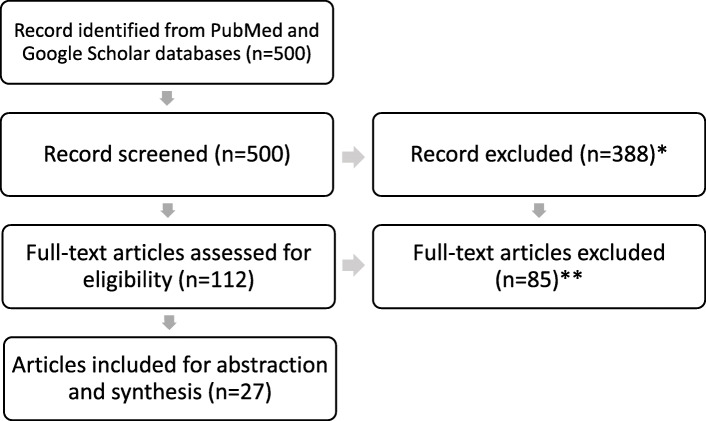
The concept of community resilience has gained considerable attention in the global health discussions since the Ebola outbreak of West Africa in 2014–2015. However, there are no measurement models to quantify community resilience. Without measurement models, it is unclear how to test strategies for building community resilience or to describe their likely intended and unintended results and their impact on health outcomes. We propose a measurement model for community resilience with relevant constructs and indicators to measure these constructs. We conducted a scoping review, systematically searching, screening and selecting relevant articles from two bibliographic databases (PUBMED and Google Scholar) for literature using search terms such as “resilience”, “community resilience” and “health systems resilience”. We screened 500 papers, then completed a full text review of 112 identified as relevant based on their title and abstract. A total of 27 papers and reports were retained for analysis. We then aggregated and synthesised the various definitions of community resilience and the frameworks for understanding these definitions. We identified key constructs from these frameworks and organised these constructs into domains and sub-domains. We proposed indicators to capture aspects of these domains and sub-domains and operationalised these indicators as a measurement model for quantifying community resilience in health systems. We propose a model with 20 indicators to assess community resilience. These indicators tap into various constructs from different theoretical frameworks of community resilience and are useful for assessing the level of knowledge, financial resources, and human, social and physical capital that are needed (or lacking) to respond to any types of shock, including health shock at the community level. This is an initial attempt to describe a multilevel measurement model for quantifying community resilience. This model will help to guide the development and testing of strategies for strengthening community resilience and will require further work to assess its relevance, reliability and validity in different LMIC settings.
Overview
The claims and statistics of this paper haven’t been checked yet.
Free: it reads the open-access text and checks the first 5 claims that cite a source we can check. Create a free account to check every claim.
Integrity signals
Registry
Cites
Statistics
Figures
Verification
Claims the paper makes
The claims and statistics of this paper haven’t been checked yet.
Free: it reads the open-access text and checks the first 5 claims that cite a source we can check. Create a free account to check every claim.
Claims other papers make about this one
Each is checked against this paper’s own text: does it say what the citing paper says it does?
The check wasn’t confident either way, so it gives no verdict — never disputed.
In the citing paper
“Traditional scales, such as the Connor–Davidson resilience scale126, were developed in high-income countries and emphasize Western constructs like self-efficacy and individual coping125.”
From Resilience and brain health in global populations (2025) · cites this paper as [125]
Experimental — accuracy not yet measured
Self-check
Percentages, sums and reported differences re-computed from the paper’s own numbers.
The self-check needs the paper’s full text.
Citations
Cites
A typology of reviews: an analysis of 14 review types and associated methodologies
Grant, M. J., & Booth, A. (2009) · Health Information & Libraries Journal · doi:10.1111/j.1471-1842.2009.00848.x · Cited by 10,817
Community Resilience as a Metaphor, Theory, Set of Capacities, and Strategy for Disaster Readiness
Norris, F. H., Stevens, S. P., Pfefferbaum, B., Wyche, K. F., & Pfefferbaum, R. L. (2008) · American Journal of Community Psychology · doi:10.1007/s10464-007-9156-6 · Cited by 5,476
A Framework to Quantitatively Assess and Enhance the Seismic Resilience of Communities
Bruneau, M., Chang, S. E., Eguchi, R. T., Lee, G. C., O'Rourke, T. D., Reinhorn, A. M., Shinozuka, M., Tierney, K., Wallace, W. A., & von Winterfeldt, D. (2003) · Earthquake Spectra · doi:10.1193/1.1623497 · Cited by 5,440
Social and ecological resilience: are they related?
Adger, W. N. (2000) · Progress in Human Geography · doi:10.1191/030913200701540465 · Cited by 4,825
Navigating Social-Ecological Systems: Building Resilience for Complexity and Change
Berkes, F., Colding, J., & Folke, C. (2008) · Cited by 2,793
A metric and frameworks for resilience analysis of engineered and infrastructure systems
Francis, R., & Bekera, B. (2014) · Reliability Engineering & System Safety · doi:10.1016/j.ress.2013.07.004 · Cited by 1,152
Navigating Social-Ecological Systems: Building Resilience for Complexity and Change
(2001) · Cambridge University Press eBooks · doi:10.1017/cbo9780511541957 · Cited by 1,059
Defining and measuring economic resilience to disasters
Rose, A. (2004) · Disaster Prevention and Management: An International Journal · doi:10.1108/09653560410556528 · Cited by 856
What is a resilient health system? Lessons from Ebola
Kruk, M. E., Myers, M., Varpilah, S. T., & Dahn, B. T. (2015) · The Lancet · doi:10.1016/s0140-6736(15)60755-3 · Cited by 828
Disruptions in Place Attachment
Brown, B. B., & Perkins, D. D. (1992) · Place Attachment · doi:10.1007/978-1-4684-8753-4_13 · Cited by 762
Research works printed but not linked: 5
- Health Systems Global. Vancouver statement for the fourth global symposium on health systems research. 2016. http://healthsystemsresearch. org/hsr2016/wp-content/uploads/Vancouver-Statement-FINAL.pdf. Accessed 11 Aug 2019.
- Gunderson LH, Holling CS. Resilience and adaptive cycles. In: Panarchy: Understanding Transformations in Human and Natural Systems. Island Press; 2001. p. 25-62.
- Booth A, Sutton A, Papaioannou D. Systematic approaches to a successful literature review. Thousand Oaks: SAGE Publications Ltd; 2016. https://uk. sagepub.com/en-gb/eur/systematic-approaches-to-a-successful-literature- review/book244586. Accessed 11 Aug 2019.
- W.A. F, Kafle SK. Integrated Community Based Risk Reduction: An Approach to Building Disaster Resilient Communities. 4th Annual International Workshop & Expo on Sumatra Tsunami Disaster & Recovery. 2009.
- The Rockefeller Foundation, ARUP. City resilience framework. 2014. https:// assets.rockefellerfoundation.org/app/uploads/20140410162455/City- Resilience-Framework-2015.pdf. Accessed 11 Aug 2019.
Cited by
Camacho, C., Bower, P., Webb, R. T., & Munford, L. A. (2023) · International Journal of Disaster Risk Reduction · doi:10.1016/j.ijdrr.2023.103870 · Cited by 86
Terrana, A., & Al‐Delaimy, W. K. (2023) · Transcultural Psychiatry · doi:10.1177/13634615231167661 · Cited by 80
Zhang, Y., & Zhao, W. G. (2024) · World Development · doi:10.1016/j.worlddev.2023.106515 · Cited by 66
Are Pandemics Gender Neutral? Women's Health and COVID-19
Simba, H., & Ngcobo, S. (2020) · Frontiers in Global Women s Health · doi:10.3389/fgwh.2020.570666 · Cited by 56
Resilience and brain health in global populations
Udeh-Momoh, C. T., Migeot, J., Blackmon, K., Mielke, M. M., Melloni, M., Cox, L., Yaffe, K., Santamaria-Garcia, H., Stern, Y., & Ibanez, A. (2025) · Nature Medicine · doi:10.1038/s41591-025-03846-w · Cited by 42
“Traditional scales, such as the Connor–Davidson resilience scale 126 , were developed in high-income countries and emphasize Western constructs like self-efficacy and individual coping 125 .”
Khan, F., Ali, Y., & Pamucar, D. S. (2021) · Kybernetes · doi:10.1108/k-02-2021-0130 · Cited by 46
Urban Resilience Assessment Using Hybrid MCDM Model Based on DEMATEL-ANP Method (DANP)
Jamali, A., Robati, M., Nikoomaram, H., Farsad, F., & Aghamohammadi, H. (2023) · Journal of the Indian Society of Remote Sensing · doi:10.1007/s12524-023-01670-8 · Cited by 37
“…to the population is one of the basic aspects in improving the quality of healthy life and increasing the resilience of society against the crisis Bhandari and Alonge (2020), Thomas et al. (2013) Insurance The insurance industry is one of the factors increasing society’s resilience to…”
BackgroundA management perspective on resilience in healthcare: a framework and avenues for future research
Agostini, L., Onofrio, R., Piccolo, C., & Stefanini, A. (2023) · BMC Health Services Research · doi:10.1186/s12913-023-09701-3 · Cited by 53
“Finding studies in developing countries is not surprising in this context, where an overarching response to disasters is common, which emphasises the need to make different actors, both public and private, interact in favour of the whole community [36, 40].”
BackgroundLi, D., Kao, W.-T., Shieh, V., Chou, F. H., & Lo, H.-W. A. (2020) · International Journal of Environmental Research and Public Health · doi:10.3390/ijerph17176246 · Cited by 34
“Several factors associated with community resilience were reported to be beneficial for publics recovering from Ebola outbreak, including level of knowledge, financial resources, and social capital (social support, social participation, and community bonds) [16].”
BackgroundFan, Y., & Lyu, X. (2021) · Psychology Research and Behavior Management · doi:10.2147/prbm.s329829 · Cited by 35
Rogers, M., Lamarche, K., Miller, M. K., Moore, K. S., Spies, L. A., Taylor, J., & Staempfli, S. (2022) · Journal of Advanced Nursing · doi:10.1111/jan.15161 · Cited by 36
Rawat, A., Pun, A., Ashish, K., Tamang, I. K., Karlström, J., Hsu, K., & Rasanathan, K. (2023) · Journal of Global Health · doi:10.7189/jogh.13.04048 · Cited by 31
Sahani, M. K., Maat, H., Balabanova, D., Woldie, M. K., Richards, P. M., Babawo, L. S., Berhanu, N., Koenraadt, S., Makonene, D., Mayhew, S., et al. (2024) · Health Research Policy and Systems · doi:10.1186/s12961-024-01139-1 · Cited by 28
“Second, judicious use of social media/digital technology, including tailored messages for different groups [35, 37, 38].”
BackgroundInfluentialPeters, M. A., Ahmed, T., Azais, V., Fernandez, P. A., Baral, P., Drouard, S. H. P., Neill, R., Bachir, K., Bassounda, P., Dube, Q., et al. (2023) · Health Policy and Planning · doi:10.1093/heapol/czad032 · Cited by 17
“We also cannot speak to the characteristics of resilience from the community perspective, which would help to supplement the findings of this supply-side study (Alonge et al. , 2019; Bhandari and Alonge, 2020).”
ResultEvidence of health system resilience in Myanmar during Cyclone Nargis: a qualitative analysis
Grimm, P. Y., Merten, S., & Wyss, K. (2021) · BMJ Open · doi:10.1136/bmjopen-2021-050700 · Cited by 14
Okyere, S. A., Frimpong, L. K., Abunyewah, M., Diko, S. K., Fatemi, M. N., Mensah, S. L., Enning, S. B., & Kita, M. (2023) · Urban Governance · doi:10.1016/j.ugj.2023.03.003 · Cited by 17
“In SSA, scholars have emphasized the impact of health pandemics ( Masanjala, 2007 ; Hunter et al., 2011 ; Bhandari & Alonge, 2020 ) on physical capital degradation, highlighting the sequential loss of and disposal of assets such as land, equipment and domestic animals.”
BackgroundResilience—Towards an interdisciplinary definition using information theory
Nisioti, E., Clark, C. J., Das, K., Ernst, E., Friedenberg, N. A., Gates, E., Lambros, M., Lazurko, A., Puzović, N., & Salas, I. (2023) · Frontiers in Complex Systems · doi:10.3389/fcpxs.2023.1236406 · Cited by 17
Resilience in interconnected community and formal health (and connected) systems
Fortnam, M., Hailey, P., Witter, S., & Balfour, N. (2024) · SSM - Health Systems · doi:10.1016/j.ssmhs.2024.100027 · Cited by 34
What is ‘community resilience’? Responding to COVID-19 in rural Zimbabwe
Bwerinofa, I. J., Mahenehene, J., Manaka, M., Mulotshwa, B., Murimbarimba, F., Mutoko, M., Sarayi, V., & Scoones, I. (2022) · BMJ Global Health · doi:10.1136/bmjgh-2022-009528 · Cited by 16
Fenxia, Z., & Zhang, W. (2024) · Progress in Disaster Science · doi:10.1016/j.pdisas.2024.100316 · Cited by 12
Sajjad, M., Raza, S. H., & Shah, A. A. (2022) · Social Indicators Research · doi:10.1007/s11205-022-02922-9 · Cited by 9
El‐Jardali, F., Kanth, P. D., Nguyen, S.-N., Varkey, S., Duran, D., Menon, R., Fadlallah, R., Malek, A., Jain, V., Saleh, M., et al. (2025) · BMJ Global Health · doi:10.1136/bmjgh-2024-016459 · Cited by 19
Das, S., Chatterjee, A., Manna, J. S., Mandal, S. K. D., Maiti, T. K., & Bhattacharyya, T. K. (2025) · Molecular Pharmaceutics · doi:10.1021/acs.molpharmaceut.5c01296 · Cited by 13
Adult attachment, stress-coping, and resilience in first-generation immigrants in the United States
Fang, C.-J., Tong, N., Villa, R. J., Flores, A. M. M., Lim, E., & Tu, A. (2021) · British Journal of Occupational Therapy · doi:10.1177/03080226211022962 · Cited by 11
“Most of the previous studies have focused on families of low-income and lower-education levels (Bhandari and Alonge, 2020; Meyer, 2020); however, the populations of the present study were involved individuals of higher education and income levels.”
How Is Health System Resilience Being Assessed? A Scoping Review
Tonga, C., Verdonck, K., Edzoa, B. E., Ateba, O. E., Marchal, B., & Michielsen, J. (2024) · International Journal of Health Policy and Management · doi:10.34172/ijhpm.8097 · Cited by 12
Practical strategies to achieve resilient health systems: results from a scoping review
Bishai, D. M., Saleh, B. M., Huda, M., Aly, E. M., Hafiz, M., Ardalan, A., & Mataria, A. (2024) · BMC Health Services Research · doi:10.1186/s12913-024-10650-8 · Cited by 15
“The measures for community resilience addressed broad features of development, livelihoods, and social cohesion that were not bounded by the health system [23, 26], and hence difficult for health sector leaders to make practical.”
BackgroundSaito, K., Komasawa, M., Ssekitoleko, R., & Aung, M. N. (2023) · Frontiers in Public Health · doi:10.3389/fpubh.2023.1214307 · Cited by 6
Jiang, Y., Lin, K., Dalton, H. E., Buys, N. J., & Sun, J. (2026) · International Journal of Mental Health Systems · doi:10.1186/s13033-026-00694-0 · Cited by 13
Jara-Rosales, S., & Rotarou, E. S. (2024) · International Journal of Environmental Research and Public Health · doi:10.3390/ijerph21121578 · Cited by 6
“…exams, and to identify their strengths and shortcomings, bearing in mind the need to increase their resilience, especially in times of crisis, so that they are capable of absorbing shocks and speed up their recovery [85,86] without a large negative impact on the provision of health services.”
Frimpong, L. K., Mensah, S. L., Okyere, S. A., Abunyewah, M., Diko, S. K., & Amankwaa, G. (2024) · Socio-Ecological Practice Research · doi:10.1007/s42532-023-00173-7 · Cited by 5
Widhiyoga, G., & Ikawati, N. (2022) · Jurnal Ilmu Sosial dan Ilmu Politik · doi:10.22146/jsp.68825 · Cited by 4
Urban Resilience Assessment Using Hybrid MCDM Model Based on DEMATEL-ANP Method (DANP)Preprint
Jamali, A., Robati, M., Nikoomaram, H., Farsad, F., & Aghamohammadi, H. (2021) · Research Square · doi:10.21203/rs.3.rs-906701/v1 · Cited by 4
Gil-Hernández, E., Carrillo, I., Martín-Delgado, J., García-Torres, D., & Mira, J. J. (2025) · JMIR Human Factors · doi:10.2196/67263 · Cited by 5
Characterizing how One Health is defined and used within primary research: A scoping review
Pearce, S. D., Kelton, D. F., Winder, C. B., Sargeant, J. M., Goltz, J., & Parmley, E. J. (2023) · International Journal of One Health · doi:10.14202/ijoh.2023.74-86 · Cited by 5
Development of a Risk Assessment Tool for Social Services Using a Modified Delphi Technique
Fuentevilla, E. F., Moreno, R. M., Andrada, A. V., & Aguado, O. V. (2024) · SAGE Open · doi:10.1177/21582440241240857 · Cited by 3
“The resilience dimension is the one that includes the largest number of indicators, due to the increasing importance of resilience or the capacity to reverse adverse situations in communities or systems (Be´ne´, 2013; Bhandari & Alonge, 2020).”
Rawat, A., Hsu, K., Ameha, A., Pun, A., Hassen, K., Simen-Kapeu, A., Rafique, N., Oulare, M., Karlström, J., Hussain, S., et al. (2024) · International Journal of Health Policy and Management · doi:10.34172/ijhpm.7996 · Cited by 5
“15,18,27,28 In ,28-30 To overcome these challenges, some have suggested that benchmarks for each indicator should be set within each country.”
BackgroundSucaldito, M. S. F. P., Malhotra, R., Palileo‐Villanueva, L. M., Besa, J. J. V., Echague, P. A., Saquilayan, M. J., Banzuela, J. M., Mendoza, K., Elepaño, A. G., Yan, L. L., et al. (2025) · Applied Clinical Informatics · doi:10.1055/a-2595-2824 · Cited by 2
Assessing and measuring community health system resilience – an updated scoping review of approaches
Espmark, J. Å., Saulnier, D. D., Trogrlić, R. Š., & Ismail, S. (2025) · BMC Health Services Research · doi:10.1186/s12913-025-13802-6 · Cited by 5
“Following a similar approach to Bhandari and Alonge [26], we categorized definitions presented in included papers into process-based definitions, absence of adverse consequences definitions, and range of attributes definitions (see Table 1).”
InfluentialHaider, Z., Rocklöv, J., Berry, P., Jobanputra, K., Ebi, K. L., Ngo, T. A., & Schwerdtle, P. N. (2026) · BMC Health Services Research · doi:10.1186/s12913-026-14089-x · Cited by 4
“Indicators: Indicators identified in the reviewed resources help confirm how climate resilience interventions improve health outcomes, supported by evidence [72].”
Influence of Internalized Moral Perspective on Resilience of the Kenyan Health System
Kemunto, O. J., & Linge, T. K. (2023) · The University Journal · doi:10.59952/tuj.v5i3.279 · Cited by 1
Practices constituting resilient communities.
Mitterlechner, M., & Beese, A.-S. (2023) · International Journal of Integrated Care · doi:10.5334/ijic.icic23219 · Cited by 1
Makhnach, A. V., Saraeva, N. M., Dagbaeva, S. B., Laktionova, A. I., & Sukhanov, A. A. (2024) · Social Psychology and Society · doi:10.17759/sps.2024150307 · Cited by 1
Madon, S., & Krishna, S. (2025) · Oxford Development Studies · doi:10.1080/13600818.2025.2556405 · Cited by 1
“So far, existing scholarship focuses mainly on capturing the outcome of community health resilience in LMICs through indicators such as the availability of economic resources, social capital, information exchanges, and decision-making capacity (Bhandari & Alonge, 2020).”
Climate Change and Public Health Preparedness in Lower-Middle-Income Countries
Makhdoom, I. F., Malik, N. I., Atta, M., Iqbal, D., Asim, N., & Zia, S. (2025) · Springer eBooks · doi:10.1007/978-3-031-99770-9_10 · Cited by 1
Exploring disciplinary perspectives on community resilience
Forster, A., Hepburn, L., Brogden, L., Boston, M., Galbrun, L., Lawanson, T., Morkel, J. D., & Bernie, D. (2025) · Disasters · doi:10.1111/disa.70036 · Cited by 1
“These terms, which align with recent scholarly work by Bhandari and Alonge (2020) and Nguyen and Akerkar (2020), suggest that core definitions of community resilience are absorption capacity, restorative capacity, robustness, fault tolerance, flexibility, survivability, and agility.”
Preliminary studies of Bandung City Health System Resilience (case study : Covid-19 pandemic)
Roosmini, D., Kanisha, T. F., Nastiti, A., Kusumah, S. W., & Salami, I. R. S. (2022) · IOP Conference Series Earth and Environmental Science · doi:10.1088/1755-1315/1065/1/012065 · Cited by 2
Tilaki, M. J. M., & Shi, J. (2024) · Springer series in design and innovation · doi:10.1007/978-3-031-60863-6_18
Manafa, G., Schmitz, T., Butler, J., Roth, A., Savaskan, N. E., Walker, B. B., & Lakes, T. (2025) · Cities & Health · doi:10.1080/23748834.2024.2440980 · Cited by 1
“Moreover, the available empirical studies often lack comparative analyses and typically focus on resilience of individuals (Liddell and Ferreira 2019) or are conducted in the context of health system resilience (Bhandari and Alonge 2020) and are lacking small-scale resilience assessments.”
Martins, F. P., Young, A. F., Batalhão, A. C. D. S., Veras, M. M., & Saldiva, P. H. N. (2025) · Estudos Avançados · doi:10.1590/s0103-4014.202539114.005 · Cited by 2
Developing a model to assess the resilience of urban health centers against disasters: a case study
Abbasi, H., Bashiri, S., & Hamamorad, A. M. (2025) · Natural Hazards · doi:10.1007/s11069-025-07662-w
“However, no specific model exists to quantify resilience, and without measurement models, the impact of strategies to build resilience remains unclear (Bhandari and Alonge 2020 ).”
Bishai, D. M., Saleh, B. M., Huda, M., Aly, E. M., Hafiz, M., Ardalan, A., & Mataria, A. (2024) · Figshare · doi:10.6084/m9.figshare.25357767
Bishai, D. M., Saleh, B. M., Huda, M., Aly, E. M., Hafiz, M., Ardalan, A., & Mataria, A. (2024) · Figshare · doi:10.6084/m9.figshare.26689871
Bishai, D. M., Saleh, B. M., Huda, M., Aly, E. M., Hafiz, M., Ardalan, A., & Mataria, A. (2024) · Figshare · doi:10.6084/m9.figshare.25357995
Roux, J., Doorn, N., Hinrichs, S., & Copeland, S. M. (2026) · Health Policy and Planning · doi:10.1093/heapol/czag005
“…cri-tiqued for assuming systems and communities have a standard baseline capacity—not considering the influence existing in-equalities—which may unintentionally shift burdens to marginalized or vulnerable actors (Bhandari and Alonge 2020, Witter et al. 2023, Saulnier and Topp 2024, Blanchet 2025).”
Fostering Artificial Intelligence in Small Businesses in Sub-Saharan Africa
(PhD), T. O. O. (2025) · Emerald Group Publishing Limited eBooks · doi:10.1108/s2040-724620250000022003
Farhat, T., Paudel, S., Razek, T., Sánchez, G., Shakya, Y. R., Tze, N., Sohani, S., Grushka, J., Nadeau, R., Sedai, B. K., et al. (2026) · BMJ Public Health · doi:10.1136/bmjph-2025-004680
Aw, S., Lam, J., Tan, L. L., Aquino, C. P., Srisilapanan, P., Lasuka, D., & Harding, S. C. (2026) · International Journal of Community Well-Being · doi:10.1007/s42413-026-00317-z
“…those that support local economies or allow flexible employment and entrepreneurship, promote independence and enable ongoing engagement in community life, reducing reliance on formal services (AlÉx, 2016; Bennett et al., 2016; Bhandari & Alonge, 2020; Carandang et al., 2019; Kok et al., 2018 ).”
Marzo, R. R., Chen, H., Thew, H. Z., Choy, J. S., Siau, C. S., Heidler, P., King, I., Rahman, F., Rana, J. A., Biçer, B. K., et al. (2026) · Progress in Disaster Science · doi:10.1016/j.pdisas.2026.100751
Metadata
- Authors
- Bhandari, S., & Alonge, O.
- Affiliations
- Johns Hopkins University (US)
- Corresponding author
- Alonge, Olakunle
- Venue
- Health Research Policy and Systems
- Published
- 2020-07-17
- Volume
- 18
- Issue
- 1
- Pages
- 81-81
- ISSN
- 1478-4505 (ISSN-L)
- PMC
- PMC7368738
- OpenAlex
- W3043190314
- Semantic Scholar
- d972dcc6955883f11aee8807f21cf0f586db34a6
- Cited by
- 58
- References
- 39
- Citations by year
- 2026: 6 · 2025: 13 · 2024: 15 · 2023: 12 · 2022: 5 · 2021: 5 · 2020: 2
- FWCI
- 1.05
- Type
- journal article
- Language
- en
- Open access
- gold
- doi.org
- Licence
- cc-by
- creativecommons.org/licenses/by/4.0 (tdm)
- creativecommons.org/licenses/by/4.0 (vor)
- Locations
- Health Research Policy and Systems (publishedVersion, cc-by)
- PubMed Central (publishedVersion, cc-by)
- PubMed (publishedVersion)
- DOAJ (DOAJ: Directory of Open Access Journals) (submittedVersion, cc-by-sa)
- Topics
- Social Sciences › Sociology and Political Science › Disaster Management and Resilience
- Health Sciences › Medicine › Public Health, Environmental and Occupational Health › Community Health and Development
- Social Sciences › Psychology › Clinical Psychology › Resilience and Mental Health
- Keywords
- community resilience, health system resilience, measurement model, resilience indicators, low- and middle-income countries, social capital, financial resources, human capital, physical capital, Ebola outbreak, multilevel measurement
- MeSH terms
- Africa, Western, Delivery of Health Care, Developing Countries, Humans, Reproducibility of Results, Hemorrhagic Fever, Ebola
About these checks
Registry, retraction, Cites and statistics results are computed, not judged, with one exception: a printed reference that no index lists is read once by a model before it counts as a citation error. Claims are extracted by a model and kept only when their quote appears verbatim in the text; each cited source is then checked, with a model’s help, for whether it says what the claim relies on. Those verdicts can be wrong — read the claim’s quote and the cited source before relying on one.
Statistics and arithmetic are recomputed, not judged.
Confidence bands are shown only for fields calibrated on our annotated test set. None is calibrated yet, so no band is shown.
What counts as a claim ›How we measure confidence ›How we check this ›
Are you an author, or do you see a problem with this page? Request a review
Data sources
Bibliographic data: Semantic Scholar, OpenAlex, Crossref.
Contains information from the Semantic Scholar Academic Graph Datasets, made available under the ODC Attribution License (ODC-BY 1.0).
Semantic Scholar’s data is described in: Kinney, R., et al. (2023). The Semantic Scholar Open Data Platform. arXiv:2301.10140.
