

Assessment of the compliance with minimum quality standards by public primary healthcare facilities in Nigeria
Open accessThe DOI matches its Crossref record; 44 of the 45 references it cites were found in a registry or an index; 25 of the 45 sources its claims cite were checked for support.
Abstract
Achieving universal health coverage (UHC) and the Sustainable Development Goals (SDG) by 2030 relies on the delivery of quality healthcare services through effective primary healthcare (PHC) systems. This study used a cross-sectional descriptive design to assess compliance across 25 736 public PHC facilities in Nigeria. Compliance with RWHSS minimum standards was found to be below 50% across all facilities, with median compliance scores of 40.7%. outreach posts had a median compliance of 32.6%, level 1 facilities 31.5% and level 2+ facilities 50.9%. Key findings revealed major gaps in health infrastructure, human resources and availability of essential medicines and equipment.
Overview
CoChat Summary
## TL;DR
This nationwide cross-sectional survey assessed compliance with Nigeria’s Revised Ward Health System Strategy minimum standards across all 25,736 public PHC facilities and found overall compliance was below 50%, with a median of 40.7%. The biggest gaps were in human resources, infrastructure, and essential medicines/equipment, and compliance varied substantially by facility type and region.
## Key findings
- Across all facilities, median compliance with minimum standards was 40.7%, with performance ranging from 1.2% to 98.0%.
- By facility type, median compliance was 32.6% for outreach posts, 31.5% for level 1 facilities, and 50.9% for level 2+ facilities.
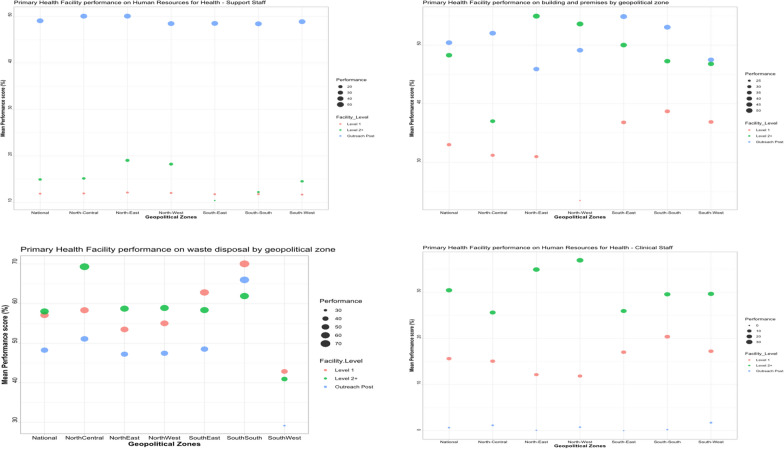
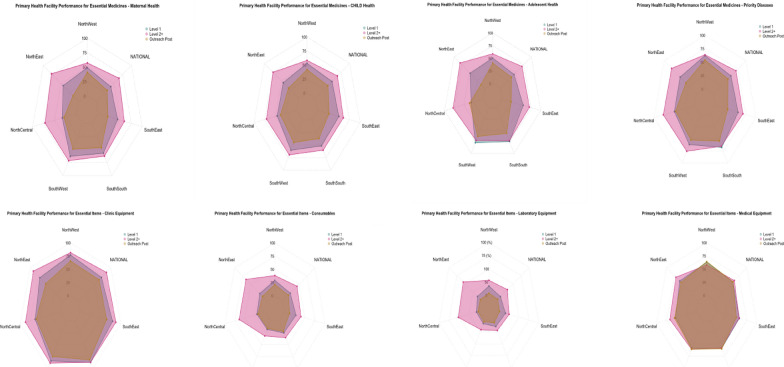
- Domain results showed low compliance for health infrastructure (39.2%), human resources (23.5%), essential medicines (43.8%), and health commodities/equipment (33.1% for outreach posts, 44.2% for level 1, 56.3% for level 2+).
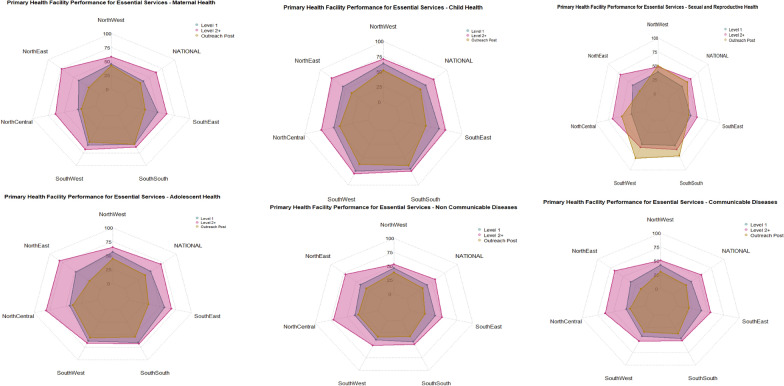
- For essential services, median compliance was 53.7% overall, and the lowest-performing service category was communicable disease services (40.4%); for essential medicines, the highest compliance was 58.0% for priority diseases and the lowest was 48.9% for maternal health medicines.
## Methods
- The study used a cross-sectional descriptive design to evaluate compliance with the Revised Ward Health System Strategy (RWHSS) minimum standards.
- It surveyed 25,736 public PHC facilities nationwide across Nigeria’s six geopolitical zones between July and September 2022.
- Data were collected with a standardized assessment tool using facility visits, structured interviews, direct observation, and CAPI via ODK; analysis used binary checklist scoring (1/0), mean domain scores converted to percentages, and visual comparison with radar charts and balloon plots.
## Limitations
- Not stated in the paper. The text does not provide an explicit limitations section or named methodological limitations.
- Evident from the text: the analysis primarily covers selected domains (infrastructure, human resources, essential medicines/commodities, service provision, equipment) even though the RWHSS includes eight thematic domains, so the reported results are not a full analysis of every domain.
Model-written summary. Check it against the paper before relying on it.
Integrity signals
Registry
Cites
Statistics
Figures
Verification
Claims the paper makes
12 Valid · 2 Not valid · 10 Not checked · 70 Own results and interpretations
The cited sources that could be checked couldn’t confirm or dispute this claim.
In the paper
“Despite the critical role of minimum standards in benchmarking PHC quality, no global consensus on these standards exists.”
- Also stated in: § Introduction Quality healthcare services are central to attaining universal health coverage (UHC) by 2030, underpinned in Sustainable Development Goal (SDG) 3.8 [1]. UHC ensures all individuals can access high-quality essential healthcare services without financial hardship [2]. Achieving UHC and the health-related SDGs is feasible through strong primary healthcare (PHC) systems to improve health outcomes and reduce health disparities [3–6]. PHC has been widely acknowledged as the backbone and the people’s gateway to a strong and effective health system [6]. It is an approach to health that equitably maximizes the level and distribution of healthcare and the well-being of individuals and communities by providing comprehensive and accessible services, from health promotion and disease prevention to treatment, rehabilitation and palliative care [6]. The 2018 Astana Declaration and the World Health Assembly in 2019 reaffirmed the critical role of and global commitment to sustainable PHC and called for increased investment in and strengthening of PHC systems to attain UHC [7, 8]. Robust PHC systems that deliver quality services can reduce catastrophic health expenditure, provide equitable access to services and produce optimal population health outcomes [1, 9, 10]. This is important, especially for low- and middle-income countries (LMICs) with limited access to high-quality essential health services [5, 11]. Therefore, while the aim is to achieve UHC, the global community has emphasized expanding the quality of healthcare services provided at PHC facilities as a means to this end [1, 5, 12]. Standards or policy documents that define best practices are often used to benchmark the quality of PHC services [13]. They provide a framework for defining, assessing, monitoring and improving the quality of care provided. Although the principles of PHC have been itemized as accessibility, community participation, equity and social justice, health promotion, contextually appropriate skills and technology and intersectoral collaboration, there is no global position on the minimum standards for PHC [14, 15]. This may relate to the spirit of the 1978 Alma Ata Declaration, which recommended that PHC be adapted to the cost and context affordable to each country as they evolve in socio-economic development [16]. Thus, the ideal PHC standards should be people-centred and sensitive to local health needs and political, social and economic contexts. · plain
“there is no global position on the minimum standards for PHC [14, 15].”
§ Assessment of the compliance with minimum quality standards by public primary healthcare facilities in Nigeria > Abstract Achieving universal health coverage (UHC) and the Sustainable Development Goals (SDG) by 2030 relies on the delivery of quality healthcare services through effective primary healthcare (PHC) systems. This necessitates robust infrastructure, adequately skilled health workers and the availability of essential medicines and commodities. Despite the critical role of minimum standards in benchmarking PHC quality, no global consensus on these standards exists. Nigeria has established minimum standards to enhance healthcare accessibility and quality, including the Revised Ward Health System Strategy (RWHSS) by the National Primary Health Care Development Agency (NPHCDA). This paper outlines the evolution of PHC minimum standards in Nigeria, evaluates compliance with RWHSS standards across all public PHC facilities, and examines the implications for ongoing PHC revitalization efforts. The study used a cross-sectional descriptive design to assess compliance across 25 736 public PHC facilities in Nigeria. Data collection involved a national survey using a standardized assessment tool focussing on infrastructure, staffing, essential medicines and service delivery. Compliance with RWHSS minimum standards was found to be below 50% across all facilities, with median compliance scores of 40.7%. Outreach posts had a median compliance of 32.6%, level 1 facilities 31.5% and level 2+ facilities 50.9%. Key findings revealed major gaps in health infrastructure, human resources and availability of essential medicines and equipment. Compliance varied regionally, with the North-west showing the highest number of facilities but varied performance across standards. The lessons learned underscore the urgent need for targeted interventions and resource allocation to address the identified deficiencies. This study highlights the critical need for regular, comprehensive compliance assessments to guide policy-makers in identifying gaps and strengthening PHC systems in Nigeria. Recommendations include enhancing monitoring mechanisms, improving resource distribution and focussing on infrastructure and human resource development to meet UHC and SDG targets. Addressing these gaps is essential for advancing Nigeria’s healthcare system and ensuring equitable, quality care for all.
What the sources say
- Could not verifycites [14] Perveen S, Lassi ZS, Mahmood MA, Perry HB, Laurence C. Application of primary healthcare principles in national community health worker programmes in low-income and middle-income countries: a scoping review. BMJ Open. 2022;12(2): e051940. PMC8811559 35110314 sourceExperimental — accuracy not yet measured
The Methods define four PHC principles for this review, and the Discussion reports uneven application of those principles in national community health worker programmes. Neither section addresses whether there is a global consensus on minimum PHC standards; searches for “minimum standards” and “consensus” found no passage establishing that claim. Page numbers were not available in our copy. (LLM, conf=0.75)
- Could not verifycites [15] Behera BK, Prasad R, Shyambhavee. Primary health-care goal and principles. Healthcare Strategies and Planning for Social Inclusion and Development. 2022;221. pmc/articles/PMC8607883/. Accessed 17 Jan 2023. sourceExperimental — accuracy not yet measured
The 'Criticism on Alma-Ata' section describes the declaration as vague, and 'Challenges for implementation of PHC' lists quality and resource problems. Neither section addresses whether a global consensus exists on minimum standards for primary healthcare; searches for minimum standards and international agreement found no such passage. Page numbers were not available in our copy. (LLM, conf=0.72)
plain- Asserted: passes — The authors put it forward as true.
- Checkable: passes — It can be checked against evidence.
- Load-bearing: passes — The paper’s conclusions depend on it.
- Based: passes — The paper gives a reason why it holds.
- Also stated in: § Introduction Quality healthcare services are central to attaining universal health coverage (UHC) by 2030, underpinned in Sustainable Development Goal (SDG) 3.8 [1]. UHC ensures all individuals can access high-quality essential healthcare services without financial hardship [2]. Achieving UHC and the health-related SDGs is feasible through strong primary healthcare (PHC) systems to improve health outcomes and reduce health disparities [3–6]. PHC has been widely acknowledged as the backbone and the people’s gateway to a strong and effective health system [6]. It is an approach to health that equitably maximizes the level and distribution of healthcare and the well-being of individuals and communities by providing comprehensive and accessible services, from health promotion and disease prevention to treatment, rehabilitation and palliative care [6]. The 2018 Astana Declaration and the World Health Assembly in 2019 reaffirmed the critical role of and global commitment to sustainable PHC and called for increased investment in and strengthening of PHC systems to attain UHC [7, 8]. Robust PHC systems that deliver quality services can reduce catastrophic health expenditure, provide equitable access to services and produce optimal population health outcomes [1, 9, 10]. This is important, especially for low- and middle-income countries (LMICs) with limited access to high-quality essential health services [5, 11]. Therefore, while the aim is to achieve UHC, the global community has emphasized expanding the quality of healthcare services provided at PHC facilities as a means to this end [1, 5, 12]. Standards or policy documents that define best practices are often used to benchmark the quality of PHC services [13]. They provide a framework for defining, assessing, monitoring and improving the quality of care provided. Although the principles of PHC have been itemized as accessibility, community participation, equity and social justice, health promotion, contextually appropriate skills and technology and intersectoral collaboration, there is no global position on the minimum standards for PHC [14, 15]. This may relate to the spirit of the 1978 Alma Ata Declaration, which recommended that PHC be adapted to the cost and context affordable to each country as they evolve in socio-economic development [16]. Thus, the ideal PHC standards should be people-centred and sensitive to local health needs and political, social and economic contexts. · plain
Every source the paper cites for this claim was checked and supports it.
In the paper
“This has affected the delivery and uptake of quality PHC services in Nigeria [35].”
§ Assessment of the compliance with minimum quality standards by public primary healthcare facilities in Nigeria > Discussion
What the sources say
- Supportedcites [35] Oyekale AS. Assessment of primary health care facilities’ service readiness in Nigeria. BMC Health Serv Res. 2017;17(1):172. 28249578 PMC5333428 source
The Background states that poor funding and mismanagement affect the coverage and quality of healthcare services in Nigeria. It also identifies disparities in access to facilities as a supply-side factor affecting service utilization. Together, these passages support the claim about delivery and uptake of quality PHC services; the supplied copy has no page numbers. (LLM, conf=0.85)
plainstates a cause- Asserted: passes — The authors put it forward as true.
- Checkable: passes — It can be checked against evidence.
- Load-bearing: passes — The paper’s conclusions depend on it.
- Based: passes — The paper gives a reason why it holds.
- Supported
The cited sources support only part of this claim — read each source’s verdict below.
In the paper
“Across the evolution of minimum standards for PHC in Nigeria, a comprehensive compliance assessment has not been conducted until now.”
§ Assessment of the compliance with minimum quality standards by public primary healthcare facilities in Nigeria > Discussion
What the sources say
- Partly supportedcites [17] Ekenna A, Itanyi IU, Nwokoro U, Hirschhorn LR, Uzochukwu B. How ready is the system to deliver primary healthcare? Results of a primary health facility assessment in Enugu State, Nigeria. Health Policy Plan. 2020;35(Supplement_1):i97-106. 33165588 PMC7649669 sourceExperimental — accuracy not yet measured
The Introduction (‘The PHC situation in Nigeria’; page not provided) says there was no documented evidence that Enugu State’s district health system policy had improved service availability and readiness 12 years after implementation. That supports a narrower gap in assessment, but not the claim that no comprehensive compliance assessment had been conducted across the evolution of PHC minimum standards throughout Nigeria. (LLM, conf=0.83)
- Could not verifycites [35] Oyekale AS. Assessment of primary health care facilities’ service readiness in Nigeria. BMC Health Serv Res. 2017;17(1):172. 28249578 PMC5333428 sourceExperimental — accuracy not yet measured
The Discussions (page unavailable) say the study considered Nigeria’s minimum PHC standard when assessing equipment and medications. The Conclusion (page unavailable) reports that many sampled facilities did not meet that standard. Neither section addresses whether a comprehensive compliance assessment had previously been conducted across the evolution of the standards; searches for prior assessments and evolving standards found no such statement. (LLM, conf=0.72)
plain- Asserted: passes — The authors put it forward as true.
- Checkable: passes — It can be checked against evidence.
- Load-bearing: passes — The paper’s conclusions depend on it.
- Based: passes — The paper gives a reason why it holds.
- Partly supported
The cited sources support only part of this claim — read each source’s verdict below.
In the paper
“These findings indicate that while some regions and facility types are performing better than others which corroborated [38],”
§ Assessment of the compliance with minimum quality standards by public primary healthcare facilities in Nigeria > Discussion
What the sources say
- Partly supportedcites [38] Kress DH, Su Y, Wang H. Assessment of primary health care system performance in Nigeria: using the primary health care performance indicator conceptual framework. Health Syst Reform. 2016;2(4):302–18. 31514724 sourceExperimental — accuracy not yet measured
The regional half of the claim is in our copy: DATA SOURCES states that 'Using SDI data from 12 surveyed states in Nigeria, we generated nationaland state-level averages for key indicators. The quality of interstate comparisons in Nigeria is relatively high,' and the state-by-state tables show large spread (essential drug availability 20% in Kebbi vs 59% in Anambra; correct diagnosis 22% in Anambra vs 57% in Kebbi/Osun; absence rate 61% in Bayelsa vs 20% in Taraba), i.e. some states performing better than others. The 'facility types' half is not supported: the CONCLUDING REMARKS limitation says 'we have not addressed urbanrural, private-public, or north-south disparities or inequality by education, state, and geopolitical zone,' and the paper's only facility-type remark (Access section, 'The technical quality of services in the private sector is variable') describes PPMV staffing quality without ranking types against public PHC facilities. So the source corroborates inter-state variation but explicitly did not analyze performance by facility type. (LLM, conf=0.78)
hedgedstates an association- Asserted: passes — The authors put it forward as true.
- Checkable: passes — It can be checked against evidence.
- Load-bearing: passes — The paper’s conclusions depend on it.
- Based: passes — The paper gives a reason why it holds.
- Partly supported
A result the paper reports from its own data — it cites no other source for it, so there is none to check. The quote shows it is in the paper.
In the paper
“The national compliance with the minimum standards for health infrastructure, irrespective of facility classification, was 39.2%.”
- Also stated in: § Discussion · plain
“The compliance with minimum standards for health infrastructure was found to be 39.2% nationally.”
§ Assessment of the compliance with minimum quality standards by public primary healthcare facilities in Nigeria > Results > Compliance outcomes across the minimum standards domains
plain- Asserted: passes — The authors put it forward as true.
- Checkable: passes — It can be checked against evidence.
- Load-bearing: passes — The paper’s conclusions depend on it.
- Based: passes — The paper gives a reason why it holds.
- Also stated in: § Discussion · plain
49 more claims
Create a free account to see all 94 claims and to verify the 4 references still open.
- Probably not a substantial claim. 25
- It may state two separate claims as one. 26
Citations
Cites
High-quality health systems in the Sustainable Development Goals era: time for a revolution
Kruk, M. E., Gage, A. D., Arsenault, C., Jordan, K., Leslie, H. H., Roder-DeWan, S., Adeyi, O., Barker, P., Daelmans, B., Doubova, S. V., et al. (2018) · The Lancet Global Health · doi:10.1016/s2214-109x(18)30386-3 · Cited by 4,057 · cited 1×
“Evidence has shown that a robust PHC system can improve population health outcomes, reduce all-cause mortality and is cost-effective in achieving UHC in LMICs [44–46].”
BackgroundNigeria Demographic and Health Survey 2008
Macro, I. (2009) · Cited by 2,063
Fendall, N. R. E. (1978) · The Lancet · doi:10.1016/s0140-6736(78)92066-4 · Cited by 1,089
Tracking Universal Health Coverage: 2017 Global Monitoring Report
World Health Organization, & Bank, W. (2017) · Washington, DC: World Health Organization eBooks · doi:10.1596/978-92-4-151355-5 · Cited by 652
The Lancet Global Health Commission on financing primary health care: putting people at the centre
Hanson, K., Brikci, N., Erlangga, D., Alebachew, A., De Allegri, M., Balabanova, D., Blecher, M., Cashin, C., Esperato, A., Hipgrave, D., et al. (2022) · The Lancet Global Health · doi:10.1016/s2214-109x(22)00005-5 · Cited by 525
Abimbola, S., Baatiema, L., & Bigdeli, M. (2019) · Health Policy and Planning · doi:10.1093/heapol/czz055 · Cited by 273 · cited 1×
“Robust PHC systems that deliver quality services can reduce catastrophic health expenditure, provide equi-table access to services and produce optimal population health outcomes [1, 9, 10].”
BackgroundBitton, A., Fifield, J., Ratcliffe, H., Karlage, A., Wang, H., Veillard, J. H., Schwarz, D., & Hirschhorn, L. R. (2019) · BMJ Global Health · doi:10.1136/bmjgh-2019-001551 · Cited by 205 · cited 1×
“There is a growing acknowl-edgment that delivering quality PHC services requires an enduring infrastructure, essential medicines, commodities, adequately staffed and skilled health workers and effective, safe, people-centred care that is timely, equitable, integrated and efficient [1, 17, 54–56].”
BackgroundCriteria, norms and standards of quality: what do they mean?
Donabedian, A. (1981) · American Journal of Public Health · doi:10.2105/ajph.71.4.409 · Cited by 188 · cited 1×
“Standards or policy documents that define best practices are often used to benchmark the quality of PHC services [13].”
BackgroundAssessment of primary health care facilities’ service readiness in Nigeria
Oyekale, A. S. (2017) · BMC Health Services Research · doi:10.1186/s12913-017-2112-8 · Cited by 159 · cited 4×
“PHC in Nigeria is poor and faces significant challenges, such as inadequate funding, maldistribution and unskilled healthcare workers, insufficient infrastructure and equipment and a lack of essential medicines and commodities [17, 22, 35–38].”
BackgroundInfluentialMeasures to strengthen primary health-care systems in low- and middle-income countries
Langlois, E. V., McKenzie, A., Schneider, H., & Mecaskey, J. W. (2020) · Bulletin of the World Health Organization · doi:10.2471/blt.20.252742 · Cited by 155 · cited 1×
“Evidence has shown that a robust PHC system can improve population health outcomes, reduce all-cause mortality and is cost-effective in achieving UHC in LMICs [44–46].”
Background
Research works printed but not linked: 5
- World Health Organization. Declaration of Astana: Global Conference on Primary Health Care. 2018. https://apps.who.int/iris/bitstream/handle/10665/328123/WHO-HIS-SDS-2018.61-eng.pdf?sequence=1&isAllowed=y. Accessed 16 Jan 2023.
- Alonge K. Primary health care in Nigeria: an appraisal of the effect of foreign donations. Afr J Health Saf Environ. 2020;1(2):86–100.
- Akinseye A. Assessment of the Primary Health Care (PHC) System in Nigeria. Am J Multidiscipl Res Dev. 2020;2(9):51–60.
- Ope BW. Reducing maternal mortality in Nigeria: addressing maternal health services’ perception and experience. J Glob Health Rep. 2020;18:4.
- Iweze D. Insurgency in the Northeast region of Nigeria and its implications on inter-state and trans-border mobility, 2009–2016. Can J Afr Stud. 2020;54(2):319–27.
Cited by
Agwu, P., Orjiakor, C. T., Odii, A., Ogbozor, P. A., Hutchinson, E., McKee, M., Onwujekwe, O. E., & Balabanova, D. (2026) · Health Systems & Reform · doi:10.1080/23288604.2026.2630426 · Cited by 6
Orjiakor, C. T., Agu, E. C., Agwu, P., Ogbozor, P. A., Obodoechi, D. N., Orjiakor, C., Odii, A., Ugwuoke, C., Eze, J. E., Bowes, N., et al. (2026) · Frontiers in Public Health · doi:10.3389/fpubh.2025.1671252 · Cited by 2
“However, recent evaluations suggest that minimum standards and funding commitments for the BHCPF have been met only to a limited extent, as facilities across the country were reported to achieve a median compliance score of 23% regarding adequate human resources (57).”
Onwukwe, C. O. S. (2026) · African Journal of Humanities and Contemporary Education Research · doi:10.62154/ajhcer.2025.021.01015
Olutegbe, N. S., & Ibidokun, A. O. (2026) · Agricultura tropica et subtropica · doi:10.2478/ats-2026-0001
Psychological Assessment in Humanitarian Conditions
Badri, A., & Kagee, A. (2026) · Springer eBooks · doi:10.1007/978-981-95-5871-1_17 · Cited by 1
Metadata
- Authors
- Sampson, S., Umar, L., Obi-Jeff, C., Oni, F., Ayodeji, O., Ebinim, H., Eboreime, E., Omeje, O., Ujah, O., Oluwatola, T., Shuaib, F., Samuel, O., Nto, S., & Okagbue, H.
- Affiliations
- National Primary Health Care Development Agency (NG)
- University of Alberta (CA)
- University of South Florida (US)
- Covenant University (NG)
- Corresponding author
- Okagbue, Hilary
- ORCID
- Venue
- Health Research Policy and Systems
- Published
- 2024-09-30
- Volume
- 22
- Issue
- 1
- Pages
- 133-133
- ISSN
- 1478-4505 (ISSN-L)
- PMC
- PMC11440655
- OpenAlex
- W4402976299
- Cited by
- 8
- References
- 45
- Citations by year
- 2026: 8
- FWCI
- 2.83
- Type
- journal article
- Language
- en
- Open access
- gold
- dx.doi.org
- Licence
- cc-by-nc-nd
- creativecommons.org/licenses/by-nc-nd/4.0 (tdm)
- creativecommons.org/licenses/by-nc-nd/4.0 (vor)
- Locations
- Health Research Policy and Systems (publishedVersion, cc-by-nc-nd)
- PubMed Central (publishedVersion, cc-by-nc-nd)
- PubMed (publishedVersion)
- DOAJ (DOAJ: Directory of Open Access Journals) (submittedVersion)
- Funders
- NPHCDA (NPHCDA/PROC/BHCPF/2022/10)
- Topics
- Health Sciences › Medicine › Public Health, Environmental and Occupational Health › Healthcare Systems and Reforms
- Health Sciences › Medicine › Public Health, Environmental and Occupational Health › Healthcare Systems and Practices
- Health Sciences › Medicine › Family Practice › Primary Care and Health Outcomes
- Keywords
- primary care, minimum quality standards, standard compliance, public health facilities, health infrastructure, healthcare workers, essential medicines, service delivery, universal health coverage, Sustainable Development Goals, Nigeria
- MeSH terms
- Sustainable Development, Cross-Sectional Studies, Delivery of Health Care, Health Facilities, Health Personnel, Health Services Accessibility, Humans, Nigeria, Primary Health Care, Quality of Health Care, Drugs, Essential, Universal Health Insurance, Guideline Adherence, Benchmarking
About these checks
Registry, retraction, Cites and statistics results are computed, not judged, with one exception: a printed reference that no index lists is read once by a model before it counts as a citation error. Claims are extracted by a model and kept only when their quote appears verbatim in the text; each cited source is then checked, with a model’s help, for whether it says what the claim relies on. Those verdicts can be wrong — read the claim’s quote and the cited source before relying on one.
The claim verdicts this report counts are experimental: their accuracy is not yet measured.
A language model drew the claims from the paper on 2026-10-10, under version 3 of the claim definition (model deepseek-v4.1-flash, prompt extract-v3).
A second model labelled each claim on 2026-10-10 (model jev-1.13-20260917, definition revision gold-guideline-v0.2).
Cited sources are checked with a language model’s help (gpt-6-sol and qwen3.8-omni-flash).
Statistics and arithmetic are recomputed, not judged.
Confidence bands are shown only for fields calibrated on our annotated test set. None is calibrated yet, so no band is shown.
What counts as a claim ›How we measure confidence ›How we check this ›
Are you an author, or do you see a problem with this page? Request a review
How to cite
Cite CoChat for the checks on this page, and the paper for its own findings.
- This page
- CoChat. (2026). Citation check: Assessment of the compliance with minimum quality standards by public primary healthcare facilities in Nigeria. https://app.cochat.ai/papers/10.1186/s12961-024-01223-6
- The paper
- Sampson, S., Umar, L., Obi-Jeff, C., Oni, F., Ayodeji, O., Ebinim, H., Eboreime, E., Omeje, O., Ujah, O., Oluwatola, T., Shuaib, F., Samuel, O., Nto, S., & Okagbue, H. (2024). Assessment of the compliance with minimum quality standards by public primary healthcare facilities in Nigeria. Health Research Policy and Systems. https://doi.org/10.1186/s12961-024-01223-6
Data sources
Bibliographic data: Semantic Scholar, OpenAlex, Crossref.
Contains information from the Semantic Scholar Academic Graph Datasets, made available under the ODC Attribution License (ODC-BY 1.0).
Semantic Scholar’s data is described in: Kinney, R., et al. (2023). The Semantic Scholar Open Data Platform. arXiv:2301.10140.
