

The DOI matches its Crossref record; 44 of the 48 references it cites were found in a registry or an index.
A systematic review of just-in-time adaptive interventions (JITAIs) to promote physical activity
Open accessAbstract
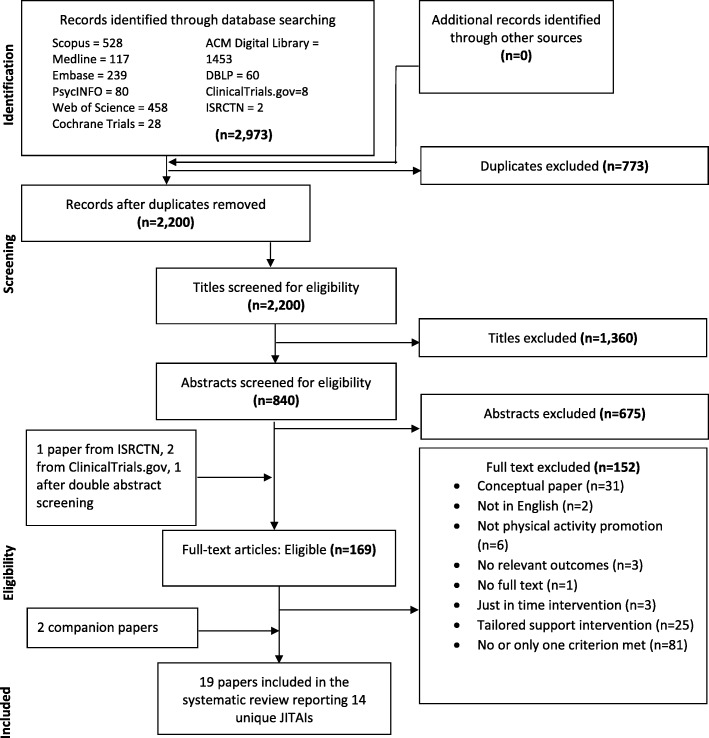
BACKGROUND: Progress in mobile health (mHealth) technology has enabled the design of just-in-time adaptive interventions (JITAIs). We define JITAIs as having three features: behavioural support that directly corresponds to a need in real-time; content or timing of support is adapted or tailored according to input collected by the system since support was initiated; support is system-triggered. We conducted a systematic review of JITAIs for physical activity to identify their features, feasibility, acceptability and effectiveness. METHODS: We searched Scopus, Medline, Embase, PsycINFO, Web of Science, DBLP, ACM Digital Library, Cochrane Central Register of Controlled Trials, ClinicalTrials.gov and the ISRCTN register using terms related to physical activity, mHealth interventions and JITAIs. We included primary studies of any design reporting data about JITAIs, irrespective of population, age and setting. Outcomes included physical activity, engagement, uptake, feasibility and acceptability. Paper screening and data extraction were independently validated. Synthesis was narrative. We used the mHealth Evidence Reporting and Assessment checklist to assess quality of intervention descriptions. RESULTS: We screened 2200 titles, 840 abstracts, 169 full-text papers, and included 19 papers reporting 14 unique JITAIs, including six randomised studies. Five JITAIs targeted both physical activity and sedentary behaviour, five sedentary behaviour only, and four physical activity only. JITAIs prompted breaks following sedentary periods and/or suggested physical activities during opportunistic moments, typically over three to four weeks. Feasibility challenges related to the technology, sensor reliability and timeliness of just-in-time messages. Overall, participants found JITAIs acceptable. We found mixed evidence for intervention effects on behaviour, but no study was sufficiently powered to detect any effects. Common behaviour change techniques were goal setting (behaviour), prompts/cues, feedback on behaviour and action planning. Five studies reported a theory-base. We found lack of evidence about cost-effectiveness, uptake, reach, impact on health inequalities, and sustained engagement. CONCLUSIONS: Research into JITAIs to increase physical activity and reduce sedentary behaviour is in its early stages. Consistent use and a shared definition of the term 'JITAI' will aid evidence synthesis. We recommend robust evaluation of theory and evidence-based JITAIs in representative populations. Decision makers and health professionals need to be cautious in signposting patients to JITAIs until such evidence is available, although they are unlikely to cause health-related harm. REFERENCE: PROSPERO 2017 CRD42017070849.
Overview
The claims and statistics of this paper haven’t been checked yet.
Run the check — free, no account needed. It reads the open-access text and checks the sources it cites.
Integrity signals
Registry
Cites
Statistics
Figures
Verification
Claims the paper makes
The claims and statistics of this paper haven’t been checked yet.
Run the check — free, no account needed. It reads the open-access text and checks the sources it cites.
Claims other papers make about this one
Each is checked against this paper’s own text: does it say what the citing paper says it does?
In the citing paper
“Beyond connectivity and feasibility, the advantages of AI chatbot programs lie essentially in the computational power to develop and deliver personalized interventions [22-24].”
In the citing paper
“Furthermore, rapid progress in mobile health technologies and functions has enabled the design of just-in-time adaptive interventions (JITAIs) [24].”
Self-check
Percentages, sums and reported differences re-computed from the paper’s own numbers.
The self-check needs the paper’s full text.
Citations
Cites
Preferred Reporting Items for Systematic Reviews and Meta-Analyses: the PRISMA statement
Moher, D., Liberati, A., Tetzlaff, J., Altman, D. G., & for the PRISMA Group (2009) · BMJ · doi:10.1136/bmj.b2535 · Cited by 83,823
Preferred reporting items for systematic reviews and meta-analyses: the PRISMA Statement.
(2009) · PubMed Central · Cited by 44,859
(1985) · Europe PMC (PubMed Central) · Cited by 9,143
Michie, S., Richardson, M., Johnston, M., Abraham, C., Francis, J., Hardeman, W., Eccles, M. P., Cane, J., & Wood, C. E. (2013) · Annals of Behavioral Medicine · doi:10.1007/s12160-013-9486-6 · Cited by 7,629 · cited 3×
“This was independently validated by four reviewers (FN, AJ, KL and JH) and FN independently validated the extraction of behaviour change techniques (BCTs) [16].”
BackgroundMethodInfluentialSelf-citationA behavior model for persuasive design
Fogg, B. (2009) · Proceedings of the 4th International Conference on Persuasive Technology · doi:10.1145/1541948.1541999 · Cited by 2,328
Nahum-Shani, I., Smith, S. N., Spring, B. J., Collins, L. M., Witkiewitz, K., Tewari, A., & Murphy, S. A. (2018) · Annals of Behavioral Medicine · doi:10.1007/s12160-016-9830-8 · Cited by 2,171
Perski, O., Blandford, A., West, R., & Michie, S. (2017) · Translational Behavioral Medicine · doi:10.1007/s13142-016-0453-1 · Cited by 1,193 · cited 1×
“Finally, we extracted data about the following outcomes: feasibility, acceptability, engagement [17], effectiveness and health-economic outcomes.”
MethodConsolvo, S., McDonald, D. W., Toscos, T., Chen, M. Y., Froehlich, J. E., Harrison, B. L., Klasnja, P., LaMarca, A., LeGrand, L., Libby, R., et al. (2008) · CHI Conference on Human Factors in Computing Systems · doi:10.1145/1357054.1357335 · Cited by 1,133 · cited 2×
“On this basis, we excluded some studies [22, 23, 40] which others described as JITAIs.”
BackgroundResultA meta-analysis of computer-tailored interventions for health behavior change
Krebs, P., Prochaska, J. O., & Rossi, J. S. (2010) · Preventive Medicine · doi:10.1016/j.ypmed.2010.06.004 · Cited by 854 · cited 1×
“We adopt the Naughton [9] definition and define behavioural JITAIs as having three key features: 1) The intervention aims to provide behavioural support that directly corresponds to a need in real time when the user is at risk of engaging in a negative health behaviour or has an opportunity to engage in a positive beh…”
MethodAgarwal, S., LeFevre, A. E., Lee, J., L’Engle, K., Mehl, G., Sinha, C., & Labrique, A. (2016) · BMJ · doi:10.1136/bmj.i1174 · Cited by 639 · cited 3×
“Table 5 Quality of intervention descriptions, assessed with the mERA checklist [18](1)”
BackgroundMethodInfluentialApps to promote physical activity among adults: a review and content analysis
Middelweerd, A., Mollee, J. S., van der Wal, C. N., Brug, J., & te Velde, S. J. (2014) · International Journal of Behavioral Nutrition and Physical Activity · doi:10.1186/s12966-014-0097-9 · Cited by 546
Kärmeniemi, M., Lankila, T., Ikäheimo, T., Koivumaa-Honkanen, H., & Korpelainen, R. (2018) · Annals of Behavioral Medicine · doi:10.1093/abm/kax043 · Cited by 446 · cited 1×
“Physical activity is strongly influenced by context such as the built environment [11], which could be exploited by JITAIs.”
BackgroundIs sedentary behaviour just physical inactivity by another name?
van der Ploeg, H. P., & Hillsdon, M. M. (2017) · International Journal of Behavioral Nutrition and Physical Activity · doi:10.1186/s12966-017-0601-0 · Cited by 350
Direito, A., Carraça, E., Rawstorn, J., Whittaker, R., & Maddison, R. (2017) · Annals of Behavioral Medicine · doi:10.1007/s12160-016-9846-0 · Cited by 337 · cited 2×
“A meta-analysis of 21 randomised controlled trials (RCTs) found that mHealth interventions achieved a significant decrease in sedentary behaviour and a non-significant increase in total physical activity, moderate to vigorous intensity physical activity and walking compared to usual care [3].”
BackgroundMethodKing, A. C., Hekler, E. B., Grieco, L. A., Winter, S. J., Sheats, J. L., Buman, M. P., Banerjee, B., Robinson, T. N., & Cirimele, J. (2013) · PLoS ONE · doi:10.1371/journal.pone.0062613 · Cited by 330 · cited 2×
“On this basis, we excluded some studies [22, 23, 40] which others described as JITAIs.”
BackgroundResultRabbi, M., Pfammatter, A. F., Zhang, M., Spring, B. J., & Choudhury, T. (2015) · JMIR mhealth and uhealth · doi:10.2196/mhealth.4160 · Cited by 300 · cited 11×
“In qualitative interviews some participants found physical activity suggestions hard to follow and not reflecting their activity preferences [28].”
BackgroundMethodInfluentialStephenson, A., McDonough, S. M., Murphy, M. H., Nugent, C. D., & Mair, J. L. (2017) · International Journal of Behavioral Nutrition and Physical Activity · doi:10.1186/s12966-017-0561-4 · Cited by 290 · cited 1×
“These interventions significantly reduced sitting time up to 6 months after the intervention, but only in studies with shorter follow-ups [4].”
Rabbi, M., Aung, M. H., Zhang, M., & Choudhury, T. (2015) · ACM International Joint Conference on Pervasive and Ubiquitous Computing (UbiComp) · doi:10.1145/2750858.2805840 · Cited by 274 · cited 8×
“Thirteen studies were conducted in the community, including three in universities [25, 31, 36], two in the workplace [29, 33] and one study in secondary care [20].”
BackgroundMethodInfluentialPersuasive technology in mobile applications promoting physical activity: a systematic review
Matthews, J., Win, K. T., Oinas-Kukkonen, H., & Freeman, M. (2016) · Journal of Medical Systems · doi:10.1007/s10916-015-0425-x · Cited by 239
Müller, A. M., Alley, S., Schoeppe, S., & Vandelanotte, C. (2016) · International Journal of Behavioral Nutrition and Physical Activity · doi:10.1186/s12966-016-0434-2 · Cited by 213 · cited 1×
“The use of mHealth technology has been recommended as portable devices make intervention delivery more interactive and responsive [3, 6, 7], for instance, by sending feedback messages in real time based on the user’s location.”
BackgroundHow do we engage with activity trackers?
Gouveia, R. H. D. F., Karapanos, E., & Hassenzahl, M. (2015) · ACM International Joint Conference on Pervasive and Ubiquitous Computing (UbiComp) · doi:10.1145/2750858.2804290 · Cited by 211 · cited 8×
“1 w ee k. Gouveia et al. (2015) [35] 1.1 Goal setting (behaviour)** (PA) 1.5 Review behavioural goal(s)** (PA) 2.2 Feedback on behaviour** (PA) 4.1 Instruction on how to perform the behaviour** (PA) 4.2 Information about antecedents* (PA) 5.1 Information about health consequences** (PA) 6.2 Social…”
BackgroundMethodResultInfluentialBond, D. S., Thomas, J. G., Raynor, H. A., Moon, J., Sieling, J., Trautvetter, J., Leblond, T. L., & Wing, R. R. (2014) · PLoS ONE · doi:10.1371/journal.pone.0100821 · Cited by 210
Collins, L. M., Nahum-Shani, I. B., & Almirall, D. (2014) · Clinical Trials · doi:10.1177/1740774514536795 · Cited by 200
Collins, L. M., Kugler, K. C., & Gwadz, M. V. (2015) · AIDS and Behavior · doi:10.1007/s10461-015-1145-4 · Cited by 166
Schembre, S. M., Liao, Y., Robertson, M. C., Dunton, G. F., Kerr, J., Haffey, M. E., Burnett, T., Basen-Engquist, K., & Hicklen, R. S. (2018) · Journal of Medical Internet Research · doi:10.2196/jmir.8701 · Cited by 154 · cited 1×
“A recent systematic review focused on just-in-time feedback in diet and physical activity interventions, rather than JITAIs [13].”
BackgroundToward a persuasive mobile application to reduce sedentary behavior
van Dantzig, S., Geleijnse, G., & van Halteren, A. (2012) · Personal and Ubiquitous Computing · doi:10.1007/s00779-012-0588-0 · Cited by 150 · cited 10×
“Thirteen studies were conducted in the community, including three in universities [25, 31, 36], two in the workplace [29, 33] and one study in secondary care [20].”
BackgroundMethodInfluentialKing, A. C., Hekler, E. B., Grieco, L. A., Winter, S. J., Sheats, J. L., Buman, M. P., Banerjee, B., Robinson, T. N., & Cirimele, J. (2016) · PLoS ONE · doi:10.1371/journal.pone.0156370 · Cited by 148 · cited 1×
“On this basis, we excluded some studies [22, 23, 40] which others described as JITAIs.”
ResultThomas, J. G., & Bond, D. S. (2015) · Health Psychology · doi:10.1037/hea0000304 · Cited by 117 · cited 2×
“[47], the percentage time spent in sedentary behaviour (primary outcome) decreased significantly in all three intervention conditions, compared to baseline (p < .”
BackgroundResultBlackman, K. C. A., Zoellner, J., Berrey, L. M., Alexander, R., Fanning, J. T., Hill, J. L., & Estabrooks, P. A. (2013) · Journal of Medical Internet Research · doi:10.2196/jmir.2745 · Cited by 100
Naughton, F. (2016) · Nicotine & Tobacco Research · doi:10.1093/ntr/ntw143 · Cited by 71 · cited 6×
“Naughton [9] provides a definition of JITAIs as a hybrid of user-triggered and server-triggered support.”
BackgroundMethodInfluentialSelf-citationPersonalized Coaching Systems to support healthy behavior in people with chronic conditions
Hermens, H. J., den Akker, H. O., Tabak, M., Wijsman, J., & Vollenbroek-Hutten, M. M. R. (2014) · Journal of Electromyography and Kinesiology · doi:10.1016/j.jelekin.2014.10.003 · Cited by 62
Müller, A. M., BLANDFORD, A. E., & Yardley, L. (2017) · mHealth · doi:10.21037/mhealth.2017.08.05 · Cited by 60
Context awareness in a handheld exercise agent
Bickmore, T., Mauer, D., & Brown, T. (2008) · Pervasive and Mobile Computing · doi:10.1016/j.pmcj.2008.05.004 · Cited by 52 · cited 1×
“, a garden with flowers) [22, 23] or rewarded previous activity [24], and so were not directly targeting a real time opportunity to be active.”
BackgroundAcceptability of smartphone technology to interrupt sedentary time in adults with diabetes
Pellegrini, C. A., Hoffman, S. A., Daly, E., Murillo, M., Iakovlev, G., & Spring, B. J. (2015) · Translational Behavioral Medicine · doi:10.1007/s13142-015-0314-3 · Cited by 47 · cited 7×
“…1.4 Action planning** (PA) 7.1 Prompts/cues** (PA) Not applicable Lin (2013), chapter 6 Optimised prototype but no changes in BCTs Not applicable Pellegrini et al. (2015) [34] 1.1 Goal setting (behaviour)** (PA) 2.2 Feedback on behaviour** (PA) 7.1 Prompts/cues** (PA) Not applicable Rabbi et…”
BackgroundMethodInfluentialMotivate: towards Context-Aware Recommendation Mobile System for Healthy Living
Lin, Y., Jessurun, J., de Vries, B., & Timmermans, H. J. P. (2011) · International Conference on Pervasive Computing Technologies for Healthcare · doi:10.4108/icst.pervasivehealth.2011.246030 · Cited by 47 · cited 7×
“Five JITAIs targeted sedentary behaviour only [30, 32– 34, 37], four physical activity only [20, 26, 27, 29], and five both sedentary behaviour and physical activity [25, 28, 31, 35, 36].”
BackgroundMethodInfluentialHakala, S., Rintala, A., Immonen, J., Karvanen, J., Heinonen, A. O., & Sjögren, T. (2017) · Journal of Rehabilitation Medicine · doi:10.2340/16501977-2195 · Cited by 45 · cited 1×
“A third meta-analysis of eight RCTs of mobile phone, self-monitoring and website interventions aimed at increasing physical activity found that effects on physical activity were similar to face-to-face interventions or written materials without technology [5].”
BackgroundMobile App to Reduce Inactivity in Sedentary Overweight Women
Finkelstein, J., Bedra, M., Li, X., Jeffrey, W., & Ouyang, P. (2015) · Studies in health technology and informatics · doi:10.3233/978-1-61499-564-7-89 · Cited by 43 · cited 6×
“[32] found that the number of episodes of prolonged inactivity (> 2 h) per day was lower (p < .”
BackgroundMethodInfluentialEnhancing physical activity through context-aware coaching
van Dantzig, S., Bulut, M., Krans, M., van der Lans, A., & de Ruyter, B. (2018) · International Conference on Pervasive Computing Technologies for Healthcare · doi:10.1145/3240925.3240928 · Cited by 34
Godino, J., Watkinson, C., Corder, K. L., Marteau, T. M., Sutton, S. R., Sharp, S. J., Griffin, S. J., & van Sluijs, E. M. F. (2013) · PLoS ONE · doi:10.1371/journal.pone.0075398 · Cited by 30 · cited 1×
“A randomised controlled trial showed that provision of personalised feedback on physical activity alone does not change behaviour [39].”
BackgroundWalkMore: promoting walking with just-in-time context-aware prompts
Ding, X., Xu, J. M., Wang, H., Chen, G., Thind, H. K., & Zhang, Y. (2016) · Wireless Health · doi:10.1109/wh.2016.7764558 · Cited by 29 · cited 10×
“Thirteen studies were conducted in the community, including three in universities [25, 31, 36], two in the workplace [29, 33] and one study in secondary care [20].”
BackgroundMethodInfluentialHe, Q., & Agu, E. (2014) · doi:10.1145/2611264.2611268 · Cited by 22 · cited 7×
“Thirteen studies were conducted in the community, including three in universities [25, 31, 36], two in the workplace [29, 33] and one study in secondary care [20].”
BackgroundMethodInfluentialRajanna, V., Lara-Garduno, R., Behera, D. J., Madanagopal, K., Goldberg, D. W., & Hammond, T. (2014) · ACM SIGSPATIAL International Workshop on the Use of GIS in Public Health (HealthGIS) · doi:10.1145/2676629.2676636 · Cited by 21
Motivate : a context-aware mobile application for physical activity promotion
Lin, Y. Y. (2013) · TU/e Research Portal · doi:10.6100/ir750185 · Cited by 7
Ouyang, P., Stewart, K. J., Bedra, M., York, S., Valdiviezo, C., & Finkelstein, J. (2015) · Circulation · doi:10.1161/circ.131.suppl_1.mp10 · Cited by 4
Research works printed but not linked: 2
- Nahum-Shani S, Smith S, Tewari A, Witkiewitz K, Collins LM, Spring B, et al. Just-in-time adaptive interventions (JITAIs): An organizing framework for ongoing health behavior support. (Technical Report No. 14–126). University Park, PA: The Methodology Center, Penn State; 2014.
- Lin Y. Evaluation user study of motivate final version. Motivate : a context-aware mobile application for physical activity promotion. Eindhoven: Technische Universiteit Eindhoven. https://doi.org/IR750185201/IR7501852013. p. 95-126.
Cited by
Sorted by citations
Zhang, J., Oh, Y. J., Lange, P., Yu, Z., & Fukuoka, Y. (2020) · Journal of Medical Internet Research · doi:10.2196/22845 · Cited by 363
“Beyond connectivity and feasibility, the advantages of AI chatbot programs lie essentially in the computational power to develop and deliver personalized interventions [22-24].”
BackgroundTorous, J., Linardon, J., Goldberg, S. B., Sun, S., Bell, I., Nicholas, J., Hassan, L., Hua, Y., Milton, A., & Firth, J. (2025) · World Psychiatry · doi:10.1002/wps.21299 · Cited by 323
Wearable Devices in Cardiovascular Medicine
Hughes, A. N., Shandhi, M. M. H., Master, H., Dunn, J., & Brittain, E. L. (2023) · Circulation Research · doi:10.1161/circresaha.122.322389 · Cited by 341
Timmons, A. C., Duong, J. B., Simo Fiallo, N., Lee, T., Vo, H. P. Q., Ahle, M. W., Comer, J. S., Brewer, L. C., Frazier, S. L., & Chaspari, T. (2023) · Perspectives on Psychological Science · doi:10.1177/17456916221134490 · Cited by 263
“, 2021); and (c) refine our methods of treatment administration to optimize precisely when, where, and how interventions are delivered (Hardeman et al., 2019).”
BackgroundAn Open-Source Monitor-Independent Movement Summary for Accelerometer Data Processing
John, D., Tang, Q., Albinali, F., & Intille, S. S. (2019) · Journal for the Measurement of Physical Behaviour · doi:10.1123/jmpb.2018-0068 · Cited by 227
Metadata
- Authors
- Hardeman, W., Houghton, J., Lane, K., Jones, A., & Naughton, F.
- Affiliations
- University of East Anglia (GB)
- Corresponding author
- Hardeman, Wendy
- Venue
- International Journal of Behavioral Nutrition and Physical Activity
- Published
- 2019-04-03
- Volume
- 16
- Issue
- 1
- Pages
- 31-31
- ISSN
- 1479-5868 (ISSN-L)
- PMC
- PMC6448257
- OpenAlex
- W2924472360
- Cited by
- 396
- References
- 48
- Citations by year
- 2026: 70 · 2025: 79 · 2024: 72 · 2023: 61 · 2022: 41 · 2021: 45 · 2020: 22 · 2019: 4
- FWCI
- 5.13
- Type
- journal article
- Language
- en
- Open access
- gold
- doi.org
- Licence
- Locations
- International Journal of Behavioral Nutrition and Physical Activity (publishedVersion, cc-by)
- Europe PMC (PubMed Central) (publishedVersion, cc-by)
- PubMed Central (publishedVersion, cc-by)
- PubMed (publishedVersion)
- UEA Digital Repository (University of East Anglia) (acceptedVersion)
- DOAJ (DOAJ: Directory of Open Access Journals) (submittedVersion)
- Apollo (University of Cambridge) (submittedVersion)
- Apollo
- Funders
- Wellcome Trust
- United Kingdom Clinical Research Collaboration
- Cancer Research UK
- National Institute for Health and Care Research
- British Heart Foundation
- Centre for Diet and Activity Research
- Medical Research Council (MR/K023187/1)
- Economic and Social Research Council
- Topics
- Health Sciences › Health Professions › General Health Professions › Mobile Health and mHealth Applications
- Health Sciences › Medicine › Public Health, Environmental and Occupational Health › Physical Activity and Health
- Social Sciences › Psychology › Applied Psychology › Digital Mental Health Interventions
- Keywords
- just-in-time adaptive interventions, physical activity promotion, mobile health, sedentary behavior, behaviour change techniques, intervention feasibility and acceptability, sensor reliability, theory-based intervention, health disparities, cost-effectiveness, sustained engagement, goal setting, action planning
- MeSH terms
- Behavior Therapy, Cost-Benefit Analysis, Health Promotion, Humans, Exercise, Sedentary Behavior
About these checks
Registry, retraction, Cites and statistics results are computed, not judged, with one exception: a printed reference that no index lists is read once by a model before it counts as a citation error. Claims are extracted by a model and kept only when their quote appears verbatim in the text; each cited source is then checked, with a model’s help, for whether it says what the claim relies on. Those verdicts can be wrong — read the claim’s quote and the cited source before relying on one.
Statistics and arithmetic are recomputed, not judged.
Confidence bands are shown only for fields calibrated on our annotated test set. None is calibrated yet, so no band is shown.
What counts as a claim ›How we measure confidence ›How we check this ›
Are you an author, or do you see a problem with this page? Request a review
