

The DOI matches its Crossref record; 44 of the 48 references it cites were found in a registry or an index.
A systematic review of just-in-time adaptive interventions (JITAIs) to promote physical activity
Open accessAbstract
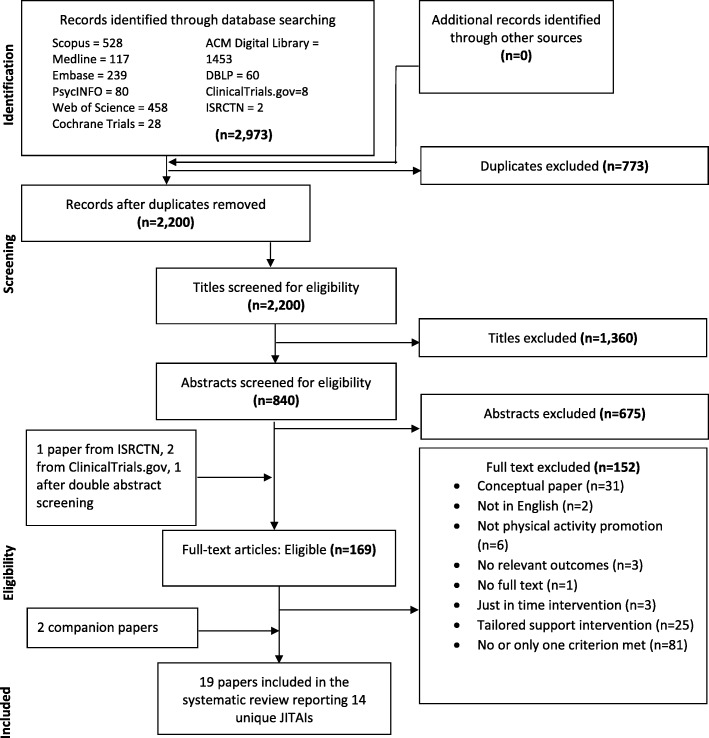
BACKGROUND: Progress in mobile health (mHealth) technology has enabled the design of just-in-time adaptive interventions (JITAIs). We define JITAIs as having three features: behavioural support that directly corresponds to a need in real-time; content or timing of support is adapted or tailored according to input collected by the system since support was initiated; support is system-triggered. We conducted a systematic review of JITAIs for physical activity to identify their features, feasibility, acceptability and effectiveness. METHODS: We searched Scopus, Medline, Embase, PsycINFO, Web of Science, DBLP, ACM Digital Library, Cochrane Central Register of Controlled Trials, ClinicalTrials.gov and the ISRCTN register using terms related to physical activity, mHealth interventions and JITAIs. We included primary studies of any design reporting data about JITAIs, irrespective of population, age and setting. Outcomes included physical activity, engagement, uptake, feasibility and acceptability. Paper screening and data extraction were independently validated. Synthesis was narrative. We used the mHealth Evidence Reporting and Assessment checklist to assess quality of intervention descriptions. RESULTS: We screened 2200 titles, 840 abstracts, 169 full-text papers, and included 19 papers reporting 14 unique JITAIs, including six randomised studies. Five JITAIs targeted both physical activity and sedentary behaviour, five sedentary behaviour only, and four physical activity only. JITAIs prompted breaks following sedentary periods and/or suggested physical activities during opportunistic moments, typically over three to four weeks. Feasibility challenges related to the technology, sensor reliability and timeliness of just-in-time messages. Overall, participants found JITAIs acceptable. We found mixed evidence for intervention effects on behaviour, but no study was sufficiently powered to detect any effects. Common behaviour change techniques were goal setting (behaviour), prompts/cues, feedback on behaviour and action planning. Five studies reported a theory-base. We found lack of evidence about cost-effectiveness, uptake, reach, impact on health inequalities, and sustained engagement. CONCLUSIONS: Research into JITAIs to increase physical activity and reduce sedentary behaviour is in its early stages. Consistent use and a shared definition of the term 'JITAI' will aid evidence synthesis. We recommend robust evaluation of theory and evidence-based JITAIs in representative populations. Decision makers and health professionals need to be cautious in signposting patients to JITAIs until such evidence is available, although they are unlikely to cause health-related harm. REFERENCE: PROSPERO 2017 CRD42017070849.
Overview
The claims and statistics of this paper haven’t been checked yet.
Run the check — free, no account needed. It reads the open-access text and checks the sources it cites.
Integrity signals
Registry
Cites
Statistics
Figures
Verification
Claims the paper makes
The claims and statistics of this paper haven’t been checked yet.
Run the check — free, no account needed. It reads the open-access text and checks the sources it cites.
Claims other papers make about this one
Each is checked against this paper’s own text: does it say what the citing paper says it does?
In the citing paper
“Beyond connectivity and feasibility, the advantages of AI chatbot programs lie essentially in the computational power to develop and deliver personalized interventions [22-24].”
In the citing paper
“Furthermore, rapid progress in mobile health technologies and functions has enabled the design of just-in-time adaptive interventions (JITAIs) [24].”
Self-check
Percentages, sums and reported differences re-computed from the paper’s own numbers.
The self-check needs the paper’s full text.
Citations
Cites
Preferred Reporting Items for Systematic Reviews and Meta-Analyses: the PRISMA statement
Moher, D., Liberati, A., Tetzlaff, J., Altman, D. G., & for the PRISMA Group (2009) · BMJ · doi:10.1136/bmj.b2535 · Cited by 83,823
Preferred reporting items for systematic reviews and meta-analyses: the PRISMA Statement.
(2009) · PubMed Central · Cited by 44,859
(1985) · Europe PMC (PubMed Central) · Cited by 9,143
Michie, S., Richardson, M., Johnston, M., Abraham, C., Francis, J., Hardeman, W., Eccles, M. P., Cane, J., & Wood, C. E. (2013) · Annals of Behavioral Medicine · doi:10.1007/s12160-013-9486-6 · Cited by 7,629 · cited 3×
“This was independently validated by four reviewers (FN, AJ, KL and JH) and FN independently validated the extraction of behaviour change techniques (BCTs) [16].”
BackgroundMethodInfluentialSelf-citationA behavior model for persuasive design
Fogg, B. (2009) · Proceedings of the 4th International Conference on Persuasive Technology · doi:10.1145/1541948.1541999 · Cited by 2,328
Nahum-Shani, I., Smith, S. N., Spring, B. J., Collins, L. M., Witkiewitz, K., Tewari, A., & Murphy, S. A. (2018) · Annals of Behavioral Medicine · doi:10.1007/s12160-016-9830-8 · Cited by 2,171
Perski, O., Blandford, A., West, R., & Michie, S. (2017) · Translational Behavioral Medicine · doi:10.1007/s13142-016-0453-1 · Cited by 1,193 · cited 1×
“Finally, we extracted data about the following outcomes: feasibility, acceptability, engagement [17], effectiveness and health-economic outcomes.”
MethodConsolvo, S., McDonald, D. W., Toscos, T., Chen, M. Y., Froehlich, J. E., Harrison, B. L., Klasnja, P., LaMarca, A., LeGrand, L., Libby, R., et al. (2008) · CHI Conference on Human Factors in Computing Systems · doi:10.1145/1357054.1357335 · Cited by 1,133 · cited 2×
“On this basis, we excluded some studies [22, 23, 40] which others described as JITAIs.”
BackgroundResultA meta-analysis of computer-tailored interventions for health behavior change
Krebs, P., Prochaska, J. O., & Rossi, J. S. (2010) · Preventive Medicine · doi:10.1016/j.ypmed.2010.06.004 · Cited by 854 · cited 1×
“We adopt the Naughton [9] definition and define behavioural JITAIs as having three key features: 1) The intervention aims to provide behavioural support that directly corresponds to a need in real time when the user is at risk of engaging in a negative health behaviour or has an opportunity to engage in a positive beh…”
MethodAgarwal, S., LeFevre, A. E., Lee, J., L’Engle, K., Mehl, G., Sinha, C., & Labrique, A. (2016) · BMJ · doi:10.1136/bmj.i1174 · Cited by 639 · cited 3×
“Table 5 Quality of intervention descriptions, assessed with the mERA checklist [18](1)”
BackgroundMethodInfluential
Research works printed but not linked: 2
- Nahum-Shani S, Smith S, Tewari A, Witkiewitz K, Collins LM, Spring B, et al. Just-in-time adaptive interventions (JITAIs): An organizing framework for ongoing health behavior support. (Technical Report No. 14–126). University Park, PA: The Methodology Center, Penn State; 2014.
- Lin Y. Evaluation user study of motivate final version. Motivate : a context-aware mobile application for physical activity promotion. Eindhoven: Technische Universiteit Eindhoven. https://doi.org/IR750185201/IR7501852013. p. 95-126.
Cited by
Sorted by citations
Zhang, J., Oh, Y. J., Lange, P., Yu, Z., & Fukuoka, Y. (2020) · Journal of Medical Internet Research · doi:10.2196/22845 · Cited by 363
“Beyond connectivity and feasibility, the advantages of AI chatbot programs lie essentially in the computational power to develop and deliver personalized interventions [22-24].”
BackgroundTorous, J., Linardon, J., Goldberg, S. B., Sun, S., Bell, I., Nicholas, J., Hassan, L., Hua, Y., Milton, A., & Firth, J. (2025) · World Psychiatry · doi:10.1002/wps.21299 · Cited by 323
Wearable Devices in Cardiovascular Medicine
Hughes, A. N., Shandhi, M. M. H., Master, H., Dunn, J., & Brittain, E. L. (2023) · Circulation Research · doi:10.1161/circresaha.122.322389 · Cited by 341
Timmons, A. C., Duong, J. B., Simo Fiallo, N., Lee, T., Vo, H. P. Q., Ahle, M. W., Comer, J. S., Brewer, L. C., Frazier, S. L., & Chaspari, T. (2023) · Perspectives on Psychological Science · doi:10.1177/17456916221134490 · Cited by 263
“, 2021); and (c) refine our methods of treatment administration to optimize precisely when, where, and how interventions are delivered (Hardeman et al., 2019).”
BackgroundAn Open-Source Monitor-Independent Movement Summary for Accelerometer Data Processing
John, D., Tang, Q., Albinali, F., & Intille, S. S. (2019) · Journal for the Measurement of Physical Behaviour · doi:10.1123/jmpb.2018-0068 · Cited by 227
Digital Interventions on Healthy Lifestyle Management: Systematic Review
Chatterjee, A., Prinz, A., Gerdes, M. W., & Martínez, S. (2021) · Journal of Medical Internet Research · doi:10.2196/26931 · Cited by 229
“• Included studies with the Scale for the Assessment of Narrative Review Articles scale 2 (107 articles) [1,32-137]”
BackgroundPerski, O., Hébert, E. T., Naughton, F., Hekler, E. B., Brown, J., & Businelle, M. S. (2021) · Addiction · doi:10.1111/add.15687 · Cited by 163
“Similar to Hardeman and colleagues’ recent review of JITAIs to promote physical activity [10], as research into JITAIs is in its early stages (both in terms of the quality of current implementations and the strength of available evidence), it is premature to comment on the effectiveness of JITAIs for reducing harmful…”
BackgroundMethodResultInfluentialSelf-citationStudying Behaviour Change Mechanisms under Complexity
Heino, M. T. J., Knittle, K. P., Noone, C., Hasselman, F., & Hankonen, N. E. (2021) · Behavioral Sciences · doi:10.3390/bs11050077 · Cited by 161
“Made possible by N-of-1 methodologies [54], this goal has been recently pursued by using control systems engineering approaches [55] and just-in-time adaptive interventions [56], among others.”
BackgroundMethodMair, J. L., Salamanca-Sanabria, A., Augsburger, M., Frese, B. F., Abend, S., Jakob, R., Kowatsch, T., & Haug, S. (2023) · Annals of Behavioral Medicine · doi:10.1093/abm/kaad041 · Cited by 168
“[83] reported that goal setting, action planning, discrepancy between current behavior and goal, feedback on behavior, prompts and cues, social reward, and instruction on how to perform a behavior were present in effective just-in-time adaptive interventions targeting physical activity.”
BackgroundTong, H. L., Quiroz, J. C., Kocaballi, A. B., Fat, S. C. M., Dao, K. P., Gehringer, H., Chow, C. K., & Laranjo, L. (2021) · Preventive Medicine · doi:10.1016/j.ypmed.2021.106532 · Cited by 136
Trends in Persuasive Technologies for Physical Activity and Sedentary Behavior: A Systematic Review
Aldenaini, N., Alqahtani, F., Orji, R., & Sampalli, S. (2020) · Frontiers in Artificial Intelligence · doi:10.3389/frai.2020.00007 · Cited by 106
“[18] conducted a systematic review of just-intime adaptive interventions (JITAIs) in mobile health (mHealth) technology for PA to determine these interventions’ effectiveness, feasibility, features, and acceptability.”
BackgroundNurmi, J., Knittle, K. P., Ginchev, T., Khattak, F., Helf, C., Zwickl, P., Castellano‐Tejedor, C., Lusilla, P., Costa‐Requena, J., Ravaja, N., et al. (2019) · JMIR mhealth and uhealth · doi:10.2196/12884 · Cited by 110
“With their interactive features, onboard sensors, and associated wearables, smartphones are a natural tool for tracking and self-monitoring activity [4,5].”
BackgroundDeep Digital Phenotyping and Digital Twins for Precision Health: Time to Dig Deeper
Fagherazzi, G. (2019) · Journal of Medical Internet Research · doi:10.2196/16770 · Cited by 89
“We have known for some time that “one size fits all” strategies are not efficient therapeutically or preventively [14].”
BackgroundWearable Devices: Current Status and Opportunities in Pain Assessment and Management
Leroux, A., Lynn, R. R., Crainiceanu, C., & Sharma, T. (2021) · Digital Biomarkers · doi:10.1159/000515576 · Cited by 94
The Potential Role of Digital Health in Obesity Care
Hinchliffe, N., Capehorn, M., Bewick, M., & Feenie, J. (2022) · Advances in Therapy · doi:10.1007/s12325-022-02265-4 · Cited by 100
“JITAIs have been shown to diminish sedentary behaviours and increase physical activity in individuals with obesity [51, 52], and a trial is underway to test a JITAI aimed at preventing lapses in healthy eating behaviour [53].”
BackgroundBaumann, H., Fiedler, J., Wunsch, K., Wöll, A., & Wollesen, B. (2022) · JMIR mhealth and uhealth · doi:10.2196/35920 · Cited by 93
“Furthermore, there is empirical evidence that just-in-time interventions [19,20], individualized or tailored interventions [21], and interventions that incorporate multiple BCTs [22] show large potential in this respect.”
BackgroundMair, J. L., Hayes, L. D., Campbell, A. K., Buchan, D. S., Easton, C., & Sculthorpe, N. F. (2022) · JMIR Formative Research · doi:10.2196/34662 · Cited by 76
“Research on JITAIs has, to date, been limited to young or middle-aged populations and community settings such as the workplace, universities, and secondary care [16]; none has targeted older adults in a free-living setting.”
BackgroundDigital Behavior Change Intervention Designs for Habit Formation: Systematic Review
Zhu, Y., Long, Y., Wang, H., Lee, K. P., Zhang, L., & Wang, S. J. (2024) · Journal of Medical Internet Research · doi:10.2196/54375 · Cited by 84
“On the other hand, limited studies have investigated how to design DBCI solutions using characteristics of these technologies, such as context awareness and inferring personal requirements [20,27].”
BackgroundSanal‐Hayes, N. E. M., Mclaughlin, M., Hayes, L. D., Mair, J. L., Ormerod, J. A., Carless, D., Hilliard, N., Meach, R., Ingram, J., & Sculthorpe, N. F. (2023) · Journal of Translational Medicine · doi:10.1186/s12967-023-04587-5 · Cited by 90
Tailored physical activity behavior change interventions: challenges and opportunities
Ma, J. K., Floegel, T. A., LI, L. C., Leese, J., Vera, M. A. D., Beauchamp, M. R., Taunton, J., Liu-Ambrose, T. Y. L., & Allen, K. D. (2021) · Translational Behavioral Medicine · doi:10.1093/tbm/ibab106 · Cited by 70
To, Q. G., Green, C., & Vandelanotte, C. (2021) · JMIR mHealth and uHealth · doi:10.2196/28577 · Cited by 68
“Overall, these interventions have been able to produce moderate effect sizes in increasing physical activity [7-10].”
BackgroundLifestyle interventions in pregnancy targeting GDM prevention: looking ahead to precision medicine
Sparks, J. R., Ghildayal, N., Hivert, M., & Redman, L. M. (2022) · Diabetologia · doi:10.1007/s00125-022-05658-w · Cited by 63
“As such, JITAIs are effective for weight management in non-pregnant women [58] and show promise in pregnant women with type 1 diabetes [30].”
BackgroundDigital Public Health – ein Überblick
Bremen, L.-W. D. P. H., Zeeb, H., Pigeot, I., & Schüz, B. (2020) · Bundesgesundheitsblatt - Gesundheitsforschung - Gesundheitsschutz · doi:10.1007/s00103-019-03078-7 · Cited by 59
van Genugten, C., Thong, M. S. Y., van Ballegooijen, W., Kleiboer, A. M., Spruijt‐Metz, D., Smit, A. C., Sprangers, M. A. G., Terhorst, Y., & Riper, H. M. (2025) · Frontiers in Digital Health · doi:10.3389/fdgth.2025.1460167 · Cited by 64
The use of advanced technology and statistical methods to predict and prevent suicide
Kleiman, E. M., Glenn, C. R., & Liu, R. T. (2023) · Nature Reviews Psychology · doi:10.1038/s44159-023-00175-y · Cited by 65
“Third, JITAIs to date have primarily focused on outcomes such as insufficient physical activity 145 .”
MethodIn Vitro Killing of Schistosomula of Schistosoma Mansoni by BCG and C. Parvum-Activated Macrophages
Mahmoud, A. A. F., Peters, P., Civil, R. H., & Remington, J. S. (1979) · The Journal of Immunology · doi:10.4049/jimmunol.122.5.1655 · Cited by 56
Fiedler, J., Eckert, T., Burchartz, A., Wöll, A., & Wunsch, K. (2021) · Sensors · doi:10.3390/s21082672 · Cited by 55
“This is especially important if the study aims to use a personalized approach as with just-in-time adaptive interventions [10] or aims to compare the result to common PA guidelines which both strongly depend on comparable data.”
BackgroundJust-in-time adaptive ecological momentary assessment (JITA-EMA)
Schneider, S., Junghaenel, D. U., Smyth, J. M., Wen, C. K. F., & Stone, A. A. (2023) · Behavior Research Methods · doi:10.3758/s13428-023-02083-8 · Cited by 65
“In practice, JITAIs are often designed to deliver interventions shortly before, during, or after a pre-sumptive state of risk or opportunity for a given individual (Hardeman et al., 2019; Perski et al., 2022).”
BackgroundThøgersen‐Ntoumani, C., Kritz, M., Grunseit, A. C., Chau, J. Y., Ahmadi, M., Holtermann, A., Koster, A., Tudor-Locke, C. E., Johnson, N. A., Sherrington, C., et al. (2023) · International Journal of Behavioral Nutrition and Physical Activity · doi:10.1186/s12966-023-01480-8 · Cited by 53
“In addition, other contemporary methodological approaches could be considered to assess effects of VILPA, including ecological momentary assessment methodologies [56] and just-in-time-adaptive interventions [52].”
BackgroundHankonen, N. E. (2020) · Health Psychology Review · doi:10.1080/17437199.2020.1814836 · Cited by 57
“…personalized, for example, just-in-time adaptive interventions, where participants are prompted with messages suited to them, based on data (e.g., Hardeman et al., 2019), expectations of enactment are likely to be higher, and monitoring whether participants enact the BCTs tailored precisely to…”
BackgroundHsu, T. C., Whelan, P., Gandrup, J., Armitage, C. J., Cordingley, L., & McBeth, J. (2024) · British Journal of Health Psychology · doi:10.1111/bjhp.12766 · Cited by 57
“We also included studies identified in the systematic reviews conducted by the Hardeman and Perski teams (Hardeman et al., 2019; Perski et al., 2022).”
InfluentialBi, S., Yuan, J., Wang, Y., Zhang, W., Zhang, L., Zhang, Y., Zhu, R., & Luo, L. (2024) · Journal of Medical Internet Research · doi:10.2196/51714 · Cited by 64
“To improve college students’physical activity behavior, digital health interventions have been recognized as a promising strategy [17,18].”
Karahanoğlu, A., Gouveia, R. H. D. F., Reenalda, J., & Ludden, G. (2021) · Sensors · doi:10.3390/s21113687 · Cited by 46
“, content and timing of feedback) could be tailored based on the collected data and triggered by the system [45].”
BackgroundKeller, R., Hartmann, S., Teepe, G. W., Lohse, K.-M., Alattas, A., Car, L. T., Müller‐Riemenschneider, F., von Wangenheim, F., Mair, J. L., & Kowatsch, T. (2021) · Journal of Medical Internet Research · doi:10.2196/33348 · Cited by 44
“More specifically, JITAIs adapt the provision of intervention content (eg, the type, timing, and intensity) by measuring the health condition or patient behavior with mobile technology such as smartphones, sensors, and software analytics to deliver intervention content at the time and in the context that the person ne…”
BackgroundLu, S.-C., Xu, M., Wang, M., Hardi, A., Cheng, A. L., Chang, S.-H., & Yen, P.-Y. (2022) · JMIR Mental Health · doi:10.2196/39454 · Cited by 45
“JITAI has been used to support health behaviors changes, such as physical activity [15,16], healthy diet [17,18], weight loss [19], and addiction [20-22].”
Giurgiu, M., Niermann, C. Y. N., Ebner‐Priemer, U., & Kanning, M. K. (2020) · JMIR mhealth and uhealth · doi:10.2196/17852 · Cited by 55
“Furthermore, sedentary behavior–triggered EMA can be modified as a methodological system in a JITAI [37].”
BackgroundInfluentialGolbus, J. R., Dempsey, W., Jackson, E. A., Nallamothu, B. K., & Klasnja, P. (2021) · Circulation Cardiovascular Quality and Outcomes · doi:10.1161/circoutcomes.120.006760 · Cited by 46
Digital chemsex support and care: The potential of just-in-time adaptive interventions
Platteau, T., Herrijgers, C., & de Wit, J. B. F. (2020) · International Journal of Drug Policy · doi:10.1016/j.drugpo.2020.102927 · Cited by 48
Keller, J., Roitzheim, C., Radtke, T., Schenkel, K., & Schwarzer, R. (2021) · JMIR mhealth and uhealth · doi:10.2196/26397 · Cited by 45
“Other strategies to prevent selective attrition in such online-based study designs include scheduling reminders and following up participants with lower study engagement using just-in-time messages or phone calls [38].”
Metzendorf, M., Wieland, L. S., & Richter, B. (2024) · Cochrane Database of Systematic Reviews · doi:10.1002/14651858.cd013591.pub2 · Cited by 52
Bridging Innovation and Equity: Advancing Public Health Through Just-in-Time Adaptive Interventions
Zainal, N. H., Liu, X., Leong, U., Yan, X., & Chakraborty, B. (2024) · Annual Review of Public Health · doi:10.1146/annurev-publhealth-071723-103909 · Cited by 42
Ester, M., Eisele, M., Wurz, A. J., McDonough, M. H., McNeely, M. L., & Culos-Reed, S. N. (2021) · JMIR Cancer · doi:10.2196/28852 · Cited by 43
Canfell, O. J., Davidson, K., Woods, L. S., Sullivan, C. M., Cocoros, N. M., Klompas, M., Zambarano, B., Eakin, E., Littlewood, R., & Burton‐Jones, A. (2022) · Frontiers in Public Health · doi:10.3389/fpubh.2022.854525 · Cited by 43
“For PPH of NCDs, an example of using organic data is just-in-time adaptive interventions (JITAIs) where prescriptive physical activity recommendations are “pushed” to individuals based on real-time monitoring of sedentary behavior via wearables (20).”
BackgroundUnderstanding Disengagement in Just-in-Time Mobile Health Interventions
Park, J., & Lee, U. (2023) · Proceedings of the ACM on Interactive Mobile Wearable and Ubiquitous Technologies · doi:10.1145/3596240 · Cited by 41
“Such features are key to the design of Just-in-Time (JIT) interventions for the sake of timely feedback delivery [32].”
BackgroundCharacterizing and predicting person-specific, day-to-day, fluctuations in walking behavior
Chevance, G., Baretta, D., Heino, M. T. J., Perski, O., Olthof, M., Klasnja, P., Hekler, E. B., & Godino, J. (2021) · PLoS ONE · doi:10.1371/journal.pone.0251659 · Cited by 43
“Applied to physical activity, the early prediction of imminent behavioral transitions represents a potentially valuable signal for delivering interventions “just-in-time” [36].”
BackgroundNeurophysiological Measurements in Higher Education: A Systematic Literature Review
Darvishi, A., Khosravi, H., Sadiq, S. W., & Weber, B. (2021) · International Journal of Artificial Intelligence in Education · doi:10.1007/s40593-021-00256-0 · Cited by 39
Environmental Issues Are Health Issues
Inauen, J., Contzen, N., Frick, V., Kadel, P., Keller, J., Kollmann, J., Mata, J., & van Valkengoed, A. M. (2021) · European Psychologist · doi:10.1027/1016-9040/a000438 · Cited by 55
“Another promising avenue is just-in-time adaptive interventions (Hardeman et al., 2019 ; Nahum-Shani et al., 2018 ) that are used to deliver interventions in critical situations when persons are most susceptible to behavioral changes.”
Microrandomized Trials: Developing Just-in-Time Adaptive Interventions for Better Public Health
Liu, X., Deliu, N., & Chakraborty, B. (2022) · American Journal of Public Health · doi:10.2105/ajph.2022.307150 · Cited by 39
Song, T., Yu, P., Bliokas, V. V., Probst, Y., Peoples, G. E., Qian, S., Houston, L., Perez, P., Amirghasemi, M., Cui, T., et al. (2021) · JMIR mhealth and uhealth · doi:10.2196/20650 · Cited by 38
“As mentioned earlier, inadequate application of the behavioral change theory to guide the design and implementation of mHealth services also leads to unsatisfactory intervention effects [23,31,35,36].”
BackgroundVenkatachalam, P., & Ray, S. (2022) · International Journal of Information Management Data Insights · doi:10.1016/j.jjimei.2022.100139 · Cited by 46
Seixas, A. A., Olaye, I. M., Wall, S. P., & Dunn, P. J. (2021) · Frontiers in Public Health · doi:10.3389/fpubh.2021.667654 · Cited by 39
“…approaches, which can be categorized as part of a suite of innovative behavioral approaches such as just-in-time adaptive interventions (18– 20), adds a unique workflow and evidence for achieving more ecologically valid approaches to overcome barriers and accentuate facilitators of…”
BackgroundWang, S., Zhang, C., Kröse, B., & van Hoof, H. (2021) · Journal of Medical Systems · doi:10.1007/s10916-021-01773-0 · Cited by 35
“The just-in-time adaptive intervention (JITAI) is an adaptive intervention design concept, aiming to provide the right type /amount of support at the right time based on an individual’s changing internal and external states [2, 3].”
BackgroundPrice, G. D., Heinz, M. V., Collins, A. C., & Jacobson, N. C. (2023) · Psychiatry Research · doi:10.1016/j.psychres.2023.115693 · Cited by 37
Bhattacharjee, A., Williams, J. J., Meyerhoff, J., Kumar, H., Mariakakis, A. T., & Kornfield, R. (2023) · CHI Conference on Human Factors in Computing Systems · doi:10.1145/3544548.3580774 · Cited by 38
Haug, S., Castro, R. P., Scholz, U., Kowatsch, T., Schaub, M. P., & Radtke, T. (2020) · JMIR mhealth and uhealth · doi:10.2196/16937 · Cited by 30
“To date, published studies on the effects of just-in-time interventions are limited to physical activity and sedentary behavior, with mixed evidence for intervention effects [13].”
BackgroundUbiquitous Affective Computing: A Review
Assabumrungrat, R., Sangnark, S., Charoenpattarawut, T., Polpakdee, W., Sudhawiyangkul, T., Boonchieng, E., & Wilaiprasitporn, T. (2021) · IEEE Sensors Journal · doi:10.1109/jsen.2021.3138269 · Cited by 33
Wang, X., Griffith, J., Adler, D. A., Castillo, J., Choudhury, T., & Wang, F. (2025) · CHI Conference on Human Factors in Computing Systems · doi:10.1145/3706598.3713852 · Cited by 42
Do, B., Mason, T. B., Yi, L., Yang, C., & Dunton, G. F. (2021) · Psychology of sport and exercise · doi:10.1016/j.psychsport.2021.101935 · Cited by 31
How Useful Are Digital Health Terms for Outcomes Research? An ISPOR Special Interest Group Report
Burrell, A. D., Zrubka, Z., Champion, A., Zah, V., Vinuesa, L., Holtorf, A., Bidino, R. D., Earla, J. R., Entwistle, J., Boltyenkov, A., et al. (2022) · Value in Health · doi:10.1016/j.jval.2022.04.1730 · Cited by 33
Wang, S., Sporrel, K., van Hoof, H., Simons, M., Boer, R. D., Ettema, D., Nibbeling, N., Deutekom, M. D. L. F., & Kröse, B. (2021) · International Journal of Environmental Research and Public Health · doi:10.3390/ijerph18116059 · Cited by 30
“Recently, just-in-time adaptive intervention (JITAI) has gained attention and been considered to be an effective strategy in the field of mobile healthcare intervention [6].”
Lee, V. V., Vijayakumar, S., Ng, W. Y., Lau, N. Y., Leong, Q. Y., Ooi, D. S. Q., Su, L. L., Lee, Y. S., Chan, S., Blasiak, A., et al. (2023) · npj Digital Medicine · doi:10.1038/s41746-023-00924-6 · Cited by 30
“Nevertheless, a recent systematic review reported that many JITAIs for physical activity lack evaluation of JITAI usage and adoption among representative real-world and clinical populations 29 .”
The Digital Transformation in Health: How AI Can Improve the Performance of Health Systems
Periáñez, Á., del Río, A. F., Nazarov, I., Jané, E., Hassan, M., Rastogi, A., & Tang, D. (2024) · Health Systems & Reform · doi:10.1080/23288604.2024.2387138 · Cited by 44
“14,38 These systems dynamically adapt, allowing rapid innovation cycles to support the deployment of agile and responsive public health and health care systems.”
Yang, C., Huh, J., Mason, T. B., Belcher, B. R., Kanning, M. K., & Dunton, G. F. (2020) · International Journal of Behavioral Nutrition and Physical Activity · doi:10.1186/s12966-020-00951-6 · Cited by 29
Implementing the Soil Enrichment Protocol at Scale: Opportunities for an Agricultural Carbon Market
Hammond, A. A. J., Motew, M. M., Brummitt, C. D., DuBuisson, M. L., Pinjuv, G., Harburg, D. V., Campbell, E. E., & Kumar, A. A. (2021) · Frontiers in Climate · doi:10.3389/fclim.2021.686440 · Cited by 28
“As a project developer, Indigo is now undertaking the first implementation of the new baseline approach in the SEP that generates what we term a Just-inTime Adaptive Baseline (JITAB)—inspired by the Just-In-Time Adaptive Intervention approach in behavioral science (NahumShani et al., 2018; Hardeman et al., 2019).”
Ng, A., Wei, B., Jain, J., Ward, E. A., Tandon, S. D., Moskowitz, J. T., Krogh‐Jespersen, S., Wakschlag, L. S., & Alshurafa, N. I. (2022) · JMIR mhealth and uhealth · doi:10.2196/33850 · Cited by 29
“Such homework can take the form of technologically supported just-in-time (JIT) interventions [21], which in the case of maternal stress can enhance effectiveness of stress-reducing techniques.”
BackgroundRohaj, A., & Bulaj, G. W. (2023) · Healthcare · doi:10.3390/healthcare11101469 · Cited by 27
Schroeder, J., Suh, J., Wilks, C. R., Czerwinski, M. P., Munson, S. A., Fogarty, J. A., & Althoff, T. (2020) · International Conference on Pervasive Computing Technologies for Healthcare · doi:10.1145/3421937.3421975 · Cited by 27
Enhancing digital health services: A machine learning approach to personalized exercise goal setting
Fang, J., Lee, V. C. S., Ji, H., & Wang, H. (2024) · Digital Health · doi:10.1177/20552076241233247 · Cited by 39
“6 Building upon the accurate cognitive health assessment provided by IoT devices, machine learning technologies in the digital health service provide personalized exercise guidance tailored to the physical needs of users, 7 and offer achievement rewards by incorporating external incentives (e.g.…”
BackgroundOikonomidi, T., Ravaud, P., LeBeau, J., & Tran, V.-T. (2023) · Journal of Clinical Epidemiology · doi:10.1016/j.jclinepi.2022.12.006 · Cited by 26
Yfantidou, S., Sermpezis, P., & Vakali, A. I. (2023) · ACM Transactions on Computing for Healthcare · doi:10.1145/3592621 · Cited by 36
“Such reminders fall under the umbrella of Just-in-Time Adaptive Interventions (JITAIs), a ield that has gathered scientiic attention [70] and should be the focus of future work in the ield of ST.”
BackgroundSocial Comparison and Mental Health
Arigo, D., Bercovitz, I., Lapitan, E., & Gular, S. (2024) · Current Treatment Options in Psychiatry · doi:10.1007/s40501-024-00313-0 · Cited by 32
“To our knowledge, social comparison is rarely included as a treatment component in JITAIs for promoting physical health [71] and has not yet been tested in JITAIs for mental health outcomes.”
Suh, J., Howe, E. S., Lewis, R., Hernandez, J., Saha, K., Althoff, T., & Czerwinski, M. P. (2024) · JMIR Mental Health · doi:10.2196/48974 · Cited by 26
“Despite JITAI systems’ potential to provide precision support [27], few studies demonstrate the value of just-in-time (JIT) support in improving user engagement [43,44].”
BackgroundJust-in-Time Adaptive Interventions: Where Are We Now and What Is Next?
Nahum-Shani, I. B., & Murphy, S. A. (2025) · Annual Review of Psychology · doi:10.1146/annurev-psych-121024-044244 · Cited by 35
Reinforcement Learning in Modern Biostatistics: Constructing Optimal Adaptive Interventions
Deliu, N., Williams, J. J., & Chakraborty, B. (2024) · International Statistical Review · doi:10.1111/insr.12583 · Cited by 32
“This distinctive characteristic contributes to its increasing popularity in a variety of behavioral domains, ranging from physical activity [47, 36] and weight management [97] to addictive disorders [42, 39] and smoking cessation [90].”
BackgroundKudinova, A. Y., Brick, L. A. D., Armey, M. F., & Nugent, N. R. (2023) · Journal of Child Psychology and Psychiatry · doi:10.1111/jcpp.13869 · Cited by 30
Herold, F., Zou, L., Theobald, P., Manser, P., Falck, R. S., Yu, Q., Liu-Ambrose, T. Y. L., Hillman, C. H., Kramer, A. F., Erickson, K. I., et al. (2025) · European Journal of Applied Physiology · doi:10.1007/s00421-025-05858-3 · Cited by 40
“…evidence holds great potential to inform and optimize intervention approaches aimed at promoting PA (e.g. “just-in-time adaptive PA interventions” (Hardeman et al. 2019; Müller et al. 2017; Wunsch et al. 2022)) to break up prolonged sitting with acute bouts of PA (Chueh et al. 2022; Li et al.…”
Cognitive and Affective Mediators of Alcohol-Facilitated Intimate-Partner Aggression
Eckhardt, C. I., Parrott, D. J., Swartout, K. M., Leone, R. M., Purvis, D. M., Massa, A. A., & Sprunger, J. G. (2021) · Clinical Psychological Science · doi:10.1177/2167702620966293 · Cited by 24
Digital encounters: Human interactions in mHealth behavior change interventions
Müssener, U. (2021) · Digital Health · doi:10.1177/20552076211029776 · Cited by 24
“41 The design of just-in-time adaptive interventions 34 in combination with personal preferences and contextual factors allow chatbots to customize the timing, amount, content, and frequency of the intervention by adapting each individual’s internal and external changes over time.”
BackgroundVětrovský, T., Král, N., Pfeiferová, M., Kühnová, J., Novák, J., Wahlich, C., Jaklova, A., Jurková, K., Janek, M., Omcirk, D., et al. (2023) · BMC Public Health · doi:10.1186/s12889-023-15513-1 · Cited by 25
Nicholas, J., Ntoumanis, N., Smith, B. J., Quested, E., Stamatakis, E., & Thøgersen‐Ntoumani, C. (2021) · BMC Medical Informatics and Decision Making · doi:10.1186/s12911-021-01391-3 · Cited by 26
Budnick, C. J., Stults‐Kolehmainen, M., Dadina, C., Bartholomew, J. B., Boullosa, D. A., Ash, G., Sinha, R., Blacutt, M. E., Haughton, A. D., & Lu, T. (2023) · Frontiers in Sports and Active Living · doi:10.3389/fspor.2023.1094288 · Cited by 25
“Conduct just-in-time adaptive interventions (JITAI) (91) to maximize opportunities when people experience “CRAVE moments” (moments when the desire to move is high), and perhaps intervene to promote desires when they are low.”
BackgroundGroarke, J. M., Richmond, J. P., McSharry, J., Groarke, A., Harney, O., Kelly, M. G., & Walsh, J. C. (2020) · JMIR mhealth and uhealth · doi:10.2196/18288 · Cited by 23
“A recent review found that these interventions are acceptable to participants and are often used in combination with the same BCTs as in this study (ie, goal setting, prompts, feedback, and action planning) [52].”
Delobelle, J., Lebuf, E., Dyck, D. V., Compernolle, S., Janek, M., Backere, F. D., & Větrovský, T. (2024) · Digital Health · doi:10.1177/20552076241262710 · Cited by 24
“13,14 Speci fi cally, these interventions adapt in real time to an individual ’ s changing internal (e.g. when an individual is most likely to be receptive and needs it most) and external (e.g. social and environmental context) states.”
BackgroundHealy, S., Patterson, F., Biddle, S., Dumuid, D., Glorieux, I., Olds, T., Woods, C. B., Bauman, A. E., Gába, A., Herring, M. P., et al. (2024) · British Journal of Sports Medicine · doi:10.1136/bjsports-2024-108500 · Cited by 23
“56 The model may also be used as a framework to help elucidate specific temporal elements obscured within the barrier of the ‘lack of time’ for exercise.”
Stults‐Kolehmainen, M., Gilson, T. A., SantaBarbara, N. J., McKee, P. C., Sinha, R., Bartholomew, J. B., Boullosa, D. A., Budnick, C. J., Bueno, F. A., Haughton, A. D., et al. (2023) · Frontiers in Sports and Active Living · doi:10.3389/fspor.2023.1033619 · Cited by 28
“These might be conducted as part of justin-time adaptive interventions (JITAI) (87), which attempt to gauge and take advantage of motivation states (i.”
BackgroundHasselman, F. (2023) · Development and Psychopathology · doi:10.1017/s0954579423001281 · Cited by 29
“…will have profound consequences for the design of diagnostic tools and intervention methods as well as the evaluation of the current empirical record (see e.g., Hardeman et al., 2019; Lichtwarck-Aschoff et al., 2012; Nahum-Shani et al., 2017; Olthof et al., 2019; Schiepek, Aichhorn, et al., 2016).”
MethodAdvances and challenges in sensor-based research in mobility, health, and place
Kim, E., Conrow, L., Röcke, C., Chaix, B., Weibel, R., & Perchoux, C. (2023) · Health & Place · doi:10.1016/j.healthplace.2023.102972 · Cited by 21
Domin, A., Uslu, A. S., Schulz, A., Ouzzahra, Y., & Vögele, C. (2022) · JMIR Formative Research · doi:10.2196/35118 · Cited by 24
“Another study reported that the JITAI condition demonstrated a significant improvement in health over the wait-list control condition [13,14].”
BackgroundSporrel, K., Wang, S., Ettema, D., Nibbeling, N., Kröse, B., Deutekom, M. D. L. F., Boer, R. D., & Simons, M. (2022) · JMIR Formative Research · doi:10.2196/35268 · Cited by 19
Cox, D. J., & Jennings, A. M. (2023) · Behavior Analysis in Practice · doi:10.1007/s40617-023-00864-3 · Cited by 21
“…interventions (JITAIs) have been used to increase physical activity, improve dietary patterns and food consumption, and to improve health-related decision making in everyday environments (e.g., Hardeman et al., 2019; Rabbi et al., 2015; Van Dantzig et al., 2013; Van Dantzig et al., 2018).”
Lentferink, A., Noordzij, M. L., Burgler, A., Klaassen, R., Derks, Y. P. M. J., Oldenhuis, H. K. E., Velthuijsen, H., & van Gemert‐Pijnen, J. E. W. C. (2021) · Behaviour and Information Technology · doi:10.1080/0144929x.2021.1876764 · Cited by 21
“The sending of JIT-messages can be highly impactful (Hardeman et al. 2019) but it is only effective when someone is also receptive to the JIT-message (Nahum-”
BackgroundBrons, A., Wang, S., Visser, B., Kröse, B., Bakkes, S. C. J., & Veltkamp, R. C. (2024) · Journal of Medical Internet Research · doi:10.2196/47774 · Cited by 22
Oh, Y. J., Liang, K.-H., Kim, D. D., Zhang, X., Yu, Z., Fukuoka, Y., & Zhang, J. (2025) · Digital Health · doi:10.1177/20552076251324445 · Cited by 19
“55,58 As for linguistic characteristics of user ’ s responses to Exerbot, participants in the relational chatbot condition demonstrated a greater use of total word counts as well as linguistic markers such as fi rst-person pronouns, prepositions, auxiliary verbs, adverbs, and question marks, which…”
Haag, D., Kumar, D., Gruber, S., Hofer, D. P., Sareban, M., Treff, G., Niebauer, J., Bull, C. N., Schmidt, A., & Smeddinck, J. D. (2025) · CHI Conference on Human Factors in Computing Systems · doi:10.1145/3706598.3713307 · Cited by 37
“The contextual variables representing these contexts were selected based on tailoring variables typically used according to JITAI literature [21, 27], existing work on momentary determinants of PA [26], and the aktivplan application [90], in which this exploratory work is grounded for motivation…”
Castro, R., Alves, M. R., de Oliveira, C. C. M., Romero, C., Perazzo, H., Simjanoski, M., Kapciznki, F., Balanzá‐Martínez, V., & Boni, R. B. D. (2022) · Frontiers in Public Health · doi:10.3389/fpubh.2021.735624 · Cited by 21
“Overall, the sample size of the included RCTs ranged between 6 (37) and 69,219 (38) participants.”
BackgroundXu, Z., & Smit, E. S. (2023) · Digital Health · doi:10.1177/20552076231183543 · Cited by 18
“Several systematic reviews have reviewed fundamental components of JITAIs and provided useful guidance on designing and testing JITAIs as well as addressing challenges.(5,33) To our knowledge, only one prior meta-analysis assessed the effectiveness of JITAIs, and it only included studies published by February 2018.”
BackgroundAllender, S. E., Hayward, J., Gupta, S., Sanigorski, A. J., Rana, S., Seward, H. G., Jacobs, S., & Venkatesh, S. (2020) · npj Digital Medicine · doi:10.1038/s41746-019-0205-y · Cited by 18
“5 A second machine learning technique, reinforcement learning, has been used in “ just-in-time ” adaptive intervention (JITAI) optimisation 6 starting with individual user/patient data to select from a set of possible interventions.”
MethodAbusamaan, M. S., Ballreich, J., Dobs, A., Kane, B., Maruthur, N., McGready, J., Riekert, K., Wanigatunga, A. A., Alderfer, M., Alver, D., et al. (2024) · Trials · doi:10.1186/s13063-024-08177-8 · Cited by 16
“Studies on JITAIs have demonstrated their effectiveness in promoting behavior change for various goals, including weight loss and physical activity, and across various patient demographics [26–36].”
BackgroundSimpson, A., Beauchamp, M. R., Dimmock, J. A., Willis, C., & Jackson, B. (2025) · Psychology of sport and exercise · doi:10.1016/j.psychsport.2025.102918 · Cited by 23
Metadata
- Authors
- Hardeman, W., Houghton, J., Lane, K., Jones, A., & Naughton, F.
- Affiliations
- University of East Anglia (GB)
- Corresponding author
- Hardeman, Wendy
- Venue
- International Journal of Behavioral Nutrition and Physical Activity
- Published
- 2019-04-03
- Volume
- 16
- Issue
- 1
- Pages
- 31-31
- ISSN
- 1479-5868 (ISSN-L)
- PMC
- PMC6448257
- OpenAlex
- W2924472360
- Cited by
- 396
- References
- 48
- Citations by year
- 2026: 70 · 2025: 79 · 2024: 72 · 2023: 61 · 2022: 41 · 2021: 45 · 2020: 22 · 2019: 4
- FWCI
- 5.13
- Type
- journal article
- Language
- en
- Open access
- gold
- doi.org
- Licence
- Locations
- International Journal of Behavioral Nutrition and Physical Activity (publishedVersion, cc-by)
- Europe PMC (PubMed Central) (publishedVersion, cc-by)
- PubMed Central (publishedVersion, cc-by)
- PubMed (publishedVersion)
- UEA Digital Repository (University of East Anglia) (acceptedVersion)
- DOAJ (DOAJ: Directory of Open Access Journals) (submittedVersion)
- Apollo (University of Cambridge) (submittedVersion)
- Apollo
- Funders
- Wellcome Trust
- United Kingdom Clinical Research Collaboration
- Cancer Research UK
- National Institute for Health and Care Research
- British Heart Foundation
- Centre for Diet and Activity Research
- Medical Research Council (MR/K023187/1)
- Economic and Social Research Council
- Topics
- Health Sciences › Health Professions › General Health Professions › Mobile Health and mHealth Applications
- Health Sciences › Medicine › Public Health, Environmental and Occupational Health › Physical Activity and Health
- Social Sciences › Psychology › Applied Psychology › Digital Mental Health Interventions
- Keywords
- just-in-time adaptive interventions, physical activity promotion, mobile health, sedentary behavior, behaviour change techniques, intervention feasibility and acceptability, sensor reliability, theory-based intervention, health disparities, cost-effectiveness, sustained engagement, goal setting, action planning
- MeSH terms
- Behavior Therapy, Cost-Benefit Analysis, Health Promotion, Humans, Exercise, Sedentary Behavior
About these checks
Registry, retraction, Cites and statistics results are computed, not judged, with one exception: a printed reference that no index lists is read once by a model before it counts as a citation error. Claims are extracted by a model and kept only when their quote appears verbatim in the text; each cited source is then checked, with a model’s help, for whether it says what the claim relies on. Those verdicts can be wrong — read the claim’s quote and the cited source before relying on one.
Statistics and arithmetic are recomputed, not judged.
Confidence bands are shown only for fields calibrated on our annotated test set. None is calibrated yet, so no band is shown.
What counts as a claim ›How we measure confidence ›How we check this ›
Are you an author, or do you see a problem with this page? Request a review
