

The DOI matches its Crossref record; 89 of the 89 references it cites were found in a registry or an index.
A systematic review and meta-analysis of the overall effects of school-based obesity prevention interventions and effect differences by intervention components
Open accessAbstract
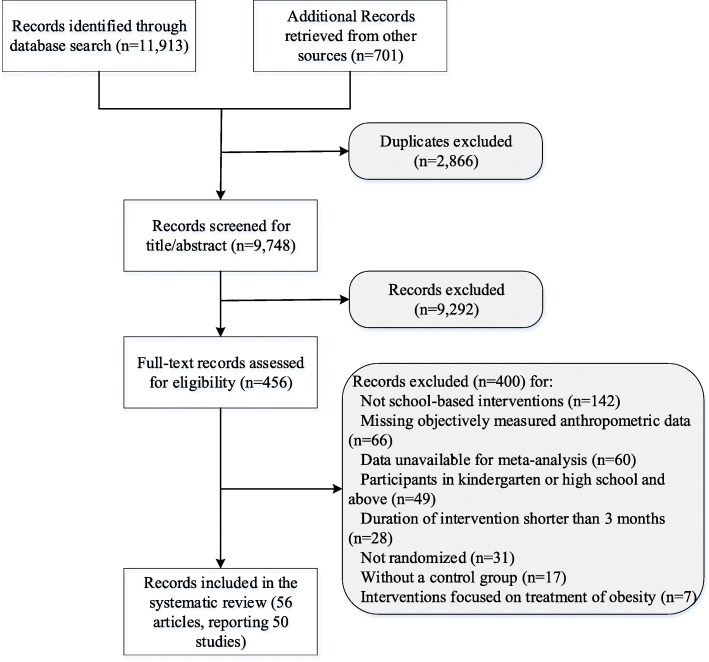
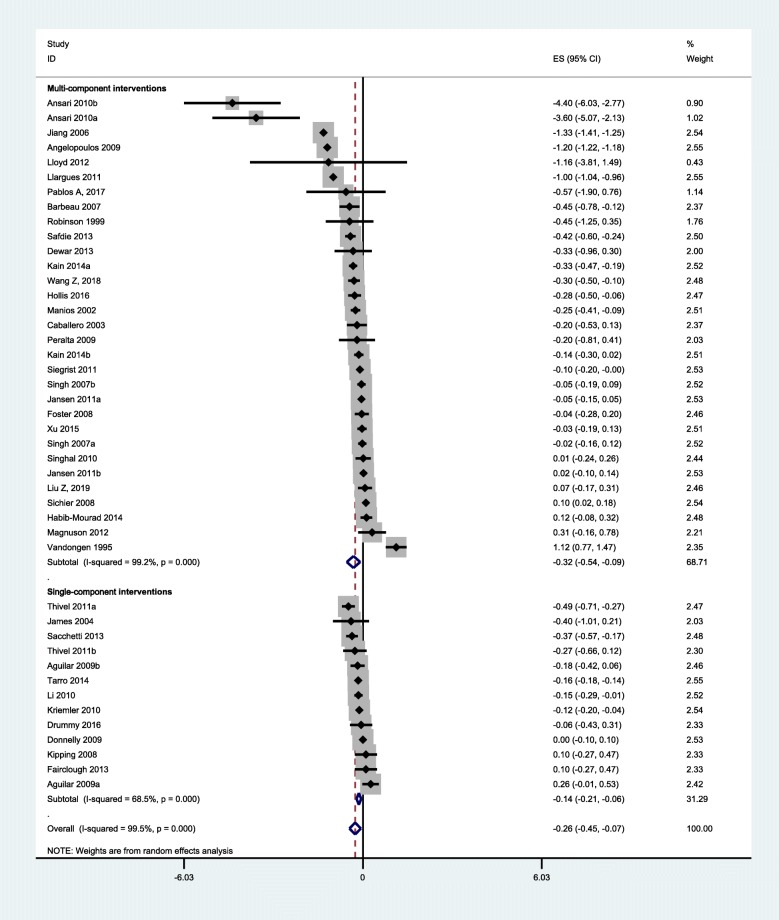
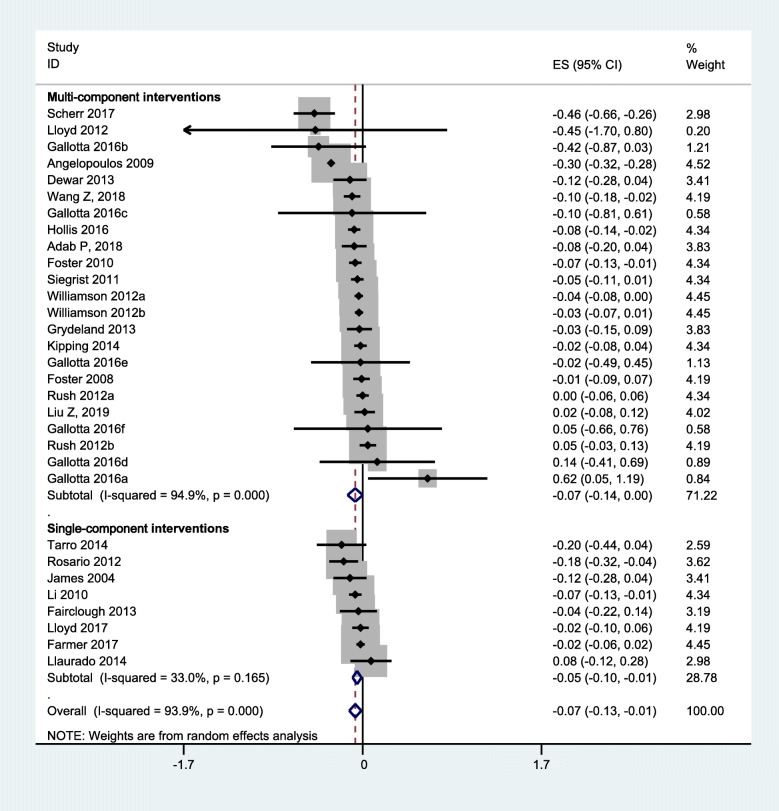
Abstract Background Childhood obesity is a serious public health concern. School-based interventions hold great promise to combat the rising trend of childhood obesity. This systematic review aimed to assess the overall effects of school-based obesity prevention interventions, and to investigate characteristics of intervention components that are potentially effective for preventing childhood obesity. Methods We systematically searched MEDLINE, CENTRAL and Embase databases to identify randomized- or cluster randomized- controlled trials of school-based obesity interventions published between 1990 and 2019. We conducted meta-analyses and subgroup analyses to determine the overall effects of obesity prevention programs and effect differences by various characteristics of intervention components on body mass index (BMI) or BMI Z-score of children. Results This systematic review included a total of 50 trials (reported by 56 publications). Significant differences were found between groups on BMI (− 0.14 kg/m2 (95% confidence interval: − 0.21, − 0.06)) and BMI Z-score (− 0.05 (− 0.10, − 0.01)) for single-component interventions; significant differences were also found between groups on BMI (− 0.32 (− 0.54, − 0.09) kg/m2) and BMI Z-score (− 0.07 (− 0.14, − 0.001)) for multi-component interventions. Subgroup analyses consistently demonstrated that effects of single-component (physical activity) interventions including curricular sessions (− 0.30 (− 0.51, − 0.10) kg/m2 in BMI) were stronger than those without curricular sessions (− 0.04 (− 0.17, 0.09) kg/m2 in BMI); effects of single-component (physical activity) interventions were also strengthened if physical activity sessions emphasized participants’ enjoyment (− 0.19 (− 0.33, − 0.05) kg/m2 in BMI for those emphasizing participants’ enjoyment; − 0.004 (− 0.10, 0.09) kg/m2 in BMI for those not emphasizing participants’ enjoyment). The current body of evidence did not find specific characteristics of intervention components that were consistently associated with improved efficacy for multi-component interventions (P > 0.05). Conclusions School-based interventions are generally effective in reducing excessive weight gain of children. Our findings contribute to increased understandings of potentially effective intervention characteristics for single-component (physical activity) interventions. The impact of combined components on effectiveness of multi-component interventions should be the topic of further research. More high-quality studies are also needed to confirm findings of this review.
Overview
The claims and statistics of this paper haven’t been checked yet.
Run the check — free, no account needed. It reads the open-access text and checks the sources it cites.
Integrity signals
Registry
Cites
Statistics
Figures
Verification
Claims the paper makes
The claims and statistics of this paper haven’t been checked yet.
Run the check — free, no account needed. It reads the open-access text and checks the sources it cites.
Claims other papers make about this one
Each is checked against this paper’s own text: does it say what the citing paper says it does?
In the citing paper
“Systematic reviews have identified well over 100 randomized trials of school-based interventions targeting student diet, physical activity, or obesity and have demonstrated that such interventions can be effective in reducing associated health risks [12–14].”
From Improving implementation of school-based healthy eating and physical activity policies, practices, and programs: a systematic review (2021) · cites this paper as [14]
Self-check
Percentages, sums and reported differences re-computed from the paper’s own numbers.
The self-check needs the paper’s full text.
Citations
Cites
The Cochrane Collaboration's tool for assessing risk of bias in randomised trials
Higgins, J. P. T., Altman, D. G., Gotzsche, P. C., Juni, P., Moher, D., Oxman, A. D., Savovic, J., Schulz, K. F., Weeks, L., Sterne, J. A. C., et al. (2011) · BMJ · doi:10.1136/bmj.d5928 · Cited by 33,817
Dermyshi, E., Wang, Y., Yan, C., Hong, W., Qiu, G., Gong, X., & Zhang, T. (2017) · Neonatology · doi:10.1159/000454668 · Cited by 24,586
Ng, M., Fleming, T., Robinson, M., Thomson, B., Graetz, N., Margono, C., Mullany, E. C., Biryukov, S., Abbafati, C., Abera, S. F., et al. (2014) · The Lancet · doi:10.1016/s0140-6736(14)60460-8 · Cited by 11,952
Hoffmann, T. C., Glasziou, P. P., Boutron, I., Milne, R., Perera, R., Moher, D., Altman, D. G., Barbour, V., Macdonald, H., Johnston, M., et al. (2014) · BMJ · doi:10.1136/bmj.g1687 · Cited by 10,548
Interventions for preventing obesity in children
Brown, T. J., Moore, T. H., Hooper, L., Gao, Y., Zayegh, A. M., Ijaz, S., Elwenspoek, M. M. C., Foxen, S. C., Magee, L., O’Malley, C. L., et al. (2019) · Cochrane Database of Systematic Reviews · doi:10.1002/14651858.cd001871.pub4 · Cited by 3,054
Childhood obesity: public-health crisis, common sense cure
Ebbeling, C. B., Pawlak, D. B., & Ludwig, D. S. (2002) · The Lancet · doi:10.1016/s0140-6736(02)09678-2 · Cited by 2,980
Reducing Children's Television Viewing to Prevent Obesity: A Randomized Controlled Trial
Robinson, T. N. (1999) · JAMA · doi:10.1001/jama.282.16.1561 · Cited by 1,838
Interventions for preventing obesity in children
Waters, E., de Silva-Sanigorski, A., Burford, B. J., Brown, T., Campbell, K. J., Gao, Y., Armstrong, R., Prosser, L., & Summerbell, C. D. (2011) · Cochrane Database of Systematic Reviews · doi:10.1002/14651858.cd001871.pub3 · Cited by 1,455
Body-Mass Index in 2.3 Million Adolescents and Cardiovascular Death in Adulthood
Twig, G., Yaniv, G., Levine, H., Leiba, A., Goldberger, N., Derazne, E., Ben-Ami Shor, D., Tzur, D., Afek, A., Shamiss, A., et al. (2016) · New England Journal of Medicine · doi:10.1056/nejmoa1503840 · Cited by 1,003
James, J., Thomas, P., Cavan, D., & Kerr, D. (2004) · BMJ · doi:10.1136/bmj.38077.458438.ee · Cited by 827
Research works printed but not linked: 1
- Siegrist M, Hanssen H, Lammel C, et al. Effects of the school-based intervention programme JuvenTUM 3 on physical fitness, physical activity, and the prevalence of overweight. Eur J Prev Cardiolog. 2012;19:S2.
Cited by
Sorted by citations
Heart Disease and Stroke Statistics—2023 Update: A Report From the American Heart Association
Tsao, C. W., Aday, A. W., Almarzooq, Z. I., Anderson, C. A. M., Arora, P., Avery, C. L., Baker-Smith, C. M., Beaton, A. Z., Boehme, A. K., Buxton, A. E., et al. (2023) · Circulation · doi:10.1161/cir.0000000000001123 · Cited by 8,300
Martin, S. S., Aday, A. W., Almarzooq, Z. I., Anderson, C. A. M., Arora, P., Avery, C. L., Baker-Smith, C. M., Barone Gibbs, B., Beaton, A. Z., Boehme, A. K., et al. (2024) · Circulation · doi:10.1161/cir.0000000000001209 · Cited by 2,800
Strategies and interventions for healthy adolescent growth, nutrition, and development
Hargreaves, D. S., Mates, E., Menon, P., Alderman, H., Devakumar, D., Fawzi, W. W., Greenfield, G., Hammoudeh, W., He, S., Lahiri, A., et al. (2021) · The Lancet · doi:10.1016/s0140-6736(21)01593-2 · Cited by 322
Self-citationLiu, Z., Gao, P., Gao, A.-Y., Lin, Y., Feng, X.-X., Zhang, F., Xu, L.-Q., Niu, W.-Y., Fang, H., Zhou, S., et al. (2022) · JAMA Pediatrics · doi:10.1001/jamapediatrics.2021.4375 · Cited by 116
Self-citationBarnes, C., McCrabb, S., Stacey, F., Nathan, N., Yoong, S. L., Grady, A., Sutherland, R., Hodder, R., Innes-Hughes, C., Davies, M., et al. (2021) · Translational Behavioral Medicine · doi:10.1093/tbm/ibab037 · Cited by 84
Hodder, R. K., O’Brien, K. M., Lorien, S. J., Wolfenden, L., Moore, T. H., Hall, A. E., Yoong, S. L., & Summerbell, C. (2022) · EClinicalMedicine · doi:10.1016/j.eclinm.2022.101635 · Cited by 92
Nally, S., Carlin, A., Blackburn, N. E., Baird, J., Salmon, J., MURPHY, M. H., & Gallagher, A. M. (2021) · Children · doi:10.3390/children8060489 · Cited by 84
Flynn, A. C., Suleiman, F., Windsor-Aubrey, H., Wolfe, I., O'Keeffe, M. M., Poston, L., & Dalrymple, K. V. (2022) · Maternal and Child Nutrition · doi:10.1111/mcn.13354 · Cited by 68
Fetal programming of obesity and type 2 diabetes
Seneviratne, S. N., & Rajindrajith, S. (2022) · World Journal of Diabetes · doi:10.4239/wjd.v13.i7.482 · Cited by 65
Cancer and Obesity: An Obesity Medicine Association (OMA) Clinical Practice Statement (CPS) 2022
Lazarus, E., & Bays, H. E. (2022) · Obesity Pillars · doi:10.1016/j.obpill.2022.100026 · Cited by 55
Interventions to prevent obesity in children aged 5 to 11 years old
Spiga, F., Davies, A. L., Tomlinson, E., Moore, T. H., Dawson, S., Breheny, K., Savović, J., Gao, Y., Phillips, S. M., Hillier-Brown, F. C., et al. (2024) · Cochrane Database of Systematic Reviews · doi:10.1002/14651858.cd015328.pub2 · Cited by 75
Wang, Z., Xu, F., Ye, Q., Tse, L. A., Xue, H., Tan, Z., Leslie, E. R., Owen, N. G., & Wang, Y. (2017) · International Journal of Obesity · doi:10.1038/ijo.2017.243 · Cited by 54
Podnar, H., Jurić, P., Karuc, J., Sáez, M., Barceló, M. A., Radman, I., Starc, G., Jurak, G., Đurić, S., Potočnik, Ž. L., et al. (2021) · Obesity Reviews · doi:10.1111/obr.13160 · Cited by 59
Wolfenden, L., McCrabb, S., Barnes, C., O’Brien, K. M., Ng, K., Nathan, N., Sutherland, R., Hodder, R. K., Tzelepis, F., Nolan, E., et al. (2022) · Cochrane Database of Systematic Reviews · doi:10.1002/14651858.cd011677.pub3 · Cited by 52
Anselma, M., Chinapaw, M. J. M., der Aa, D. A. K., & Altenburg, T. M. (2020) · PLoS ONE · doi:10.1371/journal.pone.0237969 · Cited by 39
Ekwaru, J. P., Öhinmaa, A., Dabravolskaj, J., Maximova, K., & Veugelers, P. J. (2021) · European Journal of Public Health · doi:10.1093/eurpub/ckab130 · Cited by 44
Pongutta, S., Ajetunmobi, O., Davey, C., Ferguson, E., & Lin, L. (2022) · Nutrients · doi:10.3390/nu14030589 · Cited by 36
Self-citationDzielska, A., Mazur, J., Nałęcz, H., Oblacińska, A., & Fijałkowska, A. (2020) · Nutrients · doi:10.3390/nu12072128 · Cited by 36
Interventions for Childhood Central Obesity
Aychiluhm, S. B., Mondal, U. K., Isaac, V., Ross, A. G., & Ahmed, K. Y. (2025) · JAMA Network Open · doi:10.1001/jamanetworkopen.2025.4331 · Cited by 39
Pengpid, S., & Peltzer, K. (2020) · BMC Pediatrics · doi:10.1186/s12887-020-02252-0 · Cited by 30
Møller, N. C., Oestergaard, L., Rasmussen, M. G. B., Schmidt‐Persson, J., Larsen, K. T., & Juhl, C. B. (2024) · Health & Place · doi:10.1016/j.healthplace.2024.103333 · Cited by 61
González, E. E. D., Danis‐Lozano, R., & Peñaloza, G. (2020) · Health Education Research · doi:10.1093/her/cyaa019 · Cited by 27
Hayes, A., Carrello, J., Kelly, P. J., Killedar, A., & Baur, L. A. (2021) · International Journal of Obesity · doi:10.1038/s41366-021-00751-3 · Cited by 27
Smit, M. S., Boelens, M., Mölenberg, F. J. M., Raat, H., & Jansen, W. (2022) · Pediatric Obesity · doi:10.1111/ijpo.12997 · Cited by 30
Whitehead, L., Kabdebo, I., Dunham, M., Quinn, R., Hummelshoj, J., George, C., & Denney‐Wilson, E. (2021) · Journal of Advanced Nursing · doi:10.1111/jan.14928 · Cited by 28
Overweight and Obesity in Saudi Arabia: Consequences and Solutions
Alluhidan, M., Alsukait, R. F., Alghaith, T., Shekar, M., Alazemi, N., & Herbst, C. H. (2022) · World Bank, Washington, DC eBooks · doi:10.1596/978-1-4648-1828-8 · Cited by 26
Vega‐Salas, M. J., Murray, C. B., Nunes, R. J., Hidalgo-Aréstegui, A., Curi-Quinto, K., Penny, M. E., Cueto, S., Lovegrove, J. A., Sánchez, A., & Vimaleswaran, K. S. (2022) · International Journal of Obesity · doi:10.1038/s41366-022-01226-9 · Cited by 25
Comprehensive care for patients with obesity: An Obesity Medicine Association Position Statement
Fitch, A., Alexander, L., Brown, C. F., & Bays, H. E. (2023) · Obesity Pillars · doi:10.1016/j.obpill.2023.100070 · Cited by 24
Barnes, C., Hall, A. E., Nathan, N., Sutherland, R., McCarthy, N., Pettett, M., Brown, A., & Wolfenden, L. (2021) · Preventive Medicine · doi:10.1016/j.ypmed.2021.106822 · Cited by 26
Interventions to Prevent Obesity in Mexican Children and Adolescents: Systematic Review
Aceves‐Martins, M., López‐Cruz, L., García‐Botello, M., Gutiérrez‐Gómez, Y. Y., & Moreno‐García, C. F. (2021) · Prevention Science · doi:10.1007/s11121-021-01316-6 · Cited by 24
Said, M. A., & Alibrahim, M. S. (2022) · Annals of Medicine · doi:10.1080/07853890.2022.2077429 · Cited by 22
Hassan, M. A. S., McDonough, D. J., Ryu, S., Zhou, W., Oginni, J., & Gao, Z. (2024) · Frontiers in Public Health · doi:10.3389/fpubh.2024.1504279 · Cited by 37
Habib-Mourad, C., Ghandour, L., Maliha, C., Dagher, M., Kharroubi, S., & Hwalla, N. (2020) · Nutrients · doi:10.3390/nu12092687 · Cited by 16
Which school-based interventions work better to combat obesity in children? A network meta-analysis
Nikooyeh, B., Yari, Z., Hariri, Z., Baghdadi, G., Yazdani, H., Motlagh, M. E., & Neyestani, T. R. (2025) · Systematic Reviews · doi:10.1186/s13643-025-02871-7 · Cited by 31
Shinde, S., Wang, D., & Fawzi, W. W. (2021) · Systematic Reviews · doi:10.1186/s13643-021-01756-9 · Cited by 19
Thomsen, L. T., Schmidt‐Persson, J., Damsgaard, C. T., Krustrup, P., Grøntved, A., Krølner, R. F., Nielsen, G., Lundbye‐Jensen, J., Skovgaard, T., Mølgaard, C., et al. (2024) · PLoS ONE · doi:10.1371/journal.pone.0308142 · Cited by 18
Lai, N. M., Lim, Y. S., Chaiyakunapruk, N., Lee, S. W. H., Liabsuetrakul, T., Sabbir, M., Mahmud, S. M. H., Siddiqi, U. R., Ahmed, T., Hasan, F. U. L., et al. (2025) · Child and Adolescent Mental Health · doi:10.1111/camh.70022 · Cited by 30
Börnhorst, C., Pigeot, I., Henauw, S. D., Formisano, A., Lissner, L., Molnár, D., Moreno, L. A., Tornaritis, M., Veidebaum, T., Vrijkotte, T. G. M., et al. (2023) · International Journal of Behavioral Nutrition and Physical Activity · doi:10.1186/s12966-023-01501-6 · Cited by 18
Aung, S. H., Phuanukoonnon, S., Kyaw, A. M. M., Lawpoolsri, S., Sriwichai, P., Soonthornworasiri, N., & Jittamala, P. (2023) · Heliyon · doi:10.1016/j.heliyon.2023.e16759 · Cited by 17
Likhitweerawong, N., Boonchooduang, N., Kittisakmontri, K., Chonchaiya, W., & Louthrenoo, O. (2020) · Obesity Medicine · doi:10.1016/j.obmed.2020.100287 · Cited by 16
Three-Year Follow-Up of the POIBA Intervention on Childhood Obesity: A Quasi-Experimental Study
Sánchez‐Martínez, F., Brugueras, S., Serral, G., Valmayor, S., Juárez, O., López, M. J., Ariza, C., & on behalf of the POIBA Project Evaluation Group (2021) · Nutrients · doi:10.3390/nu13020453 · Cited by 15
Lee, D. C. W., O’Brien, K. M., McCrabb, S., Wolfenden, L., Tzelepis, F., Barnes, C., Yoong, S., Bartlem, K. M., & Hodder, R. K. (2024) · Cochrane Database of Systematic Reviews · doi:10.1002/14651858.cd011677.pub4 · Cited by 17
Cai, S., Wang, H., Zhang, Y., Zhao, T., Yuan, X., Deng, H., Chen, Y., Liu, Y.-F., Dang, J., Shi, D., et al. (2025) · World Journal of Pediatrics · doi:10.1007/s12519-024-00874-3 · Cited by 13
Self-citationDavies, A. L., Spiga, F., Caldwell, D. M., Savović, J., Palmer, J. C., Tomlinson, E., Moore, T. H., Summerbell, C. D., & Higgins, J. P. T. (2025) · BMJ Public Health · doi:10.1136/bmjph-2024-001707 · Cited by 13
Tam, B. T., Murphy, J., Khor, N., Morais, J. A., & Santosa, S. (2020) · Endocrinology · doi:10.1210/endocr/bqaa142 · Cited by 13
Putter, K. C., Jackson, B., Thornton, A., Willis, C., Goh, K. M. B., Beauchamp, M. R., Benjanuvatra, N., Dimmock, J. A., & Budden, T. (2022) · BMC Public Health · doi:10.1186/s12889-022-13956-6 · Cited by 16
Neill, R. D., Lloyd, K., Best, P., & Tully, M. A. (2022) · SN Social Sciences · doi:10.1007/s43545-022-00465-x · Cited by 15
Al‐Daghri, N. M., Wani, K., Khattak, M. N. K., Alnaami, A. M., Amer, O. E., Aljohani, N. J., Hameidi, A., Alfawaz, H., Alharbi, M., & Sabico, S. (2022) · Frontiers in Pediatrics · doi:10.3389/fped.2022.887138 · Cited by 15
Pongutta, S., Ferguson, E., Davey, C., Tangcharoensathien, V., Limwattananon, S., Borghi, J., Wong, C. K. H., & Lin, L. K. (2023) · Public Health · doi:10.1016/j.puhe.2023.08.023 · Cited by 13
Self-citationWang, A., Gao, Y., Wang, J., Brown, T. J., Sun, Y., Yu, S., Tong, T. K., Zhong, L. L. D., Fong, S. S. M., Dutheil, F., et al. (2022) · Journal of Applied Research in Intellectual Disabilities · doi:10.1111/jar.12999 · Cited by 12
Russell, S., Mytton, O. T., & Viner, R. (2023) · The Lancet Public Health · doi:10.1016/s2468-2667(23)00216-5 · Cited by 10
Banany, M., Kang, M. S., Gebel, K., & Sibbritt, D. W. (2024) · Systematic Reviews · doi:10.1186/s13643-024-02475-7 · Cited by 13
Brown, V., Sheppard, L., Salmon, J., Arundell, L., Cerin, E., Ridgers, N. D., Hesketh, K. D., Daly, R. M., Dunstan, D. W., Brown, H. E., et al. (2024) · International Journal of Behavioral Nutrition and Physical Activity · doi:10.1186/s12966-024-01560-3 · Cited by 10
Hawkins, M., Belson, S. I., McClave, R., Kohls, L., Little, S., & Snelling, A. M. (2021) · Nutrients · doi:10.3390/nu13092935 · Cited by 10
Rocliffe, P., Tapia‐Serrano, M. Á., García‐González, L., Adamakis, M., Walsh, L., Bannon, A., Mulhall, E., Sherwin, I., O’Keeffe, B. T., McNamara, P., et al. (2024) · Adolescent Research Review · doi:10.1007/s40894-023-00231-x · Cited by 26
The cost-effectiveness of school-based interventions for chronic diseases: a systematic review
Lin, G., Werner, K., Alqunaiebet, A., Hamza, M. M., Alkanhal, N., Alsukait, R. F., Alruwaily, A., Rakić, S., Çetinkaya, V., Herbst, C. H., et al. (2024) · Cost Effectiveness and Resource Allocation · doi:10.1186/s12962-024-00511-w · Cited by 11
Takens, F. E., Indyk, I., Chinapaw, M. J. M., Ujčič-Voortman, J. K., van Nassau, F., & Busch, V. (2024) · BMC Public Health · doi:10.1186/s12889-024-18814-1 · Cited by 10
Effectiveness of School-Based Interventions for Preventing Obesity in Children: A Narrative Review
Alhelal, A., AlSalem, M. S., Alasmari, F. M. A., Alqarni, S. A., Alamri, R., Alshahrani, R. A. A., Alrashdi Afnan Hassan, M., Almalki, A. E., Alenezi, W. A. A., Abdulrahim, N., et al. (2024) · Cureus · doi:10.7759/cureus.75104 · Cited by 15
Hubert, P. A., Mahoney, M., Huedo-Medina, T. B., Leahey, T. M., & Duffy, V. B. (2021) · Nutrients · doi:10.3390/nu13103366 · Cited by 9
de Vries, L. W., Harrington, D. M., Grooten, I. J., Hooft, J. V. ’., van Deutekom, A. W., Roseboom, T. J., Salmon, J., Chinapaw, M. J. M., & Altenburg, T. M. (2022) · BMJ Open · doi:10.1136/bmjopen-2021-051726 · Cited by 9
Kalita, N., Cooper, K., Baird, J., Woods‐Townsend, K., Godfrey, K. M., Cooper, C. C., Inskip, H. M., Barker, M. E., Lord, J. L., & the EACH-B study group (2022) · BMJ Open · doi:10.1136/bmjopen-2021-052611 · Cited by 9
Inequalities in childhood overweight and obesity: A call to strengthen upstream policy measures
Kelly, C. N. M., Rosa, P. D., Remmele, J., Tilenbaeva, N., Arnold, R., Oberhoffer, R., Fonseca, H., Buoncristiano, M., Wickramasinghe, K. K., & Williams, J. (2025) · Public Health in Practice · doi:10.1016/j.puhip.2025.100637 · Cited by 8
Ambiente alimentar e excesso de peso em escolares: uma revisão sistemática sul-americana
Cardozo, N. D. O., Crisp, A. H., Pinheiro, A. C., Trude, A. C. B., Araneda‐Flores, J., & de Oliveira, M. R. M. (2022) · Revista Panamericana de Salud Pública · doi:10.26633/rpsp.2022.164 · Cited by 8
Camp‐Spivey, L. J., Newman, S. D., Stevens, R. N., & Nichols, M. G. (2021) · Childhood Obesity · doi:10.1089/chi.2021.0037 · Cited by 8
Simple Energy Balance or Microbiome for Childhood Obesity Prevention?
Baranowski, T., & Motil, K. J. (2021) · Nutrients · doi:10.3390/nu13082730 · Cited by 9
Wurst, R., Brame, J., Ramsenthaler, C., König, D., & Fuchs, R. (2021) · Appetite · doi:10.1016/j.appet.2021.105668 · Cited by 8
The unintended consequences of school-based health and nutrition policies: a systematic review
Turner, S. L., Libert, A. M., Haase, G., Pan, Z., Austin, A. W., & Timko, C. A. (2024) · Frontiers in Psychology · doi:10.3389/fpsyg.2024.1356663 · Cited by 7
Kula, A., Brender, R., Bernartz, K. M., & Walter, U. (2024) · BMC Public Health · doi:10.1186/s12889-024-20354-7 · Cited by 7
Ram, B., Foley, K., van Sluijs, E. M. F., Hargreaves, D. S., Viner, R., & Saxena, S. K. (2022) · BMJ Open · doi:10.1136/bmjopen-2022-061335 · Cited by 8
Lund, L., Brautsch, L. A. S., Hoeeg, D., Pedersen, N. H., Thomsen, L. T., Larsen, M. N., Krustrup, P., Damsgaard, C. T., Toft, U., & Krølner, R. F. (2024) · BMC Public Health · doi:10.1186/s12889-024-20605-7 · Cited by 7
The impact of hypothetical interventions on adiposity in adolescence
Gebremariam, M. K., Nianogo, R. A., Lien, N., Bjelland, M., Klepp, K., Bergh, I. H., Ommundsen, Y., & Arah, O. A. (2021) · Scientific Reports · doi:10.1038/s41598-021-90415-z · Cited by 7
Hildrey, R., Karner, H., Serrao, J., Lin, C. A., Shanley, E., & Duffy, V. B. (2021) · Foods · doi:10.3390/foods10030579 · Cited by 6
Killian, C. M., Opuda, E., Webster, C. A., Ha, T., Dauenhauer, B. D., & Krause, J. M. (2024) · Systematic Reviews · doi:10.1186/s13643-024-02689-9 · Cited by 7
Fediaeva, V. K., Bogova, E. A., Peterkova, V. A., & Rebrova, O. Y. (2020) · Obesity and metabolism · doi:10.14341/omet12120 · Cited by 6
FIORI, F., BRAVO, G., PARPINEL, M., MESSINA, G., MALAVOLTA, R., & LAZZER, S. (2021) · The Journal of Sports Medicine and Physical Fitness · doi:10.23736/s0022-4707.21.12011-0 · Cited by 6
Hill, A., Alston, L. V., Needham, C., Peeters, A., LaMontagne, A. D., & Nichols, M. S. (2022) · Health Promotion International · doi:10.1093/heapro/daac061 · Cited by 6
Lyu, J., Liu, Z., Zhou, S., Feng, X., Lin, Y., Gao, A., Zhang, F., Li, L., Hebestreit, A., & Wang, H. (2022) · Nutrients · doi:10.3390/nu14163272 · Cited by 11
Self-citationRodrigues, R. D. R. M., Hassan, B. K., Sgambato, M. R., Souza, B. D. S. N., Cunha, D. B., Pereira, R. A., Yokoo, E. M., & Sichieri, R. (2021) · British Journal Of Nutrition · doi:10.1017/s0007114521000076 · Cited by 6
Healthy Schoolhouse 2.0 Strides toward Equity in Obesity Prevention
McClave, R., Snelling, A. M., Hawkins, M., & Belson, S. I. (2022) · Childhood Obesity · doi:10.1089/chi.2022.0024 · Cited by 6
Campisi, S. C., Khan, A. M., Zasowski, C., & Bhutta, Z. A. (2021) · Springer eBooks · doi:10.1007/978-3-030-80068-0_44 · Cited by 5
Liu, C.-H., Chang, F.-C., Niu, Y.-Z., Liao, L.-L., Chang, Y.-J., Liao, Y., & Shih, S.-F. (2021) · Public Health Nutrition · doi:10.1017/s1368980021004961 · Cited by 5
Healthcare professionals’ perceptions of childhood obesity in Iquitos, Peru: a qualitative study
Lai, J. F., Clarke, J. L., de Wildt, G., Meza, G., Addo, M. A., Gardiner, E., & Khanna, D. (2022) · BMC Health Services Research · doi:10.1186/s12913-022-07519-z · Cited by 5
MUSLU, M. (2023) · Kastamonu Üniversitesi Sağlık Bilimleri Fakültesi Dergisi · doi:10.59778/sbfdergisi.1328523 · Cited by 5
Banany, M., Gebel, K., & Sibbritt, D. W. (2024) · International Health · doi:10.1093/inthealth/ihae029 · Cited by 6
Busch, V., Steenkamer, I., van Nassau, F., van Opdorp, P. A. J., van Houtum, L., Verhoeff, A. P., & Twisk, J. W. R. (2023) · Journal of School Health · doi:10.1111/josh.13363 · Cited by 5
Shen, Y., Liu, Z., Li, W., Zhou, S., Xu, J.-H., Chu, J., & Wang, H. (2020) · International Journal of Environmental Research and Public Health · doi:10.3390/ijerph17165932 · Cited by 5
Self-citationAltenburg, T. M., de Vries, L. W., Barbeau, K., Button, A. M., Cox, A., de Lannoy, L., MacDonald, M. J., Naidoo, R., Staiano, A. E., Tremblay, M. S., et al. (2025) · Frontiers in Public Health · doi:10.3389/fpubh.2025.1519467 · Cited by 6
Effectiveness of an Innovative Sensory Approach to Improve Children’s Nutritional Choices
Meleleo, D., Susca, G., Buccheri, V. A., Lamanna, G., Cassano, L., Chirico, V. D., Mustica, S., Caroli, M., & Bartolomeo, N. (2021) · International Journal of Environmental Research and Public Health · doi:10.3390/ijerph18126462 · Cited by 4
Qi, Y., Rong, S., Liao, K., Huo, J., Lin, Q., & Hamzah, S. H. (2022) · International Journal of Environmental Research and Public Health · doi:10.3390/ijerph192114096 · Cited by 4
Time-specific intervention effects on objectively measured physical activity in school children
Liu, Z., Yue, Z., Wen, L. M., Zhao, J., Zhou, S., Gao, A., Zhang, F., & Wang, H. (2023) · Journal of Public Health · doi:10.1007/s10389-023-01840-5 · Cited by 4
Self-citationChen, J., Xiao, W., Zhao, J., Shan, R., Heitkamp, M., Zhang, X., & Liu, Z. (2023) · Clinical Nutrition · doi:10.1016/j.clnu.2023.11.031 · Cited by 4
Self-citationImad, N., Turon, H., Grady, A., Keenan, S. J., Wyse, R., Wolfenden, L., Almond, H. M., Belski, R., Leonard, A., Peeters, A., et al. (2024) · Obesity Reviews · doi:10.1111/obr.13878 · Cited by 5
Smit, M. S., Raat, H., Mölenberg, F. J. M., Wolfers, M. E. G., Bannink, R., & Jansen, W. (2021) · BMJ Open · doi:10.1136/bmjopen-2020-046940 · Cited by 6
Race/Ethnic and Socioeconomic Disparities in Obesity
Krueger, P. M., Bayerman, S. F., & Reither, E. N. (2022) · International handbooks of population · doi:10.1007/978-3-031-10936-2_9 · Cited by 4
Camp‐Spivey, L. J., Newman, S. D., Stevens, R. N., & Nichols, M. (2022) · Journal of School Health · doi:10.1111/josh.13164 · Cited by 3
Nie, Y., Tan, Q.-Q., Son, P., Staiano, A. E., Rosenkranz, R. R., Spring, K. E., Suárez‐Reyes, M., Underwood, R. A., Androzzi, J. N., Wang, F., et al. (2025) · Scientific Reports · doi:10.1038/s41598-025-16754-3 · Cited by 4
Dabravolskaj, J., Kalubi, J., Moore, J. E., Mandour, B. A., Honorato, C., Veugelers, P. J., & Maximova, K. (2025) · Implementation Research and Practice · doi:10.1177/26334895251385936 · Cited by 4
Efficacy of a county-wide schools weight management intervention
Sanders, G., Marwa, W., WADE, B. C., & Gately, P. (2021) · Perspectives in Public Health · doi:10.1177/17579139211006738 · Cited by 3
Key, J. D., Head, K. C., Piwinski, S., Morella, K., Martin, C. T., & Melvin, C. L. (2021) · Journal of School Health · doi:10.1111/josh.13081 · Cited by 3
A Review of Health Wearable-Based Physical Activity Interventions Among Children and Adolescents
Ryu, S., & Rodriguez-Gonzalez, P. (2023) · International Journal of Physical Activity and Health · doi:10.18122/ijpah.020206.boisestate · Cited by 3
Metadata
- Authors
- Liu, Z., Xu, H.-M., Wen, L.-M., Peng, Y.-Z., Lin, L.-Z., Zhou, S., Li, W.-H., & Wang, H.-J.
- Affiliations
- Peking University (CN)
- The University of Sydney (AU)
- Venue
- International Journal of Behavioral Nutrition and Physical Activity
- Published
- 2019-10-29
- Volume
- 16
- Issue
- 1
- Pages
- 95-95
- ISSN
- 1479-5868 (ISSN-L)
- PMC
- PMC6819386
- OpenAlex
- W2982350975
- Cited by
- 175
- References
- 89
- Citations by year
- 2026: 11 · 2025: 26 · 2024: 38 · 2023: 21 · 2022: 34 · 2021: 33 · 2020: 11
- FWCI
- 3.19
- Type
- journal article
- Language
- en
- Open access
- gold
- doi.org
- Locations
- International Journal of Behavioral Nutrition and Physical Activity (publishedVersion, cc-by)
- PubMed Central (publishedVersion, cc-by)
- PubMed (publishedVersion)
- DOAJ (DOAJ: Directory of Open Access Journals) (submittedVersion)
- Funders
- National Key R&D Program of China (2016YFC1300204)
- National Natural Science Foundation of China (81903343, 81703240)
- Postdoctoral Research Foundation of China (2019M650391)
- Topics
- Health Sciences › Medicine › Public Health, Environmental and Occupational Health › Obesity, Physical Activity, Diet
- Health Sciences › Medicine › Public Health, Environmental and Occupational Health › School Health and Nursing Education
- Health Sciences › Medicine › Public Health, Environmental and Occupational Health › Obesity and Health Practices
- Keywords
- childhood obesity, school-based intervention, obesity prevention, intervention components, body mass index, BMI z-score, physical activity interventions, multicomponent intervention, nutrition education, family involvement, parental involvement, physical environment, socioemotional skills
- MeSH terms
- Child, Humans, School Health Services, Exercise, Body Mass Index, Randomized Controlled Trials as Topic, Pediatric Obesity
About these checks
Registry, retraction, Cites and statistics results are computed, not judged, with one exception: a printed reference that no index lists is read once by a model before it counts as a citation error. Claims are extracted by a model and kept only when their quote appears verbatim in the text; each cited source is then checked, with a model’s help, for whether it says what the claim relies on. Those verdicts can be wrong — read the claim’s quote and the cited source before relying on one.
Statistics and arithmetic are recomputed, not judged.
Confidence bands are shown only for fields calibrated on our annotated test set. None is calibrated yet, so no band is shown.
What counts as a claim ›How we measure confidence ›How we check this ›
Are you an author, or do you see a problem with this page? Request a review
