

Screen time and problem behaviors in children: exploring the mediating role of sleep duration
Open accessThe DOI matches its Crossref record; 33 of the 33 references it cites were found in a registry or an index.
Abstract
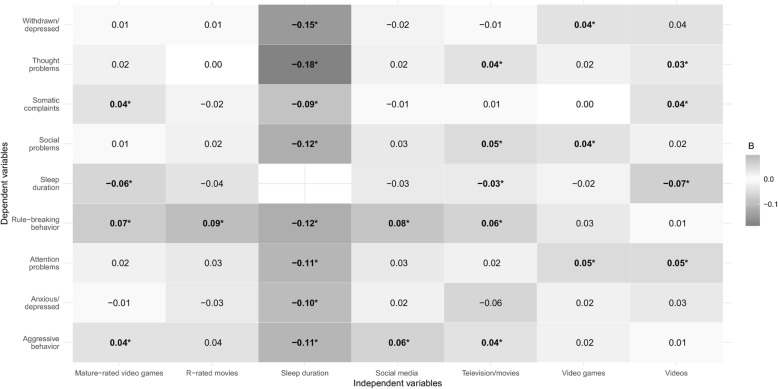
Background: Previous research examining the relationship between screen time (ST) and psychological health outcomes have primarily focused on one type of ST (i.e., television), while little research has considered other types of screens (e.g., videos, movies, social media), screen content (e.g., violent video games), or potential mediating variables. Therefore, the purpose of the present study was to assess ST types and content and their association with problem behaviors, and to determine whether these relationships were mediated by sleep duration. Methods: Parents and children provided cross-sectional baseline data (2016–18) as part of the Adolescent Brain Cognitive Development study, a broadly US representative sample of 11,875 children aged 9 to 10 years. Parents self-reported their children’s emotional and behavioral syndromes via the Child Behavior Checklist and sleep duration using one item from the Parent Sleep Disturbance Scale. Children self-reported their ST behavior, which comprised ST types (television/movies, videos, video games, and social media) and content (mature-rated video games and R-rated movies). Results: Time spent in various ST types was positively associated with problem behaviors: watching television/movies was associated with a 5.9% increase in rule-breaking behavior (incidence rate ratio [IRR] = 1.059), 5% increase in social problems (IRR = 1.050), 4% increase in aggressive behavior (IRR = 1.040), and 3.7% increase in thought problems (IRR = 1.037). Greater time spent playing mature-rated video games was associated with greater somatic complaints (IRR = 1.041), aggressive behavior (IRR = 1.039), and reduced sleep duration (IRR = .938). Sleep duration mediated the relationship between ST (type and content) and problem behaviors, albeit the effect sizes were small. The largest effects were observed between sleep duration and all problem behaviors, with greater sleep duration predicting an 8.8–16.6% decrease in problem behaviors (IRRs ranging from .834 to .905). Conclusion: Greater time spent in ST behavior was associated with greater problem behaviors among children. There was strong evidence that longer sleep duration was associated with reduced problem behaviors. While sleep duration mediated the effects of ST on problem behaviors, other potential mediating variables need to be investigated in future research.
Overview
The claims and statistics of this paper haven’t been checked yet.
Free: it reads the open-access text and checks the first 5 claims that cite a source we can check. Create a free account to check every claim.
Integrity signals
Registry
Cites
Statistics
Figures
Verification
Claims the paper makes
The claims and statistics of this paper haven’t been checked yet.
Free: it reads the open-access text and checks the first 5 claims that cite a source we can check. Create a free account to check every claim.
Claims other papers make about this one
Each is checked against this paper’s own text: does it say what the citing paper says it does?
The source backs part of the claim, not all of it — or backs it for a different population, condition or comparison.
In the citing paper
“Studies have also shown that higher levels of screen time were associated with reduced sleep duration and more sleep disturbances, which were in turn associated with internalizing, externalizing, and peer problems [62, 121].”
From Screen time and mental health: a prospective analysis of the Adolescent Brain Cognitive Development (ABCD) Study (2024) · cites this paper as [62]
Experimental — accuracy not yet measuredThe cited source says what the claim attributes to it.
In the citing paper
“Sleeping problems, especially sleep duration, have been then associated with time spent on screen, problematic behaviors, and higher internalizing and externalizing symptoms [64].”
From The Use of Social Media in Children and Adolescents: Scoping Review on the Potential Risks. (2022) · cites this paper as [64]
The cited source says what the claim attributes to it.
In the citing paper
“Out of the reports, seven explored the influence of social media and behavioral problems [22,49,64,75,76,77,78].”
From The Use of Social Media in Children and Adolescents: Scoping Review on the Potential Risks. (2022) · cites this paper as [64]
The cited source says what the claim attributes to it.
In the citing paper
“Another study confirmed that longer the time spent on screens, higher the risk for behavioral problems among children 9–10 years old, and depending on the content type visualization, the risk for an aggressive and rule-breaking behavior.”
From The Use of Social Media in Children and Adolescents: Scoping Review on the Potential Risks. (2022) · cites this paper as [64]
The cited source says what the claim attributes to it.
In the citing paper
“This association was mediated by sleep duration: longer sleep duration was associated with fewer problem behaviors [64].”
From The Use of Social Media in Children and Adolescents: Scoping Review on the Potential Risks. (2022) · cites this paper as [64]
3 more claims about this paper
Create a free account to see every claim other papers make about this one.
Self-check
Percentages, sums and reported differences re-computed from the paper’s own numbers.
The self-check needs the paper’s full text.
Citations
Cites
The benefits of playing video games.
Granic, I., Lobel, A., & Engels, R. C. M. E. (2014) · American Psychologist · doi:10.1037/a0034857 · Cited by 2,456
Systematic review of sedentary behaviour and health indicators in school-aged children and youth.
Tremblay, M. S., LeBlanc, A. G., Kho, M. E., Saunders, T. J., Larouche, R., Colley, R. C., Goldfield, G., & Gorber, S. (2011) · International Journal of Behavioral Nutrition and Physical Activity · doi:10.1186/1479-5868-8-98 · Cited by 2,085 · cited 1×
“Increased screen time (ST) has been linked with unfavorable body composition, higher cardiometabolic risk, unfavorable behavioral conduct, lower fitness, and lower self-esteem in children [2, 3].”
BackgroundSelf-citationAnderson, C. A., Shibuya, A., Ihori, N., Swing, E. L., Bushman, B. J., Sakamoto, A., Rothstein, H. R., & Saleem, M. (2010) · Psychological Bulletin · doi:10.1037/a0018251 · Cited by 2,048
Tremblay, M. S., Carson, V., Chaput, J.-P., Connor Gorber, S., Dinh, T., Duggan, M., Faulkner, G., Gray, C. E., Gruber, R., Janson, K., et al. (2016) · Applied Physiology, Nutrition, and Metabolism · doi:10.1139/apnm-2016-0151 · Cited by 2,024 · cited 2×
“, the Canadian Society for Exercise Physiology) [4] have issued guidelines on recreational ST that recommend no more than 2 h per day for children and youth (5–17 years), no more than 1 h for preschoolers (3–4 years) and older toddlers (2–3 years), and avoiding all screens for young toddlers and infants (< 2 years).”
BackgroundSelf-citationTwenge, J. M., Joiner, T. E., Rogers, M. L., & Martin, G. N. (2018) · Clinical Psychological Science · doi:10.1177/2167702617723376 · Cited by 1,705
Screen time and sleep among school-aged children and adolescents: a systematic literature review
Hale, L., & Guan, S. (2015) · Sleep Medicine Reviews · doi:10.1016/j.smrv.2014.07.007 · Cited by 1,468 · cited 1×
“, brush teeth, read a story, lights out) [34].”
BackgroundRecruiting the ABCD sample: Design considerations and procedures
Garavan, H., Bartsch, H., Conway, K., Decastro, A., Goldstein, R. Z., Heeringa, S., Jernigan, T., Potter, A., Thompson, W., & Zahs, D. (2018) · Developmental Cognitive Neuroscience · doi:10.1016/j.dcn.2018.04.004 · Cited by 1,393
BRUNI, O., OTTAVIANO, S., GUIDETTI, V., ROMOLI, M., INNOCENZI, M., CORTESI, F., & GIANNOTTI, F. (1996) · Journal of Sleep Research · doi:10.1111/j.1365-2869.1996.00251.x · Cited by 1,380
Carson, V., Hunter, S., Kuzik, N., Gray, C. E., Poitras, V. J., Chaput, J.-P., Saunders, T. J., Katzmarzyk, P. T., Okely, A. D., Connor Gorber, S., et al. (2016) · Applied Physiology, Nutrition, and Metabolism · doi:10.1139/apnm-2015-0630 · Cited by 1,380
Self-citationStiglic, N., & Viner, R. M. (2019) · BMJ Open · doi:10.1136/bmjopen-2018-023191 · Cited by 1,259 · cited 4×
“Consistent with findings from Stiglic and Viner’s [5] systematic review on ST and health outcomes among children and adolescents, our results revealed that television/movie viewing was not associated with attention problems.”
BackgroundResultInfluential
Research works printed but not linked: 1
- Muthén L Muthén B Mplus user’s guide 2017 8 Los Angeles Muthén & Muthén
Cited by
Items 101–200 of 239
Abdeta, C., Cliff, D. P., Kariippanon, K. E., Deksisa, A., Garoma, S., Diro, D. T., Chong, K. H., Antczak, D., & Okely, A. D. (2024) · Journal of Activity Sedentary and Sleep Behaviors · doi:10.1186/s44167-024-00060-w · Cited by 10
Turan, O., Garner, J., Isaiah, A., Palatino, M. C., Ernst, T., Wang, Z., & Chang, L. (2025) · SLEEP · doi:10.1093/sleep/zsaf088 · Cited by 12
Influence of Socio-Demographic, Occupational and Lifestyle Variables on Sleep Time
Dutheil, F., Saint-Arroman, C., Clinchamps, M., Flaudias, V., Fantini, M. L., Pereira, B., Berthon, M., Laporte, C., Baker, J. S., Charkhabi, M., et al. (2025) · Nature and Science of Sleep · doi:10.2147/nss.s495455 · Cited by 6
Rehman, E., Kenzhebayeva, F., Jahangir, M., Sharif, K., Ahmed, J., & Khan, A. (2025) · Scientific Reports · doi:10.1038/s41598-025-90673-1 · Cited by 8
From stress to screen: family factors on the path to problematic media use in children aged 4–11
Yayla, İ. E., Makas, S., Yıldırım, S., Dombak, K., & Çelik, E. (2025) · Frontiers in Psychology · doi:10.3389/fpsyg.2025.1699094 · Cited by 10
Tomezzoli, E., D’Ecclesiis, O., Raimondi, S., Pravettoni, G., Cammarata, G., Testa, G., Bellerba, F., Gnagnarella, P., Iannuzzo, M. L., Sartório, A., et al. (2023) · Frontiers in Public Health · doi:10.3389/fpubh.2023.1237443 · Cited by 6
Prevalence of Sleep Disorders in Primary School Children and its Relationship with Obesity
Durmuş, H., Solak, Y., Kaya, E., & Canbolat, H. (2021) · Güncel Pediatri · doi:10.4274/jcp.2021.38980 · Cited by 8
Foo, N., Ismail, N. B., & Arshat, Z. (2022) · Journal of Educational and Developmental Psychology · doi:10.5539/jedp.v12n2p94 · Cited by 9
Léger, D., Ehlinger, V., Spilka, S., Nézet, O. L., Fauroux, B., Pitron, V., & Godeau, E. (2025) · PLoS ONE · doi:10.1371/journal.pone.0314815 · Cited by 4
Screen Time and Behaviour in Preschool-Aged Children: Relationships With Caregiver Perceptions
Axelsson, E. L., Metse, A. P., Nanthakumar, S., Paech, G. M., Quinn, A. A., Purcell, K., Asis, A., & Robbins, I. (2025) · Australasian Journal of Early Childhood · doi:10.1177/18369391251376711 · Cited by 9
Iglesias‐Vázquez, L., Garcidueñas-Fimbres, T. E., Martínez, C. G., Castro-Collado, C., Leis, R., de la Puente, M. F., Moreno, L. A., Navas‐Carretero, S., Corella, D., Echeverría, A. M., et al. (2025) · World Journal of Pediatrics · doi:10.1007/s12519-025-00963-x · Cited by 12
Exposure and use of digital media among under-five children
Babusabgari, S., & Balakrishna, B. B. (2021) · International Journal of Contemporary Pediatrics · doi:10.18203/2349-3291.ijcp20213315 · Cited by 8
Bueno, M. R. D. O., Werneck, A. O., Zambrin, L. F., da Silva, K. S., Serassuelo, H., Romanzini, M., & Ronque, Ê. R. V. (2021) · Mental health and physical activity · doi:10.1016/j.mhpa.2021.100430 · Cited by 6
Filho, P. C. B. D. S., Oliveira, S. M., & Silva, M. D. A. (2022) · Saúde com · doi:10.22481/rsc.v18i2.9774 · Cited by 8
Rojo‐Wissar, D. M., Acosta, J., DiMarzio, K., Hare, M. M., Dale, C. F., Sanders, W., & Parent, J. M. (2023) · Child and Adolescent Mental Health · doi:10.1111/camh.12665 · Cited by 6
Meghji, K. A., Talpur, M., Khan, A., Fatima, H., Memon, U., & Monisha (2025) · Pakistan Journal of Health Sciences · doi:10.54393/pjhs.v6i3.2745 · Cited by 11
Longitudinal changes in screen time, sleep, and sports/exercise activity in early adolescence
Nagata, J. M., Helmer, C. K., Memon, Z., Ramappa, S., Wong, J. H., Diep, T., Al-Shoaibi, A. A. A., Ganson, K. T., Testa, A. M., Baker, F. C., et al. (2025) · BMC Pediatrics · doi:10.1186/s12887-025-06368-z · Cited by 8
Parker, M. A., Harton, M. R., Mattey-Mora, P. P., & Streck, J. M. (2025) · BMC Public Health · doi:10.1186/s12889-025-25956-3 · Cited by 4
Nagata, J. M., Wong, J. H., Kim, K. E., Nayak, S., Li, E. J., Richardson, R. A., Rauschecker, A. M., Sugrue, L. P., Ganson, K. T., Piatkowski, T. M., et al. (2026) · The Lancet Regional Health - Americas · doi:10.1016/j.lana.2026.101454 · Cited by 7
Goyal, R. (2022) · Counselling & Psychotherapy Review Singapore · doi:10.1142/s2810968623500018 · Cited by 3
Takahashi, I., Obara, T., Ishikuro, M., Orui, M., Noda, A., Shinoda, G., Nagami, F., Hozawa, A., Nishimura, T., Tsuchiya, K. J., et al. (2024) · Journal of Public Health · doi:10.1093/pubmed/fdae240 · Cited by 4
The Effect of Leisure Time Sport on Executive Functions in Danish 1st Grade Children
Siersbaek, G. M., Have, M., & Wedderkopp, N. (2022) · Children · doi:10.3390/children9101458 · Cited by 5
A associação entre o uso de telas e o desenvolvimento infantil: uma revisão de literatura
Carvalho, L. R., & Pinto, P. M. (2023) · Research Society and Development · doi:10.33448/rsd-v12i4.40885 · Cited by 15
Sârbu, E. A., Iovu, M.-B., Lazăr, F., & Ghețău, C. (2024) · BRAIN BROAD RESEARCH IN ARTIFICIAL INTELLIGENCE AND NEUROSCIENCE · doi:10.18662/brain/15.1/536 · Cited by 3
Pisolkar, V., Dena, I., Green, K. L., Palmer-Clarke, Y., Hinz, T., & Muhajarine, N. (2024) · International Journal of Qualitative Studies on Health and Well-Being · doi:10.1080/17482631.2024.2361494 · Cited by 5
Harriman, N. W., Chen, J. T., Lee, S., & Slopen, N. B. (2024) · Journal of Adolescent Health · doi:10.1016/j.jadohealth.2024.05.008 · Cited by 4
Goodman, P. B., Palka, J. M., Nguyen, A., Carroll, B., & Holland, A. A. (2024) · Journal of Pediatric Neuropsychology · doi:10.1007/s40817-024-00162-y · Cited by 2
Bekar, P., & Efe, E. (2025) · Archives of Psychiatric Nursing · doi:10.1016/j.apnu.2025.151854 · Cited by 7
Screen Time and Sleep Bruxism—A Comparison Between the Present Time and the COVID-19 Pandemic
Mitova, N. G., & Dimitrova, M. (2025) · Children · doi:10.3390/children12101396 · Cited by 4
Hu, S., Zhang, Z., Feng, X., & Shi, P. (2025) · BMC Pediatrics · doi:10.1186/s12887-025-05930-z · Cited by 3
Marin-Dragu, S., Orr, M., Corkum, P. V., Rusak, B., Bagnell, A. L., & Meier, S. M. (2025) · Cyberpsychology Journal of Psychosocial Research on Cyberspace · doi:10.5817/cp2025-5-3 · Cited by 2
Prospective associations between media parenting practices and adolescent video game use
Nagata, J. M., Sportsman, D., Wong, J. H., Nayak, S., Li, E. J., Ganson, K. T., Piatkowski, T. M., He, J., Testa, A. M., & Baker, F. C. (2026) · World Journal of Pediatrics · doi:10.1007/s12519-025-01009-y · Cited by 4
Gnazzo, M., Bargiacchi, G., Vetri, L., Parisi, L., Testa, D., Smirni, D., Maltese, A., Baldini, V., Pisanò, G., Germanò, E., et al. (2026) · Pediatric Reports · doi:10.3390/pediatric18010017 · Cited by 2
ASSOCIATION BETWEEN GAMING HABITS AND DIGITAL WELLNESS AMONG YOUTH IN KOCHIA
Manaly, S. T., & Ravindran, L. (2026) · ShodhVichar Journal of Media and Mass Communication · doi:10.29121/shodhvichar.v2.i1.2026.96 · Cited by 3
Parents perception on pattern and effects of usage of electronic devices among school going children
Kuriakose, R., Prasad Nayak, N., & Saldanha, P. R. M. (2020) · International Journal of Contemporary Pediatrics · doi:10.18203/2349-3291.ijcp20200212 · Cited by 3
Park, B., & Yoo, S. (2023) · Korean Journal of Child Studies · doi:10.5723/kjcs.2023.44.3.309 · Cited by 2
Negrea, M. O., Negrea, G. O., Săndulescu, G., Neamtu, B. M., Costea, R. M., Teodoru, M., Cipăian, C. R., Solomon, A., Popa, M. L., & Domnariu, C. D. (2023) · Children · doi:10.3390/children10111746 · Cited by 2
Bharati, D. R., Choudhary, S., Prasad, N., & Kumar, S. (2024) · Journal of Primary Care Specialties · doi:10.4103/jopcs.jopcs_44_23 · Cited by 2
Hale, L. E., Hartstein, L. E., & Ceranoglu, T. A. (2024) · Pediatric Clinics of North America · doi:10.1016/j.pcl.2024.07.032 · Cited by 2
Prevalence of excessive screen time in hospitalized pediatric patients
Affeldt, G. H., Medeiros, G. K., Vieira, V., & Ziegler, B. (2025) · Jornal de Pediatria · doi:10.1016/j.jped.2025.02.005 · Cited by 3
Wang, R., Chen, J., Tao, L., Qiang, Y., Yang, Q., & Li, B. (2022) · Frontiers in Pediatrics · doi:10.3389/fped.2022.863241 · Cited by 2
Blinder, H., Narang, I., Chaput, J., Katz, S. L., & on behalf of the Canadian Sleep and Circadian Network (2022) · Journal of Clinical Sleep Medicine · doi:10.5664/jcsm.10376 · Cited by 3
Self-citationExamining the Association of Second Grade Children's Sleep and Screen Time Recommendations
Hunt, E. T., Ranjit, N., Brazendale, K., Burkart, S. A., Brown, D. E., & Hoelscher, D. M. (2022) · Journal of Applied Research on Children Informing Policy for Children at Risk · doi:10.58464/2155-5834.1489 · Cited by 2
Akçay, N., Güney, H. D., Keskin, K., & Göbel, P. (2023) · Gaziantep Üniversitesi Spor Bilimleri Dergisi · doi:10.31680/gaunjss.1346863 · Cited by 3
Children’s Screen Time At Home: A Study of Parents’ Knowledge, Attitude and PracticePreprint
Arippin, N. F.-A., Mahmud, M. H., Rahman, H. A., Aliy-Yuin, K.-Y. A., Lai, S. C. L., & Mumin, K. H. A. (2021) · Research Square · doi:10.21203/rs.3.rs-574122/v1 · Cited by 2
Kirlić, N., Colaizzi, J. M., Cosgrove, K. T., Cohen, Z. P., Yeh, H., Breslin, F. J., Morris, A. S., Aupperle, R. L., & Paulus, M. P. (2020) · OSF Preprints (OSF Preprints) · doi:10.31219/osf.io/ebf3r · Cited by 2
IMPACT OF COVID 19 LOCKDOWN ON CHILD HEALTH AND BEHAVIOUR
Rajesh, K. D., Dawre, R. M., Kinikar, A. A., Valvi, C., & Rajput, U. C. (2021) · INTERNATIONAL JOURNAL OF SCIENTIFIC RESEARCH · doi:10.36106/ijsr/3903692 · Cited by 1
Uso de pantalla y duración de sueño en estudiantes universitarios
de Guadalajara, U., Espinoza-Gallardo, A. C., Vázquez, Y. V. M., de Guadalajara, U., Zepeda-Salvador, A. P., de Guadalajara, U., Moreno, A. G. M., de Guadalajara, U., Cisneros, L. C. V., & de Guadalajara, U. (2023) · Journal of Behavior and Feeding · doi:10.32870/jbf.v3i5.37 · Cited by 8
Screen Time and Health Impact among Preschool Children
Ashaari, S. R. A. H., Mayilvahanam, S., Ahmad, D., Saat, R., & Rameli, F. E. (2024) · International Journal of Academic Research in Business and Social Sciences · doi:10.6007/ijarbss/v14-i5/21550 · Cited by 1
Prevention of vision disorders at school age: view of secondary school teachers on the problem
Antypkin, Y. G., Абатуров, А. Е., Medvedovska, N. V., Denysiuk, L. I., Miroshnikov, О. О., & Bondarenko, N. Y. (2024) · CHILD`S HEALTH · doi:10.22141/2224-0551.19.4.2024.1702 · Cited by 1
The relationship between screen exposure and behavior problems in children: a network analysis
Yang, L., Xiangrui, J., Jiang, W., & LongYan, P. (2025) · Psychology Health & Medicine · doi:10.1080/13548506.2025.2519222 · Cited by 2
You, Y., Chen, Y., Shang, J., Tan, L., Yu, M., Wu, Y., Li, X., Guo, P., & Zhang, Q. (2025) · Nature and Science of Sleep · doi:10.2147/nss.s549178 · Cited by 3
Neighborhood Quality and Screen Use: Findings From the Adolescent Brain Cognitive Development Study
Nagata, J. M., Helmer, C. K., Memon, Z., Talebloo, J., Ganson, K. T., Testa, A. M., He, J., Magid, H. S. A., Gooding, H. C., & Baker, F. C. (2025) · Academic Pediatrics · doi:10.1016/j.acap.2025.103164 · Cited by 3
Screen time, sleep quality and mental health among adolescents of secondary schools in Dharan
Aryal, I., Gyawali, V., Pradhan, N., Lama, S., & Thapa, K. (2025) · PLOS mental health. · doi:10.1371/journal.pmen.0000405 · Cited by 3
Liu, Q., Peng, S., Yang, Y., Guo, Y., Jiang, G., & Guo, L. (2026) · Public Health · doi:10.1016/j.puhe.2026.106140 · Cited by 2
Baskin-sommers, A. R., Gearing, D., Ramduny, J., Zhang, Z., Townsend, N., Dupree, C., Fink, C., Horenkamp, L., Karcher, N. R., Patel, H., et al. (2026) · Developmental Cognitive Neuroscience · doi:10.1016/j.dcn.2026.101686 · Cited by 3
Prevalence and Correlates of Emotion Dysregulation in Children: Results from the ABCD Study
Koleilat, R., Sabalbal, A., Baroud, E., & Shamseddeen, W. A. (2026) · Journal of Child and Adolescent Psychopharmacology · doi:10.1177/10445463251415488 · Cited by 1
Uzun, A. D., Çakır, B., Bılaç, Ö., Sapmaz, Ş. Y., & Kandemır, H. (2023) · Scandinavian Journal of Child and Adolescent Psychiatry and Psychology · doi:10.2478/sjcapp-2023-0003 · Cited by 2
Prabhakar, M., Prasad, H. G., & Reddy, R. S. (2023) · Telangana Journal of Psychiatry · doi:10.4103/tjp.tjp_6_23 · Cited by 2
Lueangapapong, N., Chuthapisith, J., & Thampratankul, L. (2024) · Brain and Development · doi:10.1016/j.braindev.2024.08.003 · Cited by 1
Design and Evaluation of M-Kids Mobile Applications for Islamic Preschoolers in Malaysia
Idris, W. I. S. (2025) · Advances in information quality and management · doi:10.4018/979-8-3373-2086-1.ch009 · Cited by 2
Sotnikova–Meleshkina, Z. V., & Martynenko, O. V. (2020) · Reports of Vinnytsia National Medical University · doi:10.31393/reports-vnmedical-2020-24(4)-17 · Cited by 1
Modified Informatization Index of Children’s Life
Криволапчук, И. А., Chernova, M. B., Gerasimova, A. A., Chicherin, V. P., & Васильевич, М. В. (2020) · Lecture notes in networks and systems · doi:10.1007/978-3-030-59126-7_62 · Cited by 1
Baron-Polańczyk, E. (2021) · Kwartalnik Naukowy Fides et Ratio · doi:10.34766/fetr.v48i4.937 · Cited by 1
Reasons for the Use of ICT by Children and Teenagers in Daily Practice - Differentiating Factors
Baron-Polańczyk, E. (2021) · The New Educational Review · doi:10.15804/tner.21.65.3.08 · Cited by 1
Nagaoka, M., Kubo, H., Tashiro, K., Kinoshita, M., Inoue, H., Soejima, H., & Fujise, N. (2022) · Psychiatry and Clinical Neurosciences Reports · doi:10.1002/pcn5.29 · Cited by 1
Screen time and its association with adolescents' lifestyles in a city in the Brazilian Northeast
Braga, I. A. F., Maroneze, L. R., Oliveira, L. R., dos Santos, A. W., & de Andrade, A. M. (2022) · Research Society and Development · doi:10.33448/rsd-v11i15.37671 · Cited by 2
TƏHSİLALANLARIN SAĞLAMLIQ VƏZİYYƏTİNƏ VƏ HƏYAT TƏRZİNƏ KOMPÜTER TEXNOLOGİYALARININ TƏSİRİ
Balayeva, Ş. M., Gabulov, G. G., Сулейман-заде, Н. Г., Гасанова, С. А., & Исмаилова, З. Г. (2023) · Azerbajdžanskij medicinskij žurnal · doi:10.34921/amj.2023.2.018 · Cited by 1
Palmer, C., Sheth, C., Marshall, A., Adise, S., Baker, F., Chang, L., Clark, D., Dagher, R., Dowling, G., Gonzalez, M., et al. (2021) · bioRxiv · doi:10.1101/2021.06.30.450555 · Cited by 3
Kim, H., Ma, J., Lee, S., & Gu, Y. (2021) · Research Square · doi:10.21203/rs.3.rs-783015/v1 · Cited by 1
How Do People with Late Bedtimes use Social Media?Preprint
Wang, S., Xu, Y., Tian, X., Song, Y., Luo, Y., & Zhu, M. (2022) · Research Square · doi:10.21203/rs.3.rs-1133832/v1 · Cited by 4
Lo, C. K. M., Chan, E. W. W., Cho, Y. W., Chan, K. L., Ip, P., & Ho, F. K. W. (2024) · doi:10.2196/preprints.59529 · Cited by 1
Vaak voorkomende slaapproblemen bij jonge kinderen: Achtergrondinformatie voor preventieve kindzorg
N, D. R., & Deschoemaeker, M. (2020) · JGZ Tijdschrift voor jeugdgezondheidszorg · doi:10.1007/s12452-020-00229-0
González‐Andrade, F., Ocaña-Terán, C., & Aguinaga-Romero, G. (2018) · Revista de la Facultad de Ciencias Médicas (Quito) · doi:10.29166/rfcmq.v43i2.2821 · Cited by 1
The functional state of girls with high motor fitness in the conditions of digitalization
Криволапчук, И. А., Chernova, M. B., Gerasimova, A. A., & Chicherin, V. P. (2021) · SHS Web of Conferences · doi:10.1051/shsconf/202111702004
Relationship between parental and children's screen time at home
Liu, Y. (2021) · cIRcle (University of British Columbia) · doi:10.14288/1.0402555 · Cited by 2
Hastie, M. (2022) · F1000Research · doi:10.12688/f1000research.75661.1
Majumder, S., & Khatua, I. (2023) · International Journal of Science and Research (IJSR) · doi:10.21275/sr221219130335
Savaş, Z. Ö., & Büyük, E. T. (2023) · Journal of Turkish Sleep Medicine · doi:10.4274/jtsm.galenos.2022.82612
Smart Hafiz sebagai Media Pembelajaran Literasi Al-Qur’an di Lingkungan Keluarga
Syafaatunnisa, S., & Nurulhaq, D. (2023) · Jurnal Intelektual Jurnal Pendidikan dan Studi Keislaman · doi:10.33367/ji.v13i1.3592
OS MALEFÍCIOS DO EXCESSIVO TEMPO DE TELA DURANTE A COVID-19 EM CRIANÇAS: UMA REVISÃO INTEGRATIVA
Brumassio, L. F., Filho, R. S., Ribeiro, S. J. M., & Nunes, R. F. (2023) · REVISTA SAÚDE MULTIDISCIPLINAR · doi:10.53740/rsm.v15i2.677
Edukasi Screen Time pada Anak di Masyarakat Kota Tasikmalaya
Husna, H. N., Izfadllillah, T., Wardani, G. A., Pratama, A., Rahma, A. A., & Micola, M. Y. (2023) · Nuansa Akademik Jurnal Pembangunan Masyarakat · doi:10.47200/jnajpm.v8i2.1829 · Cited by 7
Why Parental Education may be the Key to Raising the Digital Natives?
Varma, A., & Sudarsanam, A. (2024) · Indian Pediatrics · doi:10.1007/s13312-024-3083-6 · Cited by 1
Correlates of small screens play in 6–10-year-old children in ChinaPreprint
Chen, L., liao, J., & Ye, S. (2024) · Research Square · doi:10.21203/rs.3.rs-3914275/v1
Exposição digital às telas e suas consequências para a criança
Diniz, Y. C. D. S., Rafael, E. C. D., de Andrade, J. P. P., Sousa, L. A., & de Sousa, M. N. A. (2023) · Revista Brasileira de Filosofia e História · doi:10.18378/rbfh.v12i3.9955 · Cited by 1
Association of Screen Time and Mental Disorders among Chinese AdolescentsPreprint
Xu, J., Duan, H., Qin, K., & Liu, B. (2024) · Research Square · doi:10.21203/rs.3.rs-4233571/v1
Features of quality of life formation in children with visual impairments
Denysiuk, L. I. (2024) · Pathologia · doi:10.14739/2310-1237.2024.1.300963
Strengthening Families Through Crisis Management: High-Risk Children and Familial Support
Gamez, A. M., & Harrell, A. (2024) · Advances in early childhood and K-12 education · doi:10.4018/979-8-3693-1451-7.ch014
ФАКТОРИ РИЗИКУ РОЗВИТКУ РОЗЛАДІВ ЗОРОВИХ ФУНКЦІЙ У ДИТЯЧОМУ ВІЦІ
Denisiuk, L., & Medvedovska, N. V. (2024) · Вісник соціальної гігієни та організації охорони здоров я України · doi:10.11603/1681-2786.2024.1.14628 · Cited by 7
The Mental Health Decline in Children during the Covid-19 Pandemic.Preprint
Weissman, J. D., Kramsky, J., Pinder, N., Jay, M. R., & Taylor, J. D. (2024) · Research Square · doi:10.21203/rs.3.rs-4542313/v1
Denysiuk, L. I. (2024) · Bulletin of Problems Biology and Medicine · doi:10.29254/2077-4214-2024-2-173-438-446
Llaguno, N. S., Guglielmi, V., Tsunemi, M. H., Pedrazzoli, M., Pinheiro, E. M., & Avelar, A. F. M. (2023) · Rev. Soc. Bras. Enferm. Ped · doi:10.31508/1676-379320230041i · Cited by 1
O sono de crianças em período escolar
Llaguno, N. S., Guglielmi, V., Tsunemi, M. H., Pedrazzoli, M., Pinheiro, E. M., & Avelar, A. F. M. (2023) · Rev. Soc. Bras. Enferm. Ped · doi:10.31508/1676-379320230041
Abdeta, C., Cliff, D. P., Kariippanon, K. E., Deksisa, A., Garoma, S., Diro, D. T., Chong, K. H., Antczak, D., & Okely, A. D. (2024) · Research Square · doi:10.21203/rs.3.rs-4598823/v1
Medvedovska, N. V., Denysiuk, L. I., & Bondarenko, N. Y. (2024) · CHILD`S HEALTH · doi:10.22141/2224-0551.19.5.2024.1722 · Cited by 2
Exploring the Link Between Early Technology Exposure and Developmental Milestones in Childhood
Atkins, J. B., Difulvio, S., Boneh, J., Myers, R., Tohic, C., Dickson, C., Peña, D., & Simanton, E. G. (2024) · Cureus · doi:10.7759/cureus.71791 · Cited by 1
The causal effect of screen uses versus reading on the brain development in early adolescents
Li, M., Zhao, R., Xu, X., Chen, R., Chen, R., Zhang, Y., Zhao, Z., Dang, X., & Wu, D. (2024) · Proceedings on CD-ROM - International Society for Magnetic Resonance in Medicine. Scientific Meeting and Exhibition/Proceedings of the International Society for Magnetic Resonance in Medicine, Scientific Meeting and Exhibition · doi:10.58530/2024/1161
Parental Mediation During Covid-19 Lockdown in Singapore
Jiow, H. J., Goh, L., Lian, I., Mascrinhas, E., & Tan, T. (2024) · Mobile communication in Asia · doi:10.1007/978-94-024-2282-5_6
Aguiar, A., Rajah, J. K., Conway-Moore, K., Savona, N., Knai, C., Vlad, I., Samdal, O., Rutter, H., Lien, N., & Kopainsky, B. (2025) · Social Science & Medicine · doi:10.1016/j.socscimed.2025.117706 · Cited by 3
Metadata
- Authors
- Guerrero, M. D., Barnes, J. D., Chaput, J.-P., & Tremblay, M. S.
- Affiliations
- Children's Hospital of Eastern Ontario (CA)
- University of Ottawa (CA)
- Corresponding author
- Guerrero, Michelle D.
- Venue
- International Journal of Behavioral Nutrition and Physical Activity
- Published
- 2019-11-14
- Volume
- 16
- Issue
- 1
- Pages
- 105-105
- ISSN
- 1479-5868 (ISSN-L)
- PMC
- PMC6854622
- OpenAlex
- W2983311422
- Cited by
- 240
- References
- 33
- Citations by year
- 2026: 27 · 2025: 50 · 2024: 52 · 2023: 41 · 2022: 26 · 2021: 32 · 2020: 11
- FWCI
- 46.48
- Type
- journal article
- Language
- en
- Open access
- gold
- doi.org
- Licence
- cc-by
- creativecommons.org/licenses/by/4.0/ (tdm)
- creativecommons.org/licenses/by/4.0/ (vor)
- Locations
- International Journal of Behavioral Nutrition and Physical Activity (publishedVersion, cc-by)
- PubMed Central (publishedVersion, cc-by)
- PubMed (publishedVersion)
- DOAJ (DOAJ: Directory of Open Access Journals) (submittedVersion, cc-by-sa)
- uO Research (University of Ottawa) (submittedVersion, public-domain)
- Funders
- Foundation for the National Institutes of Health (U01DA041022, U01DA041028, U01DA041048, U01DA041089, U01DA041106, U01DA041117, U01DA041120, U01DA041134, U01DA041148, U01DA041156, U01DA041174, U24DA041123, and U24DA041147)
- Topics
- Social Sciences › Education › Child Development and Digital Technology
- Social Sciences › Sociology and Political Science › Impact of Technology on Adolescents
- Social Sciences › Psychology › Clinical Psychology › Child and Adolescent Psychosocial and Emotional Development
- Keywords
- screen time, sleep duration, behavioral problems, children, mediation, television, video games, social media, aggression, rule violations, social problems, somatic symptoms, thought problems, sleep disorders, Adolescent Brain Cognitive Development Study
- MeSH terms
- Problem Behavior, Screen Time, Aggression, Child, Cross-Sectional Studies, Humans, Sleep, United States
About these checks
Registry, retraction, Cites and statistics results are computed, not judged, with one exception: a printed reference that no index lists is read once by a model before it counts as a citation error. Claims are extracted by a model and kept only when their quote appears verbatim in the text; each cited source is then checked, with a model’s help, for whether it says what the claim relies on. Those verdicts can be wrong — read the claim’s quote and the cited source before relying on one.
Statistics and arithmetic are recomputed, not judged.
Confidence bands are shown only for fields calibrated on our annotated test set. None is calibrated yet, so no band is shown.
What counts as a claim ›How we measure confidence ›How we check this ›
Are you an author, or do you see a problem with this page? Request a review
Data sources
Bibliographic data: Semantic Scholar, OpenAlex, Crossref.
Contains information from the Semantic Scholar Academic Graph Datasets, made available under the ODC Attribution License (ODC-BY 1.0).
Semantic Scholar’s data is described in: Kinney, R., et al. (2023). The Semantic Scholar Open Data Platform. arXiv:2301.10140.
