

Screen time and problem behaviors in children: exploring the mediating role of sleep duration
Open accessThe DOI matches its Crossref record; 33 of the 33 references it cites were found in a registry or an index.
Abstract
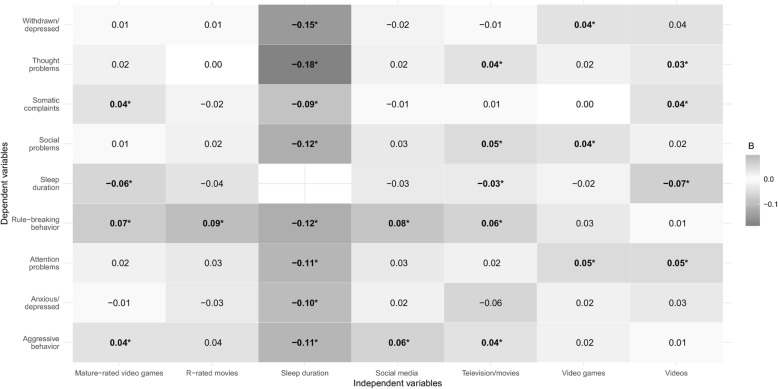
Background: Previous research examining the relationship between screen time (ST) and psychological health outcomes have primarily focused on one type of ST (i.e., television), while little research has considered other types of screens (e.g., videos, movies, social media), screen content (e.g., violent video games), or potential mediating variables. Therefore, the purpose of the present study was to assess ST types and content and their association with problem behaviors, and to determine whether these relationships were mediated by sleep duration. Methods: Parents and children provided cross-sectional baseline data (2016–18) as part of the Adolescent Brain Cognitive Development study, a broadly US representative sample of 11,875 children aged 9 to 10 years. Parents self-reported their children’s emotional and behavioral syndromes via the Child Behavior Checklist and sleep duration using one item from the Parent Sleep Disturbance Scale. Children self-reported their ST behavior, which comprised ST types (television/movies, videos, video games, and social media) and content (mature-rated video games and R-rated movies). Results: Time spent in various ST types was positively associated with problem behaviors: watching television/movies was associated with a 5.9% increase in rule-breaking behavior (incidence rate ratio [IRR] = 1.059), 5% increase in social problems (IRR = 1.050), 4% increase in aggressive behavior (IRR = 1.040), and 3.7% increase in thought problems (IRR = 1.037). Greater time spent playing mature-rated video games was associated with greater somatic complaints (IRR = 1.041), aggressive behavior (IRR = 1.039), and reduced sleep duration (IRR = .938). Sleep duration mediated the relationship between ST (type and content) and problem behaviors, albeit the effect sizes were small. The largest effects were observed between sleep duration and all problem behaviors, with greater sleep duration predicting an 8.8–16.6% decrease in problem behaviors (IRRs ranging from .834 to .905). Conclusion: Greater time spent in ST behavior was associated with greater problem behaviors among children. There was strong evidence that longer sleep duration was associated with reduced problem behaviors. While sleep duration mediated the effects of ST on problem behaviors, other potential mediating variables need to be investigated in future research.
Overview
The claims and statistics of this paper haven’t been checked yet.
Free: it reads the open-access text and checks the first 5 claims that cite a source we can check. Create a free account to check every claim.
Integrity signals
Registry
Cites
Statistics
Figures
Verification
Claims the paper makes
The claims and statistics of this paper haven’t been checked yet.
Free: it reads the open-access text and checks the first 5 claims that cite a source we can check. Create a free account to check every claim.
Claims other papers make about this one
Each is checked against this paper’s own text: does it say what the citing paper says it does?
The source backs part of the claim, not all of it — or backs it for a different population, condition or comparison.
In the citing paper
“Studies have also shown that higher levels of screen time were associated with reduced sleep duration and more sleep disturbances, which were in turn associated with internalizing, externalizing, and peer problems [62, 121].”
From Screen time and mental health: a prospective analysis of the Adolescent Brain Cognitive Development (ABCD) Study (2024) · cites this paper as [62]
Experimental — accuracy not yet measuredThe cited source says what the claim attributes to it.
In the citing paper
“Sleeping problems, especially sleep duration, have been then associated with time spent on screen, problematic behaviors, and higher internalizing and externalizing symptoms [64].”
From The Use of Social Media in Children and Adolescents: Scoping Review on the Potential Risks. (2022) · cites this paper as [64]
The cited source says what the claim attributes to it.
In the citing paper
“Out of the reports, seven explored the influence of social media and behavioral problems [22,49,64,75,76,77,78].”
From The Use of Social Media in Children and Adolescents: Scoping Review on the Potential Risks. (2022) · cites this paper as [64]
The cited source says what the claim attributes to it.
In the citing paper
“Another study confirmed that longer the time spent on screens, higher the risk for behavioral problems among children 9–10 years old, and depending on the content type visualization, the risk for an aggressive and rule-breaking behavior.”
From The Use of Social Media in Children and Adolescents: Scoping Review on the Potential Risks. (2022) · cites this paper as [64]
The cited source says what the claim attributes to it.
In the citing paper
“This association was mediated by sleep duration: longer sleep duration was associated with fewer problem behaviors [64].”
From The Use of Social Media in Children and Adolescents: Scoping Review on the Potential Risks. (2022) · cites this paper as [64]
3 more claims about this paper
Create a free account to see every claim other papers make about this one.
Self-check
Percentages, sums and reported differences re-computed from the paper’s own numbers.
The self-check needs the paper’s full text.
Citations
Cites
The benefits of playing video games.
Granic, I., Lobel, A., & Engels, R. C. M. E. (2014) · American Psychologist · doi:10.1037/a0034857 · Cited by 2,456
Systematic review of sedentary behaviour and health indicators in school-aged children and youth.
Tremblay, M. S., LeBlanc, A. G., Kho, M. E., Saunders, T. J., Larouche, R., Colley, R. C., Goldfield, G., & Gorber, S. (2011) · International Journal of Behavioral Nutrition and Physical Activity · doi:10.1186/1479-5868-8-98 · Cited by 2,085 · cited 1×
“Increased screen time (ST) has been linked with unfavorable body composition, higher cardiometabolic risk, unfavorable behavioral conduct, lower fitness, and lower self-esteem in children [2, 3].”
BackgroundSelf-citationAnderson, C. A., Shibuya, A., Ihori, N., Swing, E. L., Bushman, B. J., Sakamoto, A., Rothstein, H. R., & Saleem, M. (2010) · Psychological Bulletin · doi:10.1037/a0018251 · Cited by 2,048
Tremblay, M. S., Carson, V., Chaput, J.-P., Connor Gorber, S., Dinh, T., Duggan, M., Faulkner, G., Gray, C. E., Gruber, R., Janson, K., et al. (2016) · Applied Physiology, Nutrition, and Metabolism · doi:10.1139/apnm-2016-0151 · Cited by 2,024 · cited 2×
“, the Canadian Society for Exercise Physiology) [4] have issued guidelines on recreational ST that recommend no more than 2 h per day for children and youth (5–17 years), no more than 1 h for preschoolers (3–4 years) and older toddlers (2–3 years), and avoiding all screens for young toddlers and infants (< 2 years).”
BackgroundSelf-citationTwenge, J. M., Joiner, T. E., Rogers, M. L., & Martin, G. N. (2018) · Clinical Psychological Science · doi:10.1177/2167702617723376 · Cited by 1,705
Screen time and sleep among school-aged children and adolescents: a systematic literature review
Hale, L., & Guan, S. (2015) · Sleep Medicine Reviews · doi:10.1016/j.smrv.2014.07.007 · Cited by 1,468 · cited 1×
“, brush teeth, read a story, lights out) [34].”
BackgroundRecruiting the ABCD sample: Design considerations and procedures
Garavan, H., Bartsch, H., Conway, K., Decastro, A., Goldstein, R. Z., Heeringa, S., Jernigan, T., Potter, A., Thompson, W., & Zahs, D. (2018) · Developmental Cognitive Neuroscience · doi:10.1016/j.dcn.2018.04.004 · Cited by 1,393
BRUNI, O., OTTAVIANO, S., GUIDETTI, V., ROMOLI, M., INNOCENZI, M., CORTESI, F., & GIANNOTTI, F. (1996) · Journal of Sleep Research · doi:10.1111/j.1365-2869.1996.00251.x · Cited by 1,380
Carson, V., Hunter, S., Kuzik, N., Gray, C. E., Poitras, V. J., Chaput, J.-P., Saunders, T. J., Katzmarzyk, P. T., Okely, A. D., Connor Gorber, S., et al. (2016) · Applied Physiology, Nutrition, and Metabolism · doi:10.1139/apnm-2015-0630 · Cited by 1,380
Self-citationStiglic, N., & Viner, R. M. (2019) · BMJ Open · doi:10.1136/bmjopen-2018-023191 · Cited by 1,259 · cited 4×
“Consistent with findings from Stiglic and Viner’s [5] systematic review on ST and health outcomes among children and adolescents, our results revealed that television/movie viewing was not associated with attention problems.”
BackgroundResultInfluentialBarch, D. M., Albaugh, M. D., Avenevoli, S., Chang, L., Clark, D. B., Glantz, M. D., Hudziak, J. J., Jernigan, T. L., Tapert, S. F., Yurgelun-Todd, D., et al. (2018) · Developmental Cognitive Neuroscience · doi:10.1016/j.dcn.2017.10.010 · Cited by 814 · cited 2×
“Outcomes The Child Behavior Checklist (CBCL) is a parent-report measure used to assess a broad range of emotional and behavioral syndromes among children aged 6 to 18 years [11, 15].”
BackgroundAstill, R. G., Van der Heijden, K. B., Van IJzendoorn, M. H., & Van Someren, E. J. W. (2012) · Psychological Bulletin · doi:10.1037/a0028204 · Cited by 707
Luciana, M., Bjork, J. M., Nagel, B. J., Barch, D. M., Gonzalez, R., Nixon, S. J., & Banich, M. T. (2018) · Developmental Cognitive Neuroscience · doi:10.1016/j.dcn.2018.02.006 · Cited by 530
Time spent on social network sites and psychological well-being: a meta-analysis
Huang, C. (2017) · Cyberpsychology, Behavior, and Social Networking · doi:10.1089/cyber.2016.0758 · Cited by 457
Testing the 8-Syndrome Structure of the Child Behavior Checklist in 30 Societies
Ivanova, M. Y., Achenbach, T. M., Dumenci, L., Rescorla, L. A., Almqvist, F., Weintraub, S., Bilenberg, N., Bird, H., Chen, W. J., Dobrean, A., et al. (2007) · Journal of Clinical Child & Adolescent Psychology · doi:10.1080/15374410701444363 · Cited by 416
Digital Media and Sleep in Childhood and Adolescence
LeBourgeois, M. K., Hale, L., Chang, A.-M., Akacem, L. D., Montgomery-Downs, H. E., & Buxton, O. M. (2017) · Pediatrics · doi:10.1542/peds.2016-1758j · Cited by 383
Suchert, V., Hanewinkel, R., & Isensee, B. (2015) · Preventive Medicine · doi:10.1016/j.ypmed.2015.03.026 · Cited by 329 · cited 1×
“Additionally, several researchers have called for more studies examining potential mediators for the relationship between ST and psychological health outcomes [5, 6].”
BackgroundConsequences of Sleep Loss or Sleep Disruption in Children
Sadeh, A. (2007) · Sleep Medicine Clinics · doi:10.1016/j.jsmc.2007.05.012 · Cited by 218
Screen time, physical activity and mental health among urban adolescents in China
Cao, H., Qian, Q., Weng, T., Yuan, C., Sun, Y., Wang, H., & Tao, F. (2011) · Preventive Medicine · doi:10.1016/j.ypmed.2011.09.002 · Cited by 211
Zhao, J., Zhang, Y., Jiang, F., Ip, P., Ho, F. K. W., Zhang, Y., & Huang, H. (2018) · The Journal of Pediatrics · doi:10.1016/j.jpeds.2018.06.029 · Cited by 176
Effect of Visual Media Use on School Performance: A Prospective Study
Sharif, I., Wills, T. A., & Sargent, J. D. (2010) · Journal of Adolescent Health · doi:10.1016/j.jadohealth.2009.05.012 · Cited by 152
Nuutinen, T., Roos, E., Ray, C., Villberg, J. J., Välimaa, R. S., Rasmussen, M., Holstein, B. E., Godeau, E., Beck, F., Léger, D., et al. (2014) · International Journal of Public Health · doi:10.1007/s00038-014-0561-y · Cited by 144
Sleep Duration and Regularity are Associated with Behavioral Problems in 8-year-old Children
Pesonen, A.-K., Räikkönen, K., Paavonen, E. J., Heinonen, K., Komsi, N., Lahti, J., Kajantie, E., Järvenpää, A.-L., & Strandberg, T. (2010) · International Journal of Behavioral Medicine · doi:10.1007/s12529-009-9065-1 · Cited by 110
Media use and health outcomes in adolescents: findings from a nationally representative survey.
Casiano, H., Kinley, J., Katz, L. Y., Chartier, M., & Sareen, J. (2012) · Europe PMC (PubMed Central) · Cited by 95
A longitudinal study of risk-glorifying video games and behavioral deviance.
Hull, J. G., Brunelle, T. J., Prescott, A. T., & Sargent, J. D. (2014) · Journal of Personality and Social Psychology · doi:10.1037/a0036058 · Cited by 93
Physical Activity, Sedentary Behavior, and Depressive Symptoms Among Adolescents
Hume, C., Timperio, A., Veitch, J., Salmon, J., Crawford, D., & Ball, K. (2011) · Journal of Physical Activity and Health · doi:10.1123/jpah.8.2.152 · Cited by 90
Vandendriessche, A., Ghekiere, A., Van Cauwenberg, J., De Clercq, B., Dhondt, K., DeSmet, A., Tynjälä, J., Verloigne, M., & Deforche, B. (2019) · International Journal of Environmental Research and Public Health · doi:10.3390/ijerph16061072 · Cited by 69
Owens, J. A., Mehlenbeck, R., Lee, J., & King, M. M. (2008) · Archives of Pediatrics & Adolescent Medicine · doi:10.1001/archpedi.162.4.313 · Cited by 65
A longitudinal study of risk-glorifying video games and reckless driving.
Hull, J. G., Draghici, A. M., & Sargent, J. D. (2012) · Psychology of Popular Media Culture · doi:10.1037/a0029510 · Cited by 55
Ferrari, G., Pires, C. A. M., Solé, D., Matsudo, V. K. R., Katzmarzyk, P. T., & Fisberg, M. (2018) · Jornal de Pediatria · doi:10.1016/j.jped.2017.12.003 · Cited by 45
Marino, C., Vieno, A., Lenzi, M., Borraccino, A., Lazzeri, G., & Lemma, P. (2016) · International Journal of School Health · doi:10.17795/intjsh-32921 · Cited by 28
Ferrari, G., Pires, C. A. M., Solé, D., Matsudo, V. K. R., Katzmarzyk, P. T., & Fisberg, M. (2019) · Jornal de Pediatria (Versão em Português) · doi:10.1016/j.jpedp.2017.12.014 · Cited by 16
Advocating for a cautious, conservative approach to screen time guidelines in young children
Okely, A. D., Tremblay, M. S., Reilly, J. J., Draper, C. E., & Robinson, T. N. (2019) · The Journal of Pediatrics · doi:10.1016/j.jpeds.2018.11.060 · Cited by 8
Self-citation
Research works printed but not linked: 1
- Muthén L Muthén B Mplus user’s guide 2017 8 Los Angeles Muthén & Muthén
Cited by
The Use of Social Media in Children and Adolescents: Scoping Review on the Potential Risks.
Bozzola, E., Spina, G., Agostiniani, R., Barni, S., Russo, R., Scarpato, E., Di Mauro, A., Di Stefano, A. V., Caruso, C., Corsello, G., et al. (2022) · International Journal of Environmental Research and Public Health · doi:10.3390/ijerph19169960 · Cited by 552
“[64] Clinical Study Time spent on screen has been associated to sleeping problems, especially sleep duration, and with problematic behaviors, higher internalizing, and externalizing symptoms.”
BackgroundInfluentialMajumdar, P., Biswas, A., & Sahu, S. (2020) · Chronobiology International · doi:10.1080/07420528.2020.1786107 · Cited by 477
Eirich, R., McArthur, B. A., Anhorn, C., McGuinness, C., Christakis, D. A., & Madigan, S. (2022) · JAMA Psychiatry · doi:10.1001/jamapsychiatry.2022.0155 · Cited by 293
Paulich, K. N., Ross, J. M., Lessem, J. M., & Hewitt, J. K. (2021) · PLOS ONE · doi:10.1371/journal.pone.0256591 · Cited by 174
“Another study used the ABCD Study sample in examining the mediating role of sleep in screen time and problem behaviors in children, and found that sleep duration mediates the association between screen time and problem behaviors [19].”
MethodScreen time among school-aged children of aged 6–14: a systematic review
Qi, J., Yan, Y., & Yin, H. (2023) · Global Health Research and Policy · doi:10.1186/s41256-023-00297-z · Cited by 273
Metadata
- Authors
- Guerrero, M. D., Barnes, J. D., Chaput, J.-P., & Tremblay, M. S.
- Affiliations
- Children's Hospital of Eastern Ontario (CA)
- University of Ottawa (CA)
- Corresponding author
- Guerrero, Michelle D.
- Venue
- International Journal of Behavioral Nutrition and Physical Activity
- Published
- 2019-11-14
- Volume
- 16
- Issue
- 1
- Pages
- 105-105
- ISSN
- 1479-5868 (ISSN-L)
- PMC
- PMC6854622
- OpenAlex
- W2983311422
- Cited by
- 240
- References
- 33
- Citations by year
- 2026: 27 · 2025: 50 · 2024: 52 · 2023: 41 · 2022: 26 · 2021: 32 · 2020: 11
- FWCI
- 46.48
- Type
- journal article
- Language
- en
- Open access
- gold
- doi.org
- Licence
- cc-by
- creativecommons.org/licenses/by/4.0/ (tdm)
- creativecommons.org/licenses/by/4.0/ (vor)
- Locations
- International Journal of Behavioral Nutrition and Physical Activity (publishedVersion, cc-by)
- PubMed Central (publishedVersion, cc-by)
- PubMed (publishedVersion)
- DOAJ (DOAJ: Directory of Open Access Journals) (submittedVersion, cc-by-sa)
- uO Research (University of Ottawa) (submittedVersion, public-domain)
- Funders
- Foundation for the National Institutes of Health (U01DA041022, U01DA041028, U01DA041048, U01DA041089, U01DA041106, U01DA041117, U01DA041120, U01DA041134, U01DA041148, U01DA041156, U01DA041174, U24DA041123, and U24DA041147)
- Topics
- Social Sciences › Education › Child Development and Digital Technology
- Social Sciences › Sociology and Political Science › Impact of Technology on Adolescents
- Social Sciences › Psychology › Clinical Psychology › Child and Adolescent Psychosocial and Emotional Development
- Keywords
- screen time, sleep duration, behavioral problems, children, mediation, television, video games, social media, aggression, rule violations, social problems, somatic symptoms, thought problems, sleep disorders, Adolescent Brain Cognitive Development Study
- MeSH terms
- Problem Behavior, Screen Time, Aggression, Child, Cross-Sectional Studies, Humans, Sleep, United States
About these checks
Registry, retraction, Cites and statistics results are computed, not judged, with one exception: a printed reference that no index lists is read once by a model before it counts as a citation error. Claims are extracted by a model and kept only when their quote appears verbatim in the text; each cited source is then checked, with a model’s help, for whether it says what the claim relies on. Those verdicts can be wrong — read the claim’s quote and the cited source before relying on one.
Statistics and arithmetic are recomputed, not judged.
Confidence bands are shown only for fields calibrated on our annotated test set. None is calibrated yet, so no band is shown.
What counts as a claim ›How we measure confidence ›How we check this ›
Are you an author, or do you see a problem with this page? Request a review
Data sources
Bibliographic data: Semantic Scholar, OpenAlex, Crossref.
Contains information from the Semantic Scholar Academic Graph Datasets, made available under the ODC Attribution License (ODC-BY 1.0).
Semantic Scholar’s data is described in: Kinney, R., et al. (2023). The Semantic Scholar Open Data Platform. arXiv:2301.10140.
