

The DOI matches its Crossref record; 66 of the 66 references it cites were found in a registry or an index.
The combination of CXCL9, CXCL10 and CXCL11 levels during primary HIV infection predicts HIV disease progression
Abstract
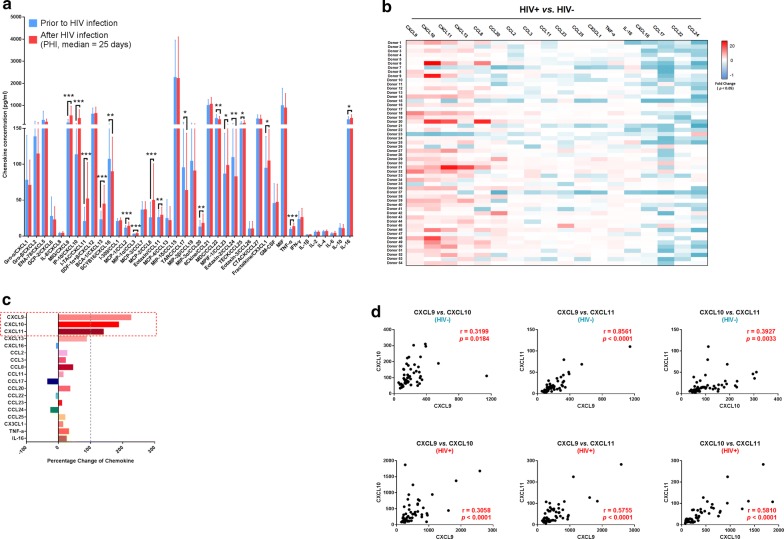
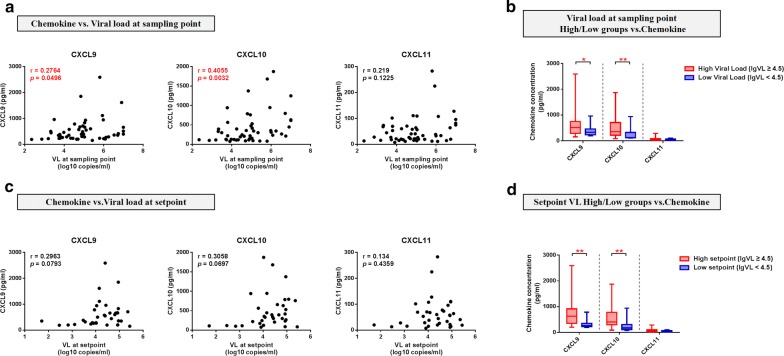
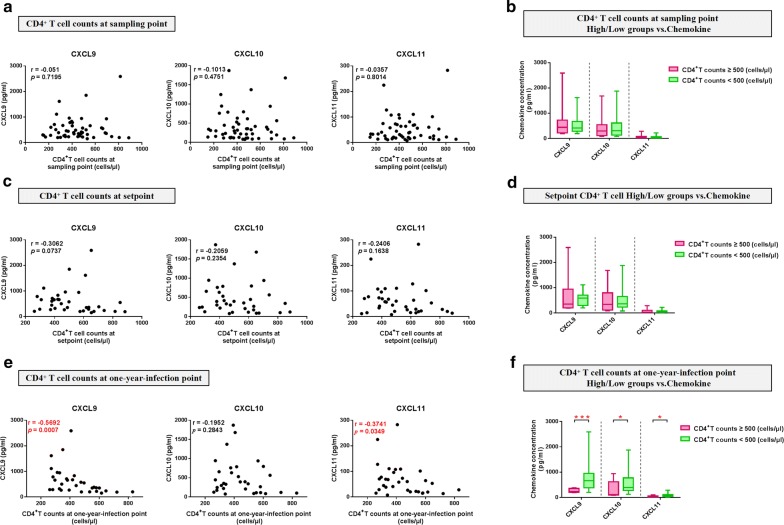
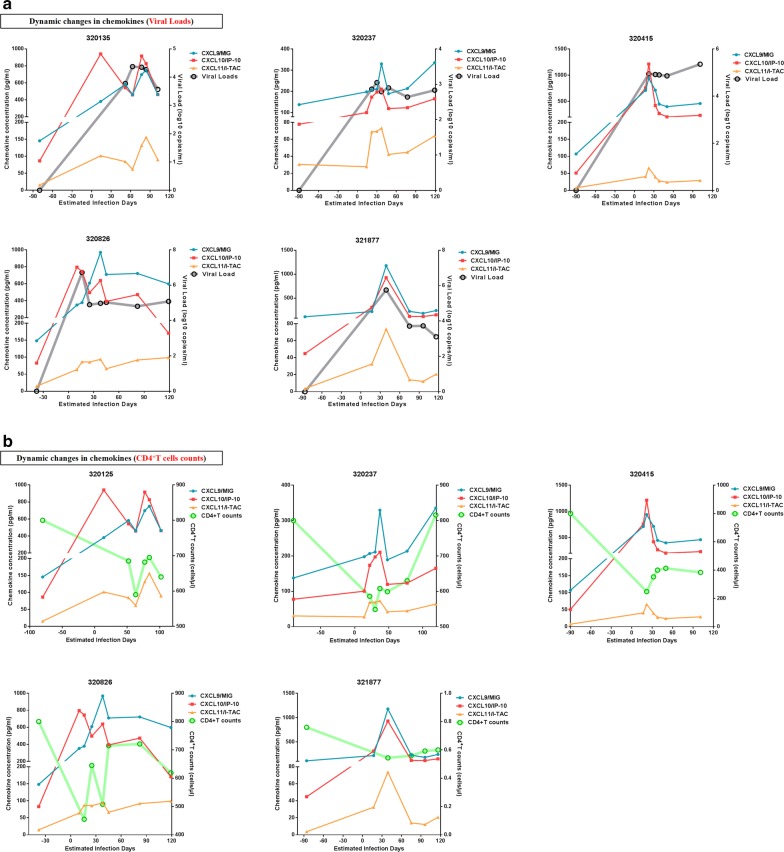
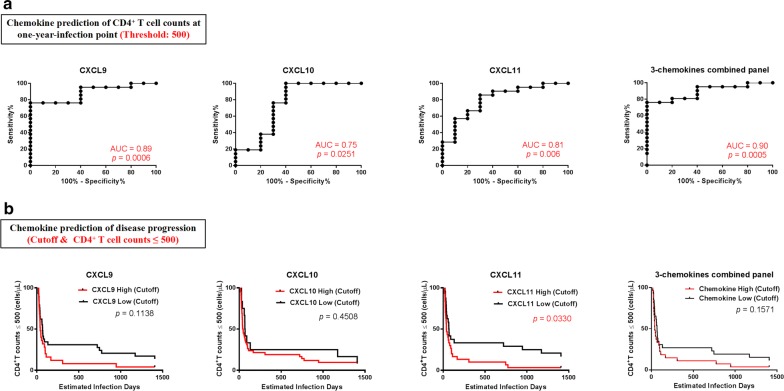
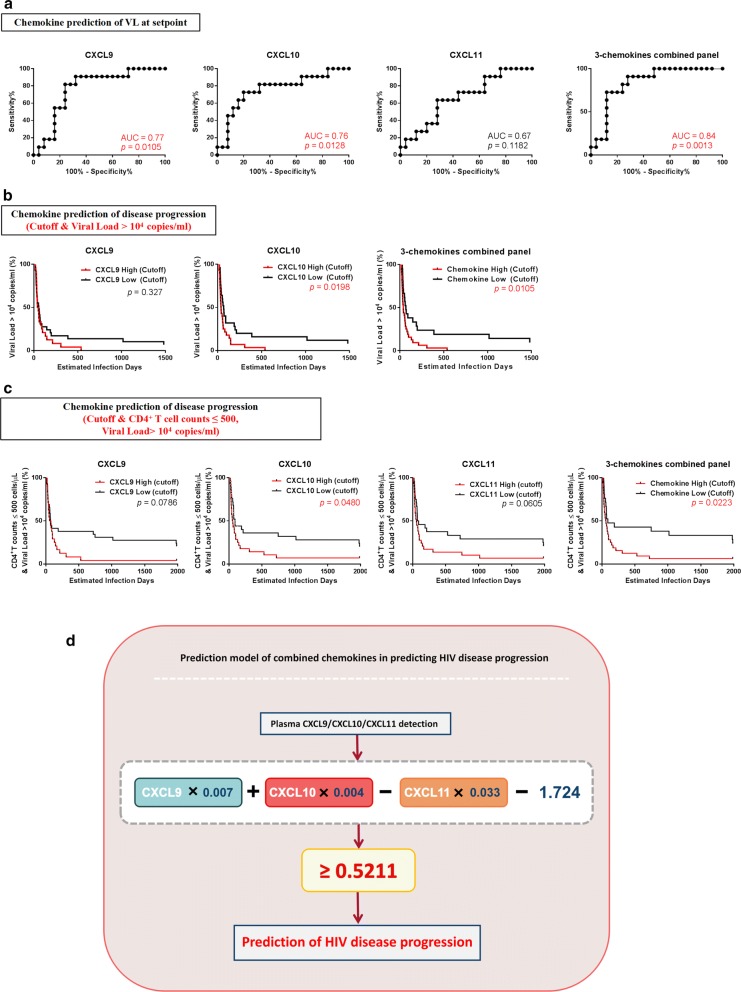
Background: Chemokines are small chemotactic cytokines involved in inflammation, cell migration, and immune regulation in both physiological and pathological contexts. Here, we investigated the profile of chemokines during primary HIV infection (PHI). Methods: Fifty-four participants with blood samples before and during HIV infection and clinical information available were selected from an HIV-negative man who have sex with men (MSM) prospective cohort. Thirty chemokines and 10 cytokines were measured pre- and post-HIV infection in the same individuals using a Bio-Plex Pro™ Human Chemokine Panel. Results: Levels of 18 chemokines/cytokines changed significantly during PHI relative to pre-HIV infection levels; 14 were up-regulated and 4 down-regulated. Among them, CXCL9, CXCL10, and CXCL11 were the most prominently raised. Levels of CXCL9 and CXCL10 were much higher in the high-set point group (log viral load (lgVL) ≥ 4.5) than those in the low-set point group (lgVL < 4.5) and levels of CXCL9, CXCL10, and CXCL11 were higher in the low-CD4 + T-cell count group (CD4 + T-cell count ≥ 500). A formula to predict HIV disease progression using a combination panel comprising CXCL9, CXCL10, and CXCL11 was developed, where risk score = 0.007 × CXCL9 + 0.004 × CXCL10 − 0.033 × CXCL11 − 1.724, with risk score values higher than the cutoff threshold (0.5211) indicating more rapid HIV disease progression. Conclusions: A panel of plasma CXCL9, CXCL10, and CXCL11 measured during primary HIV-1 infection could predict long-term HIV disease prognosis in an MSM group and has potential as a novel biomarker in the clinic.
Overview
The claims and statistics of this paper haven’t been checked yet.
Run the check — free, no account needed. It reads the open-access text and checks the sources it cites.
Integrity signals
Registry
Cites
Statistics
Figures
Verification
Claims the paper makes
The claims and statistics of this paper haven’t been checked yet.
Run the check — free, no account needed. It reads the open-access text and checks the sources it cites.
Claims other papers make about this one
Each is checked against this paper’s own text: does it say what the citing paper says it does?
The source backs part of the claim, not all of it — or backs it for a different population, condition or comparison.
In the citing paper
“Interestingly, CXCL10 is typically secreted by monocytes and migratory DCs during virus infections [[48], [49], [50], [51]], and CXCL10 was highly associated with disease severity in COVID-19 cases [51,52].”
From Systemic profiling of immune responses in healthy adults vaccinated with an RBD-targeting COVID-19 mRNA vaccine (2025) · cites this paper as [50]
Experimental — accuracy not yet measured
Self-check
Percentages, sums and reported differences re-computed from the paper’s own numbers.
The self-check needs the paper’s full text.
Citations
Cites
Zlotnik, A., & Yoshie, O. (2000) · Immunity · doi:10.1016/s1074-7613(00)80165-x · Cited by 3,859
Chemokines in the cancer microenvironment and their relevance in cancer immunotherapy
Nagarsheth, N., Wicha, M. S., & Zou, W. (2017) · Nature Reviews Immunology · doi:10.1038/nri.2017.49 · Cited by 2,206
Chemokines and Chemokine Receptors: Positioning Cells for Host Defense and Immunity
Griffith, J. W., Sokol, C. L., & Luster, A. D. (2014) · Annual Review of Immunology · doi:10.1146/annurev-immunol-032713-120145 · Cited by 2,059
Borrow, P., Lewicki, H., Hahn, B. H., Shaw, G. M., & Oldstone, M. B. (1994) · Journal of Virology · doi:10.1128/jvi.68.9.6103-6110.1994 · Cited by 1,882
Fiebig, E. W., Wright, D. J., Rawal, B. D., Garrett, P. E., Schumacher, R. T., Peddada, L., Heldebrant, C., Smith, R., Conrad, A., Kleinman, S. H., et al. (2003) · AIDS · doi:10.1097/00002030-200309050-00005 · Cited by 1,305
The immune response during acute HIV-1 infection: clues for vaccine development
McMichael, A. J., Borrow, P., Tomaras, G. D., Goonetilleke, N., & Haynes, B. F. (2010) · Nature Reviews Immunology · doi:10.1038/nri2674 · Cited by 871
Cole, K. E., Strick, C. A., Paradis, T. J., Ogborne, K. T., Loetscher, M., Gladue, R. P., Lin, W., Boyd, J. G., Moser, B., Wood, D. E., et al. (1998) · The Journal of Experimental Medicine · doi:10.1084/jem.187.12.2009 · Cited by 870
Deeks, S. G., Kitchen, C. M. R., Liu, L., Guo, H., Gascon, R., Narváez, A. B., Hunt, P., Martin, J. N., Kahn, J. O., Levy, J., et al. (2004) · Blood · doi:10.1182/blood-2003-09-3333 · Cited by 804
Mig and IP-10: CXC chemokines that target lymphocytes
Farber, J. M. (1997) · Journal of Leukocyte Biology · doi:10.1002/jlb.61.3.246 · Cited by 779
The role of CXC chemokines and their receptors in cancer
Vandercappellen, J., Van Damme, J., & Struyf, S. (2008) · Cancer Letters · doi:10.1016/j.canlet.2008.04.050 · Cited by 643
Cited by
Odak, I., Riemann, L., Sandrock, I., Cossmann, A., Ramos, G. M., Hammerschmidt, S. I., Ritter, C., Friedrichsen, M., Hassan, A., Dopfer-Jablonka, A., et al. (2024) · eBioMedicine · doi:10.1016/j.ebiom.2023.104947 · Cited by 17
Zhou, C., Sun, M., Huang, X., Liu, P., Ouyang, Z., Wu, M., Yuan, L., Chen, J., Shu, W., Cao, T., et al. (2025) · hLife · doi:10.1016/j.hlife.2025.04.008 · Cited by 5
Metadata
- Authors
- Yin, X., Wang, Z., Wu, T., Ma, M., Zhang, Z., Chu, Z., Hu, Q., Ding, H., Han, X., Xu, J., Shang, H., & Jiang, Y.
- ORCID
- Shang, Hong
- Venue
- Journal of Translational Medicine
- Published
- 2019-12
- Volume
- 17
- Issue
- 1
- ISSN
- 1479-5876
- PMC
- PMC6909626
- Cited by
- 54
- References
- 66
- Language
- en
- Licence
- creativecommons.org/licenses/by/4.0/ (tdm)
- creativecommons.org/licenses/by/4.0/ (vor, 12 d)
- Funders
- Mega Projects of National Science Research for the 13th Five-Year Plan (2017ZX10201101)
About these checks
Registry, retraction, Cites and statistics results are computed, not judged, with one exception: a printed reference that no index lists is read once by a model before it counts as a citation error. Claims are extracted by a model and kept only when their quote appears verbatim in the text; each cited source is then checked, with a model’s help, for whether it says what the claim relies on. Those verdicts can be wrong — read the claim’s quote and the cited source before relying on one.
Statistics and arithmetic are recomputed, not judged.
Confidence bands are shown only for fields calibrated on our annotated test set. None is calibrated yet, so no band is shown.
What counts as a claim ›How we measure confidence ›How we check this ›
Are you an author, or do you see a problem with this page? Request a review
How to cite
Cite CoChat for the checks on this page, and the paper for its own findings.
- This page
- CoChat. (2026). Citation check: The combination of CXCL9, CXCL10 and CXCL11 levels during primary HIV infection predicts HIV disease progression. https://app.cochat.ai/papers/10.1186/s12967-019-02172-3
- The paper
- Yin, X., Wang, Z., Wu, T., Ma, M., Zhang, Z., Chu, Z., Hu, Q., Ding, H., Han, X., Xu, J., Shang, H., & Jiang, Y. (2019). The combination of CXCL9, CXCL10 and CXCL11 levels during primary HIV infection predicts HIV disease progression. Journal of Translational Medicine. https://doi.org/10.1186/s12967-019-02172-3
Data sources
Bibliographic data: Semantic Scholar, OpenAlex, Crossref.
Contains information from the Semantic Scholar Academic Graph Datasets, made available under the ODC Attribution License (ODC-BY 1.0).
Semantic Scholar’s data is described in: Kinney, R., et al. (2023). The Semantic Scholar Open Data Platform. arXiv:2301.10140.
