

Effects of a ketogenic diet in overweight women with polycystic ovary syndrome
Open accessThe DOI matches its Crossref record; 82 of the 82 references it cites were found in a registry or an index.
Abstract
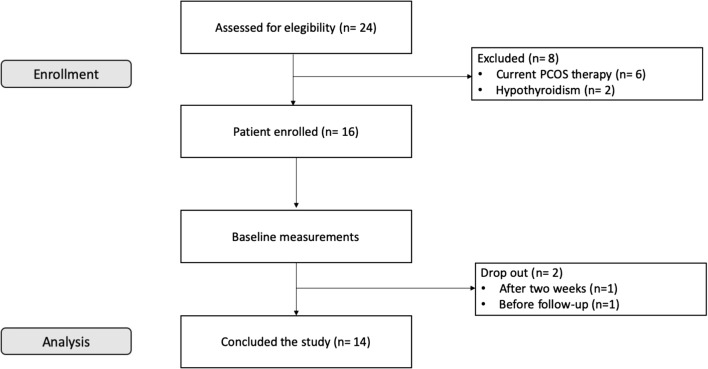
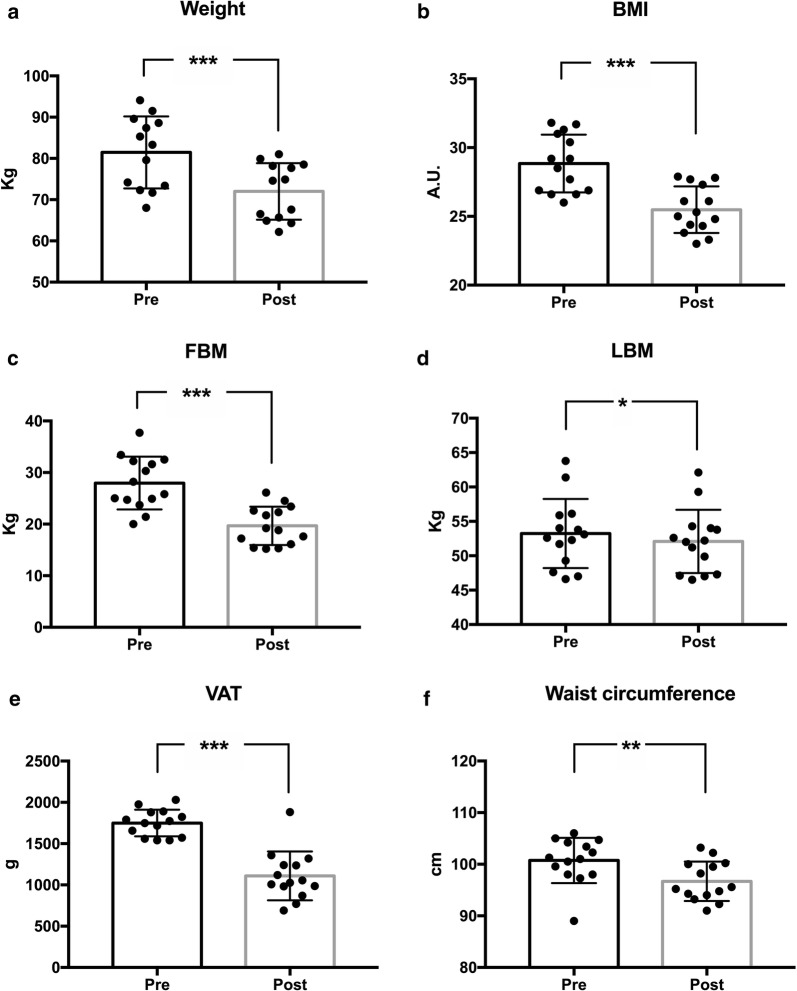
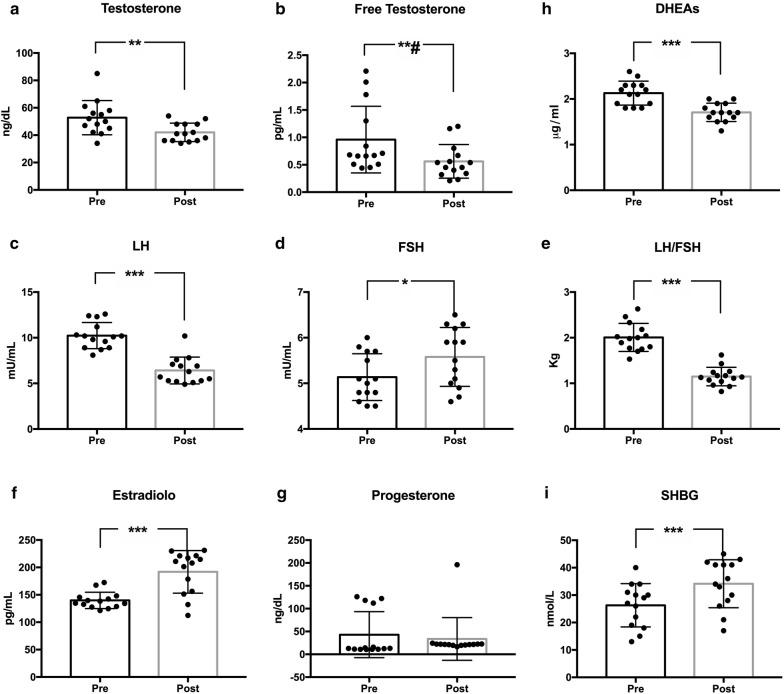
Background: Polycystic ovary syndrome (PCOS) is the most common endocrine disorder in women during reproductive age. It is characterised clinically by oligo-ovulation or anovulation, hyper-androgenism, and the presence of polycystic ovaries. It is associated with an increased prevalence of metabolic syndrome, cardiovascular disease and type 2 diabetes. The onset of PCOS has been associated to several hereditary and environmental factors, but insulin resistance plays a key pathogenetic role. We sought to investigate the effects of a ketogenic diet (KD) on women of childbearing age with a diagnosis of PCOS. Methods: Fourteen overweight women with diagnosis of PCOS underwent to a ketogenic Mediterranean diet with phyoextracts (KEMEPHY) for 12 week. Changes in body weight, body mass index (BMI), fat body mass (FBM), lean body mass (LBM), visceral adipose tissue (VAT), insulin, glucose, HOMA-IR, total cholesterol, low density lipoprotein (LDL), high density lipoprotein (HDL), triglycerides (TGs), total and free testosterone, luteinizing hormone (LH), follicle stimulating hormone (FSH); dehydroepiandrosterone sulfate (DHEAs), estradiol, progesterone, sex hormone binding globulin (SHBG) and Ferriman Gallwey score were evaluated. Results: After 12 weeks, anthropometric and body composition measurements revealed a significant reduction of body weight (− 9.43 kg), BMI (− 3.35), FBM (8.29 kg) and VAT. There was a significant, slightly decrease of LBM. A significant decrease in glucose and insulin blood levels were observed, together with a significant improvement of HOMA-IR. A significant decrease of triglycerides, total cholesterol and LDL were observed along with a rise in HDL levels. The LH/FSH ratio, LH total and free testosterone, and DHEAS blood levels were also significantly reduced. Estradiol, progesterone and SHBG increased. The Ferriman Gallwey Score was slightly, although not significantly, reduced. Conclusions: Our results suggest that a KD may be considered as a valuable non pharmacological treatment for PCOS. Longer treatment periods should be tested to verify the effect of a KD on the dermatological aspects of PCOS. Trial registration Clinicaltrial.gov, NCT04163120, registrered 10 November 2019, retrospectively registered, https://clinicaltrials.gov.
Overview
The claims and statistics of this paper haven’t been checked yet.
Free: it reads the open-access text and checks the first 5 claims that cite a source we can check. Create a free account to check every claim.
Integrity signals
Registry
Cites
Statistics
Figures
Verification
Claims the paper makes
The claims and statistics of this paper haven’t been checked yet.
Free: it reads the open-access text and checks the first 5 claims that cite a source we can check. Create a free account to check every claim.
Claims other papers make about this one
Each is checked against this paper’s own text: does it say what the citing paper says it does?
The source backs part of the claim, not all of it — or backs it for a different population, condition or comparison.
In the citing paper
“showing that in the five women who completed the study, there was a significant reduction in body weight, percent free testosterone, LH/FSH ratio, fasting serum insulin and symptoms.”
From Low-Calorie Ketogenic Diet: Potential Application in the Treatment of Polycystic Ovary Syndrome in Adolescents (2023) · cites this paper as [68]
Experimental — accuracy not yet measuredThe cited source says what the claim attributes to it.
In the citing paper
“Once activated, SIRT1 and AMPK positively affect glucose homeostasis and improve insulin sensitivity [21, 22].”
From Ketogenic Diet as Medical Prescription in Women with Polycystic Ovary Syndrome (PCOS) (2023) · cites this paper as [21]
The cited source says what the claim attributes to it.
In the citing paper
“Other diets that have been studied are the low saturated fat weight-loss diet, low GI diet [16], the ketogenic Mediterranean with phytoextracts (KEMEPHY) diet [17], and the very low carbohydrate diet.”
From PCOS and nutritional approaches: Differences between lean and obese phenotype (2021) · cites this paper as [17]
The cited source says what the claim attributes to it.
In the citing paper
“A ketogenic Mediterranean diet intervention (Table 1) showed initial improvements in cardiometabolic risk profiles, including lipid profiles after 12 weeks among individuals with PCOS with overweight and obesity [82].”
From Moving beyond Weight: A Narrative Review of the Dietary and Lifestyle Management for Reducing Cardiometabolic Risk in Polycystic Ovary Syndrome (PCOS) (2023) · cites this paper as [82]
The cited source says what the claim attributes to it.
In the citing paper
“Researchers found significant reductions in body weight, BMI, fat mass, WC, lean body mass (LBM), glucose and insulin concentrations, HOMA-IR, and lipid profiles, along with improvements in HDL-C concentrations, among individuals with PCOS after the 12-week intervention.”
From Moving beyond Weight: A Narrative Review of the Dietary and Lifestyle Management for Reducing Cardiometabolic Risk in Polycystic Ovary Syndrome (PCOS) (2023) · cites this paper as [82]
4 more claims about this paper
Create a free account to see every claim other papers make about this one.
Self-check
Percentages, sums and reported differences re-computed from the paper’s own numbers.
The self-check needs the paper’s full text.
Citations
Cites
(2004) · Fertility and Sterility · doi:10.1016/j.fertnstert.2003.10.004 · Cited by 9,050
Men at risk: occupation and male infertility
Claman, P. (2004) · Fertility and Sterility · doi:10.1016/s0015-0282(03)01188-9 · Cited by 2,387
The ketone metabolite β-hydroxybutyrate blocks NLRP3 inflammasome-mediated inflammatory disease
Youm, Y.-H., Nguyen, K. Y., Grant, R. W., Goldberg, E. L., Bodogai, M., Kim, D., D'Agostino, D., Planavsky, N., Lupfer, C., Kanneganti, T. D., et al. (2015) · Nature Medicine · doi:10.1038/nm.3804 · Cited by 2,172
Fauser, B. C. J. M., Tarlatzis, B. C., Rebar, R. W., Legro, R. S., Balen, A. H., Lobo, R., Carmina, E., Chang, J., Yildiz, B. O., Laven, J. S. E., et al. (2012) · Fertility and Sterility · doi:10.1016/j.fertnstert.2011.09.024 · Cited by 1,976
Legro, R. S., Arslanian, S. A., Ehrmann, D. A., Hoeger, K. M., Murad, M. H., Pasquali, R., & Welt, C. K. (2013) · The Journal of Clinical Endocrinology & Metabolism · doi:10.1210/jc.2013-2350 · Cited by 1,919 · cited 3×
“Guidelines [12] propose hormonal contraceptives as first-line management for menstrual abnormalities and hirsutism/acne in PCOS whilst metformin is suggested as treatment in women with PCOS and Type 2 diabetes or impaired glucose tolerance when lifestyle modification fail.”
InfluentialMulti-dimensional Roles of Ketone Bodies in Fuel Metabolism, Signaling, and Therapeutics
Puchalska, P., & Crawford, P. A. (2017) · Cell Metabolism · doi:10.1016/j.cmet.2016.12.022 · Cited by 1,610
Long-term persistence of hormonal adaptations to weight loss
Sumithran, P., Prendergast, L. A., Delbridge, E., Purcell, K., Shulkes, A., Kriketos, A., & Proietto, J. (2011) · New England Journal of Medicine · doi:10.1056/nejmoa1105816 · Cited by 1,449 · cited 1×
“The advantage is further substantial if we compare common hypocaloric diets which are strongly restrictive towards the lipids, which keep the level of the orexigenic hormones up to 12 months from the suspension of the diet [52, 53].”
Norman, R. J., Dewailly, D., Legro, R. S., & Hickey, T. E. (2007) · The Lancet · doi:10.1016/s0140-6736(07)61345-2 · Cited by 1,360 · cited 1×
“However, even though lifestyle modification based on the principles of caloric restriction remains a primary therapy for PCOS and caloric restriction seems more important than macronutrient composition [13, 14], little data are available about diet’s macronutrient modification as therapeutic approach [15–17].”
Cahill, G. F. (2006) · Annual Review of Nutrition · doi:10.1146/annurev.nutr.26.061505.111258 · Cited by 1,319
Epidemiology, diagnosis, and management of polycystic ovary syndrome
Sirmans, S., & Pate, K. (2013) · Clinical Epidemiology · doi:10.2147/clep.s37559 · Cited by 1,302
Cited by
Polycystic Ovary Syndrome: Etiology, Current Management, and Future Therapeutics
Singh, S., Pal, N., Shubham, S., Sarma, D. K., Verma, V., Marotta, F., & Kumar, M. (2023) · Journal of Clinical Medicine · doi:10.3390/jcm12041454 · Cited by 521
Zhu, H., Bi, D., Zhang, Y., Kong, C., Du, J., Wu, X., Wei, Q., & Qin, H. (2022) · Signal Transduction and Targeted Therapy · doi:10.1038/s41392-021-00831-w · Cited by 399
Barrea, L., Arnone, A., Annunziata, G., Muscogiuri, G., Laudisio, D., Salzano, C., Pugliese, G., Colao, A., & Savastano, S. (2019) · Nutrients · doi:10.3390/nu11102278 · Cited by 306
Lifestyle management in polycystic ovary syndrome – beyond diet and physical activity
Cowan, S., Lim, S., Alycia, C., Pirotta, S., Thomson, R., Gibson-Helm, M., Blackmore, R., Naderpoor, N., Bennett, C., Ee, C., et al. (2023) · BMC Endocrine Disorders · doi:10.1186/s12902-022-01208-y · Cited by 240
“Regarding α-LA, a small pre-post study (n=6) administered 1200 mg/day for 16 weeks, and reported improved IR, LDL-C and TAG, though no effects on TAC or plasma oxidation metabolites [213].”
BackgroundInfluentialMetabolic Syndrome and PCOS: Pathogenesis and the Role of Metabolites
Chen, W., & Pang, Y. (2021) · Metabolites · doi:10.3390/metabo11120869 · Cited by 228
Metadata
- Authors
- Paoli, A., Mancin, L., Giacona, M. C., Bianco, A., & Caprio, M.
- Affiliations
- University of Padua (IT)
- University of Verona (IT)
- University of Palermo (IT)
- San Raffaele University of Rome (IT)
- Corresponding author
- Paoli, Antonio
- Venue
- Journal of Translational Medicine
- Published
- 2020-02-27
- Volume
- 18
- Issue
- 1
- Pages
- 104-104
- ISSN
- 1479-5876 (ISSN-L)
- PMC
- PMC7045520
- OpenAlex
- W3010567443
- Semantic Scholar
- ac93f115c8c864b7e13f8fec9e6aef4c31b9c48a
- Cited by
- 281
- References
- 82
- Citations by year
- 2026: 31 · 2025: 41 · 2024: 68 · 2023: 52 · 2022: 34 · 2021: 46 · 2020: 7
- FWCI
- 30.65
- Type
- journal article
- Language
- en
- Open access
- gold
- doi.org
- Licence
- cc-by
- creativecommons.org/licenses/by/4.0 (tdm)
- creativecommons.org/licenses/by/4.0 (vor)
- Locations
- Journal of Translational Medicine (publishedVersion, cc-by)
- PubMed Central (publishedVersion, cc-by)
- PubMed (publishedVersion)
- Padua Research Archive (University of Padova) (submittedVersion, cc-by)
- DOAJ (DOAJ: Directory of Open Access Journals) (submittedVersion, cc-by-sa)
- Nova Science Publishers (Nova Science Publishers, Inc.) (submittedVersion, other-oa)
- Topics
- Health Sciences › Medicine › Reproductive Medicine › Ovarian function and disorders
- Health Sciences › Medicine › Physiology (medical) › Diet and metabolism studies
- Health Sciences › Medicine › Endocrinology, Diabetes and Metabolism › Diabetes, Cardiovascular Risks, and Lipoproteins
- Keywords
- polycystic ovary syndrome, ketogenic diet, Mediterranean diet, overweight women, insulin resistance, HOMA-IR, body composition, visceral adipose tissue, lipid profile, testosterone, sex hormones, Ferriman-Gallwey score, non-pharmacological treatment, weight loss, hyperandrogenism, dehydroepiandrosterone sulfate
- MeSH terms
- Diabetes Mellitus, Type 2, Female, Humans, Insulin, Insulin Resistance, Luteinizing Hormone, Polycystic Ovary Syndrome, Body Mass Index, Overweight, Diet, Ketogenic
About these checks
Registry, retraction, Cites and statistics results are computed, not judged, with one exception: a printed reference that no index lists is read once by a model before it counts as a citation error. Claims are extracted by a model and kept only when their quote appears verbatim in the text; each cited source is then checked, with a model’s help, for whether it says what the claim relies on. Those verdicts can be wrong — read the claim’s quote and the cited source before relying on one.
Statistics and arithmetic are recomputed, not judged.
Confidence bands are shown only for fields calibrated on our annotated test set. None is calibrated yet, so no band is shown.
What counts as a claim ›How we measure confidence ›How we check this ›
Are you an author, or do you see a problem with this page? Request a review
Data sources
Bibliographic data: Semantic Scholar, OpenAlex, Crossref.
Contains information from the Semantic Scholar Academic Graph Datasets, made available under the ODC Attribution License (ODC-BY 1.0).
Semantic Scholar’s data is described in: Kinney, R., et al. (2023). The Semantic Scholar Open Data Platform. arXiv:2301.10140.
