

Genome-wide multi-trait analysis of irritable bowel syndrome and related mental conditions identifies 38 new independent variants
Open accessThe DOI matches its Crossref record; 79 of the 79 references it cites were found in a registry or an index.
Abstract
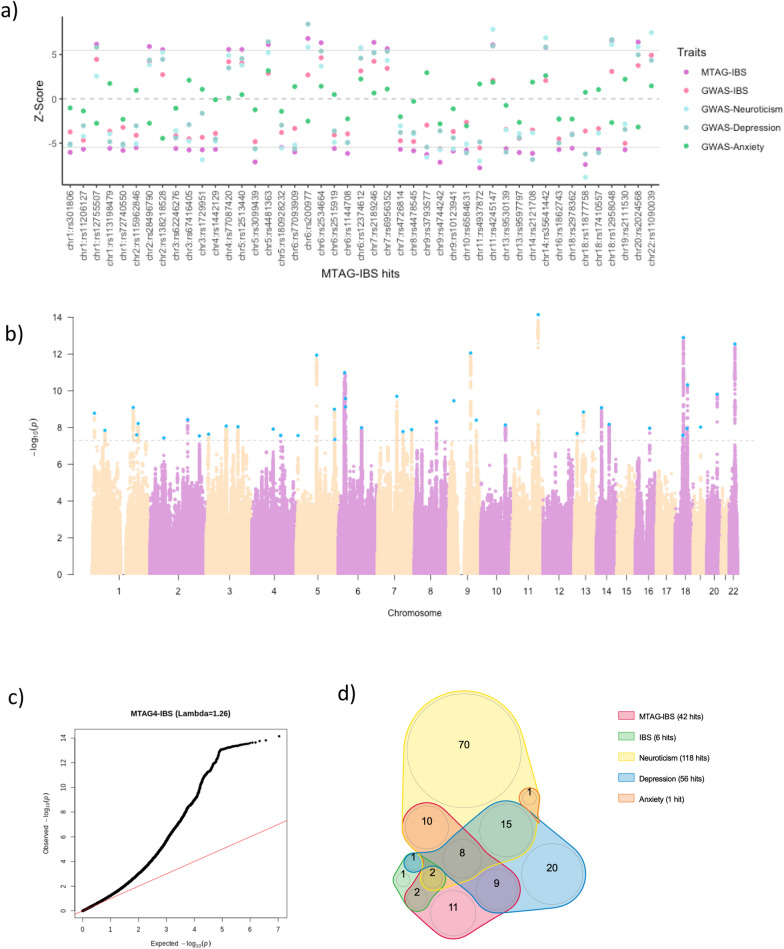
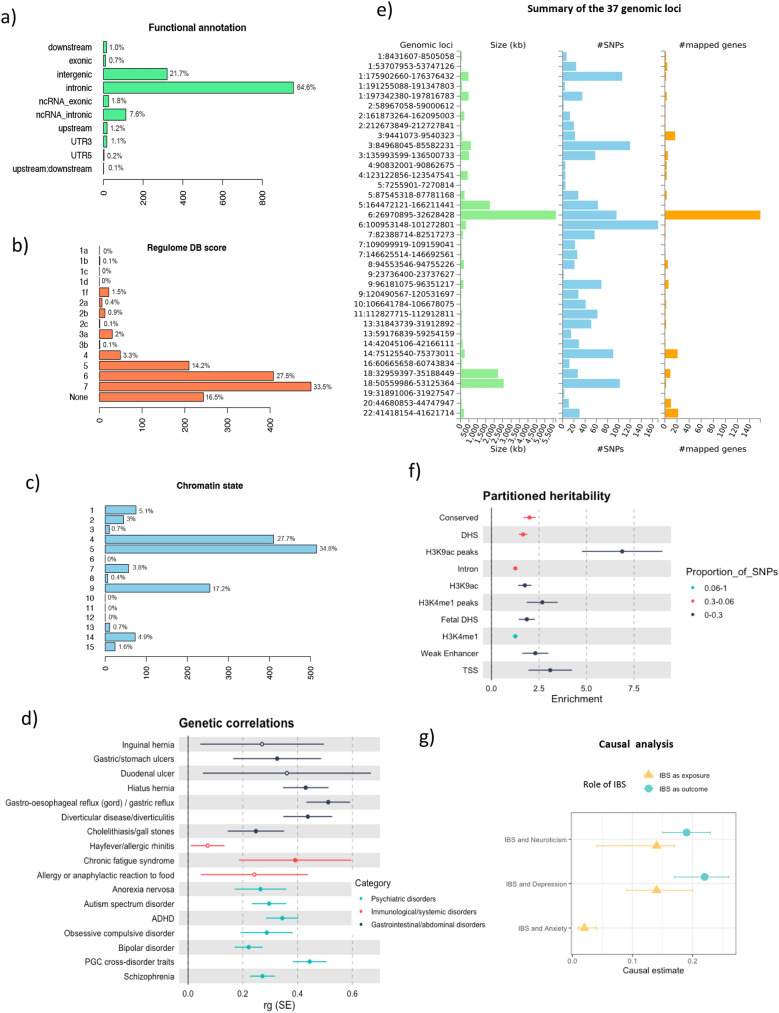
Background: Irritable bowel syndrome (IBS) is a chronic disorder of gut-brain interaction frequently accompanied by mental conditions, including depression and anxiety. Despite showing substantial heritability and being partly determined by a genetic component, the genetic underpinnings explaining the high rates of comorbidity remain largely unclear and there are no conclusive data on the temporal relationship between them. Exploring the overlapping genetic architecture between IBS and mental conditions may help to identify novel genetic loci and biological mechanisms underlying IBS and causal relationships between them. Methods: We quantified the genetic overlap between IBS, neuroticism, depression and anxiety, conducted a multi-trait genome-wide association study (GWAS) considering these traits and investigated causal relationships between them by using the largest GWAS to date. Results: IBS showed to be a highly polygenic disorder with extensive genetic sharing with mental conditions. Multi-trait analysis of IBS and neuroticism, depression and anxiety identified 42 genome-wide significant variants for IBS, of which 38 are novel. Fine-mapping risk loci highlighted 289 genes enriched in genes upregulated during early embryonic brain development and gene-sets related with psychiatric, digestive and autoimmune disorders. IBS-associated genes were enriched for target genes of anti-inflammatory and antirheumatic drugs, anesthetics and opioid dependence pharmacological treatment. Mendelian-randomization analysis accounting for correlated pleiotropy identified bidirectional causal effects between IBS and neuroticism and depression and causal effects of the genetic liability of IBS on anxiety. Conclusions: These findings provide evidence of the polygenic architecture of IBS, identify novel genome-wide significant variants for IBS and extend previous knowledge on the genetic overlap and relationship between gastrointestinal and mental disorders.
Overview
The claims and statistics of this paper haven’t been checked yet.
Free: it reads the open-access text and checks the first 5 claims that cite a source we can check. Create a free account to check every claim.
Integrity signals
Registry
Cites
Statistics
Figures
Verification
Claims the paper makes
The claims and statistics of this paper haven’t been checked yet.
Free: it reads the open-access text and checks the first 5 claims that cite a source we can check. Create a free account to check every claim.
Claims other papers make about this one
Each is checked against this paper’s own text: does it say what the citing paper says it does?
The source backs part of the claim, not all of it — or backs it for a different population, condition or comparison.
In the citing paper
“Earlier studies have primarily focused on genetic linkages among IBS, GERD, and neuropsychiatric conditions [6], [8], [42].”
From The hidden genetic and microbial networks connecting neuropsychiatric and digestive disorders (2025) · cites this paper as [42]
Experimental — accuracy not yet measured
Self-check
Percentages, sums and reported differences re-computed from the paper’s own numbers.
The self-check needs the paper’s full text.
Citations
Cites
Molecular Mechanisms of Depression: Perspectives on New Treatment Strategies
Lang, U. E., & Borgwardt, S. (2013) · Cellular Physiology and Biochemistry · doi:10.1159/000350094 · Cited by 8,475
The MR-Base platform supports systematic causal inference across the human phenome
Hemani, G., Zheng, J., Elsworth, B., Wade, K. H., Haberland, V., Baird, D., Laurin, C., Burgess, S., Bowden, J., Langdon, R., et al. (2018) · eLife · doi:10.7554/elife.34408 · Cited by 7,959 · cited 2×
“We found significant genetic correlations between IBS and 13 gastrointestinal, immunological or psychiatric disorders using GWAS summary statistics available in the MR-Base database [35], including gastric reflux (rg = 0.”
BackgroundMethodLD Score regression distinguishes confounding from polygenicity in genome-wide association studies
Schizophrenia Working Group of the Psychiatric Genomics Consortium, Bulik-Sullivan, B. K., Loh, P.-R., Finucane, H. K., Ripke, S., Yang, J., Patterson, N., Daly, M. J., Price, A. L., & Neale, B. M. (2015) · Nature Genetics · doi:10.1038/ng.3211 · Cited by 5,559
Functional mapping and annotation of genetic associations with FUMA
Watanabe, K., Taskesen, E., van Bochoven, A., & Posthuma, D. (2017) · Nature Communications · doi:10.1038/s41467-017-01261-5 · Cited by 4,083 · cited 7×
“Functional annotation of the credible variants was conducted using FUMA [31].”
MethodInfluentialMAGMA: Generalized Gene-Set Analysis of GWAS Data
de Leeuw, C. A., Mooij, J. M., Heskes, T., & Posthuma, D. (2015) · PLOS Computational Biology · doi:10.1371/journal.pcbi.1004219 · Cited by 3,653
Genetic Epidemiology of Major Depression: Review and Meta-Analysis
Sullivan, P. F., Neale, M. C., & Kendler, K. S. (2000) · American Journal of Psychiatry · doi:10.1176/appi.ajp.157.10.1552 · Cited by 3,431
WebGestalt 2019: gene set analysis toolkit with revamped UIs and APIs
Liao, Y., Wang, J., Jaehnig, E. J., Shi, Z., & Zhang, B. (2019) · Nucleic Acids Research · doi:10.1093/nar/gkz401 · Cited by 3,144 · cited 3×
“WEB‑based GEne SeT AnaLysis Toolkit (WebGestAlt): http:// www. Additional file 1.”
MethodInfluentialeQTLGen, Wray, N. R., 23andMe, the Major Depressive Disorder Working Group of the Psychiatric Genomics Consortium, Ripke, S., Mattheisen, M., Trzaskowski, M., Byrne, E. M., Abdellaoui, A., Adams, M. J., et al. (2018) · Nature Genetics · doi:10.1038/s41588-018-0090-3 · Cited by 3,005
Partitioning heritability by functional annotation using genome-wide association summary statistics
ReproGen Consortium, Finucane, H. K., Schizophrenia Working Group of the Psychiatric Genomics Consortium, The RACI Consortium, Bulik-Sullivan, B., Gusev, A., Trynka, G., Reshef, Y., Loh, P.-R., Anttila, V., et al. (2015) · Nature Genetics · doi:10.1038/ng.3404 · Cited by 2,604 · cited 8×
“We explored genetic correlations between our MTAGIBS results and gastrointestinal, immunological and psychiatric disorders using LDSC analysis [22].”
MethodInfluentialHoward, D. M., Adams, M. J., Clarke, T.-K., Hafferty, J. D., Gibson, J., Shirali, M., Coleman, J. R. I., Hagenaars, S. P., Ward, J., Wigmore, E. M., et al. (2019) · Nature Neuroscience · doi:10.1038/s41593-018-0326-7 · Cited by 2,565
The gut-brain axis: interactions between enteric microbiota, central and enteric nervous systems.
(2015) · PubMed Central · Cited by 2,540
Sperber, A. D., Bangdiwala, S. I., Drossman, D. A., Ghoshal, U. C., Simren, M., Tack, J., Whitehead, W. E., Dumitrascu, D. L., Fang, X., Fukudo, S., et al. (2021) · Gastroenterology · doi:10.1053/j.gastro.2020.04.014 · Cited by 2,263 · cited 1×
“1% according to the strict Rome IV criteria [2].”
MethodSelf-citationAnalysis of shared heritability in common disorders of the brain
The Brainstorm Consortium, Anttila, V., Bulik-Sullivan, B., Finucane, H. K., Walters, R. K., Bras, J., Duncan, L., Escott-Price, V., Falcone, G. J., Gormley, P., et al. (2018) · Science · doi:10.1126/science.aap8757 · Cited by 1,924 · cited 1×
“We detected 27 SNPs for IBS also associated with at least one of the three mental conditions under study, and found evidence supporting that IBS and neuroticism, which is genetically correlated with many psychiatric disorders [39], share a considerable proportion of their genetic background.”
BackgroundSelf-citationGenetic Investigation of ANthropometric Traits (GIANT) Consortium, Yang, J., DIAbetes Genetics Replication And Meta-analysis (DIAGRAM) Consortium, Ferreira, T., Morris, A. P., Medland, S. E., Madden, P. A. F., Heath, A. C., Martin, N. G., Montgomery, G. W., et al. (2012) · Nature Genetics · doi:10.1038/ng.2213 · Cited by 1,712 · cited 3×
“05) using COJO implemented in Genome-wide Complex Trait Analysis (GCTA) [26].”
MethodInfluentialGenomic Relationships, Novel Loci, and Pleiotropic Mechanisms across Eight Psychiatric Disorders
Lee, P. H., Anttila, V., Won, H., Feng, Y.-C. A., Rosenthal, J., Zhu, Z., Tucker-Drob, E. M., Nivard, M. G., Grotzinger, A. D., Posthuma, D., et al. (2019) · Cell · doi:10.1016/j.cell.2019.11.020 · Cited by 1,381
Self-citationMulti-trait analysis of genome-wide association summary statistics using MTAG
23andMe Research Team, Turley, P., Social Science Genetic Association Consortium, Walters, R. K., Maghzian, O., Okbay, A., Lee, J. J., Fontana, M. A., Nguyen-Viet, T. A., Wedow, R., et al. (2018) · Nature Genetics · doi:10.1038/s41588-017-0009-4 · Cited by 1,112 · cited 4×
“MTAG estimates trait-specific effects from GWAS summary statistics of several traits genetically correlated while accounting for sample overlap across the discovery samples [24].”
BackgroundMethodResultInfluentialThe epidemiology of irritable bowel syndrome
Card, T., Canavan, C., & West, J. (2014) · Clinical Epidemiology · doi:10.2147/clep.s40245 · Cited by 889 · cited 3×
“IBS research is extremely challenging due to the multifactorial etiology of the disease and the heterogeneity of patients, who present high comorbidity rates for mental disorders, particularly, anxiety and depression, which impacts negatively on the patients’ quality of life [1, 3, 4].”
BackgroundFord, A. C., Sperber, A. D., Corsetti, M., & Camilleri, M. (2020) · The Lancet · doi:10.1016/s0140-6736(20)31548-8 · Cited by 818
FINEMAP: efficient variable selection using summary data from genome-wide association studies
Benner, C., Spencer, C. C. A., Havulinna, A. S., Salomaa, V., Ripatti, S., & Pirinen, M. (2016) · Bioinformatics · doi:10.1093/bioinformatics/btw018 · Cited by 815
23andMe Research Team, Nagel, M., Jansen, P. R., Stringer, S., Watanabe, K., de Leeuw, C. A., Bryois, J., Savage, J. E., Hammerschlag, A. R., Skene, N. G., et al. (2018) · Nature Genetics · doi:10.1038/s41588-018-0151-7 · Cited by 799 · cited 1×
“Given that standard errors, required by CAUSE, were not available from the largest study on neuroticism to date [37], we used the GWAS dataset on neuroticism by Luciano et al.”
MethodHyde, C. L., Nagle, M. W., Tian, C., Chen, X., Paciga, S. A., Wendland, J. R., Tung, J. Y., Hinds, D. A., Perlis, R. H., & Winslow, A. R. (2016) · Nature Genetics · doi:10.1038/ng.3623 · Cited by 784 · cited 1×
“depression and other mental disorders, such as RERE, that regulates retinoic acid signaling during development [44–46], PCLO, involved in synaptic vesicle trafficking, TMEM161B [47], a brain-expressed transmembrane protein [48], RBFOX1, a splicing regulator mainly expressed in neurons, that is one of the most pleiotro…”
BackgroundFond, G., Loundou, A., Hamdani, N., Boukouaci, W., Dargel, A., Oliveira, J., Roger, M., Tamouza, R., Leboyer, M., & Boyer, L. (2014) · European Archives of Psychiatry and Clinical Neuroscience · doi:10.1007/s00406-014-0502-z · Cited by 647
Morrison, J., Knoblauch, N., Marcus, J. H., Stephens, M., & He, X. (2020) · Nature Genetics · doi:10.1038/s41588-020-0631-4 · Cited by 591 · cited 10×
“Only significant enrichments are displayed. g Causal relationships between IBS and neuroticism, depression and anxiety assessed using Causal Analysis Using Summary Effect estimates (CAUSE).”
MethodInfluentialHippocampal long-term potentiation and neural cell adhesion molecules L1 and NCAM
Lüthi, A., Laurent, J.-P., Figurovt, A., Mullert, D., & Schachnert, M. (1994) · Nature · doi:10.1038/372777a0 · Cited by 564 · cited 1×
“Among top findings we identified genes associated with IBS in previous GWAS, such as CADM2 and NCAM1, members of the synaptic cell adhesion molecules that play a role in synapse organization and plasticity [40, 41].”
BackgroundZamani, M., Alizadeh‐Tabari, S., & Zamani, V. (2019) · Alimentary Pharmacology & Therapeutics · doi:10.1111/apt.15325 · Cited by 496
The Genetics of Stress-Related Disorders: PTSD, Depression, and Anxiety Disorders
Smoller, J. W. (2016) · Neuropsychopharmacology · doi:10.1038/npp.2015.266 · Cited by 480
Frei, O., Holland, D., Smeland, O. B., Shadrin, A. A., Fan, C. C., Maeland, S., O’Connell, K. S., Wang, Y., Djurovic, S., Thompson, W. K., et al. (2019) · Nature Communications · doi:10.1038/s41467-019-10310-0 · Cited by 421 · cited 9×
“MiXeR caclulates the GAD generalized anxiety disorder; UKBB UK Biobank a N effective sample sizes were calculated following the equation: Neff = 4/(1/Ncases + 1/Ncontrols) b Number of genome-wide significant independent SNPs c Sample size excluding the 23andMe cohort d Genome-wide significant SNPs including the 23andM…”
MethodInfluentialLuciano, M., Hagenaars, S. P., Davies, G., Hill, W. D., Clarke, T.-K., Shirali, M., Harris, S. E., Marioni, R. E., Liewald, D. C., Fawns-Ritchie, C., et al. (2018) · Nature Genetics · doi:10.1038/s41588-017-0013-8 · Cited by 391 · cited 1×
“in 329,821 subjects as an alternative [38].”
American College of Gastroenterology Monograph on Management of Irritable Bowel Syndrome
Ford, A. C., Moayyedi, P., Chey, W. D., Harris, L. A., Lacy, B. E., Saito, Y. A., & Quigley, E. M. M. (2018) · American Journal of Gastroenterology · doi:10.1038/s41395-018-0084-x · Cited by 388 · cited 1×
“IBS research is extremely challenging due to the multifactorial etiology of the disease and the heterogeneity of patients, who present high comorbidity rates for mental disorders, particularly, anxiety and depression, which impacts negatively on the patients’ quality of life [1, 3, 4].”
BackgroundThe gut-brain axis: the missing link in depression
Evrensel, A., & Ceylan, M. E. (2015) · Clinical Psychopharmacology and Neuroscience · doi:10.9758/cpn.2015.13.3.239 · Cited by 338 · cited 1×
“These findings may reflect the multi-factorial etiology proposed for IBS involving psychological factors, abnormal brain functioning and dysregulation of brain-gut interactions [15, 65–67], as previously proposed in different psychiatric disorders such as depression [68].”
BackgroundSaffouri, G. B., Shields-Cutler, R. R., Chen, J., Yang, Y., Lekatz, H. R., Hale, V. L., Cho, J. M., Battaglioli, E. J., Bhattarai, Y., Thompson, K. J., et al. (2019) · Nature Communications · doi:10.1038/s41467-019-09964-7 · Cited by 311
(2013) · Swanson's Family Medicine Review: A Problem-Oriented Approach · doi:10.1016/b978-1-4557-0790-4.00038-x · Cited by 298
Papakostas, G. I., Mischoulon, D., Shyu, I., Alpert, J. E., & Fava, M. (2010) · American Journal of Psychiatry · doi:10.1176/appi.ajp.2009.09081198 · Cited by 297 · cited 1×
“drugs of interest include S-adenosylmethionine, involved in neurotransmission signaling that has a putative antidepressant effect [72, 73] or allopurinol that improves inflammatory bowel disease clinical outcomes [74], among others.”
BackgroundEijsbouts, C., Zheng, T., Kennedy, N. A., Bonfiglio, F., Anderson, C. A., Moutsianas, L., Holliday, J., Shi, J., Shringarpure, S., 23andMe Research Team, et al. (2021) · Nature Genetics · doi:10.1038/s41588-021-00950-8 · Cited by 280 · cited 10×
“IBS 53,400 433,201 486,601 190,159 6 [18]”
BackgroundMethodResultInfluentialSelf-citationLee, C., Doo, E., Choi, J. M., Jang, S.-H., Ryu, H.-S., Lee, J. Y., Oh, J. H., Park, J. H., Kim, Y. S., & Brain-Gut Axis Research Group of Korean Society of Neurogastroenterology and Motility (2017) · Journal of Neurogastroenterology and Motility · doi:10.5056/jnm16220 · Cited by 258
Burke, W. J., & McArthur-Miller, D. A. (2001) · PubMed · Cited by 257
PROTAC-DB: an online database of PROTACs
Weng, G., Shen, C., Cao, D., Gao, J., Dong, X., He, Q., Yang, B., Li, D., Wu, J., & Hou, T. (2021) · Nucleic Acids Research · doi:10.1093/nar/gkaa807 · Cited by 219
Fine Mapping Causal Variants with an Approximate Bayesian Method Using Marginal Test Statistics
Chen, W., Larrabee, B. R., Ovsyannikova, I. G., Kennedy, R. B., Haralambieva, I. H., Poland, G. A., & Schaid, D. J. (2015) · Genetics · doi:10.1534/genetics.115.176107 · Cited by 213 · cited 1×
“1 [29] following the pipeline available elsewhere [30].”
BackgroundWu, Y., Murray, G. K., Byrne, E. M., Sidorenko, J., Visscher, P. M., & Wray, N. R. (2021) · Nature Communications · doi:10.1038/s41467-021-21280-7 · Cited by 212 · cited 2×
“Despite these strong genetic correlations, the genetic underpinnings explaining the high rates of comorbidity between IBS and mental conditions remain largely unclear and there are no conclusive data on the temporal and causal relationship between them [18, 19].”
BackgroundFadgyas-Stanculete, M., Buga, A.-M., Popa-Wagner, A., & Dumitrascu, D. L. (2014) · Journal of Molecular Psychiatry · doi:10.1186/2049-9256-2-4 · Cited by 197
Sibelli, A., Chalder, T., Everitt, H., Workman, P., Windgassen, S., & Moss-Morris, R. (2016) · Psychological Medicine · doi:10.1017/s0033291716001987 · Cited by 196
Quantitative Proteomic Analysis of Post-translational Modifications of Human Histones
Beck, H. C., Nielsen, E. C., Matthiesen, R., Jensen, L. H., Sehested, M., Finn, P., Grauslund, M., Hansen, A. M., & Jensen, O. N. (2006) · Molecular & Cellular Proteomics · doi:10.1074/mcp.m600007-mcp200 · Cited by 194 · cited 1×
“More specifically, we found genes encoding histones and histone modifying enzymes among top findings, and enrichment of IBS associations in histone acetylation and methylation peaks and in target genes for the histone deacetylase inhibitor belinostat [57].”
BackgroundPrevalence of irritable bowel syndrome among university students
Hazlett-Stevens, H., Craske, M. G., Mayer, E. A., Chang, L., & Naliboff, B. D. (2003) · Journal of Psychosomatic Research · doi:10.1016/s0022-3999(03)00019-9 · Cited by 170
Ayano, G. (2016) · Journal of Mental Disorders and Treatment · doi:10.4172/2471-271x.1000120 · Cited by 163 · cited 1×
“depression and other mental disorders, such as RERE, that regulates retinoic acid signaling during development [44–46], PCLO, involved in synaptic vesicle trafficking, TMEM161B [47], a brain-expressed transmembrane protein [48], RBFOX1, a splicing regulator mainly expressed in neurons, that is one of the most pleiotro…”
BackgroundHong, S., Zheng, G., & Wiley, J. W. (2015) · Gastroenterology · doi:10.1053/j.gastro.2014.09.032 · Cited by 153
S-Adenosylmethionine (SAMe) for Neuropsychiatric Disorders: A Clinician-Oriented Review of Research
Sharma, A., as Work Group of the American Psychiatric Association Council on Research, Gerbarg, P., Bottiglieri, T., Massoumi, L., Carpenter, L. L., Lavretsky, H., Muskin, P. R., Brown, R. P., & Mischoulon, D. (2017) · The Journal of Clinical Psychiatry · doi:10.4088/jcp.16r11113 · Cited by 153 · cited 1×
“drugs of interest include S-adenosylmethionine, involved in neurotransmission signaling that has a putative antidepressant effect [72, 73] or allopurinol that improves inflammatory bowel disease clinical outcomes [74], among others.”
BackgroundEpigenetic modulation of chronic anxiety and pain by histone deacetylation
Tran, L., Schulkin, J., Ligon, C. O., & Greenwood-Van Meerveld, B. (2015) · Molecular Psychiatry · doi:10.1038/mp.2014.122 · Cited by 148 · cited 1×
“These results add additional evidence towards the role of epigenetic programming in inflammation, visceral pain as well as in intestinal permeability, sensibility and motility in both humans and animal models of IBS [58, 59, 63, 64].”
ResultMartínez, C., Rodiño-Janeiro, B. K., Lobo, B., Stanifer, M. L., Klaus, B., Granzow, M., González-Castro, A. M., Salvo-Romero, E., Alonso-Cotoner, C., Pigrau, M., et al. (2017) · Gut · doi:10.1136/gutjnl-2016-311477 · Cited by 146
Self-citationIrritable bowel syndrome is strongly associated with generalized anxiety disorder: a community study
LEE, S., WU, J., MA, Y. L., TSANG, A., GUO, W. ‐., & SUNG, J. (2009) · Alimentary Pharmacology & Therapeutics · doi:10.1111/j.1365-2036.2009.04074.x · Cited by 136 · cited 1×
“Accounting for such factors may contribute to better characterize the disorder, capture its genetic background and identify overlap with other comorbid disorders that may impact on IBS risk, prognosis and clinical outcome [6]; (ii) Despite the strong genetic correlation between IBS and the three mental conditions unde…”
BackgroundImmune activation in irritable bowel syndrome: what is the evidence?
Aguilera‐Lizarraga, J., Hussein, H., & Boeckxstaens, G. E. (2022) · Nature reviews. Immunology · doi:10.1038/s41577-022-00700-9 · Cited by 136
Smriga, M., & Torii, K. (2003) · Proceedings of the National Academy of Sciences · doi:10.1073/pnas.2436556100 · Cited by 107 · cited 2×
“Interestingly, l-lysine, and other 5-HT4 receptor antagonists, are promising targets for the treatment of diarrhea-predominant IBS [70, 71] and may aminorate serotonin disturbances in gut and brain that account for part of intestinal and mental disorders [69].”
BackgroundLee, Y.-T., Hu, L.-Y., Shen, C.-C., Huang, M.-W., Tsai, S.-J., Yang, A. C., Hu, C.-K., Perng, C.-L., Huang, Y.-S., & Hung, J.-H. (2015) · PLOS ONE · doi:10.1371/journal.pone.0133283 · Cited by 106 · cited 1×
“These findings support that IBS increases the risk of subsequent depressive and anxiety disorders described in longitudinal study designs [75] and also previous evidence supporting that prior depression raises the risk of developing IBS [76, 77].”
ResultFregeau, B., Kim, B., Hernández, A., Jordan, V. K., Cho, M. T., Schnur, R. E., Monaghan, K. G., Juusola, J., Rosenfeld, J. A., Bhoj, E. J. K., et al. (2016) · The American Journal of Human Genetics · doi:10.1016/j.ajhg.2016.03.002 · Cited by 103
Moloney, R. D., Stilling, R. M., Dinan, T. G., & Cryan, J. F. (2015) · Neurogastroenterology & Motility · doi:10.1111/nmo.12675 · Cited by 95 · cited 2×
“These results add additional evidence towards the role of epigenetic programming in inflammation, visceral pain as well as in intestinal permeability, sensibility and motility in both humans and animal models of IBS [58, 59, 63, 64].”
ResultStaudacher, H. M., Mikocka-Walus, A., & Ford, A. C. (2021) · The Lancet Gastroenterology & Hepatology · doi:10.1016/s2468-1253(20)30363-0 · Cited by 95
Replication and characterization of CADM2 and MSRA genes on human behavior
Boutwell, B., Hinds, D., Tielbeek, J., Ong, K. K., Day, F. R., Perry, J. R. B., Agee, M., Alipanahi, B., Auton, A., Bell, R. K., et al. (2017) · Heliyon · doi:10.1016/j.heliyon.2017.e00349 · Cited by 92
A novel anti-inflammatory role of NCAM-derived mimetic peptide, FGL
Downer, E. J., Cowley, T. R., Lyons, A., Mills, K. H. G., Berezin, V., Bock, E., & Lynch, M. A. (2008) · Neurobiology of Aging · doi:10.1016/j.neurobiolaging.2008.03.017 · Cited by 90
Bharucha, A. E., Camilleri, M., Haydock, S., Ferber, I., Burton, D., Cooper, S., Tompson, D., Fitzpatrick, K., Higgins, R., & Zinsmeister, A. R. (2000) · Gut · doi:10.1136/gut.47.5.667 · Cited by 90 · cited 1×
“Interestingly, l-lysine, and other 5-HT4 receptor antagonists, are promising targets for the treatment of diarrhea-predominant IBS [70, 71] and may aminorate serotonin disturbances in gut and brain that account for part of intestinal and mental disorders [69].”
BackgroundWang, J., Huang, D., Zhou, Y., Yao, H., Liu, H., Zhai, S., Wu, C., Zheng, Z., Zhao, K., Wang, Z., et al. (2019) · Nucleic Acids Research · doi:10.1093/nar/gkz1026 · Cited by 74
Tam, F. S. F., Hillier, K., & Bunce, K. T. (1994) · British Journal of Pharmacology · doi:10.1111/j.1476-5381.1994.tb16186.x · Cited by 73 · cited 1×
“Interestingly, l-lysine, and other 5-HT4 receptor antagonists, are promising targets for the treatment of diarrhea-predominant IBS [70, 71] and may aminorate serotonin disturbances in gut and brain that account for part of intestinal and mental disorders [69].”
BackgroundZhang, Q., Wang, F., Geng, Q., Zheng, W., Ng, C. H., Ungvari, G. S., Yuan, Z., Mei, S., Wang, G., & Xiang, Y. (2018) · International Journal of Biological Sciences · doi:10.7150/ijbs.25001 · Cited by 71
Maihofer, A. X., Choi, K. W., Coleman, J. R. I., Daskalakis, N. P., Denckla, C. A., Ketema, E., Morey, R. A., Polimanti, R. A., Ratanatharathorn, A. D., Torres, K., et al. (2021) · Biological Psychiatry · doi:10.1016/j.biopsych.2021.09.020 · Cited by 71 · cited 1×
“To discard inflation in our results we calculated the max-false discovery rate (max-FDR) using default settings as previously described [24, 25].”
MethodDemystifying non-coding GWAS variants: an overview of computational tools and methods
Schipper, M., & Posthuma, D. (2022) · Human Molecular Genetics · doi:10.1093/hmg/ddac198 · Cited by 70 · cited 2×
“Although the role of non-coding variants is still unclear, it has been suggested that non-coding variants may impact the phenotype by alteration of regulatory elements such as enhancers, transcription factor binding sites or chromatin state [56].”
BackgroundNisticò, V., Rossi, R. E., D'Arrigo, A. M., Priori, A., Gambini, O., & Demartini, B. (2022) · Journal of Neurogastroenterology and Motility · doi:10.5056/jnm21079 · Cited by 69
Role of Dopamine and D2 Dopamine Receptor in the Pathogenesis of Inflammatory Bowel Disease
Tolstanova, G. M., Deng, X., Ahluwalia, A., Paunovic, B., Prysiazhniuk, A., Остапченко, Л. І., Tarnawski, A. S., Sandor, Z., & Szabó, S. (2015) · Digestive Diseases and Sciences · doi:10.1007/s10620-015-3698-5 · Cited by 65 · cited 1×
“Interestingly, several studies in animal models suggested an important role for dopamine signaling both in the development and progression of inflammatory bowel disease [51] and treatment with D2R agonists decreased the severity of ulcerative colitis in mice and rats [52].”
BackgroundGenotype-phenotype correlations in individuals with pathogenic RERE variants
Jordan, V. K., Fregeau, B., Ge, X., Giordano, J. L., Wapner, R. J., Balcı, T. B., Carter, M. T., Bernat, J. A., Moccia, A., Srivastava, A., et al. (2018) · Human Mutation · doi:10.1002/humu.23400 · Cited by 58
Wohlfarth, C., Schmitteckert, S., Härtle, J. D., Houghton, L. A., Dweep, H., Fortea, M., Assadi, G., Braun, A., Mederer, T., Pöhner, S., et al. (2017) · Scientific Reports · doi:10.1038/s41598-017-13982-0 · Cited by 56
Self-citationYeh, H., Chien, W., Chung, C., Hu, J., & Tzeng, N. (2018) · International Journal of Clinical Practice · doi:10.1111/ijcp.13212 · Cited by 43
Goodwin, L., White, P. D., Hotopf, M., Stansfeld, S. A., & Clark, C. (2013) · Psychosomatic Medicine · doi:10.1097/psy.0b013e31827c351b · Cited by 36 · cited 1×
“These findings support that IBS increases the risk of subsequent depressive and anxiety disorders described in longitudinal study designs [75] and also previous evidence supporting that prior depression raises the risk of developing IBS [76, 77].”
ResultAguirre, J. E., Winston, J. H., & Sarna, S. K. (2017) · Neurogastroenterology & Motility · doi:10.1111/nmo.13081 · Cited by 34 · cited 2×
“These results add additional evidence towards the role of epigenetic programming in inflammation, visceral pain as well as in intestinal permeability, sensibility and motility in both humans and animal models of IBS [58, 59, 63, 64].”
ResultGenome-Wide Significance for PCLO as a Gene for Major Depressive Disorder
Mbarek, H., Milaneschi, Y., Hottenga, J., Ligthart, L., de Geus, E. J. C., Ehli, E. A., Willemsen, G. A. H. M., Davies, G. E., Smit, J. H., Boomsma, D. I., et al. (2017) · Twin Research and Human Genetics · doi:10.1017/thg.2017.30 · Cited by 34 · cited 3×
“1 and MSH5SAPCD1), RNA splicing (CELF4), chromatin remodeling (EP300 and HIST1H3J), mRNA transport (FAM120A) or nucleic acid binding (TCF4 and ELAVL2), as well as in brain development (TMEM161B) or presynaptic activity (PCLO).”
BackgroundGastrointestinal Dopamine in Inflammatory Bowel Diseases: A Systematic Review
Kurnik‐Łucka, M., Pasieka, P. M., Łączak, P., Wojnarski, M., Jurczyk, M., & Gil, K. (2021) · International Journal of Molecular Sciences · doi:10.3390/ijms222312932 · Cited by 31
Manuel, A. M., Dai, Y., Jia, P., Freeman, L. A., & Zhao, Z. (2022) · Human Molecular Genetics · doi:10.1093/hmg/ddac265 · Cited by 24 · cited 1×
“This variant was identified as likely affecting DNA methylation patterns in multiple sclerosis (MS) in a gene-regulatory network integrating GWAS summary statistics and DNA methylation profiles from 140 cases of MS and 139 controls [55].”
BackgroundMoreau, B., Clément, P., Théorêt, Y., & Seidman, E. G. (2017) · Therapeutic Advances in Gastroenterology · doi:10.1177/1756283x17733657 · Cited by 22 · cited 1×
“drugs of interest include S-adenosylmethionine, involved in neurotransmission signaling that has a putative antidepressant effect [72, 73] or allopurinol that improves inflammatory bowel disease clinical outcomes [74], among others.”
BackgroundGreenbaum, J., & Deng, H. (2017) · Journal of Bone and Mineral Research · doi:10.1002/jbmr.3154 · Cited by 21
Katsuki, A., Kakeda, S., Watanabe, K., Igata, R., Otsuka, Y., Kishi, T., Nguyen, L., Ueda, I., Iwata, N., Korogi, Y., et al. (2019) · Neuropsychiatric Disease and Treatment · doi:10.2147/ndt.s204461 · Cited by 21 · cited 1×
“A neuroimaging study of drug-naïve individuals with MDD found that reductions in cortical thickness among patients (n = 47) compared to controls (n = 42) were significantly larger among those with the T/T genotype of this SNP compared to C carriers [53].”
ResultRole of microRNA in IBS with increased gut permeability
Vicario, M., Martínez, C., & Santos, J. (2010) · Gut · doi:10.1136/gut.2009.203695 · Cited by 18
Self-citationTurner, C. A., Lyons, D. M., Buckmaster, C. L., Aurbach, E. L., Watson, S. J., Schatzberg, A. F., & Akil, H. (2018) · Neuropsychopharmacology · doi:10.1038/s41386-018-0052-6 · Cited by 13
Wang, Y., Ma, T., Zhu, Y., Chu, X., Yao, S., Wang, H.-F., Cai, J., Wang, X.-F., & Jiang, X. (2017) · Genetic Testing and Molecular Biomarkers · doi:10.1089/gtmb.2016.0402 · Cited by 11 · cited 1×
“However, this SNP did not show association with any of the phenotypes studied [54].”
Background
Research works printed but not linked: 1
- Nagel M Jansen PR Stringer S Watanabe K De Leeuw CA Bryois J Meta-analysis of genome-wide association studies for neuroticism in 449,484 individuals identifies novel genetic loci and pathways Nat Genet 2018 50 920 927 10.1038/s41588-018-0151-7 29942085 · DOI · Paper page
Cited by
The gut microbiome in disorders of gut–brain interaction
Kraïmi, N., Ross, T., Pujo, J., & Palma, G. D. (2024) · Gut Microbes · doi:10.1080/19490976.2024.2360233 · Cited by 101
“12 158 Of interest, IBS was shown to share extensive genetic traits with anxiety, depression, and neuroticism, 126,159 pointing toward the bidirectional link between IBS and psychological conditions.”
BackgroundDing, H., Jiang, Y., Sun, Q., Song, Y., Dong, S., Xu, Q., Li, L., Liu, C., Li, B., Jiang, H., et al. (2025) · Communications Biology · doi:10.1038/s42003-025-07481-6 · Cited by 14
“To uncover the shared genetic mechanism contributing to psychiatric and gastrointestinal disorders, recent studies have detected multiple pleiotropic loci at the genomics level, suggesting an important role of GBA in these conditions 15,16,25 .”
Association between small intestine bacterial overgrowth and psychiatric disorders
Bogielski, B., Michalczyk, K., Głodek, P., Tempka, B., Gębski, W., & Stygar, D. M. (2024) · Frontiers in Endocrinology · doi:10.3389/fendo.2024.1438066 · Cited by 15
“This condition can lead to gastrointestinal and systemic issues, including bloating, diarrhea, malnutrition, and abdominal pain (3 – 5).”
BackgroundHuang, W., Zhang, L., Ma, Y., Yu, S., Lyu, Y., Tong, S., Wang, J., Jiang, R., Meng, M., Wu, Y., et al. (2024) · International Journal of Surgery · doi:10.1097/js9.0000000000002039 · Cited by 9
“We were able to con fi rm previously observed associations of various phenotypes with IBS, including neuroticism [59] , anxiety [60] and depression [59] .”
Evolutionary medicine approaches to chronic disease: The case of irritable bowel syndrome
Lenover, M. B., & Shenk, M. K. (2023) · Evolutionary Anthropology Issues News and Reviews · doi:10.1002/evan.22010 · Cited by 8
“14,89 The epigenetic role of the gut microbiome as a mediator between genes and environment has been proposed as a potential explanation for how these gene ‐ by ‐ environment interactions occur in IBS patients and warrants further investigation.”
Background
Metadata
- Authors
- Alemany, S., Soler-Artigas, M., Cabana-Domínguez, J., Fakhreddine, D., Llonga, N., Vilar-Ribó, L., Rodríguez-Urrutia, A., Palacio, J., González-Castro, A. M., Lobo, B., Alonso-Cotoner, C., Simrén, M., Santos, J., Ramos-Quiroga, J. A., & Ribasés, M.
- Affiliations
- Universitat Autònoma de Barcelona (ES)
- Vall d'Hebron Hospital Universitari (ES)
- Vall d'Hebron Institut de Recerca (ES)
- University of North Carolina at Chapel Hill (US)
- Corresponding author
- Alemany, Silvia
- Ribasés, Marta
- ORCID
- Venue
- Journal of Translational Medicine
- Published
- 2023-04-21
- Volume
- 21
- Issue
- 1
- Pages
- 272-272
- ISSN
- 1479-5876 (ISSN-L)
- PMC
- PMC10120121
- OpenAlex
- W4366690664
- Cited by
- 20
- References
- 78
- Citations by year
- 2026: 6 · 2025: 5 · 2024: 7 · 2023: 2
- FWCI
- 5.68
- Type
- journal article
- Language
- en
- Open access
- gold
- doi.org
- Licence
- cc-by
- creativecommons.org/licenses/by/4.0 (tdm)
- creativecommons.org/licenses/by/4.0 (vor)
- Locations
- Journal of Translational Medicine (publishedVersion, cc-by)
- PubMed Central (publishedVersion, cc-by)
- PubMed (publishedVersion)
- Dipòsit Digital de Documents de la UAB (Universitat Autònoma de Barcelona) (submittedVersion, cc-by)
- RUNA. Repositorio Institucional del Sergas (Servicio Gallego de Salud (SERGAS)) (submittedVersion, cc-by)
- DOAJ (DOAJ: Directory of Open Access Journals) (submittedVersion, cc-by-sa)
- Funders
- Agència de Gestió d'Ajuts Universitaris i de Recerca (2017SGR-00444, 2017SGR-1461)
- European Regional Development Fund (IJC2018-035346-I)
- Horizon 2020 Framework Programme (848228 (DISCOvERIE))
- Ministry of Science, Innovation and Universities (RYC2021-031324-I)
- Instituto de Salud Carlos III (CP22/00128, CP22/00026)
- Topics
- Health Sciences › Medicine › Gastroenterology › Gastrointestinal motility and disorders
- Life Sciences › Biochemistry, Genetics and Molecular Biology › Genetics › Genetic Associations and Epidemiology
- Life Sciences › Biochemistry, Genetics and Molecular Biology › Molecular Biology › Gut microbiota and health
- Keywords
- irritable bowel syndrome, depression, anxiety, neuroticism, gut-brain axis, genetic overlap, polygenic architecture, novel genetic variants, fine mapping, pleiotropy, causal relationship, brain development genes, opioid use disorder, anti-inflammatory agents, autoimmune disease
- MeSH terms
- Anxiety, Humans, Phenotype, Comorbidity, Irritable Bowel Syndrome, Genome-Wide Association Study
About these checks
Registry, retraction, Cites and statistics results are computed, not judged, with one exception: a printed reference that no index lists is read once by a model before it counts as a citation error. Claims are extracted by a model and kept only when their quote appears verbatim in the text; each cited source is then checked, with a model’s help, for whether it says what the claim relies on. Those verdicts can be wrong — read the claim’s quote and the cited source before relying on one.
Statistics and arithmetic are recomputed, not judged.
Confidence bands are shown only for fields calibrated on our annotated test set. None is calibrated yet, so no band is shown.
What counts as a claim ›How we measure confidence ›How we check this ›
Are you an author, or do you see a problem with this page? Request a review
Data sources
Bibliographic data: Semantic Scholar, OpenAlex, Crossref.
Contains information from the Semantic Scholar Academic Graph Datasets, made available under the ODC Attribution License (ODC-BY 1.0).
Semantic Scholar’s data is described in: Kinney, R., et al. (2023). The Semantic Scholar Open Data Platform. arXiv:2301.10140.
