

Adapting modeling and simulation credibility standards to computational systems biology
Open accessThe DOI matches its Crossref record; 69 of the 70 references it cites were found in a registry or an index; 27 of the 55 sources its claims cite were checked for support.
Abstract
Computational models are increasingly used in high-impact decision making in science, engineering, and medicine. The National Aeronautics and Space Administration (NASA) uses computational models to perform complex experiments that are otherwise prohibitively expensive or require a microgravity environment. Similarly, the Food and Drug Administration (FDA) and European Medicines Agency (EMA) have began accepting models and simulations as forms of evidence for pharmaceutical and medical device approval. It is crucial that computational models meet a standard of credibility when using them in high-stakes decision making. For this reason, institutes including NASA, the FDA, and the EMA have developed standards to promote and assess the credibility of computational models and simulations. However, due to the breadth of models these institutes assess, these credibility standards are mostly qualitative and avoid making specific recommendations. On the other hand, modeling and simulation in systems biology is a narrower domain and several standards are already in place. As systems biology models increase in complexity and influence, the development of a credibility assessment system is crucial. Here we review existing standards in systems biology, credibility standards in other science, engineering, and medical fields, and propose the development of a credibility standard for systems biology models.
Overview
CoChat Summary
TL;DR
This review surveys existing systems biology modeling standards and credibility frameworks from NASA, FDA, EMA, and ASME, arguing that systems biology’s narrower scope makes it well-suited for a credibility standard. It proposes developing a quantitative or semi-quantitative credibility scoring system for mechanistic systems biology models, potentially informed by automated tools such as MEMOTE and FROG.
Key findings
- Reproducibility remains a major credibility problem: 49% of published models undergoing BioModels review and curation were not reproducible, primarily due to missing simulation materials, lack of public model/code availability, and insufficient documentation; with extra effort, an additional 12% could be reproduced.
- Systems biology already has standards for model representation (SBML, CellML, BioPAX), annotation (MIRIAM, SBO, OMEX), simulation and parameter estimation (MIASE, KiSAO, SED-ML, PEtab), and dissemination (FAIR, COMBINE archives), but no widely used standard for model credibility.
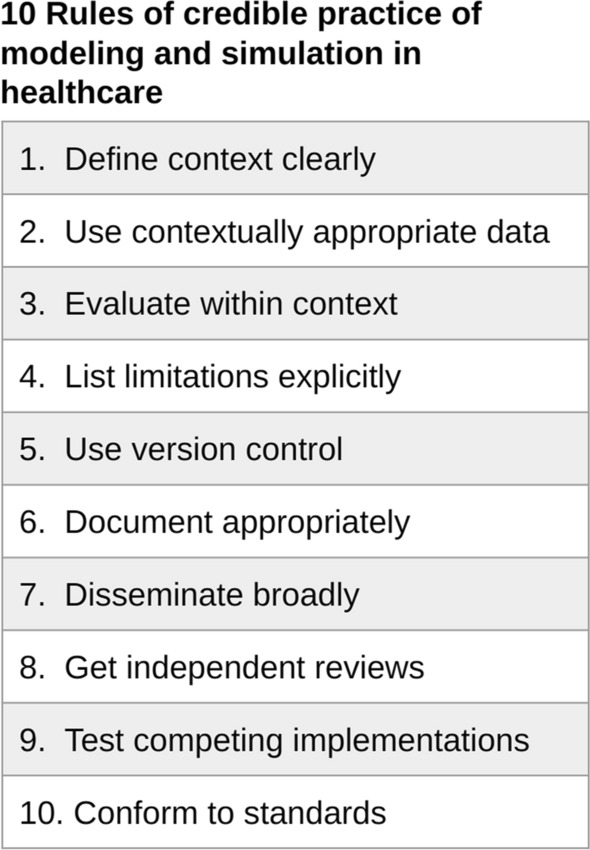
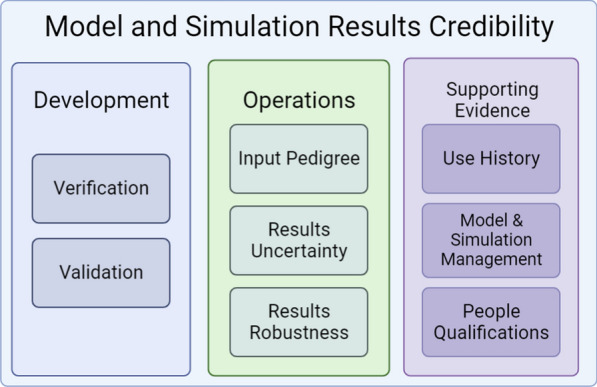
- Credibility standards in other fields are largely qualitative: NASA’s Credibility Assessment Scale has eight factors grouped into development, operations, and management, each scored 0–4; FDA guidance has ten categories and no scoring; EMA’s PBPK guideline requires sensitivity analysis, executable simulation files, and discussion of uncertainty.
- Automated model-testing tools exist—MEMOTE scores genome-scale metabolic models, and FROG analysis generates reproducible reference datasets—but the paper states that a high MEMOTE score is not itself an assessment of credibility.
Methods
- Narrative review and proposal; no new experimental data or primary sample are reported.
- The authors review current systems biology standards, credibility guidelines in systems biology and other fields, and tools for systems biology model testing.
- The main analysis is a conceptual synthesis arguing that existing standards could support development of a credibility standard for mechanistic systems biology models.
Limitations
- Stated: no standard for model credibility in systems biology exists; existing credibility standards are mostly qualitative and avoid specific recommendations; FDA guidelines are nonbinding and lack scoring; context-of-use dependence complicates automated credibility assessment.
- Stated: NASA’s CAS still has a significant subjective component, and different decision makers may assign different credibility to the same model.
- Evident from the text: this is a review and proposal without empirical validation or a concrete scoring rubric, and no systematic review methodology is described.
Model-written summary. Check it against the paper before relying on it.
Integrity signals
Registry
Cites
Statistics
Figures
Verification
Claims the paper makes
22 Valid · 3 Not valid · 18 Not checked · 47 Own results and interpretations
Every source the paper cites for this claim was checked and supports it.
In the paper
“With some extra effort, an additional 12% of the published models could be reproduced.”
§ Adapting modeling and simulation credibility standards to computational systems biology > Introduction
What the sources say
- Supportedcites [7] Krishna T Sarubini K Roberts Matthew G Meyer Johannes P Sharif SMU Ashley X Matthieu M Ahmad Z Jinghao M Szeyi N Nguyen Tung V Mihai G Henning H Malik-Sheriff RS Reproducibility in systems biology modelling Mol Syst Biol 2021 17 2 e9982 10.15252/msb.20209982 33620773 PMC7901289 source
The section “12% of the models could be reproduced with further effort” states that about 12% of all models were reproduced through empirical corrections or author support. Figure 1B repeats this result. The claim’s “additional” distinguishes these models from those reproduced directly, as the paper does. (LLM, conf=0.95)
hedgedstates a possible cause- Asserted: passes — The authors put it forward as true.
- Checkable: passes — It can be checked against evidence.
- Load-bearing: unclear — It is unclear whether the paper’s conclusions depend on it.
- Based: passes — The paper gives a reason why it holds.
- Supported
Every source the paper cites for this claim was checked and supports it.
In the paper
“Many modelers reproduce simulations by reading the simulation description in the corresponding publication [46].”
§ Adapting modeling and simulation credibility standards to computational systems biology > Current standards in systems biology > Simulation and parameter estimation
What the sources say
- Supportedcites [46] Waltemath D Adams R Beard DA Bergmann FT Bhalla US Britten R Chelliah V Cooling MT Cooper J Crampin EJ Garny A Hoops S Hucka M Hunter P Klipp E Laibe C Miller AK Moraru L Nickerson D Nielsen P Nikolski M Sahle S Sauro HM Schmidt H Snoep JL Tolle D Wolkenhauer O Le Novère N Minimum information about a simulation experiment (MIASE) PLoS Comput Biol 2011 7 4 e1001122 10.1371/journal.pcbi.1001122 21552546 PMC3084216 source
In “Needs for a Standard Description of Simulations Experiments,” the paper says that users typically read the simulation description in the corresponding publication when trying existing simulation protocols. This directly supports the citing sentence’s paraphrase. (LLM, conf=0.94)
plain- Asserted: passes — The authors put it forward as true.
- Checkable: passes — It can be checked against evidence.
- Load-bearing: passes — The paper’s conclusions depend on it.
- Based: passes — The paper gives a reason why it holds.
- Supported
The sources with a verdict support this claim; the rest weren’t checked yet, have no full text we could read, or their verdicts aren’t rated yet.
In the paper
“For this reason, systems biology model representation has become standardized using XML-based languages SBML [10, 13], CellML [14], and BioPAX [15].”
§ Adapting modeling and simulation credibility standards to computational systems biology > Current standards in systems biology > Model representation
What the sources say
- Not checked yetcites [10] Klipp E Wolfram Liebermeister 2007 Anselm Helbig Axel Kowald, and Jörg schaber. standards in computational systems biology 17420739 source
Checked before — its earlier verdict is held back until a new check runs.
- Supportedcites [13] Machado D Costa RS Rocha M Ferreira EC Tidor B Modeling formalisms in systems biology AMB Express 2011 1 45 10.1186/2191-0855-1-45 22141422 PMC3285092 source
The citation to this paper is attached to SBML, not to CellML or BioPAX. In the Standardization section, the paper calls SBML the de facto standard of the systems biology community and describes it as an XML-based language for model representation. (LLM, conf=0.94)
- Not checked — no full text of the sourcecites [14] Cuellar AA Lloyd CM Nielsen PF Bullivant DP Nickerson DP Hunter PJ An overview of CellML 1.1, a biological model description language Simulation 2003 79 12 740 747 10.1177/0037549703040939 source
- Supportedcites [15] Demir E Cary MP Paley S Fukuda K Lemer C Vastrik I Guanming W D’Eustachio P Schaefer C Luciano J Schacherer F Martinez-Flores I Zhenjun H Jimenez-Jacinto V Joshi-Tope G Kandasamy K Lopez-Fuentes AC Mi H Pichler E Rodchenkov I Splendiani A Tkachev S Zucker J Gopinath G Rajasimha H Ramakrishnan R Shah I Syed M Anwar N Babur O Blinov M Brauner E Corwin D Donaldson S Gibbons F Goldberg R Hornbeck P Luna A Murray-Rust P Neumann E Reubenacker O Samwald M van Iersel M Wimalaratne S Allen K Braun B Whirl-Carrillo M Dahlquist K Finney A Gillespie M Glass E Gong L Haw R Honig M Hubaut O Kane D Krupa S K source
The Implementation section describes BioPAX as a standard language for representing biological pathways. The Language evolution section states that its OWL-based ontology and data can be stored in an XML-based format. The BioPAX citation supports the BioPAX portion of the sentence; SBML and CellML have separate citations. (LLM, conf=0.91)
plainstates a cause- Asserted: passes — The authors put it forward as true.
- Checkable: passes — It can be checked against evidence.
- Load-bearing: unclear — It is unclear whether the paper’s conclusions depend on it.
- Based: passes — The paper gives a reason why it holds.
- Not checked yet
The cited sources support only part of this claim — read each source’s verdict below.
In the paper
“Due to the increasing importance of computational models in scientific discovery, the National Aeronautics and Space Administration (NASA), the FDA, and other regulatory bodies have developed standards to assess the credibility of models [4, 8, 9].”
§ Adapting modeling and simulation credibility standards to computational systems biology > Introduction
What the sources say
- Not matchedcites [4] Assessing the credibility of computational modeling and simulation in medical device submissions: Draft guidance for industry and food and drug administration staff. U.S. Food and Drug Administration, 2021.
We searched by its title and found no matching paper.
- Not matchedcites [8] Babula Maria, Bertch William, Green Lawrence, Hale Joseph, Mosier Gary, Steele Martin, Woods Jody. NASA Standard for Models and Simulations: Credibility Assessment Scale. In 47th AIAA Aerospace Sciences Meeting including The New Horizons Forum and Aerospace Exposition, Orlando, Florida. American Institute of Aeronautics and Astronautics.2007.
We searched by its title and found no matching paper.
- Partly supportedcites [9] Shepard T Scott G Cole S Nordmark A Bouzom F Physiologically based models in regulatory submissions: Output from the ABPI/MHRA forum on physiologically based modeling and simulation CPT Pharmacometrics Syst. Pharmacol. 2015 4 4 221 225 10.1002/psp4.30 26225245 PMC4429575 sourceExperimental — accuracy not yet measured
The European Regulatory Viewpoint (page unavailable) reports a published European PBPK concept paper and plans for a guideline on model qualification and reporting. It mentions an earlier FDA workshop, but does not say the FDA developed credibility standards; the Discussion Topics section says PBPK system-model qualification standards were not yet agreed. Our copy does not mention NASA. (LLM, conf=0.87)
plainstates a cause- Asserted: passes — The authors put it forward as true.
- Checkable: passes — It can be checked against evidence.
- Load-bearing: passes — The paper’s conclusions depend on it.
- Based: passes — The paper gives a reason why it holds.
- Not matched
The cited sources support only part of this claim — read each source’s verdict below.
In the paper
“It was recently discovered that 49% of published models undergoing the review and curation process for the BioModels [6] database were not reproducible primarily due to missing materials necessary for simulation, the availability of the model and code in public databases, and lack of documentation [7].”
§ Adapting modeling and simulation credibility standards to computational systems biology > Introduction
What the sources say
- Partly supportedcites [7] Krishna T Sarubini K Roberts Matthew G Meyer Johannes P Sharif SMU Ashley X Matthieu M Ahmad Z Jinghao M Szeyi N Nguyen Tung V Mihai G Henning H Malik-Sheriff RS Reproducibility in systems biology modelling Mol Syst Biol 2021 17 2 e9982 10.15252/msb.20209982 33620773 PMC7901289 sourceExperimental — accuracy not yet measured
Split into 2 atoms — 0 confirmed, 2 partially supported, 0 disputed, 0 misattributed, 0 unverifiable. Expand the claim to see per-atom verdicts.
plainstates a cause- Asserted: passes — The authors put it forward as true.
- Checkable: passes — It can be checked against evidence.
- Load-bearing: passes — The paper’s conclusions depend on it.
- Based: passes — The paper gives a reason why it holds.
- Partly supported
18 more claims · 2 with their cited sources checked
Create a free account to see all 90 claims and to verify the 13 references still open.
- Probably not a substantial claim. 44
- It may state two separate claims as one. 43
Citations
Cites
The FAIR Guiding Principles for scientific data management and stewardship
Wilkinson, M. D., Dumontier, M., Aalbersberg, I. J., Appleton, G., Axton, M., Baak, A., Blomberg, N., Boiten, J.-W., da Silva Santos, L. B., Bourne, P. E., et al. (2016) · Scientific Data · doi:10.1038/sdata.2016.18 · Cited by 18,423
UniProt: the Universal Protein knowledgebase
Apweiler, R. (2004) · Nucleic Acids Research · doi:10.1093/nar/gkh131 · Cited by 7,498
Hucka, M., Finney, A., Sauro, H. M., Bolouri, H., Doyle, J. C., Kitano, H., Arkin, A. P., Bornstein, B. J., Bray, D., Cornish-Bowden, A., et al. (2003) · Bioinformatics · doi:10.1093/bioinformatics/btg015 · Cited by 3,060
Self-citationChEBI in 2016: Improved services and an expanding collection of metabolites
Hastings, J., Owen, G., Dekker, A., Ennis, M., Kale, N., Muthukrishnan, V., Turner, S., Swainston, N., Mendes, P., & Steinbeck, C. (2016) · Nucleic Acids Research · doi:10.1093/nar/gkv1031 · Cited by 1,083
The systems biology graphical notation.
Novère, N. L., Hucka, M., Mi, H., Moodie, S., Schreiber, F., Sorokin, A., Demir, E., Wegner, K., Aladjem, M. I., Wimalaratne, S. M., et al. (2009) · Nature Biotechnology · doi:10.1038/nbt.1558 · Cited by 903 · cited 1×
“Although standards also exist for graphical representation of systems biology models (SBGN) [11] and representation of simulation results (SBRML) [12], these will not be discussed here as they are less relevant to the future implementation of model credibility standards.”
BackgroundSelf-citationUniform Resource Identifier (URI): Generic Syntax
Berners-Lee, T., Fielding, R., & Masinter, L. (2005) · doi:10.17487/rfc3986 · Cited by 815
Le Novere, N. (2006) · Nucleic Acids Research · doi:10.1093/nar/gkj092 · Cited by 762
The BioPAX community standard for pathway data sharing
Demir, E., Cary, M. P., Paley, S., Fukuda, K., Lemer, C., Vastrik, I., Wu, G., D'Eustachio, P., Schaefer, C., Luciano, J., et al. (2010) · Nature Biotechnology · doi:10.1038/nbt.1666 · Cited by 745
The Semantic Web: the roles of XML and RDF
Decker, S., Melnik, S., van Harmelen, F., Fensel, D., Klein, M., Broekstra, J., Erdmann, M., & Horrocks, I. (2000) · IEEE Internet Computing · doi:10.1109/4236.877487 · Cited by 743 · cited 7×
“RDF annotation is supported by the software libraries libSBML [44] and JSBML [45].”
MethodInfluentialDrug–target interaction prediction: databases, web servers and computational models
Chen, X., Yan, C. C., Zhang, X., Zhang, X., Dai, F., Yin, J., & Zhang, Y. (2016) · Briefings in Bioinformatics · doi:10.1093/bib/bbv066 · Cited by 658
Research works printed but not linked: 1
- Olivier BG Bergmann FT SBML level 3 package: flux balance constraints version 2 J. Integr. Bioinform. 2018 10.1515/jib-2017-0082 29522419 PMC6167036 · DOI · Paper page
Cited by
Microbiome modeling: a beginner's guide
Lange, E., Kranert, L., Krüger, J., Benndorf, D., & Heyer, R. (2024) · Frontiers in Microbiology · doi:10.3389/fmicb.2024.1368377 · Cited by 21
Multi-scale models of whole cells: progress and challenges
Georgouli, K., Yeom, J.-S., Blake, R., & Navid, A. (2023) · Frontiers in Cell and Developmental Biology · doi:10.3389/fcell.2023.1260507 · Cited by 27
“Developments of tools like Memote (Lieven et al., 2020) for standardizing the GEMs and FROG ensemble of analyses for ensuring reproducibility of published models (Tatka et al., 2023) have signi fi cantly increased con fi dence in the quality of models that will be incorporated in future WCMs.”
MethodTolk, A. (2023) · SIMULATION · doi:10.1177/00375497231216471 · Cited by 21
“41 There are more application domains than defense and healthcare, but these two are the most active ones and supported by numerous research projects.”
Cancer drug resistance as learning of signaling networks
Keresztes, D., Kerestély, M., Szarka, L., Kovács, B. M., Schulc, K., Veres, D. V., & Csermely, P. (2025) · Biomedicine & Pharmacotherapy · doi:10.1016/j.biopha.2025.117880 · Cited by 20
Michael, C. T., Almohri, S. A., Linderman, J. J., & Kirschner, D. E. (2024) · Frontiers in Systems Biology · doi:10.3389/fsysb.2023.1283341 · Cited by 18
Making PBPK models more reproducible in practice
Domínguez-Romero, E., Mazurenko, S., Scheringer, M., dos Santos, V. A. P. M., Evelo, C. T., Anton, M., Hancock, J. M., Županič, A., & Diez, M. S. (2024) · Briefings in Bioinformatics · doi:10.1093/bib/bbae569 · Cited by 16
van Kampen, A. H. C., Mahamune, U., Jongejan, A., van Schaik, B. D. C., Balashova, D., Lashgari, D., Pras‐Raves, M. L., Wever, E. J. M., Dane, A. D., García-Valiente, R., et al. (2024) · Nature Communications · doi:10.1038/s41467-024-52446-8 · Cited by 23
“…research, there are initiatives like the Minimum Information About a Simulation Experiment (MIASE) guidelines 110 , the corresponding simulation experiment description markup language (SED-ML) 111 , COMBINE/OMEX to share and reproduce modeling projects 112 , and a range of others 113 .”
Pathak, R. K., & Kim, J. (2024) · Briefings in Bioinformatics · doi:10.1093/bib/bbae025 · Cited by 12
“…mining, comparing the model output with experimental data, sensitivity analysis,optimizing the model through parameter estimation, conducting robustness testing and refining the model if errors are observed by adjusting parameters, reaction kinetics, to ensure accurate predictions [99–101].”
MethodUnderstanding molecular signaling cascades in neural disease using multi-resolution models
Viswan, N. A., & Bhalla, U. S. (2023) · Current Opinion in Neurobiology · doi:10.1016/j.conb.2023.102808 · Cited by 6
Černousova, A., & Patrono, E. (2025) · Frontiers in Neuroscience · doi:10.3389/fnins.2025.1653828 · Cited by 7
“Validation also includes ensuring the model is internally consistent, can be reproduced independently, and has been reviewed by domain experts who are not model developers (Fitzpatrick and Stefan, 2022; Tatka et al., 2023).”
From FAIR to CURE: guidelines for computational models of biological systems
Sauro, H. M., Agmon, E., Blinov, M. L., Gennari, J. H., Hellerstein, J. L., Heydarabadipour, A., Jardine, B., May, E. E., Nickerson, D. P., Smith, L. P., et al. (2026) · npj Systems Biology and Applications · doi:10.1038/s41540-026-00651-0 · Cited by 33
“We will not revisitthemany issues and recommendations concerning the reproducibility of computational experiments, and readers are referred to the many publications that have appeared in recent years 16,17,27,28,51 .”
Self-citationSystem level network data and models attack cancer drug resistance
Kerestély, M., Keresztes, D., Szarka, L., Kovács, B. M., Schulc, K., Veres, D. V., & Csermely, P. (2025) · British Journal of Pharmacology · doi:10.1111/bph.17469 · Cited by 6
“…(Dai et al., 2021; De Jonghe et al., 2024; Diamant et al., 2025; Eckhart et al., 2024; Feng et al., 2024; Jia et al., 2023; Niarakis et al., 2022; Panneerselvam et al., 2024; Piochi et al., 2023; Puniya et al., 2024; Szalai et al., 2023; Tatka et al., 2023; Touré et al., 2020; Wang et al., 2024).”
InfluentialFAIRification of computational models in biologyPreprint
Balaur, I., Nickerson, D. P., Welter, D., Wodke, J. A. H., Ancien, F., Gebhardt, T., Grouès, V., Hermjakob, H., König, M., Radde, N. E., et al. (2025) · bioRxiv (Cold Spring Harbor Laboratory) · doi:10.1101/2025.03.21.644517 · Cited by 2
“SBML or CellML files stored inside the archive. the Systems Biology Graphical Notation (SBGN) 17 files for graphical representations of the network. of”
Computational modelling of cardiovascular pathophysiology to risk stratify commercial spaceflight
Morris, P., Anderton, R. A., Marshall-Goebel, K. J., Britton, J. K., Lee, S. M. C., Smith, N. P., van de Vosse, F. N., Ong, K. M., Newman, T., Taylor, D., et al. (2024) · Nature Reviews Cardiology · doi:10.1038/s41569-024-01047-5 · Cited by 4
“142), which is recognized by the FDA 143 .”
He, X., Wang, X., Xiang, W., & Zhang, G. (2026) · AEU - International Journal of Electronics and Communications · doi:10.1016/j.aeue.2026.156411 · Cited by 1
Manchel, A., Erdemir, A., Mulugeta, L., Ku, J. P., Rego, B. V., Horner, M., Lytton, W. W., Myers, J. G., & Vadigepalli, R. (2025) · PLoS ONE · doi:10.1371/journal.pone.0313711 · Cited by 1
“Similarly, multiple standards exist for systems biology applications, which have been reviewed in Tatka et al. 2023 [8], that aim to address conceptual information, nomenclature, data formats, and representations of biochemical systems, and intend to improve the communication and sharing of M&S…”
InfluentialNASIRU, Z., BELLO, S., UMAR, A., et al. (2025) · Federal University Gusau Faculty of Education Journal · doi:10.64348/zije.2025128
“Biology teaching is central to science education, enabling learners to understand the natural world (Tatka et al., 2023).”
Modelling maternal cardiovascular adaptation to pregnancy: a scoping review
Hunt, K. F., Polydoros, I., van Loon, R., Townsend, R., & Reynolds, R. M. (2025) · BMC Pregnancy and Childbirth · doi:10.1186/s12884-025-08270-z · Cited by 4
“To realise the promise of this emerging field to improve maternal and fetal outcomes, models should be developed in line with agreed reproducibility and credibility standards, and validated in large, diverse pregnancy cohorts across a wide range of gestations [111].”
Cao, Z., Chen, B., Chen, Y., et al. (2026) · Measurement Science and Technology · doi:10.1088/1361-6501/ae6abc
Wang, X., Liu, M., Jia, M., Wang, Q., Li, X., Zou, Q., Huang, X., Zhang, L., Lv, X., Wang, J., et al. (2026) · The Innovation Oncology · doi:10.59717/j.xinn-oncol.2026.100027 · Cited by 1
Systems biology and multi-omics integration
Hossein‐Zadeh, N. G. (2026) · Elsevier eBooks · doi:10.1016/b978-0-443-45663-3.00006-3
XML Languages and Simulators for Analyzing Molecular Communications Systems
Cevallos, Y., Naranjo, P. G. V., Inca, D., Pilligua, E., Tello-Oquendo, L., León, M., Gómez, C. V., Tene, T., Svozilík, J., Bodero-Poveda, E., et al. (2026) · Signals and communication technology · doi:10.1007/978-3-032-33040-6_2
Chen, X., Li, T., Tong, W., & Chen, M. (2026) · Elsevier eBooks · doi:10.1016/b978-0-443-26514-3.00019-9
Metadata
- Authors
- Tatka, L. T., Smith, L. P., Hellerstein, J. L., & Sauro, H. M.
- Affiliations
- University of Washington (US)
- Corresponding author
- Tatka, Lillian T.
- Venue
- Journal of Translational Medicine
- Published
- 2023-07-26
- Volume
- 21
- Issue
- 1
- Pages
- 501-501
- ISSN
- 1479-5876 (ISSN-L)
- PMC
- PMC10369698
- OpenAlex
- W4385295938
- Semantic Scholar
- cc07b720b81ea5e28643364bb91a210705f239b5
- Cited by
- 27
- References
- 69
- Citations by year
- 2026: 11 · 2025: 7 · 2024: 6 · 2023: 3
- FWCI
- 2.65
- Type
- journal article
- Language
- en
- Open access
- gold
- doi.org
- Licence
- cc-by
- creativecommons.org/licenses/by/4.0 (tdm)
- creativecommons.org/licenses/by/4.0 (vor)
- Locations
- Journal of Translational Medicine (publishedVersion, cc-by)
- PubMed Central (publishedVersion, cc-by)
- PubMed (publishedVersion)
- arXiv (Cornell University) (submittedVersion, cc-by-nc-nd)
- DOAJ (DOAJ: Directory of Open Access Journals) (submittedVersion, cc-by-sa)
- arXiv (Cornell University)
- Funders
- National Institute of Biomedical Imaging and Bioengineering (P41GM109824)
- National Science Foundation (1933453)
- Topics
- Social Sciences › Arts and Humanities › History and Philosophy of Science › Philosophy of Biology and Scientific Explanation
- Social Sciences › Decision Sciences › Information Systems and Management › Scientific Computing and Data Management
- Life Sciences › Biochemistry, Genetics and Molecular Biology › Molecular Biology › Gene Regulatory Network Analysis
- Keywords
- computational systems biology, model credibility, modeling and simulation, regulatory standards, FDA, EMA, NASA, model validation, evidence-based decision making
- MeSH terms
- Computer Simulation, Computational Biology, Systems Biology
About these checks
Registry, retraction, Cites and statistics results are computed, not judged, with one exception: a printed reference that no index lists is read once by a model before it counts as a citation error. Claims are extracted by a model and kept only when their quote appears verbatim in the text; each cited source is then checked, with a model’s help, for whether it says what the claim relies on. Those verdicts can be wrong — read the claim’s quote and the cited source before relying on one.
The claim verdicts this report counts are experimental: their accuracy is not yet measured.
A language model drew the claims from the paper on 2026-10-10, under version 3 of the claim definition (model deepseek-v4.1-flash, prompt extract-v3).
A second model labelled each claim on 2026-10-10 (model jev-1.13-20260917, definition revision gold-guideline-v0.2).
Cited sources are checked with a language model’s help (gpt-6-sol).
Statistics and arithmetic are recomputed, not judged.
Confidence bands are shown only for fields calibrated on our annotated test set. None is calibrated yet, so no band is shown.
What counts as a claim ›How we measure confidence ›How we check this ›
Are you an author, or do you see a problem with this page? Request a review
Data sources
Bibliographic data: Semantic Scholar, OpenAlex, Crossref.
Contains information from the Semantic Scholar Academic Graph Datasets, made available under the ODC Attribution License (ODC-BY 1.0).
Semantic Scholar’s data is described in: Kinney, R., et al. (2023). The Semantic Scholar Open Data Platform. arXiv:2301.10140.
