

A systematic review and meta-analysis of carbohydrate benefits associated with randomized controlled competition-based performance trials
Open accessThe DOI matches its Crossref record; 72 of the 72 references it cites were found in a registry or an index.
Abstract
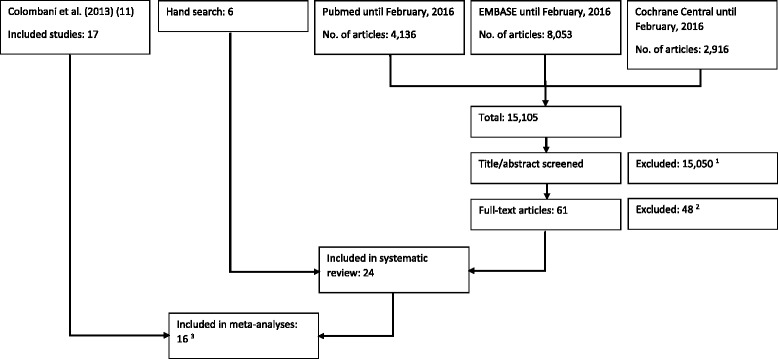
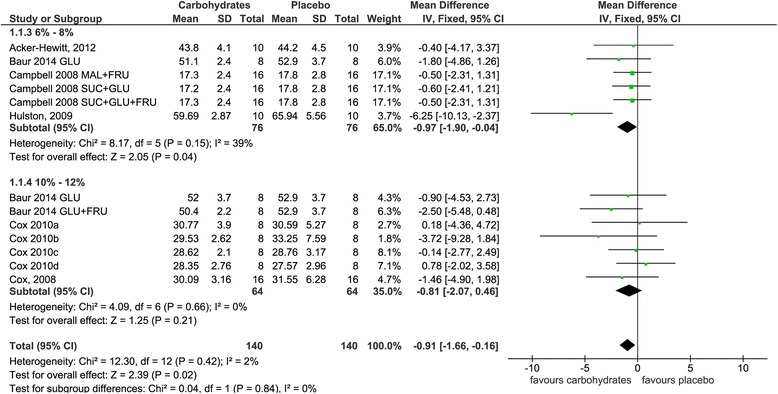
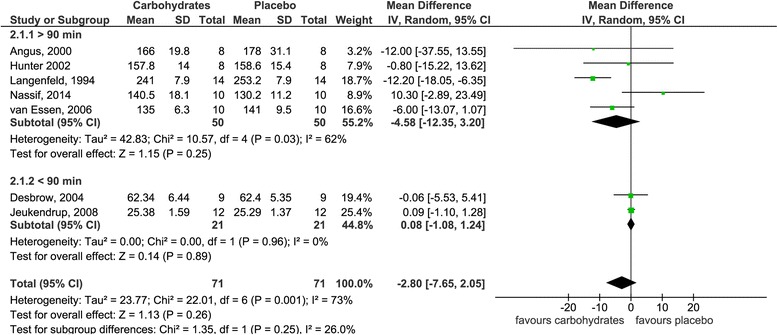
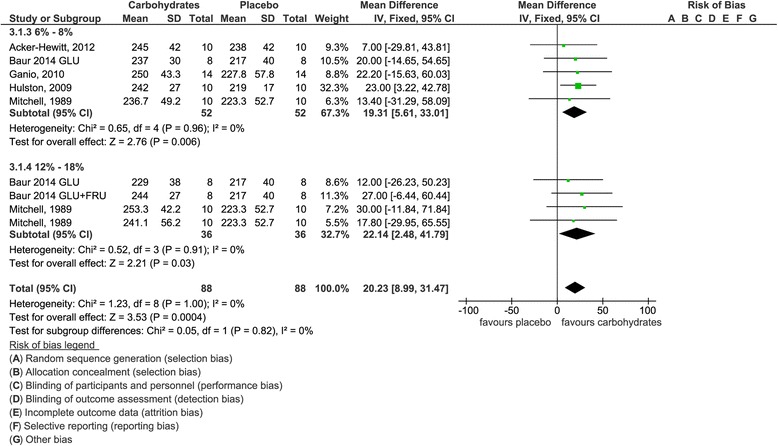
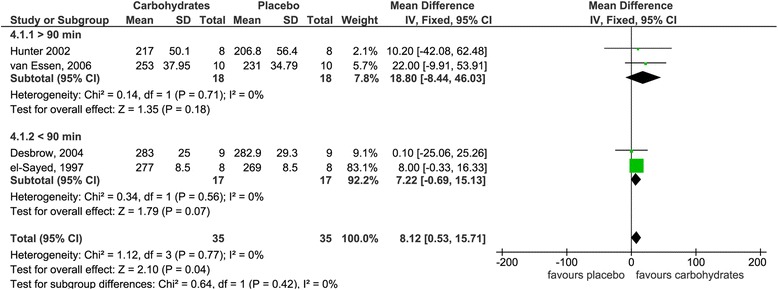
BACKGROUND: Carbohydrate supplements are widely used by athletes as an ergogenic aid before and during sports events. The present systematic review and meta-analysis aimed at synthesizing all available data from randomized controlled trials performed under real-life conditions. METHODS: MEDLINE, EMBASE, and the Cochrane Central Register of Controlled Trials were searched systematically up to February 2015. Study groups were categorized according to test mode and type of performance measurement. Subgroup analyses were done with reference to exercise duration and range of carbohydrate concentration. Random effects and fixed effect meta-analyses were performed using the Software package by the Cochrane Collaboration Review Manager 5.3. RESULTS: Twenty-four randomized controlled trials met the objectives and were included in the present systematic review, 16 of which provided data for meta-analyses. Carbohydrate supplementations were associated with a significantly shorter exercise time in groups performing submaximal exercise followed by a time trial [mean difference -0.9 min (95 % confidence interval -1.7, -0.2), p = 0.02] as compared to controls. Subgroup analysis showed that improvements were specific for studies administering a concentration of carbohydrates between 6 and 8 % [mean difference -1.0 min (95 % confidence interval -1.9, -0.0), p = 0.04]. Concerning groups with submaximal exercise followed by a time trial measuring power accomplished within a fixed time or distance, mean power output was significantly higher following carbohydrate load (mean difference 20.2 W (95 % confidence interval 9.0, 31.5), p = 0.0004]. Likewise, mean power output was significantly increased following carbohydrate intervention in groups with time trial measuring power within a fixed time or distance (mean difference 8.1 W (95 % confidence interval 0.5, 15.7) p = 0.04]. CONCLUSION: Due to the limitations of this systematic review, results can only be applied to a subset of athletes (trained male cyclists). For those, we could observe a potential ergogenic benefit of carbohydrate supplementation especially in a concentration range between 6 and 8 % when exercising longer than 90 min.
Overview
The claims and statistics of this paper haven’t been checked yet.
Free: it reads the open-access text and checks the first 5 claims that cite a source we can check. Create a free account to check every claim.
Integrity signals
Registry
Cites
Statistics
Figures
Verification
Claims the paper makes
The claims and statistics of this paper haven’t been checked yet.
Free: it reads the open-access text and checks the first 5 claims that cite a source we can check. Create a free account to check every claim.
Claims other papers make about this one
Each is checked against this paper’s own text: does it say what the citing paper says it does?
The source backs part of the claim, not all of it — or backs it for a different population, condition or comparison.
In the citing paper
“When considering duration, associated reviews have documented that bouts of moderate to intense exercise need to reach exercise durations that extend well into 90th minute of exercise before carbohydrate is shown to consistently yield an ergogenic outcome [41, 68, 69].”
From ISSN exercise & sports nutrition review update: research & recommendations (2018) · cites this paper as [68]
Experimental — accuracy not yet measuredThe source backs part of the claim, not all of it — or backs it for a different population, condition or comparison.
In the citing paper
“Notably, this strategy becomes even more important if the athlete is under-fueled prior to the exercise task or is fasted vs. unfasted at the start of exercise [68, 69, 129].”
From ISSN exercise & sports nutrition review update: research & recommendations (2018) · cites this paper as [68]
Experimental — accuracy not yet measuredThe source backs part of the claim, not all of it — or backs it for a different population, condition or comparison.
In the citing paper
“Research has clearly identified carbohydrate as an ergogenic aid that can prolong exercise [41, 68].”
From ISSN exercise & sports nutrition review update: research & recommendations (2018) · cites this paper as [68]
Experimental — accuracy not yet measuredThe source backs part of the claim, not all of it — or backs it for a different population, condition or comparison.
In the citing paper
“In both papers, the authors contend that the ability of carbohydrate administration during bouts of exercise spanning less than 70 min to operate in an ergogenic fashion is largely mixed in the literature. It was further suggested that not until exercise durations meet or exceed 90 min does the administration of a ~ 6–8% carbohydrate solution exert a consistent ergogenic benefit particularly when”
From International society of sports nutrition position stand: nutrient timing (2017) · cites this paper as [57]
Experimental — accuracy not yet measuredThe cited source says what the claim attributes to it.
In the citing paper
“Moreover, these reviews have also pointed to the impact of fasting status on documentation of ergogenic outcomes [41, 68, 69].”
From ISSN exercise & sports nutrition review update: research & recommendations (2018) · cites this paper as [68]
2 more claims about this paper
Create a free account to see every claim other papers make about this one.
Self-check
Percentages, sums and reported differences re-computed from the paper’s own numbers.
The self-check needs the paper’s full text.
Citations
Cites
Quantifying heterogeneity in a meta‐analysis
Higgins, J. P. T., & Thompson, S. G. (2002) · Statistics in Medicine · doi:10.1002/sim.1186 · Cited by 36,763 · cited 1×
“statistic to detect heterogeneity [17].”
Nutrition and Athletic Performance
(2009) · Medicine & Science in Sports & Exercise · doi:10.1249/mss.0b013e31890eb86 · Cited by 1,084 · cited 2×
“It has been indicated that during an overnight fast liver glycogen stores are reduced substantially by amounts as high as 80 % [1, 2].”
BackgroundMuscle glycogen utilization during prolonged strenuous exercise when fed carbohydrate
Coyle, E. F., Coggan, A. R., Hemmert, M. K., & Ivy, J. L. (1986) · Journal of Applied Physiology · doi:10.1152/jappl.1986.61.1.165 · Cited by 1,022 · cited 1×
“In general, this might be due to multiple factors including maintenance of blood glucose [55–57] and high levels of carbohydrate oxidation especially towards the end of exercise [58, 59], thus sparing liver glycogen [60–63], as well as a central effect of carbohydrates [48, 52].”
BackgroundValidity, Reliability and Sensitivity of Measures of Sporting Performance
Currell, K., & Jeukendrup, A. E. (2008) · Sports Medicine · doi:10.2165/00007256-200838040-00003 · Cited by 768 · cited 3×
“time trails), yielded better results with respect to validity, reliability and sensitivity as compared to time-to-exhaustion protocols [12].”
BackgroundResultInfluentialCarbohydrate sensing in the human mouth: effects on exercise performance and brain activity
Chambers, E. S., Bridge, M. W., & Jones, D. A. (2009) · The Journal of Physiology · doi:10.1113/jphysiol.2008.164285 · Cited by 594 · cited 3×
“It has been suggested that oral receptors within the mouth and the digestive tract sense carbohydrates and activate brain regions associated with reward and pleasure which may lead to enhanced performance [5, 10, 48].”
BackgroundA comparison of statistical methods for meta‐analysis
Brockwell, S. E., & Gordon, I. R. (2001) · Statistics in Medicine · doi:10.1002/sim.650 · Cited by 573
Carbohydrate intake during exercise and performance
Jeukendrup, A. E. (2004) · Nutrition · doi:10.1016/j.nut.2004.04.017 · Cited by 490
The effect of carbohydrate mouth rinse on 1-h cycle time trial performance
CARTER, J. M., JEUKENDRUP, A. E., & JONES, D. A. (2004) · Medicine & Science in Sports & Exercise · doi:10.1249/01.mss.0000147585.65709.6f · Cited by 437 · cited 2×
“However, most mouth rinse studies were conducted in a fasted state [48, 50, 52, 53] or had other limitations such as lack of or improper randomization [51, 54] or uncertain time of last ingested meal [49].”
BackgroundThe use of carbohydrates during exercise as an ergogenic aid
Cermak, N. M., & van Loon, L. J. C. (2013) · Sports Medicine · doi:10.1007/s40279-013-0079-0 · Cited by 300 · cited 2×
“Furthermore, 12 reviews [3–6, 9, 10, 19–24] concerning this topic were hand-searched for eligible studies, however no additional study fulfilling the search criteria was identified.”
Background1 Carbohydrate Ingestion During Prolonged Exercise: Effects on Metabolism and Performance
COGGAN, A. R., & COYLE, E. F. (1991) · Exercise and Sport Sciences Reviews · doi:10.1249/00003677-199101000-00001 · Cited by 294 · cited 1×
“Furthermore, 12 reviews [3–6, 9, 10, 19–24] concerning this topic were hand-searched for eligible studies, however no additional study fulfilling the search criteria was identified.”
Background
Cited by
ISSN exercise & sports nutrition review update: research & recommendations
Kerksick, C. M., Wilborn, C. D., Roberts, M. D., Smith-Ryan, A., Kleiner, S. M., Jäger, R., Collins, R., Cooke, M., Davis, J. N., Galvan, E., et al. (2018) · Journal of the International Society of Sports Nutrition · doi:10.1186/s12970-018-0242-y · Cited by 945
International society of sports nutrition position stand: nutrient timing
Kerksick, C. M., Arent, S., Schoenfeld, B. J., Stout, J. R., Campbell, B., Wilborn, C. D., Taylor, L., Kalman, D., Smith-Ryan, A. E., Kreider, R. B., et al. (2017) · Journal of the International Society of Sports Nutrition · doi:10.1186/s12970-017-0189-4 · Cited by 622
Heat Adaptation in Military Personnel: Mitigating Risk, Maximizing Performance
Parsons, I., Stacey, M. J., & Woods, D. R. (2019) · Frontiers in Physiology · doi:10.3389/fphys.2019.01485 · Cited by 105
Ogden, H. B., Child, R. B., Fallowfield, J. L., Delves, S. K., Westwood, C. S., & Layden, J. D. (2020) · Nutrients · doi:10.3390/nu12020537 · Cited by 84
“The ingestion of CHO pre-, during and post-exercise in athletic populations, is widely recommended to improve exercise performance [185], accelerate recovery [186] and maintain immune function [187].”
BackgroundBrietzke, C., Franco‐Alvarenga, P. E., Coelho‐Júnior, H. J., Silveira, R., Asano, R. Y., & Pires, F. O. (2018) · Sports Medicine · doi:10.1007/s40279-018-1029-7 · Cited by 74
McCartney, D., Desbrow, B., & Irwin, C. (2018) · Sports Medicine · doi:10.1007/s40279-017-0800-5 · Cited by 52
“Thus, this methodological approach may exaggerate the influence of CHO supplementation on subsequent athletic performance [8].”
BackgroundNutritional approaches to counter performance constraints in high‐level sports competition
Burke, L. M. (2021) · Experimental Physiology · doi:10.1113/ep088188 · Cited by 51
Pugh, J. N., Wagenmakers, A. J. M., Doran, D. A., Fleming, S. C., Fielding, B. A., Morton, J. P., & Close, G. L. (2020) · American Journal of Physiology-Endocrinology and Metabolism · doi:10.1152/ajpendo.00452.2019 · Cited by 46
“This performance benefit has since been reported in numerous publications, with exogenous carbohydrate ingestion showing ergogenic effects for endurance performance in most of these studies (39, 49).”
BackgroundLarrosa, M., Gil‐Izquierdo, Á., González‐Rodríguez, L. G., Alférez, M. J. M., Juan, A. F. S., Sánchez-Gómez, Á., Calvo‐Ayuso, N., Ramos-Álvarez, J. J., Fernández‐Lázaro, D., López-Grueso, R., et al. (2024) · Nutrition Reviews · doi:10.1093/nutrit/nuae082 · Cited by 70
Bourdas, D. I., Souglis, A. G., Zacharakis, E. D., Geladas, N. D., & Travlos, A. K. (2021) · Nutrients · doi:10.3390/nu13124223 · Cited by 51
King, A., Helms, E., Zinn, C., & Jukic, I. (2022) · Sports Medicine · doi:10.1007/s40279-022-01716-w · Cited by 33
“46) [76], and time to exhaustion (SMD = 0.”
BackgroundHartley, C., Carr, A., Bowe, S. J., Bredie, W. L. P., & Keast, R. S. J. (2022) · Sports Medicine · doi:10.1007/s40279-022-01658-3 · Cited by 34
“8 Meta‐Analysis Statistical Approach As previously discussed, the conventional meta-analytic method used in the current review is often used within previously published systematic reviews and meta-analyses [49, 51].”
BackgroundMethodInfluentialTan, J., Krasilshchikov, O., Kuan, G., Hashim, H. A., Aldhahi, M. I., Al-Mhanna, S. B., & Badicu, G. (2023) · Healthcare · doi:10.3390/healthcare11172443 · Cited by 23
Zhu, Y., Sun, F., Li, C., & Chow, D. H. K. (2020) · International Journal of Environmental Research and Public Health · doi:10.3390/ijerph17239037 · Cited by 17
“Research suggests that CHO ingestion during a soccer match maintains the blood glucose concentration and spares muscle glycogen, which may improve performance in soccer [6].”
BackgroundMetabolic adaptations to endurance training and nutrition strategies influencing performance
Earnest, C. P., Rothschild, J. A., Harnish, C., & Naderi, A. (2018) · Research in Sports Medicine · doi:10.1080/15438627.2018.1544134 · Cited by 19
Kinetic changes in sweat lactate following fatigue during constant workload exercise
Okawara, H., Sawada, T., Nakashima, D., Maeda, Y., Minoji, S., Morisue, T., Katsumata, Y., Matsumoto, M., Nakamura, M., & Nagura, T. (2022) · Physiological Reports · doi:10.14814/phy2.15169 · Cited by 16
Road gradient and cycling power: An observational study in male professional cyclists
Valenzuela, P. L., Mateo‐March, M., Muriel, X., Zabala, M., Lucía, A., Pallarés, J. G., & Barranco‐Gil, D. (2022) · Journal of science and medicine in sport · doi:10.1016/j.jsams.2022.10.001 · Cited by 13
Deli, C. K., Poulios, A., Georgakouli, K., Παπανικολάου, Κ., Papoutsis, A., Selemekou, M., Karathanos, V. Τ., Draganidis, D., Τσιόκανος, Α., Koutedakis, Y., et al. (2018) · Journal of Sports Sciences · doi:10.1080/02640414.2018.1442781 · Cited by 14
Mor, A., Kayacan, Y., İpekoğlu, G., & Arslanoğlu, E. (2018) · Archives of Physiology and Biochemistry · doi:10.1080/13813455.2018.1465098 · Cited by 16
Kozlowski, K. F., Ferrentino, A. R., & Cerny, F. (2020) · The Journal of Strength and Conditioning Research · doi:10.1519/jsc.0000000000003297 · Cited by 14
“Although much research exists to support ingestion of CHO beverages (11,22), little exists analyzing the effects of energy gels and at what frequency they should be ingested.”
BackgroundRequirements of Proteins, Carbohydrates, and Fats for Athletes
Kerksick, C. M. (2018) · Elsevier eBooks · doi:10.1016/b978-0-12-813922-6.00038-2 · Cited by 28
Keane, J., Shovlin, A., Devenney, S., Malone, S., Young, D., Coratella, G., Collins, K. D., & Shortall, M. (2020) · Nutrients · doi:10.3390/nu12071926 · Cited by 8
“One of the challenges faced by a practitioner when aiming to apply previous research findings is that several studies investigating the effects of CHO do so in a fasted state [20].”
BackgroundPapadopoulou, S. Κ., Kroustalloudi, E., Pagkalos, I. G., Κοκκινοπούλου, Ά., & Hassapidou, M. N. (2017) · Arab Journal of Nutrition and Exercise (AJNE) · doi:10.18502/ajne.v2i1.1242 · Cited by 7
“The main nutrient that can improve endurance and reduce fatigue is carbohydrates [20, 72], through maintaining blood glucose levels, CHO oxidation rates and preventing glycogen depletion [13].”
BackgroundSurgeon Energy Expenditure and Substrate Utilization During Simulated Spine Surgery
Whitney, D. C., Ives, S. J., Leonard, G. R., Vanderbrook, D. J., & Lawrence, J. P. (2019) · Journal of the American Academy of Orthopaedic Surgeons · doi:10.5435/jaaos-d-18-00284 · Cited by 7
STIMULANT-CONTAINING ENERGY DRINKS: What You Need to Know
Higgins, J. P., Babu, K. M., Deuster, P. A., & Shearer, J. (2018) · ACSMʼs Health & Fitness Journal · doi:10.1249/fit.0000000000000379 · Cited by 4
Absence of dietary control precludes solid conclusions for sport nutrition trials
Reis, C. E. G., Saunders, B., & da Costa, T. H. M. (2020) · Journal of science and medicine in sport · doi:10.1016/j.jsams.2020.11.017 · Cited by 5
Wąsacz, W., Rydzik, Ł., Kryst, Ł., Spieszny, M., Jaworski, J., & Ambroży, T. (2025) · Applied Sciences · doi:10.3390/app151810048 · Cited by 2
Okawara, H., Sawada, T., Nakashima, D., Maeda, Y., Minoji, S., Morisue, T., Katsumata, Y., Matsumoto, M., Nakamura, M., & Nagura, T. (2022) · Sensors · doi:10.3390/s22155473 · Cited by 4
“The participants were asked to refrain from consuming any food and caffeine for 3 [22] and 12 h, respectively [23], before the exercise test.”
MethodMora-Fernández, A., López-Grueso, R., Conde-Pipó, J., Latorre, J. A., Giménez-Blasi, N., & Mariscal‐Arcas, M. (2025) · Science & Sports · doi:10.1016/j.scispo.2024.10.004 · Cited by 1
A novel fatigue monitoring system using sweat lactate: a preliminary study
Takemoto, A., Okawara, H., Sudo, T., Sawada, T., Hirakawa, R., Muramoto, Y., Katsumata, Y., Nakamura, M., Nagura, T., & Nakashima, D. (2025) · Fatigue Biomedicine Health & Behavior · doi:10.1080/21641846.2025.2554557 · Cited by 3
“On the day of each test, the participants were instructed to avoid any food intake for 3 h [18, 19] and the consumption of caffeine [20] or alcohol for 12 h.”
Efecto del consumo de hidratos de carbono en los deportes de resistencia
López-Solís, R., Camacho‐Díaz, B. H., Campos‐Mendiola, R., & Ortiz-Rodríguez, M. A. (2019) · Revista de Didáctica Práctica · doi:10.35429/jpd.2019.9.3.1.7 · Cited by 1
Understanding the composition of sports recovery drinks, a necessity for adequate prescription
Urrialde, R. (2021) · Archivos de medicina del deporte: revista de la Federación Española de Medicina del Deporte y de la Confederación Iberoamericana de Medicina del Deporte · doi:10.18176/archmeddeporte.00055 · Cited by 1
Alimentos vs. suplementos fontes de carboidratos: Efeitos na performance
Jackix, E. D. A. (2019) · Revista Brasileira de Nutrição Funcional · doi:10.32809/2176-4522.42.77.02 · Cited by 1
van der Weyden, M. S., Martin, J. R., Rodriguez, J., & Boolani, A. (2023) · Sports · doi:10.3390/sports11040088 · Cited by 2
Onuma, N., Shindo, D., Matsuo, E., Sakazaki, M., Nagai, Y., & Yamanaka, K. (2023) · BMC Sports Science Medicine and Rehabilitation · doi:10.1186/s13102-023-00702-7 · Cited by 3
Optimal Nutrition for Endurance Exercise: A Systematic Review
Andrus, B. W. (2017) · Journal of Nutritional Health & Food Science · doi:10.15226/jnhfs.2017.00198 · Cited by 1
Effects of Commercial Isotonic Sports Drinks during Intermittent Exertion
Zart, S., & Fröhlich, M. (2019) · International Journal of Kinesiology and Sports Science · doi:10.7575/aiac.ijkss.v.7n.1p.1 · Cited by 4
Fuentes-Barría, H., Aguilera-Eguía, R. A., González-Wong, C., Flores-Fernández, C., Herrera-Serna, B. Y., Pérez, D. I. V., & Urbano-Cerda, S. (2020) · Universidad y Salud · doi:10.22267/rus.202203.200 · Cited by 2
Effects of carbohydrate restriction on exercise performance
Shiose, K. (2017) · 体力科學 · doi:10.7600/jspfsm.66.125 · Cited by 1
Blennerhassett, C. (2018) · Edge Hill University
Pugh, J. N. (2019) · Liverpool John Moores University · doi:10.24377/ljmu.t.00010815 · Cited by 1
Staudt, J. S., Rodrigues, L., & Rodrigues, R. (2018) · Revista Portuguesa de Ciências do Desporto · doi:10.5628/rpcd.18.03.16
Editorial: Ser professor com a ajuda de Nietzsche (2)
dos Santos, J. A. R. (2018) · Revista Portuguesa de Ciências do Desporto · doi:10.5628/rpcd.18.03.09
Heat Acclimation for Special Populations
(2020) · Frontiers research topics · doi:10.3389/978-2-88966-018-6 · Cited by 1
Optimizing Nutrition for Exercise and Sports
Gonzalez, D. E., Latt, S. L., Blalock, T., Leutholtz, B., & Kreider, R. B. (2023) · Nutrition and health · doi:10.1007/978-3-031-24663-0_29
Exercise and sports performance
Zinn, C., Harvey, C., Noakes, T. D., Smith, J. A. H., Webster, C. C., & Sáenz, C. (2023) · Elsevier eBooks · doi:10.1016/b978-0-12-821617-0.00013-9
ULUSOY, Y., & KOÇAK, F. (2023) · International Journal of Disabilities Sports & Health Sciences · doi:10.33438/ijdshs.1350939 · Cited by 1
Lee, S. J. L., van Rens, F. E. C. A., & Peiffer, J. J. (2024) · International Journal of Sports Physiology and Performance · doi:10.1123/ijspp.2023-0143
Unpacking the impacts of caffeine containing energy drinks on athletic performance
Martin, J., & Shearer, J. (2025) · Elsevier eBooks · doi:10.1016/b978-0-443-13803-4.00008-2
Elibol, E., Çaylak, B. N., & Göl, S. (2025) · BMC Sports Science Medicine and Rehabilitation · doi:10.1186/s13102-025-01116-3 · Cited by 1
“Carbohydrates are essential for replenishing glycogen stores and preventing low blood sugar, both of which help enhance performance [4].”
Tarrit, B., Moretton, C., Duclos, M., Metz, L., Chanséaume, E., Ennequin, G., Thivel, D., & RANNOU, F. (2026) · The Journal of Sports Medicine and Physical Fitness · doi:10.23736/s0022-4707.25.17488-4
Salame, A., Brown, D., Oueijan, K., & McCullough, D. (2026) · Journal of the International Society of Sports Nutrition · doi:10.1080/15502783.2026.2669307 · Cited by 1
“Overall, whether the results of this review differ from those observed under thermoneutral conditions [75], partly due to gastrointestinal distress, merits further investigation.”
Shinagawa, A., Myoenzono, K., Takai, E., Ohno, H., Namma-Motonaga, K., Kamihigashi, E., Kamahara, K., & Kamei, A. (2026) · Frontiers in Sports and Active Living · doi:10.3389/fspor.2026.1892171
“When studies indicate the effectiveness of sports foods, such as sports gels and sports drinks (27 – 29), these options can be recommended for supplementary food intake and hydration.”
Енергоефективні теплотехнології сухих порошкових композитних білково-вуглеводних концентратів
AVRAMENKO, A., Авдєєва, Л. Ю., Maletska, K. D., Turchyna, T., Макаренко, А. А., & Декуша, Г. В. (2026) · Publishing House "Akademperiodyka" of the National Academy of Sciences of Ukraine eBooks · doi:10.15407/akademperiodyka.593.154
Engeroff, T., Niederer, D., & Groneberg, D. A. (2026) · Research Square · doi:10.21203/rs.3.rs-10961054/v1
Metadata
- Authors
- Pöchmüller, M., Schwingshackl, L., Colombani, P. C., & Hoffmann, G.
- Affiliations
- University of Vienna (AT)
- German Institute of Human Nutrition (DE)
- Swiss Federal Institute of Sport Magglingen SFISM (CH)
- Corresponding author
- Hoffmann, Georg
- Venue
- Journal of the International Society of Sports Nutrition
- Publisher
- Informa UK Limited
- Published
- 2016-01-05
- Volume
- 13
- Issue
- 1
- Pages
- 27-27
- ISSN
- 1550-2783 (ISSN-L)
- PMC
- PMC4940907
- OpenAlex
- W2461539100
- Cited by
- 56
- References
- 72
- Citations by year
- 2026: 5 · 2025: 5 · 2024: 2 · 2023: 6 · 2022: 5 · 2021: 3 · 2020: 8 · 2019: 6 · 2018: 11 · 2017: 5
- FWCI
- 0.80
- Type
- journal article
- Language
- en
- Open access
- gold
- doi.org
- Licence
- Locations
- Journal of the International Society of Sports Nutrition (publishedVersion, other-oa)
- PubMed Central (publishedVersion, cc-by)
- PubMed (publishedVersion)
- Phaidra (Universität Wien) (submittedVersion, cc-by-nc-nd)
- Informationszentrum Lebenswissenschaften (ZB MED) (submittedVersion, cc-by)
- Funders
- Universität Wien
- Topics
- Health Sciences › Nursing › Nutrition and Dietetics › Muscle metabolism and nutrition
- Health Sciences › Medicine › Orthopedics and Sports Medicine › Sports Performance and Training
- Health Sciences › Medicine › Physiology (medical) › Cardiovascular and exercise physiology
- Keywords
- carbohydrate supplementation, ergogenic aids, endurance exercise, time trial performance, output power, carbohydrate concentration, cyclists, exercise duration, submaximal exercise
- MeSH terms
- Bicycling, Dietary Carbohydrates, Humans, Exercise, Randomized Controlled Trials as Topic, Dietary Supplements, Athletic Performance, Athletes, Sports Nutritional Physiological Phenomena
About these checks
Registry, retraction, Cites and statistics results are computed, not judged, with one exception: a printed reference that no index lists is read once by a model before it counts as a citation error. Claims are extracted by a model and kept only when their quote appears verbatim in the text; each cited source is then checked, with a model’s help, for whether it says what the claim relies on. Those verdicts can be wrong — read the claim’s quote and the cited source before relying on one.
Statistics and arithmetic are recomputed, not judged.
Confidence bands are shown only for fields calibrated on our annotated test set. None is calibrated yet, so no band is shown.
What counts as a claim ›How we measure confidence ›How we check this ›
Are you an author, or do you see a problem with this page? Request a review
Data sources
Bibliographic data: Semantic Scholar, OpenAlex, Crossref.
Contains information from the Semantic Scholar Academic Graph Datasets, made available under the ODC Attribution License (ODC-BY 1.0).
Semantic Scholar’s data is described in: Kinney, R., et al. (2023). The Semantic Scholar Open Data Platform. arXiv:2301.10140.
