

A systematic review and meta-analysis of carbohydrate benefits associated with randomized controlled competition-based performance trials
Open accessThe DOI matches its Crossref record; 72 of the 72 references it cites were found in a registry or an index.
Abstract
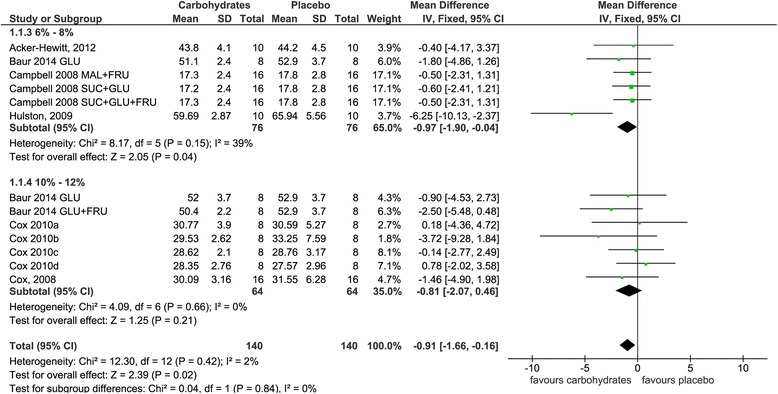
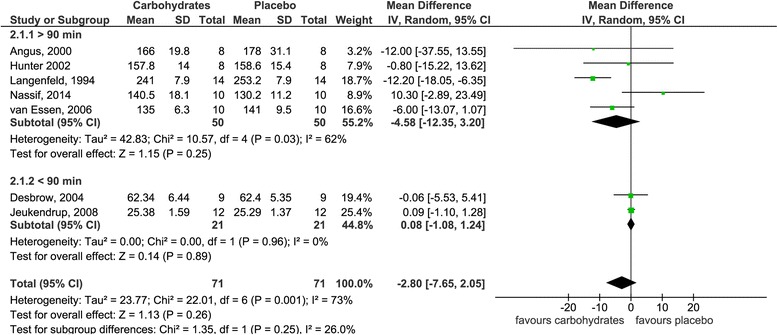
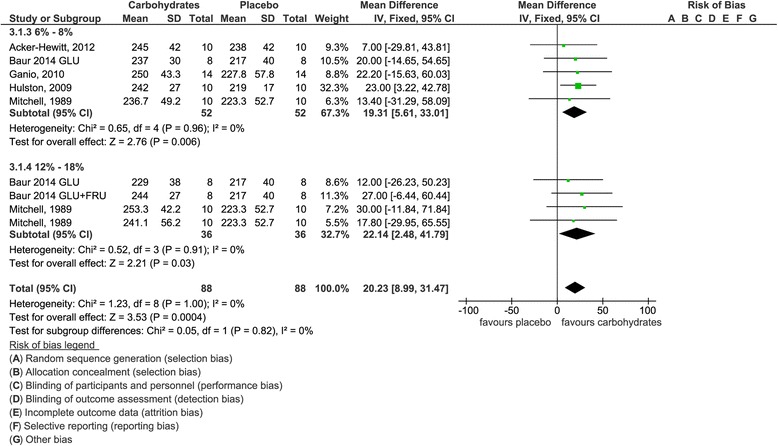
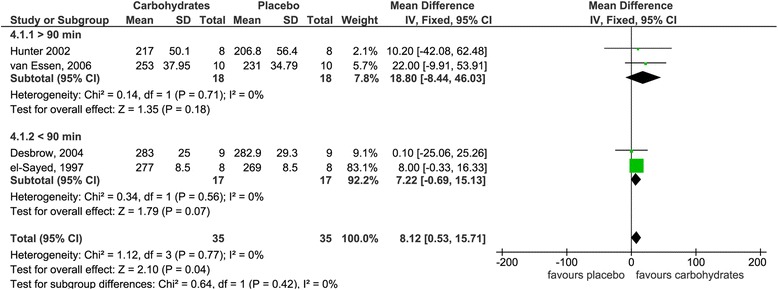
BACKGROUND: Carbohydrate supplements are widely used by athletes as an ergogenic aid before and during sports events. The present systematic review and meta-analysis aimed at synthesizing all available data from randomized controlled trials performed under real-life conditions. METHODS: MEDLINE, EMBASE, and the Cochrane Central Register of Controlled Trials were searched systematically up to February 2015. Study groups were categorized according to test mode and type of performance measurement. Subgroup analyses were done with reference to exercise duration and range of carbohydrate concentration. Random effects and fixed effect meta-analyses were performed using the Software package by the Cochrane Collaboration Review Manager 5.3. RESULTS: Twenty-four randomized controlled trials met the objectives and were included in the present systematic review, 16 of which provided data for meta-analyses. Carbohydrate supplementations were associated with a significantly shorter exercise time in groups performing submaximal exercise followed by a time trial [mean difference -0.9 min (95 % confidence interval -1.7, -0.2), p = 0.02] as compared to controls. Subgroup analysis showed that improvements were specific for studies administering a concentration of carbohydrates between 6 and 8 % [mean difference -1.0 min (95 % confidence interval -1.9, -0.0), p = 0.04]. Concerning groups with submaximal exercise followed by a time trial measuring power accomplished within a fixed time or distance, mean power output was significantly higher following carbohydrate load (mean difference 20.2 W (95 % confidence interval 9.0, 31.5), p = 0.0004]. Likewise, mean power output was significantly increased following carbohydrate intervention in groups with time trial measuring power within a fixed time or distance (mean difference 8.1 W (95 % confidence interval 0.5, 15.7) p = 0.04]. CONCLUSION: Due to the limitations of this systematic review, results can only be applied to a subset of athletes (trained male cyclists). For those, we could observe a potential ergogenic benefit of carbohydrate supplementation especially in a concentration range between 6 and 8 % when exercising longer than 90 min.
Overview
The claims and statistics of this paper haven’t been checked yet.
Free: it reads the open-access text and checks the first 5 claims that cite a source we can check. Create a free account to check every claim.
Integrity signals
Registry
Cites
Statistics
Figures
Verification
Claims the paper makes
The claims and statistics of this paper haven’t been checked yet.
Free: it reads the open-access text and checks the first 5 claims that cite a source we can check. Create a free account to check every claim.
Claims other papers make about this one
Each is checked against this paper’s own text: does it say what the citing paper says it does?
The source backs part of the claim, not all of it — or backs it for a different population, condition or comparison.
In the citing paper
“When considering duration, associated reviews have documented that bouts of moderate to intense exercise need to reach exercise durations that extend well into 90th minute of exercise before carbohydrate is shown to consistently yield an ergogenic outcome [41, 68, 69].”
From ISSN exercise & sports nutrition review update: research & recommendations (2018) · cites this paper as [68]
Experimental — accuracy not yet measuredThe source backs part of the claim, not all of it — or backs it for a different population, condition or comparison.
In the citing paper
“Notably, this strategy becomes even more important if the athlete is under-fueled prior to the exercise task or is fasted vs. unfasted at the start of exercise [68, 69, 129].”
From ISSN exercise & sports nutrition review update: research & recommendations (2018) · cites this paper as [68]
Experimental — accuracy not yet measuredThe source backs part of the claim, not all of it — or backs it for a different population, condition or comparison.
In the citing paper
“Research has clearly identified carbohydrate as an ergogenic aid that can prolong exercise [41, 68].”
From ISSN exercise & sports nutrition review update: research & recommendations (2018) · cites this paper as [68]
Experimental — accuracy not yet measuredThe source backs part of the claim, not all of it — or backs it for a different population, condition or comparison.
In the citing paper
“In both papers, the authors contend that the ability of carbohydrate administration during bouts of exercise spanning less than 70 min to operate in an ergogenic fashion is largely mixed in the literature. It was further suggested that not until exercise durations meet or exceed 90 min does the administration of a ~ 6–8% carbohydrate solution exert a consistent ergogenic benefit particularly when”
From International society of sports nutrition position stand: nutrient timing (2017) · cites this paper as [57]
Experimental — accuracy not yet measuredThe cited source says what the claim attributes to it.
In the citing paper
“Moreover, these reviews have also pointed to the impact of fasting status on documentation of ergogenic outcomes [41, 68, 69].”
From ISSN exercise & sports nutrition review update: research & recommendations (2018) · cites this paper as [68]
2 more claims about this paper
Create a free account to see every claim other papers make about this one.
Self-check
Percentages, sums and reported differences re-computed from the paper’s own numbers.
The self-check needs the paper’s full text.
Citations
Cites
Quantifying heterogeneity in a meta‐analysis
Higgins, J. P. T., & Thompson, S. G. (2002) · Statistics in Medicine · doi:10.1002/sim.1186 · Cited by 36,763 · cited 1×
“statistic to detect heterogeneity [17].”
Nutrition and Athletic Performance
(2009) · Medicine & Science in Sports & Exercise · doi:10.1249/mss.0b013e31890eb86 · Cited by 1,084 · cited 2×
“It has been indicated that during an overnight fast liver glycogen stores are reduced substantially by amounts as high as 80 % [1, 2].”
BackgroundMuscle glycogen utilization during prolonged strenuous exercise when fed carbohydrate
Coyle, E. F., Coggan, A. R., Hemmert, M. K., & Ivy, J. L. (1986) · Journal of Applied Physiology · doi:10.1152/jappl.1986.61.1.165 · Cited by 1,022 · cited 1×
“In general, this might be due to multiple factors including maintenance of blood glucose [55–57] and high levels of carbohydrate oxidation especially towards the end of exercise [58, 59], thus sparing liver glycogen [60–63], as well as a central effect of carbohydrates [48, 52].”
BackgroundValidity, Reliability and Sensitivity of Measures of Sporting Performance
Currell, K., & Jeukendrup, A. E. (2008) · Sports Medicine · doi:10.2165/00007256-200838040-00003 · Cited by 768 · cited 3×
“time trails), yielded better results with respect to validity, reliability and sensitivity as compared to time-to-exhaustion protocols [12].”
BackgroundResultInfluentialCarbohydrate sensing in the human mouth: effects on exercise performance and brain activity
Chambers, E. S., Bridge, M. W., & Jones, D. A. (2009) · The Journal of Physiology · doi:10.1113/jphysiol.2008.164285 · Cited by 594 · cited 3×
“It has been suggested that oral receptors within the mouth and the digestive tract sense carbohydrates and activate brain regions associated with reward and pleasure which may lead to enhanced performance [5, 10, 48].”
BackgroundA comparison of statistical methods for meta‐analysis
Brockwell, S. E., & Gordon, I. R. (2001) · Statistics in Medicine · doi:10.1002/sim.650 · Cited by 573
Carbohydrate intake during exercise and performance
Jeukendrup, A. E. (2004) · Nutrition · doi:10.1016/j.nut.2004.04.017 · Cited by 490
The effect of carbohydrate mouth rinse on 1-h cycle time trial performance
CARTER, J. M., JEUKENDRUP, A. E., & JONES, D. A. (2004) · Medicine & Science in Sports & Exercise · doi:10.1249/01.mss.0000147585.65709.6f · Cited by 437 · cited 2×
“However, most mouth rinse studies were conducted in a fasted state [48, 50, 52, 53] or had other limitations such as lack of or improper randomization [51, 54] or uncertain time of last ingested meal [49].”
BackgroundThe use of carbohydrates during exercise as an ergogenic aid
Cermak, N. M., & van Loon, L. J. C. (2013) · Sports Medicine · doi:10.1007/s40279-013-0079-0 · Cited by 300 · cited 2×
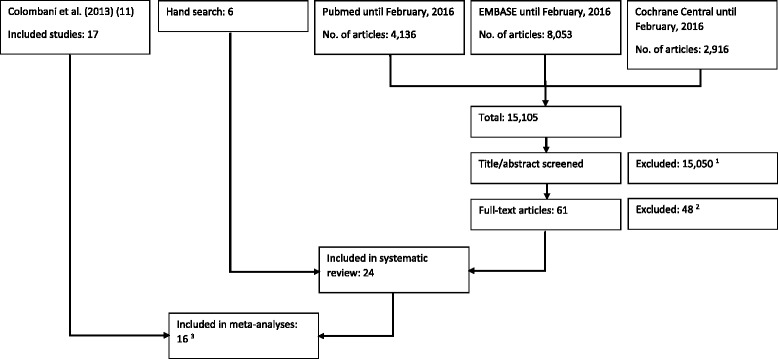
“Furthermore, 12 reviews [3–6, 9, 10, 19–24] concerning this topic were hand-searched for eligible studies, however no additional study fulfilling the search criteria was identified.”
Background1 Carbohydrate Ingestion During Prolonged Exercise: Effects on Metabolism and Performance
COGGAN, A. R., & COYLE, E. F. (1991) · Exercise and Sport Sciences Reviews · doi:10.1249/00003677-199101000-00001 · Cited by 294 · cited 1×
“Furthermore, 12 reviews [3–6, 9, 10, 19–24] concerning this topic were hand-searched for eligible studies, however no additional study fulfilling the search criteria was identified.”
BackgroundCarbohydrate-Electrolyte Feedings Improve 1 h Time Trial Cycling Performance
Jeukendrup, A., Brouns, F., Wagenmakers, A., & Saris, W. (1997) · International Journal of Sports Medicine · doi:10.1055/s-2007-972607 · Cited by 271
Carbohydrate-Loading and Exercise Performance: An Update
Hawley, J. A., Schabort, E. J., Noakes, T. D., & Dennis, S. C. (1997) · Sports Medicine · doi:10.2165/00007256-199724020-00001 · Cited by 263
Stellingwerff, T., & Cox, G. R. (2014) · Applied Physiology, Nutrition, and Metabolism · doi:10.1139/apnm-2014-0027 · Cited by 246 · cited 2×
“Furthermore, 12 reviews [3–6, 9, 10, 19–24] concerning this topic were hand-searched for eligible studies, however no additional study fulfilling the search criteria was identified.”
BackgroundSuperior Endurance Performance with Ingestion of Multiple Transportable Carbohydrates
CURRELL, K., & JEUKENDRUP, A. E. (2008) · Medicine & Science in Sports & Exercise · doi:10.1249/mss.0b013e31815adf19 · Cited by 243 · cited 1×
“It has been suggested that the ingestion of carbohydrates that use different, not competing, transporters increases the maximal carbohydrate oxidation rate (up to 105 g/h) [66], which has been verified by numerous studies [24, 39, 67–69].”
ResultThe Effectiveness of Commercially Available Sports Drinks
Coombes, J. S., & Hamilton, K. L. (2000) · Sports Medicine · doi:10.2165/00007256-200029030-00004 · Cited by 205 · cited 1×
“Furthermore, 12 reviews [3–6, 9, 10, 19–24] concerning this topic were hand-searched for eligible studies, however no additional study fulfilling the search criteria was identified.”
BackgroundInfluence of carbohydrate loading on fuel substrate turnover and oxidation during prolonged exercise
Bosch, A. N., Dennis, S. C., & Noakes, T. D. (1993) · Journal of Applied Physiology · doi:10.1152/jappl.1993.74.4.1921 · Cited by 196 · cited 1×
“In general, this might be due to multiple factors including maintenance of blood glucose [55–57] and high levels of carbohydrate oxidation especially towards the end of exercise [58, 59], thus sparing liver glycogen [60–63], as well as a central effect of carbohydrates [48, 52].”
BackgroundBurke, L. M., & Deakin, V. (2002) · Acquire (CQUniversity) · Cited by 195
Jeukendrup, A. E., Raben, A., Gijsen, A., Stegen, J. H. C. H., Brouns, F., Saris, W. H. M., & Wagenmakers, A. J. M. (1999) · The Journal of Physiology · doi:10.1111/j.1469-7793.1999.579ac.x · Cited by 178 · cited 1×
“In general, this might be due to multiple factors including maintenance of blood glucose [55–57] and high levels of carbohydrate oxidation especially towards the end of exercise [58, 59], thus sparing liver glycogen [60–63], as well as a central effect of carbohydrates [48, 52].”
BackgroundJentjens, R. L. P. G., & Jeukendrup, A. E. (2005) · British Journal of Nutrition · doi:10.1079/bjn20041368 · Cited by 171 · cited 1×
“It has been suggested that the ingestion of carbohydrates that use different, not competing, transporters increases the maximal carbohydrate oxidation rate (up to 105 g/h) [66], which has been verified by numerous studies [24, 39, 67–69].”
ResultMouth rinse but not ingestion of a carbohydrate solution improves 1‐h cycle time trial performance
Pottier, A., Bouckaert, J., Gilis, W., Roels, T., & Derave, W. (2010) · Scandinavian Journal of Medicine & Science in Sports · doi:10.1111/j.1600-0838.2008.00868.x · Cited by 167 · cited 1×
“However, most mouth rinse studies were conducted in a fasted state [48, 50, 52, 53] or had other limitations such as lack of or improper randomization [51, 54] or uncertain time of last ingested meal [49].”
BackgroundCox, G. R., Clark, S. A., Cox, A. J., Halson, S. L., Hargreaves, M., Hawley, J. A., Jeacocke, N., Snow, R. J., Yeo, W. K., & Burke, L. M. (2010) · Journal of Applied Physiology · doi:10.1152/japplphysiol.00950.2009 · Cited by 165 · cited 2×
“, 2010 [36] CHO vs.”
BackgroundIs the Gut an Athletic Organ?: Digestion, Absorption and Exercise
Brouns, F., & Beckers, E. (1993) · Sports Medicine · doi:10.2165/00007256-199315040-00003 · Cited by 156 · cited 1×
“A high dose of ingested carbohydrates while exercising may cause gastrointestinal discomfort [64] which subsequently may decrease performance [65].”
BackgroundMetabolism and performance following carbohydrate ingestion late in exercise
COGGAN, A. R., & COYLE, E. F. (1989) · Medicine & Science in Sports & Exercise · doi:10.1249/00005768-198902000-00011 · Cited by 153 · cited 1×
“In general, this might be due to multiple factors including maintenance of blood glucose [55–57] and high levels of carbohydrate oxidation especially towards the end of exercise [58, 59], thus sparing liver glycogen [60–63], as well as a central effect of carbohydrates [48, 52].”
BackgroundCarbohydrate Mouth Rinsing in the Fed State: Lack of Enhancement of Time-Trial Performance
Beelen, M., Berghuis, J., Bonaparte, B., Ballak, S. B., Jeukendrup, A. E., & van Loon, L. J. C. (2009) · International Journal of Sport Nutrition and Exercise Metabolism · doi:10.1123/ijsnem.19.4.400 · Cited by 152 · cited 5×
“We found one eligible study [27] with a mouth-rinse intervention, the remaining 21 studies compared the effect of a carbohydrate-containing drink versus a noncarbohydrate placebo.”
BackgroundInfluentialLane, S. C., Bird, S. R., Burke, L. M., & Hawley, J. A. (2013) · Applied Physiology, Nutrition, and Metabolism · doi:10.1139/apnm-2012-0300 · Cited by 147 · cited 1×
“However, most mouth rinse studies were conducted in a fasted state [48, 50, 52, 53] or had other limitations such as lack of or improper randomization [51, 54] or uncertain time of last ingested meal [49].”
BackgroundThe effect of glucose infusion on glucose kinetics during a 1-h time trial
CARTER, J. M., JEUKENDRUP, A. E., MANN, C. H., & JONES, D. A. (2004) · Medicine & Science in Sports & Exercise · doi:10.1249/01.mss.0000139892.69410.d8 · Cited by 137 · cited 1×
“For exercise durations lasting ≤ 90 min there should be sufficient substrate without power loss given the condition of regularly filled glycogen stores [14–16].”
BackgroundThe Influence of Carbohydrate Mouth Rinse on Self-Selected Speeds during a 30-min Treadmill Run
Rollo, I., Williams, C., Gant, N., & Nute, M. (2008) · International Journal of Sport Nutrition and Exercise Metabolism · doi:10.1123/ijsnem.18.6.585 · Cited by 137 · cited 1×
“However, most mouth rinse studies were conducted in a fasted state [48, 50, 52, 53] or had other limitations such as lack of or improper randomization [51, 54] or uncertain time of last ingested meal [49].”
BackgroundOxidation of Combined Ingestion of Maltodextrins and Fructose during Exercise
WALLIS, G. A., ROWLANDS, D. S., SHAW, C., JENTJENS, R. L. P. G., & JEUKENDRUP, A. E. (2005) · Medicine & Science in Sports & Exercise · doi:10.1249/01.mss.0000155399.23358.82 · Cited by 134 · cited 1×
“It has been suggested that the ingestion of carbohydrates that use different, not competing, transporters increases the maximal carbohydrate oxidation rate (up to 105 g/h) [66], which has been verified by numerous studies [24, 39, 67–69].”
ResultBURKE, L. M., HAWLEY, J. A., ANGUS, D. J., COX, G. R., CLARK, S. A., CUMMINGS, N. K., DESBROW, B., & HARGREAVES, M. (2002) · Medicine & Science in Sports & Exercise · doi:10.1097/00005768-200201000-00014 · Cited by 131 · cited 3×
“be excluded due to either different carbohydrate intervention [mouth rinse [27], carboloading [25, 26]], or presentation of data in an inoperable unit (N/m) [32], or presentation of results only via graphics, respectively [33].”
BackgroundMethodOrmsbee, M., Bach, C., & Baur, D. (2014) · Nutrients · doi:10.3390/nu6051782 · Cited by 130 · cited 2×
“Furthermore, 12 reviews [3–6, 9, 10, 19–24] concerning this topic were hand-searched for eligible studies, however no additional study fulfilling the search criteria was identified.”
BackgroundInfluence of carbohydrate dosage on exercise performance and glycogen metabolism
Mitchell, J. B., Costill, D. L., Houmard, J. A., Fink, W. J., Pascoe, D. D., & Pearson, D. R. (1989) · Journal of Applied Physiology · doi:10.1152/jappl.1989.67.5.1843 · Cited by 129 · cited 4×
“Hand search was done using the reference lists of two meta-analyses [7, 8], yielding one additional article suitable for this systematic review [13].”
BackgroundMethodInfluentialInfluence of Mouth Rinsing a Carbohydrate Solution on 1-h Running Performance
ROLLO, I., COLE, M., MILLER, R., & WILLIAMS, C. (2010) · Medicine & Science in Sports & Exercise · doi:10.1249/mss.0b013e3181bac6e4 · Cited by 125 · cited 1×
“However, most mouth rinse studies were conducted in a fasted state [48, 50, 52, 53] or had other limitations such as lack of or improper randomization [51, 54] or uncertain time of last ingested meal [49].”
BackgroundFailure of Protein to Improve Time Trial Performance when Added to a Sports Drink
VAN ESSEN, M., & GIBALA, M. J. (2006) · Medicine & Science in Sports & Exercise · doi:10.1249/01.mss.0000228958.82968.0a · Cited by 118
Carbohydrate feeding during exercise
Jeukendrup, A. E. (2008) · European Journal of Sport Science · doi:10.1080/17461390801918971 · Cited by 115
Effects of Acute Carbohydrate Supplementation on Endurance Performance: A Meta-Analysis
Vandenbogaerde, T. J., & Hopkins, W. G. (2011) · Sports Medicine · doi:10.2165/11590520-000000000-00000 · Cited by 112 · cited 1×
“Hand search was done using the reference lists of two meta-analyses [7, 8], yielding one additional article suitable for this systematic review [13].”
MethodBosch, A. N., Dennis, S. C., & Noakes, T. D. (1994) · Journal of Applied Physiology · doi:10.1152/jappl.1994.76.6.2364 · Cited by 107
The effect of different durations of carbohydrate mouth rinse on cycling performance
Sinclair, J., Bottoms, L., Flynn, C., Bradley, E., Alexander, G., McCullagh, S., Finn, T., & Hurst, H. T. (2014) · European Journal of Sport Science · doi:10.1080/17461391.2013.785599 · Cited by 106 · cited 1×
“However, most mouth rinse studies were conducted in a fasted state [48, 50, 52, 53] or had other limitations such as lack of or improper randomization [51, 54] or uncertain time of last ingested meal [49].”
BackgroundAngus, D. J., Hargreaves, M., Dancey, J., & Febbraio, M. A. (2000) · Journal of Applied Physiology · doi:10.1152/jappl.2000.88.1.113 · Cited by 101
Can Carbohydrate Mouth Rinse Improve Performance during Exercise? A Systematic Review
De Ataide e Silva, T., Di Cavalcanti Alves de Souza, M., De Amorim, J., Stathis, C., Leandro, C., & Lima-Silva, A. (2013) · Nutrients · doi:10.3390/nu6010001 · Cited by 97
EFFECTS OF CAFFEINE, FRUCTOSE, AND GLUCOSE INGESTION ON MUSCLE GLYCOGEN UTILIZATION DURING EXERCISE
Erickson, M., Schwarzkopf, R., & McKenzie, R. (1986) · Medicine & Science in Sports & Exercise · doi:10.1249/00005768-198604001-00307 · Cited by 95 · cited 1×
“In general, this might be due to multiple factors including maintenance of blood glucose [55–57] and high levels of carbohydrate oxidation especially towards the end of exercise [58, 59], thus sparing liver glycogen [60–63], as well as a central effect of carbohydrates [48, 52].”
BackgroundCarbohydrate ingestion improves endurance performance during a 1h simulated cycling time trial
S. El-Sayed, M., Balmer, J., & Rattu, A. J. M. (1997) · Journal of Sports Sciences · doi:10.1080/026404197367506 · Cited by 94
Carbohydrate Ingestion during Endurance Exercise Improves Performance in Adults1,2
Temesi, J., Johnson, N. A., Raymond, J., Burdon, C. A., & O'Connor, H. T. (2011) · Journal of Nutrition · doi:10.3945/jn.110.137075 · Cited by 93 · cited 1×
“Hand search was done using the reference lists of two meta-analyses [7, 8], yielding one additional article suitable for this systematic review [13].”
MethodGlucose ingestion at rest and during prolonged exercise.
COSTILL, D. L., Bennett, A., Branam, G. E., & EDDY, D. E. (1973) · Journal of Applied Physiology · doi:10.1152/jappl.1973.34.6.764 · Cited by 83 · cited 1×
“In general, this might be due to multiple factors including maintenance of blood glucose [55–57] and high levels of carbohydrate oxidation especially towards the end of exercise [58, 59], thus sparing liver glycogen [60–63], as well as a central effect of carbohydrates [48, 52].”
BackgroundCarbohydrate loading failed to improve 100-km cycling performance in a placebo-controlled trial
Burke, L. M., Hawley, J. A., Schabort, E. J., Gibson, A. S. C., Mujika, I., & Noakes, T. D. (2000) · Journal of Applied Physiology · doi:10.1152/jappl.2000.88.4.1284 · Cited by 77 · cited 3×
“be excluded due to either different carbohydrate intervention [mouth rinse [27], carboloading [25, 26]], or presentation of data in an inoperable unit (N/m) [32], or presentation of results only via graphics, respectively [33].”
BackgroundMethodThe Governor has a sweet tooth – Mouth sensing of nutrients to enhance sports performance
Burke, L. M., & Maughan, R. J. (2015) · European Journal of Sport Science · doi:10.1080/17461391.2014.971880 · Cited by 76 · cited 1×
“It has been suggested that oral receptors within the mouth and the digestive tract sense carbohydrates and activate brain regions associated with reward and pleasure which may lead to enhanced performance [5, 10, 48].”
BackgroundTriplett, D., Doyle, J. A., Rupp, J. C., & Benardot, D. (2010) · International Journal of Sport Nutrition and Exercise Metabolism · doi:10.1123/ijsnem.20.2.122 · Cited by 75 · cited 1×
“It has been suggested that the ingestion of carbohydrates that use different, not competing, transporters increases the maximal carbohydrate oxidation rate (up to 105 g/h) [66], which has been verified by numerous studies [24, 39, 67–69].”
ResultCaffeine Ingestion Does Not Alter Performance during a 100-km Cycling Time-Trial Performance
Hunter, A. M., St, A., Gibson, C., Collins, M., Lambert, M., & Noakes, T. D. (2002) · International Journal of Sport Nutrition and Exercise Metabolism · doi:10.1123/ijsnem.12.4.438 · Cited by 72 · cited 3×
“Group 4 included four studies [42, 45–47] with four interventions in total.”
BackgroundNo effect of carbohydrate feeding on 16 km cycling time trial performance
Jeukendrup, A. E., Hopkins, S., Vargas, A., & Hulston, C. J. (2008) · European Journal of Applied Physiology · doi:10.1007/s00421-008-0838-z · Cited by 70 · cited 1×
“Group 2 included seven studies [40–46] with seven interventions in total.”
BackgroundRowlands, D. S., Swift, M., Ros, M., & Green, J. G. (2012) · Applied Physiology, Nutrition, and Metabolism · doi:10.1139/h2012-013 · Cited by 70 · cited 1×
“A high dose of ingested carbohydrates while exercising may cause gastrointestinal discomfort [64] which subsequently may decrease performance [65].”
BackgroundEffects of caffeine, fructose, and glucose ingestion on muscle glycogen utilization during exercise
ERICKSON, M. A., SCHWARZKOPF, R. J., & MCKENZIE, R. D. (1987) · Medicine & Science in Sports & Exercise · doi:10.1249/00005768-198712000-00007 · Cited by 67
Carbohydrate-Supplement Form and Exercise Performance
Campbell, C., Prince, D., Braun, M., Applegate, E., & Casazza, G. A. (2008) · International Journal of Sport Nutrition and Exercise Metabolism · doi:10.1123/ijsnem.18.2.179 · Cited by 62 · cited 3×
“, 2008 [34] 16 8 males/8 females 35/32 59/50”
BackgroundCarbohydrate-Electrolyte Feedings and 1h Time Trial Cycling Performance
Desbrow, B., Anderson, S., Barrett, J., Rao, E., & Hargreaves, M. (2004) · International Journal of Sport Nutrition and Exercise Metabolism · doi:10.1123/ijsnem.14.5.541 · Cited by 59
Fate of exogenous glucose during exercise of different intensities in humans
Pirnay, F., Crielaard, J. M., Pallikarakis, N., Lacroix, M., Mosora, F., Krzentowski, G., Luyckx, A. S., & Lefebvre, P. J. (1982) · Journal of Applied Physiology · doi:10.1152/jappl.1982.53.6.1620 · Cited by 59 · cited 1×
“In general, this might be due to multiple factors including maintenance of blood glucose [55–57] and high levels of carbohydrate oxidation especially towards the end of exercise [58, 59], thus sparing liver glycogen [60–63], as well as a central effect of carbohydrates [48, 52].”
BackgroundA Systematic Review of the Efficacy of Ergogenic Aids for Improving Running Performance
Schubert, M. M., & Astorino, T. A. (2013) · Journal of Strength and Conditioning Research · doi:10.1519/jsc.0b013e31826cad24 · Cited by 46 · cited 1×
“Furthermore, 12 reviews [3–6, 9, 10, 19–24] concerning this topic were hand-searched for eligible studies, however no additional study fulfilling the search criteria was identified.”
BackgroundClarke, N. D., MacLaren, D. P. M., Reilly, T. P., & Drust, B. (2010) · European Journal of Applied Physiology · doi:10.1007/s00421-010-1771-5 · Cited by 45
Acker-Hewitt, T. L., Shafer, B. M., Saunders, M. J., Goh, Q., & Luden, N. D. (2012) · Applied Physiology, Nutrition, and Metabolism · doi:10.1139/h11-160 · Cited by 42 · cited 2×
“[38] did not find a significantly better performance subsequent to a carbohydrate solution when compared to placebo, while El-Sayed et al.”
BackgroundNo Placebo Effect from Carbohydrate Intake during Prolonged Exercise
Hulston, C. J., & Jeukendrup, A. E. (2009) · International Journal of Sport Nutrition and Exercise Metabolism · doi:10.1123/ijsnem.19.3.275 · Cited by 41 · cited 3×
“, 2009 [37] CHO vs.”
BackgroundGlucose–Fructose Enhances Performance versus Isocaloric, but Not Moderate, Glucose
BAUR, D. A., SCHROER, A. B., LUDEN, N. D., WOMACK, C. J., SMYTH, S. A., & SAUNDERS, M. J. (2014) · Medicine & Science in Sports & Exercise · doi:10.1249/mss.0000000000000284 · Cited by 39 · cited 2×
“Since only one trial [39] enrolled subjects with a mean VO2max that would classify them as elite endurance athletes, the results are most likely not affected by heterogeneity between baseline capacities of study participants.”
BackgroundCorreia‐Oliveira, C. R., Bertuzzi, R., Kiss, M. A. P. D., & Lima‐Silva, A. E. (2013) · Sports Medicine · doi:10.1007/s40279-013-0054-9 · Cited by 36 · cited 2×
“Furthermore, 12 reviews [3–6, 9, 10, 19–24] concerning this topic were hand-searched for eligible studies, however no additional study fulfilling the search criteria was identified.”
BackgroundEffect of increased blood glucose availability on glucose kinetics during exercise
Howlett, K., Angus, D., Proietto, J., & Hargreaves, M. (1998) · Journal of Applied Physiology · doi:10.1152/jappl.1998.84.4.1413 · Cited by 34 · cited 1×
“In general, this might be due to multiple factors including maintenance of blood glucose [55–57] and high levels of carbohydrate oxidation especially towards the end of exercise [58, 59], thus sparing liver glycogen [60–63], as well as a central effect of carbohydrates [48, 52].”
BackgroundEl-Sayed, M. S., Rattu, A. J. M., & Roberts, I. (1995) · International Journal of Sport Nutrition · doi:10.1123/ijsn.5.3.215 · Cited by 33
Colombani, P. C., Mannhart, C., & Mettler, S. (2013) · Nutrition Journal · doi:10.1186/1475-2891-12-16 · Cited by 30 · cited 7×
“Overnight fasting may probably result in more easily reproducible outcomes due to a more balanced state of metabolism in comparison to a postprandial state [11].”
BackgroundMethodSelf-citationRollo, I., & Williams, C. (2010) · Journal of Sports Sciences · doi:10.1080/02640410903582784 · Cited by 29 · cited 3×
“Two studies tested the advantage of carbohydrates during a running exercise and were not included into one of the four groups because of considerable physiological differences between this and the other types of exercise [28, 29].”
BackgroundMethodLangenfeld, M., Seifert, J. G., Rudge, S. R., & Bucher, R. J. (1994) · PubMed · Cited by 25
Cox, A. J., Pyne, D. B., Cox, G. R., Callister, R., & Gleeson, M. (2008) · International Journal of Sports Medicine · doi:10.1055/s-2008-1038753 · Cited by 22 · cited 2×
“, 2008 [35] CHO vs.”
BackgroundGanio, M. S., Klau, J. F., Lee, E. C., Yeargin, S. W., McDermott, B. P., Buyckx, M., Maresh, C. M., & Armstrong, L. E. (2010) · International Journal of Sport Nutrition and Exercise Metabolism · doi:10.1123/ijsnem.20.2.104 · Cited by 21 · cited 1×
“Two articles presented their outcomes as work [13, 31], which was converted into power prior to analyses by dividing work by the required time.”
BackgroundClinical Sports Nutrition 4th Ed.
Porr, J. (2012) · Europe PMC (PubMed Central) · Cited by 20
McGawley, K., Shannon, O. M., & Betts, J. A. (2012) · Applied Physiology, Nutrition, and Metabolism · doi:10.1139/h2012-040 · Cited by 20 · cited 5×
“, 2012 [29] 10 6 males/4 females 26/24 63/62”
BackgroundMethodInfluentialNassif, C., Gomes, A. R., Peixoto, G. H. C., Chagas, M. H., Soares, D. D., Garcia, E. S., Drinkwater, E. J., Cannon, J., & Marino, F. E. (2014) · PLoS ONE · doi:10.1371/journal.pone.0104710 · Cited by 19
Is There a Specific Role for Sucrose in Sports and Exercise Performance?
Wallis, G. A., & Wittekind, A. (2013) · International Journal of Sport Nutrition and Exercise Metabolism · doi:10.1123/ijsnem.23.6.571 · Cited by 19 · cited 2×
“It has been suggested that the ingestion of carbohydrates that use different, not competing, transporters increases the maximal carbohydrate oxidation rate (up to 105 g/h) [66], which has been verified by numerous studies [24, 39, 67–69].”
BackgroundResultFate of14C Glucose Ingested During Prolonged Exercise*
Handel, P. J. V., Fink, W., Branam, G. E., & COSTILL, D. L. (1980) · International Journal of Sports Medicine · doi:10.1055/s-2008-1034647 · Cited by 14
Effects of 4- and 8-h preexercise feedings on substrate use and performance
Flynn, M. G., MICHAUD, T. J., Rodríguez-Zayas, J., Lambert, C. P., Boone, J. B., & Moleski, R. W. (1989) · Journal of Applied Physiology · doi:10.1152/jappl.1989.67.5.2066 · Cited by 12 · cited 1×
“be excluded due to either different carbohydrate intervention [mouth rinse [27], carboloading [25, 26]], or presentation of data in an inoperable unit (N/m) [32], or presentation of results only via graphics, respectively [33].”
Background
Cited by
ISSN exercise & sports nutrition review update: research & recommendations
Kerksick, C. M., Wilborn, C. D., Roberts, M. D., Smith-Ryan, A., Kleiner, S. M., Jäger, R., Collins, R., Cooke, M., Davis, J. N., Galvan, E., et al. (2018) · Journal of the International Society of Sports Nutrition · doi:10.1186/s12970-018-0242-y · Cited by 945
International society of sports nutrition position stand: nutrient timing
Kerksick, C. M., Arent, S., Schoenfeld, B. J., Stout, J. R., Campbell, B., Wilborn, C. D., Taylor, L., Kalman, D., Smith-Ryan, A. E., Kreider, R. B., et al. (2017) · Journal of the International Society of Sports Nutrition · doi:10.1186/s12970-017-0189-4 · Cited by 622
Heat Adaptation in Military Personnel: Mitigating Risk, Maximizing Performance
Parsons, I., Stacey, M. J., & Woods, D. R. (2019) · Frontiers in Physiology · doi:10.3389/fphys.2019.01485 · Cited by 105
Ogden, H. B., Child, R. B., Fallowfield, J. L., Delves, S. K., Westwood, C. S., & Layden, J. D. (2020) · Nutrients · doi:10.3390/nu12020537 · Cited by 84
“The ingestion of CHO pre-, during and post-exercise in athletic populations, is widely recommended to improve exercise performance [185], accelerate recovery [186] and maintain immune function [187].”
BackgroundBrietzke, C., Franco‐Alvarenga, P. E., Coelho‐Júnior, H. J., Silveira, R., Asano, R. Y., & Pires, F. O. (2018) · Sports Medicine · doi:10.1007/s40279-018-1029-7 · Cited by 74
Metadata
- Authors
- Pöchmüller, M., Schwingshackl, L., Colombani, P. C., & Hoffmann, G.
- Affiliations
- University of Vienna (AT)
- German Institute of Human Nutrition (DE)
- Swiss Federal Institute of Sport Magglingen SFISM (CH)
- Corresponding author
- Hoffmann, Georg
- Venue
- Journal of the International Society of Sports Nutrition
- Publisher
- Informa UK Limited
- Published
- 2016-01-05
- Volume
- 13
- Issue
- 1
- Pages
- 27-27
- ISSN
- 1550-2783 (ISSN-L)
- PMC
- PMC4940907
- OpenAlex
- W2461539100
- Cited by
- 56
- References
- 72
- Citations by year
- 2026: 5 · 2025: 5 · 2024: 2 · 2023: 6 · 2022: 5 · 2021: 3 · 2020: 8 · 2019: 6 · 2018: 11 · 2017: 5
- FWCI
- 0.80
- Type
- journal article
- Language
- en
- Open access
- gold
- doi.org
- Licence
- Locations
- Journal of the International Society of Sports Nutrition (publishedVersion, other-oa)
- PubMed Central (publishedVersion, cc-by)
- PubMed (publishedVersion)
- Phaidra (Universität Wien) (submittedVersion, cc-by-nc-nd)
- Informationszentrum Lebenswissenschaften (ZB MED) (submittedVersion, cc-by)
- Funders
- Universität Wien
- Topics
- Health Sciences › Nursing › Nutrition and Dietetics › Muscle metabolism and nutrition
- Health Sciences › Medicine › Orthopedics and Sports Medicine › Sports Performance and Training
- Health Sciences › Medicine › Physiology (medical) › Cardiovascular and exercise physiology
- Keywords
- carbohydrate supplementation, ergogenic aids, endurance exercise, time trial performance, output power, carbohydrate concentration, cyclists, exercise duration, submaximal exercise
- MeSH terms
- Bicycling, Dietary Carbohydrates, Humans, Exercise, Randomized Controlled Trials as Topic, Dietary Supplements, Athletic Performance, Athletes, Sports Nutritional Physiological Phenomena
About these checks
Registry, retraction, Cites and statistics results are computed, not judged, with one exception: a printed reference that no index lists is read once by a model before it counts as a citation error. Claims are extracted by a model and kept only when their quote appears verbatim in the text; each cited source is then checked, with a model’s help, for whether it says what the claim relies on. Those verdicts can be wrong — read the claim’s quote and the cited source before relying on one.
Statistics and arithmetic are recomputed, not judged.
Confidence bands are shown only for fields calibrated on our annotated test set. None is calibrated yet, so no band is shown.
What counts as a claim ›How we measure confidence ›How we check this ›
Are you an author, or do you see a problem with this page? Request a review
Data sources
Bibliographic data: Semantic Scholar, OpenAlex, Crossref.
Contains information from the Semantic Scholar Academic Graph Datasets, made available under the ODC Attribution License (ODC-BY 1.0).
Semantic Scholar’s data is described in: Kinney, R., et al. (2023). The Semantic Scholar Open Data Platform. arXiv:2301.10140.
