

Effect of low dose, short-term creatine supplementation on muscle power output in elite youth soccer players
Open accessThe DOI matches its Crossref record; 46 of the 47 references it cites were found in a registry or an index.
Abstract
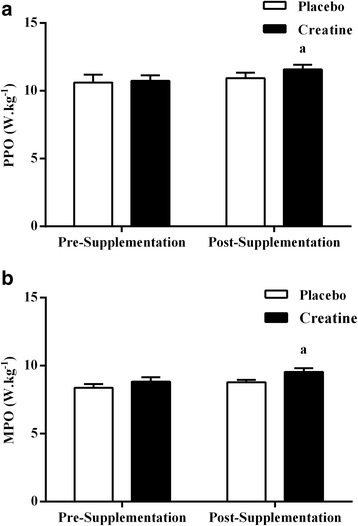
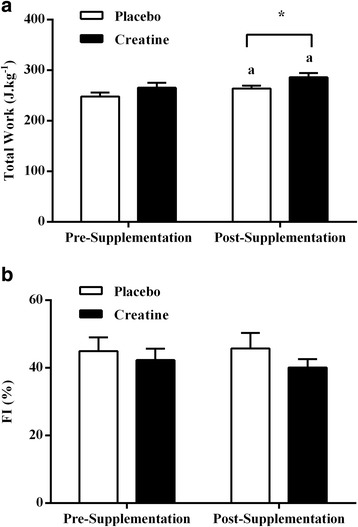
Background To determine the effects of a low dose, short-term Creatine monohydrate (Cr) supplementation (0.03 g.kg.d−1 during 14 d) on muscle power output in elite youth soccer players. Methods Using a two-group matched, double blind, placebo-controlled design, nineteen male soccer players (mean age = 17.0 ± 0.5 years) were randomly assigned to either Cr (N = 9) or placebo (N = 10) group. Before and after supplementation, participants performed a 30s Wingate Anaerobic Test (WAnT) to assess peak power output (PPO), mean power output (MPO), fatigue index (FI), and total work. Results There were significant increases in both PPO and MPO after the Cr supplementation period (P ≤ 0.05) but not the placebo period. There were also significant increases in total work, but not FI, after the Cr supplementation and placebo periods (P ≤ 0.05). Notably, there were differences in total work between the Cr and placebo groups after (P ≤ 0.05) but not before the 14 d supplementation period. Conclusion There is substantial evidence to indicate that a low-dose, short-term oral Cr supplementation beneficially affected muscle power output in elite youth soccer players.
Overview
The claims and statistics of this paper haven’t been checked yet.
Free: it reads the open-access text and checks the first 5 claims that cite a source we can check. Create a free account to check every claim.
Integrity signals
Registry
Cites
Statistics
Figures
Verification
Claims the paper makes
The claims and statistics of this paper haven’t been checked yet.
Free: it reads the open-access text and checks the first 5 claims that cite a source we can check. Create a free account to check every claim.
Claims other papers make about this one
Each is checked against this paper’s own text: does it say what the citing paper says it does?
The source backs part of the claim, not all of it — or backs it for a different population, condition or comparison.
In the citing paper
“Most recently, in 2017 a similar study (86) with elite youth (17.0 ± 0.5 years) soccer players found significant improvements in power output following a low-dose creatine supplementation regimen (0.03 g/kg/day) for 7 days.”
From Safety of Creatine Supplementation in Active Adolescents and Youth: A Brief Review (2018) · cites this paper as [86]
Experimental — accuracy not yet measuredThe source backs part of the claim, not all of it — or backs it for a different population, condition or comparison.
In the citing paper
“For example, a 2017 study involving elite youth soccer players (mean age 17.0 ± 0.5 years) reported significant improvements in power output following a low-dose creatine regimen (0.03 g/kg/day) over seven days [89].”
From Optimizing Performance Nutrition for Adolescent Athletes: A Review of Dietary Needs, Risks, and Practical Strategies (2025) · cites this paper as [89]
Experimental — accuracy not yet measuredThe cited source says what the claim attributes to it.
In the citing paper
“Lastly, Yanez-Silva et al. [41] reported improvements in peak and mean power output as well as total work completed during a Wingate anaerobic capacity test.”
From Creatine Supplementation in Children and Adolescents (2021) · cites this paper as [41]
The cited source says what the claim attributes to it.
In the citing paper
“There were no differences in fatigue for either group.”
From Creatine supplementation in the pediatric and adolescent athlete-- A literature review (2023) · cites this paper as [24]
The cited source says what the claim attributes to it.
In the citing paper
“The creatine group experienced a significant increase in PPO, MPO, and TW from pre-to post-supplementation; however, there was only a significant difference between the creatine and placebo groups for TW.24”
From Creatine supplementation in the pediatric and adolescent athlete-- A literature review (2023) · cites this paper as [24]
9 more claims about this paper
Create a free account to see every claim other papers make about this one.
Self-check
Percentages, sums and reported differences re-computed from the paper’s own numbers.
The self-check needs the paper’s full text.
Citations
Cites
Statistical Power Analysis for the Behavioral Sciences
Muller, K. (1989) · Technometrics · doi:10.1080/00401706.1989.10488618 · Cited by 99,167
Statistical power analysis for the behavioral sciences
(1990) · Computers, Environment and Urban Systems · doi:10.1016/0198-9715(90)90050-4 · Cited by 65,269
Baltosser, W. H., & Zar, J. H. (1996) · Ecology · doi:10.2307/2265725 · Cited by 35,166
An analysis of variance test for normality (complete samples)
SHAPIRO, S. S., & WILK, M. B. (1965) · Biometrika · doi:10.1093/biomet/52.3-4.591 · Cited by 23,480
Generalized equations for predicting body density of men
Jackson, A. S., & Pollock, M. L. (1978) · British Journal of Nutrition · doi:10.1079/bjn19780152 · Cited by 3,201
Physiology of Soccer: An Update
St??len, T., Chamari, K., Castagna, C., & Wisl??ff, U. (2005) · Sports Medicine · doi:10.2165/00007256-200535060-00004 · Cited by 2,325
Aerobic endurance training improves soccer performance
HELGERUD, J., ENGEN, L. C., WISL??FF, U., & HOFF, J. (2001) · Medicine and Science in Sports and Exercise · doi:10.1097/00005768-200111000-00019 · Cited by 1,186
Elevation of creatine in resting and exercised muscle of normal subjects by creatine supplementation
Harris, R. C., Söderlund, K., & Hultman, E. (1992) · Clinical Science · doi:10.1042/cs0830367 · Cited by 1,168 · cited 8×
“Moreover, it has been suggested that higher level of PCr availability might accelerate the rate of PCr resynthesis after multiple bouts of intense exercise [7, 8]. le is distributed under the terms of the Creative Commons Attribution 4.0 .org/licenses/by/4.0/), which permits unrestricted use, distribution, and ive app…”
BackgroundInfluentialAnthropometric and physiological predispositions for elite soccer
Reilly, T., Bangsbo, J., & Franks, A. (2000) · Journal of Sports Sciences · doi:10.1080/02640410050120050 · Cited by 1,151
Human muscle metabolism during intermittent maximal exercise
Gaitanos, G. C., Williams, C., Boobis, L. H., & Brooks, S. (1993) · Journal of Applied Physiology · doi:10.1152/jappl.1993.75.2.712 · Cited by 967
Muscle creatine loading in men
Hultman, E., Soderlund, K., Timmons, J. A., Cederblad, G., & Greenhaff, P. L. (1996) · Journal of Applied Physiology · doi:10.1152/jappl.1996.81.1.232 · Cited by 822
Effect of oral creatine supplementation on skeletal muscle phosphocreatine resynthesis
Greenhaff, P. L., Bodin, K., Soderlund, K., & Hultman, E. (1994) · American Journal of Physiology-Endocrinology and Metabolism · doi:10.1152/ajpendo.1994.266.5.e725 · Cited by 531
(2004) · Springer Texts in Statistics · doi:10.1007/b98963 · Cited by 517
Midgley, A. W., McNaughton, L. R., Polman, R., & Marchant, D. (2007) · Sports Medicine · doi:10.2165/00007256-200737120-00002 · Cited by 460
Greenhaff, P. L., Casey, A., Short, A. H., Harris, R., Soderlund, K., & Hultman, E. (1993) · Clinical Science · doi:10.1042/cs0840565 · Cited by 460 · cited 7×
“Moreover, it has been suggested that higher level of PCr availability might accelerate the rate of PCr resynthesis after multiple bouts of intense exercise [7, 8]. le is distributed under the terms of the Creative Commons Attribution 4.0 .org/licenses/by/4.0/), which permits unrestricted use, distribution, and ive app…”
BackgroundInfluentialEffects of creatine supplementation on body composition, strength, and sprint performance
KREIDER, R. B., FERREIRA, M., WILSON, M., GRINDSTAFF, P., PLISK, S., REINARDY, J., CANTLER, E., & ALMADA, A. L. (1998) · Medicine & Science in Sports & Exercise · doi:10.1097/00005768-199801000-00011 · Cited by 430 · cited 5×
“imal or near maximal exercise bout [8] and an increased potential for Cr acts as an cellular buffer on hydrogen”
BackgroundInfluentialBooth, D. E. (2003) · Technometrics · doi:10.1198/tech.2003.s135 · Cited by 371
Performance and muscle fiber adaptations to creatine supplementation and heavy resistance training
VOLEK, J. S., DUNCAN, N. D., MAZZETTI, S. A., STARON, R. S., PUTUKIAN, M., G??MEZ, A. L., PEARSON, D. R., FINK, W. J., & KRAEMER, W. J. (1999) · Medicine & Science in Sports & Exercise · doi:10.1097/00005768-199908000-00011 · Cited by 366 · cited 1×
“tensities and facilitate their skeletal muscle adaptive responses to exercise training [42].”
BackgroundCasey, A., Constantin-Teodosiu, D., Howell, S., Hultman, E., & Greenhaff, P. L. (1996) · American Journal of Physiology-Endocrinology and Metabolism · doi:10.1152/ajpendo.1996.271.1.e31 · Cited by 343 · cited 1×
“[37] found a 4% increase in the total work performed.”
BackgroundCreatine supplementation with specific view to exercise/sports performance: An update
Cooper, R., Naclerio, F., Allgrove, J., & Jimenez, A. (2012) · Journal of the International Society of Sports Nutrition · doi:10.1186/1550-2783-9-33 · Cited by 306 · cited 1×
“The mechanisms behind the ergogenic effects of Cr ingestion are multifactorial and have yet to be fully elucidated [40].”
BackgroundCreatine supplementation and dynamic high-intensity intermittent exercise
Balsom, P. D., Ekblom, B., Söerlund, K., Sjödln, B., & Hultman, E. (1993) · Scandinavian Journal of Medicine & Science in Sports · doi:10.1111/j.1600-0838.1993.tb00378.x · Cited by 282 · cited 2×
“These changes in body weight might be attributed, at least in part, to a positive nitrogen balance, which causes an increase in protein synthesis rate [41].”
BackgroundBirch, R., Noble, D., & Greenhaff, P. L. (1994) · European Journal of Applied Physiology and Occupational Physiology · doi:10.1007/bf01094800 · Cited by 251
Relationship Between Endurance Field Tests and Match Performance in Young Soccer Players
Castagna, C., Manzi, V., Impellizzeri, F., Weston, M., & Barbero Alvarez, J. C. (2010) · Journal of Strength and Conditioning Research · doi:10.1519/jsc.0b013e3181e72709 · Cited by 220
Wragg, C. B., Maxwell, N. S., & Doust, J. H. (2000) · European Journal of Applied Physiology · doi:10.1007/s004210000246 · Cited by 197
Zupan, M. F., Arata, A. W., Dawson, L. H., Wile, A. L., Payn, T. L., & Hannon, M. E. (2009) · Journal of Strength and Conditioning Research · doi:10.1519/jsc.0b013e3181b1b21b · Cited by 191
Adverse Effects of Creatine Supplementation: Fact or Fiction?
Poortmans, J. R., & Francaux, M. (2000) · Sports Medicine · doi:10.2165/00007256-200030030-00002 · Cited by 176
Creatine supplementation and sprint performance in soccer players
MUJIKA, I., PADILLA, S., IBA??EZ, J., IZQUIERDO, M., & GOROSTIAGA, E. (2000) · Medicine & Science in Sports & Exercise · doi:10.1097/00005768-200002000-00039 · Cited by 168
Effects of creatine supplementation on muscle power, endurance, and sprint performance
IZQUIERDO, M., IBA??EZ, J., GONZ??LEZ-BADILLO, J. J., & GOROSTIAGA, E. M. (2002) · Medicine and Science in Sports and Exercise · doi:10.1097/00005768-200202000-00023 · Cited by 159 · cited 4×
“Each supplement was measured using electronically calibrated scales and placed in identical coded airtight bags [11].”
BackgroundMethodResultInfluentialEffect of creatine supplementation on sprint exercise performance and muscle metabolism
Snow, R. J., McKenna, M. J., Selig, S. E., Kemp, J., Stathis, C. G., & Zhao, S. (1998) · Journal of Applied Physiology · doi:10.1152/jappl.1998.84.5.1667 · Cited by 137
Protein- and carbohydrate-induced augmentation of whole body creatine retention in humans
Steenge, G. R., Simpson, E. J., & Greenhaff, P. L. (2000) · Journal of Applied Physiology · doi:10.1152/jappl.2000.89.3.1165 · Cited by 132 · cited 1×
“They were instructed to ingest the supplements with food because this enhances body Cr retention [19].”
BackgroundMcKenna, M. J., Morton, J., Selig, S. E., & Snow, R. J. (1999) · Journal of Applied Physiology · doi:10.1152/jappl.1999.87.6.2244 · Cited by 111
Cox, G., Mujika, I., Tumilty, D., & Burke, L. (2002) · International Journal of Sport Nutrition and Exercise Metabolism · doi:10.1123/ijsnem.12.1.33 · Cited by 110
Effect of creatine on aerobic and anaerobic metabolism in skeletal muscle in swimmers.
Thompson, C. H., Kemp, G. J., Sanderson, A. L., Dixon, R. M., Styles, P., Taylor, D. J., & Radda, G. K. (1996) · British Journal of Sports Medicine · doi:10.1136/bjsm.30.3.222 · Cited by 100
A simple method for individual anaerobic threshold as predictor of max lactate steady state
BALDARI, C., & GUIDETTI, L. (2000) · Medicine & Science in Sports & Exercise · doi:10.1097/00005768-200010000-00022 · Cited by 93
Creatine supplementation in young soccer players
Ostojic, S. M. (2004) · International Journal of Sport Nutrition and Exercise Metabolism · doi:10.1123/ijsnem.14.1.95 · Cited by 72 · cited 3×
“He concluded that supplementation with Cr in young soccer players improved soccer-specific skill performance compared with ingestion of placebo [31].”
BackgroundEffect of Creatine Loading on Endurance Capacity and Sprint Power in Cyclists
Vandebuerie, F., Eynde, B., Vandenberghe, K., & Hespel, P. (1998) · International Journal of Sports Medicine · doi:10.1055/s-2007-971950 · Cited by 61
Low-dose creatine supplementation enhances fatigue resistance in the absence of weight gain
Rawson, E. S., Stec, M. J., Frederickson, S. J., & Miles, M. P. (2011) · Nutrition · doi:10.1016/j.nut.2010.04.001 · Cited by 58 · cited 5×
“[12] has shown that ingesting low doses of Cr as low as ~2.”
BackgroundMethodResultInfluentialZuniga, J. M., Housh, T. J., Camic, C. L., Hendrix, C. R., Mielke, M., Johnson, G. O., Housh, D. J., & Schmidt, R. J. (2012) · Journal of Strength and Conditioning Research · doi:10.1519/jsc.0b013e318234eba1 · Cited by 46
EFFECT OF LOW-DOSE,SHORT-DURATION CREATINE SUPPLEMENTATION ON ANAEROBIC EXERCISE PERFORMANCE
HOFFMAN, J. R., STOUT, J. R., FALVO, M. J., KANG, J., & RATAMESS, N. A. (2005) · Journal of Strength and Conditioning Research · doi:10.1519/00124278-200505000-00004 · Cited by 46
Effect of oral creatine supplementation on isokinetic torque production
GILLIAM, J. D., HOHZORN, C., MARTIN, D., & TRIMBLE, M. H. (2000) · Medicine & Science in Sports & Exercise · doi:10.1097/00005768-200005000-00017 · Cited by 41
EFFECTS OF REPEATED CREATINE SUPPLEMENTATION ON MUSCLE, PLASMA, AND URINE CREATINE LEVELS
RAWSON, E. S., PERSKY, A. M., PRICE, T. B., & CLARKSON, P. M. (2004) · Journal of Strength and Conditioning Research · doi:10.1519/00124278-200402000-00024 · Cited by 31
Short-term Creatine Supplementation Improves Maximum Quadriceps Contraction in Women
Kambis, K. W., & Pizzedaz, S. K. (2003) · International Journal of Sport Nutrition and Exercise Metabolism · doi:10.1123/ijsnem.13.1.87 · Cited by 26 · cited 1×
“These findings are consistent with the previous observations [39] that the majority of muscle Cr uptake appears to occur during the initial days of Cr supplementation, with a lower retention of the administered dose during subsequent supplementation days.”
Result(2011) · Cited by 15
Eckerson, J. M., Bull, A. A., & Moore, G. A. (2008) · Journal of Strength and Conditioning Research · doi:10.1519/jsc.0b013e31816a40ad · Cited by 13
CREATINE SUPPLEMENTATION AND PERFORMANCE DURING OFF-SEASON TRAINING IN FEMALE SOCCER PLAYERS
Larson, D. E., Hunter, G. R., Trowbridge, C. A., Turk, J. C., HARBIN, P. A., & TORMAN, S. L. (1998) · Medicine & Science in Sports & Exercise · doi:10.1097/00005768-199805001-01503 · Cited by 11
(2004) · doi:10.1519/1533-4287(2004)018
Research works printed but not linked: 2
- Gordon CC Chumlea WC Roche AF Lohman TG Roche AF Martorell R Stature, recumbent length, and weight Anthropometric standardization reference manual 1988 Champaign Human Kinetics
- Bosco CC Tranquilli J Tihanyi R Colli S D’Ottavio S Viru A Influence of oral supplementation with creatine monohydrate on physical capacity evaluated in laboratory and field tests Med Sport 1995 48 391 7
Cited by
Creatine in health and disease
Kreider, R. B., & Stout, J. R. (2021) · Nutrients · doi:10.3390/nu13020447 · Cited by 227
Kreider, R. B., Jäger, R., & Purpura, M. (2022) · Nutrients · doi:10.3390/nu14051035 · Cited by 103
“Improvements in performance have been reported in individuals participating in weight training [55,89,95,103–113], running [114–118], soccer [87,119,120], swimming [79,80,121–124], volleyball [125], softball [126], ice hockey [127], golf [128], among others [24].”
BackgroundMielgo-Ayuso, J., Calleja-Gonzalez, J., Marqués-Jiménez, D., Caballero-García, A., Córdova, A., & Fernández-Lázaro, D. (2019) · Nutrients · doi:10.3390/nu11040757 · Cited by 91
“…et al. 2 02 [21] Biwer et al. 20 3 [15] Ostojic 2004 [ 8] Claudino et al. 2014 [20] Williams et al. 2014 [16] Ramírez-Campillo et al. 2015 [19] Yáñez-Silva et al. 2017 [7] Nutrients 2019, 11, x FOR P E REVIEW 4 of 17 The mean (M), sta d r devi ti n (SD), a sample size dat wer ext acted by on…”
BackgroundMethodInfluentialWu, S.-H., Chen, K., Hsu, C., Chen, H.-C., Chen, J., Yu, S.-Y., & Shiu, Y.-J. (2022) · Nutrients · doi:10.3390/nu14061255 · Cited by 90
Creatine Supplementation: An Update
Hall, M., Manetta, E., & Tupper, K. (2021) · Current Sports Medicine Reports · doi:10.1249/jsr.0000000000000863 · Cited by 80
Metadata
- Authors
- Yáñez-Silva, A., Buzzachera, C. F., Piçarro, I. D. C., Januario, R. S. B., Ferreira, L. H. B., McAnulty, S. R., Utter, A. C., & Souza-Junior, T. P.
- Affiliations
- Dirección de InvestigaciónUniversidad Mayor Santiago de Chile; Universidad Santo Tomás, Talca. Chile. Carrera de Educación Física Santiago de Chile Chile
- Universidade Norte do Paraná (BR)
- School of Physical Education, Max Planck Faculty Indaiatuba Brazil
- Department of Physical EducationNorth University of Parana Londrina Brazil
- Department of Physical EducationResearch Group on Metabolism, Nutrition and Strength Training Curitiba Brazil
- Appalachian State University (US)
- Venue
- Journal of the International Society of Sports Nutrition
- Publisher
- Informa UK Limited
- Published
- 2017-01-03
- Volume
- 14
- Issue
- 1
- Pages
- 5-5
- ISSN
- 1550-2783 (ISSN-L)
- PMC
- PMC5296953
- OpenAlex
- W2587175381
- Cited by
- 67
- References
- 47
- Citations by year
- 2026: 5 · 2025: 13 · 2024: 13 · 2023: 6 · 2022: 10 · 2021: 10 · 2020: 4 · 2019: 2 · 2018: 3 · 2017: 1
- FWCI
- 1.46
- Type
- journal article
- Language
- en
- Open access
- gold
- doi.org
- Licence
- Locations
- Journal of the International Society of Sports Nutrition (publishedVersion, cc-by)
- Europe PMC (PubMed Central) (publishedVersion, cc-by)
- PubMed Central (publishedVersion, cc-by)
- PubMed (publishedVersion)
- DOAJ (DOAJ: Directory of Open Access Journals) (submittedVersion)
- Funders
- Appalachian State University
- Conselho Nacional de Desenvolvimento Científico e Tecnológico
- Topics
- Health Sciences › Nursing › Nutrition and Dietetics › Muscle metabolism and nutrition
- Health Sciences › Medicine › Orthopedics and Sports Medicine › Sports Performance and Training
- Health Sciences › Medicine › Physiology (medical) › Biochemical effects in animals
- Keywords
- creatine monohydrate, creatine supplementation, low-dose supplementation, short-term supplementation, muscle power output, youth football players, elite youth athletes, Wingate test, peak power, average output power, fatigue index, total work, anaerobic performance
- MeSH terms
- Adolescent, Creatine, Double-Blind Method, Humans, Male, Physical Endurance, Soccer, Task Performance and Analysis, Muscle, Skeletal, Dietary Supplements, Sports Nutritional Physiological Phenomena
About these checks
Registry, retraction, Cites and statistics results are computed, not judged, with one exception: a printed reference that no index lists is read once by a model before it counts as a citation error. Claims are extracted by a model and kept only when their quote appears verbatim in the text; each cited source is then checked, with a model’s help, for whether it says what the claim relies on. Those verdicts can be wrong — read the claim’s quote and the cited source before relying on one.
Statistics and arithmetic are recomputed, not judged.
Confidence bands are shown only for fields calibrated on our annotated test set. None is calibrated yet, so no band is shown.
What counts as a claim ›How we measure confidence ›How we check this ›
Are you an author, or do you see a problem with this page? Request a review
Data sources
Bibliographic data: Semantic Scholar, OpenAlex, Crossref.
Contains information from the Semantic Scholar Academic Graph Datasets, made available under the ODC Attribution License (ODC-BY 1.0).
Semantic Scholar’s data is described in: Kinney, R., et al. (2023). The Semantic Scholar Open Data Platform. arXiv:2301.10140.
