

The DOI matches its Crossref record; 57 of the 58 references it cites were found in a registry or an index.
Time-dependent effects of CX3CR1 in a mouse model of mild traumatic brain injury
Open accessAbstract
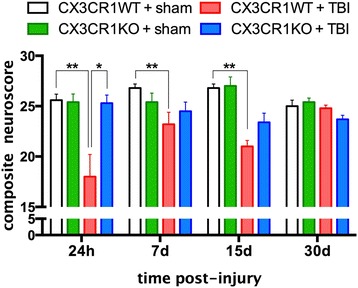
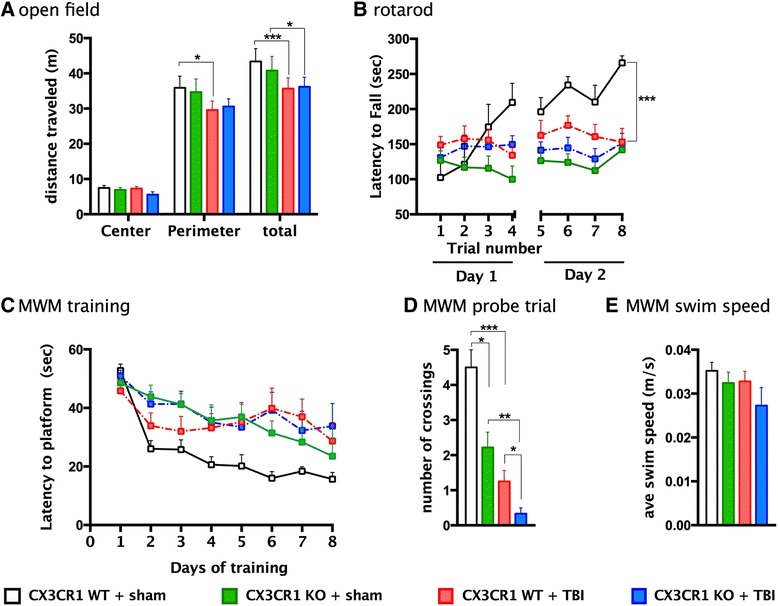
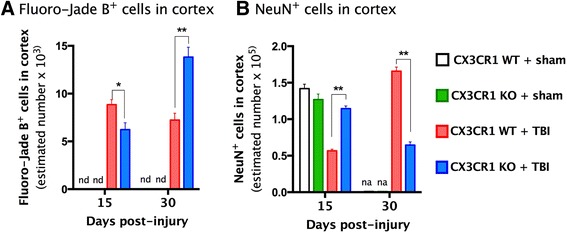
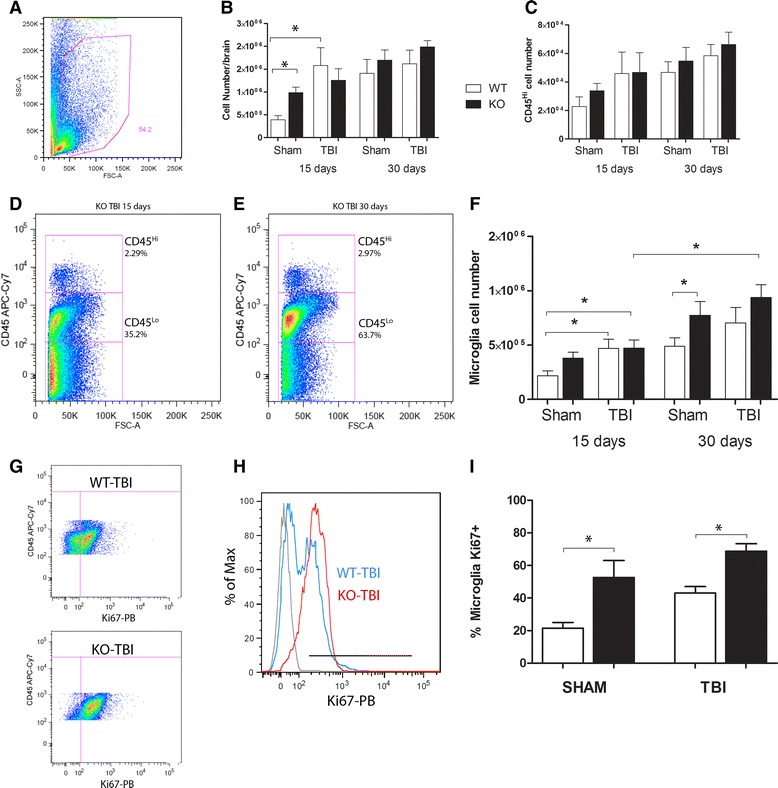
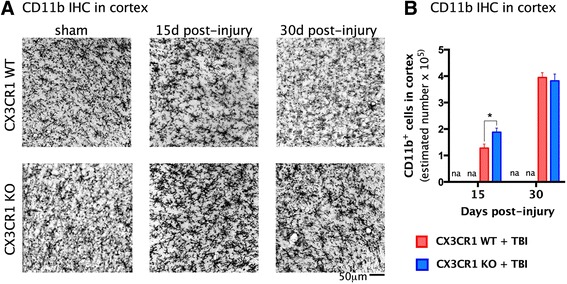
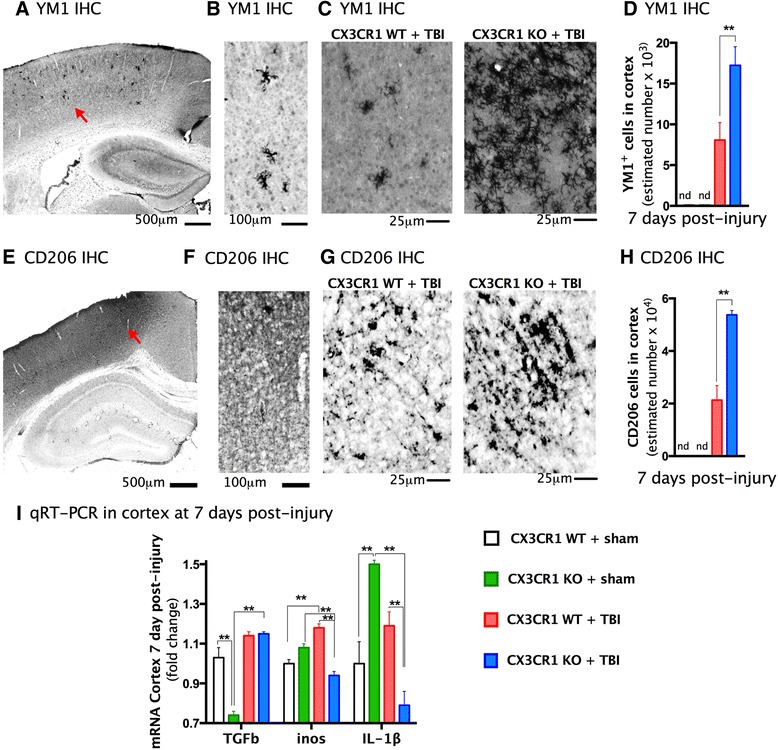
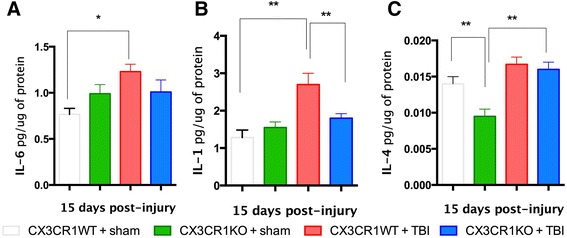
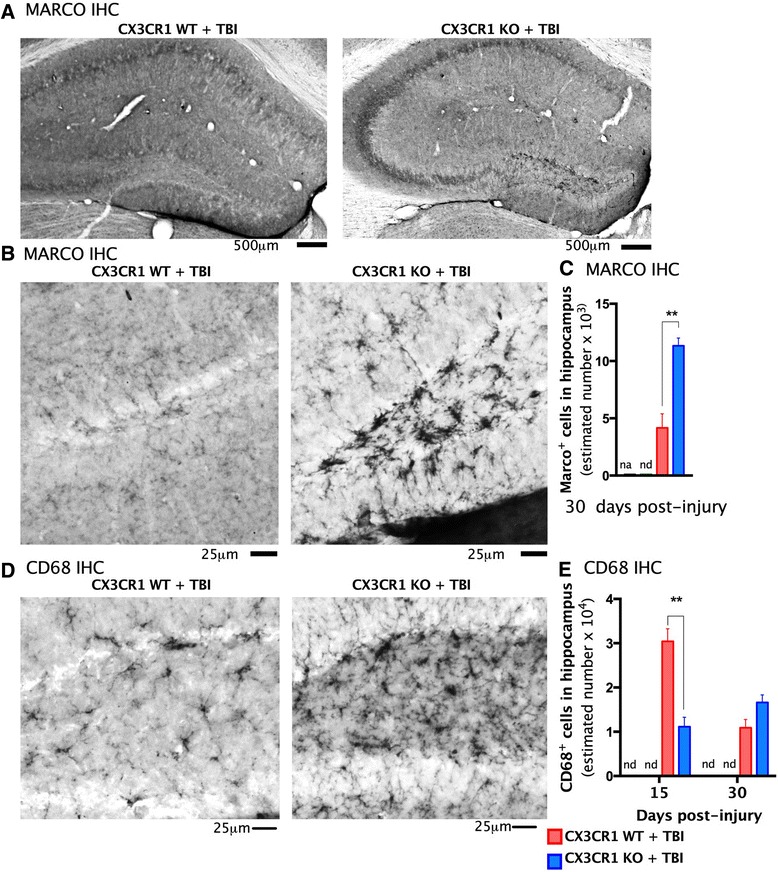
BACKGROUND: Neuroinflammation is an important secondary mechanism that is a key mediator of the long-term consequences of neuronal injury that occur in traumatic brain injury (TBI). Microglia are highly plastic cells with dual roles in neuronal injury and recovery. Recent studies suggest that the chemokine fractalkine (CX3CL1, FKN) mediates neural/microglial interactions via its sole receptor CX3CR1. CX3CL1/CX3CR1 signaling modulates microglia activation, and depending upon the type and time of injury, either protects or exacerbates neurological diseases. METHODS: In this study, mice deficient in CX3CR1 were subjected to mild controlled cortical impact injury (CCI), a model of TBI. We evaluated the effects of genetic deletion of CX3CR1 on histopathology, cell death/survival, microglia activation, and cognitive function for 30 days post-injury. RESULTS: During the acute post-injury period (24 h-15 days), motor deficits, cell death, and neuronal cell loss were more profound in injured wild-type than in CX3CR1(-/-) mice. In contrast, during the chronic period of 30 days post-TBI, injured CX3CR1(-/-) mice exhibited greater cognitive dysfunction and increased neuronal death than wild-type mice. The protective and deleterious effects of CX3CR1 were associated with changes in microglia phenotypes; during the acute phase CX3CR1(-/-) mice showed a predominant anti-inflammatory M2 microglial response, with increased expression of Ym1, CD206, and TGFβ. In contrast, increased M1 phenotypic microglia markers, Marco, and CD68 were predominant at 30 days post-TBI. CONCLUSION: Collectively, these novel data demonstrate a time-dependent role for CX3CL1/CX3CR1 signaling after TBI and suggest that the acute and chronic responses to mild TBI are modulated in part by distinct microglia phenotypes.
Overview
The claims and statistics of this paper haven’t been checked yet.
Run the check — free, no account needed. It reads the open-access text and checks the sources it cites.
Integrity signals
Registry
Cites
Statistics
Figures
Verification
Claims the paper makes
The claims and statistics of this paper haven’t been checked yet.
Run the check — free, no account needed. It reads the open-access text and checks the sources it cites.
Claims other papers make about this one
Each is checked against this paper’s own text: does it say what the citing paper says it does?
The source backs part of the claim, not all of it — or backs it for a different population, condition or comparison.
In the citing paper
“After a single CCI TBI, Cx3cr1−/− mice have improved motor recovery and decreased neuronal loss through 15 days post-injury (DPI).”
From The Inflammatory Continuum of Traumatic Brain Injury and Alzheimer’s Disease (2018) · cites this paper as [80]
Experimental — accuracy not yet measuredThe cited source says what the claim attributes to it.
In the citing paper
“By 30 DPI, however, these Cx3cr1−/− mice have worse cognitive dysfunction and neuronal loss compared to wild-type controls.”
From The Inflammatory Continuum of Traumatic Brain Injury and Alzheimer’s Disease (2018) · cites this paper as [80]
The cited source says what the claim attributes to it.
In the citing paper
“These changes are directly associated with an altered and time-dependent inflammatory profile in microglia (80).”
From The Inflammatory Continuum of Traumatic Brain Injury and Alzheimer’s Disease (2018) · cites this paper as [80]
Self-check
Percentages, sums and reported differences re-computed from the paper’s own numbers.
The self-check needs the paper’s full text.
Citations
Cites
The chemokine system in diverse forms of macrophage activation and polarization
MANTOVANI, A., SICA, A., SOZZANI, S., ALLAVENA, P., VECCHI, A., & LOCATI, M. (2004) · Trends in Immunology · doi:10.1016/j.it.2004.09.015 · Cited by 6,534 · cited 1×
“M1 microglia are generally considered pro-inflammatory whereas, M2 microglia are generally anti-inflammatory [29 – 34].”
Alternative activation of macrophages
Gordon, S. (2003) · Nature Reviews Immunology · doi:10.1038/nri978 · Cited by 6,189 · cited 1×
“M1 microglia are generally considered pro-inflammatory whereas, M2 microglia are generally anti-inflammatory [29–34].”
Blood Monocytes Consist of Two Principal Subsets with Distinct Migratory Properties
Geissmann, F., Jung, S., & Littman, D. R. (2003) · Immunity · doi:10.1016/s1074-7613(03)00174-2 · Cited by 3,504 · cited 1×
“Conversely, monocytes of the subset Ly6C low /CX3CR1 high are CCR2 deficient and are dependent on CX3CR1 for recruitment [51 – 53].”
West, M. J., Slomianka, L., & Gundersen, H. J. G. (1991) · The Anatomical Record · doi:10.1002/ar.1092310411 · Cited by 2,994 · cited 1×
“All cell counts were obtained using the Optical Fractionator method of unbiased stereological counting techniques [39].”
Jung, S., Aliberti, J., Graemmel, P., Sunshine, M. J., Kreutzberg, G. W., Sher, A., & Littman, D. R. (2000) · Molecular and Cellular Biology · doi:10.1128/mcb.20.11.4106-4114.2000 · Cited by 2,632 · cited 1×
“Indeed, deleting CX3CR1 [4] exacerbates microglial neurotoxicity induced by systemic inflammation in rodent models of Parkinson’s disease and amyotrophic lateral sclerosis [5].”
Nahrendorf, M., Swirski, F. K., Aikawa, E., Stangenberg, L., Wurdinger, T., Figueiredo, J.-L., Libby, P., Weissleder, R., & Pittet, M. J. (2007) · The Journal of Experimental Medicine · doi:10.1084/jem.20070885 · Cited by 2,300 · cited 2×
“For example, in a model of myocardial infarction, tissue repair requires recruitment of Ly6C and then Ly6C monocytes [53].”
Kigerl, K. A., Gensel, J. C., Ankeny, D. P., Alexander, J. K., Donnelly, D. J., & Popovich, P. G. (2009) · The Journal of Neuroscience · doi:10.1523/jneurosci.3257-09.2009 · Cited by 2,130 · cited 2×
“Ly6C monocytes are proteolitic, degrade injured tissue, and give rise to M1 macrophages in vivo [35, 56].”
Arnold, L., Henry, A., Poron, F., Baba-Amer, Y., van Rooijen, N., Plonquet, A., Gherardi, R. K., & Chazaud, B. (2007) · The Journal of Experimental Medicine · doi:10.1084/jem.20070075 · Cited by 2,002 · cited 1×
“CX3CR1 monocytes may differentiate from Ly6C monocytes in tissue and thus may not require CX3CR1 for recruitment [54, 55].”
Microglia Shape Adult Hippocampal Neurogenesis through Apoptosis-Coupled Phagocytosis
Sierra, A., Encinas, J. M., Deudero, J. J. P., Chancey, J. H., Enikolopov, G., Overstreet-Wadiche, L. S., Tsirka, S. E., & Maletic-Savatic, M. (2010) · Cell Stem Cell · doi:10.1016/j.stem.2010.08.014 · Cited by 1,622 · cited 10×
“Antibodies and dilutions were as follows: rat CD11b (Serotec, Raleigh, NC, USA; 1:500); mouse CD68 (Serotec; 1:200); rabbit YM1 (Stem cell technology, Vancouver, BC, Canada; 1:400); rat Marco (Serotec; 1:500); mouse NeuN (Millipore, Temecula, CA, USA; 1:1000).”
InfluentialControl of microglial neurotoxicity by the fractalkine receptor
Cardona, A. E., Pioro, E. P., Sasse, M. E., Kostenko, V., Cardona, S. M., Dijkstra, I. M., Huang, D., Kidd, G., Dombrowski, S., Dutta, R., et al. (2006) · Nature Neuroscience · doi:10.1038/nn1715 · Cited by 1,531 · cited 2×
“Indeed, deleting CX3CR1 [4] exacerbates microglial neurotoxicity induced by systemic inflammation in rodent models of Parkinson’s disease and amyotrophic lateral sclerosis [5].”
Self-citation
Research works printed but not linked: 2
- Frank-Cannon TC, Alto LT, McAlpine FE, Tansey MG. Does neuroinflammation fan the flame in neurodegenerative diseases? Mol Neurodegener. 2009;4:47. · DOI · Paper page
- Gaetani P, Pisano P, Solinas G, Colombo P, Destro A, Levi D, et al. Immunohistohemical expression of the chemokine fractalkine and its receptor in the human brain cortex after severe traumatic brain injury and brain hemorrhage. J Neurosurg Sci. 2013;57(1):55–62.
Cited by
Sorted by citations
Items 101–101 of 101
Microglia: A Double-Sided Sword in Stroke
Shi, H., Xu, M., Shi, Y., Gao, Y., Chen, J., & Hu, X. (2016) · Springer series in translational stroke research · doi:10.1007/978-3-319-32337-4_7
Metadata
- Authors
- Febinger, H. Y., Thomasy, H. E., Pavlova, M. N., Ringgold, K. M., Barf, P. R., George, A. M., Grillo, J. N., Bachstetter, A. D., Garcia, J. A., Cardona, A. E., Opp, M. R., & Gemma, C.
- Affiliations
- University of Washington (US)
- University of Kentucky (US)
- The University of Texas at San Antonio (US)
- Corresponding author
- Gemma, Carmelina
- Venue
- Journal of Neuroinflammation
- Published
- 2015-09-02
- Volume
- 12
- Issue
- 1
- Pages
- 154-154
- ISSN
- 1742-2094 (ISSN-L)
- PMC
- PMC4557842
- OpenAlex
- W1944546979
- Cited by
- 110
- References
- 58
- Citations by year
- 2026: 10 · 2025: 8 · 2024: 5 · 2023: 10 · 2022: 6 · 2021: 15 · 2020: 10 · 2019: 13 · 2018: 16 · 2017: 7 · 2016: 9 · 2015: 1
- FWCI
- 7.76
- Type
- journal article
- Language
- en
- Open access
- gold
- doi.org
- Locations
- Journal of Neuroinflammation (publishedVersion, cc-by)
- Europe PMC (PubMed Central) (publishedVersion, cc-by)
- PubMed Central (publishedVersion, cc-by)
- PubMed (publishedVersion)
- UKnowledge (University of Kentucky) (submittedVersion, cc-by)
- Funders
- National Institutes of Health (SC1GM095426)
- Topics
- Health Sciences › Medicine › Clinical Neurology › Traumatic Brain Injury and Neurovascular Disturbances
- Life Sciences › Neuroscience › Neurology › Neuroinflammation and Neurodegeneration Mechanisms
- Health Sciences › Medicine › Clinical Neurology › Traumatic Brain Injury Research
- Keywords
- CX3CR1, fractalkine, mild traumatic brain injury, microglial activation, M1/M2 microglial polarization, neuroinflammation, controlled cortical impact, neuronal cell death, cognitive impairment, CX3CR1 knockout mice
- MeSH terms
- CX3C Chemokine Receptor 1, Analysis of Variance, Animals, Brain, Brain Injuries, Disease Models, Animal, Exploratory Behavior, Flow Cytometry, Fluoresceins, Leukocytes, Mononuclear, Macrophage Activation, Male, Mice, Transgenic, Neurons, Psychomotor Disorders, Time Factors, Maze Learning, Receptors, Chemokine, Rotarod Performance Test, Green Fluorescent Proteins, Mice
About these checks
Registry, retraction, Cites and statistics results are computed, not judged, with one exception: a printed reference that no index lists is read once by a model before it counts as a citation error. Claims are extracted by a model and kept only when their quote appears verbatim in the text; each cited source is then checked, with a model’s help, for whether it says what the claim relies on. Those verdicts can be wrong — read the claim’s quote and the cited source before relying on one.
Statistics and arithmetic are recomputed, not judged.
Confidence bands are shown only for fields calibrated on our annotated test set. None is calibrated yet, so no band is shown.
What counts as a claim ›How we measure confidence ›How we check this ›
Are you an author, or do you see a problem with this page? Request a review
