

Associations between gut microbiota and Alzheimer’s disease, major depressive disorder, and schizophrenia
Open accessThe DOI matches its Crossref record; 58 of the 58 references it cites were found in a registry or an index.
Abstract
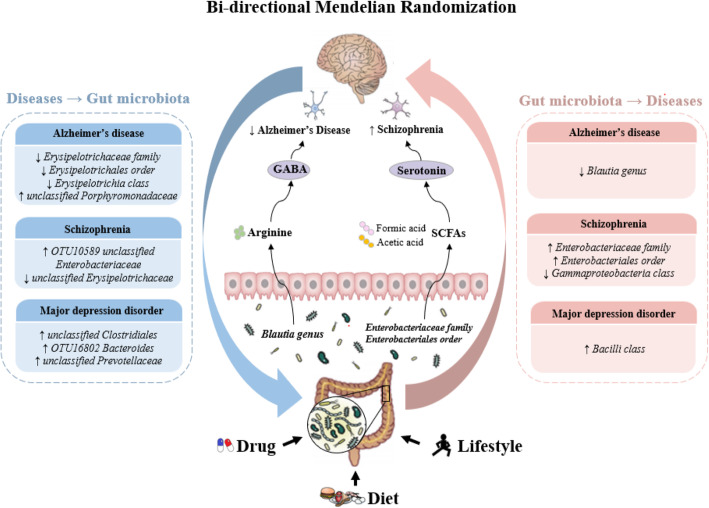
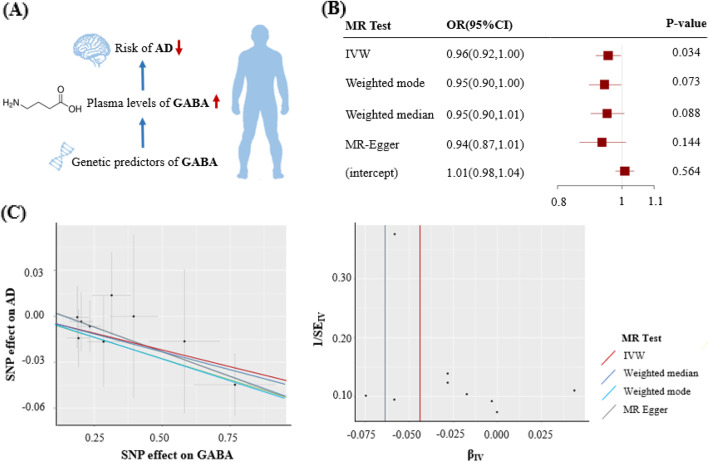
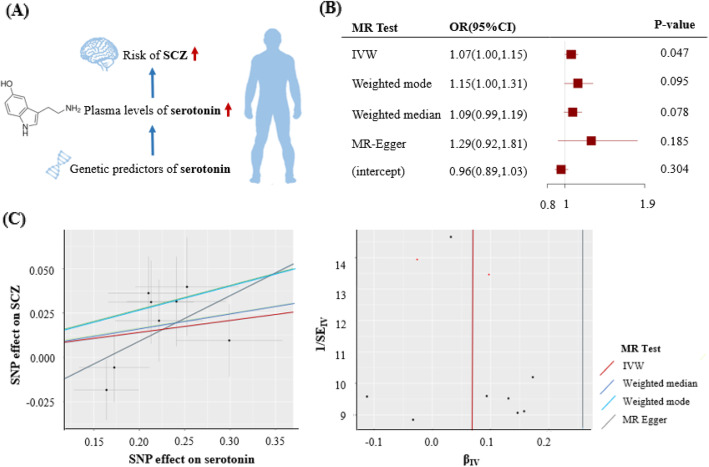
Background: Growing evidence has shown that alterations in the gut microbiota composition were associated with a variety of neuropsychiatric conditions. However, whether such associations reflect causality remains unknown. We aimed to reveal the causal relationships among gut microbiota, metabolites, and neuropsychiatric disorders including Alzheimer’s disease (AD), major depressive disorder (MDD), and schizophrenia (SCZ). Methods: A two-sample bi-directional Mendelian randomization analysis was performed by using genetic variants from genome-wide association studies as instrumental variables for gut microbiota, metabolites, AD, MDD, and SCZ, respectively. Results: We found suggestive associations of host-genetic-driven increase in Blautia (OR, 0.88; 95%CI, 0.79–0.99; P = 0.028) and elevated γ-aminobutyric acid (GABA) (0.96; 0.92–1.00; P = 0.034), a downstream product of Blautia -dependent arginine metabolism, with a lower risk of AD. Genetically increased Enterobacteriaceae family and Enterobacteriales order were potentially associated with a higher risk of SCZ (1.09; 1.00–1.18; P = 0.048), while Gammaproteobacteria class (0.90; 0.83–0.98; P = 0.011) was related to a lower risk for SCZ. Gut production of serotonin was potentially associated with an increased risk of SCZ (1.07; 1.00–1.15; P = 0.047). Furthermore, genetically increased Bacilli class was related to a higher risk of MDD (1.07; 1.02–1.12; P = 0.010). In the other direction, neuropsychiatric disorders altered gut microbiota composition. Conclusions: These data for the first time provide evidence of potential causal links between gut microbiome and AD, MDD, and SCZ. GABA and serotonin may play an important role in gut microbiota-host crosstalk in AD and SCZ, respectively. Further investigations in understanding the underlying mechanisms of associations between gut microbiota and AD, MDD, and SCZ are required.
Overview
The claims and statistics of this paper haven’t been checked yet.
Free: it reads the open-access text and checks the first 5 claims that cite a source we can check. Create a free account to check every claim.
Integrity signals
Registry
Cites
Statistics
Figures
Verification
Claims the paper makes
The claims and statistics of this paper haven’t been checked yet.
Free: it reads the open-access text and checks the first 5 claims that cite a source we can check. Create a free account to check every claim.
Claims other papers make about this one
Each is checked against this paper’s own text: does it say what the citing paper says it does?
The cited source says what the claim attributes to it.
In the citing paper
“Substantial evidence links the gut microbiome to a variety of neuropsychiatric conditions[11], [12], [13], [14] and gastrointestinal diseases[15], [16], [17], [18].”
From The hidden genetic and microbial networks connecting neuropsychiatric and digestive disorders (2025) · cites this paper as [11]
Self-check
Percentages, sums and reported differences re-computed from the paper’s own numbers.
The self-check needs the paper’s full text.
Citations
Cites
Bowden, J., Davey Smith, G., Haycock, P. C., & Burgess, S. (2016) · Genetic Epidemiology · doi:10.1002/gepi.21965 · Cited by 8,922
Meta-Analysis of 74,046 Individuals Identifies 11 New Susceptibility Loci for Alzheimer’s Disease
(EADI), E. A. D. I., Lambert, J.-C., (GERAD), G. A. E. R. I. A. D., Alzheimer's Disease Genetic Consortium (ADGC), (CHARGE), C. F. H. A. A. R. I. G. E., Ibrahim-Verbaas, C. A., Harold, D., Naj, A. C., Sims, R., Bellenguez, C., et al. (2013) · Nature Genetics · doi:10.1038/ng.2802 · Cited by 4,336
Emdin, C. A., Khera, A. V., & Kathiresan, S. (2017) · JAMA · doi:10.1001/jama.2017.17219 · Cited by 3,637
Robust inference in summary data Mendelian randomization via the zero modal pleiotropy assumption
Hartwig, F. P., Davey Smith, G., & Bowden, J. (2017) · International Journal of Epidemiology · doi:10.1093/ije/dyx102 · Cited by 3,485
eQTLGen, Wray, N. R., 23andMe, the Major Depressive Disorder Working Group of the Psychiatric Genomics Consortium, Ripke, S., Mattheisen, M., Trzaskowski, M., Byrne, E. M., Abdellaoui, A., Adams, M. J., et al. (2018) · Nature Genetics · doi:10.1038/s41588-018-0090-3 · Cited by 3,005
Gut microbiome alterations in Alzheimer’s disease
Vogt, N. M., Kerby, R. L., Dill-McFarland, K. A., Harding, S. J., Merluzzi, A. P., Johnson, S. C., Carlsson, C. M., Asthana, S., Zetterberg, H., Blennow, K., et al. (2017) · Scientific Reports · doi:10.1038/s41598-017-13601-y · Cited by 2,137
The neuroactive potential of the human gut microbiota in quality of life and depression
Valles-Colomer, M., Falony, G., Darzi, Y., Tigchelaar, E. F., Wang, J., Tito, R. Y., Schiweck, C., Kurilshikov, A., Joossens, M., Wijmenga, C., et al. (2019) · Nature Microbiology · doi:10.1038/s41564-018-0337-x · Cited by 1,963
Interactions between the microbiota, immune and nervous systems in health and disease
Fung, T. C., Olson, C. A., & Hsiao, E. Y. (2017) · Nature Neuroscience · doi:10.1038/nn.4476 · Cited by 1,900
Causal relationships among the gut microbiome, short-chain fatty acids and metabolic diseases
Sanna, S., van Zuydam, N. R., Mahajan, A., Kurilshikov, A., Vich Vila, A., Võsa, U., Mujagic, Z., Masclee, A. A. M., Jonkers, D. M. A. E., Oosting, M., et al. (2019) · Nature Genetics · doi:10.1038/s41588-019-0350-x · Cited by 1,539
Neurotransmitter modulation by the gut microbiota
Strandwitz, P. (2018) · Brain Research · doi:10.1016/j.brainres.2018.03.015 · Cited by 1,527
Cited by
Items 201–240 of 240
A influência da microbiota intestinal na patogênese da depressão
Ferreira, J. V. A., Simionato, B. B., Pereira, L. D. F. C., Daniel, M. H. B., Melo, M. A. M. D., & de Aquino, É. C. (2024) · Cuadernos de Educación y Desarrollo · doi:10.55905/cuadv16n2-ed.esp.001
Mingdong, W., Gao, X., Yongjun, Q., Mingshuai, W., & Hao, P. (2023) · Figshare · doi:10.6084/m9.figshare.24123719
Yu, H., Chen, S., Li, X., Lin, J., Xue, Z., Liu, J., Lin, W. V., & Cao, L. S. (2024) · SSRN Electronic Journal · doi:10.2139/ssrn.4802934
Zhou, Y., Wang, Y., Feng, Y., Sun, T., & Xu, J. (2024) · Research Square · doi:10.21203/rs.3.rs-4812423/v1
Causal Link between Gut Microbiota and Myopia—A Two-Sample Mendelian Randomization Analysis
何, 明. (2025) · Advances in Clinical Medicine · doi:10.12677/acm.2025.153713
Gut Microbiome Composition in Patients with Major Depressive Disorder and Schizophrenia
Kettani, Z. E., Yacoubi, F. A. E., Ansong, D. O., Chakib, S., Bidar, H., Akhattab, A., Rhalem, W., Rfaki, A., Merzouki, M., Ouali, E. M. E., et al. (2025) · Lecture notes in networks and systems · doi:10.1007/978-3-031-91337-2_9
Chakib, S., Janahi, S. E., Bidar, H., Jbara, S., Yakoubi, Z. E., Idrissi, N. A., Hamdi, S., Aasfara, J., & Ghazal, H. (2025) · Lecture notes in networks and systems · doi:10.1007/978-3-031-91337-2_11
Vastrad, B. M., Pattanashetti, S., & Vastrad, C. M. (2026) · Ageing International · doi:10.1007/s12126-026-09665-9
From gut to brain: pioneering microbial strategies against Alzheimer’s disease
Wu, J., He, J., Liu, R., Zhang, H., Liu, L., & Peng, C. (2025) · Food Science and Human Wellness · doi:10.26599/fshw.2025.9250864
Shi, X., Wei, T., Hu, Y., Wang, M., & Tang, Y. (2022) · Figshare · doi:10.6084/m9.figshare.21018930
Zhao, Q., Baranova, A., Cao, H., & Zhang, F. (2024) · Figshare · doi:10.6084/m9.figshare.26211643
Shi, X., Wei, T., Hu, Y., Wang, M., & Tang, Y. (2022) · Figshare · doi:10.6084/m9.figshare.21018927
Ornish, D. M., Madison, C. A., Kivipelto, M., Kemp, C., McCulloch, C. E., Galasko, D., Artz, J., Rentz, D. M., Lin, J., Norman, K., et al. (2024) · Figshare · doi:10.6084/m9.figshare.26729677
Zhao, Q., Baranova, A., Cao, H., & Zhang, F. (2024) · Figshare · doi:10.6084/m9.figshare.26211261
Additional file 1 of Diet patterns and cognitive performance in a UK Female Twin Registry (TwinsUK)
McEvoy, C. T., Jennings, A., Steves, C. J., MacGregor, A. J., Spector, T. D., & Cassidy, A. (2024) · Figshare · doi:10.6084/m9.figshare.25052208
Mingdong, W., Xiang, G., Yongjun, Q., Mingshuai, W., & Hao, P. (2023) · Figshare · doi:10.6084/m9.figshare.24123722
Lozano, J. (2023) · LA Referencia (Red Federada de Repositorios Institucionales de Publicaciones Científicas)
Sun, F., Li, H., Gong, B., Hui, S., He, R., Yu, M., Li, Y., Yang, S., & Huang, P. (2025) · Genetics Research · doi:10.1155/genr/6931243
GUT–BRAIN AXIS AND SCHIZOPHRENIA: EXPLORING THE MICROBIAL CONNECTION
(2025) · International Research Journal of Modernization in Engineering Technology and Science · doi:10.56726/irjmets82863
Dréan, M. E. L. (2023) · theses.fr (ABES) · doi:10.70675/082c2ee8zd636z417ez9619z667a81475fb9
MartínezGarcía, M. (2025) · UVaDOC UVaDOC University of Valladolid Documentary Repository (University of Valladolid)
The selection of matching donors for patients in fecal microbiota transplantation
Qian, X., Yao, W., Wang, W., Shao, H., & Xu, Z. (2026) · Frontiers in Microbiology · doi:10.3389/fmicb.2026.1859411
“…that the disrupted gut microbiota micro-environment was manifested in patients with inflammatory bowel disease (IBD), Clostridium difficile infection (CDI), obesity, Alzheimer’s disease, and other diseases (Zhang et al., 2024; Garza-González et al., 2019; Han et al., 2024; Zhuang et al., 2020).”
Self-citationSerum Zonulin Levels in Patients with Heroin Addiction
Çokünlü, Y., Yücel, K., INANLI, I., Kahraman, S., & Şenol, A. (2026) · SiSli Etfal Hastanesi Tip Bulteni / The Medical Bulletin of Sisli Hospital · doi:10.14744/semb.2026.52028
“[6-10] Many gastrointestinal symptoms, including constipation, leaky gut, bloating, nausea, and vomiting, can occur with opioid use.”
From Iron to Depression: The Crosstalk Between the Periphery and Brain
Zhang, J., Song, X., Huo, M., Jia, F., Hu, H., Xie, J., & Song, N. (2026) · Neuroscience Bulletin · doi:10.1007/s12264-026-01676-5
An investigation of the abnormalities in the microbiome‑gut‑brain axis in betel quid chewers
Yang, Q., Fu, L., Chen, H., Huang, W., Guo, Y., Liting, L., Fu, Q., Liu, T., & Chen, F. (2026) · Scientific Reports · doi:10.1038/s41598-026-60616-5
“The enrichment of potentially pro-inflammatory taxa like Streptococcus , Blautia , Collinsella , and Ruminococcus gnavus in the Are group was particularly noteworthy, which aligned with a dysbiotic state often linked to systemic inflammation and metabolic disturbances 35,36 .”
Mental health and gut-brain crosstalk: implications for depression and Alzheimer's disease
Skourti, K., Katsaitis, F., Pavlidi, P., Anesti, M., Balla, J., Emvalomatis, A., Kokras, N., Dalla, C., & Sotiropoulos, I. (2026) · Neuroscience Applied · doi:10.1016/j.nsa.2026.107023
Functional materials synthesis via pulse electrolysis mode
Сахненко, М. Д., Zhelavska, Y., Руднєва, С. І., Проскуріна, В. О., & Поспєлов, О. П. (2024) · eNTUKhPIIR Repository (Kharkiv Polytechnic Institute)
Microbiota intestinal e suas relações com a doença de Alzheimer: uma revisão sistemática
Magalhães, T. V. (2026) · Brazilian Journal of Medical and Health Sciences · doi:10.64597/hm3qjb44
Xu, B., Li, X., Dong, S., Zhang, Z., Jin, D., Li, G., & Wang, J. (2026) · CNS Neuroscience & Therapeutics · doi:10.1002/cns.71117
Tyrrell, T. M. (2026) · Digital Commons (Liberty University)
Filho, I. J. Z., Filho, D. R., Duarte, M. G., de Avance, A. D., Pettersen, H. G. V., Magalhães, S. R. L., de Andrade, P. P. F. P., Junior, A. G. R., & de Oliveira, L. M. (2026) · International Journal of Nutrology · doi:10.54448/ijn26405
Suolistomikrobiston muutokset Alzheimerin taudissa
Brandt, E. (2022) · UEF eRepo (University of Eastern Finland)
Wang, A., Liu, Z., Song, F., & Liu, S. (2026) · Food Bioscience · doi:10.1016/j.fbio.2026.110294
Yu, H., Zhang, F., Wen, Y., Zheng, Z., Chen, G., Pan, Y., Wu, P., Ye, Q., Han, J., Chen, X., et al. (2022) · doi:10.3389/fphar.2022.1038188.s001
Li, Y., Wang, K., Zhang, Y., Yang, J., Wu, Y., & Zhao, M. (2023) · doi:10.3389/fcimb.2023.1200299.s001
Yan, S., Wang, H., Feng, B., Ye, L., & Chen, A. (2024) · doi:10.3389/fimmu.2024.1332757.s002
Shen, J., Feng, Y., Lu, M., He, J., & Yang, H. (2023) · doi:10.3389/fneur.2023.1189746.s001
Wang, J., Fiori, P. L., Capobianco, G., Carru, C., & Chen, Z. (2024) · doi:10.3389/fendo.2024.1275419.s001
Liu, K., Zou, J., Fan, H., Hu, H., & You, Z. (2022) · doi:10.3389/fimmu.2022.930318.s001
Metadata
- Authors
- Zhuang, Z., Yang, R., Wang, W., Qi, L., & Huang, T.
- Affiliations
- Peking University (CN)
- Tulane University (US)
- Corresponding author
- Qi, Lu
- Huang, Tao
- Venue
- Journal of Neuroinflammation
- Published
- 2020-10-02
- Volume
- 17
- Issue
- 1
- Pages
- 288-288
- ISSN
- 1742-2094 (ISSN-L)
- PMC
- PMC7532639
- OpenAlex
- W3090879627
- Semantic Scholar
- f9e6f20166865ff729c81d9467879c9ec4ca7694
- Cited by
- 220
- References
- 57
- Citations by year
- 2026: 15 · 2025: 53 · 2024: 66 · 2023: 36 · 2022: 32 · 2021: 16 · 2020: 2
- FWCI
- 7.05
- Type
- journal article
- Language
- en
- Open access
- gold
- doi.org
- Licence
- cc-by
- creativecommons.org/licenses/by/4.0 (tdm)
- creativecommons.org/licenses/by/4.0 (vor)
- Locations
- Journal of Neuroinflammation (publishedVersion, cc-by)
- PubMed Central (publishedVersion, cc-by)
- PubMed (publishedVersion)
- DOAJ (DOAJ: Directory of Open Access Journals) (submittedVersion, cc-by-sa)
- Funders
- Beijing Technology and Business University
- Peking University (2019YFC2003400)
- Topics
- Life Sciences › Biochemistry, Genetics and Molecular Biology › Molecular Biology › Gut microbiota and health
- Life Sciences › Biochemistry, Genetics and Molecular Biology › Genetics › Genetic Associations and Epidemiology
- Life Sciences › Neuroscience › Biological Psychiatry › Tryptophan and brain disorders
- Keywords
- gut microbiota, Alzheimer's disease, major depressive disorder, schizophrenia, neuropsychiatric disorders, Blautia, GABA, serotonin, arginine metabolism, Enterobacteriaceae, Gammaproteobacteria, bacilli, causal inference, gut-brain axis, microbial metabolites
- MeSH terms
- Gastrointestinal Microbiome, Alzheimer Disease, Major Depressive Disorder, Humans, Schizophrenia, Genetic Predisposition to Disease, Genome-Wide Association Study
About these checks
Registry, retraction, Cites and statistics results are computed, not judged, with one exception: a printed reference that no index lists is read once by a model before it counts as a citation error. Claims are extracted by a model and kept only when their quote appears verbatim in the text; each cited source is then checked, with a model’s help, for whether it says what the claim relies on. Those verdicts can be wrong — read the claim’s quote and the cited source before relying on one.
Statistics and arithmetic are recomputed, not judged.
Confidence bands are shown only for fields calibrated on our annotated test set. None is calibrated yet, so no band is shown.
What counts as a claim ›How we measure confidence ›How we check this ›
Are you an author, or do you see a problem with this page? Request a review
Data sources
Bibliographic data: Semantic Scholar, OpenAlex, Crossref.
Contains information from the Semantic Scholar Academic Graph Datasets, made available under the ODC Attribution License (ODC-BY 1.0).
Semantic Scholar’s data is described in: Kinney, R., et al. (2023). The Semantic Scholar Open Data Platform. arXiv:2301.10140.
