

Associations between gut microbiota and Alzheimer’s disease, major depressive disorder, and schizophrenia
Open accessThe DOI matches its Crossref record; 58 of the 58 references it cites were found in a registry or an index.
Abstract
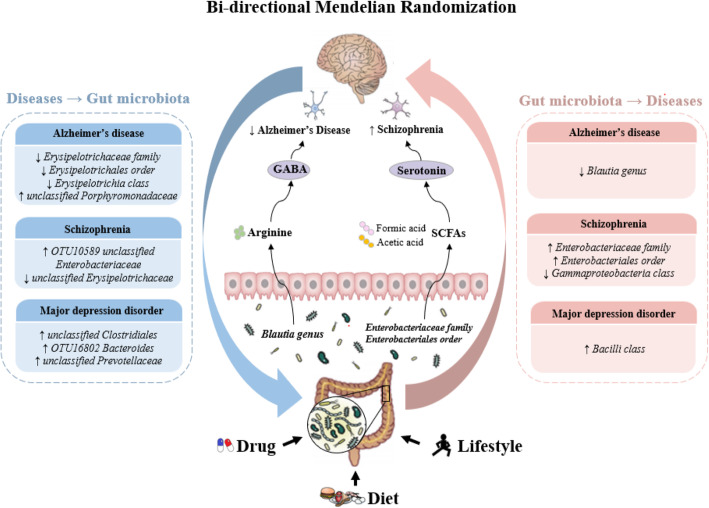
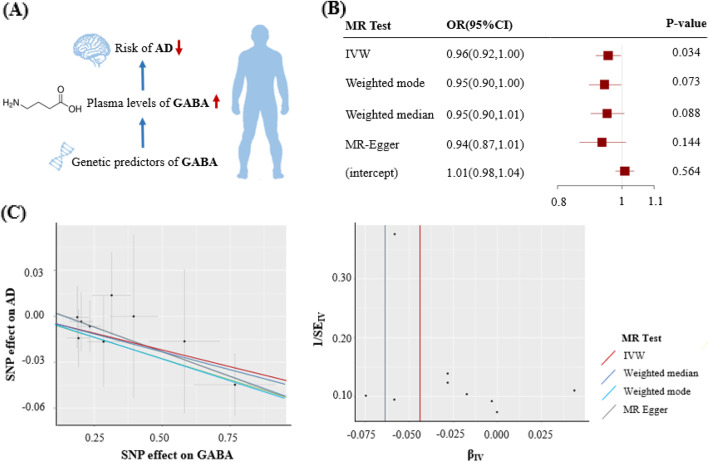
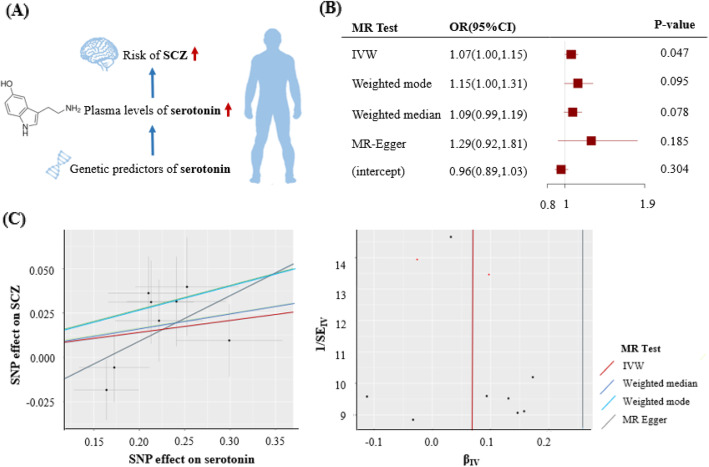
Background: Growing evidence has shown that alterations in the gut microbiota composition were associated with a variety of neuropsychiatric conditions. However, whether such associations reflect causality remains unknown. We aimed to reveal the causal relationships among gut microbiota, metabolites, and neuropsychiatric disorders including Alzheimer’s disease (AD), major depressive disorder (MDD), and schizophrenia (SCZ). Methods: A two-sample bi-directional Mendelian randomization analysis was performed by using genetic variants from genome-wide association studies as instrumental variables for gut microbiota, metabolites, AD, MDD, and SCZ, respectively. Results: We found suggestive associations of host-genetic-driven increase in Blautia (OR, 0.88; 95%CI, 0.79–0.99; P = 0.028) and elevated γ-aminobutyric acid (GABA) (0.96; 0.92–1.00; P = 0.034), a downstream product of Blautia -dependent arginine metabolism, with a lower risk of AD. Genetically increased Enterobacteriaceae family and Enterobacteriales order were potentially associated with a higher risk of SCZ (1.09; 1.00–1.18; P = 0.048), while Gammaproteobacteria class (0.90; 0.83–0.98; P = 0.011) was related to a lower risk for SCZ. Gut production of serotonin was potentially associated with an increased risk of SCZ (1.07; 1.00–1.15; P = 0.047). Furthermore, genetically increased Bacilli class was related to a higher risk of MDD (1.07; 1.02–1.12; P = 0.010). In the other direction, neuropsychiatric disorders altered gut microbiota composition. Conclusions: These data for the first time provide evidence of potential causal links between gut microbiome and AD, MDD, and SCZ. GABA and serotonin may play an important role in gut microbiota-host crosstalk in AD and SCZ, respectively. Further investigations in understanding the underlying mechanisms of associations between gut microbiota and AD, MDD, and SCZ are required.
Overview
The claims and statistics of this paper haven’t been checked yet.
Free: it reads the open-access text and checks the first 5 claims that cite a source we can check. Create a free account to check every claim.
Integrity signals
Registry
Cites
Statistics
Figures
Verification
Claims the paper makes
The claims and statistics of this paper haven’t been checked yet.
Free: it reads the open-access text and checks the first 5 claims that cite a source we can check. Create a free account to check every claim.
Claims other papers make about this one
Each is checked against this paper’s own text: does it say what the citing paper says it does?
The cited source says what the claim attributes to it.
In the citing paper
“Substantial evidence links the gut microbiome to a variety of neuropsychiatric conditions[11], [12], [13], [14] and gastrointestinal diseases[15], [16], [17], [18].”
From The hidden genetic and microbial networks connecting neuropsychiatric and digestive disorders (2025) · cites this paper as [11]
Self-check
Percentages, sums and reported differences re-computed from the paper’s own numbers.
The self-check needs the paper’s full text.
Citations
Cites
Bowden, J., Davey Smith, G., Haycock, P. C., & Burgess, S. (2016) · Genetic Epidemiology · doi:10.1002/gepi.21965 · Cited by 8,922
Meta-Analysis of 74,046 Individuals Identifies 11 New Susceptibility Loci for Alzheimer’s Disease
(EADI), E. A. D. I., Lambert, J.-C., (GERAD), G. A. E. R. I. A. D., Alzheimer's Disease Genetic Consortium (ADGC), (CHARGE), C. F. H. A. A. R. I. G. E., Ibrahim-Verbaas, C. A., Harold, D., Naj, A. C., Sims, R., Bellenguez, C., et al. (2013) · Nature Genetics · doi:10.1038/ng.2802 · Cited by 4,336
Emdin, C. A., Khera, A. V., & Kathiresan, S. (2017) · JAMA · doi:10.1001/jama.2017.17219 · Cited by 3,637
Robust inference in summary data Mendelian randomization via the zero modal pleiotropy assumption
Hartwig, F. P., Davey Smith, G., & Bowden, J. (2017) · International Journal of Epidemiology · doi:10.1093/ije/dyx102 · Cited by 3,485
eQTLGen, Wray, N. R., 23andMe, the Major Depressive Disorder Working Group of the Psychiatric Genomics Consortium, Ripke, S., Mattheisen, M., Trzaskowski, M., Byrne, E. M., Abdellaoui, A., Adams, M. J., et al. (2018) · Nature Genetics · doi:10.1038/s41588-018-0090-3 · Cited by 3,005
Gut microbiome alterations in Alzheimer’s disease
Vogt, N. M., Kerby, R. L., Dill-McFarland, K. A., Harding, S. J., Merluzzi, A. P., Johnson, S. C., Carlsson, C. M., Asthana, S., Zetterberg, H., Blennow, K., et al. (2017) · Scientific Reports · doi:10.1038/s41598-017-13601-y · Cited by 2,137
The neuroactive potential of the human gut microbiota in quality of life and depression
Valles-Colomer, M., Falony, G., Darzi, Y., Tigchelaar, E. F., Wang, J., Tito, R. Y., Schiweck, C., Kurilshikov, A., Joossens, M., Wijmenga, C., et al. (2019) · Nature Microbiology · doi:10.1038/s41564-018-0337-x · Cited by 1,963
Interactions between the microbiota, immune and nervous systems in health and disease
Fung, T. C., Olson, C. A., & Hsiao, E. Y. (2017) · Nature Neuroscience · doi:10.1038/nn.4476 · Cited by 1,900
Causal relationships among the gut microbiome, short-chain fatty acids and metabolic diseases
Sanna, S., van Zuydam, N. R., Mahajan, A., Kurilshikov, A., Vich Vila, A., Võsa, U., Mujagic, Z., Masclee, A. A. M., Jonkers, D. M. A. E., Oosting, M., et al. (2019) · Nature Genetics · doi:10.1038/s41588-019-0350-x · Cited by 1,539
Neurotransmitter modulation by the gut microbiota
Strandwitz, P. (2018) · Brain Research · doi:10.1016/j.brainres.2018.03.015 · Cited by 1,527
Genome-wide association analysis identifies 13 new risk loci for schizophrenia
Multicenter Genetic Studies of Schizophrenia Consortium, Ripke, S., Psychosis Endophenotypes International Consortium, Wellcome Trust Case Control Consortium 2, O'Dushlaine, C., Chambert, K., Moran, J. L., Kähler, A. K., Akterin, S., Bergen, S. E., et al. (2013) · Nature Genetics · doi:10.1038/ng.2742 · Cited by 1,496
GABA-modulating bacteria of the human gut microbiota
Strandwitz, P., Kim, K. H., Terekhova, D., Liu, J. K., Sharma, A., Levering, J., McDonald, D., Dietrich, D., Ramadhar, T. R., Lekbua, A., et al. (2018) · Nature Microbiology · doi:10.1038/s41564-018-0307-3 · Cited by 1,170
Genetic determinants of the gut microbiome in UK twins
Goodrich, J. K., Davenport, E. R., Beaumont, M., Jackson, M. A., Knight, R., Ober, C., Spector, T. D., Bell, J. T., Clark, A. G., & Ley, R. E. (2016) · Cell Host & Microbe · doi:10.1016/j.chom.2016.04.017 · Cited by 1,048
Correlation between the human fecal microbiota and depression
Naseribafrouei, A., Hestad, K., Avershina, E., Sekelja, M., Linløkken, A., Wilson, R., & Rudi, K. (2014) · Neurogastroenterology & Motility · doi:10.1111/nmo.12378 · Cited by 1,044
Reduction of Abeta amyloid pathology in APPPS1 transgenic mice in the absence of gut microbiota
Harach, T., Marungruang, N., Duthilleul, N., Cheatham, V., Mc Coy, K. D., Frisoni, G., Neher, J. J., Fåk, F., Jucker, M., Lasser, T., et al. (2017) · Scientific Reports · doi:10.1038/srep41802 · Cited by 901
van de Wouw, M., Boehme, M., Lyte, J. M., Wiley, N., Strain, C., O'Sullivan, O., Clarke, G., Stanton, C., Dinan, T. G., & Cryan, J. F. (2018) · The Journal of Physiology · doi:10.1113/jp276431 · Cited by 789
Regulation of inflammation by microbiota interactions with the host
Blander, J. M., Longman, R. S., Iliev, I. D., Sonnenberg, G. F., & Artis, D. (2017) · Nature Immunology · doi:10.1038/ni.3780 · Cited by 646
Wang, J., Thingholm, L. B., Skiecevičienė, J., Rausch, P., Kummen, M., Hov, J. R., Degenhardt, F., Heinsen, F.-A., Rühlemann, M. C., Szymczak, S., et al. (2016) · Nature Genetics · doi:10.1038/ng.3695 · Cited by 625 · cited 1×
“We leveraged summary statistics from a GWAS of gut microbiota conducted among two independent but geographically matched cohorts of European ancestry (n = 1812) using 16S rRNA gene sequencing (Table 1) [19], which yielded a total of 38 and 374 identified phyla and genera respectively.”
MethodMild cognitive impairment has similar alterations as Alzheimer's disease in gut microbiota
Li, B., He, Y., Ma, J., Huang, P., Du, J., Cao, L., Wang, Y., Xiao, Q., Tang, H., & Chen, S. (2019) · Alzheimer's & Dementia · doi:10.1016/j.jalz.2019.07.002 · Cited by 478
Association of host genome with intestinal microbial composition in a large healthy cohort
GEM Project Research Consortium, Turpin, W., Espin-Garcia, O., Xu, W., Silverberg, M. S., Kevans, D., Smith, M. I., Guttman, D. S., Griffiths, A., Panaccione, R., et al. (2016) · Nature Genetics · doi:10.1038/ng.3693 · Cited by 460
Altered gut microbiota and short chain fatty acids in Chinese children with autism spectrum disorder
Liu, S., Li, E., Sun, Z., Fu, D., Duan, G., Jiang, M., Yu, Y., Mei, L., Yang, P., Tang, Y., et al. (2019) · Scientific Reports · doi:10.1038/s41598-018-36430-z · Cited by 457 · cited 1×
“Importantly, epidemiological study indicated that elevated Enterobacteriales was also associated with a higher risk of ASD, suggesting that the same changes in intestinal microbiota composition might lead to different outcomes due to gene-gene interactions and gene-environment interactions [44].”
BackgroundThe microbiota-gut-brain axis: neurobehavioral correlates, health and sociality
Montiel-Castro, A. J., González-Cervantes, R. M., Bravo-Ruiseco, G., & Pacheco-López, G. (2013) · Frontiers in Integrative Neuroscience · doi:10.3389/fnint.2013.00070 · Cited by 413
Haran, J. P., Bhattarai, S. K., Foley, S. E., Dutta, P., Ward, D. V., Bucci, V., & McCormick, B. A. (2019) · mBio · doi:10.1128/mbio.00632-19 · Cited by 412 · cited 1×
“A cohort study (n = 108) reported that decreased proportion of Blautia hansenii was associated with a higher risk of AD [30], while two case-control studies observed that Blautia were more abundant in AD patients [5, 31].”
ResultLiu, F., Li, J., Wu, F., Zheng, H., Peng, Q., & Zhou, H. (2019) · Translational Psychiatry · doi:10.1038/s41398-019-0389-6 · Cited by 336
A Genome-wide Association Study of the Human Metabolome in a Community-Based Cohort
Rhee, E. P., Ho, J. E., Chen, M.-H., Shen, D., Cheng, S., Larson, M. G., Ghorbani, A., Shi, X., Helenius, I. T., O’Donnell, C. J., et al. (2013) · Cell Metabolism · doi:10.1016/j.cmet.2013.06.013 · Cited by 321
Shen, Y., Xu, J., Li, Z., Huang, Y., Yuan, Y., Wang, J., Zhang, M., Hu, S., & Liang, Y. (2018) · Schizophrenia Research · doi:10.1016/j.schres.2018.01.002 · Cited by 314
New Targets for Schizophrenia Treatment beyond the Dopamine Hypothesis
Yang, A., & Tsai, S.-J. (2017) · International Journal of Molecular Sciences · doi:10.3390/ijms18081689 · Cited by 282
Nguyen, T. T., Kosciolek, T., Maldonado, Y., Daly, R. E., Martin, A. S., McDonald, D., Knight, R., & Jeste, D. V. (2019) · Schizophrenia Research · doi:10.1016/j.schres.2018.09.014 · Cited by 260
Bäuerl, C., Collado, M. C., Diaz Cuevas, A., Viña, J., & Pérez Martínez, G. (2018) · Letters in Applied Microbiology · doi:10.1111/lam.12882 · Cited by 238
The role of serotonin in the pathophysiology and treatment of schizophrenia
(1997) · The Journal of Neuropsychiatry and Clinical Neurosciences · doi:10.1176/jnp.9.1.1 · Cited by 211
Towards a Better Understanding of GABAergic Remodeling in Alzheimer’s Disease
Govindpani, K., Calvo-Flores Guzmán, B., Vinnakota, C., Waldvogel, H., Faull, R., & Kwakowsky, A. (2017) · International Journal of Molecular Sciences · doi:10.3390/ijms18081813 · Cited by 208
GABAAreceptors in aging and Alzheimer’s disease
Rissman, R. A., De Blas, A. L., & Armstrong, D. M. (2007) · Journal of Neurochemistry · doi:10.1111/j.1471-4159.2007.04832.x · Cited by 192
Alzheimer’s disease: amino acid levels and brain metabolic status
Gueli, M. C., & Taibi, G. (2013) · Neurological Sciences · doi:10.1007/s10072-013-1289-9 · Cited by 154
Park, J.-Y., Choi, J., Lee, Y., Lee, J.-E., Lee, E.-H., Kwon, H.-J., Yang, J., Jeong, B.-R., Kim, Y.-K., & Han, P.-L. (2017) · Experimental Neurobiology · doi:10.5607/en.2017.26.6.369 · Cited by 147 · cited 1×
“However, animal studies regarding the effects of Blautia genus on AD have yielded conflicting results, but extrapolating these findings to human beings is challenging [28, 29].”
BackgroundNeuroinflammation, gut microbiome, and Alzheimer's disease
Lin, L., Zheng, L. J., & Zhang, L. J. (2018) · Molecular Neurobiology · doi:10.1007/s12035-018-0983-2 · Cited by 147
Relevance of gutmicrobiota in cognition, behaviour and Alzheimer’s disease
de J.R. De-Paula, V., Forlenza, A. S., & Forlenza, O. V. (2018) · Pharmacological Research · doi:10.1016/j.phrs.2018.07.007 · Cited by 145
Glutamate-glutamine and GABA in brain of normal aged and patients with cognitive impairment
Huang, D., Liu, D., Yin, J., Qian, T., Shrestha, S., & Ni, H. (2016) · European Radiology · doi:10.1007/s00330-016-4669-8 · Cited by 142
Small talk: microbial metabolites involved in the signaling from microbiota to brain
Caspani, G., & Swann, J. (2019) · Current Opinion in Pharmacology · doi:10.1016/j.coph.2019.08.001 · Cited by 138
Cao, G., Tao, F., Hu, Y., Li, Z., Zhang, Y., Deng, B., & Zhan, X. (2019) · Food & Function · doi:10.1039/c8fo02370k · Cited by 138
Depression and the role of genes involved in dopamine metabolism and signalling
Opmeer, E. M., Kortekaas, R., & Aleman, A. (2010) · Progress in Neurobiology · doi:10.1016/j.pneurobio.2010.06.003 · Cited by 131
Sun, L., Zhang, H., Cao, Y., Wang, C., Zhao, C., Wang, H., Cui, G., Wang, M., Pan, Y., Shi, Y., et al. (2019) · International Journal of Medical Sciences · doi:10.7150/ijms.37322 · Cited by 127
Neurotransmitter amino acids in cerebrospinal fluid of patients with Alzheimer's disease
Jiménez‐Jiménez, F. J., Molina, J. A., Gómez, P. A., Vargas, C., de Bustos, F., Benito‐León, J., Tallón-Barranco, A., Pareja, M. O., Gasalla, T., & Arenas, J. (1998) · Journal of Neural Transmission · doi:10.1007/s007020050056 · Cited by 106
Xin, Y., Diling, C., Jian, Y., Ting, L., Guoyan, H., Hualun, L., Xiaocui, T., Guoxiao, L., Ou, S., Chaoqun, Z., et al. (2018) · Frontiers in Neurology · doi:10.3389/fneur.2018.00412 · Cited by 104
Inta, D., Lang, U. E., Borgwardt, S., Meyer-Lindenberg, A., & Gass, P. (2016) · Schizophrenia Bulletin · doi:10.1093/schbul/sbw088 · Cited by 98 · cited 1×
“Recent research has indicated that gut inflammation can induce activation of microglia and the kynurenine pathway, which activate systemic inflammationinducing depressive or schizophrenic symptoms [56, 57].”
BackgroundTHE ROLE OF MICROBIOTA IN DEPRESSION - A BRIEF REVIEW
University Psychiatric Clinic Ljubljana, L., Zalar, B., Haslberger, A., University of Vienna, D. O. N. S., Peterlin, B., & Clinical Institute of Medical Genetics, U. M. C. L. (2018) · Psychiatria Danubina · doi:10.24869/psyd.2018.136 · Cited by 94 · cited 1×
“These gut microbial metabolites play crucial roles in maintaining a healthy neuropsychiatric function, and if dysregulated, potentially causally linked to neuropsychiatric disorders according to previous studies [3, 24, 25].”
BackgroundProbiotics and prebiotics: focus on psychiatric disorders – a systematic review
Barbosa, R. S. D., & Vieira-Coelho, M. A. (2020) · Nutrition Reviews · doi:10.1093/nutrit/nuz080 · Cited by 93 · cited 1×
“A meta-analysis of RCTs showed that probiotics, typically including Lactobacillus and Bifidobacterium, had some benefit for MDD, but we found no associations for these microbiota, possibly due to the synergistic effect of gut microbiome so that the influence of a particular taxon may be different from multiple taxa [4…”
MethodMicrobiome and Mental Health, Specifically as It Relates to Adolescents
Simkin, D. R. (2019) · Current Psychiatry Reports · doi:10.1007/s11920-019-1075-3 · Cited by 85
Intestinal Crosstalk between Microbiota and Serotonin and its Impact on Gut Motility
Ge, X., Pan, J., Liu, Y., Wang, H., Zhou, W., & Wang, X. (2018) · Current Pharmaceutical Biotechnology · doi:10.2174/1389201019666180528094202 · Cited by 77
Manyevitch, R., Protas, M., Scarpiello, S., Deliso, M., Bass, B., Nanajian, A., Chang, M., Thompson, S. M., Khoury, N., Gonnella, R., et al. (2018) · Current Alzheimer Research · doi:10.2174/1567205014666170921122458 · Cited by 65 · cited 2×
“Our findings supported previous metaanalysis of 35 observational studies which suggested that GABA level in AD were significantly lower than that of controls [12].”
THE ROLE OF MICROBIOTA IN DEPRESSION - A BRIEF REVIEW
Zalar, B., Haslberger, A. G., & Peterlin, B. (2018) · Psychiatria Danubina · doi:10.24869/spsih.2018.136 · Cited by 62
Elderly patients have an altered gut-brain axis regardless of the presence of cirrhosis
Bajaj, J. S., Ahluwalia, V., Steinberg, J. L., Hobgood, S., Boling, P. A., Godschalk, M., Habib, S., White, M. B., Fagan, A., Gavis, E. A., et al. (2016) · Scientific Reports · doi:10.1038/srep38481 · Cited by 59
Liu, X., Zheng, H., Lu, R., Huang, H., Zhu, H., Yin, C., Mo, Y.-Y., Wu, J., Liu, X., Deng, M., et al. (2019) · Frontiers in Microbiology · doi:10.3389/fmicb.2019.01151 · Cited by 50
Depressive symptoms in schizophrenia and dopamine and serotonin gene polymorphisms
Peitl, V., Štefanović, M., & Karlović, D. (2017) · Progress in Neuro-Psychopharmacology and Biological Psychiatry · doi:10.1016/j.pnpbp.2017.04.011 · Cited by 48
Influence of clozapine on platelet serotonin, monoamine oxidase and plasma serotonin levels
Ertuğrul, A., Uçar, G., Başar, K., Demir, B., Yabanoğlu, S., & Uluğ, B. (2006) · Psychiatry Research · doi:10.1016/j.psychres.2005.12.009 · Cited by 42
Platelet serotonin concentration and depressive symptoms in patients with schizophrenia
Peitl, V., Vidrih, B., Karlović, Z., Getaldić, B., Peitl, M., & Karlović, D. (2016) · Psychiatry Research · doi:10.1016/j.psychres.2016.03.006 · Cited by 42
Du, C., Gao, W., Ma, K., Yu, S.-X., Li, N., Yan, S.-Q., Zhou, F., Liu, Z., Chen, W., Lei, L., et al. (2018) · International Journal of Molecular Sciences · doi:10.3390/ijms19040993 · Cited by 41 · cited 1×
“Although several animal studies suggested that anti-AD microbes, such as Erysipelotrichiaceae, decreased in mouse models with AD, and Porphyromonadaceae increased in aged mice [28, 51], other animal studies showed that the relative abundance of Erysipelotrichiaceae was positively correlated with AD [52, 53].”
ResultSabokdast, M., Habibi-Rezaei, M., Moosavi‐Movahedi, A. A., Ferdousi, M., Azimzadeh-Irani, E., & Poursasan, N. (2015) · DARU Journal of Pharmaceutical Sciences · doi:10.1186/s40199-015-0126-5 · Cited by 34
Bergin, D. H., Yu, J., Zhang, H., & Liu, P. (2015) · Neuroscience · doi:10.1016/j.neuroscience.2015.04.034 · Cited by 17
Cited by
Tryptophan metabolism and gut-brain homeostasis
Roth, W., Zadeh, K., Vekariya, R., Ge, Y., & Mohamadzadeh, M. (2021) · International Journal of Molecular Sciences · doi:10.3390/ijms22062973 · Cited by 519
“Several other genera, including Clostridium, Ruminococcus, Blautia and Lactobacillus expressing TPH decarboxylases catabolize TPH to tryptamine [71].”
BackgroundGamma-aminobutyric acid as a potential postbiotic mediator in the gut–brain axis
Braga, J. D., Thongngam, M., & Kumrungsee, T. (2024) · npj Science of Food · doi:10.1038/s41538-024-00253-2 · Cited by 224
“As men-tionedabove,homocarnosinecouldpossiblybeagoodreservoirofGABAin thebrain,andotherneurologicaldisorders,suchasAD,ASD,andSCZ,can beassociatedwithhomocarnosineastheyarecharacterizedbylowGABA levels,andGABAcaninducehomocarnosineproduction 35,88,92,134 .”
BackgroundOrnish, D. M., Madison, C. A., Kivipelto, M., Kemp, C., McCulloch, C. E., Galasko, D., Artz, J., Rentz, D. M., Lin, J., Norman, K., et al. (2024) · Alzheimer s Research & Therapy · doi:10.1186/s13195-024-01482-z · Cited by 200
“For example, Blautia, which increased during the intervention in the intervention group, has previously been associated with a lower risk of AD, potentially due to its involvement in increasing γ-aminobutyric acid (GABA) production [37].”
BackgroundProbiotics for Alzheimer’s Disease: A Systematic Review
Naomi, R., Embong, H., Othman, F., Ghazi, H. F., Maruthey, N., & Bahari, H. (2021) · Nutrients · doi:10.3390/nu14010020 · Cited by 194
“Another study reports the causal effect of elevated GABA, which is a downstream product of Blautia- dependent arginine metabolism with a lower risk of AD [39].”
BackgroundGut Microbiota and Psychiatric Disorders: A Two-Sample Mendelian Randomization Study
Ni, J.-J., Xu, Q., Yan, S.-S., Han, B.-X., Zhang, H., Wei, X.-T., Feng, G.-J., Zhao, M., Pei, Y.-F., & Zhang, L. (2022) · Frontiers in Microbiology · doi:10.3389/fmicb.2021.737197 · Cited by 181
Metadata
- Authors
- Zhuang, Z., Yang, R., Wang, W., Qi, L., & Huang, T.
- Affiliations
- Peking University (CN)
- Tulane University (US)
- Corresponding author
- Qi, Lu
- Huang, Tao
- Venue
- Journal of Neuroinflammation
- Published
- 2020-10-02
- Volume
- 17
- Issue
- 1
- Pages
- 288-288
- ISSN
- 1742-2094 (ISSN-L)
- PMC
- PMC7532639
- OpenAlex
- W3090879627
- Cited by
- 220
- References
- 57
- Citations by year
- 2026: 15 · 2025: 53 · 2024: 66 · 2023: 36 · 2022: 32 · 2021: 16 · 2020: 2
- FWCI
- 7.05
- Type
- journal article
- Language
- en
- Open access
- gold
- doi.org
- Licence
- cc-by
- creativecommons.org/licenses/by/4.0 (tdm)
- creativecommons.org/licenses/by/4.0 (vor)
- Locations
- Journal of Neuroinflammation (publishedVersion, cc-by)
- PubMed Central (publishedVersion, cc-by)
- PubMed (publishedVersion)
- DOAJ (DOAJ: Directory of Open Access Journals) (submittedVersion, cc-by-sa)
- Funders
- Beijing Technology and Business University
- Peking University (2019YFC2003400)
- Topics
- Life Sciences › Biochemistry, Genetics and Molecular Biology › Molecular Biology › Gut microbiota and health
- Life Sciences › Biochemistry, Genetics and Molecular Biology › Genetics › Genetic Associations and Epidemiology
- Life Sciences › Neuroscience › Biological Psychiatry › Tryptophan and brain disorders
- Keywords
- gut microbiota, Alzheimer's disease, major depressive disorder, schizophrenia, neuropsychiatric disorders, Blautia, GABA, serotonin, arginine metabolism, Enterobacteriaceae, Gammaproteobacteria, bacilli, causal inference, gut-brain axis, microbial metabolites
- MeSH terms
- Gastrointestinal Microbiome, Alzheimer Disease, Major Depressive Disorder, Humans, Schizophrenia, Genetic Predisposition to Disease, Genome-Wide Association Study
About these checks
Registry, retraction, Cites and statistics results are computed, not judged, with one exception: a printed reference that no index lists is read once by a model before it counts as a citation error. Claims are extracted by a model and kept only when their quote appears verbatim in the text; each cited source is then checked, with a model’s help, for whether it says what the claim relies on. Those verdicts can be wrong — read the claim’s quote and the cited source before relying on one.
Statistics and arithmetic are recomputed, not judged.
Confidence bands are shown only for fields calibrated on our annotated test set. None is calibrated yet, so no band is shown.
What counts as a claim ›How we measure confidence ›How we check this ›
Are you an author, or do you see a problem with this page? Request a review
Data sources
Bibliographic data: Semantic Scholar, OpenAlex, Crossref.
Contains information from the Semantic Scholar Academic Graph Datasets, made available under the ODC Attribution License (ODC-BY 1.0).
Semantic Scholar’s data is described in: Kinney, R., et al. (2023). The Semantic Scholar Open Data Platform. arXiv:2301.10140.
