

High coverage but low quality of maternal and newborn health services in the coverage cascade: who is benefitted and left behind in accessing better quality health services in Nepal?
Open accessThe DOI matches its Crossref record; 73 of the 79 references it cites were found in a registry or an index.
Abstract
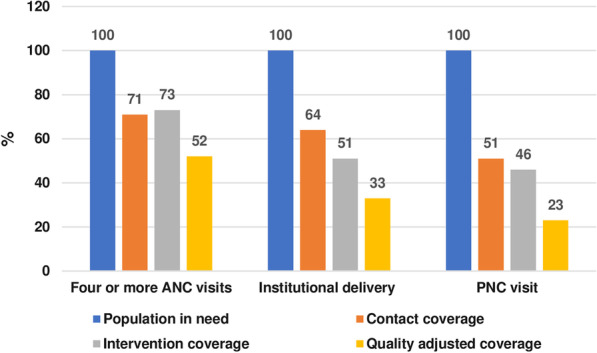
Background: Antenatal care (ANC) visits, institutional delivery, and postnatal care (PNC) visits are vital to improve the health of mothers and newborns. Despite improved access to these routine maternal and newborn health (MNH) services in Nepal, little is known about the cascade of health service coverage, particularly contact coverage, intervention-specific coverage, and quality-adjusted coverage of MNH services. This study examined the cascade of MNH services coverage, as well as social determinants associated with uptake of quality MNH services in Nepal. Methods: We conducted a secondary analysis of data derived from the Nepal Demographic and Health Survey (NDHS) 2016, taking 1978 women aged 15–49 years who had a live birth in the 2 years preceding the survey. Three outcome variables were (i) four or more (4+) ANC visits, (ii) institutional delivery, and (iii) first PNC visit for mothers and newborns within 48 h of childbirth. We applied a cascade of health services coverage, including contact coverage, intervention-specific and quality-adjusted coverage, using a list of specific intervention components for each outcome variable. Several social determinants of health were included as independent variables to identify determinants of uptake of quality MNH services. We generated a quality score for each outcome variable and dichotomised the scores into two categories of “poor” and “optimal” quality, considering > 0.8 as a cut-off point. Binomial logistic regression was conducted and odds ratios (OR) were reported with 95% confidence intervals (CIs) at the significance level of p < 0.05 (two-tailed). Results: Contact coverage was higher than intervention-specific coverage and quality-adjusted coverage across all MNH services. Women with advantaged ethnicities or who had access to bank accounts had higher odds of receiving optimal quality MNH services, while women who speak the Maithili language and who had high birth order (≥ 4) had lower odds of receiving optimal quality ANC services. Women who received better quality ANC services had higher odds of receiving optimal quality institutional delivery. Women received poor quality PNC services if they were from remote provinces, had higher birth order and perceived problems when not having access to female providers. Conclusions: Women experiencing ethnic and social disadvantages, and from remote provinces received poor quality MNH services. The quality-adjusted coverage can be estimated using household survey data, such as demographic and health surveys, especially in countries with limited routine data. Policies and programs should focus on increasing quality of MNH services and targeting disadvantaged populations and those living in remote areas. Ensuring access to female health providers and improving the quality of earlier maternity visits could improve the quality of health care during the pregnancy-delivery-postnatal period.
Overview
The claims and statistics of this paper haven’t been checked yet.
Free: it reads the open-access text and checks the first 5 claims that cite a source we can check. Create a free account to check every claim.
Integrity signals
Registry
Cites
Statistics
Figures
Verification
Claims the paper makes
The claims and statistics of this paper haven’t been checked yet.
Free: it reads the open-access text and checks the first 5 claims that cite a source we can check. Create a free account to check every claim.
Claims other papers make about this one
Each is checked against this paper’s own text: does it say what the citing paper says it does?
The cited source says what the claim attributes to it.
In the citing paper
“Low-and middle-income countries (LMIC) have a long history of poor access to and poor quality of health services, particularly in the maternal and child health (MCH) arena [1][2][3][4].”
From Digital Health Technologies for Maternal and Child Health in Africa and Other Low- and Middle-Income Countries: Cross-disciplinary Scoping Review With Stakeholder Consultation (2023) · doi:10.2196/42161 · cites this paper as [2]
Self-check
Percentages, sums and reported differences re-computed from the paper’s own numbers.
The self-check needs the paper’s full text.
Citations
Cites
Donabedian, A. (1988) · JAMA · doi:10.1001/jama.260.12.1743 · Cited by 5,895
High-quality health systems in the Sustainable Development Goals era: time for a revolution
Kruk, M. E., Gage, A. D., Arsenault, C., Jordan, K., Leslie, H. H., Roder-DeWan, S., Adeyi, O., Barker, P., Daelmans, B., Doubova, S. V., et al. (2018) · The Lancet Global Health · doi:10.1016/s2214-109x(18)30386-3 · Cited by 4,057
Purposeful selection of variables in logistic regression
Bursac, Z., Gauss, C. H., Williams, D. K., & Hosmer, D. W. (2008) · Source Code for Biology and Medicine · doi:10.1186/1751-0473-3-17 · Cited by 4,035
A Conceptual Framework for Action on the Social Determinants of Health
UNSPECIFIED (2010) · University Libraries (University of Maryland) · doi:10.13016/17cr-aqb9 · Cited by 2,325
Variable selection – A review and recommendations for the practicing statistician
Heinze, G., Wallisch, C., & Dunkler, D. (2018) · Biometrical Journal · doi:10.1002/bimj.201700067 · Cited by 1,639
Akinwande, M. O., Dikko, H. G., & Samson, A. (2015) · Open Journal of Statistics · doi:10.4236/ojs.2015.57075 · Cited by 1,534
Nepal Demographic And Health Survey 2006
Mohp, P., & Nepal (2007) · Cited by 1,312
Johnston, R., Jones, K., & Manley, D. (2018) · Quality & Quantity · doi:10.1007/s11135-017-0584-6 · Cited by 1,181
Kruk, M. E., Gage, A. D., Joseph, N. T., Danaei, G., García-Saisó, S., & Salomon, J. A. (2018) · The Lancet · doi:10.1016/s0140-6736(18)31668-4 · Cited by 885
Barros, A. J., Ronsmans, C., Axelson, H., Loaiza, E., Bertoldi, A. D., França, G. V., Bryce, J., Boerma, J. T., & Victora, C. G. (2012) · The Lancet · doi:10.1016/s0140-6736(12)60113-5 · Cited by 549
Health service coverage and its evaluation.
Tanahashi, T. (1978) · Europe PMC (PubMed Central) · Cited by 503
Joshi, C., Torvaldsen, S., Hodgson, R., & Hayen, A. (2014) · BMC Pregnancy and Childbirth · doi:10.1186/1471-2393-14-94 · Cited by 392
Benova, L., Tunçalp, Ö., Moran, A. C., & Campbell, O. M. R. (2018) · BMJ Global Health · doi:10.1136/bmjgh-2018-000779 · Cited by 281
Randive, B., Diwan, V., & De Costa, A. (2013) · PLoS ONE · doi:10.1371/journal.pone.0067452 · Cited by 247
The quality–coverage gap in antenatal care: toward better measurement of effective coverage
Hodgins, S., & D'Agostino, A. (2014) · Global Health: Science and Practice · doi:10.9745/ghsp-d-13-00176 · Cited by 228
Effective Coverage: A Metric for Monitoring Universal Health Coverage
Ng, M., Fullman, N., Dieleman, J. L., Flaxman, A. D., Murray, C. J. L., & Lim, S. S. (2014) · PLoS Medicine · doi:10.1371/journal.pmed.1001730 · Cited by 212
Khanal, V., Adhikari, M., Karkee, R., & Gavidia, T. (2014) · BMC Women's Health · doi:10.1186/1472-6874-14-19 · Cited by 201
Self-citationMarsh, A. D., Muzigaba, M., Diaz, T., Requejo, J., Jackson, D., Chou, D., Cresswell, J. A., Guthold, R., Moran, A. C., Strong, K. L., et al. (2020) · The Lancet Global Health · doi:10.1016/s2214-109x(20)30104-2 · Cited by 180
Darmstadt, G. L., Walker, N., Lawn, J. E., Bhutta, Z. A., Haws, R. A., & Cousens, S. (2008) · Health Policy and Planning · doi:10.1093/heapol/czn001 · Cited by 158
Implementing Federalism in the Health System of Nepal: Opportunities and Challenges
Thapa, R., Bam, K., Tiwari, P., Sinha, T. K., & Dahal, S. (2018) · International Journal of Health Policy and Management · doi:10.15171/ijhpm.2018.121 · Cited by 158
Bibliometric analysis of peer-reviewed literature on antimicrobial stewardship from 1990 to 2019
Sweileh, W. M. (2021) · Globalization and Health · doi:10.1186/s12992-020-00651-7 · Cited by 158
Advances in the measurement of coverage for RMNCH and nutrition: from contact to effective coverage
Amouzou, A., Leslie, H. H., Ram, M., Fox, M. J., Jiwani, S. S., Requejo, J. H., Marchant, T., Munos, M. K., Vaz, L. M. E., Weiss, W. M., et al. (2019) · BMJ Global Health · doi:10.1136/bmjgh-2018-001297 · Cited by 156
Adhikari, R. P., Shrestha, M. L., Satinsky, E. N., & Upadhaya, N. (2021) · BMC Pregnancy and Childbirth · doi:10.1186/s12884-020-03485-8 · Cited by 152
Blanc, A. K., Diaz, C., McCarthy, K. J., & Berdichevsky, K. (2016) · BMC Pregnancy and Childbirth · doi:10.1186/s12884-016-1047-0 · Cited by 143
Poor Quality for Poor Women? Inequities in the Quality of Antenatal and Delivery Care in Kenya
Sharma, J., Leslie, H. H., Kundu, F., & Kruk, M. E. (2017) · PLOS ONE · doi:10.1371/journal.pone.0171236 · Cited by 140
Effective coverage of primary care services in eight high-mortality countries
Leslie, H. H., Malata, A. M., Ndiaye, Y., & Kruk, M. E. (2017) · BMJ Global Health · doi:10.1136/bmjgh-2017-000424 · Cited by 132
Drivers of stunting reduction in Peru: a country case study
Huicho, L., Vidal-Cárdenas, E., Akseer, N., Brar, S., Conway-Moore, K., Islam, M., Juárez-Chávez, E., Rappaport, A. I., Tasic, H., Vaivada, T., et al. (2020) · American Journal of Clinical Nutrition · doi:10.1093/ajcn/nqaa164 · Cited by 125
Measuring the adequacy of antenatal health care: a national cross-sectional study in Mexico
Heredia-Pi, I., Servan-Mori, E., Darney, G., Reyes-Morales, H., & Lozano, R. (2016) · Bulletin of the World Health Organization · doi:10.2471/blt.15.168302 · Cited by 123
Timing of First Antenatal Care (ANC) and Inequalities in Early Initiation of ANC in Nepal
Paudel, Y. R., Jha, T., & Mehata, S. (2017) · Frontiers in Public Health · doi:10.3389/fpubh.2017.00242 · Cited by 109
Panth, A., & Kafle, P. (2018) · Obstetrics and Gynecology International · doi:10.1155/2018/4530161 · Cited by 108
Nguhiu, P. K., Barasa, E., & Chuma, J. M. (2017) · Tropical Medicine & International Health · doi:10.1111/tmi.12841 · Cited by 104
Caste System: Theories and Practices in Nepal
Subedi, M. S. (2011) · Himalayan Journal of Sociology and Anthropology · doi:10.3126/hjsa.v4i0.4672 · Cited by 103
Shibanuma, A., Yeji, F., Okawa, S., Mahama, E., Kikuchi, K., Narh, C., Enuameh, Y., Nanishi, K., Oduro, A., Owusu-Agyei, S., et al. (2018) · BMJ Global Health · doi:10.1136/bmjgh-2018-000786 · Cited by 100
Trends, determinants and inequities of 4+ ANC utilisation in Bangladesh
Rahman, A., Nisha, M. K., Begum, T., Ahmed, S., Alam, N., & Anwar, I. (2017) · Journal of Health, Population and Nutrition · doi:10.1186/s41043-016-0078-5 · Cited by 98
Carvajal–Aguirre, L., Amouzou, A., Mehra, V., Ziqi, M., Zaka, N., & Newby, H. (2017) · Journal of Global Health · doi:10.7189/jogh.07.020501 · Cited by 97
Drivers of stunting reduction in Nepal: a country case study
Conway-Moore, K., Akseer, N., Subedi, R. K., Brar, S., Bhattarai, B., Dhungana, R. R., Islam, M., Mainali, A., Pradhan, N., Tasic, H., et al. (2020) · American Journal of Clinical Nutrition · doi:10.1093/ajcn/nqaa218 · Cited by 83
Karkee, R., Lee, A. H., & Khanal, V. (2014) · BMJ Open · doi:10.1136/bmjopen-2013-004372 · Cited by 78
Self-citationBhandari, R., Pokhrel, K. N., Nguyen, G., & Amatya, A. (2019) · PLoS ONE · doi:10.1371/journal.pone.0214590 · Cited by 75
Anindya, K., Marthias, T., Vellakkal, S., Carvalho, N., Atun, R. A., Morgan, A., Zhao, Y. W., Hulse, E. S. G., McPake, B., & Lee, J. T. (2021) · EClinicalMedicine · doi:10.1016/j.eclinm.2021.101103 · Cited by 74
Progress in maternal and child health: how has South Asia fared?
Akseer, N., Kamali, M., Arifeen, S. E., Malik, A., Bhatti, Z., Thacker, N., Maksey, M., D’Silva, H., da Silva, I. C., & Bhutta, Z. A. (2017) · BMJ · doi:10.1136/bmj.j1608 · Cited by 73
Factors determining satisfaction among facility-based maternity clients in Nepal
Mehata, S., Paudel, Y. R., Dariang, M., Aryal, K. K., Paudel, S., Mehta, R. K., King, S., & Barnett, S. (2017) · BMC Pregnancy and Childbirth · doi:10.1186/s12884-017-1532-0 · Cited by 73
Khatri, R. B., Dangi, T. P., Gautam, R. K., Shrestha, K. N., & Homer, C. (2017) · PLoS ONE · doi:10.1371/journal.pone.0177602 · Cited by 70
Self-citationEffective coverage of facility delivery in Bangladesh, Haiti, Malawi, Nepal, Senegal, and Tanzania
Wang, W., Mallick, L. M., Allen, C., & Pullum, T. W. (2019) · PLoS ONE · doi:10.1371/journal.pone.0217853 · Cited by 66
Effective coverage as a new approach to health system performance assessment: a scoping review
Jannati, A., Sadeghi, V., Imani, A., & Saadati, M. (2018) · BMC Health Services Research · doi:10.1186/s12913-018-3692-7 · Cited by 65
Association of sedentary behavior and metabolic syndrome
Lemes, Í. R., Sui, X., Fernandes, R. A., Blair, S. N., Turi‐Lynch, B. C., Codogno, J. S., & Monteiro, H. L. (2019) · Public Health · doi:10.1016/j.puhe.2018.11.007 · Cited by 64
Ashish, K. C., Jha, A. K., Shrestha, M. P., Zhou, H., Gurung, A., Thapa, J., & Budhathoki, S. S. (2019) · Maternal and Child Health Journal · doi:10.1007/s10995-019-02826-0 · Cited by 64
Hasan, M. M., Magalhães, R. J. S., Fatima, Y., Ahmed, S., & Mamun, A. A. (2021) · Global Health Science and Practice · doi:10.9745/ghsp-d-20-00533 · Cited by 61
McCollum, R., Taegtmeyer, M., Otiso, L., Mireku, M., Muturi, N., Martineau, T., & Theobald, S. (2019) · International Journal for Equity in Health · doi:10.1186/s12939-019-0967-5 · Cited by 58
Khatri, R. B., & Karkee, R. (2018) · Reproductive Health Matters · doi:10.1080/09688080.2018.1535686 · Cited by 56
Self-citationNeupane, B., Rijal, S., Srijana, G. C., & Basnet, T. B. (2020) · BMC Pregnancy and Childbirth · doi:10.1186/s12884-020-02976-y · Cited by 56
Factors associated with utilization of adolescent-friendly services in Bhaktapur district, Nepal
Napit, K., Shrestha, K. B., Magar, S. A., Paudel, R., Thapa, B., Dhakal, B. R., & Amatya, A. (2020) · Journal of Health Population and Nutrition · doi:10.1186/s41043-020-0212-2 · Cited by 54
Yadav, U. K., Ghimire, P., Amatya, A., & Lamichhane, A. (2021) · Anemia · doi:10.1155/2021/8847472 · Cited by 53
Low effective coverage of family planning and antenatal care services in Ethiopia
Yakob, B., Gage, A. D., Nigatu, T. G., Hurlburt, S., Hagos, S., Dinsa, G. D., H, D. B. M. P., Berman, P., Kruk, M. E., & Tekle, E. (2018) · International Journal for Quality in Health Care · doi:10.1093/intqhc/mzy251 · Cited by 52
Bhusal, U. P. (2021) · BMC Public Health · doi:10.1186/s12889-021-12287-2 · Cited by 48
Adhikari, M., Chalise, B., Bista, B., Pandey, A. R., & Upadhyaya, D. P. (2020) · BMC Pregnancy and Childbirth · doi:10.1186/s12884-020-03218-x · Cited by 46
Kim, H., Novakovic, U., Muntaner, C., & Hawkes, M. (2019) · Global Health Action · doi:10.1080/16549716.2019.1651017 · Cited by 39
Sprague, C. C. (1974) · Academic Medicine · doi:10.1097/00001888-197401000-00001 · Cited by 38
Ashish, K. C., Peterson, S., Gurung, R., Skalkidou, A., Gautam, J., Malla, H., Paudel, P., Bhattarai, K., Joshi, N., Tinkari, B. S., et al. (2021) · Journal of Global Health · doi:10.7189/jogh.11.05010 · Cited by 38
Respectful maternal and newborn care: measurement in one EN-BIRTH study hospital in Nepal
EN-BIRTH Study Group, Gurung, R., Ruysen, H., Sunny, A. K., Day, L. T., Penn‐Kekana, L., Målqvist, M., Ghimire, B., Singh, D., Basnet, O., et al. (2021) · BMC Pregnancy and Childbirth · doi:10.1186/s12884-020-03516-4 · Cited by 37
Khatri, R. B., Durham, J., & Assefa, Y. A. (2021) · Globalization and Health · doi:10.1186/s12992-021-00752-x · Cited by 36
Self-citationKoulidiati, J., Nesbitt, R., Ouédraogo, N., Hien, H., Robyn, P. J., Compaoré, P., Souares, A., & Brenner, S. (2018) · BMJ Open · doi:10.1136/bmjopen-2017-020423 · Cited by 35
Toolan, M., Barnard, K., Lynch, M., Maharjan, N., Thapa, M., Rai, N., Lavender, T., Larkin, M., Caldwell, D. M., Burden, C., et al. (2021) · AJOG Global Reports · doi:10.1016/j.xagr.2021.100019 · Cited by 35
Huda, T. M., Hayes, A., & Dibley, M. J. (2018) · Journal of Global Health · doi:10.7189/jogh.08.010416 · Cited by 31
Nguyen, P. H., Long, K. Q., Pramanik, P., Billah, S. M., Menon, P., Piwoz, E., & Leslie, H. H. (2021) · BMJ Open · doi:10.1136/bmjopen-2020-040109 · Cited by 31
Paudyal, N., Parajuli, K. R., García-Larsen, V., Adhikari, R. K., Devkota, M. D., Rijal, S., Chitekwe, S., & Torlesse, H. (2021) · Maternal and Child Nutrition · doi:10.1111/mcn.13173 · Cited by 30
Thapa, N. R. (2020) · Reproductive Health · doi:10.1186/s12978-020-00954-3 · Cited by 29
Khatri, R. B., Assefa, Y. A., Protani, M. M., Karkee, R., & Durham, J. (2021) · BMC Public Health · doi:10.1186/s12889-021-11142-8 · Cited by 28
Self-citationMorgan, A., Jimenez‐Soto, E., Bhandari, G. P., & Kermode, M. (2014) · Tropical Medicine & International Health · doi:10.1111/tmi.12390 · Cited by 27
Byrne, A., Hodge, A., Jimenez‐Soto, E., & Morgan, A. (2013) · Asia Pacific Journal of Public Health · doi:10.1177/1010539513496139 · Cited by 27
The quality of skilled birth attendants in Nepal: High aspirations and ground realities
Rajbhandari, R., Rai, S., Hathi, S., Thapa, R., Rai, I., & Shrestha, A. (2019) · PLoS ONE · doi:10.1371/journal.pone.0214577 · Cited by 26
Darmstadt, G. L. (2010) · Seminars in Perinatology · doi:10.1053/j.semperi.2010.09.003 · Cited by 24
Operationalising health systems thinking: a pathway to high effective coverage
Vaz, L. M. E., Franco, L. M., Guenther, T., Simmons, K., Herrera, S., & Wall, S. N. (2020) · Health Research Policy and Systems · doi:10.1186/s12961-020-00615-8 · Cited by 23
Martínez, S., Carrasquilla, G., Guerrero, R., Gómez‐Dantés, H., Castro, V. S., Arreola‐Ornelas, H., & Bedregal, P. (2011) · PubMed · Cited by 22
Mahato, P. K., Waithaka, E., van Teijlingen, E., Pant, P. R., & Biswas, A. (2018) · WHO South-East Asia Journal of Public Health · doi:10.4103/2224-3151.228424 · Cited by 19
Paudel, M., Javanparast, S., Dasvarma, G., & Newman, L. (2019) · BMC Health Services Research · doi:10.1186/s12913-019-3979-3 · Cited by 18
Trimmer, C., & Målqvist, M. (2019) · BMC Health Services Research · doi:10.1186/s12913-018-3857-4 · Cited by 14
The professional role of skilled birth attendants’ in Nepal – A phenomenographic study
Wahlström, S., Björklund, M., & Munck, B. (2019) · Sexual & Reproductive Healthcare · doi:10.1016/j.srhc.2019.05.003 · Cited by 7
Research works printed but not linked: 14
- WHO Trends in maternal mortality 2000 to 2017: estimates by WHO, UNICEF, UNFPA, World Bank Group and the United Nations Population Division 2019 Geneva WHO
- WHO WHO recommendations on antenatal care for a positive pregnancy experience 2016 Geneva World Health Organization 28079998
- WHO Compilation of WHO recommendations on maternal, newborn, child and adolescent health 2013 Geneva World Health Organization
- WHO WHO recommendations on postnatal care of the mother and newborn 2014 Geneva World Health Organization 24624481
- WHO UNICEF Pregnancy, childbirth, postpartum and newborn care: a guide for essential practice 2015 Geneva World Health Organization 26561684
- Ministry of Health New ERA ICF Nepal Demographic and Health Survey 2016 2017 Kathmandu Ministry of Health
- MoHP[Nepal] Nepal health sector strategy 2016–2021 2015 Kathmandu Ministry of Health, Government of Nepal
- Family Health Division Nepal safe motherhood and newborn health road map 2030 2019 Kathmandu Kathmandu Family Welfare Division, MOHP, Nepal
- MoHP[Nepal] Nepal’s every newborn action plan 2016 Kathmandu Ministry of Health, Government of Nepal
- Khatri RB. Towards equity of maternal and newborn health services in Nepal. Ph.D thesis. The University of Queensland, Australia; 2021.
- MOHP [Nepal] New ERA ICF International Nepal demographic and health survey 2016 2017 Kathmandu Ministry of Health, Nepal, Ministry of Health and Population, New ERA, and ICF International
- WHO Definition of skilled health personnel providing care during childbirth 2018 Geneva World Health Organization
- World Health Organization WHO recommendations on postnatal care of the mother and newborn 2014 Geneva World Health Organization 24624481
- Tamang L Goma D Kumariniraula H Roshnitui T Binod A Rising cesarean section rates in Nepal: question of safety and integrity on obstetric emergency practice J Gynecol Women’s Health 2017 7 4 555716
Cited by
Continuity and care coordination of primary health care: a scoping review
Khatri, R., Endalamaw, A., Erku, D., Wolka, E., Nigatu, F., Zewdie, A., & Assefa, Y. (2023) · BMC Health Services Research · doi:10.1186/s12913-023-09718-8 · Cited by 189
Self-citation(2022) · doi:10.2196/preprints.42161 · Cited by 106
Khatri, R. B., Mengistu, T. S., & Assefa, Y. A. (2022) · BMC Pregnancy and Childbirth · doi:10.1186/s12884-022-05331-5 · Cited by 68
“household survey data such as demographic and health surveys [124].”
Self-citationDandona, R., Kumar, G. A., Majumder, M., Akbar, M., Dora, S. S. P., & Dandona, L. (2023) · The Lancet Regional Health - Southeast Asia · doi:10.1016/j.lansea.2023.100332 · Cited by 29
Metadata
- Authors
- Khatri, R. B., Durham, J., Karkee, R., & Assefa, Y.
- Affiliations
- The University of Queensland (AU)
- Queensland University of Technology (AU)
- B.P. Koirala Institute of Health Sciences (NP)
- Corresponding author
- Khatri, Resham B.
- Venue
- Reproductive Health
- Published
- 2022-07-19
- Volume
- 19
- Issue
- 1
- Pages
- 163-163
- ISSN
- 1742-4755 (ISSN-L)
- PMC
- PMC9297647
- OpenAlex
- W4286218977
- Semantic Scholar
- bbeddac4654c4e0f3bb30f46714844a8a9f21479
- Cited by
- 36
- References
- 79
- Citations by year
- 2026: 6 · 2025: 11 · 2024: 5 · 2023: 13 · 2022: 1
- FWCI
- 8.23
- Type
- journal article
- Language
- en
- Open access
- gold
- doi.org
- Licence
- cc-by
- creativecommons.org/licenses/by/4.0 (tdm)
- creativecommons.org/licenses/by/4.0 (vor)
- Locations
- Reproductive Health (publishedVersion, cc-by)
- PubMed Central (publishedVersion, cc-by)
- PubMed (publishedVersion)
- QUT ePrints (Queensland University of Technology) (submittedVersion, cc-by)
- DOAJ (DOAJ: Directory of Open Access Journals) (submittedVersion, cc-by-sa)
- Funders
- University of Queensland
- Topics
- Health Sciences › Medicine › Pediatrics, Perinatology and Child Health › Global Maternal and Child Health
- Health Sciences › Medicine › Pediatrics, Perinatology and Child Health › Maternal and Neonatal Healthcare
- Health Sciences › Medicine › Obstetrics and Gynecology › Maternal and Perinatal Health Interventions
- Keywords
- maternal and newborn health services, cascade of care, prenatal care, institutional delivery, postpartum care, social determinants of health, ethnic disparities, Maithili language, birth order, Nepal
- MeSH terms
- Female, Humans, Infant, Newborn, Maternal Health Services, Nepal, Pregnancy, Prenatal Care, Women's Health, Parturition
About these checks
Registry, retraction, Cites and statistics results are computed, not judged, with one exception: a printed reference that no index lists is read once by a model before it counts as a citation error. Claims are extracted by a model and kept only when their quote appears verbatim in the text; each cited source is then checked, with a model’s help, for whether it says what the claim relies on. Those verdicts can be wrong — read the claim’s quote and the cited source before relying on one.
Statistics and arithmetic are recomputed, not judged.
Confidence bands are shown only for fields calibrated on our annotated test set. None is calibrated yet, so no band is shown.
What counts as a claim ›How we measure confidence ›How we check this ›
Are you an author, or do you see a problem with this page? Request a review
Data sources
Bibliographic data: Semantic Scholar, OpenAlex, Crossref.
Contains information from the Semantic Scholar Academic Graph Datasets, made available under the ODC Attribution License (ODC-BY 1.0).
Semantic Scholar’s data is described in: Kinney, R., et al. (2023). The Semantic Scholar Open Data Platform. arXiv:2301.10140.
