

The DOI matches its Crossref record; 260 of the 260 references it cites were found in a registry or an index.
Contributions of Age-Related Thymic Involution to Immunosenescence and Inflammaging
Open accessAbstract
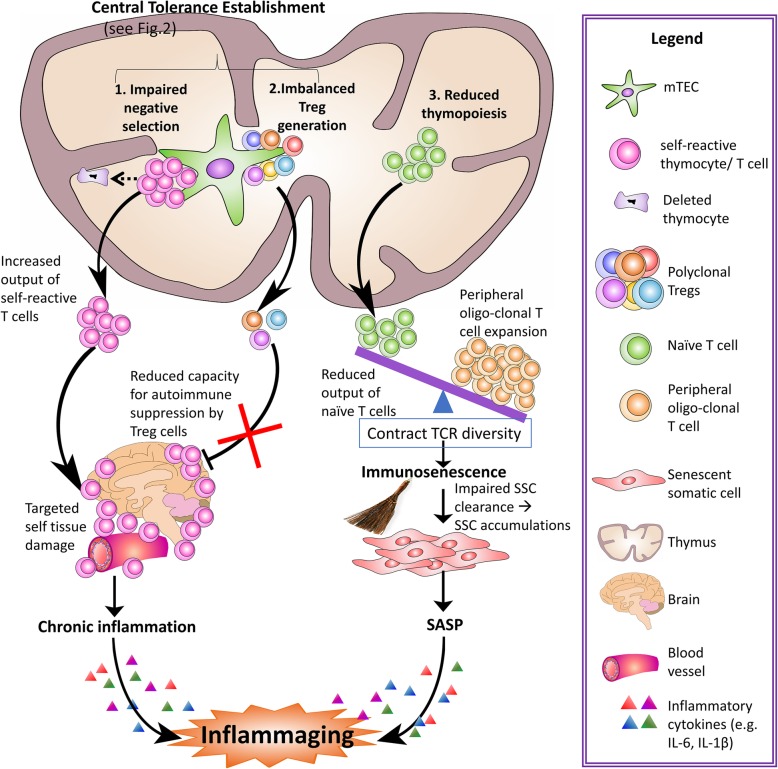
Immune system aging is characterized by the paradox of immunosenescence (insufficiency) and inflammaging (over-reaction), which incorporate two sides of the same coin, resulting in immune disorder. Immunosenescence refers to disruption in the structural architecture of immune organs and dysfunction in immune responses, resulting from both aged innate and adaptive immunity. Inflammaging, described as a chronic, sterile, systemic inflammatory condition associated with advanced age, is mainly attributed to somatic cellular senescence-associated secretory phenotype (SASP) and age-related autoimmune predisposition. However, the inability to reduce senescent somatic cells (SSCs), because of immunosenescence, exacerbates inflammaging. Age-related adaptive immune system deviations, particularly altered T cell function, are derived from age-related thymic atrophy or involution, a hallmark of thymic aging. Recently, there have been major developments in understanding how age-related thymic involution contributes to inflammaging and immunosenescence at the cellular and molecular levels, including genetic and epigenetic regulation, as well as developments of many potential rejuvenation strategies. Herein, we discuss the research progress uncovering how age-related thymic involution contributes to immunosenescence and inflammaging, as well as their intersection. We also describe how T cell adaptive immunity mediates inflammaging and plays a crucial role in the progression of age-related neurological and cardiovascular diseases, as well as cancer. We then briefly outline the underlying cellular and molecular mechanisms of age-related thymic involution, and finally summarize potential rejuvenation strategies to restore aged thymic function.
Overview
The claims and statistics of this paper haven’t been checked yet.
Run the check — free, no account needed. It reads the open-access text and checks the sources it cites.
Integrity signals
Registry
Cites
Statistics
Figures
Verification
Claims the paper makes
The claims and statistics of this paper haven’t been checked yet.
Run the check — free, no account needed. It reads the open-access text and checks the sources it cites.
Claims other papers make about this one
Each is checked against this paper’s own text: does it say what the citing paper says it does?
The source backs part of the claim, not all of it — or backs it for a different population, condition or comparison.
In the citing paper
“T cell–output decline is an important feature of immunosenescence as well as the production of senescence-associated secretory phenotype, increased glycolysis, and reactive oxygen species.”
From Immunosenescence: a key player in cancer development (2020) · cites this paper as [25]
Experimental — accuracy not yet measuredIn the citing paper
“T cell–output decline is an important feature of immunosenescence as well as the production of senescence-associated secretory phenotype, increased glycolysis, and reactive oxygen species.”
From Immunosenescence: a key player in cancer development (2020) · cites this paper as [25]
In the citing paper
“Thymus degeneration leads to a decrease in the number and proportion of CD8+ naïve T cells, which is one of the main manifestations of immunosenescence [24, 25] (Fig. 2).”
From Immunosenescence: a key player in cancer development (2020) · cites this paper as [25]
Self-check
Percentages, sums and reported differences re-computed from the paper’s own numbers.
The self-check needs the paper’s full text.
Citations
Cites
PD-1 and PD-L1 Immune Checkpoint Blockade to Treat Breast Cancer
Hartkopf, A. D., Taran, F., Wallwiener, M., Walter, C. B., Krämer, B., Grischke, E., & Brucker, S. Y. (2016) · Breast Care · doi:10.1159/000453569 · Cited by 30,989
Adverse Renal Effects of Immune Checkpoint Inhibitors: A Narrative Review
Wanchoo, R., Karam, S., Uppal, N. N., Barta, V. S., Deray, G., Devoe, C., Launay‐Vacher, V., Jhaveri, K. D., & on behalf of Cancer and Kidney International Network Workgroup on Immune Checkpoint Inhibitors (2017) · American Journal of Nephrology · doi:10.1159/000455014 · Cited by 15,320
Coussens, L. M., & Werb, Z. (2002) · Nature · doi:10.1038/nature01322 · Cited by 15,111
Safety, activity, and immune correlates of anti–PD-1 antibody in cancer
Topalian, S. L., Hodi, F. S., Brahmer, J. R., Gettinger, S. N., Smith, D. C., McDermott, D. F., Powderly, J. D., Carvajal, R. D., Sosman, J. A., Atkins, M. B., et al. (2012) · New England Journal of Medicine · doi:10.1056/nejmoa1200690 · Cited by 12,628
The serial cultivation of human diploid cell strains
Hayflick, L., & Moorhead, P. S. (1961) · Experimental Cell Research · doi:10.1016/0014-4827(61)90192-6 · Cited by 8,508
Inflammation and cancer: back to Virchow?
Balkwill, F., & Mantovani, A. (2001) · The Lancet · doi:10.1016/s0140-6736(00)04046-0 · Cited by 7,746
Regulatory T Cells and Immune Tolerance
Sakaguchi, S., Yamaguchi, T., Nomura, T., & Ono, M. (2008) · Cell · doi:10.1016/j.cell.2008.05.009 · Cited by 5,485
Inflamm‐aging: An Evolutionary Perspective on Immunosenescence
FRANCESCHI, C., BONAFÈ, M., VALENSIN, S., OLIVIERI, F., DE LUCA, M., OTTAVIANI, E., & DE BENEDICTIS, G. (2000) · Annals of the New York Academy of Sciences · doi:10.1111/j.1749-6632.2000.tb06651.x · Cited by 5,358
The senescence-associated secretory phenotype: the dark side of tumor suppression
Coppé, J.-P., Desprez, P.-Y., Krtolica, A., & Campisi, J. (2010) · Annual Review of Pathology: Mechanisms of Disease · doi:10.1146/annurev-pathol-121808-102144 · Cited by 5,206
STATs in cancer inflammation and immunity: a leading role for STAT3
Yu, H., Pardoll, D., & Jove, R. (2009) · Nature reviews. Cancer · doi:10.1038/nrc2734 · Cited by 4,383
Cited by
Sorted by citations
Immunosenescence: molecular mechanisms and diseases
Liu, Z., Liang, Q., Ren, Y., Guo, C., Ge, X., Wang, L., Cheng, Q., Luo, P., Zhang, Y., & Han, X. (2023) · Signal Transduction and Targeted Therapy · doi:10.1038/s41392-023-01451-2 · Cited by 1,082
Mittelbrunn, M., & Kroemer, G. (2021) · Nature Immunology · doi:10.1038/s41590-021-00927-z · Cited by 702
Immunosenescence: a key player in cancer development
Lian, J., Yue, Y., Yu, W., & Zhang, Y. (2020) · Journal of Hematology & Oncology · doi:10.1186/s13045-020-00986-z · Cited by 510
Immunology of aging: the birth of inflammaging
Fulop, T., Larbi, A., Pawelec, G., Khalil, A., Cohen, A. A., Hirokawa, K., Witkowski, J. M., & Franceschi, C. (2021) · Clinical Reviews in Allergy & Immunology · doi:10.1007/s12016-021-08899-6 · Cited by 464
The aging gut microbiome and its impact on host immunity
Bosco, N., & Noti, M. (2021) · Genes and Immunity · doi:10.1038/s41435-021-00126-8 · Cited by 435
Metadata
- Authors
- Thomas, R., Wang, W., & Su, D.-M.
- Affiliations
- University of North Texas Health Science Center (US)
- Corresponding author
- Su, Dong-Ming
- Venue
- Immunity & Ageing
- Published
- 2020-01-20
- Volume
- 17
- Issue
- 1
- Pages
- 2-2
- ISSN
- 1742-4933 (ISSN-L)
- PMC
- PMC6971920
- OpenAlex
- W3010019019
- Cited by
- 442
- References
- 260
- Citations by year
- 2026: 69 · 2025: 76 · 2024: 84 · 2023: 64 · 2022: 51 · 2021: 58 · 2020: 40
- FWCI
- 5.39
- Type
- journal article
- Language
- en
- Open access
- gold
- doi.org
- Locations
- Immunity & Ageing (publishedVersion, cc-by)
- PubMed Central (publishedVersion, cc-by)
- PubMed (publishedVersion)
- DOAJ (DOAJ: Directory of Open Access Journals) (submittedVersion)
- Funders
- National Institute of Allergy and Infectious Diseases (R01AI121147)
- Topics
- Life Sciences › Immunology and Microbiology › Immunology › T-cell and B-cell Immunology
- Life Sciences › Biochemistry, Genetics and Molecular Biology › Cell Biology › Telomeres, Telomerase, and Senescence
- Life Sciences › Biochemistry, Genetics and Molecular Biology › Aging › Genetics, Aging, and Longevity in Model Organisms
- Keywords
- thymic involution, immunosenescence, inflammaging, thymic aging, T cell function, cellular senescence, senescence-associated secretory phenotype, epigenetic regulation, age-related neurological diseases, age-related cardiovascular disease
About these checks
Registry, retraction, Cites and statistics results are computed, not judged, with one exception: a printed reference that no index lists is read once by a model before it counts as a citation error. Claims are extracted by a model and kept only when their quote appears verbatim in the text; each cited source is then checked, with a model’s help, for whether it says what the claim relies on. Those verdicts can be wrong — read the claim’s quote and the cited source before relying on one.
Statistics and arithmetic are recomputed, not judged.
Confidence bands are shown only for fields calibrated on our annotated test set. None is calibrated yet, so no band is shown.
What counts as a claim ›How we measure confidence ›How we check this ›
Are you an author, or do you see a problem with this page? Request a review
