

Virtual reality distraction induces hypoalgesia in patients with chronic low back pain: a randomized controlled trial
Open accessThe DOI matches its Crossref record; 86 of the 86 references it cites were found in a registry or an index.
Abstract
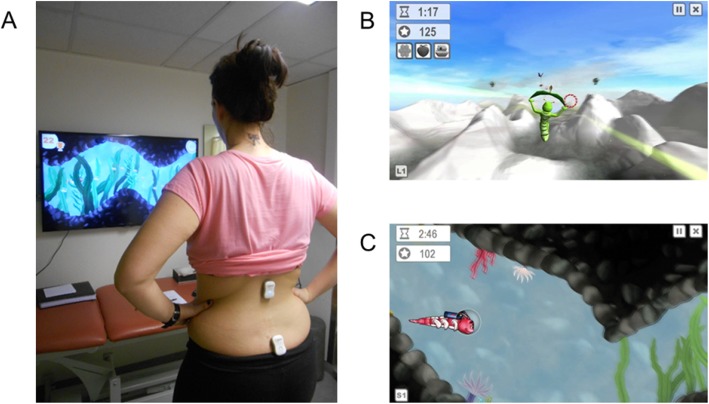
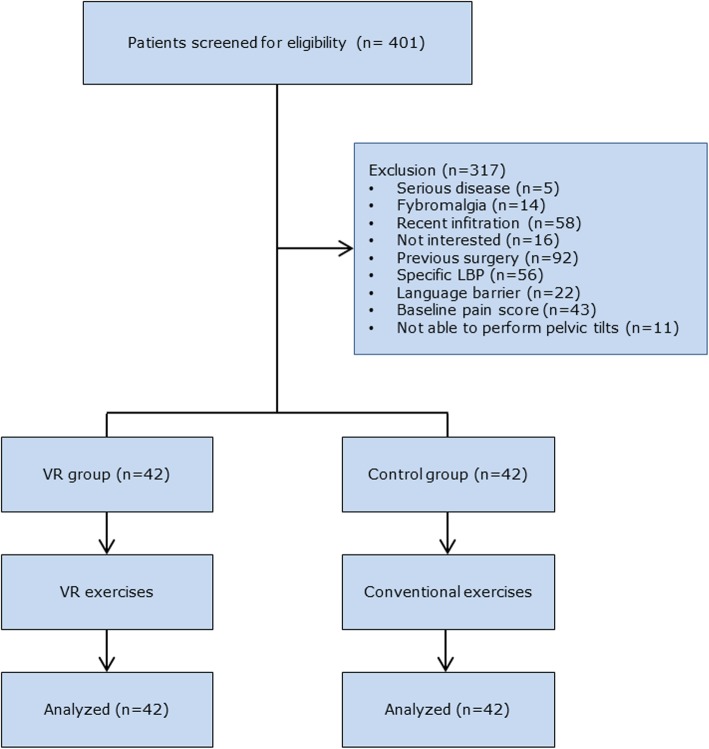
Background: Attentional distraction from pain has been shown to be largely ineffective for obtaining a hypoalgesic effect in patients with chronic pain when compared to a control condition. It has been hypothesized that this may be due to the non-engaging types of distraction that have been used so far. Moreover, it is suggested that the hypoalgesic effects of distraction may be attenuated by pain-related cognitions and emotions, as they may increase the attention to pain. Methods: In this randomized controlled trial, patients with chronic nonspecific low back pain in the intervention group ( n = 42) performed a single exercise session with nonimmersive VR games, while those in the control group ( n = 42) performed the same exercises without VR games. We investigated whether VR distraction had a hypoalgesic effect during and immediately after the exercises, and whether it reduced the time spent thinking of pain during the exercises. We further explored whether pain-related fear, pain catastrophizing and baseline pain intensity moderated the effects of VR distraction. Results: VR distraction had a hypoalgesic effect during (Cohen’s d = 1.29) and immediately after (Cohen’s d = 0.85) the exercises, and it also reduced the time spent thinking of pain (Cohen’s d = 1.31). Preliminary exploratory analyses showed that pain-related fear, pain catastrophizing and baseline pain intensity did not moderate the effects of VR distraction. Conclusions: Large effect sizes of VR distraction induced hypoalgesia were observed. This suggests that nonimmersive VR games can be used when it is deemed important to reduce the pain during exercises in patients with chronic nonspecific low back pain. Trial registration: NCT02679300 . This trial was registered on 10 February 2016.
Overview
The claims and statistics of this paper haven’t been checked yet.
Free: it reads the open-access text and checks the first 5 claims that cite a source we can check. Create a free account to check every claim.
Integrity signals
Registry
Cites
Statistics
Figures
Verification
Claims the paper makes
The claims and statistics of this paper haven’t been checked yet.
Free: it reads the open-access text and checks the first 5 claims that cite a source we can check. Create a free account to check every claim.
Claims other papers make about this one
Each is checked against this paper’s own text: does it say what the citing paper says it does?
The cited source says what the claim attributes to it.
In the citing paper
“In addition, virtual reality–based training has been shown to reduce the focus on pain by dividing attention to tasks [25,26] and increase the motivation of movement through progressive achievement [27-29].”
From Virtual Reality–Based Training in Chronic Low Back Pain: Systematic Review and Meta-Analysis of Randomized Controlled Trials (2024) · cites this paper as [25]
Self-check
Percentages, sums and reported differences re-computed from the paper’s own numbers.
The self-check needs the paper’s full text.
Citations
Cites
Lakens, D. (2013) · Frontiers in Psychology · doi:10.3389/fpsyg.2013.00863 · Cited by 10,303
The Pain Catastrophizing Scale: Development and validation.
Sullivan, M. J. L., Bishop, S. R., & Pivik, J. (1995) · Psychological Assessment · doi:10.1037//1040-3590.7.4.524 · Cited by 8,227
Treede, R.-D., Rief, W., Barke, A., Aziz, Q., Bennett, M. I., Benoliel, R., Cohen, M., Evers, S., Finnerup, N. B., First, M. B., et al. (2019) · Pain · doi:10.1097/j.pain.0000000000001384 · Cited by 3,478 · cited 1×
“Pain scores are often separated into three categories, and in patients with LBP, a score on the NPRS between 1 and 4 has been reported as mild, between 5 and 6 as moderate and ≥ 7 as severe [59, 60].”
BackgroundA Study of the Natural History of Back Pain: Part I
ROLAND, M., & MORRIS, R. (1983) · Spine · doi:10.1097/00007632-198303000-00004 · Cited by 3,395
Slater, M., & Wilbur, S. (1997) · Presence: Teleoperators and Virtual Environments · doi:10.1162/pres.1997.6.6.603 · Cited by 3,034 · cited 1×
“Immersion refers to the objective characteristics of the technological system [50, 68], such as the occlusion from the outside world or the presence of a high definition panoramic view.”
BackgroundThe cost of dichotomising continuous variables
Altman, D. G., & Royston, P. (2006) · BMJ · doi:10.1136/bmj.332.7549.1080 · Cited by 2,688
Fear of movement/(re)injury in chronic low back pain and its relation to behavioral performance
Vlaeyen, J. W. S., Kole-Snijders, A. M. J., Boeren, R. G. B., & van Eek, H. (1995) · Pain · doi:10.1016/0304-3959(94)00279-n · Cited by 2,446
Measuring and defining the experience of immersion in games
Jennett, C., Cox, A. L., Cairns, P., Dhoparee, S., Epps, A., Tijs, T., & Walton, A. (2008) · International Journal of Human-Computer Studies · doi:10.1016/j.ijhcs.2008.04.004 · Cited by 2,065 · cited 2×
“To confirm this, participants in the VRgroup were asked to answer the following question, which was derived from the Immersive Experience Questionnaire [51]: ‘To what extent did you feel motivated while playing the virtual reality games?’ (1 = not at all, 7 = a lot).”
MethodCrombez, G., Vlaeyen, J. W. S., Heuts, P. H. T. G., & Lysens, R. (1999) · Pain · doi:10.1016/s0304-3959(98)00229-2 · Cited by 1,675
Chiarotto, A., Maxwell, L. J., Ostelo, R. W., Boers, M., Tugwell, P., & Terwee, C. B. (2019) · The Journal of Pain · doi:10.1016/j.jpain.2018.07.009 · Cited by 704
Cited by
Exercise therapy for chronic low back pain
Hayden, J. A., Ellis, J., Ogilvie, R., Malmivaara, A., & van Tulder, M. W. (2021) · Cochrane Database of Systematic Reviews · doi:10.1002/14651858.cd009790.pub2 · Cited by 589
Virtual Reality Applications in Chronic Pain Management: Systematic Review and Meta-analysis
Goudman, L., Jansen, J., Billot, M., Vets, N., De Smedt, A., Roulaud, M., Rigoard, P., & Moens, M. (2022) · JMIR Serious Games · doi:10.2196/34402 · Cited by 224
“Psychological outcomes, such as kinesiophobia and fear, mood, satisfaction, expectations of pain, pain focus, time spent thinking about pain, self-efficacy, emotions, motivation, stress, catastrophizing, acceptability, global impression of change, ownership, and agency, were measu red in 19 s tud ie s [45,48,52,55-59,…”
BackgroundMethodInfluentialBerton, A., Longo, U. G., Candela, V., Fioravanti, S., Giannone, L., Arcangeli, V., Alciati, V., Berton, C., Facchinetti, G., Marchetti, A., et al. (2020) · Journal of Clinical Medicine · doi:10.3390/jcm9082567 · Cited by 195
“Matheve 2020, Belgium [19] 84 RCT VR 21 months Pekyavas 2017, Turkey [20] 30 RCT VR 2 months and half Azma, 2017, Iran [21] 54 RCT TR 6 months Hernandez, 2016, Mexico City [22] 20 but during the study lost 9 patients Auto-controlled study TR 6 months”
BackgroundTeh, J. J., Pascoe, D. J., Hafeji, S., Parchure, R., Koczoski, A., Rimmer, M. P., Khan, K. S., & Al Wattar, B. H. (2024) · BMC Medicine · doi:10.1186/s12916-024-03266-6 · Cited by 132
Tejera, D., Beltran-Alacreu, H., Cano-de-la-Cuerda, R., Leon Hernández, J. V., Martín-Pintado-Zugasti, A., Calvo-Lobo, C., Gil-Martínez, A., & Fernández-Carnero, J. (2020) · International Journal of Environmental Research and Public Health · doi:10.3390/ijerph17165950 · Cited by 121
Metadata
- Authors
- Matheve, T., Bogaerts, K., & Timmermans, A.
- Affiliations
- Hasselt University (BE)
- Corresponding author
- Matheve, Thomas
- Venue
- Journal of NeuroEngineering and Rehabilitation
- Published
- 2020-04-22
- Volume
- 17
- Issue
- 1
- Pages
- 55-55
- ISSN
- 1743-0003 (ISSN-L)
- PMC
- PMC7178732
- OpenAlex
- W3017878292
- Cited by
- 118
- References
- 86
- Citations by year
- 2026: 12 · 2025: 22 · 2024: 25 · 2023: 17 · 2022: 22 · 2021: 12 · 2020: 8
- FWCI
- 8.85
- Type
- journal article
- Language
- en
- Open access
- gold
- doi.org
- Licence
- cc-by
- creativecommons.org/licenses/by/4.0/ (tdm)
- creativecommons.org/licenses/by/4.0/ (vor)
- Locations
- Journal of NeuroEngineering and Rehabilitation (publishedVersion, cc-by)
- PubMed Central (publishedVersion, cc-by)
- PubMed (publishedVersion)
- Ghent University Academic Bibliography (Ghent University) (submittedVersion, cc-by)
- Lirias (KU Leuven) (submittedVersion, cc-by)
- DOAJ (DOAJ: Directory of Open Access Journals) (submittedVersion, cc-by-sa)
- Document Server@UHasselt (UHasselt) (submittedVersion, other-oa)
- Topics
- Health Sciences › Health Professions › Physical Therapy, Sports Therapy and Rehabilitation › Musculoskeletal pain and rehabilitation
- Physical Sciences › Computer Science › Human-Computer Interaction › Virtual Reality Applications and Impacts
- Health Sciences › Medicine › Pediatrics, Perinatology and Child Health › Pediatric Pain Management Techniques
- Keywords
- virtual reality, attentional distraction, hypoalgesia, chronic low back pain, physical activity, fear of pain, pain catastrophizing, baseline pain intensity, pain-related cognitions
- MeSH terms
- Virtual Reality, Adult, Attention, Female, Humans, Male, Pain Measurement, Exercise, Low Back Pain, Video Games, Pain Management
About these checks
Registry, retraction, Cites and statistics results are computed, not judged, with one exception: a printed reference that no index lists is read once by a model before it counts as a citation error. Claims are extracted by a model and kept only when their quote appears verbatim in the text; each cited source is then checked, with a model’s help, for whether it says what the claim relies on. Those verdicts can be wrong — read the claim’s quote and the cited source before relying on one.
Statistics and arithmetic are recomputed, not judged.
Confidence bands are shown only for fields calibrated on our annotated test set. None is calibrated yet, so no band is shown.
What counts as a claim ›How we measure confidence ›How we check this ›
Are you an author, or do you see a problem with this page? Request a review
How to cite
Cite CoChat for the checks on this page, and the paper for its own findings.
- This page
- CoChat. (2026). Citation check: Virtual reality distraction induces hypoalgesia in patients with chronic low back pain: a randomized controlled trial. https://app.cochat.ai/papers/10.1186/s12984-020-00688-0
- The paper
- Matheve, T., Bogaerts, K., & Timmermans, A. (2020). Virtual reality distraction induces hypoalgesia in patients with chronic low back pain: a randomized controlled trial. Journal of NeuroEngineering and Rehabilitation. https://doi.org/10.1186/s12984-020-00688-0
Data sources
Bibliographic data: Semantic Scholar, OpenAlex, Crossref.
Contains information from the Semantic Scholar Academic Graph Datasets, made available under the ODC Attribution License (ODC-BY 1.0).
Semantic Scholar’s data is described in: Kinney, R., et al. (2023). The Semantic Scholar Open Data Platform. arXiv:2301.10140.
