

Bipolar II compared with bipolar I disorder: baseline characteristics and treatment response to quetiapine in a pooled analysis of five placebo-controlled clinical trials of acute bipolar depression
Open accessThe DOI matches its Crossref record; 37 of the 38 references it cites were found in a registry or an index.
Abstract
BACKGROUND: Bipolar I and II represent the most common and severe subtypes of bipolar disorder. Although bipolar I disorder is relatively well studied, the clinical characteristics and response to treatment of patients with bipolar II disorder are less well understood. METHODS: To compare the severity and burden of illness of patients with bipolar II versus bipolar I disorder, baseline demographic, clinical, and quality of life data were examined in 1900 patients with bipolar I and 973 patients with bipolar II depression, who were enrolled in five similarly designed clinical placebo-controlled trials of quetiapine immediate-release and quetiapine extended-release. Acute (8 weeks) response to treatment was also compared by assessing rating scale scores, including Montgomery-Åsberg depression rating scale, Hamilton rating scale for anxiety, Young mania rating scale, and clinical global impression-severity scores, in the bipolar I and II populations in the same pooled database. RESULTS: Patients with bipolar I and bipolar II depression were similar in demographics, baseline rating scale scores (depression, anxiety, mania, and quality of life), and mood episode histories. Symptom improvements in response to quetiapine were greater versus comparators (lithium, paroxetine, and placebo) at 4 and 8 weeks in both bipolar I and II patients. Patients with the bipolar II subtype initially showed slower responses to all treatments, but, by 8 weeks, attained similar symptom improvement as patients with bipolar I depression. CONCLUSIONS: Pooled analysis of five clinical trials of quetiapine demonstrated that patients with bipolar II depression have a similar burden of illness and quality of life to patients with bipolar I. Bipolar II patients consistently showed a slower response to treatments than bipolar I patients, but, after 8 weeks of treatment with quetiapine, symptom improvements were similar between bipolar I and II disorder subtypes.
Overview
The claims and statistics of this paper haven’t been checked yet.
Free: it reads the open-access text and checks the first 5 claims that cite a source we can check. Create a free account to check every claim.
Integrity signals
Registry
Cites
Statistics
Figures
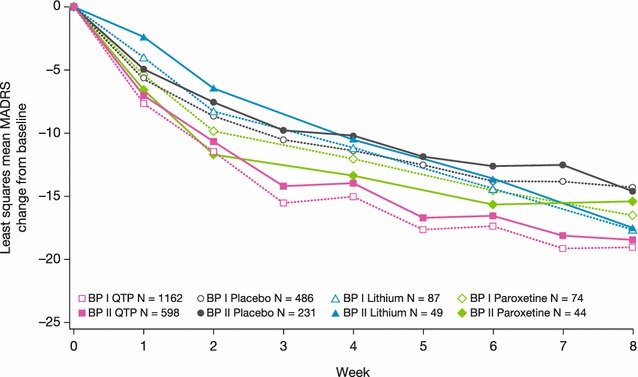
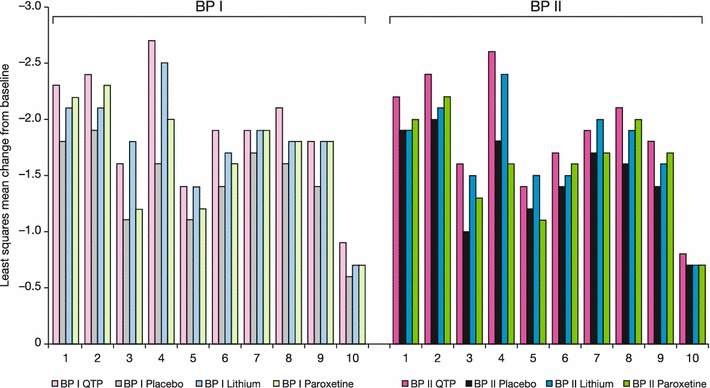
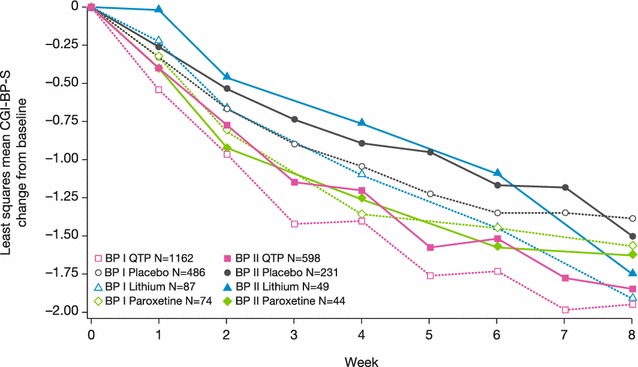
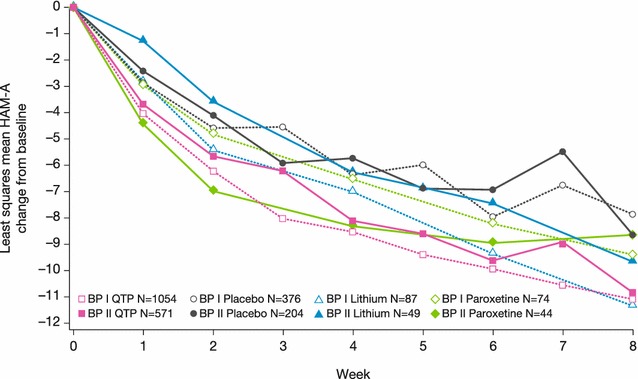
Verification
Claims the paper makes
The claims and statistics of this paper haven’t been checked yet.
Free: it reads the open-access text and checks the first 5 claims that cite a source we can check. Create a free account to check every claim.
Claims other papers make about this one
Each is checked against this paper’s own text: does it say what the citing paper says it does?
The source backs part of the claim, not all of it — or backs it for a different population, condition or comparison.
In the citing paper
“Pooled analyses of five identically designed trials demonstrated that quetiapine was superior to placebo, and moreover was equally effective for acute depression in BDI and BDII.243, 437”
From Canadian Network for Mood and Anxiety Treatments ( CANMAT ) and International Society for Bipolar Disorders ( ISBD ) 2018 guidelines for the management of patients with bipolar disorder (2018) · cites this paper as [243]
Experimental — accuracy not yet measuredThe cited source says what the claim attributes to it.
In the citing paper
“Quetiapine (level 1),241, 242, 243 lithium (level 2),244, 245, 246 lamotrigine (level 2)242, 247, 248 and lurasidone (level 2)249 are all recommended as first‐line treatment options with evidence for efficacy as monotherapy.”
Self-check
Percentages, sums and reported differences re-computed from the paper’s own numbers.
The self-check needs the paper’s full text.
Citations
Cites
Diagnostic and Statistical Manual of Mental Disorders
American Psychiatric Association (2013) · doi:10.1176/appi.books.9780890425596 · Cited by 116,369
Diagnostic and Statistical Manual of Mental Disorders
Williams, J. B. W., & First, M. (2013) · Encyclopedia of Social Work · doi:10.1093/acrefore/9780199975839.013.104 · Cited by 109,519
Hamilton, M. (1960) · Journal of Neurology, Neurosurgery & Psychiatry · doi:10.1136/jnnp.23.1.56 · Cited by 32,817
A new depression scale designed to be sensitive to change
Montgomery, S. A., & Åsberg, M. (1979) · British Journal of Psychiatry · doi:10.1192/bjp.134.4.382 · Cited by 13,962 · cited 1×
“HAM-D, YMRS, Clinical Global Impression-BipolarSeverity (CGI-BP-S), and Hamilton Rating Scale for anxiety (HAM-A) [30–32].”
MethodThe assessment of anxiety states by rating
HAMILTON, M. (1959) · British Journal of Medical Psychology · doi:10.1111/j.2044-8341.1959.tb00467.x · Cited by 11,455
A Rating Scale for Mania: Reliability, Validity and Sensitivity
Young, R. C., Biggs, J. T., Ziegler, V. E., & Meyer, D. A. (1978) · British Journal of Psychiatry · doi:10.1192/bjp.133.5.429 · Cited by 8,744 · cited 1×
“Additional inclusion criteria in all studies were a Hamilton depression rating scale (HAMD) 17-item score ≥20, HAM-D item 1 score ≥2, and Young mania rating scale (YMRS) score ≤12 [27, 28].”
BackgroundDiagnostic and Statistical Manual of Mental Disorders
Siegel, L. J., & Fletcher‐Janzen, E. (2014) · Encyclopedia of Special Education · doi:10.1002/9781118660584.ese0728 · Cited by 3,423
Prevalence and Correlates of Bipolar Spectrum Disorder in the World Mental Health Survey Initiative
Merikangas, K. R., Jin, R., He, J.-P., Kessler, R. C., Lee, S., Sampson, N. A., Viana, M. C., Andrade, L. H., Hu, C., Karam, E. G., et al. (2011) · Archives of General Psychiatry · doi:10.1001/archgenpsychiatry.2011.12 · Cited by 2,627 · cited 1×
“There is increasing evidence that the bipolar II subtype is at least as prevalent as bipolar I disorder [2] and is associated with substantial disability, comorbidity, mortality, and impact on quality of life, as recognized in the latest Diagnostic and Statistical Manual of Mental Disorders (DSM-5) [1, 3–6].”
BackgroundThe Long-term Natural History of the Weekly Symptomatic Status of Bipolar I Disorder
Judd, L. L., Akiskal, H. S., Schettler, P. J., Endicott, J., Maser, J., Solomon, D. A., Leon, A. C., Rice, J. A., & Keller, M. B. (2002) · Archives of General Psychiatry · doi:10.1001/archpsyc.59.6.530 · Cited by 2,106
(1993) · PubMed · Cited by 1,900
Judd, L. L., Akiskal, H. S., Schettler, P. J., Coryell, W., Endicott, J., Maser, J. D., Solomon, D. A., Leon, A. C., & Keller, M. B. (2003) · Archives of General Psychiatry · doi:10.1001/archpsyc.60.3.261 · Cited by 1,243 · cited 1×
“Depressive episodes typically exceed manic/hypomanic episodes in duration and frequency in both bipolar I and II subtypes, so patients therefore present most frequently to physicians with depressive symptoms [7–10].”
BackgroundYatham, L. N., Kennedy, S. H., Parikh, S. V., Schaffer, A., Beaulieu, S., Alda, M., O’Donovan, C., MacQueen, G., McIntyre, R. S., Sharma, V., et al. (2013) · Bipolar Disorders · doi:10.1111/bdi.12025 · Cited by 1,217
Effectiveness of Adjunctive Antidepressant Treatment for Bipolar Depression
Sachs, G. S., Nierenberg, A. A., Calabrese, J. R., Marangell, L. B., Wisniewski, S. R., Gyulai, L., Friedman, E. S., Bowden, C. L., Fossey, M. D., Ostacher, M. J., et al. (2007) · New England Journal of Medicine · doi:10.1056/nejmoa064135 · Cited by 937 · cited 1×
“For example, antidepressant monotherapy in patients with bipolar depression is associated with elevated rates of mood switch to mania [14–16], while the use of antidepressants as adjunctive therapy to mood stabilizers does not appear to be associated with increased efficacy in bipolar depression [17].”
BackgroundSheehan, D. V. (1984) · Medical Entomology and Zoology · Cited by 883
Calabrese, J. R., Keck, P. E., Macfadden, W., Minkwitz, M., Ketter, T. A., Weisler, R. H., Cutler, A. J., McCoy, R., Wilson, E., Mullen, J., et al. (2005) · American Journal of Psychiatry · doi:10.1176/appi.ajp.162.7.1351 · Cited by 883 · cited 4×
“The profiles of adverse events reported in the pooled analyses are consistent with the known adverse event profiles of these agents, and as reported and discussed in the original papers [21–25].”
MethodResultInfluentialThase, M. E., Macfadden, W., Weisler, R. H., Chang, W., Paulsson, B., Khan, A., & Calabrese, J. R. (2006) · Journal of Clinical Psychopharmacology · doi:10.1097/01.jcp.0000248603.76231.b7 · Cited by 559 · cited 4×
“The profiles of adverse events reported in the pooled analyses are consistent with the known adverse event profiles of these agents, and as reported and discussed in the original papers [21–25].”
MethodResultInfluentialThree times more days depressed than manic or hypomanic in both bipolar I and bipolar II disorder 1
Kupka, R. W., Altshuler, L. L., Nolen, W. A., Suppes, T., Luckenbaugh, D. A., Leverich, G. S., Frye, M. A., Keck, P. E., McElroy, S. L., Grunze, H., et al. (2007) · Bipolar Disorders · doi:10.1111/j.1399-5618.2007.00467.x · Cited by 397 · cited 1×
“Depressive episodes typically exceed manic/hypomanic episodes in duration and frequency in both bipolar I and II subtypes, so patients therefore present most frequently to physicians with depressive symptoms [7–10].”
BackgroundYoung, A. H., McElroy, S. L., Bauer, M., Philips, N., Chang, W., Olausson, B., Paulsson, B., Brecher, M., & EMBOLDEN I (Trial 001) Investigators (2010) · The Journal of Clinical Psychiatry · doi:10.4088/jcp.08m04995gre · Cited by 390 · cited 1×
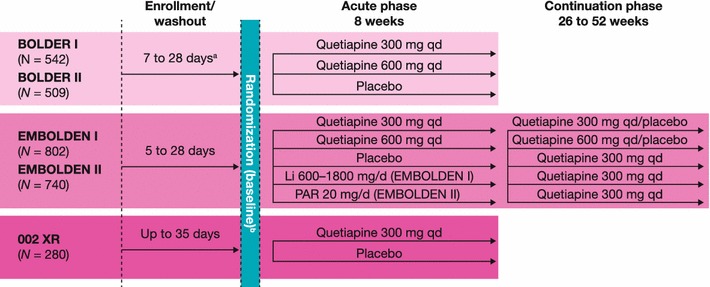
“The EMBOLDEN I and II trials additionally included lithium (600–1800 mg/ day) and paroxetine (20 mg/day), respectively, as active controls [22, 24].”
BackgroundMcElroy, S. L., Weisler, R. H., Chang, W., Olausson, B., Paulsson, B., Brecher, M., Agambaram, V., Merideth, C., Nordenhem, A., Young, A. H., et al. (2010) · The Journal of Clinical Psychiatry · doi:10.4088/jcp.08m04942gre · Cited by 328
Viktorin, A., Lichtenstein, P., Thase, M. E., Larsson, H., Lundholm, C., Magnusson, P. K. E., & Landén, M. (2014) · American Journal of Psychiatry · doi:10.1176/appi.ajp.2014.13111501 · Cited by 246 · cited 1×
“For example, antidepressant monotherapy in patients with bipolar depression is associated with elevated rates of mood switch to mania [14–16], while the use of antidepressants as adjunctive therapy to mood stabilizers does not appear to be associated with increased efficacy in bipolar depression [17].”
BackgroundGrunze, H., Kasper, S., Goodwin, G., Bowden, C., Baldwin, D., Licht, R., Vieta, E., Möller, H.-J., & WFSBP Task Force on Treatment Guide (2002) · The World Journal of Biological Psychiatry · doi:10.3109/15622970209150612 · Cited by 185 · cited 1×
“As a result, there are limited recommendations in guidelines on the treatment of bipolar II depression [18–20].”
BackgroundSuppes, T. M., Datto, C. J., Minkwitz, M. C., Nordenhem, A., Walker, C., & Darko, D. F. (2009) · Journal of Affective Disorders · doi:10.1016/j.jad.2009.10.007 · Cited by 183
Self-citationBipolar II Disorder: Epidemiology, Diagnosis and Management
Benazzi, F. (2007) · CNS Drugs · doi:10.2165/00023210-200721090-00003 · Cited by 179
Altshuler, L. L., Suppes, T., Black, D. O., Nolen, W. A., Leverich, G., Keck, P. E., Frye, M. A., Kupka, R., McElroy, S. L., Grunze, H., et al. (2006) · American Journal of Psychiatry · doi:10.1176/appi.ajp.163.2.313 · Cited by 155
Ballenger, J. C. (2011) · Yearbook of Psychiatry and Applied Mental Health · doi:10.1016/j.ypsy.2010.10.088 · Cited by 146
Bond, D. J., Noronha, M. M., Kauer-Sant'Anna, M., Lam, R. W., & Yatham, L. N. (2008) · The Journal of Clinical Psychiatry · doi:10.4088/jcp.v69n1009 · Cited by 139
Rating scales in depression: limitations and pitfalls
Bech, P. (2006) · Dialogues in Clinical Neuroscience · doi:10.31887/dcns.2006.8.2/pbech · Cited by 129
Bipolar disorders in DSM-5: strengths, problems and perspectives
Angst, J. (2013) · International Journal of Bipolar Disorders · doi:10.1186/2194-7511-1-12 · Cited by 104
Maina, G., Albert, U., Bellodi, L., Colombo, C., Faravelli, C., Monteleone, P., Bogetto, F., Cassano, G. B., & Maj, M. (2007) · The Journal of Clinical Psychiatry · doi:10.4088/jcp.v68n0205 · Cited by 92 · cited 1×
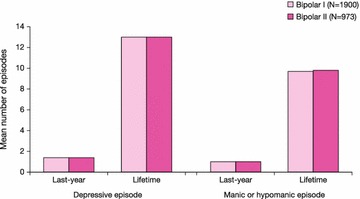
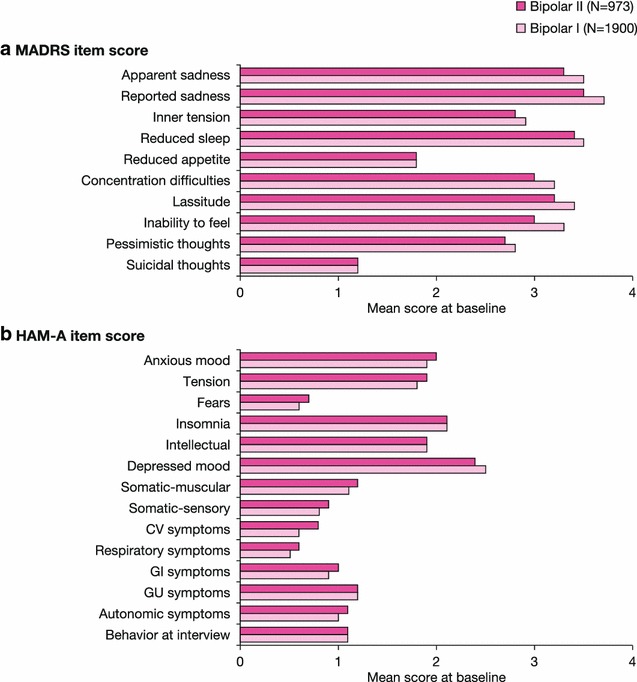
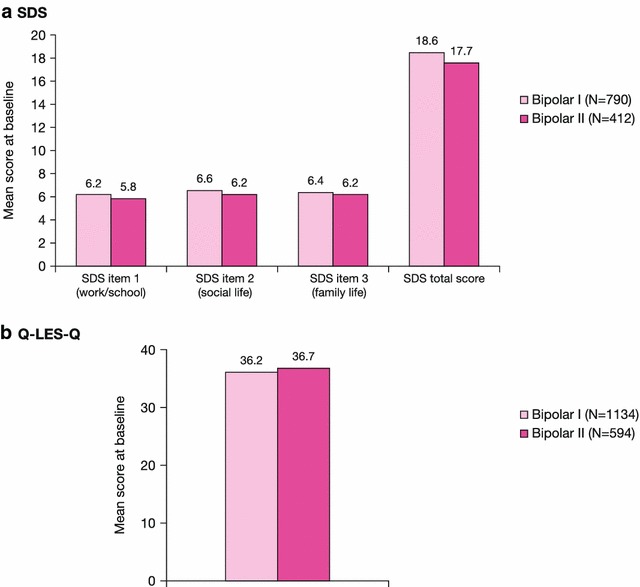
“[11]), the patients with bipolar II disorder enrolled in these studies had a generally similar burden of illness history as bipolar I disorder, while also confirming previous reports of similar baseline disability and impact on quality of life for both bipolar subtypes [1, 5, 6].”
ResultBipolar II Disorder: Symptoms, Course, and Response to Treatment
MacQueen, G. M., & Young, L. T. (2001) · Psychiatric Services · doi:10.1176/appi.ps.52.3.358 · Cited by 87
Pharmacotherapy for the Treatment of Acute Bipolar II Depression: Current Evidence
Swartz, H. A., & Thase, M. E. (2011) · The Journal of Clinical Psychiatry · doi:10.4088/jcp.09r05192gre · Cited by 60
Burden of Illness in Bipolar Depression
Manning, J. S. (2005) · The Primary Care Companion For CNS Disorders · doi:10.4088/pcc.v07n0601 · Cited by 45
Weinstock, L. M., Strong, D., Uebelacker, L. A., & Miller, I. W. (2010) · Journal of Psychiatric Research · doi:10.1016/j.jpsychires.2010.03.010 · Cited by 39
Quetiapine monotherapy in bipolar II depression: combined data from four large, randomized studies
Young, A. H., Calabrese, J. R., Gustafsson, U., Berk, M., McElroy, S. L., Thase, M. E., Suppes, T., & Earley, W. (2013) · International Journal of Bipolar Disorders · doi:10.1186/2194-7511-1-10 · Cited by 35 · cited 1×
“For the current analyses of pooled data from the five clinical trials, mean and SD or SE values are provided for baseline data and response to treatment, with pooling of 300 and 600 mg dose groups for quetiapine IR in the BOLDER and EMBOLDEN studies (both quetiapine doses were significantly superior to placebo in the…”
MethodPendergast, L. L., Youngstrom, E. A., Merkitch, K. G., Moore, K. A., Black, C. L., Abramson, L. Y., & Alloy, L. B. (2013) · Psychological Assessment · doi:10.1037/a0035138 · Cited by 26
Suppes, T. M., Datto, C. J., Minkwitz, M. C., Nordenhem, A., Walker, C., & Darko, D. F. (2014) · Journal of Affective Disorders · doi:10.1016/j.jad.2014.07.007 · Cited by 26
Self-citationA prediction rule for diagnosing hypomania
Benazzi, F. (2008) · Progress in Neuro-Psychopharmacology and Biological Psychiatry · doi:10.1016/j.pnpbp.2008.12.007 · Cited by 9
Research works printed but not linked: 1
- Guy W ECDEU assessment manual for psychopharmacology: publication ADM 76-338 1976 Rockville, MD US Department of Health, Education and Welfare
Cited by
Yatham, L. N., Kennedy, S. H., Parikh, S. V., Schaffer, A., Bond, D. J., Frey, B. N., Sharma, V., Goldstein, B. I., Rej, S., Beaulieu, S., et al. (2018) · Bipolar Disorders · doi:10.1111/bdi.12609 · Cited by 1,852
Liu, Y. K., Ling, S., Lui, L. M. W., Ceban, F., Vinberg, M., Kessing, L. V., Ho, R., Rhee, T. G., Gill, H., Cao, B., et al. (2021) · Journal of Affective Disorders · doi:10.1016/j.jad.2021.12.110 · Cited by 117
Heterogeneity and Polygenicity in Psychiatric Disorders: A Genome-Wide Perspective
Wendt, F. R., Pathak, G. A., Tylee, D. S., Goswami, A., & Polimanti, R. A. (2020) · Chronic Stress · doi:10.1177/2470547020924844 · Cited by 72
Corticosteroid-Induced Psychiatric Disorders: Mechanisms, Outcomes, and Clinical Implications
Nasereddin, L., Alnajjar, O., Bashar, H., Abuarab, S. F., Al-Adwan, R., Chellappan, D. K., & Barakat, M. M. (2024) · Diseases · doi:10.3390/diseases12120300 · Cited by 68
Dev, D. A., Le, G. H., Kwan, A. T. H., Wong, S., Arulmozhi, A., Ceban, F., Teopiz, K. M., Meshkat, S., Rosenblat, J. D., Guillen-Burgos, H. F., et al. (2024) · Journal of Affective Disorders · doi:10.1016/j.jad.2024.06.045 · Cited by 32
Metadata
- Authors
- Datto, C., Pottorf, W. J., Feeley, L., LaPorte, S., & Liss, C.
- Affiliations
- AstraZeneca (United States) (US)
- Corresponding author
- Datto, Catherine
- ORCID
- Datto, Catherine
- Venue
- Annals of General Psychiatry
- Published
- 2016-03-11
- Volume
- 15
- Issue
- 1
- Pages
- 9-9
- ISSN
- 1744-859X (ISSN-L)
- PMC
- PMC4788818
- OpenAlex
- W2295288073
- Cited by
- 32
- References
- 38
- Citations by year
- 2026: 2 · 2025: 3 · 2024: 6 · 2023: 2 · 2022: 3 · 2021: 3 · 2020: 5 · 2019: 1 · 2018: 5 · 2017: 2
- FWCI
- 2.37
- Type
- journal article
- Language
- en
- Open access
- gold
- doi.org
- Licence
- cc-by
- Locations
- Annals of General Psychiatry (publishedVersion, cc-by)
- PubMed Central (publishedVersion, cc-by)
- PubMed (publishedVersion)
- Funders
- AstraZeneca Pharmaceuticals
- Topics
- Health Sciences › Medicine › Psychiatry and Mental health › Bipolar Disorder and Treatment
- Health Sciences › Medicine › Pharmacology (medical) › Treatment of Major Depression
- Health Sciences › Medicine › Psychiatry and Mental health › Schizophrenia research and treatment
- Keywords
- bipolar II disorder, bipolar I disorder, bipolar depression, quetiapine, acute bipolar depression, treatment response, disease burden, quality of life, lithium, paroxetine, pooled analysis
About these checks
Registry, retraction, Cites and statistics results are computed, not judged, with one exception: a printed reference that no index lists is read once by a model before it counts as a citation error. Claims are extracted by a model and kept only when their quote appears verbatim in the text; each cited source is then checked, with a model’s help, for whether it says what the claim relies on. Those verdicts can be wrong — read the claim’s quote and the cited source before relying on one.
Statistics and arithmetic are recomputed, not judged.
Confidence bands are shown only for fields calibrated on our annotated test set. None is calibrated yet, so no band is shown.
What counts as a claim ›How we measure confidence ›How we check this ›
Are you an author, or do you see a problem with this page? Request a review
Data sources
Bibliographic data: Semantic Scholar, OpenAlex, Crossref.
Contains information from the Semantic Scholar Academic Graph Datasets, made available under the ODC Attribution License (ODC-BY 1.0).
Semantic Scholar’s data is described in: Kinney, R., et al. (2023). The Semantic Scholar Open Data Platform. arXiv:2301.10140.
