

The DOI matches its Crossref record; 6 of the 6 references it cites were found in a registry or an index.
Power asymmetries in global governance for health: a conceptual framework for analyzing the political-economic determinants of health inequities
Open accessAbstract
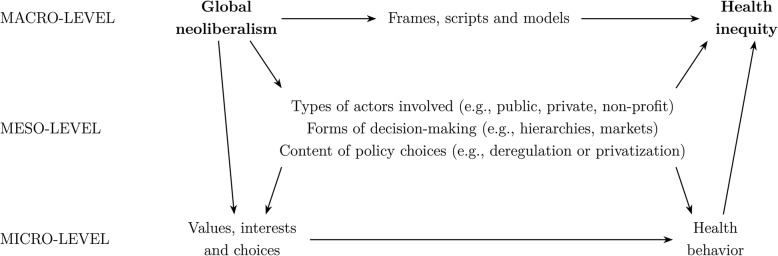
Background: Recent scholarship has increasingly identified global power asymmetries as the root cause of health inequities. This article examines how such asymmetries manifest in global governance for health, and how this impacts health outcomes. Results: We focus on the political-economic determinants of global health inequities, and how these determinants operate at different levels of social action (micro, meso, and macro) through distinct but interacting mechanisms. To clarify how these mechanisms operate, we develop an integrative framework for examining the links between global neoliberalism—the currently dominant policy paradigm premised on advancing the reach of markets and promoting ever-growing international economic integration—and global health inequities, and show how these mechanisms have macro–macro, macro–meso–macro, and macro–micro–macro manifestations. Conclusions: Our approach enables the design of theoretically-nuanced empirical strategies to document the multiple ways in which the political economy entrenches or, alternatively, might ameliorate global health inequities.
Overview
The claims and statistics of this paper haven’t been checked yet.
Run the check — free, no account needed. It reads the open-access text and checks the sources it cites.
Integrity signals
Registry
Cites
Statistics
Figures
Verification
Claims the paper makes
The claims and statistics of this paper haven’t been checked yet.
Run the check — free, no account needed. It reads the open-access text and checks the sources it cites.
Claims other papers make about this one
Each is checked against this paper’s own text: does it say what the citing paper says it does?
The cited source says what the claim attributes to it.
In the citing paper
“Both adopt a multi-level, systems-thinking perspective, recognizing that public health issues are the result of a complex interplay between various levels of influence (Birn et al., 2018;Kentikelenis & Rochford, 2019;Sallis et al., 2008).”
From Sexual and gender-based violence against South Sudanese refugees in Uganda: a mixed-methods study (2025) · cites this paper as Kentikelenis & Rochford, 2019
Self-check
Percentages, sums and reported differences re-computed from the paper’s own numbers.
The self-check needs the paper’s full text.
Citations
Cites
Social determinants of health inequalities
Marmot, M. (2005) · The Lancet · doi:10.1016/s0140-6736(05)71146-6 · Cited by 5,086
Malik, V. S., Pan, A., Willett, W. C., & Hu, F. B. (2013) · The American Journal of Clinical Nutrition · doi:10.3945/ajcn.113.058362 · Cited by 1,668
Moodie, R., Stuckler, D., Monteiro, C., Sheron, N., Neal, B., Thamarangsi, T., Lincoln, P., & Casswell, S. (2013) · The Lancet · doi:10.1016/s0140-6736(12)62089-3 · Cited by 1,663
Stuckler, D., McKee, M., Ebrahim, S., & Basu, S. (2012) · PLoS Medicine · doi:10.1371/journal.pmed.1001235 · Cited by 666
Revisiting the corporate and commercial determinants of health
McKee, M., & Stuckler, D. (2018) · American Journal of Public Health · doi:10.2105/ajph.2018.304510 · Cited by 281
Stubbs, T., Kentikelenis, A., Stuckler, D., McKee, M., & King, L. (2017) · Social Science & Medicine · doi:10.1016/j.socscimed.2016.12.016 · Cited by 198
Self-citation
Research works printed but not linked: 100
- Ottersen OP, Dasgupta J, Blouin C, Buss P, Chongsuvivatwong V, Frenk J, et al. The political origins of health inequity: prospects for change. Lancet. 2014;383(9917):630–67. · DOI · Paper page
- Frenk J, Moon S. Governance challenges in global health. N Engl J Med. 2013;368(10):936–42. · DOI
- Labonté R, Schrecker T. Globalization and social determinants of health: introduction and methodological background (part 1 of 3). Glob Health. 2007;3:5–5. · DOI
- Forster T, Kentikelenis A, Stubbs TH, King L. Globalization and health equity: the impact of structural adjustment programs on developing countries. Soc Sci Med. 2019. https://doi.org/10.1016/j.socscimed.2019.112496. · DOI
- McColl K. Europe told to deliver more aid for health. Lancet. 2008;371(9630):2072–3. · DOI
- Hoffman SJ, Cole CB. Defining the global health system and systematically mapping its network of actors. Glob Health. 2018;14(1):38. · DOI
- Szlezák NA, Bloom BR, Jamison DT, Keusch GT, Michaud CM, Moon S, et al. The global health system: actors, norms, and expectations in transition. PLoS Med. 2010;7(1):e1000183. · DOI
- Gostin LO, Mok EA. Grand challenges in global health governance. Br Med Bull. 2009;90(1):7–18. · DOI
- Marmot MG, Allen J, Bell R, Bloomer E, Goldblatt P. WHO European review of social determinants of health and the health divide. Lancet. 2012;380(9846):1011–29. · DOI · Paper page
- Bambra C, Gibson M, Sowden A, Wright K, Whitehead M, Petticrew M. Tackling the wider social determinants of health and health inequalities: evidence from systematic reviews. J Epidemiol Community Health. 2010;64(4):284–91. · DOI
- Braveman P, Gottlieb L. The social determinants of health: It’s time to consider the causes of the causes. Public Health Rep. 2014;129(1_suppl2):19–31. · DOI · Paper page
- Gkiouleka A, Huijts T, Beckfield J, Bambra C. Understanding the micro and macro politics of health: inequalities, intersectionality & institutions: a research agenda. Soc Sci Med. 2018;200:92–8. · DOI · Paper page
- Mays N, Pope C, Popay J. Systematically reviewing qualitative and quantitative evidence to inform management and policy-making in the health field. J Health Serv Res Policy. 2005;10(suppl 1):6–20. · DOI
- Moon S, Szlezák NA, Michaud CM, Jamison DT, Keusch GT, Clark WC, et al. The global health system: lessons for a stronger institutional framework. PLoS Med. 2010;7(1):e1000193. · DOI
- Kickbusch I. Action on global health: addressing global health governance challenges. Public Health. 2005;119(11):969–73. · DOI
- Kickbusch I, Reddy KS. Global health governance – the next political revolution. Public Health. 2015;129(7):838–42. · DOI
- Kenworthy NJ, MacKenzie R, Lee K, editors. Case studies on corporations and Global Health governance: impacts, influence and accountability. Not Lanham: Rowman & Littlefield; 2016.
- Lee K, Kamradt-Scott A. The multiple meanings of global health governance: a call for conceptual clarity. Glob Health. 2014;10(1):28. · DOI
- Clinton C, Sridhar D. Governing global health: who runs the world and why? Oxford: Oxford University Press; 2017.
- Held D, Kickbusch I, McNally K, Piselli D, Told M. Gridlock, innovation and resilience in global health governance. Global Policy. 2019;10(2):161–77. · DOI
- Halliday TC. Recursivity of global normmaking: a sociolegal agenda. Ann Rev Law Soc Sci. 2009;5(1):263–89. · DOI
- Florini A. The evolution of international norms. Int Stud Q. 1996;40(3):363–89. · DOI
- Björkdahl A. Norms in international relations: some conceptual and methodological reflections. Camb Rev Int Aff. 2002;15(1):9–23. · DOI
- Chorev N. Changing global norms through reactive diffusion: the case of intellectual property protection of AIDS drugs. Am Sociol Rev. 2012;77(5):831–53. · DOI
- Lukes S. Methodological individualism reconsidered. Br J Sociol. 1968;19(2):119–29. · DOI
- List C, Spiekermann K. Methodological individualism and holism in political science: a reconciliation. Am Pol Sci Rev. 2013;107(4):629–43. · DOI
- Kincaid H. Philosophical foundations of the social sciences. Cambridge: Cambridge University Press; 1996.
- Jepperson R, Meyer JW. Multiple levels of analysis and the limitations of methodological individualisms. Sociol Theory. 2011;29(1):54–73. · DOI
- Weber M. Economy and society: an outline of interpretive sociology. Berkeley: University of California Press; 1978.
- Schattschneider EE. The Semisovereign people: a realist’s view of democracy in America. New York: Holt, Rinehart and Winston; 1960.
- Abraham J. The pharmaceutical industry as a political player. Lancet. 2002;360(9344):1498–502. · DOI
- Lukes S. Power: a radical view. Basingstoke: Palgrave Macmillan; 2005. · DOI
- McGoey L, Thiel D, West R, Narcy F. Philanthrocapitalism and crimes of the powerful. Politix. 2018;121(1):29–54. · DOI
- Shiffman J. Knowledge, moral claims and the exercise of power in global health. Int J Health Policy Manag. 2014;3(6):297–9. · DOI
- Domhoff GW. The power elite and the state: how policy is made in America. New York: Aldine de Gruyter; 1990.
- Kentikelenis AE, Seabrooke L. The politics of world polity: script-writing in international organizations. Am Sociol Rev. 2017;82(5):1065–92. · DOI
- Koppell JGS. Accountable global governance organizations. In: Bovens M, Goodin RE, Schillemans T, editors. The Oxford handbook of public accountability. Oxford: Oxford University Press; 2014. p. 370–86.
- Simmons BA, Dobbin F, Geoffrey Garrett, eds. The Global Diffusion of Markets and Democracy. Cambridge: Cambridge University Press; 2008. · DOI
- Dobbin F, Simmons BA, Garrett G. The global diffusion of public policies: social construction, coercion, competition, or learning? Annu Rev Sociol. 2007;33(1):449–72. · DOI
- Reinsberg B, Kentikelenis AE, Stubbs TH, King LP. The world system and the hollowing-out of state capacity: how structural adjustment programs impact bureaucratic quality in developing countries. Am J Sociol. 2019;123(4):1222–57. · DOI
- Reinsberg B, Stubbs T, Kentikelenis A, King L. Bad governance: how privatization increases corruption in the developing world: how privatization increases corruption. Regul Governance. 2019. https://doi.org/10.1111/rego.12265. · DOI
- Mann M. The autonomous power of the state: its origins, mechanisms and results. Eur J Sociol. 1984;25(2):185–213. · DOI · Paper page
- Chorev N, Shadlen KC. Intellectual property, access to medicines, and health: new research horizons. Stud Comp Int Dev. 2015;50(2):143–56. · DOI
- Lencucha R. Philip Morris versus Uruguay: health governance challenged. Lancet. 2010;376(9744):852–3. · DOI
- Kickbusch I, Hanefeld J. Role for academic institutions and think tanks in speeding progress on sustainable development goals. BMJ. 2017;24:j3519. · DOI
- Bourdieu P. Social space and symbolic power. Sociol Theory. 1989;7(1):14–25. · DOI
- Chorev N. The World Health Organization between north and south. Ithaca: Cornell University Press; 2012. · DOI
- Aso T. Crucial role of finance ministry in achieving universal health coverage. Lancet. 2017;390(10111):2415–7. · DOI
- Feldbaum H, Lee K, Michaud J. Global health and foreign policy. Epidemiol Rev. 2010;32(1):82–92. · DOI
- Chorev N. Restructuring neoliberalism at the World Health Organization. Rev Int Polit Econ. 2013;20(4):627–66. · DOI
- Stuckler D, Basu S, McKee M. Global health philanthropy and institutional relationships: how should conflicts of interest be addressed? PLoS Med. 2011;8(4):e1001020. · DOI
- McCoy D, Chand S, Sridhar D. Global health funding: how much, where it comes from and where it goes. Health Policy Plan. 2009;24(6):407–17. · DOI · Paper page
- McCoy D, Kembhavi G, Patel J, Luintel A. The Bill & Melinda Gates Foundation’s grant-making programme for global health. Lancet. 2009;373(9675):1645–53. · DOI
- TechnoServe. The Coca-Cola Company, TechnoServe and the Gates Foundation partner to boost incomes of 50,000 small-scale farmers in East Africa. 2010. https://www.technoserve.org/press-room/detail/the-coca-cola-company-technoserve-and-the-gates-foundation-partner-to-boost. Accessed 10 Oct 2019.
- Barlow P, Serôdio P, Ruskin G, McKee M, Stuckler D. Science organisations and Coca-Cola’s ‘war’ with the public health community: insights from an internal industry document. J Epidemiol Community Health. 2018;72(9):761–3. · DOI
- Swinburn BA, Sacks G, Hall KD, McPherson K, Finegood DT, Moodie ML, et al. The global obesity pandemic: shaped by global drivers and local environments. Lancet. 2011;378(9793):804–14. · DOI · Paper page
- Scott WR. Institutions and organizations. Thousand Oaks: SAGE; 1995.
- Hironaka A. Greening the globe: world society and environmental change. Cambridge: Cambridge University Press; 2014. · DOI
- Schofer E, Hironaka A, Frank DJ, Longhofer W. Sociological institutionalism and world society. In: Amenta E, Nash K, Scott A, editors. The Wiley-Blackwell companion to political sociology. Oxford: Wiley-Blackwell; 2012. p. 57–68. · DOI
- Kentikelenis A, Babb SL. The making of neoliberal globalization: norm substitution and the politics of clandestine institutional change. Am J Sociol. 2019;124(6):1720–62. · DOI
- Babb SL, Kentikelenis AE. International financial institutions as agents of neoliberalism. In: Cahill D, Cooper M, Konings M, Primrose D, editors. The SAGE handbook of neoliberalism. Thousand Oaks: SAGE; 2018. p. 16–27. · DOI
- Forster T, Kentikelenis AE, Reinsberg B, Stubbs TH, King LP. How structural adjustment programs affect inequality: a disaggregated analysis of IMF conditionality, 1980–2014. Soc Sci Res. 2019;80:83–113. · DOI
- Kentikelenis AE, King LP, McKee M, Stuckler D. The International Monetary Fund and the Ebola outbreak. Lancet Glob Health. 2014;3(2):e69–70. · DOI · Paper page
- Gilson L, McIntyre D. Removing user fees for primary care in Africa: the need for careful action. BMJ. 2005;331(7519):762–5. · DOI
- Yates R. Universal health care and the removal of user fees. Lancet. 2009;373(9680):2078–81. · DOI
- Chorev N, Babb SL. The crisis of neoliberalism and the future of international institutions: a comparison of the IMF and the WTO. Theory Soc. 2009;38(5):459–84. · DOI
- Wade RH. Greening the bank: the struggle over the environment, 1970–1995. In: Lewis JP, Kapur D, Webb RC, editors. The World Bank: its first half century, vol. II. Washington, DC: Brookings Institution Press; 1997. p. 611–734.
- Boyle EH, Meyer JW. Modern law as a secularized and global model: implications for the sociology of law. Soziale Welt. 1998;49(3):213–32.
- Drori GS, Meyer JW, Hwang H, editors. Globalization and organization: world society and organizational change. Oxford: Oxford University Press; 2006.
- Meyer JW. World society, institutional theories, and the actor. Annu Rev Sociol. 2010;36(1):1–20. · DOI
- Hanrieder T. How do professions globalize? Lessons from the south in US medical education. Int Political Sociol. 2019;13(3):296–314. · DOI
- Horton R. Offline: the case against global health. Lancet. 2014;383(9930):1705. · DOI
- Scott JC. Weapons of the weak: everyday forms of peasant resistance. New Haven: Yale University Press; 1985.
- Berliner LS, Kenworthy NJ. Producing a worthy illness: personal crowdfunding amidst financial crisis. Soc Sci Med. 2017;187:233–42. · DOI
- Volpp KG, Asch DA. Make the healthy choice the easy choice: using behavioral economics to advance a culture of health. QJM. 2017;110(5):271–5.
- Harvey D. A brief history of neoliberalism. Oxford: Oxford University Press; 2007.
- Centeno MA, Cohen JN. The arc of neoliberalism. Annu Rev Sociol. 2012;38(1):317–40. · DOI
- Labonté R, Stuckler D. The rise of neoliberalism: how bad economics imperils health and what to do about it. J Epidemiol Community Health. 2016;70(3):312–9. · DOI
- Schrecker T. Neoliberalism and health: the linkages and the dangers. Sociol Compass. 2016;10(10):952–71. · DOI
- Schrecker T, Bambra C. How politics makes us sick: neoliberal epidemics. Basingstoke: Palgrave Macmillan; 2015. · DOI
- Stubbs TH, Kentikelenis AE. Targeted social safeguards in the age of universal social protection: the IMF and health systems of low-income countries. Crit Public Health. 2018;28(2):132–9. · DOI
- Fourcade-Gourinchas M, Babb SL. The rebirth of the liberal creed: paths to neoliberalism in four countries. Am J Sociol. 2002;108(3):533–79. · DOI
- Broome A, Seabrooke L. Shaping policy curves: cognitive authority in transnational capacity building. Public Adm. 2015;93(4):956–72. · DOI
- Milanovic B. Global inequality: a new approach for the age of globalization. Cambridge: Harvard University Press; 2016. · DOI
- Forster T, Kentikelenis A, Bambra C. Health inequalities in Europe: setting the stage for progressive policy action. Dublin: Foundation for European Progressive Studies & Think-tank for Action on Social Change; 2018.
- Hall PA, Lamont M, editors. Successful societies: how institutions and culture affect health. Cambridge: Cambridge University Press; 2009.
- Hall PA, Lamont M, editors. Social resilience in the neo-Liberal era. Cambridge: Cambridge University Press; 2013.
- Basu S, Carney MA, Kenworthy NJ. Ten years after the financial crisis: the long reach of austerity and its global impacts on health. Soc Sci Med. 2017;187:203–7. · DOI
- Reeves A, McKee M, Stuckler D. ‘It’s the sun wot won it’: evidence of media influence on political attitudes and voting from a UK quasi-natural experiment. Soc Sci Res. 2016;56:44–57. · DOI
- Reeves A, Basu S, McKee M, Marmot MG, Stuckler D. Austere or not? UK coalition government budgets and health inequalities. J R Soc Med. 2013;106(11):432–6. · DOI
- Carney MA. ‘Sharing one’s destiny’: effects of austerity on migrant health provisioning in the Mediterranean borderlands. Soc Sci Med. 2017;187:251–8. · DOI
- Barlow P, McKee M, Basu S, Stuckler D. Impact of the north American free trade agreement on high-fructose corn syrup supply in Canada: a natural experiment using synthetic control methods. CMAJ. 2017;189(26):E881–7. · DOI · Paper page
- Mendez Lopez A, Loopstra R, McKee M, Stuckler D. Is trade liberalisation a vector for the spread of sugar-sweetened beverages? A cross-national longitudinal analysis of 44 low- and middle-income countries. Soc Sci Med. 2017;172:21–7. · DOI
- Karanikolos M, Mladovsky P, Cylus J, Thomson S, Basu S, Stuckler D, et al. Financial crisis, austerity, and health in Europe. Lancet. 2013;381(9874):1323–31. · DOI
- Kentikelenis AE. Structural adjustment and health: a conceptual framework and evidence on pathways. Soc Sci Med. 2017;187:296–305. · DOI
- Baker P, Kay A, Walls H. Trade and investment liberalization and Asia’s noncommunicable disease epidemic: a synthesis of data and existing literature. Glob Health. 2014;10:20. · DOI
- McNeill D, Birkbeck CD, Fukuda-Parr S, Grover A, Schrecker T, Stuckler D. Political origins of health inequities: trade and investment agreements. Lancet. 2017;389(10070):760–2. · DOI
- Lynch J. Reframing inequality? The health inequalities turn as a dangerous frame shift. J Public Health. 2017;39(4):653–60.
- Sassen S. Expulsions: brutality and complexity in the global economy. Cambridge: Belknap Press; 2014. · DOI
- Sen A. Conceptualizing and measuring poverty. In: Grusky D, Kanbur R, editors. Poverty and inequality. Stanford: Stanford University Press; 2006.
Cited by
Sorted by citations
Sexual and gender-based violence against South Sudanese refugees in Uganda: a mixed-methods study
Michaelsen, S. (2025) · Université de Montréal · doi:10.71781/1596
Metadata
- Authors
- Kentikelenis, A., & Rochford, C.
- Affiliations
- Norwegian University of Science and Technology (NO)
- University of Oxford (GB)
- Corresponding author
- Kentikelenis, Alexander
- Venue
- Globalization and Health
- Published
- 2019-11
- Volume
- 15
- Issue
- S1
- Pages
- 70-70
- ISSN
- 1744-8603 (ISSN-L)
- PMC
- PMC6881908
- OpenAlex
- W2990061494
- Cited by
- 48
- References
- 6
- Citations by year
- 2026: 12 · 2025: 6 · 2024: 8 · 2023: 11 · 2022: 3 · 2021: 7 · 2020: 1
- FWCI
- 3.86
- Type
- journal article
- Language
- en
- Open access
- gold
- doi.org
- Licence
- Locations
- Globalization and Health (publishedVersion, cc-by)
- PubMed Central (publishedVersion, cc-by)
- PubMed (publishedVersion)
- Archivio istituzionale della Ricerca - Bocconi (submittedVersion, cc-by)
- DOAJ (DOAJ: Directory of Open Access Journals) (submittedVersion, cc-by-sa)
- Funders
- Universitetet i Oslo
- Topics
- Health Sciences › Medicine › Public Health, Environmental and Occupational Health › Global Public Health Policies and Epidemiology
- Social Sciences › Political Science and International Relations › Public health and occupational medicine
- Social Sciences › Health › Public Health and Social Inequalities
- Keywords
- global health governance, power imbalance, health disparities, political economy of health, neoliberalism, global neoliberalism, international economic integration, conceptual framework
- MeSH terms
- Humans, Politics, Power, Psychological, Socioeconomic Factors, Global Health, Health Status Disparities, Social Determinants of Health
About these checks
Registry, retraction, Cites and statistics results are computed, not judged, with one exception: a printed reference that no index lists is read once by a model before it counts as a citation error. Claims are extracted by a model and kept only when their quote appears verbatim in the text; each cited source is then checked, with a model’s help, for whether it says what the claim relies on. Those verdicts can be wrong — read the claim’s quote and the cited source before relying on one.
Statistics and arithmetic are recomputed, not judged.
Confidence bands are shown only for fields calibrated on our annotated test set. None is calibrated yet, so no band is shown.
What counts as a claim ›How we measure confidence ›How we check this ›
Are you an author, or do you see a problem with this page? Request a review
