

The DOI matches its Crossref record; 43 of the 43 references it cites were found in a registry or an index.
The impact of the novel coronavirus disease (COVID-19) pandemic on drug overdose-related deaths in the United States and Canada: a systematic review of observational studies and analysis of public health surveillance data
Open accessAbstract
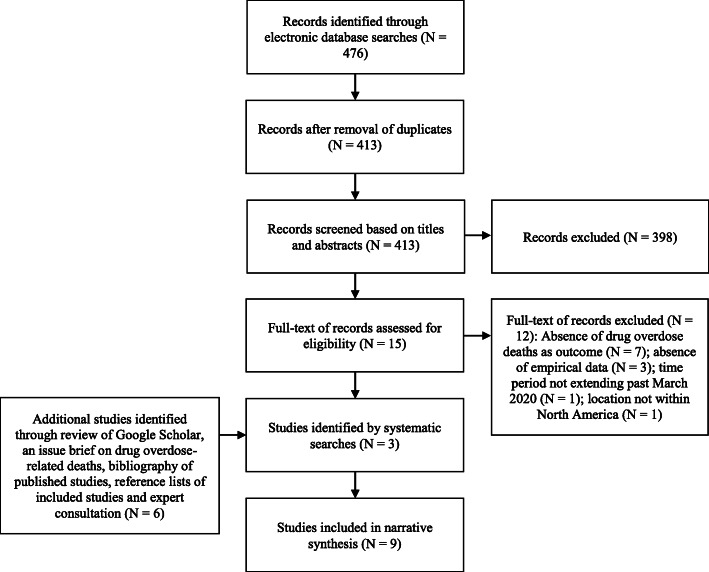
Background: There are preliminary indications that the trajectory of drug overdose-related deaths in North America has been exacerbated due to the novel coronavirus disease pandemic (COVID-19). As such, the impact of COVID-19 on drug overdose-related deaths was examined through a systematic review of the literature and percentage change analyses of surveillance data. Methods: Systematic searches in electronic databases were conducted, a topical issue brief and bibliography were reviewed, reference lists of included studies were searched and expert consultations were held to identify studies (Registration # CRD42021230223). Observational studies from the United States and Canada were eligible for inclusion if drug overdose-related deaths were assessed in quantitative or qualitative analyses onwards from at least March 2020. In addition, percentage changes comparing drug overdose-related deaths in the second annual quarter (Q2 2020 [April to June]) with the first annual quarter (Q1 2020 [January to March]) were generated using national and subnational data from public health surveillance systems and reports from jurisdictions in the United States and Canada. Results: Nine studies were included in the systematic review, eight from the United States and one from Canada. The maximum outcome assessment period in the included studies extended until September 2020. Drug overdose-related deaths after the onset of COVID-19 were higher compared with the months leading up to the pandemic in 2020 and the comparative months in 2019. In additional percentage change analyses, drug overdose-related deaths increased by 2 to 60% in jurisdictions in the United States and by 58% in Canada when comparing Q2 2020 with Q1 2020. Conclusions: Drug overdose-related deaths increased after the onset of COVID-19. The current situation necessitates a multi-pronged approach, encompassing expanded access to substance use disorder treatment, undisrupted access to harm reduction services, emphasis on risk reduction strategies, provision of a safe drug supply and decriminalization of drug use.
Overview
The claims and statistics of this paper haven’t been checked yet.
Run the check — free, no account needed. It reads the open-access text and checks the sources it cites.
Integrity signals
Registry
Cites
Statistics
Figures
Verification
Claims the paper makes
The claims and statistics of this paper haven’t been checked yet.
Run the check — free, no account needed. It reads the open-access text and checks the sources it cites.
Claims other papers make about this one
Each is checked against this paper’s own text: does it say what the citing paper says it does?
The source backs part of the claim, not all of it — or backs it for a different population, condition or comparison.
In the citing paper
“Most notable are the increases in drug- related overdose deaths in the US, which have skyrocketed over the past decade and further accelerated during the COVID pan demic 7,8 .”
From Substance use disorders: a comprehensive update of classification, epidemiology, neurobiology, clinical aspects, treatment and prevention (2023) · cites this paper as [7]
Experimental — accuracy not yet measured
Self-check
Percentages, sums and reported differences re-computed from the paper’s own numbers.
The self-check needs the paper’s full text.
Citations
Cites
Preferred Reporting Items for Systematic Reviews and Meta-Analyses: the PRISMA statement
Moher, D., Liberati, A., Tetzlaff, J., Altman, D. G., & for the PRISMA Group (2009) · BMJ · doi:10.1136/bmj.b2535 · Cited by 83,823
Preferred Reporting Items for Systematic Reviews and Meta-Analyses: The PRISMA Statement
Moher, D., Liberati, A., Tetzlaff, J., Altman, D. G., & The PRISMA Group (2009) · PLoS Medicine · doi:10.1371/journal.pmed.1000097 · Cited by 64,042
Preferred reporting items for systematic reviews and meta-analyses: the PRISMA Statement.
(2009) · PubMed Central · Cited by 44,859
A novel coronavirus from patients with pneumonia in China, 2019
Zhu, N., Zhang, D., Wang, W., Li, X., Yang, B., Song, J., Zhao, X., Huang, B., Shi, W., Lu, R., et al. (2020) · New England Journal of Medicine · doi:10.1056/nejmoa2001017 · Cited by 28,244
Zhou, F., Yu, T., Du, R., Fan, G., Liu, Y., Liu, Z., Xiang, J., Wang, Y., Song, B., Gu, X., et al. (2020) · The Lancet · doi:10.1016/s0140-6736(20)30566-3 · Cited by 27,263
Wang, G., Ma, R., Qiao, G., Wada, K., Aizawa, Y., & Satoh, T. (2015) · Integrative Medicine International · doi:10.1159/000368408 · Cited by 18,762
(2002) · Cited by 13,211
Holmes, E. A., O'Connor, R. C., Perry, V. H., Tracey, I., Wessely, S., Arseneault, L., Ballard, C., Christensen, H., Cohen Silver, R., Everall, I., et al. (2020) · The Lancet Psychiatry · doi:10.1016/s2215-0366(20)30168-1 · Cited by 5,715
WHO Coronavirus Disease (COVID-19) Dashboard
e, C. R. D. I. (2020) · Bangladesh Physiotherapy Journal · doi:10.46945/bpj.10.1.03.01 · Cited by 5,465
Guidance on Conducting a Systematic Literature Review
Xiao, Y., & Watson, M. (2019) · Journal of Planning Education and Research · doi:10.1177/0739456x17723971 · Cited by 3,467
Research works printed but not linked: 6
- Ontario Agency for Health Protection and Promotion (Public Health Ontario). Rapid review: Substance use-related harms and risk factors during periods of disruption. Toronto, Ontario: Queen's Printer for Ontario; 2020.
- British Columbia Coroners Service. Illicit drug toxicity deaths in BC January 1, 2010 – November 30, 2020. Burnaby, British Columbia: British Columbia Coroners Service; 2020.
- Alter A, Yeager C. The consequences of COVID-19 on the overdose epidemic: overdoses are increasing. Overdose Detection Mapping Application Program: Washington, District of Columbia; 2020.
- Georgia Department of Public Health. Updated suspected drug overdose increases in Georgia amid COVID-19 Atlanta. Georgia: Georgia Department of Public Health; 2020.
- Giesel S, DeLaquil M, Wright N. Drug overdose deaths among Minnesota residents from January through June 2020: drug overdose deaths during the emerging COVID-19 pandemic. Minnesota Department of Health: Saint Paul, Minnesota; 2020.
- Georgia Department of Public Health. Opioid overdose surveillance preliminary report Georgia, 2019. Atlanta, Georgia: Georgia Department of Public Health; 2020.
Cited by
Sorted by citations
Volkow, N. D., & Blanco, C. (2023) · World psychiatry · doi:10.1002/wps.21073 · Cited by 503
Slaunwhite, A., Min, J. E., Palis, H., Urbanoski, K., Pauly, B., Barker, B., Crabtree, A., Bach, P., Krebs, E., Dale, L., et al. (2024) · BMJ · doi:10.1136/bmj-2023-076336 · Cited by 100
The COVID ‐19 pandemic and its consequences for chronic pain: a narrative review
Shanthanna, H., Nelson, A. M., Kissoon, N. R., & Narouze, S. (2022) · Anaesthesia · doi:10.1111/anae.15801 · Cited by 77
Digital interventions for substance use disorders in young people: rapid review
Monarque, M., Sabetti, J., & Ferrari, M. (2023) · Substance Abuse Treatment Prevention and Policy · doi:10.1186/s13011-023-00518-1 · Cited by 69
Increased solitary drug use during COVID-19: An unintended consequence of social distancing
Schneider, K. E., Allen, S. T., Rouhani, S., Morris, M., Haney, K., Saloner, B. K., & Sherman, S. G. (2022) · International Journal of Drug Policy · doi:10.1016/j.drugpo.2022.103923 · Cited by 39
Hickey, M. D., Imbert, E., Appa, A. A., Rosario, J. B. D., Lynch, E., Friend, J., Avila, R., Clemenzi-Allen, A., Riley, E. D., Gandhi, M., et al. (2022) · The Journal of Infectious Diseases · doi:10.1093/infdis/jiac267 · Cited by 38
Simha, S., Ahmed, Y., Brummett, C. M., Waljee, J. F., Englesbe, M. J., & Bicket, M. C. (2022) · Regional Anesthesia & Pain Medicine · doi:10.1136/rapm-2022-103591 · Cited by 33
Pauly, B., McCall, J., Cameron, F., Stuart, H., Hobbs, H., Sullivan, G., Ranger, C., & Urbanoski, K. A. (2022) · International Journal of Drug Policy · doi:10.1016/j.drugpo.2022.103849 · Cited by 30
Have deaths of despair risen during the COVID-19 pandemic? A systematic review
Rahimi-Ardabili, H., Feng, X., Nguyen, P.-Y., & Astell-Burt, T. (2022) · International Journal of Environmental Research and Public Health · doi:10.3390/ijerph191912835 · Cited by 26
Buckley, C. M., Ye, Y., Kerr, W. C., Mulia, N., Puka, K., Rehm, J. T., & Probst, C. (2022) · BMC Medicine · doi:10.1186/s12916-022-02590-z · Cited by 24
Self-citationEmergence of Erythromycin-Resistant Invasive Group A Streptococcus, West Virginia, USA, 2020–2021
Powell, L. M., Choi, S. J., Chipman, C. E., Grund, M. E., LaSala, P. R., & Łukomski, S. (2023) · Emerging infectious diseases · doi:10.3201/eid2905.221421 · Cited by 24
Zang, X., Walley, A. Y., Chatterjee, A., Kimmel, S. D., Morgan, J. R., Murphy, S. M., Linas, B. P., Nolen, S., Reilly, B., Urquhart, C., et al. (2023) · Addiction · doi:10.1111/add.16324 · Cited by 22
Teck, J. T. W., Zlatkute, G., Pérez, A. O., Dritschel, H., Ghosh, A., Potenza, M. N., Ambekar, A., Ekhtiari, H., Stein, D. J., Khazaal, Y., et al. (2022) · The Lancet Psychiatry · doi:10.1016/s2215-0366(22)00374-1 · Cited by 21
Palzes, V. A., Chi, F. W., Metz, V. E., Sterling, S., Asyyed, A. H., Ridout, K. K., & Campbell, C. I. (2023) · JAMA Health Forum · doi:10.1001/jamahealthforum.2023.1018 · Cited by 21
Bartholomew, T. S., Tookes, H. E., Chueng, T. A., Bluthenthal, R. N., Wenger, L. D., Kral, A. H., & Lambdin, B. H. (2023) · Harm Reduction Journal · doi:10.1186/s12954-023-00861-3 · Cited by 21
The decriminalization of illicit drugs in British Columbia: a national evaluation protocol.
Russell, C., Ali, F., Imtiaz, S., Butler, A., Greer, A., Rehm, J., the Decriminalization Evaluation Research Group, Bardwell, G., Bonn, M., Boyd, J., et al. (2024) · BMC Public Health · doi:10.1186/s12889-024-20336-9 · Cited by 19
Self-citationMitra, S., Bouck, Z., Larney, S., Zolopa, C., Høj, S. B., Minoyan, N., Upham, K., Rammohan, I., Mok, W. Y., Hayashi, K., et al. (2024) · Harm Reduction Journal · doi:10.1186/s12954-024-00996-x · Cited by 19
Drug supply measures and drug overdose mortality in the era of fentanyl and stimulants
Cano, M., Timmons, P., Hooten, M., & Sweeney, K. (2023) · Drug and Alcohol Dependence Reports · doi:10.1016/j.dadr.2023.100197 · Cited by 17
“…and drug overdose mortality rates in the years 2020 – 2021, compared to 2019, may also possibly reflect COVID-19-related disruptions in drug markets or increased contributions of social factors to drug overdose mortality during the unique circumstances of the pandemic (Imtiaz et al., 2021).”
BackgroundDurand, L., Keenan, E., Boland, F., Harnedy, N., Delargy, Í., Scully, M., Mayock, P., Ebbitt, W., Vázquez, M. O., Corrigan, N., et al. (2022) · International Journal of Drug Policy · doi:10.1016/j.drugpo.2022.103768 · Cited by 18
Kline, A., Williams, J. M., Steinberg, M. L., Mattern, D., Chesin, M. S., Borys, S. V., & Chaguturu, V. (2023) · Journal of Substance Use and Addiction Treatment · doi:10.1016/j.josat.2023.209028 · Cited by 15
Puthur, C., Nabatte, B., Tinkitina, B., Kabatereine, N. B., & Chami, G. F. (2025) · BMJ Public Health · doi:10.1136/bmjph-2024-002151 · Cited by 14
Armour, R., Ghamarian, E., Helmer, J. S., Buick, J. E., Thorpe, K. E., Austin, M., Bacon, J., Boutet, M., Cournoyer, A., Dionne, R., et al. (2023) · Resuscitation · doi:10.1016/j.resuscitation.2023.110054 · Cited by 14
Tang, V. M., Goud, R., Zawertailo, L. A., Selby, P. L., Coroiu, A., Sloan, M. E., Chenoweth, M. J., Buchman, D. Z., Ibrahim, C., Blumberger, D. M., et al. (2023) · Psychiatry Research · doi:10.1016/j.psychres.2023.115340 · Cited by 15
Opioid overdose prevention education in Texas during the COVID-19 pandemic
Mathias, C. W., Cavazos, D. M., McGlothen‐Bell, K., Crawford, A. D., Flowers-Joseph, B., Wang, Z., & Cleveland, L. M. (2023) · Harm Reduction Journal · doi:10.1186/s12954-023-00769-y · Cited by 10
Lott, A. M. K., Danner, A. N., Malte, C. A., Williams, E. C., Gordon, A. J., Halvorson, M. A., Saxon, A. J., Hagedorn, H., Sayre, G. G., & Hawkins, E. J. (2023) · Journal of Addiction Medicine · doi:10.1097/adm.0000000000001156 · Cited by 10
Lessons in Implementation from a 5-Year SBIRT Effort Using a Mixed-Methods Approach
Evans, B., Kamon, J. L., & Turner, W. C. (2023) · The Journal of Behavioral Health Services & Research · doi:10.1007/s11414-023-09835-6 · Cited by 10
Growth in Suicide Rates Among Children During the Illicit Opioid Crisis
Powell, D. (2023) · Demography · doi:10.1215/00703370-11077660 · Cited by 10
Young, S., Gomes, T., Kolla, G., McCormack, D., Dodd, Z., Raboud, J., & Bayoumi, A. M. (2023) · PLoS ONE · doi:10.1371/journal.pone.0295145 · Cited by 9
Impact of COVID-19 on emergency medical services utilization and severity in the U.S. Upper Midwest
Shalom, M., Boggust, B., Rogerson, M. C., Myers, L. A., Huang, S. J., & McCoy, R. G. (2024) · PLoS ONE · doi:10.1371/journal.pone.0299608 · Cited by 9
Spencer, S., Hedden, L., Vaughan, C., Marshall, E. G., Lukewich, J., Asghari, S., Gill, P. S., Buote, R., Meredith, L., Moritz, L. R., et al. (2022) · SSM - Qualitative Research in Health · doi:10.1016/j.ssmqr.2022.100176 · Cited by 9
Stringfellow, E. J., Lim, T. Y., DiGennaro, C., Hasgül, Z., & Jalali, M. S. (2023) · PNAS Nexus · doi:10.1093/pnasnexus/pgad064 · Cited by 9
Jaffe, K., Blawatt, S., Lehal, E., Lock, K., Easterbrook, A., Macdonald, S., Harrison, S., Lajeunesse, J., Byres, D., Schechter, M. T., et al. (2023) · Harm Reduction Journal · doi:10.1186/s12954-023-00779-w · Cited by 9
Harruff, R. C., Yarid, N. A., Barbour, W. L., & Martin, Y. H. (2023) · Journal of Forensic Sciences · doi:10.1111/1556-4029.15329 · Cited by 8
Skinner, A., Nolen, S., Cerdá, M., Rich, J. D., & Marshall, B. D. L. (2024) · The American Journal of Drug and Alcohol Abuse · doi:10.1080/00952990.2024.2364338 · Cited by 8
Harruff, R. C., Simpson, C. M., Gifford, A. L., Yarid, N. A., Barbour, W. L., & Heidere, C. (2022) · American Journal of Forensic Medicine & Pathology · doi:10.1097/paf.0000000000000798 · Cited by 8
Sud, A., Chiu, K., Friedman, J. R., & Dupouy, J. (2023) · International Journal of Drug Policy · doi:10.1016/j.drugpo.2023.104161 · Cited by 7
COVID-19 impact on opioid overdose after jail release in Massachusetts
Friedmann, P. D., Dunn, D., Michener, P. S., Bernson, D., Stopka, T. J., Pivovarova, E., Ferguson, W. J., Rottapel, R. E., Hoskinson, R. A., Wilson, D., et al. (2023) · Drug and Alcohol Dependence Reports · doi:10.1016/j.dadr.2023.100141 · Cited by 7
Disease-related stigma among people who inject drugs in Toronto amidst the COVID-19 pandemic
Bowles, J. M., Kolla, G., Smith, L. R., Scheim, A. I., Dodd, Z., & Werb, D. (2023) · Drug and Alcohol Dependence Reports · doi:10.1016/j.dadr.2023.100167 · Cited by 7
Mancheño‐Velasco, C., Dacosta‐Sánchez, D., Blanc, A., Narváez‐Camargo, M., & Lozano, O. M. (2022) · Journal of Clinical Medicine · doi:10.3390/jcm11154341 · Cited by 7
Art therapy’s engagement of brain networks for enduring recovery from addiction
Quinn, P. (2025) · Frontiers in Psychiatry · doi:10.3389/fpsyt.2024.1458063 · Cited by 7
Imtiaz, S., Abdul, S. A., Jiang, H., Russell, C., Ali, F., Henderson, I., Foll, B. L., Elton‐Marshall, T., Kinniburgh, B. A., & Rehm, J. T. (2025) · Drug and Alcohol Review · doi:10.1111/dar.70036 · Cited by 6
Self-citationSkinner, A., Li, Y., Jent, V. A., Goedel, W. C., Hallowell, B. D., Allen, B., Leifheit, K. M., Cartus, A. R., Macmadu, A., Pratty, C., et al. (2024) · BMJ Public Health · doi:10.1136/bmjph-2023-000756 · Cited by 5
Baloh, J., Charton, H., & Curran, G. M. (2023) · Substance Use & Misuse · doi:10.1080/10826084.2023.2257305 · Cited by 5
The impact of the COVID‐19 pandemic on addictive disorders—an update
Marsden, J., Brown, J., Clark, L., Cousijn, J., Hall, W., Hickman, M., Holmes, J., Humphreys, K. N., Jackson, S. E., Peacock, A., et al. (2022) · Addiction · doi:10.1111/add.16033 · Cited by 4
Schirle, L. M., Kwun, S., Suh, A., Sanchez‐Roige, S., Jeffery, A. D., & Samuels, D. C. (2023) · Journal of Opioid Management · doi:10.5055/jom.2023.0754 · Cited by 4
Identification of Factors Necessary for Gatekeeper of Overdose
Nagashima, K., Hiruma, K., Nakamura, E., Watanabe, M., & Sekine, Y. (2023) · Biological and Pharmaceutical Bulletin · doi:10.1248/bpb.b23-00530 · Cited by 4
Ali, F., Russell, C., Law, J., Talbot, A., Elton‐Marshall, T., Bozinoff, N., Imtiaz, S., Rehm, J. T., Giang, V., & Rush, B. R. (2023) · The Canadian Journal of Addiction · doi:10.1097/cxa.0000000000000167 · Cited by 4
Self-citationKline, D., White, B. N., Lancaster, K. E., Egan, K. L., Murphy, E., Miller, W. C., & Hepler, S. A. (2025) · Epidemiology · doi:10.1097/ede.0000000000001838 · Cited by 3
Andrade, L. A., Gurgel, M. A. D. S. L., da Paz, W. S., Monteiro, G. R., de Araújo, K. C. G., dos Santos, A. D., de Souza, C. D. F., de Sousa, Á. F. L., Cepas, L. A., Fernandes, A. P., et al. (2026) · The Lancet Regional Health - Americas · doi:10.1016/j.lana.2025.101371 · Cited by 3
Trachtenberg, E., Ruzal, K., Forkosh, O., & Bartal, I. B.-A. (2024) · Scientific Reports · doi:10.1038/s41598-024-56979-2 · Cited by 4
Sanchez, K., da Graca, B., Hall, L., Bennett, M., Powers, M. B., & Warren, A. M. (2022) · Substance Abuse Research and Treatment · doi:10.1177/11782218221126973 · Cited by 3
Oser, C. B., McGladrey, M., Oyler, D. R., Knudsen, H. K., WALSH, S. L., Stitzer, S., Goetz, M., Booty, M. D., Hargis, E., Johnson, S., et al. (2024) · Journal of Substance Use and Addiction Treatment · doi:10.1016/j.josat.2024.209618 · Cited by 2
Kerman, N., Sanches, M., Kidd, S. A., & Stergiopoulos, V. (2025) · Journal of Urban Health · doi:10.1007/s11524-025-00984-x · Cited by 2
Man, N. W. Y., Akhurst, J., Price, O. H., Chrzanowska, A., Sutherland, R., Dietze, P., Bruno, R., Degenhardt, L. J., Yuen, W. S., Moran, L. L., et al. (2025) · Drug and Alcohol Review · doi:10.1111/dar.14088 · Cited by 2
Abdul, S. A., Wu, E., Jiang, H., Russell, C., Ali, F., Rehm, J. T., Butler, A., Elton‐Marshall, T., Henderson, I., Gomes, T., et al. (2026) · International Journal of Drug Policy · doi:10.1016/j.drugpo.2026.105261 · Cited by 2
Self-citationRedona, P. T., Woods, C., Jackson, D. W., Hayman, J., & Usher, K. J. (2022) · Cureus · doi:10.7759/cureus.28813 · Cited by 2
The effects of the COVID-19 pandemic on drug and poison–related deaths in Gold Coast, Australia
Thompson, I., Olumbe, A. K., Tse, R. D., & Thompson, M. (2022) · Forensic Science Medicine and Pathology · doi:10.1007/s12024-022-00555-5 · Cited by 2
SARS-CoV-2 (COVID-19) Experience at an Academic Medical Examiner’s Office
Prahlow, J. A., Jones, P., Bailey, K., Grande, A. J., Obead, A., Pink, C., Douglas, E. A., Shattuck, B. L., Fisher‐Hubbard, A., Brown, T. T., et al. (2024) · Academic Forensic Pathology · doi:10.1177/19253621231224532 · Cited by 2
Boyd, J. (2025) · International Journal of Drug Policy · doi:10.1016/j.drugpo.2025.104719 · Cited by 2
Trends in Drug and Polysubstance-Related Deaths in the State of Texas: County Comparisons
Nicanord, E. J., Lee, W.-C. M., Konopnicki, S. A., & Campbell, K. M. (2025) · Cureus · doi:10.7759/cureus.79175 · Cited by 2
Gallant, K., Speed, K. A., Betsos, A., Abele, B., Bonn, M., Crichlow, F., de Kiewit, A., Nurse, M., Sherstobitoff, A., Touesnard, N., et al. (2025) · Harm Reduction Journal · doi:10.1186/s12954-025-01221-z · Cited by 2
Clingan, S. E., Woodruff, S. I., Gaines, T. L., & Davidson, P. J. (2022) · Journal of Addictive Diseases · doi:10.1080/10550887.2022.2108287 · Cited by 2
Kumar, M., Holodinsky, J. K., Yu, A., McNaughton, C. D., Austin, P. C., Chu, A., Hill, M. D., Norris, C. M., Lee, D. S., Kapral, M. K., et al. (2024) · Canadian Journal of Public Health · doi:10.17269/s41997-024-00934-1 · Cited by 1
Chen, L.-C., Mao, C.-Y., Cheong, C.-W., Chen, W.-C., Yen, T., & Chen, H. (2025) · International Journal of General Medicine · doi:10.2147/ijgm.s520738 · Cited by 1
Post-overdose outreach programs in Massachusetts before and after the onset of the COVID-19 pandemic
Walley, A. Y., Wang, J., To, C., Duska, M., Murray, S., Wiggins, M., Rolles, A., Yan, S., Kosakowski, S., Bagley, S. M., et al. (2025) · Journal of Substance Use and Addiction Treatment · doi:10.1016/j.josat.2025.209799 · Cited by 1
Høj, S. B., Coignard-Friedman, R., Sako, A., de Montigny, C., Beauchemin-Nadeau, M.-È., Léandre, R., Minoyan, N., Boyer-Legault, G., Chougar, S., Lamont, S.-K., et al. (2025) · Harm Reduction Journal · doi:10.1186/s12954-025-01328-3 · Cited by 1
Moreheart, S., Shannon, K., Hayashi, K., Bartels, W., Pearson, J., Krüsi, A., & Goldenberg, S. M. (2026) · Harm Reduction Journal · doi:10.1186/s12954-026-01398-x · Cited by 1
Cullip, M., Rosenthal, J. S., & Dmetrichuk, J. M. (2026) · Forensic Science International · doi:10.1016/j.forsciint.2026.113031 · Cited by 1
Buchman, D. Z., Lo, S., Ding, P. Q., Dosani, N., Fazelzad, R., Furlan, A. D., Isenberg, S. R., Spithoff, S. M., Tedesco, A., Zimmermann, C., et al. (2022) · Palliative Medicine · doi:10.1177/02692163221143153 · Cited by 1
Trailblazing through the Opioid Epidemic. Will Science Prevail?
Limratana, P., & Yuki, K. (2023) · Translational Perioperative and Pain Medicine · doi:10.31480/2330-4871/175 · Cited by 1
Kneeland, I. J., Biesen, J. N., Fink, B. C., Keeling, L. A., & Lindsey, L. (2024) · The Journal of Behavioral Health Services & Research · doi:10.1007/s11414-024-09905-3 · Cited by 1
Olson, A. W., Bucaloiu, A., Allen, C. I., Tusing, L. D., Henzler-Buckingham, H. A., Gregor, C. M., Freitag, L. A., Hooker, S. A., Rossom, R. C., Solberg, L. I., et al. (2025) · BMJ Open · doi:10.1136/bmjopen-2024-090462 · Cited by 1
Coburn, S. B., Manabe, Y. C., Laeyendecker, O. B., Sherman, S. G., Baker, O. R., Quinn, T. C., Graham, L. A., Thomas, F. D., Southall, P. E., Weedn, V. W., et al. (2022) · Open Forum Infectious Diseases · doi:10.1093/ofid/ofac142
Bydon, M., Durrani, S., & Mualem, W. (2022) · Neurosurgery · doi:10.1227/neu.0000000000001989
Adicciones y COVID-19, impacto de la pandemia
Varela, A., & Flórez, G. (2022) · Adicciones · doi:10.20882/adicciones.1855
Kline, A., Williams, J. M., Steinberg, M. L., Mattern, D., Chesin, M. S., Borys, S. V., & Chaguturu, V. (2022) · SSRN Electronic Journal · doi:10.2139/ssrn.4170596
Moallef, S., DeBeck, K., Fairbairn, N. S., Cui, Z., Brar, R., Wilson, D., Johnson, C., Milloy, M., & Hayashi, K. (2022) · Addiction Science & Clinical Practice · doi:10.1186/s13722-022-00354-x
Yeung, D., Zelazny, S., Ahluwalia, S. C., & Beaghley, S. (2023) · RAND Corporation eBooks · doi:10.7249/rra1692-1
Creating and evaluating the score to assess overdose: the OD score
Nagashima, K., Yasuno, N., & Watanabe, M. (2024) · BMC Emergency Medicine · doi:10.1186/s12873-023-00923-6
Kenefick, H. W., & Wing, A. (2024) · Harm Reduction Journal · doi:10.1186/s12954-024-00948-5
Impact of COVID-19 on Emergency Medical Services Utilization and Severity in the U.S. Upper MidwestPreprint
Boggust, B., McCoy, R. G., Shalom, M., Myers, L. A., & Rogerson, C. (2024) · medRxiv · doi:10.1101/2024.02.15.24302863
Mustafa, A. B., Babar, M. Z. M., Saleem, M., Zafar, U., Farooq, H., Munir, N., Khan, T. R., & Adil, M. A. (2024) · Journal of Pakistan Psychiatric Society · doi:10.63050/jpps.21.01.269
Increased Alcohol and Drug-Related Deaths During COVID-19 Pandemic in Brazil: A Collateral Epidemic?Preprint
Andrade, L. A., Gurgel, M. A. D. S. L., da Paz, W. S., Monteiro, G. R., de Araújo, K. C. G., dos Santos, A. D., de Souza, C. D. F., de Sousa, Á. F., Cepas, L. A., Fernandes, A. P., et al. (2024) · SSRN Electronic Journal · doi:10.2139/ssrn.5068605
Ullah, S., & Khan, F. (2025) · Forensic Research & Criminology International Journal · doi:10.15406/frcij.2024.13.00433
Russell, C., Yakubovich, A. R., O'Campo, P. J., Qu, K., Plumptre, L., Kouyoumdjian, F. G., & Matheson, F. I. (2025) · International Journal of Prison Health · doi:10.1108/ijoph-06-2024-0034
Self-citationLovrečić, M., & Lovrečić, B. (2025) · Heroin addiction and related clinical problems · doi:10.62401/2531-4122-2025-25
Kenefick, H. W., & Wing, A. (2024) · Figshare · doi:10.6084/m9.figshare.26680337
Kenefick, H. W., & Wing, A. (2024) · Figshare · doi:10.6084/m9.figshare.26680340
Kenefick, H. W., & Wing, A. (2024) · Figshare · doi:10.6084/m9.figshare.26680334
Kenefick, H. W., & Wing, A. (2024) · Figshare · doi:10.6084/m9.figshare.26680343
Buckley, C. M., Ye, Y., Kerr, W. C., Mulia, N., Puka, K., Rehm, J. T., & Probst, C. (2022) · Figshare · doi:10.6084/m9.figshare.21393885
Self-citationGeographical Variation in SARS-CoV-2 Transmission Potential in Massachusetts
Lee, I. S.-T., Hua, X., Kersey, J. X., Shioda, K., Chowell, G., & Fung, I. C. (2026) · Epidemiologia · doi:10.3390/epidemiologia7010015
Alanazi, E. B., Alenezi, T. S. T., Alenezi, H. K. H., Alanazi, B. D. G., Alanazi, W. A. T., Alenez, T. A. M., Alanazi, M. L. J., Alruwaili, M., Alanazi, M. M. M., & alenezi, Y. H. (2024) · International Journal of Computational and Experimental Science and Engineering · doi:10.22399/ijcesen.4793
Jaume-Feliciosi, N., HURSTON, J., Benca‐Bachman, C. E., & Palmer, R. H. C. (2026) · Journal of Health Psychology · doi:10.1177/13591053261434373
Lingering Effects Of The COVID-19 Pandemic On Non-COVID-19 Death Rates In The US, 2020–24
Ruhm, C. J. (2026) · Health Affairs · doi:10.1377/hlthaff.2025.01313
Jaffe, K., Jutras‐Aswad, D., Spector‐Bagdady, K., & Richardson, L. (2026) · International Journal of Drug Policy · doi:10.1016/j.drugpo.2026.105278
Zhao, Y., Ategbole, M., Lu, Y., Wang, K., & Xu, C. D. (2026) · Psychology Health & Medicine · doi:10.1080/13548506.2026.2659694
Mothers’ and Fathers’ Binge Drinking and Parenting Problems During the Pandemic
Longmore, M. A., King, I. Y., Kaufman-Parks, A. M., Manning, W. D., & Giordano, P. C. (2026) · Journal of Human Services · doi:10.52678/001c.160844
Imtiaz, S., Abdul, S. A., Sanches, M., Russell, C., Ali, F., & Rehm, J. T. (2026) · American Journal of Preventive Medicine · doi:10.1016/j.amepre.2026.108526
Self-citationErdem, O. (2026) · Springer eBooks · doi:10.1007/978-3-032-24189-4_10
Metadata
- Authors
- Imtiaz, S., Nafeh, F., Russell, C., Ali, F., Elton-Marshall, T., & Rehm, J.
- Affiliations
- Centre for Addiction and Mental Health (CA)
- Corresponding author
- Imtiaz, Sameer
- Venue
- Substance Abuse Treatment, Prevention, and Policy
- Published
- 2021-11-29
- Volume
- 16
- Issue
- 1
- Pages
- 87-87
- ISSN
- 1747-597X (ISSN-L)
- PMC
- PMC8628272
- OpenAlex
- W3217757484
- Cited by
- 101
- References
- 43
- Citations by year
- 2026: 13 · 2025: 16 · 2024: 21 · 2023: 27 · 2022: 24
- FWCI
- 3.21
- Type
- journal article
- Language
- en
- Open access
- gold
- doi.org
- Locations
- Substance Abuse Treatment Prevention and Policy (publishedVersion, cc-by)
- PubMed Central (publishedVersion, cc-by)
- PubMed (publishedVersion)
- uO Research (University of Ottawa) (submittedVersion, public-domain)
- TSpace (University of Toronto) (submittedVersion)
- DOAJ (DOAJ: Directory of Open Access Journals) (submittedVersion, cc-by-sa)
- Funders
- CIHR Institute of Neurosciences, Mental Health and Addiction (CUG-171602)
- Topics
- Health Sciences › Medicine › Public Health, Environmental and Occupational Health › Opioid Use Disorder Treatment
- Health Sciences › Medicine › Epidemiology › Substance Abuse Treatment and Outcomes
- Health Sciences › Medicine › Epidemiology › HIV, Drug Use, Sexual Risk
- Keywords
- COVID-19 pandemic, drug overdose deaths, opioid overdose, substance use disorders, harm reduction, drug decriminalization, risk mitigation strategies, substance use disorder treatment access, disease surveillance, United States, Canada
- MeSH terms
- COVID-19, SARS-CoV-2, Canada, Humans, United States, Pandemics, Public Health Surveillance, Drug Overdose
About these checks
Registry, retraction, Cites and statistics results are computed, not judged, with one exception: a printed reference that no index lists is read once by a model before it counts as a citation error. Claims are extracted by a model and kept only when their quote appears verbatim in the text; each cited source is then checked, with a model’s help, for whether it says what the claim relies on. Those verdicts can be wrong — read the claim’s quote and the cited source before relying on one.
Statistics and arithmetic are recomputed, not judged.
Confidence bands are shown only for fields calibrated on our annotated test set. None is calibrated yet, so no band is shown.
What counts as a claim ›How we measure confidence ›How we check this ›
Are you an author, or do you see a problem with this page? Request a review
