

A systematic review of the use of the Consolidated Framework for Implementation Research
Open accessThe DOI matches its Crossref record; 44 of the 45 references it cites were found in a registry or an index.
Abstract
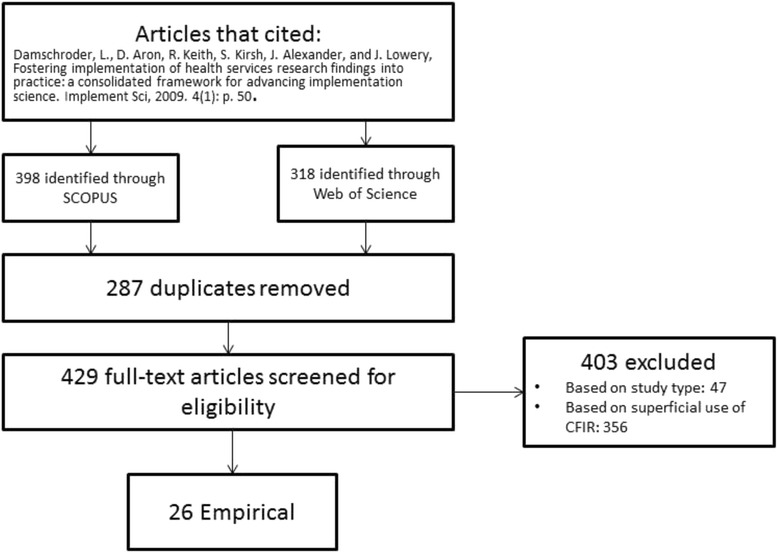
BACKGROUND: In 2009, Damschroder et al. developed the Consolidated Framework for Implementation Research (CFIR), which provides a comprehensive listing of constructs thought to influence implementation. This systematic review assesses the extent to which the CFIR's use in implementation research fulfills goals set forth by Damschroder et al. in terms of breadth of use, depth of application, and contribution to implementation research. METHODS: We searched Scopus and Web of Science for publications that cited the original CFIR publication by Damschroder et al. (Implement Sci 4:50, 2009) and downloaded each unique result for review. After applying exclusion criteria, the final articles were empirical studies published in peer-review journals that used the CFIR in a meaningful way (i.e., used the CFIR to guide data collection, measurement, coding, analysis, and/or reporting). A framework analysis approach was used to guide abstraction and synthesis of the included articles. RESULTS: Twenty-six of 429 unique articles (6 %) met inclusion criteria. We found great breadth in CFIR application; the CFIR was applied across a wide variety of study objectives, settings, and units of analysis. There was also variation in the method of included studies (mixed methods (n = 13); qualitative (n = 10); quantitative (n = 3)). Depth of CFIR application revealed some areas for improvement. Few studies (n = 3) reported justification for selection of CFIR constructs used; the majority of studies (n = 14) used the CFIR to guide data analysis only; and few studies investigated any outcomes (n = 11). Finally, reflections on the contribution of the CFIR to implementation research were scarce. CONCLUSIONS: Our results indicate that the CFIR has been used across a wide range of studies, though more in-depth use of the CFIR may help advance implementation science. To harness its potential, researchers should consider how to most meaningfully use the CFIR. Specific recommendations for applying the CFIR include explicitly justifying selection of CFIR constructs; integrating the CFIR throughout the research process (in study design, data collection, and analysis); and appropriately using the CFIR given the phase of implementation of the research (e.g., if the research is post-implementation, using the CFIR to link determinants of implementation to outcomes).
Overview
The claims and statistics of this paper haven’t been checked yet.
Free: it reads the open-access text and checks the first 5 claims that cite a source we can check. Create a free account to check every claim.
Integrity signals
Registry
Cites
Statistics
Figures
Verification
Claims the paper makes
The claims and statistics of this paper haven’t been checked yet.
Free: it reads the open-access text and checks the first 5 claims that cite a source we can check. Create a free account to check every claim.
Claims other papers make about this one
Each is checked against this paper’s own text: does it say what the citing paper says it does?
The cited source says what the claim attributes to it.
In the citing paper
“Kirk et al.’s 2015 review of 26 articles with meaningful use of the CFIR found that most users employed mixed (n = 13) or qualitative (n = 10) methods and used the CFIR in the post-implementation phase (n = 15) [13].”
From The updated consolidated framework for implementation research based on user feedback (2022) · cites this paper as [13]
The cited source says what the claim attributes to it.
In the citing paper
“Determinant frameworks can thus be used to inform choice of implementation strategies that may best address contextual determinants [14], generate hypotheses to prospectively guide predictions of implementation outcomes, or retrospectively explain implementation outcomes by assessing differences in determinants across implementation settings [11, 13, 15].”
From The updated consolidated framework for implementation research based on user feedback (2022) · cites this paper as [13]
The cited source says what the claim attributes to it.
In the citing paper
“The majority of CFIR users employ qualitative methods to assess constructs [13].”
From The updated consolidated framework for implementation research based on user feedback (2022) · cites this paper as [13]
The cited source says what the claim attributes to it.
In the citing paper
“In their systematic review of CFIR application, Kirk et al highlight gaps in depth of use of the framework, variation in selection of CFIR constructs, and a lack of justification of constructs used, limiting comparison of findings across time and contexts.14”
The cited source says what the claim attributes to it.
In the citing paper
“One indicator of this is a finding by Kirk et al: Among 26 research studies that meaningfully used CFIR, only two of the 26 included patients among their unit of analysis.14”
4 more claims about this paper
Create a free account to see every claim other papers make about this one.
Self-check
Percentages, sums and reported differences re-computed from the paper’s own numbers.
The self-check needs the paper’s full text.
Citations
Cites
Damschroder, L. J., Aron, D. C., Keith, R. E., Kirsh, S. R., Alexander, J. A., & Lowery, J. C. (2009) · Implementation Science · doi:10.1186/1748-5908-4-50 · Cited by 14,496 · cited 10×
“At the macro level, the CFIR provides a standardized structure for building on findings across studies [3].”
BackgroundMethodInfluentialSelf-citationGale, N. K., Heath, G., Cameron, E., Rashid, S., & Redwood, S. (2013) · BMC Medical Research Methodology · doi:10.1186/1471-2288-13-117 · Cited by 10,865 · cited 1×
“Objective 3: determine the contribution of the CFIR to implementation research General co posed by D • Cohere • Whethe • Whethe Microsoft Excel where content was arrayed in a matrix format consisting of rows (articles), columns (codes), and cells (summarized data) [8].”
BackgroundQualitative research practice: a guide for social science students and researchers
(2003) · Choice Reviews Online · doi:10.5860/choice.41-1319 · Cited by 10,543
Proctor, E., Silmere, H., Raghavan, R., Hovmand, P., Aarons, G., Bunger, A., Griffey, R., & Hensley, M. (2011) · Administration and Policy in Mental Health and Mental Health Services Research · doi:10.1007/s10488-010-0319-7 · Cited by 8,721 · cited 2×
“[25]), (2) provide clearer linkage of CFIR constructs with outcomes, and (3) provide clearer specification of which CFIR constructs were used to investigate outcomes.”
BackgroundComparison of PubMed, Scopus, Web of Science, and Google Scholar: strengths and weaknesses
Falagas, M. E., Pitsouni, E. I., Malietzis, G. A., & Pappas, G. (2008) · The FASEB Journal · doi:10.1096/fj.07-9492lsf · Cited by 5,039 · cited 1×
“, Google Scholar) [6].”
The Challenge of Innovation Implementation
Klein, K. J., & Sorra, J. S. (1996) · The Academy of Management Review · doi:10.2307/259164 · Cited by 2,113 · cited 1×
“Investigation of outcomes is critical for the field of implementation science overall because optimal implementation outcomes are a necessary condition for innovation effectiveness [25, 26].”
BackgroundFrench, S. D., Green, S. E., O’Connor, D. A., McKenzie, J. E., Francis, J. J., Michie, S., Buchbinder, R., Schattner, P., Spike, N., & Grimshaw, J. M. (2012) · Implementation Science · doi:10.1186/1748-5908-7-38 · Cited by 1,338 · cited 1×
“Better integration of the CFIR (or other theoretical framework) into empirical studies would help to address gaps in use of theory and advance implementation science [4, 31, 32].”
Kitson, A. L., Rycroft-Malone, J., Harvey, G., McCormack, B., Seers, K., & Titchen, A. (2008) · Implementation Science · doi:10.1186/1748-5908-3-1 · Cited by 1,314 · cited 1×
“earlier by developers of the PARIHS framework [27].”
MethodMeho, L. I., & Yang, K. (2007) · Journal of the American Society for Information Science and Technology · doi:10.1002/asi.20677 · Cited by 974
Damschroder, L. J., & Lowery, J. C. (2013) · Implementation Science · doi:10.1186/1748-5908-8-51 · Cited by 734
Self-citation
Cited by
The updated consolidated framework for implementation research based on user feedback
Damschroder, L. J., Reardon, C. M., Widerquist, M. A. O., & Lowery, J. (2022) · Implementation Science · doi:10.1186/s13012-022-01245-0 · Cited by 4,452
“’s 2015 review of 26 articles with meaningful use of the CFIR found that most users employed mixed (n = 13) or qualitative (n = 10) methods and used the CFIR in the post-implementation phase (n = 15) [13].”
BackgroundMethodSelf-citationSystematic review of the Exploration, Preparation, Implementation, Sustainment (EPIS) framework
Moullin, J. C., Dickson, K. S., Stadnick, N. A., Rabin, B., & Aarons, G. A. (2019) · Implementation Science · doi:10.1186/s13012-018-0842-6 · Cited by 1,223
Gale, R. C., Wu, J., Erhardt, T., Bounthavong, M., Reardon, C. M., Damschroder, L. J., & Midboe, A. M. (2019) · Implementation Science · doi:10.1186/s13012-019-0853-y · Cited by 846
“Damschroder LJ, Aron DC, Keith RE, Kirsh SR, Alexander JA, Lowery JC. Fostering implementation of health services research findings into practice: a consolidated framework for advancing implementation science.”
MethodInfluentialSelf-citationDamschroder, L. J., Reardon, C. M., Opra Widerquist, M. A., & Lowery, J. (2022) · Implementation Science · doi:10.1186/s13012-021-01181-5 · Cited by 784
“The Consolidated Framework for Implementation Research (CFIR) is one of the most widely used frameworks within and outside implementation science [8, 10].”
BackgroundMethodSelf-citationMay, C. R., Cummings, A., Girling, M., Bracher, M., Mair, F. S., May, C. M., Murray, E., Myall, M., Rapley, T., & Finch, T. (2018) · Implementation Science · doi:10.1186/s13012-018-0758-1 · Cited by 683
“’s review of reports of the Consolidated Framework for Implementation Research [18], we”
Background
Metadata
- Authors
- Kirk, M. A., Kelley, C., Yankey, N., Birken, S. A., Abadie, B., & Damschroder, L.
- Affiliations
- University of North Carolina at Chapel Hill (US)
- VA Ann Arbor Healthcare System (US)
- Eastern Michigan University (US)
- Corresponding author
- Kirk, M. Alexis
- Venue
- Implementation Science
- Published
- 2015-12
- Volume
- 11
- Issue
- 1
- Pages
- 72-72
- ISSN
- 1748-5908 (ISSN-L)
- PMC
- PMC4869309
- OpenAlex
- W2398003476
- Semantic Scholar
- c8757b9931f0128e029ff09f1d76564f0b0c686b
- Cited by
- 1,496
- References
- 45
- Citations by year
- 2026: 160 · 2025: 173 · 2024: 236 · 2023: 209 · 2022: 213 · 2021: 182 · 2020: 151 · 2019: 87 · 2018: 40 · 2017: 38 · 2016: 4 · 2015: 2
- FWCI
- 5.03
- Type
- journal article
- Language
- en
- Open access
- gold
- doi.org
- Licence
- cc-by
- Locations
- Implementation Science (publishedVersion, cc-by)
- PubMed Central (publishedVersion, cc-by)
- PubMed (publishedVersion)
- Carolina Digital Repository (University of North Carolina at Chapel Hill) (submittedVersion)
- Funders
- RTI International (NA)
- Topics
- Health Sciences › Health Professions › General Health Professions › Health Policy Implementation Science
- Health Sciences › Health Professions › General Health Professions › Health Sciences Research and Education
- Health Sciences › Medicine › Public Health, Environmental and Occupational Health › Clinical practice guidelines implementation
- Keywords
- Consolidated Framework for Implementation Research, implementation research, implementation factors, implementation outcomes
- MeSH terms
- Goals, Health Plan Implementation, Health Services Research, Humans
About these checks
Registry, retraction, Cites and statistics results are computed, not judged, with one exception: a printed reference that no index lists is read once by a model before it counts as a citation error. Claims are extracted by a model and kept only when their quote appears verbatim in the text; each cited source is then checked, with a model’s help, for whether it says what the claim relies on. Those verdicts can be wrong — read the claim’s quote and the cited source before relying on one.
Statistics and arithmetic are recomputed, not judged.
Confidence bands are shown only for fields calibrated on our annotated test set. None is calibrated yet, so no band is shown.
What counts as a claim ›How we measure confidence ›How we check this ›
Are you an author, or do you see a problem with this page? Request a review
Data sources
Bibliographic data: Semantic Scholar, OpenAlex, Crossref.
Contains information from the Semantic Scholar Academic Graph Datasets, made available under the ODC Attribution License (ODC-BY 1.0).
Semantic Scholar’s data is described in: Kinney, R., et al. (2023). The Semantic Scholar Open Data Platform. arXiv:2301.10140.
