

The DOI matches its Crossref record; 96 of the 99 references it cites were found in a registry or an index; 4 of the 46 sources its claims cite were checked for support.
Making sense of complexity in context and implementation: the Context and Implementation of Complex Interventions (CICI) framework
Open accessAbstract
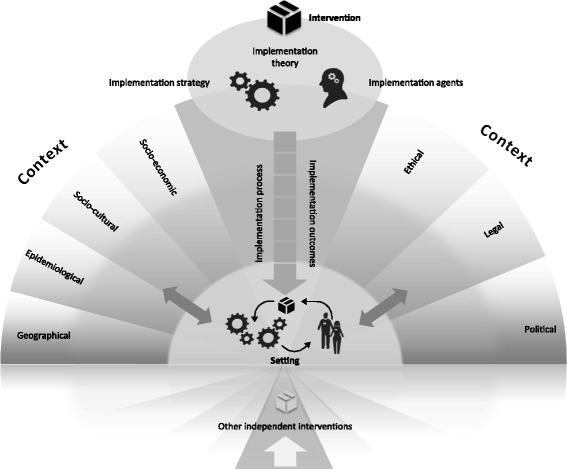
BACKGROUND: The effectiveness of complex interventions, as well as their success in reaching relevant populations, is critically influenced by their implementation in a given context. Current conceptual frameworks often fail to address context and implementation in an integrated way and, where addressed, they tend to focus on organisational context and are mostly concerned with specific health fields. Our objective was to develop a framework to facilitate the structured and comprehensive conceptualisation and assessment of context and implementation of complex interventions. METHODS: The Context and Implementation of Complex Interventions (CICI) framework was developed in an iterative manner and underwent extensive application. An initial framework based on a scoping review was tested in rapid assessments, revealing inconsistencies with respect to the underlying concepts. Thus, pragmatic utility concept analysis was undertaken to advance the concepts of context and implementation. Based on these findings, the framework was revised and applied in several systematic reviews, one health technology assessment (HTA) and one applicability assessment of very different complex interventions. Lessons learnt from these applications and from peer review were incorporated, resulting in the CICI framework. RESULTS: The CICI framework comprises three dimensions-context, implementation and setting-which interact with one another and with the intervention dimension. Context comprises seven domains (i.e., geographical, epidemiological, socio-cultural, socio-economic, ethical, legal, political); implementation consists of five domains (i.e., implementation theory, process, strategies, agents and outcomes); setting refers to the specific physical location, in which the intervention is put into practise. The intervention and the way it is implemented in a given setting and context can occur on a micro, meso and macro level. Tools to operationalise the framework comprise a checklist, data extraction tools for qualitative and quantitative reviews and a consultation guide for applicability assessments. CONCLUSIONS: The CICI framework addresses and graphically presents context, implementation and setting in an integrated way. It aims at simplifying and structuring complexity in order to advance our understanding of whether and how interventions work. The framework can be applied in systematic reviews and HTA as well as primary research and facilitate communication among teams of researchers and with various stakeholders.
Overview
AI snapshot
Written from the paper’s full text.
TL;DR
The paper presents the Context and Implementation of Complex Interventions (CICI) framework, which integrates context, implementation, and setting for complex interventions. It was developed iteratively through literature searches, concept analysis, and extensive application in systematic reviews, HTA, and applicability assessment.
Key findings
- The CICI framework comprises three interacting dimensions: context, implementation, and setting. Context has seven domains (geographical, epidemiological, socio-cultural, socio-economic, ethical, legal, political); implementation has five domains (implementation theory, process, strategies, agents, outcomes); setting refers to the specific physical location where the intervention is put into practice.
- Development included systematic searches yielding 35 publications on implementation and 17 on context, followed by pragmatic utility concept analysis that distinguished context, implementation, and setting.
- The revised framework was applied in three rapid assessments, a demonstration HTA of reinforced home-based palliative care, quantitative and qualitative systematic reviews, and an applicability assessment with semi-structured consultations with palliative care experts from three European countries; it was also externally peer-reviewed by three experts.
- Tools developed include a generic checklist, data extraction tools for qualitative and quantitative reviews, and a consultation guide; a worked example applied CICI, CFIR, and PARiHS to the Irish Air Pollution Act, finding CFIR and PARiHS had difficulty capturing public health context.
Methods
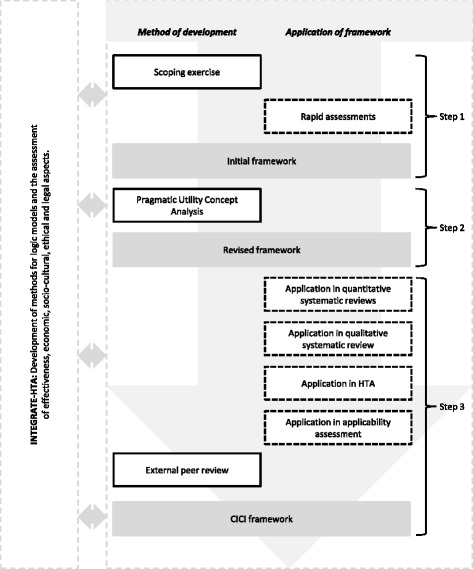
- The CICI framework was developed in a three-step iterative process within the INTEGRATE-HTA project: initial framework from purposive literature searches and three rapid assessments; pragmatic utility concept analysis using systematic searches for context in EMBASE/MEDLINE and forward tracking for implementation in Google Scholar; revision and extensive application.
- Applications included a demonstration HTA, quantitative systematic reviews, a qualitative systematic review using CICI as a best-fit framework, and an applicability assessment; appraisal used seven pre-specified criteria and external peer review.
- A worked example applied CICI, CFIR, and PARiHS to the Air Pollution Act on the Marketing, Sale and Distribution of Coal, using the primary study and grey literature searches.
Limitations
- The paper states that searches lacked explicit coverage of management and organisational studies; the setting dimension is less well conceptualised because the search strategy targeted context and implementation; no formal consensus method such as Delphi was used; and the latest framework version has not yet been fully tested.
- The paper states that primary studies report little detail on context and implementation, limiting population of the framework, and that extracting data on context and implementation imposes additional workload in quantitative reviews, potentially substantial if further sources are consulted.
- Evident from the text: the generic framework does not display relationships between dimensions or domains; applications noted overlaps between context and implementation dimensions and discomfort with the original ethical domain definition; peer reviewers questioned practical uptake given additional workload and called for clearer distinction between context and implementation and greater elaboration of domain definitions.
Model-written summary. Check it against the paper before relying on it.
Integrity signals
Registry
Cites
Statistics
Figures
Verification
Claims the paper makes
35 No basis given · 24 Not checked yet · 20 Own result · 19 Own interpretation · 7 Own method · 1 Partly supported · accuracy not yet measured
The cited sources support only part of this claim — read each source’s verdict below.
In the paper
“All of these community or organisational characteristics jointly influence implementation climate [14, 15], system readiness for change [14, 17, 67] and capacity for change [15, 62, 68, 69] and thus the chances of an intervention being implemented successfully.”
§ Making sense of complexity in context and implementation: the Context and Implementation of Complex Interventions (CICI) framework > Results > Macro, meso or micro levels
What the sources say
- Supportedcites [14] Damschroder LJ, Aron DC, Keith RE, Kirsh SR, Alexander JA, Lowery JC. Fostering implementation of health services research findings into practice: a consolidated framework for advancing implementation science. Implement Sci. 2009;4. source
The Results (Inner setting) describe implementation climate and readiness for implementation as organizational factors relevant to implementing an intervention. The paper also discusses how inner-setting constructs influence and interact. This supports the climate and readiness portions for which this source is cited; the sentence cites other works for capacity for change. (LLM, conf=0.86)
- Supportedcites [15] Greenhalgh T, Robert G, Macfarlane F, Bate P, Kyriakidou O. Diffusion of Innovations in Service Organizations: systematic review and recommendations. Milbank Q. 2004;82:581–629. source
The paper’s “Receptive Context for Change” and “System Readiness for Innovation” passages describe how organizational features shape receptiveness and readiness to assimilate an innovation. Its discussion of interactions among model components says that context-dependent interactions determine implementation success. The citing sentence attaches other references, not this source, to “capacity for change.” The supplied copy labels these passages “Abstract” and gives no page numbers. (LLM, conf=0.87)
- Not checked yetcites [17] Klein KJ, Sorra JS. The challenge of innovation implementation. Acad Manag Rev. 1996;21:1055–80. source
- Not checked yetcites [67] Weiner BJ, Lewis MA, Linnan LA. Using organization theory to understand the determinants of effective implementation of worksite health promotion programs. Health Educ Res. 2009;24:292–305. source
- Not checked yetcites [62] Packard T. Organizational change: a conceptual framework to advance the evidence base. J Hum Behav Soc Environ. 2013;23. source
- Partly supportedcites [68] Emmons KM, Weiner B, Fernandez ME, Tu S-P. Systems antecedents for dissemination and implementation: a review and analysis of measures. Health Educ Behav. 2012;39:87–105. sourceExperimental — accuracy not yet measured
The Introduction (page unavailable) identifies organizational readiness, climate and other organizational factors as possible influences on dissemination and implementation. The Results > Climate section reports associations between climate and implementation-related outcomes, but describes mixed predictive evidence. The paper does not establish that all the characteristics jointly influence climate, readiness and capacity for change, or that they collectively determine implementation success. (LLM, conf=0.84)
- Partly supportedcites [69] Flottorp SA, Oxman AD, Krause J, Musila NR, Wensing M, Godycki-Cwirko M, Baker R, Eccles MP. A checklist for identifying determinants of practice: a systematic review and synthesis of frameworks and taxonomies of factors that prevent or enable improvements in healthcare professional practice. Implement Sci. 2013;8. sourceExperimental — accuracy not yet measured
The Background says that constellations of determinants affect changes in practice, and the Results synthesis lists organisational resources, climate, readiness and capacities among implementation-related factors (page numbers unavailable). The paper does not establish that all the characteristics jointly influence each of the three named constructs, or that they do so through the causal chain asserted in the claim. (LLM, conf=0.82)
plaindirect- Asserted: passes — The authors put it forward as true.
- Checkable: passes — It can be checked against evidence.
- Load-bearing: passes — The paper’s conclusions depend on it.
- Based: passes — The paper gives a reason why it holds.
- Supported
A result the paper reports from its own data — it cites no other source for it, so there is none to check. The quote shows it is in the paper.
In the paper
“The rapid assessments unveiled inconsistencies in the interpretation of the terms context and implementation and the characteristics assigned to each of these among members of the research team.”
§ Making sense of complexity in context and implementation: the Context and Implementation of Complex Interventions (CICI) framework > Methods > Step 1
plaindirect- Asserted: passes — The authors put it forward as true.
- Checkable: passes — It can be checked against evidence.
- Load-bearing: passes — The paper’s conclusions depend on it.
- Based: passes — The paper gives a reason why it holds.
A result the paper reports from its own data — it cites no other source for it, so there is none to check. The quote shows it is in the paper.
In the paper
“The test cases did, however, also reveal that selected aspects under specific domains of context and implementation had been missing.”
§ Making sense of complexity in context and implementation: the Context and Implementation of Complex Interventions (CICI) framework > Results > Towards the CICI framework (step 3)
plain- Asserted: passes — The authors put it forward as true.
- Checkable: passes — It can be checked against evidence.
- Load-bearing: passes — The paper’s conclusions depend on it.
- Based: passes — The paper gives a reason why it holds.
A result the paper reports from its own data — it cites no other source for it, so there is none to check. The quote shows it is in the paper.
In the paper
“In particular, the concept of reinforced home-based palliative care, as defined for the HTA, did not fit the German context, where reinforcement (e.g., carer support) is integrated in every palliative care construct available.”
§ Making sense of complexity in context and implementation: the Context and Implementation of Complex Interventions (CICI) framework > Results > Towards the CICI framework (step 3)
plain- Asserted: passes — The authors put it forward as true.
- Checkable: passes — It can be checked against evidence.
- Load-bearing: unclear — It is unclear whether the paper’s conclusions depend on it.
- Based: passes — The paper gives a reason why it holds.
The paper states this without a source or data behind it here, so there is nothing to check it against. The quote shows it is in the paper.
In the paper
“The framework was assessed as compatible with other methods developed and applied within INTEGRATE-HTA (i.e., assessments of ethical or socio-cultural issues, logic model and the INTEGRATE-HTA model) as a consequence of their development taking place side-by-side.”
§ Making sense of complexity in context and implementation: the Context and Implementation of Complex Interventions (CICI) framework > Results > Towards the CICI framework (step 3)
plaindirect- Asserted: passes — The authors put it forward as true.
- Checkable: passes — It can be checked against evidence.
- Load-bearing: unclear — It is unclear whether the paper’s conclusions depend on it.
- Based: passes — The paper gives a reason why it holds.
In the paper
“In the applicability assessment, the framework partly missed the complexity and adaptability of the intervention [14].”
§ Making sense of complexity in context and implementation: the Context and Implementation of Complex Interventions (CICI) framework > Results > Towards the CICI framework (step 3)
What the sources say
- Not checked yetcites [14] Damschroder LJ, Aron DC, Keith RE, Kirsh SR, Alexander JA, Lowery JC. Fostering implementation of health services research findings into practice: a consolidated framework for advancing implementation science. Implement Sci. 2009;4. source
plain- Asserted: passes — The authors put it forward as true.
- Checkable: passes — It can be checked against evidence.
- Load-bearing: passes — The paper’s conclusions depend on it.
- Based: passes — The paper gives a reason why it holds.
The paper states this without a source or data behind it here, so there is nothing to check it against. The quote shows it is in the paper.
In the paper
“In line with the tradition of previous implementation frameworks, the application of the revised CICI framework in quantitative reviews does not make relationships between dimensions or domains explicit.”
§ Making sense of complexity in context and implementation: the Context and Implementation of Complex Interventions (CICI) framework > Results > Towards the CICI framework (step 3)
plain- Asserted: passes — The authors put it forward as true.
- Checkable: passes — It can be checked against evidence.
- Load-bearing: unclear — It is unclear whether the paper’s conclusions depend on it.
- Based: passes — The paper gives a reason why it holds.
The paper states this without a source or data behind it here, so there is nothing to check it against. The quote shows it is in the paper.
In the paper
“To our knowledge, no concept analysis of implementation has been undertaken to date.”
§ Making sense of complexity in context and implementation: the Context and Implementation of Complex Interventions (CICI) framework > Discussion > Theoretical underpinnings and scope
hedged- Asserted: passes — The authors put it forward as true.
- Checkable: passes — It can be checked against evidence.
- Load-bearing: passes — The paper’s conclusions depend on it.
- Based: unclear — It is unclear why the paper says it holds.
In the paper
“In terms of previous frameworks, models or theories, Damschroder’s Consolidated Framework for advancing Implementation Research, Greenhalgh’s landmark review, Roger’s Diffusion of Innovation Theory, and Klein and Sorra’s Theory of Innovation [17] and Ajzen’s Theory of Planned Behaviour were particularly influential in the development of the CICI framework.”
§ Making sense of complexity in context and implementation: the Context and Implementation of Complex Interventions (CICI) framework > Discussion > Theoretical underpinnings and scope
What the sources say
- Not checked yetcites [17] Klein KJ, Sorra JS. The challenge of innovation implementation. Acad Manag Rev. 1996;21:1055–80. source
plaindirect- Asserted: passes — The authors put it forward as true.
- Checkable: passes — It can be checked against evidence.
- Load-bearing: unclear — It is unclear whether the paper’s conclusions depend on it.
- Based: passes — The paper gives a reason why it holds.
A result the paper reports from its own data — it cites no other source for it, so there is none to check. The quote shows it is in the paper.
In the paper
“In our various applications of the framework as well as in the worked example, a significant problem was that primary studies reported little detail on context and implementation; this was less problematic when using primary qualitative or mixed-method studies.”
§ Making sense of complexity in context and implementation: the Context and Implementation of Complex Interventions (CICI) framework > Discussion > Need for detailed assessment and reporting
plain- Asserted: passes — The authors put it forward as true.
- Checkable: passes — It can be checked against evidence.
- Load-bearing: passes — The paper’s conclusions depend on it.
- Based: passes — The paper gives a reason why it holds.
- Probably not a substantial claim. 50
- It may state two separate claims as one. 46
The paper states this without a source or data behind it here, so there is nothing to check it against. The quote shows it is in the paper.
In the paper
“The initial framework comprised two dimensions—context and implementation—with eight domains (i.e., locational, geographical, epidemiological, socio-cultural, socio-economic, ethical, legal and political) and four domains (i.e., provider, organisation and structure, funding and policy), respectively.”
§ Making sense of complexity in context and implementation: the Context and Implementation of Complex Interventions (CICI) framework > Results > Initial framework (step 1)
plain- Asserted: passes — The authors put it forward as true.
- Checkable: passes — It can be checked against evidence.
- Load-bearing: passes — The paper’s conclusions depend on it.
- Based: passes — The paper gives a reason why it holds.
Probably not a substantial claim. It may state two separate claims as one.
A result the paper reports from its own data — it cites no other source for it, so there is none to check. The quote shows it is in the paper.
In the paper
“The framework was considered feasible to apply across all the different applications; ease of use was ensured through clear use of terminology, step-by-step guidance and the provision of ready-to-use data extraction tools.”
§ Making sense of complexity in context and implementation: the Context and Implementation of Complex Interventions (CICI) framework > Results > Towards the CICI framework (step 3)
plaindirect- Asserted: passes — The authors put it forward as true.
- Checkable: passes — It can be checked against evidence.
- Load-bearing: passes — The paper’s conclusions depend on it.
- Based: passes — The paper gives a reason why it holds.
It may state two separate claims as one.
The paper states this without a source or data behind it here, so there is nothing to check it against. The quote shows it is in the paper.
In the paper
“The CICI framework addresses and graphically presents context, implementation and setting in an integrated way.”
§ Making sense of complexity in context and implementation: the Context and Implementation of Complex Interventions (CICI) framework > Abstract > Conclusions
plain- Asserted: passes — The authors put it forward as true.
- Checkable: passes — It can be checked against evidence.
- Load-bearing: passes — The paper’s conclusions depend on it.
- Based: passes — The paper gives a reason why it holds.
Probably not a substantial claim. It may state two separate claims as one.
A result the paper reports from its own data — it cites no other source for it, so there is none to check. The quote shows it is in the paper.
In the paper
“On the other hand, in the qualitative systematic review, the framework facilitated the assessment of relationships through data extracts being attributed to several domains, for example, ‘access to healthcare’ emerged as a relevant aspect under three context domains (geographical, political, ethical and socio-economic).”
§ Making sense of complexity in context and implementation: the Context and Implementation of Complex Interventions (CICI) framework > Results > Towards the CICI framework (step 3)
plaindirect- Asserted: passes — The authors put it forward as true.
- Checkable: passes — It can be checked against evidence.
- Load-bearing: passes — The paper’s conclusions depend on it.
- Based: passes — The paper gives a reason why it holds.
It may state two separate claims as one.
A result the paper reports from its own data — it cites no other source for it, so there is none to check. The quote shows it is in the paper.
In the paper
“In terms of coherence, the framework was appraised as largely consistent; significant overlaps between the context and implementation dimensions were noted.”
§ Making sense of complexity in context and implementation: the Context and Implementation of Complex Interventions (CICI) framework > Results > Towards the CICI framework (step 3)
plaincorrelational- Asserted: passes — The authors put it forward as true.
- Checkable: passes — It can be checked against evidence.
- Load-bearing: unclear — It is unclear whether the paper’s conclusions depend on it.
- Based: passes — The paper gives a reason why it holds.
It may state two separate claims as one.
The paper states this without a source or data behind it here, so there is nothing to check it against. The quote shows it is in the paper.
In the paper
“The additional time required is limited, where extraction is only performed on the included study; it may be substantial if further sources (e.g., qualitative studies or process evaluations cited in the included study) are also consulted.”
§ Making sense of complexity in context and implementation: the Context and Implementation of Complex Interventions (CICI) framework > Results > Towards the CICI framework (step 3)
hedgedconditional- Asserted: passes — The authors put it forward as true.
- Checkable: passes — It can be checked against evidence.
- Load-bearing: unclear — It is unclear whether the paper’s conclusions depend on it.
- Based: passes — The paper gives a reason why it holds.
It may state two separate claims as one.
In the paper
“Based on the systematic searches, we included 35 publications developing, proposing or describing theories, models or conceptual frameworks for implementation (see Additional file 1) and 17 publications doing the same for context (see Additional file 2) [37].”
§ Making sense of complexity in context and implementation: the Context and Implementation of Complex Interventions (CICI) framework > Results > Towards the revised framework (step 2)
What the sources say
- Not checked yetcites [37] Pfadenhauer LM, Mozygemba K, Gerhardus A, Hofmann B, Booth A, Lysdahl KB, Tummers M, Burns J, Rehfuess EA. Context and implementation: a concept analysis towards conceptual maturity. Z Evid Fortbild Qual Gesundhwes. 2015;109:103–14. source
plain- Asserted: passes — The authors put it forward as true.
- Checkable: passes — It can be checked against evidence.
- Load-bearing: passes — The paper’s conclusions depend on it.
- Based: passes — The paper gives a reason why it holds.
It may state two separate claims as one.
The paper states this without a source or data behind it here, so there is nothing to check it against. The quote shows it is in the paper.
In the paper
“The framework was also considered helpful in guiding the formulation of questions about these links, which in return inspires the advancement of theory regarding interactions between domains as well as context and implementation dimensions.”
§ Making sense of complexity in context and implementation: the Context and Implementation of Complex Interventions (CICI) framework > Results > Towards the CICI framework (step 3)
plaindirect- Asserted: passes — The authors put it forward as true.
- Checkable: passes — It can be checked against evidence.
- Load-bearing: passes — The paper’s conclusions depend on it.
- Based: passes — The paper gives a reason why it holds.
Probably not a substantial claim. It may state two separate claims as one.
In the paper
“This resulted in considerably improved efficiency of our searches without a significant loss of information [37].”
§ Making sense of complexity in context and implementation: the Context and Implementation of Complex Interventions (CICI) framework > Methods > Step 2
What the sources say
- Not checked yetcites [37] Pfadenhauer LM, Mozygemba K, Gerhardus A, Hofmann B, Booth A, Lysdahl KB, Tummers M, Burns J, Rehfuess EA. Context and implementation: a concept analysis towards conceptual maturity. Z Evid Fortbild Qual Gesundhwes. 2015;109:103–14. source
plaindirect- Asserted: passes — The authors put it forward as true.
- Checkable: passes — It can be checked against evidence.
- Load-bearing: fails — The paper’s conclusions may not depend on it.
- Based: passes — The paper gives a reason why it holds.
Probably not a substantial claim. The paper’s conclusions may not depend on it. It may state two separate claims as one.
A result the paper reports from its own data — it cites no other source for it, so there is none to check. The quote shows it is in the paper.
In the paper
“Generally, the framework has proven to be methodologically flexible due to its good applicability in quantitative and qualitative systematic reviews and the primary qualitative, quantitative or mixed-method studies included in these, although data extraction was sometimes limited by poor reporting.”
§ Making sense of complexity in context and implementation: the Context and Implementation of Complex Interventions (CICI) framework > Results > Towards the CICI framework (step 3)
hedgeddirect- Asserted: passes — The authors put it forward as true.
- Checkable: passes — It can be checked against evidence.
- Load-bearing: passes — The paper’s conclusions depend on it.
- Based: passes — The paper gives a reason why it holds.
It may state two separate claims as one.
The paper states this without a source or data behind it here, so there is nothing to check it against. The quote shows it is in the paper.
In the paper
“In quantitative reviews, extracting data on context and implementation imposes an additional workload on researchers.”
§ Making sense of complexity in context and implementation: the Context and Implementation of Complex Interventions (CICI) framework > Results > Towards the CICI framework (step 3)
plaindirect- Asserted: passes — The authors put it forward as true.
- Checkable: passes — It can be checked against evidence.
- Load-bearing: fails — The paper’s conclusions may not depend on it.
- Based: passes — The paper gives a reason why it holds.
Probably not a substantial claim. The paper’s conclusions may not depend on it.
A result the paper reports from its own data — it cites no other source for it, so there is none to check. The quote shows it is in the paper.
In the paper
“The high granularity of the framework proved capable of facilitating extraction of—often scarcely—reported information on context and implementation and supported the structuring of this information.”
§ Making sense of complexity in context and implementation: the Context and Implementation of Complex Interventions (CICI) framework > Results > Towards the CICI framework (step 3)
plaindirect- Asserted: passes — The authors put it forward as true.
- Checkable: passes — It can be checked against evidence.
- Load-bearing: passes — The paper’s conclusions depend on it.
- Based: passes — The paper gives a reason why it holds.
It may state two separate claims as one.
The paper states this without a source or data behind it here, so there is nothing to check it against. The quote shows it is in the paper.
In the paper
“Also, data extractors were not comfortable with our original definition of the ethical domain.”
§ Making sense of complexity in context and implementation: the Context and Implementation of Complex Interventions (CICI) framework > Results > Towards the CICI framework (step 3)
plain- Asserted: passes — The authors put it forward as true.
- Checkable: passes — It can be checked against evidence.
- Load-bearing: fails — The paper’s conclusions may not depend on it.
- Based: passes — The paper gives a reason why it holds.
Probably not a substantial claim. The paper’s conclusions may not depend on it.
The paper states this without a source or data behind it here, so there is nothing to check it against. The quote shows it is in the paper.
In the paper
“Context comprises seven domains (i.e., geographical, epidemiological, socio-cultural, socio-economic, ethical, legal, political); implementation consists of five domains (i.e., implementation theory, process, strategies, agents and outcomes); setting refers to the specific physical location, in which the intervention is put into practise.”
§ Making sense of complexity in context and implementation: the Context and Implementation of Complex Interventions (CICI) framework > Abstract > Results
plain- Asserted: passes — The authors put it forward as true.
- Checkable: passes — It can be checked against evidence.
- Load-bearing: passes — The paper’s conclusions depend on it.
- Based: passes — The paper gives a reason why it holds.
Probably not a substantial claim.
The paper states this without a source or data behind it here, so there is nothing to check it against. The quote shows it is in the paper.
In the paper
“The concept of context, on the other hand, is less studied and applied in diverse ways across different fields, among them implementation science.”
§ Making sense of complexity in context and implementation: the Context and Implementation of Complex Interventions (CICI) framework > Results > Towards the revised framework (step 2)
plain- Asserted: passes — The authors put it forward as true.
- Checkable: passes — It can be checked against evidence.
- Load-bearing: passes — The paper’s conclusions depend on it.
- Based: passes — The paper gives a reason why it holds.
Probably not a substantial claim.
The paper states this without a source or data behind it here, so there is nothing to check it against. The quote shows it is in the paper.
In the paper
“The concept of implementation is situated within an advancing and well-connected field of implementation science.”
§ Making sense of complexity in context and implementation: the Context and Implementation of Complex Interventions (CICI) framework > Results > Towards the revised framework (step 2)
boosted- Asserted: passes — The authors put it forward as true.
- Checkable: fails — It may be too vague to check against evidence.
- Load-bearing: fails — The paper’s conclusions may not depend on it.
- Based: passes — The paper gives a reason why it holds.
Probably not a substantial claim. It may be too vague to check against evidence. The paper’s conclusions may not depend on it.
A result the paper reports from its own data — it cites no other source for it, so there is none to check. The quote shows it is in the paper.
In the paper
“The concept analysis led to a clear conceptual distinction between context and setting as well as a more comprehensive formulation of characteristics for each of the domains of context and implementation.”
§ Making sense of complexity in context and implementation: the Context and Implementation of Complex Interventions (CICI) framework > Results > Towards the revised framework (step 2)
boosteddirect- Asserted: passes — The authors put it forward as true.
- Checkable: passes — It can be checked against evidence.
- Load-bearing: passes — The paper’s conclusions depend on it.
- Based: passes — The paper gives a reason why it holds.
Probably not a substantial claim. It may state two separate claims as one.
The paper states this without a source or data behind it here, so there is nothing to check it against. The quote shows it is in the paper.
In the paper
“The CICI framework comprises three dimensions—context, implementation and setting—which interact with one another and with the intervention dimension.”
§ Making sense of complexity in context and implementation: the Context and Implementation of Complex Interventions (CICI) framework > Abstract > Results
plaincorrelational- Asserted: passes — The authors put it forward as true.
- Checkable: passes — It can be checked against evidence.
- Load-bearing: passes — The paper’s conclusions depend on it.
- Based: passes — The paper gives a reason why it holds.
Probably not a substantial claim. It may state two separate claims as one.
The paper states this without a source or data behind it here, so there is nothing to check it against. The quote shows it is in the paper.
In the paper
“A certain degree of adaptation with regard to the domains to be considered in relation to a specific intervention is clearly a strength of the framework.”
§ Making sense of complexity in context and implementation: the Context and Implementation of Complex Interventions (CICI) framework > Results > Towards the CICI framework (step 3)
boosted- Asserted: passes — The authors put it forward as true.
- Checkable: passes — It can be checked against evidence.
- Load-bearing: passes — The paper’s conclusions depend on it.
- Based: passes — The paper gives a reason why it holds.
Probably not a substantial claim.
A result the paper reports from its own data — it cites no other source for it, so there is none to check. The quote shows it is in the paper.
In the paper
“Setting—a term that is sometimes used synonymously with context—emerged as an additional and distinct concept of interest.”
§ Making sense of complexity in context and implementation: the Context and Implementation of Complex Interventions (CICI) framework > Results > Towards the revised framework (step 2)
hedgedcorrelational- Asserted: passes — The authors put it forward as true.
- Checkable: passes — It can be checked against evidence.
- Load-bearing: passes — The paper’s conclusions depend on it.
- Based: passes — The paper gives a reason why it holds.
Probably not a substantial claim.
A result the paper reports from its own data — it cites no other source for it, so there is none to check. The quote shows it is in the paper.
In the paper
“In the qualitative review, issues arose in relation to the attribution of text extracts to specific domains (e.g., provider vs. organisational domain).”
§ Making sense of complexity in context and implementation: the Context and Implementation of Complex Interventions (CICI) framework > Results > Towards the CICI framework (step 3)
plain- Asserted: passes — The authors put it forward as true.
- Checkable: passes — It can be checked against evidence.
- Load-bearing: fails — The paper’s conclusions may not depend on it.
- Based: passes — The paper gives a reason why it holds.
Probably not a substantial claim. The paper’s conclusions may not depend on it.
The paper states this without a source or data behind it here, so there is nothing to check it against. The quote shows it is in the paper.
In the paper
“Context comprises seven domains (i.e., geographical, epidemiological, socio-cultural, socio-economic, ethical, legal, political); implementation consists of five domains (i.e., implementation theory, process, strategies, agents and outcomes); setting refers to the specific physical location, in which the intervention is put into practise.”
§ Making sense of complexity in context and implementation: the Context and Implementation of Complex Interventions (CICI) framework > Abstract > Results
plain- Asserted: passes — The authors put it forward as true.
- Checkable: passes — It can be checked against evidence.
- Load-bearing: passes — The paper’s conclusions depend on it.
- Based: passes — The paper gives a reason why it holds.
Probably not a substantial claim.
The paper states this without a source or data behind it here, so there is nothing to check it against. The quote shows it is in the paper.
In the paper
“While its generic version does not display relationships, the framework allows for their assessment when applied to a complex intervention.”
§ Making sense of complexity in context and implementation: the Context and Implementation of Complex Interventions (CICI) framework > Results > Towards the CICI framework (step 3)
plain- Asserted: passes — The authors put it forward as true.
- Checkable: passes — It can be checked against evidence.
- Load-bearing: passes — The paper’s conclusions depend on it.
- Based: passes — The paper gives a reason why it holds.
Probably not a substantial claim. It may state two separate claims as one.
The paper states this without a source or data behind it here, so there is nothing to check it against. The quote shows it is in the paper.
In the paper
“While studies looking at policy and environmental interventions reported more details on the macro context, studies evaluating educational, psychoeducational, psychological, social as well as spiritual interventions reported more details on the meso level relating to context or setting.”
§ Making sense of complexity in context and implementation: the Context and Implementation of Complex Interventions (CICI) framework > Results > Towards the CICI framework (step 3)
plaincorrelational- Asserted: passes — The authors put it forward as true.
- Checkable: passes — It can be checked against evidence.
- Load-bearing: unclear — It is unclear whether the paper’s conclusions depend on it.
- Based: passes — The paper gives a reason why it holds.
It may state two separate claims as one.
The paper states this without a source or data behind it here, so there is nothing to check it against. The quote shows it is in the paper.
In the paper
“The intervention, informed by theory, lies at the heart of the CICI framework with its reach and effectiveness being affected by context and implementation.”
§ Making sense of complexity in context and implementation: the Context and Implementation of Complex Interventions (CICI) framework > Results > Initial framework (step 1)
plaindirect- Asserted: passes — The authors put it forward as true.
- Checkable: passes — It can be checked against evidence.
- Load-bearing: passes — The paper’s conclusions depend on it.
- Based: passes — The paper gives a reason why it holds.
Probably not a substantial claim.
The paper states this without a source or data behind it here, so there is nothing to check it against. The quote shows it is in the paper.
In the paper
“The intervention and the way it is implemented in a given setting and context can occur on a micro, meso and macro level.”
§ Making sense of complexity in context and implementation: the Context and Implementation of Complex Interventions (CICI) framework > Abstract > Results
plain- Asserted: passes — The authors put it forward as true.
- Checkable: passes — It can be checked against evidence.
- Load-bearing: passes — The paper’s conclusions depend on it.
- Based: fails — The paper may give no reason why it holds.
Probably not a substantial claim. The paper may give no reason why it holds.
The paper states this without a source or data behind it here, so there is nothing to check it against. The quote shows it is in the paper.
In the paper
“Tools to operationalise the framework comprise a checklist, data extraction tools for qualitative and quantitative reviews and a consultation guide for applicability assessments.”
§ Making sense of complexity in context and implementation: the Context and Implementation of Complex Interventions (CICI) framework > Abstract > Results
plain- Asserted: passes — The authors put it forward as true.
- Checkable: passes — It can be checked against evidence.
- Load-bearing: passes — The paper’s conclusions depend on it.
- Based: passes — The paper gives a reason why it holds.
Probably not a substantial claim. It may state two separate claims as one.
A result the paper reports from its own data — it cites no other source for it, so there is none to check. The quote shows it is in the paper.
In the paper
“Overall, as summarised in Table 3, the revised framework showed good internal coherence and completeness, applicability and user-friendliness and was found to contribute to theory advancement and development.”
§ Making sense of complexity in context and implementation: the Context and Implementation of Complex Interventions (CICI) framework > Results > Towards the CICI framework (step 3)
plain- Asserted: passes — The authors put it forward as true.
- Checkable: passes — It can be checked against evidence.
- Load-bearing: passes — The paper’s conclusions depend on it.
- Based: passes — The paper gives a reason why it holds.
It may state two separate claims as one.
The paper states this without a source or data behind it here, so there is nothing to check it against. The quote shows it is in the paper.
In the paper
“Moreover, the graphical display arising from its use highlights how dimensions and domains interact within a complex system.”
§ Making sense of complexity in context and implementation: the Context and Implementation of Complex Interventions (CICI) framework > Results > Towards the CICI framework (step 3)
plaindirect- Asserted: passes — The authors put it forward as true.
- Checkable: passes — It can be checked against evidence.
- Load-bearing: fails — The paper’s conclusions may not depend on it.
- Based: passes — The paper gives a reason why it holds.
Probably not a substantial claim. The paper’s conclusions may not depend on it.
A result the paper reports from its own data — it cites no other source for it, so there is none to check. The quote shows it is in the paper.
In the paper
“In relation to completeness, researchers considered the framework complete at the level of the domains but not with respect to the aspects covered.”
§ Making sense of complexity in context and implementation: the Context and Implementation of Complex Interventions (CICI) framework > Results > Towards the CICI framework (step 3)
plain- Asserted: passes — The authors put it forward as true.
- Checkable: passes — It can be checked against evidence.
- Load-bearing: fails — The paper’s conclusions may not depend on it.
- Based: passes — The paper gives a reason why it holds.
Probably not a substantial claim. The paper’s conclusions may not depend on it. It may state two separate claims as one.
The paper states this without a source or data behind it here, so there is nothing to check it against. The quote shows it is in the paper.
In the paper
“Through systematic literature searches and concept analysis, the CICI framework builds on previous knowledge and presents a strong theoretical basis; through empirical applications across several distinct complex health interventions, it has proven its value across a range of different methodological approaches (e.g., qualitative and quantitative systematic reviews, primary qualitative research).”
§ Making sense of complexity in context and implementation: the Context and Implementation of Complex Interventions (CICI) framework > Discussion
boosteddirect- Asserted: passes — The authors put it forward as true.
- Checkable: passes — It can be checked against evidence.
- Load-bearing: passes — The paper’s conclusions depend on it.
- Based: passes — The paper gives a reason why it holds.
It may state two separate claims as one.
The paper states this without a source or data behind it here, so there is nothing to check it against. The quote shows it is in the paper.
In the paper
“Numerous frameworks, theories and models assessing implementation and, to a lesser extent, context have been published over the past decades.”
§ Making sense of complexity in context and implementation: the Context and Implementation of Complex Interventions (CICI) framework > Discussion
plain- Asserted: passes — The authors put it forward as true.
- Checkable: passes — It can be checked against evidence.
- Load-bearing: passes — The paper’s conclusions depend on it.
- Based: fails — The paper may give no reason why it holds.
Probably not a substantial claim. The paper may give no reason why it holds.
A result the paper reports from its own data — it cites no other source for it, so there is none to check. The quote shows it is in the paper.
In the paper
“Issues identified in scientific articles and grey literature documents could easily be categorised under relevant domains, and the CICI framework also facilitated explicit consideration of potential interactions occurring between domains and dimensions and across various levels.”
§ Making sense of complexity in context and implementation: the Context and Implementation of Complex Interventions (CICI) framework > Results > Operationalisation of the CICI framework
hedgeddirect- Asserted: passes — The authors put it forward as true.
- Checkable: passes — It can be checked against evidence.
- Load-bearing: passes — The paper’s conclusions depend on it.
- Based: passes — The paper gives a reason why it holds.
It may state two separate claims as one.
The paper states this without a source or data behind it here, so there is nothing to check it against. The quote shows it is in the paper.
In the paper
“Moreover, the ethical, socio-economic or epidemiological context, concepts that are regularly used in HTA and are known to have a considerable impact on the uptake, reach and effectiveness of an intervention, are rarely considered.”
§ Making sense of complexity in context and implementation: the Context and Implementation of Complex Interventions (CICI) framework > Discussion > Theoretical underpinnings and scope
plain- Asserted: passes — The authors put it forward as true.
- Checkable: passes — It can be checked against evidence.
- Load-bearing: passes — The paper’s conclusions depend on it.
- Based: fails — The paper may give no reason why it holds.
Probably not a substantial claim. The paper may give no reason why it holds.
- Rests on an assumption: The ethical, socio-economic or epidemiological context have a considerable impact on the uptake, reach and effectiveness of an intervention.
The paper states this without a source or data behind it here, so there is nothing to check it against. The quote shows it is in the paper.
In the paper
“All of these settings involve different implementation agents, require different implementation strategies and allow the assessment of different implementation outcomes.”
§ Making sense of complexity in context and implementation: the Context and Implementation of Complex Interventions (CICI) framework > Results > Operationalisation of the CICI framework
plaindirect- Asserted: passes — The authors put it forward as true.
- Checkable: passes — It can be checked against evidence.
- Load-bearing: passes — The paper’s conclusions depend on it.
- Based: passes — The paper gives a reason why it holds.
Probably not a substantial claim. It may state two separate claims as one.
The paper states this without a source or data behind it here, so there is nothing to check it against. The quote shows it is in the paper.
In the paper
“The CICI framework includes step-by-step pragmatic guidance, a generic checklist to be adapted for different purposes and data extraction tools as well as a graphical representation to facilitate its application in practise.”
§ Making sense of complexity in context and implementation: the Context and Implementation of Complex Interventions (CICI) framework > Discussion
plain- Asserted: passes — The authors put it forward as true.
- Checkable: passes — It can be checked against evidence.
- Load-bearing: passes — The paper’s conclusions depend on it.
- Based: fails — The paper may give no reason why it holds.
Probably not a substantial claim. The paper may give no reason why it holds. It may state two separate claims as one.
The paper states this without a source or data behind it here, so there is nothing to check it against. The quote shows it is in the paper.
In the paper
“Few of these frameworks address implementation and context in an integrated fashion, and very few offer pragmatic guidance and worked examples of how to apply the framework, theory or model in practise.”
§ Making sense of complexity in context and implementation: the Context and Implementation of Complex Interventions (CICI) framework > Discussion
plain- Asserted: passes — The authors put it forward as true.
- Checkable: passes — It can be checked against evidence.
- Load-bearing: passes — The paper’s conclusions depend on it.
- Based: fails — The paper may give no reason why it holds.
Probably not a substantial claim. The paper may give no reason why it holds. It may state two separate claims as one.
The paper states this without a source or data behind it here, so there is nothing to check it against. The quote shows it is in the paper.
In the paper
“Consequently, as we applied the CFIR and PARiHS to the Air Pollution Act, many relevant aspects of context and implementation were not captured at all, while a substantial proportion of the CFIR and PARiHS domains remained unpopulated.”
§ Making sense of complexity in context and implementation: the Context and Implementation of Complex Interventions (CICI) framework > Results > Operationalisation of the CICI framework
plainSingle case- Asserted: passes — The authors put it forward as true.
- Checkable: passes — It can be checked against evidence.
- Load-bearing: passes — The paper’s conclusions depend on it.
- Based: passes — The paper gives a reason why it holds.
It may state two separate claims as one.
The paper states this without a source or data behind it here, so there is nothing to check it against. The quote shows it is in the paper.
In the paper
“In summary, according to the feedback received, the framework performed well against seven pre-specified criteria.”
§ Making sense of complexity in context and implementation: the Context and Implementation of Complex Interventions (CICI) framework > Discussion > Methodological strengths and limitations
boosted- Asserted: passes — The authors put it forward as true.
- Checkable: passes — It can be checked against evidence.
- Load-bearing: fails — The paper’s conclusions may not depend on it.
- Based: fails — The paper may give no reason why it holds.
Probably not a substantial claim. The paper’s conclusions may not depend on it. The paper may give no reason why it holds.
The paper states this without a source or data behind it here, so there is nothing to check it against. The quote shows it is in the paper.
In the paper
“In contrast, we had difficulties with applying the CFIR and PARiHS to our intervention of choice, as both assume that those delivering and those receiving the intervention (e.g., doctors, nurses) are nested within the organisation implementing the change (e.g., hospitals, health centres); consequently, the detailed assessment of context exclusively relates to this organisational context.”
§ Making sense of complexity in context and implementation: the Context and Implementation of Complex Interventions (CICI) framework > Results > Operationalisation of the CICI framework
plaindirect- Asserted: passes — The authors put it forward as true.
- Checkable: passes — It can be checked against evidence.
- Load-bearing: passes — The paper’s conclusions depend on it.
- Based: passes — The paper gives a reason why it holds.
It may state two separate claims as one.
A result the paper reports from its own data — it cites no other source for it, so there is none to check. The quote shows it is in the paper.
In the paper
“Previously published theories, frameworks or models, as identified from our systematic searches are based on different theoretical underpinnings, although these are often not made explicit.”
§ Making sense of complexity in context and implementation: the Context and Implementation of Complex Interventions (CICI) framework > Discussion > Theoretical underpinnings and scope
plain- Asserted: passes — The authors put it forward as true.
- Checkable: passes — It can be checked against evidence.
- Load-bearing: passes — The paper’s conclusions depend on it.
- Based: passes — The paper gives a reason why it holds.
It may state two separate claims as one.
None of the sources cited for this claim have been checked yet.
In the paper
“The effectiveness of complex interventions, as well as their success in reaching all relevant target populations, is critically influenced by their implementation in a given context; indeed, effectiveness, implementation and context are inextricably linked [1, 2].”
§ Making sense of complexity in context and implementation: the Context and Implementation of Complex Interventions (CICI) framework > Background
What the sources say
- Not checked yetcites [1] Waters E, Hall BJ, Armstrong R, Doyle J, Pettman TL, de Silva-Sanigorski A. Essential components of public health evidence reviews: capturing intervention complexity, implementation, economics and equity. J Public Health (Oxf). 2011;33:462–5. source
- Not checked yetcites [2] Wells M, Williams B, Treweek S, Coyle J, Taylor J. Intervention description is not enough: evidence from an in-depth multiple case study on the untold role and impact of context in randomised controlled trials of seven complex interventions. Trials. 2012;13:95. source
boostedcorrelational- Asserted: passes — The authors put it forward as true.
- Checkable: passes — It can be checked against evidence.
- Load-bearing: passes — The paper’s conclusions depend on it.
- Based: passes — The paper gives a reason why it holds.
It may state two separate claims as one.
A conclusion the paper draws from its own results — it cites no other source for it, so there is none to check. The quote shows it is in the paper.
In the paper
“The framework can be applied in systematic reviews and HTA as well as primary research and facilitate communication among teams of researchers and with various stakeholders.”
§ Making sense of complexity in context and implementation: the Context and Implementation of Complex Interventions (CICI) framework > Abstract > Conclusions
plaindirect- Asserted: passes — The authors put it forward as true.
- Checkable: passes — It can be checked against evidence.
- Load-bearing: passes — The paper’s conclusions depend on it.
- Based: passes — The paper gives a reason why it holds.
It may state two separate claims as one.
None of the sources cited for this claim have been checked yet.
In the paper
“An implementation effort can be promoted and facilitated by single implementation leaders [14, 15] and/or implementation teams [82].”
§ Making sense of complexity in context and implementation: the Context and Implementation of Complex Interventions (CICI) framework > Results > Implementation domains
What the sources say
- Not checked yetcites [14] Damschroder LJ, Aron DC, Keith RE, Kirsh SR, Alexander JA, Lowery JC. Fostering implementation of health services research findings into practice: a consolidated framework for advancing implementation science. Implement Sci. 2009;4. source
- Not checked yetcites [15] Greenhalgh T, Robert G, Macfarlane F, Bate P, Kyriakidou O. Diffusion of Innovations in Service Organizations: systematic review and recommendations. Milbank Q. 2004;82:581–629. source
- Not checked yetcites [82] Metz A, Bartley L. Active implementation frameworks for program success. Zero to One. 2012;32:11–8.
plainconditional- Asserted: passes — The authors put it forward as true.
- Checkable: passes — It can be checked against evidence.
- Load-bearing: unclear — It is unclear whether the paper’s conclusions depend on it.
- Based: passes — The paper gives a reason why it holds.
It may state two separate claims as one.
A conclusion the paper draws from its own results — it cites no other source for it, so there is none to check. The quote shows it is in the paper.
In the paper
“However, given that primary research, evidence synthesis and evidence-based policy and practise are inextricably linked [32], the framework is likely to be equally relevant for primary research.”
§ Making sense of complexity in context and implementation: the Context and Implementation of Complex Interventions (CICI) framework > Background
hedged- Asserted: passes — The authors put it forward as true.
- Checkable: fails — It may be too vague to check against evidence.
- Load-bearing: fails — The paper’s conclusions may not depend on it.
- Based: passes — The paper gives a reason why it holds.
Probably not a substantial claim. It may be too vague to check against evidence. The paper’s conclusions may not depend on it.
What the paper did — it cites no source for this, so there is none to check. The quote shows it is in the paper.
In the paper
“Our searches had not been designed to capture all relevant aspects, which precluded a formal concept analysis.”
§ Making sense of complexity in context and implementation: the Context and Implementation of Complex Interventions (CICI) framework > Results > Towards the revised framework (step 2)
plaindirect- Asserted: passes — The authors put it forward as true.
- Checkable: passes — It can be checked against evidence.
- Load-bearing: fails — The paper’s conclusions may not depend on it.
- Based: passes — The paper gives a reason why it holds.
Probably not a substantial claim. The paper’s conclusions may not depend on it. It may state two separate claims as one.
None of the sources cited for this claim have been checked yet.
In the paper
“Implementation is considered to be a process, a constellation of processes, efforts or the means or methods of fitting, assimilating or putting into use an intervention—either evidence-based or theory-based—in an organisation or a setting [14, 30, 31].”
§ Making sense of complexity in context and implementation: the Context and Implementation of Complex Interventions (CICI) framework > Background
What the sources say
- Not checked yetcites [14] Damschroder LJ, Aron DC, Keith RE, Kirsh SR, Alexander JA, Lowery JC. Fostering implementation of health services research findings into practice: a consolidated framework for advancing implementation science. Implement Sci. 2009;4. source
- Not checked yetcites [30] Rabin BA, Brownson RC, Haire-Joshu D, Kreuter MW, Weaver NL. A glossary for dissemination and implementation research in health. J Public Health Manag Pract. 2008;14:117–23. source
- Not checked yetcites [31] Simpson DD. A framework for implementing sustainable oral health promotion interventions. J Public Health Dent. 2011;71:S84–94. source
plain- Asserted: passes — The authors put it forward as true.
- Checkable: passes — It can be checked against evidence.
- Load-bearing: passes — The paper’s conclusions depend on it.
- Based: passes — The paper gives a reason why it holds.
Probably not a substantial claim.
What the paper did — it cites no source for this, so there is none to check. The quote shows it is in the paper.
In the paper
“At the same time, the framework was externally peer-reviewed by three experts with intentions to apply the framework.”
§ Making sense of complexity in context and implementation: the Context and Implementation of Complex Interventions (CICI) framework > Methods > Step 3
plain- Asserted: passes — The authors put it forward as true.
- Checkable: passes — It can be checked against evidence.
- Load-bearing: fails — The paper’s conclusions may not depend on it.
- Based: passes — The paper gives a reason why it holds.
Probably not a substantial claim. The paper’s conclusions may not depend on it.
A conclusion the paper draws from its own results — it cites no other source for it, so there is none to check. The quote shows it is in the paper.
In the paper
“It therefore helps to review all sources of complexity in relation to a given intervention and to examine the interactions between them.”
§ Making sense of complexity in context and implementation: the Context and Implementation of Complex Interventions (CICI) framework > Results > Towards the CICI framework (step 3)
plaindirect- Asserted: passes — The authors put it forward as true.
- Checkable: passes — It can be checked against evidence.
- Load-bearing: passes — The paper’s conclusions depend on it.
- Based: passes — The paper gives a reason why it holds.
It may state two separate claims as one.
None of the sources cited for this claim have been checked yet.
In the paper
“Importantly, uses of the terms ‘context’ and ‘implementation’ and their meanings vary widely in the health literature, lacking consensual definitions and descriptions as well as clearly delineated boundaries.”
§ Making sense of complexity in context and implementation: the Context and Implementation of Complex Interventions (CICI) framework > Background
What the sources say
- Not checked yetcites [13] Kitson A, Harvey G, McCormack B. Enabling the implementation of evidence based practice: a conceptual framework. Quality in Health Care. 1998;7:149–58. source
- Not checked yetcites [28] McCormack B, Kitson A, Harvey G, Rycroft-Malone J, Titchen A, Seers K. Getting evidence into practice: the meaning of ‘context’. J Adv Nurs. 2002;38:94–104. source
plain- Asserted: passes — The authors put it forward as true.
- Checkable: passes — It can be checked against evidence.
- Load-bearing: passes — The paper’s conclusions depend on it.
- Based: passes — The paper gives a reason why it holds.
It may state two separate claims as one.
None of the sources cited for this claim have been checked yet.
In the paper
“Context is often used synonymously with setting and environment [13, 28], embracing static (e.g., physical environment) and dynamic aspects (e.g., relationships, networks) as well as the theory underpinning the intervention and its implementation [29].”
§ Making sense of complexity in context and implementation: the Context and Implementation of Complex Interventions (CICI) framework > Background
What the sources say
- Not checked yetcites [13] Kitson A, Harvey G, McCormack B. Enabling the implementation of evidence based practice: a conceptual framework. Quality in Health Care. 1998;7:149–58. source
- Not checked yetcites [28] McCormack B, Kitson A, Harvey G, Rycroft-Malone J, Titchen A, Seers K. Getting evidence into practice: the meaning of ‘context’. J Adv Nurs. 2002;38:94–104. source
- Not checked yetcites [29] Pawson R, Greenhalgh T, Harvey G, Walshe K. Realist review—a new method of systematic review designed for complex policy interventions. J Health Serv Res Policy. 2005;10 Suppl 1:21–34. source
plain- Asserted: passes — The authors put it forward as true.
- Checkable: passes — It can be checked against evidence.
- Load-bearing: passes — The paper’s conclusions depend on it.
- Based: passes — The paper gives a reason why it holds.
Probably not a substantial claim.
None of the sources cited for this claim have been checked yet.
In the paper
“The two aspects are rarely assessed in an integrated way, although selected frameworks have attempted to do so (e.g., [14, 27]).”
§ Making sense of complexity in context and implementation: the Context and Implementation of Complex Interventions (CICI) framework > Background
What the sources say
- Not checked yetcites [14] Damschroder LJ, Aron DC, Keith RE, Kirsh SR, Alexander JA, Lowery JC. Fostering implementation of health services research findings into practice: a consolidated framework for advancing implementation science. Implement Sci. 2009;4. source
- Not checked yetcites [27] Stetler CB, Damschroder LJ, Helfrich CD, Hagedorn HJ. A guide for applying a revised version of the PARIHS framework for implementation. Implement Sci. 2011;6. source
plain- Asserted: passes — The authors put it forward as true.
- Checkable: passes — It can be checked against evidence.
- Load-bearing: passes — The paper’s conclusions depend on it.
- Based: passes — The paper gives a reason why it holds.
It may state two separate claims as one.
The paper states this without a source or data behind it here, so there is nothing to check it against. The quote shows it is in the paper.
In the paper
“These other interventions are likely to influence the reach and effectiveness of the intervention under investigation in a specific setting.”
§ Making sense of complexity in context and implementation: the Context and Implementation of Complex Interventions (CICI) framework > Results > Macro, meso or micro levels
hedgedconditional- Asserted: passes — The authors put it forward as true.
- Checkable: passes — It can be checked against evidence.
- Load-bearing: passes — The paper’s conclusions depend on it.
- Based: fails — The paper may give no reason why it holds.
Probably not a substantial claim. The paper may give no reason why it holds.
A conclusion the paper draws from its own results — it cites no other source for it, so there is none to check. The quote shows it is in the paper.
In the paper
“Operationalised as a checklist and/or graphical representation, the framework can help researchers and research organisations to communicate with the policy and practise audiences they intend to reach.”
§ Making sense of complexity in context and implementation: the Context and Implementation of Complex Interventions (CICI) framework > Conclusions
plainconditional- Asserted: passes — The authors put it forward as true.
- Checkable: fails — It may be too vague to check against evidence.
- Load-bearing: passes — The paper’s conclusions depend on it.
- Based: passes — The paper gives a reason why it holds.
Probably not a substantial claim. It may be too vague to check against evidence.
None of the sources cited for this claim have been checked yet.
In the paper
“McCormack and colleagues looked at context as part of the Promoting Action on Research Implementation in Health Services (PARiHS) framework [37]; Squires and colleagues have not yet published their concept analysis [90].”
§ Making sense of complexity in context and implementation: the Context and Implementation of Complex Interventions (CICI) framework > Discussion > Theoretical underpinnings and scope
What the sources say
- Not checked yetcites [37] Pfadenhauer LM, Mozygemba K, Gerhardus A, Hofmann B, Booth A, Lysdahl KB, Tummers M, Burns J, Rehfuess EA. Context and implementation: a concept analysis towards conceptual maturity. Z Evid Fortbild Qual Gesundhwes. 2015;109:103–14. source
- Not checked yetcites [90] Squires JE, Graham ID, Hutchinson AM, Linklater S, Brehaut JC, Curran J, Ivers N, Lavis JN, Michie S, Sales AE, et al. Understanding context in knowledge translation: a concept analysis study protocol. J Adv Nurs. 2015;71:1146–55. source
plain- Asserted: passes — The authors put it forward as true.
- Checkable: passes — It can be checked against evidence.
- Load-bearing: fails — The paper’s conclusions may not depend on it.
- Based: passes — The paper gives a reason why it holds.
Probably not a substantial claim. The paper’s conclusions may not depend on it. It may state two separate claims as one.
None of the sources cited for this claim have been checked yet.
In the paper
“Previously published approaches primarily focus on implementation, although the details of implementation theory, implementation strategy or a comprehensive implementation process are often neglected (e.g., [14, 53, 84, 85]).”
§ Making sense of complexity in context and implementation: the Context and Implementation of Complex Interventions (CICI) framework > Discussion > Theoretical underpinnings and scope
What the sources say
- Not checked yetcites [14] Damschroder LJ, Aron DC, Keith RE, Kirsh SR, Alexander JA, Lowery JC. Fostering implementation of health services research findings into practice: a consolidated framework for advancing implementation science. Implement Sci. 2009;4. source
- Not checked yetcites [53] Aarons GA, Hurlburt M, Horwitz SM. Advancing a conceptual model of evidence-based practice implementation in public service sectors. Adm Policy Ment Health. 2011;38:4–23. source
- Not checked yetcites [84] May CR, Mair F, Finch T, MacFarlane A, Dowrick C, Treweek S, Rapley T, Ballini L, Ong BN, Rogers A, et al. Development of a theory of implementation and integration: normalization process theory. Implement Sci. 2009;4. source
- Not checked yetcites [85] May C. Towards a general theory of implementation. Implement Sci. 2013;8. source
plain- Asserted: passes — The authors put it forward as true.
- Checkable: passes — It can be checked against evidence.
- Load-bearing: passes — The paper’s conclusions depend on it.
- Based: passes — The paper gives a reason why it holds.
It may state two separate claims as one.
A conclusion the paper draws from its own results — it cites no other source for it, so there is none to check. The quote shows it is in the paper.
In the paper
“Integrating insights gained in previously published frameworks, theories or models, it adds a macro perspective that seeks to capture all aspects of complex interventions.”
§ Making sense of complexity in context and implementation: the Context and Implementation of Complex Interventions (CICI) framework > Discussion > Theoretical underpinnings and scope
plain- Asserted: passes — The authors put it forward as true.
- Checkable: passes — It can be checked against evidence.
- Load-bearing: passes — The paper’s conclusions depend on it.
- Based: passes — The paper gives a reason why it holds.
It may state two separate claims as one.
A conclusion the paper draws from its own results — it cites no other source for it, so there is none to check. The quote shows it is in the paper.
In the paper
“The CICI framework highlights this breadth and depth of the influence of context from a societal perspective and shows that context can act at one or several different levels (micro, meso and macro), thereby adding granularity and flexibility to the assessment of a complex intervention.”
§ Making sense of complexity in context and implementation: the Context and Implementation of Complex Interventions (CICI) framework > Discussion > Theoretical underpinnings and scope
plaindirect- Asserted: passes — The authors put it forward as true.
- Checkable: passes — It can be checked against evidence.
- Load-bearing: passes — The paper’s conclusions depend on it.
- Based: passes — The paper gives a reason why it holds.
Probably not a substantial claim. It may state two separate claims as one.
What the paper did — it cites no source for this, so there is none to check. The quote shows it is in the paper.
In the paper
“Importantly, we did not employ any formal method of consensus building, such as a Delphi approach.”
§ Making sense of complexity in context and implementation: the Context and Implementation of Complex Interventions (CICI) framework > Discussion > Methodological strengths and limitations
plain- Asserted: passes — The authors put it forward as true.
- Checkable: passes — It can be checked against evidence.
- Load-bearing: fails — The paper’s conclusions may not depend on it.
- Based: passes — The paper gives a reason why it holds.
Probably not a substantial claim. The paper’s conclusions may not depend on it.
In the paper
“We are aware of at least two other concept analyses of context [90].”
§ Making sense of complexity in context and implementation: the Context and Implementation of Complex Interventions (CICI) framework > Discussion > Theoretical underpinnings and scope
What the sources say
- Not checked yetcites [90] Squires JE, Graham ID, Hutchinson AM, Linklater S, Brehaut JC, Curran J, Ivers N, Lavis JN, Michie S, Sales AE, et al. Understanding context in knowledge translation: a concept analysis study protocol. J Adv Nurs. 2015;71:1146–55. source
hedged- Asserted: passes — The authors put it forward as true.
- Checkable: passes — It can be checked against evidence.
- Load-bearing: fails — The paper’s conclusions may not depend on it.
- Based: passes — The paper gives a reason why it holds.
Probably not a substantial claim. The paper’s conclusions may not depend on it.
None of the sources cited for this claim have been checked yet.
In the paper
“Context often plays a subordinate role; where it is considered explicitly, it is usually restricted to an organisational context [27, 44, 91].”
§ Making sense of complexity in context and implementation: the Context and Implementation of Complex Interventions (CICI) framework > Discussion > Theoretical underpinnings and scope
What the sources say
- Not checked yetcites [27] Stetler CB, Damschroder LJ, Helfrich CD, Hagedorn HJ. A guide for applying a revised version of the PARIHS framework for implementation. Implement Sci. 2011;6. source
- Not checked yetcites [44] Kitson AL, Rycroft-Malone J, Harvey G, McCormack B, Seers K, Titchen A. Evaluating the successful implementation of evidence into practice using the PARiHS framework: theoretical and practical challenges. Implementation science : IS. 2008;3:1–1. source
- Not checked yetcites [91] Rycroft-Malone J, Seers K, Chandler J, Hawkes CA, Crichton N, Allen C, Bullock I, Strunin L. The role of evidence, context, and facilitation in an implementation trial: implications for the development of the PARIHS framework. Implement Sci. 2013;8. source
plain- Asserted: passes — The authors put it forward as true.
- Checkable: passes — It can be checked against evidence.
- Load-bearing: passes — The paper’s conclusions depend on it.
- Based: passes — The paper gives a reason why it holds.
It may state two separate claims as one.
In the paper
“while keeping in mind that it is impossible to look for and discover everything [99].”
§ Making sense of complexity in context and implementation: the Context and Implementation of Complex Interventions (CICI) framework > Conclusions
What the sources say
- Not checked yetcites [99] Peters M, Harmsen M, Laurant M, Wensing M. Ruimte voor verandering? Knelpunten en mogelijkheden voor verbeteringen in de patiëntenzorg [Room for improvement? Barriers to and facilitators for improvement of patient care]. Nijmegen: Centre for Quality of Care Research (WOK), Radboud University Nijmegen Medical Centre; 2002.
plain- Asserted: passes — The authors put it forward as true.
- Checkable: fails — It may be too vague to check against evidence.
- Load-bearing: fails — The paper’s conclusions may not depend on it.
- Based: passes — The paper gives a reason why it holds.
Probably not a substantial claim. It may be too vague to check against evidence. The paper’s conclusions may not depend on it.
A conclusion the paper draws from its own results — it cites no other source for it, so there is none to check. The quote shows it is in the paper.
In the paper
“Instead, for public health/complex interventions, there is often an organisational or even sectoral disconnection between the implementing organisation(s) and those receiving the intervention, and context is concerned with the society at large.”
§ Making sense of complexity in context and implementation: the Context and Implementation of Complex Interventions (CICI) framework > Results > Operationalisation of the CICI framework
plain- Asserted: passes — The authors put it forward as true.
- Checkable: passes — It can be checked against evidence.
- Load-bearing: passes — The paper’s conclusions depend on it.
- Based: passes — The paper gives a reason why it holds.
It may state two separate claims as one.
A conclusion the paper draws from its own results — it cites no other source for it, so there is none to check. The quote shows it is in the paper.
In the paper
“Lastly, the CICI framework pays tribute to competing interventions that might have a considerable impact on the uptake, reach and effectiveness of the intervention being investigated.”
§ Making sense of complexity in context and implementation: the Context and Implementation of Complex Interventions (CICI) framework > Discussion > Theoretical underpinnings and scope
hedgedconditional- Asserted: passes — The authors put it forward as true.
- Checkable: passes — It can be checked against evidence.
- Load-bearing: fails — The paper’s conclusions may not depend on it.
- Based: fails — The paper may give no reason why it holds.
Probably not a substantial claim. The paper’s conclusions may not depend on it. The paper may give no reason why it holds.
What the paper did — it cites no source for this, so there is none to check. The quote shows it is in the paper.
In the paper
“It must also be noted that the setting dimension is less well conceptualised, mostly because our search strategy was designed to yield insights into the concepts of context and implementation.”
§ Making sense of complexity in context and implementation: the Context and Implementation of Complex Interventions (CICI) framework > Discussion > Methodological strengths and limitations
plaindirect- Asserted: passes — The authors put it forward as true.
- Checkable: passes — It can be checked against evidence.
- Load-bearing: fails — The paper’s conclusions may not depend on it.
- Based: passes — The paper gives a reason why it holds.
Probably not a substantial claim. The paper’s conclusions may not depend on it. It may state two separate claims as one.
In the paper
“Some limitations pertaining to the searches are described elsewhere, for example the lack of explicit searches in databases of management and organisational studies [37].”
§ Making sense of complexity in context and implementation: the Context and Implementation of Complex Interventions (CICI) framework > Discussion > Methodological strengths and limitations
What the sources say
- Not checked yetcites [37] Pfadenhauer LM, Mozygemba K, Gerhardus A, Hofmann B, Booth A, Lysdahl KB, Tummers M, Burns J, Rehfuess EA. Context and implementation: a concept analysis towards conceptual maturity. Z Evid Fortbild Qual Gesundhwes. 2015;109:103–14. source
plain- Asserted: passes — The authors put it forward as true.
- Checkable: passes — It can be checked against evidence.
- Load-bearing: fails — The paper’s conclusions may not depend on it.
- Based: passes — The paper gives a reason why it holds.
Probably not a substantial claim. The paper’s conclusions may not depend on it.
In the paper
“While the literature tends to conceptualise setting as having physical boundaries [98], this may fall short of acknowledging developments during the last decade (e.g., telemedicine, Internet- or smart phone-based interventions).”
§ Making sense of complexity in context and implementation: the Context and Implementation of Complex Interventions (CICI) framework > Discussion > Methodological strengths and limitations
What the sources say
- Not checked yetcites [98] World Health Organization, Division of Health Promotion Education and Communication. Health promotion glossary. Geneva: World Health Organization; 1998.
hedgedconditional- Asserted: passes — The authors put it forward as true.
- Checkable: passes — It can be checked against evidence.
- Load-bearing: fails — The paper’s conclusions may not depend on it.
- Based: passes — The paper gives a reason why it holds.
Probably not a substantial claim. The paper’s conclusions may not depend on it.
A conclusion the paper draws from its own results — it cites no other source for it, so there is none to check. The quote shows it is in the paper.
In the paper
“The CICI framework constitutes one way of structuring this complexity in order to advance our understanding of whether and how interventions work, while keeping in mind that it is impossible to look for and discover everything [99].”
§ Making sense of complexity in context and implementation: the Context and Implementation of Complex Interventions (CICI) framework > Conclusions
plain- Asserted: passes — The authors put it forward as true.
- Checkable: fails — It may be too vague to check against evidence.
- Load-bearing: passes — The paper’s conclusions depend on it.
- Based: passes — The paper gives a reason why it holds.
Probably not a substantial claim. It may be too vague to check against evidence.
A conclusion the paper draws from its own results — it cites no other source for it, so there is none to check. The quote shows it is in the paper.
In the paper
“In moving beyond the organisational context, the framework is particularly suitable for public health and other interventions that are assessed or analysed on a macro level or on several levels concurrently.”
§ Making sense of complexity in context and implementation: the Context and Implementation of Complex Interventions (CICI) framework > Discussion > Theoretical underpinnings and scope
plaincorrelational- Asserted: passes — The authors put it forward as true.
- Checkable: fails — It may be too vague to check against evidence.
- Load-bearing: passes — The paper’s conclusions depend on it.
- Based: passes — The paper gives a reason why it holds.
Probably not a substantial claim. It may be too vague to check against evidence.
A conclusion the paper draws from its own results — it cites no other source for it, so there is none to check. The quote shows it is in the paper.
In the paper
“Complexity is not only inherent in the intervention but also a consequence of interactions between the intervention and its implementation in context.”
§ Making sense of complexity in context and implementation: the Context and Implementation of Complex Interventions (CICI) framework > Conclusions
plaindirect- Asserted: passes — The authors put it forward as true.
- Checkable: fails — It may be too vague to check against evidence.
- Load-bearing: passes — The paper’s conclusions depend on it.
- Based: fails — The paper may give no reason why it holds.
Probably not a substantial claim. It may be too vague to check against evidence. The paper may give no reason why it holds. It may state two separate claims as one.
- Rests on an assumption: An intervention and its implementation interact in multiple ways within any given setting and context, with these interactions taking place at multiple levels.
A conclusion the paper draws from its own results — it cites no other source for it, so there is none to check. The quote shows it is in the paper.
In the paper
“It can serve both as a determinant framework that seeks to conceptualise, describe and understand the multiple influences on implementation outcomes, and as an evaluation framework that clarifies the context, setting and implementation aspects to be assessed when examining implementation success or lack thereof.”
§ Making sense of complexity in context and implementation: the Context and Implementation of Complex Interventions (CICI) framework > Discussion
plain- Asserted: passes — The authors put it forward as true.
- Checkable: passes — It can be checked against evidence.
- Load-bearing: passes — The paper’s conclusions depend on it.
- Based: passes — The paper gives a reason why it holds.
It may state two separate claims as one.
A conclusion the paper draws from its own results — it cites no other source for it, so there is none to check. The quote shows it is in the paper.
In the paper
“To our knowledge, the CICI framework is the first attempt to provide guidance for assessing setting, context and implementation of complex interventions in a comprehensive manner, for integrating the views of different disciplines (economics, ethics, sociology, law) and for adapting a concept of context that is embedded in a broad public health perspective rather than a narrower organisational”
§ Making sense of complexity in context and implementation: the Context and Implementation of Complex Interventions (CICI) framework > Discussion
hedged- Asserted: passes — The authors put it forward as true.
- Checkable: passes — It can be checked against evidence.
- Load-bearing: passes — The paper’s conclusions depend on it.
- Based: passes — The paper gives a reason why it holds.
It may state two separate claims as one.
What the paper did — it cites no source for this, so there is none to check. The quote shows it is in the paper.
In the paper
“A limitation is, however, that the latest version of the framework has not yet been fully tested.”
§ Making sense of complexity in context and implementation: the Context and Implementation of Complex Interventions (CICI) framework > Discussion > Methodological strengths and limitations
plain- Asserted: passes — The authors put it forward as true.
- Checkable: passes — It can be checked against evidence.
- Load-bearing: fails — The paper’s conclusions may not depend on it.
- Based: passes — The paper gives a reason why it holds.
Probably not a substantial claim. The paper’s conclusions may not depend on it.
In the paper
“Over the last few decades, considerable work has been undertaken to elaborate and define elements of organisational context as well as behaviours that influence an implementation effort (REFS).”
§ Making sense of complexity in context and implementation: the Context and Implementation of Complex Interventions (CICI) framework > Discussion > Theoretical underpinnings and scope
What the sources say
- Not checked yetcites REFS
plain- Asserted: passes — The authors put it forward as true.
- Checkable: passes — It can be checked against evidence.
- Load-bearing: fails — The paper’s conclusions may not depend on it.
- Based: passes — The paper gives a reason why it holds.
Probably not a substantial claim. The paper’s conclusions may not depend on it.
A conclusion the paper draws from its own results — it cites no other source for it, so there is none to check. The quote shows it is in the paper.
In the paper
“In this way, the CICI framework can serve as a comprehensive starting point for examining context and implementation; where useful, granularity within specific domains can be added by bringing in insights from previously published frameworks.”
§ Making sense of complexity in context and implementation: the Context and Implementation of Complex Interventions (CICI) framework > Discussion > Theoretical underpinnings and scope
plain- Asserted: passes — The authors put it forward as true.
- Checkable: fails — It may be too vague to check against evidence.
- Load-bearing: passes — The paper’s conclusions depend on it.
- Based: passes — The paper gives a reason why it holds.
Probably not a substantial claim. It may be too vague to check against evidence. It may state two separate claims as one.
A conclusion the paper draws from its own results — it cites no other source for it, so there is none to check. The quote shows it is in the paper.
In the paper
“Finally, while developed primarily for evidence synthesis, the usefulness of the framework depends on the evidence available.”
§ Making sense of complexity in context and implementation: the Context and Implementation of Complex Interventions (CICI) framework > Conclusions
plaincorrelational- Asserted: passes — The authors put it forward as true.
- Checkable: passes — It can be checked against evidence.
- Load-bearing: passes — The paper’s conclusions depend on it.
- Based: passes — The paper gives a reason why it holds.
It may state two separate claims as one.
What the paper did — it cites no source for this, so there is none to check. The quote shows it is in the paper.
In the paper
“The combination of systematic searches to identify existing frameworks, theories and models of context and implementation and formal methods to derive definitions and detailed characteristics of the relevant concepts provides a strong theoretical basis for the CICI framework and constitutes one of its major strengths.”
§ Making sense of complexity in context and implementation: the Context and Implementation of Complex Interventions (CICI) framework > Discussion > Methodological strengths and limitations
boosteddirect- Asserted: passes — The authors put it forward as true.
- Checkable: passes — It can be checked against evidence.
- Load-bearing: passes — The paper’s conclusions depend on it.
- Based: passes — The paper gives a reason why it holds.
Probably not a substantial claim. It may state two separate claims as one.
The paper relies on this without support.
Many existing frameworks, theories and models are specific rather than generic, e.g., focussing only on organisational context, and therefore do not lend themselves to application across diverse health interventions.
“Moreover, many of these frameworks, theories and models are specific rather than generic, e.g., focussing only on organisational context, and therefore do not lend themselves to application across diverse health interventions.”
The paper relies on this without support.
Few existing frameworks appear suitable for use within systematic reviews and HTAs.
“Furthermore, few of these frameworks appear suitable for use within systematic reviews and HTAs.”
The paper relies on this without support.
Many existing frameworks, models and theories are relatively abstract in nature and lack guidance on how to operationalise them in practise.
“Indeed, many of these frameworks, models and theories are relatively abstract in nature and lack guidance on how to operationalise them in practise.”
The paper relies on this without support.
Context, implementation and the intervention interact with one another and often co-evolve over time in a setting.
“In the setting dimension, context, implementation and the intervention, which are described according to intervention theory, design and delivery characteristics [46], interact with one another and often co-evolve over time.”
The paper relies on this without support.
Interventions are typically implemented simultaneously within different settings and at multiple levels.
“Interventions are typically implemented simultaneously within different settings and at multiple levels.”
The paper relies on this without support.
The ethical, socio-economic or epidemiological context have a considerable impact on the uptake, reach and effectiveness of an intervention.
“Moreover, the ethical, socio-economic or epidemiological context, concepts that are regularly used in HTA and are known to have a considerable impact on the uptake, reach and effectiveness of an intervention, are rarely considered.”
The paper relies on this without support.
An intervention and its implementation interact in multiple ways within any given setting and context, with these interactions taking place at multiple levels.
“As stated repeatedly throughout this paper, an intervention and its implementation interact in multiple ways within any given setting and context, with these interactions taking place at multiple levels.”
The paper relies on this without support.
The success in populating the dimensions and domains of the CICI framework with evidence critically depends on detailed assessment and reporting of information in primary studies.
“The success in populating the dimensions and domains of the CICI framework with evidence critically depends on detailed assessment and reporting of information in primary studies.”
The paper relies on this without support.
Many widely used reporting guidelines acknowledge context but most only require researchers to report on the setting.
“While many of the widely used reporting guidelines, such as STROBE, SQUIRE, TREND and the extension of CONSORT for Pragmatic Trials, acknowledge context, most only require researchers to report on the setting.”
Claims other papers make about this one
Each is checked against this paper’s own text: does it say what the citing paper says it does?
In the citing paper
“Effectiveness of healthcare interventions such as bubble CPAP is critically influenced by the context in which these interventions are being delivered [14].”
From Barriers and enablers of implementing bubble Continuous Positive Airway Pressure (CPAP): Perspectives of health professionals in Malawi (2020) · cites this paper as [14]
Self-check
Percentages, sums and reported differences re-computed from the paper’s own numbers.
Each contradiction between two passages listed here was confirmed by an independent check.
Rated minor: it would not touch a result — a value no result rests on, a p-value that stays on the same side of the significance level, or a conflict that is clerical, resolved elsewhere in the paper, or outside its own findings.
In the paper
§ Making sense of complexity in context and implementation: the Context and Implementation of Complex Interventions (CICI) framework > Results > Towards the CICI framework (step 3)
“under three context domains”
§ Making sense of complexity in context and implementation: the Context and Implementation of Complex Interventions (CICI) framework > Results > Towards the CICI framework (step 3)
“(geographical, political, ethical and socio-economic)”
Citations
Cites
Self-efficacy: Toward a unifying theory of behavioral change
Bandura, A. (1977) · Psychological Review · doi:10.1037/0033-295x.84.2.191 · Cited by 43,925
DiMaggio, P. J., & Powell, W. W. (1983) · American Sociological Review · doi:10.2307/2095101 · Cited by 38,435
Rogers, E. M., Singhal, A., & Quinlan, M. M. (2019) · Routledge eBooks · doi:10.4324/9780203710753-35 · Cited by 37,670
(1975) · PhilPapers (PhilPapers Foundation) · Cited by 36,737
DiMaggio, P., & Powell, W. W. (2004) · Advances in strategic management · doi:10.1016/s0742-3322(00)17011-1 · Cited by 25,973
Damschroder, L. J., Aron, D. C., Keith, R. E., Kirsh, S. R., Alexander, J. A., & Lowery, J. C. (2009) · Implementation Science · doi:10.1186/1748-5908-4-50 · Cited by 14,496
Absorptive Capacity: A Review, Reconceptualization, and Extension
Zahra, S. A., & George, G. (2002) · The Academy of Management Review · doi:10.5465/amr.2002.6587995 · Cited by 10,758
Self-efficacy: Toward a unifying theory of behavioral change
Bandura, A. (1978) · Advances in Behaviour Research and Therapy · doi:10.1016/0146-6402(78)90002-4 · Cited by 10,586
DiMaggio, P. (1983) · American Sociological Review · Cited by 9,078
Diffusion of Innovations in Service Organizations: Systematic Review and Recommendations
GREENHALGH, T., ROBERT, G., MACFARLANE, F., BATE, P., & KYRIAKIDOU, O. (2004) · The Milbank Quarterly · doi:10.1111/j.0887-378x.2004.00325.x · Cited by 7,448
Research works printed but not linked: 13
- Medical Research Council. A framework for development and evaluation of RCTs for complex interventions to improve health. London: Medical Research Council; 2000.
- Fineout-Overholt E, Melnyk B. Organizational Culture and Readiness for System-Wide Implementation of EBP (OCR-SIEP) scale. Gilbert: ARCC llc Publishing; 2006.
- Burns J, Polus S, Brereton L, Ward S, Chilcott J, Pfadenhauer L, Rehfuess E. Effectiveness of home-based and reinforced home-based palliative care: a systematic review with semi-structured expert consultations. in submission process 2016.
- Rohwer A, Pfadenhauer LM, Burns J, Brereton L, Gerhardus A, Booth A, Oortwijn W, Rehfuess EA: Logic models help make sense of complexity in systematic reviews and health technology assessments. J Clin Epidemiol. 2016, in press. · DOI · Paper page
- Fellin P. Understanding American communities. In: Rothamn J, Erlich J, Tropman J, editors. Strategies of community organizations. Itasca: Peacock; 1995.
- Scott W. Conceptualizing organizational fields: Linking organizations and societal systems. In: Derlien H, Gerhardt U, Scharpf F, editors. Systemrationalitat und Partial Interesse [System Rationality and Partial Interests]. Baden Baden: Nomos Verlagsgesellschaft; 1994. p. 203–21.
- Bandura A. Social foundations of thought and action: a social cognitive theory. Prentice Hill: Englewood Cliffs, New Jersey; 1986.
- Rogers EM. Diffusion of innovations. 4th ed. New York: Free Press; 1995.
- Mozygemba K, Hofmann B, Lysdahl KB, Pfadenhauer L, Van Der Wilt GJ, Gerhardus A. Guidance to assess socio-cultural aspects. In: Lysdahl KB, Mozygemba K, Burns J, Chilcott JB, Brönneke JB, Hofmann B, editors. Guidance for assessing effectiveness, economic aspects, ethical aspects, socio-cultural aspects and legal aspects in complex technologies. 2015.
- Statens Beredning för Medicinsk Utvärdering (SBU). Utvärdering av metoder i hälso- og sjukvården, en handbok. Etiska och sociala aspekter. Stockholm: SBU (Statens beredning för medicinsk utvärdering); 2014.
- Brönneke JB, Hofmann B, Lysdahl KB, Van Der Wilt GJ, Buchner B. Guidance to assess legal aspects. In: Lysdahl KB, Mozygemba K, Burns J, Chilcott JB, Brönneke JB, Hofmann B, editors. Guidance for assessing effectiveness, economic aspects, ethical aspects, socio-cultural aspects and legal aspects in complex technologies. 2015.
- Metz A, Bartley L. Active implementation frameworks for program success. Zero to One. 2012;32:11–8.
- Peters M, Harmsen M, Laurant M, Wensing M. Ruimte voor verandering? Knelpunten en mogelijkheden voor verbeteringen in de patiëntenzorg [Room for improvement? Barriers to and facilitators for improvement of patient care]. Nijmegen: Centre for Quality of Care Research (WOK), Radboud University Nijmegen Medical Centre; 2002.
Cited by
Sorted by citations
Items 201–300 of 1,000
Nurse practitioner integration: Conceptual development to enhance application in policy and research
Porat‐Dahlerbruch, J., Poghosyan, L., Blumenthal, N. P., Ratz, S., & Ellen, M. (2022) · Journal of the American Association of Nurse Practitioners · doi:10.1097/jxx.0000000000000761 · Cited by 23
Fridberg, H., Wallin, L., & Tistad, M. (2022) · BMC Health Services Research · doi:10.1186/s12913-022-08516-y · Cited by 24
Equity and specific populations
Welch, V. A., Petkovic, J., Jull, J., Hartling, L., Klassen, T. P., Kristjansson, E., Pardo, J. P., Petticrew, M. P., Stott, D. J., Thomson, D., et al. (2019) · Wiley eBooks · doi:10.1002/9781119536604.ch16 · Cited by 23
Movsisyan, A., Rehfuess, E. A., & Norris, S. L. (2020) · BMC Medical Research Methodology · doi:10.1186/s12874-020-01132-6 · Cited by 23
Self-citationPfadenhauer, L. M. (2021) · International Journal of Health Policy and Management · doi:10.34172/ijhpm.2021.147 · Cited by 26
Self-citationCritical success factors for high routine immunization performance: A case study of Nepal
Hester, K. A., Sakas, Z., Ellis, A. S., Bose, A. S., Darwar, R., Gautam, J. S., Jaishwal, C., James, H., Keskinocak, P., Nazzal, D., et al. (2022) · Vaccine X · doi:10.1016/j.jvacx.2022.100214 · Cited by 22
Brima, N., Morhason-Bello, I. O., Charles, V., Davies, J. I., & Leather, A. J. M. (2022) · BMJ Open · doi:10.1136/bmjopen-2022-062616 · Cited by 22
Abrahams, Z., Boisits, S., Schneider, M., Honikman, S., & Lund, C. (2023) · Scientific Reports · doi:10.1038/s41598-023-36150-z · Cited by 23
Wirtz, M. A., Bitzer, E. M., Albert, U., Ansmann, L., Bögel, M., Ernstmann, N., Hollederer, A., Hower, K. I., Nowak, M., & Vollmar, H. C. (2019) · Das Gesundheitswesen · doi:10.1055/a-0862-0588 · Cited by 25
A critical review of energy behaviour change: The influence of context
Heiskanen, E., Matschoss, K., Laakso, S., & Apajalahti, E. (2019) · Elsevier eBooks · doi:10.1016/b978-0-12-818567-4.00015-6 · Cited by 24
Imagery, Visualization, and Mental Simulation Interventions
Hagger, M. S., & Conroy, D. (2020) · Cambridge University Press eBooks · doi:10.1017/9781108677318.033 · Cited by 23
Changing Behavior Using the Common-Sense Model of Self-Regulation
Cameron, L. D., Fleszar‐Pavlović, S. E., & Khachikian, T. (2020) · Cambridge University Press eBooks · doi:10.1017/9781108677318.005 · Cited by 29
Cole, C. B., Pacca, J., Mehl, A., Tomasulo, A., van der Veken, L., Viola, A., & Ridde, V. (2018) · Reproductive Health · doi:10.1186/s12978-018-0574-8 · Cited by 21
From bench to policy: a critical analysis of models for evidence-informed policymaking in healthcare
Jabali, H., Yazdani, S., Pourasghari, H., & Maleki, M. (2024) · Frontiers in Public Health · doi:10.3389/fpubh.2024.1264315 · Cited by 26
Penney, L., Nahid, M., Leykum, L. K., Lanham, H. J., Noël, P. H., Finley, E. P., & Pugh, J. A. (2018) · BMC Health Services Research · doi:10.1186/s12913-018-3712-7 · Cited by 27
Copeland, L., Littlecott, H., Couturiaux, D., Hoddinott, P., Segrott, J., Murphy, S., Moore, G. F., & Evans, R. (2021) · PLoS ONE · doi:10.1371/journal.pone.0254020 · Cited by 27
Svedin, F., Brantnell, A., Farrand, P. A., Blomberg, O., Coumoundouros, C., von Essén, L., Åberg, A. C., & Woodford, J. (2021) · BMJ Open · doi:10.1136/bmjopen-2020-048097 · Cited by 21
Leunis, S., Vandecruys, M., Cornelissen, V., Craenenbroeck, A. H. V., Geest, S. D., Monbaliu, D. R. L., & Smet, S. D. (2022) · Kidney and Dialysis · doi:10.3390/kidneydial2020029 · Cited by 23
Srivastava, S., Bertone, M. P., Basu, S., Allegri, M. D., & Brenner, S. (2023) · Health Research Policy and Systems · doi:10.1186/s12961-023-01012-7 · Cited by 21
Ribaut, J., Dabbs, A. D., Dobbels, F., Teynor, A., Mess, E. V., Hoffmann, T., & Geest, S. D. (2023) · JMIR mhealth and uhealth · doi:10.2196/48625 · Cited by 23
Littlecott, H., Moore, G. F., McCann, M., Meléndez‐Torres, G. J., Mercken, L. A. G., Reed, H., Mann, M. K., Dobbie, F., & Hawkins, J. L. (2022) · BMC Public Health · doi:10.1186/s12889-021-12333-z · Cited by 22
Bouckley, T., Peiris, D., Nambiar, D., Mishra, S., Sood, T., Purwar, P., Elshaug, A. G., Landon, B. E., Pearson, S., Schneider, C. H., et al. (2025) · International Journal for Equity in Health · doi:10.1186/s12939-025-02436-z · Cited by 24
Wikström, E., Dellenborg, L., Wallin, L., Gillespie, B. M., & Andersson, A. E. (2018) · American Journal of Infection Control · doi:10.1016/j.ajic.2018.08.024 · Cited by 20
Engagement of Stakeholders in the Design, Evaluation, and Implementation of Complex Interventions
Hudson, J. L., Moon, Z., Hughes, L. D., & Moss-Morris, R. E. (2020) · Cambridge University Press eBooks · doi:10.1017/9781108677318.024 · Cited by 20
Co-production and arts-informed inquiry as creative power for knowledge mobilisation
MacGregor, S., Cooper, A., Searle, M. J., & Kukkonen, T. (2022) · Evidence & Policy · doi:10.1332/174426421x16478737939339 · Cited by 20
Windle, G., Flynn, G., Hoare, Z., Masterson‐Algar, P., Egan, K. J., Edwards, R. T., Jones, C., Spector, A. E., Algar-Skaife, K., Hughes, G., et al. (2022) · BMJ Open · doi:10.1136/bmjopen-2022-064314 · Cited by 20
Hecke, A. V., Vlerick, I., Akhayad, S., Daem, M., Decoene, E., & Kinnaer, L. (2022) · European Journal of Oncology Nursing · doi:10.1016/j.ejon.2022.102257 · Cited by 20
Uri Gneezy, B., Kajackaite, A., & Meier, S. (2020) · Cambridge University Press eBooks · doi:10.1017/9781108677318.036 · Cited by 20
Okoroafor, S. C., & Christmals, C. D. (2023) · BMC Health Services Research · doi:10.1186/s12913-023-09848-z · Cited by 21
Murdoch, J., Curran, R., van Rensburg, A. J., Awotiwon, A., Dube, A., Bachmann, M. O., Petersen, I., & Fairall, L. R. (2021) · Infectious Diseases of Poverty · doi:10.1186/s40249-021-00840-5 · Cited by 19
Valenta, S., Ribaut, J., Leppla, L., Mielke, J., Teynor, A., Koehly, K., Gerull, S., Grossmann, F. F., Witzig-Brändli, V., Geest, S. D., et al. (2023) · Frontiers in Health Services · doi:10.3389/frhs.2022.977564 · Cited by 24
Wendt, J., Scheller, D. A., Flechtner‐Mors, M., Meshkovska, B., Łuszczyńska, A., Lien, N., Forberger, S., Banik, A., Łobczowska, K., & Steinacker, J. M. (2023) · Frontiers in Public Health · doi:10.3389/fpubh.2023.935292 · Cited by 22
Verweij, L., Oesch, S., & Naef, R. (2023) · BMC Health Services Research · doi:10.1186/s12913-023-10285-1 · Cited by 22
Lubanga, A. F., Bwanali, A. N., Kambiri, F., Harawa, G., Mudenda, S., Mpinganjira, S., Singano, N., Makole, T., Kapatsa, T., Kamayani, M., et al. (2024) · Expert Review of Anti-infective Therapy · doi:10.1080/14787210.2024.2362270 · Cited by 25
Levack, W., Meeting, P. I. T. 5. C. R. M., Gross, D. P., Martin, R., Every‐Palmer, S., Kiekens, C., Cordani, C., & Négrini, S. (2024) · European Journal of Physical and Rehabilitation Medicine · doi:10.23736/s1973-9087.24.08459-4 · Cited by 18
Dopp, A. R., Mundey, P., Silovsky, J. F., Hunter, M. D., & Slemaker, A. (2019) · Child Abuse & Neglect · doi:10.1016/j.chiabu.2019.104043 · Cited by 22
Health Promotion Interventions: Lessons from the Transfer of Good Practices in CHRODIS-PLUS
Barnfield, A., Savolainen, N., & Lounamaa, A. (2020) · International Journal of Environmental Research and Public Health · doi:10.3390/ijerph17041281 · Cited by 20
Fortune, N., Madden, R., Riley, T., & Short, S. D. (2021) · Health Promotion International · doi:10.1093/heapro/daab011 · Cited by 19
Moore, G. F., Evans, R., Hawkins, J. L., Littlecott, H., & Turley, R. (2017) · Cochrane Database of Systematic Reviews · doi:10.1002/14651858.ed000122 · Cited by 19
Peers as Agents of Dating Violence Prevention: Feasibility Analysis of an Intervention
dos Santos, K. B., & Murta, S. G. (2019) · Temas em Psicologia · doi:10.9788/tp2019.3-03 · Cited by 18
Granberg, A., Matérne, M., Lundqvist, L., & Duberg, A. (2021) · BMC Health Services Research · doi:10.1186/s12913-021-06570-6 · Cited by 19
Indicators of Drug-Related Community Impacts of Open Drug Scenes: A Scoping Review
Zafarghandi, M. B. S., Eshrati, S., Rashedi, V., Vameghi, M., Arezoomandan, R., Clausen, T., & Waal, H. (2021) · European Addiction Research · doi:10.1159/000519886 · Cited by 18
Holm, A., Nikolajsen, L., & Dreyer, P. (2021) · Australian Critical Care · doi:10.1016/j.aucc.2021.09.008 · Cited by 21
Physical activity promotion in rural health care settings: A rapid realist review
Pelletier, C., Cornish, K., Amyot, T., Pousette, A., Fox, G., Snadden, D., & Manyanga, T. (2022) · Preventive Medicine Reports · doi:10.1016/j.pmedr.2022.101905 · Cited by 23
McEachan, R., Rashid, R., Santorelli, G., Tate, J., Thorpe, J. M., McQuaid, J. B., Wright, J., Pickett, K. E., Pringle, K. J., Bojke, L., et al. (2022) · Environmental Health · doi:10.1186/s12940-022-00942-z · Cited by 18
Contextual factors influencing the implementation of advanced practice nursing in Catalonia, Spain
Rivera, D., Prades, J., Guerra, S. S., & Borràs, J. M. (2023) · International Nursing Review · doi:10.1111/inr.12866 · Cited by 18
Adeagbo, O., Badru, O. A., Nkfusai, C. N., & Bain, L. E. (2023) · AIDS and Behavior · doi:10.1007/s10461-023-04162-5 · Cited by 18
Measures implemented in the school setting to contain the COVID-19 pandemic
Littlecott, H., Krishnaratne, S., Burns, J., Rehfuess, E. A., Sell, K., Klinger, C., Strahwald, B., Movsisyan, A., Metzendorf, M., Schoenweger, P., et al. (2024) · Cochrane Database of Systematic Reviews · doi:10.1002/14651858.cd015029.pub2 · Cited by 18
Self-citationKinnaer, L., Decoene, E., Hecke, A. V., & Foulon, V. (2019) · Journal of Advanced Nursing · doi:10.1111/jan.14157 · Cited by 17
Ruiter, R. A. C., Crutzen, R., de Leeuw, E., & Kok, G. (2020) · Cambridge University Press eBooks · doi:10.1017/9781108677318.018 · Cited by 20
Murta, S. G., Vinha, L. G. D. A., Nobre-Sandoval, L. D. A., Rocha, V. P. S., Duailibe, K. D., Gomes, M. D. S. M., Farias, D. A., & FOXCROFT, D. R. (2020) · Drugs Education Prevention and Policy · doi:10.1080/09687637.2020.1769030 · Cited by 17
Seward, N., Murdoch, J., Hanlon, C., Araya, R., Gao, W., Harding, R., Lund, C., Hinrichs, S., Mayston, R., Kartha, M. R., et al. (2021) · BMJ Open · doi:10.1136/bmjopen-2021-048742 · Cited by 17
Prävention und Gesundheitsförderung in Settings und Lebenswelten
Dadaczynski, K. (2019) · Springer Reference Pflege, Therapie, Gesundheit · doi:10.1007/978-3-662-58314-2_37 · Cited by 18
Towards a complex systems model of evidence for public health
Stronks, K., Rod, M. H., Rutter, H., & Rod, N. H. (2025) · BMJ Global Health · doi:10.1136/bmjgh-2025-021061 · Cited by 16
Schlebusch, L., Chambers, N. J., Dawson-Squibb, J.-J., Harty, M., Franz, L., & de Vries, P. J. (2020) · Elsevier eBooks · doi:10.1016/b978-0-12-819749-3.00005-1 · Cited by 18
Murta, S. G., Nobre-Sandoval, L. D. A., Rocha, V. P. S., Miranda, A. A. V., Duailibe, K. D., Farias, D. A., de Menezes, J. C. L., Abdala, I. G., Gomes, M. D. S. M., & Vinha, L. G. D. A. (2020) · Prevention Science · doi:10.1007/s11121-020-01173-9 · Cited by 16
Regauer, V., Seckler, E., Campbell, C., Phillips, A., Rotter, T., Bauer, P., & Müller, M. (2021) · Implementation Science Communications · doi:10.1186/s43058-021-00222-w · Cited by 17
Damiaens, A., Fraeyman, J., Fakroune, S., Hutsebaut, C., Roussel, S., Dyck, L. V., Hal, G. F. V., den Broucke, S. V., & Foulon, V. (2021) · International Journal of Integrated Care · doi:10.5334/ijic.5612 · Cited by 17
Ogutu, E. A., Ellis, A. S., Hester, K. A., Rodriguez, K., Sakas, Z., Jaishwal, C., Yang, C., Dixit, S. M., Bose, A. S., Sarr, M., et al. (2024) · BMJ Open · doi:10.1136/bmjopen-2023-079358 · Cited by 20
Grimmer, K. A., Louw, Q. A., Dizon, J. M. R., van Niekerk, S.-M., Ernstzen, D. V., & Wiysonge, C. S. (2019) · Health Research Policy and Systems · doi:10.1186/s12961-019-0454-x · Cited by 22
Coll‐Planas, L., Alias, S. B., Tully, M. A., Caserotti, P., Giné‐Garriga, M., Blackburn, N. E., Skjødt, M., Wirth, K., Deidda, M., McIntosh, E., et al. (2019) · BMJ Open · doi:10.1136/bmjopen-2018-027073 · Cited by 17
Implementation of maternal and perinatal death reviews: a scoping review protocol
Kinney, M. V., Walugembe, D. R., Wanduru, P., Waiswa, P., & George, A. S. (2019) · BMJ Open · doi:10.1136/bmjopen-2019-031328 · Cited by 15
Anrooij, K. V., Hilgenkamp, T. I. M., Leusink, G. L., van der Cruijsen, A. W. C., Jansen, H., Naaldenberg, J., & van der Velden, K. (2020) · International Journal of Environmental Research and Public Health · doi:10.3390/ijerph17030794 · Cited by 17
Gobat, N., Littlecott, H., Williams, A., McEwan, K., Stanton, H., Robling, M. R., Rollnick, S., Murphy, S., & Evans, R. (2021) · BMC Public Health · doi:10.1186/s12889-020-10124-6 · Cited by 18
Coulibaly, A., Gautier, L., Zitti, T., & Ridde, V. (2020) · Health Research Policy and Systems · doi:10.1186/s12961-020-00566-0 · Cited by 20
Grol, S. M., Molleman, G. R. M., van Heumen, N., van den Muijsenbergh, M. E. T. C., Haan, N. S., & Schers, H. (2021) · Health Policy · doi:10.1016/j.healthpol.2021.04.011 · Cited by 17
Heine, M., & Hanekom, S. D. (2023) · International Journal of Environmental Research and Public Health · doi:10.3390/ijerph20043580 · Cited by 21
Emke, H., Altenburg, T. M., Dijkstra, S. C., Pinzon, A. L., Stronks, K., Waterlander, W. E., Kremers, S., & Chinapaw, M. J. M. (2024) · Frontiers in Public Health · doi:10.3389/fpubh.2024.1272663 · Cited by 18
Nielsen, K. K., O'Reilly, S. L., Wu, N., Dasgupta, K., & Maindal, H. T. (2018) · Trials · doi:10.1186/s13063-018-3072-y · Cited by 16
Local Adaptations to Implement the Strengthening Families Program in Northeastern Brazil
de Menezes, J. C. L., Nobre-Sandoval, L. D. A., & Murta, S. G. (2020) · International Journal of Mental Health and Addiction · doi:10.1007/s11469-019-00196-w · Cited by 16
Gwayi-Chore, M.-C., Aruldas, K., Avokpaho, E., Chirambo, C. M., Kaliappan, S. P., Houngbégnon, P., Togbevi, C. I., Chabi, F., Nindi, P., Simwanza, J., et al. (2022) · BMC Health Services Research · doi:10.1186/s12913-022-08080-5 · Cited by 19
ASSIST: a reablement program for older adults in Sweden – a feasibility study
Assander, S., Bergström, A., Eriksson, C., Meijer, S., & Guidetti, S. G. E. (2022) · BMC Geriatrics · doi:10.1186/s12877-022-03185-2 · Cited by 16
Thusini, S., Milenova, M., Nahabedian, N., Grey, B., Soukup, T., & Henderson, C. (2022) · BMC Health Services Research · doi:10.1186/s12913-022-08171-3 · Cited by 17
Litchfield, I. J., Barrett, T. G., Hamilton-Shield, J. P., Moore, T. H., Narendran, P., Redwood, S., Searle, A., Uday, S., Wheeler, J., & Greenfield, S. (2023) · International Journal for Equity in Health · doi:10.1186/s12939-023-01976-6 · Cited by 18
Changing Behavior Using Social Identity Processes
Reynolds, K. J., Branscombe, N. R., Subašić, E., & Willis, L. (2020) · Cambridge University Press eBooks · doi:10.1017/9781108677318.016 · Cited by 21
Dimensions of the Complexity of Health Interventions: What Are We Talking about? A Review
Trompette, J., Kivits, J., Minary, L., & Alla, F. (2020) · International Journal of Environmental Research and Public Health · doi:10.3390/ijerph17093069 · Cited by 17
Murray, J. E., Lynch, Y., Goldbart, J., Moulam, L., Judge, S., Webb, E., Jayes, M., Meredith, S., Whittle, H. C., Randall, N., et al. (2020) · Health Services and Delivery Research · doi:10.3310/hsdr08450 · Cited by 16
Vlerick, I., Kinnaer, L., Delbaere, B., Coolbrandt, A., Decoene, E., Thomas, L., Vanderlinde, R., & Hecke, A. V. (2023) · Journal of Advanced Nursing · doi:10.1111/jan.16023 · Cited by 15
Kinnaer, L., Nelis, M., Hecke, A. V., & Foulon, V. (2020) · European Journal of Oncology Nursing · doi:10.1016/j.ejon.2020.101765 · Cited by 15
Dossou, J., Belle, S. V., & Marchal, B. (2021) · Frontiers in Public Health · doi:10.3389/fpubh.2021.553980 · Cited by 15
Strategies for Implementing a One Welfare Framework into Emergency Management
Squance, H., MacDonald, C., Stewart, C., Prasanna, R., & Johnston, D. M. (2021) · Animals · doi:10.3390/ani11113141 · Cited by 15
Teeling, S. P., Davies, C., Barnard, M., O’Connor, L., Coffey, A., Lambert, V., McNamara, M. S., Tuohy, D., Frawley, T., Redmond, C., et al. (2021) · International Journal of Environmental Research and Public Health · doi:10.3390/ijerph182211932 · Cited by 14
Designing for Dissemination and Sustainability
Kwan, B. M., Luke, D. A., Adsul, P., Koorts, H., Morrato, E. H., & Glasgow, R. E. (2023) · Oxford University Press eBooks · doi:10.1093/oso/9780197660690.003.0027 · Cited by 14
Parra-Pulido, R. A., Peña, Y. T. H., & Mejía, C. A. Z. (2024) · Urban Science · doi:10.3390/urbansci8040202 · Cited by 19
En Route to Implementation Science 3.0
Albers, B., Shlonsky, A., & Mildon, R. L. (2020) · Springer eBooks · doi:10.1007/978-3-030-03874-8_1 · Cited by 18
Sombié, I., Degroote, S., Somé, P. A., & Ridde, V. (2020) · Implementation Science · doi:10.1186/s13012-020-00989-x · Cited by 15
Social Media for ImpLementing Evidence (SMILE): Conceptual Framework
Zhao, J., Harvey, G., Vandyk, A. D., & Gifford, W. (2022) · JMIR Formative Research · doi:10.2196/29891 · Cited by 16
Evidenzbasierte Public Health: Perspektiven und spezifische Umsetzungsfaktoren
Rehfuess, E. A., Zhelyazkova, A., von Philipsborn, P., Griebler, U., & Bock, F. D. (2021) · Bundesgesundheitsblatt - Gesundheitsforschung - Gesundheitsschutz · doi:10.1007/s00103-021-03308-x · Cited by 17
Self-citationRamchandran, R. S., Nooraie, R. Y., Dadgostar, P., Yilmaz, S., Basant, J., & Dozier, A. M. (2022) · JMIR Diabetes · doi:10.2196/32162 · Cited by 15
Łobczowska, K., Banik, A., Forberger, S., Kaczmarek, K., Kubiak, T., Neumann‐Podczaska, A., Romaniuk, P., Scheidmeir, M., Scheller, D. A., Steinacker, J. M., et al. (2022) · BMC Public Health · doi:10.1186/s12889-022-13340-4 · Cited by 14
Söling, S., Demirer, I., Köberlein–Neu, J., Hower, K. I., Müller, B. S., Pfaff, H., Karbach, U., & AdAM Study Group (2023) · BMC Family Practice · doi:10.1186/s12875-023-02081-x · Cited by 14
Sell, K., Jessani, N., Ayele, F. M., Rehfuess, E. A., Rohwer, A. C., Delobelle, P., Balugaba, B. E., Schmidt, B., Kedir, K., Mpando, T., et al. (2023) · Health Research Policy and Systems · doi:10.1186/s12961-023-01038-x · Cited by 14
Self-citationIntegrated Care Models for Older Adults with Depression and Physical Comorbidity: A Scoping Review
Tops, L., Beerten, S. G., Vandenbulcke, M., Vermandere, M., & Deschodt, M. (2024) · International Journal of Integrated Care · doi:10.5334/ijic.7576 · Cited by 20
Knamiller, C., Rashid, R., Bryant, M., Bailey, E., & McEachan, R. (2024) · Transportation Research Interdisciplinary Perspectives · doi:10.1016/j.trip.2024.101112 · Cited by 14
Krishnamoorthy, S., Mathieu, S. L., Armstrong, G. T., Ross, V. L., Francis, J., Reifels, L., & Kõlves, K. (2024) · Archives of Suicide Research · doi:10.1080/13811118.2024.2368127 · Cited by 14
Drivers of and barriers to Sustainable Urban Mobility Plan implementation: Lessons from Copenhagen
Peters, N. V., & Reisch, L. A. (2025) · Case Studies on Transport Policy · doi:10.1016/j.cstp.2025.101417 · Cited by 17
Rölker-Denker, L., Kowalski, C., Ansmann, L., Hahn, U., Hammer, A., Auer, R., Kostuj, T., & Nöst, S. (2019) · Das Gesundheitswesen · doi:10.1055/a-0862-0565 · Cited by 14
Contextual determinants of CHILDREN’S health care and policy in Europe
Zdunek, K., Schröder‐Bäck, P., Alexander, D., Rigby, M., & Blair, M. E. (2019) · BMC Public Health · doi:10.1186/s12889-019-7164-8 · Cited by 14
Oh, A., Gaysynsky, A., Knott, C. L., Nock, N. L., Erwin, D. O., & Vinson, C. (2019) · Translational Behavioral Medicine · doi:10.1093/tbm/ibz103 · Cited by 15
Ballengee, L. A., Rushton, S., Lewinski, A. A., Hwang, S., Zullig, L. L., Ricks, K. A. B., Ramos, K., Brahmajothi, M. V., Moore, T. S., Blalock, D. V., et al. (2022) · Journal of General Internal Medicine · doi:10.1007/s11606-021-07217-2 · Cited by 18
Metadata
- Authors
- Pfadenhauer, L. M., Gerhardus, A., Mozygemba, K., Lysdahl, K. B., Booth, A., Hofmann, B., Wahlster, P., Polus, S., Burns, J., Brereton, L., & Rehfuess, E.
- Affiliations
- Ludwig-Maximilians-Universität München (DE)
- University of Bremen (DE)
- University of Oslo (NO)
- University of Sheffield (GB)
- Corresponding author
- Pfadenhauer, Lisa M.
- ORCID
- Venue
- Implementation Science
- Published
- 2017-02-15
- Volume
- 12
- Issue
- 1
- Pages
- 21-21
- ISSN
- 1748-5908 (ISSN-L)
- PMC
- PMC5312531
- OpenAlex
- W2588392437
- Semantic Scholar
- 141e96cb1d6c8ef8f904f5f1d32a0ff22718e8f1
- Cited by
- 1,016
- References
- 99
- Citations by year
- 2026: 91 · 2025: 112 · 2024: 153 · 2023: 108 · 2022: 148 · 2021: 125 · 2020: 151 · 2019: 66 · 2018: 45 · 2017: 15
- FWCI
- 13.33
- Type
- journal article
- Language
- en
- Open access
- gold
- doi.org
- Licence
- cc-by
- Locations
- Implementation Science (publishedVersion, cc-by)
- Europe PMC (PubMed Central) (publishedVersion, cc-by)
- PubMed Central (publishedVersion, cc-by)
- PubMed (publishedVersion)
- White Rose Research Online (University of Leeds, The University of Sheffield, University of York) (acceptedVersion)
- Open access LMU (Ludwid Maxmilian's Universitat Munchen) (submittedVersion)
- NORA - Norwegian Open Research Archives (submittedVersion, cc-by)
- Zenodo (CERN European Organization for Nuclear Research) (submittedVersion, cc-by)
- Funders
- Seventh Framework Programme (306141)
- Topics
- Health Sciences › Health Professions › General Health Professions › Health Policy Implementation Science
- Social Sciences › Public Administration › Evaluation and Performance Assessment
- Social Sciences › Decision Sciences › Statistics, Probability and Uncertainty › Meta-analysis and systematic reviews
- Keywords
- complex interventions, context, implementation, conceptual framework, implementation theory, setting, applicability assessment, health technology assessment, intervention effectiveness, stakeholder communication
- MeSH terms
- Bioethics, Diffusion of Innovation, Health Policy, Legislation as Topic, Socioeconomic Factors, Technology Assessment, Biomedical, Organizational Culture, Checklist
About these checks
Registry, retraction, Cites and statistics results are computed, not judged, with one exception: a printed reference that no index lists is read once by a model before it counts as a citation error. Claims are extracted by a model and kept only when their quote appears verbatim in the text; each cited source is then checked, with a model’s help, for whether it says what the claim relies on. Those verdicts can be wrong — read the claim’s quote and the cited source before relying on one.
A language model drew the claims from the paper on 2026-10-06, under version 3 of the claim definition (model deepseek-v4.1-flash, prompt extract-v3).
A second model labelled each claim on 2026-10-06 (model jev-1.13-20260917, definition revision gold-guideline-v0.2).
Cited sources are checked with a language model’s help (gpt-6-sol).
Statistics and arithmetic are recomputed, not judged.
Confidence bands are shown only for fields calibrated on our annotated test set. None is calibrated yet, so no band is shown.
What counts as a claim ›How we measure confidence ›How we check this ›
Are you an author, or do you see a problem with this page? Request a review
