

The DOI matches its Crossref record; 101 of the 102 references it cites were found in a registry or an index.
Testing the leadership and organizational change for implementation (LOCI) intervention in substance abuse treatment: a cluster randomized trial study protocol
Open accessAbstract
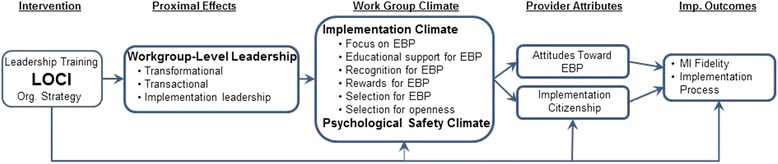
BACKGROUND: Evidence-based practice (EBP) implementation represents a strategic change in organizations that requires effective leadership and alignment of leadership and organizational support across organizational levels. As such, there is a need for combining leadership development with organizational strategies to support organizational climate conducive to EBP implementation. The leadership and organizational change for implementation (LOCI) intervention includes leadership training for workgroup leaders, ongoing implementation leadership coaching, 360° assessment, and strategic planning with top and middle management regarding how they can support workgroup leaders in developing a positive EBP implementation climate. METHODS: This test of the LOCI intervention will take place in conjunction with the implementation of motivational interviewing (MI) in 60 substance use disorder treatment programs in California, USA. Participants will include agency executives, 60 program leaders, and approximately 360 treatment staff. LOCI will be tested using a multiple cohort, cluster randomized trial that randomizes workgroups (i.e., programs) within agency to either LOCI or a webinar leadership training control condition in three consecutive cohorts. The LOCI intervention is 12 months, and the webinar control intervention takes place in months 1, 5, and 8, for each cohort. Web-based surveys of staff and supervisors will be used to collect data on leadership, implementation climate, provider attitudes, and citizenship. Audio recordings of counseling sessions will be coded for MI fidelity. The unit of analysis will be the workgroup, randomized by site within agency and with care taken that co-located workgroups are assigned to the same condition to avoid contamination. Hierarchical linear modeling (HLM) will be used to analyze the data to account for the nested data structure. DISCUSSION: LOCI has been developed to be a feasible and effective approach for organizations to create a positive climate and fertile context for EBP implementation. The approach seeks to cultivate and sustain both effective general and implementation leadership as well as organizational strategies and support that will remain after the study has ended. Development of a positive implementation climate for MI should result in more positive service provider attitudes and behaviors related to the use of MI and, ultimately, higher fidelity in the use of MI. TRIAL REGISTRATION: This study is registered with Clinicaltrials.gov ( NCT03042832 ), 2 February 2017, retrospectively registered.
Overview
The claims and statistics of this paper haven’t been checked yet.
Run the check — free, no account needed. It reads the open-access text and checks the sources it cites.
Integrity signals
Registry
Cites
Statistics
Figures
Verification
Claims the paper makes
The claims and statistics of this paper haven’t been checked yet.
Run the check — free, no account needed. It reads the open-access text and checks the sources it cites.
Claims other papers make about this one
Each is checked against this paper’s own text: does it say what the citing paper says it does?
The source backs part of the claim, not all of it — or backs it for a different population, condition or comparison.
In the citing paper
“Rigorous assessment of implementation leadership is critical to inform implementation research and practice in this domain as recent studies have shown that implementation leadership is a malleable organizational characteristic [28].”
From Leading the charge in the education sector: development and validation of the School Implementation Leadership Scale (SILS) (2022) · cites this paper as [28]
Experimental — accuracy not yet measuredThe cited source says what the claim attributes to it.
In the citing paper
“Existing leadership-focused implementation strategies, such as Leadership and Organizational Change for Implementation (LOCI) [28] or iLead [93] also likely have utility for promoting implementation leadership behaviors among principals and other school building-level leaders.”
From Leading the charge in the education sector: development and validation of the School Implementation Leadership Scale (SILS) (2022) · cites this paper as [28]
In the citing paper
“In addition, to the developed implementation model and implementation strategy, EPIS was used to code qualitative data and select quantitative survey measures.”
From Ten recommendations for using implementation frameworks in research and practice (2020) · cites this paper as [55]
In the citing paper
“The Leadership and Organizational Change for Implementation (LOCI) intervention employed the EPIS framework to select key implementation determinants to test in a large cluster RCT [55].”
From Ten recommendations for using implementation frameworks in research and practice (2020) · cites this paper as [55]
In the citing paper
“In this study, implementation leadership from first-level team leaders/managers, organizational climate and culture, implementation climate, and psychological safety climate were selected as determinants to test their influence on the fidelity of the EBP being implemented.”
From Ten recommendations for using implementation frameworks in research and practice (2020) · cites this paper as [55]
Self-check
Percentages, sums and reported differences re-computed from the paper’s own numbers.
The self-check needs the paper’s full text.
Citations
Cites
Hierarchical Linear Models: Applications and Data Analysis Methods.
Longford, N. T., Bryk, A. S., & Raudenbush, S. W. (1993) · Contemporary Sociology A Journal of Reviews · doi:10.2307/2075823 · Cited by 18,773
Organizational culture and leadership
(1993) · Long Range Planning · doi:10.1016/0024-6301(93)90120-5 · Cited by 16,530
Damschroder, L. J., Aron, D. C., Keith, R. E., Kirsh, S. R., Alexander, J. A., & Lowery, J. C. (2009) · Implementation Science · doi:10.1186/1748-5908-4-50 · Cited by 14,496
Psychological Safety and Learning Behavior in Work Teams
Edmondson, A. (1999) · Administrative Science Quarterly · doi:10.2307/2666999 · Cited by 12,026
Diffusion of Innovations in Service Organizations: Systematic Review and Recommendations
GREENHALGH, T., ROBERT, G., MACFARLANE, F., BATE, P., & KYRIAKIDOU, O. (2004) · The Milbank Quarterly · doi:10.1111/j.0887-378x.2004.00325.x · Cited by 7,448
Motivational interviewing: preparing people for change.
Miller, W. R., & Rollnick, S. (2002) · Cited by 7,002
Introduction to Statistical Mediation Analysis
MacKinnon, D. P. (2012) · doi:10.4324/9780203809556 · Cited by 5,618
Preacher, K. J., Curran, P. J., & Bauer, D. J. (2006) · Journal of Educational and Behavioral Statistics · doi:10.3102/10769986031004437 · Cited by 5,044
Transformational and Transactional Leadership: A Meta-Analytic Test of Their Relative Validity.
Judge, T. A., & Piccolo, R. F. (2004) · Journal of Applied Psychology · doi:10.1037/0021-9010.89.5.755 · Cited by 4,464
Organizational culture and leadership
Tohidi, H., & Jabbari, M. M. (2012) · Procedia - Social and Behavioral Sciences · doi:10.1016/j.sbspro.2011.12.156 · Cited by 4,328
Research works printed but not linked: 4
- Bass BM, Avolio BJ. The implications of transformational and transactional leadership for individual, team, and organizational development. In: Pasmore W, Woodman RW, editors. Research in organizational change and development. Greenwich: JAI Press; 1990. p. 231–72.
- Rogers EM. Diffusions of innovations. 4th ed. New York: The Free Press; 1995.
- Aarons GA, Ehrhart MG, Horowitz JD. Leadership to facilitate evidence-based practice implementation in healthcare organizations. In: Academy of Management Annual Meeting; Montreal. 2010.
- Balas EA, Boren SA. Managing clinical knowledge for healthcare improvements. In: Bemmel J, McCray AT, editors. Yearbook of medical informatics 2000: patient-centered systems. Stuttgart: Schattauer Verlagsgesellschaft; 2000. p. 65–70.
Cited by
Sorted by citations
Systematic review of the Exploration, Preparation, Implementation, Sustainment (EPIS) framework
Moullin, J. C., Dickson, K. S., Stadnick, N. A., Rabin, B., & Aarons, G. A. (2019) · Implementation Science · doi:10.1186/s13012-018-0842-6 · Cited by 1,223
Self-citationTen recommendations for using implementation frameworks in research and practice
Moullin, J. C., Dickson, K. S., Stadnick, N. A., Albers, B., Nilsen, P., Broder-Fingert, S., Mukasa, B., & Aarons, G. A. (2020) · Implementation Science Communications · doi:10.1186/s43058-020-00023-7 · Cited by 488
Self-citationLyon, A. R., Cook, C. R., Brown, E. C., Locke, J., Davis, C., Ehrhart, M., & Aarons, G. A. (2018) · Implementation Science · doi:10.1186/s13012-017-0705-6 · Cited by 199
Self-citationLyon, A. R., & Bruns, E. J. (2019) · School Mental Health · doi:10.1007/s12310-018-09306-w · Cited by 191
Williams, N. J., Wolk, C. B., Becker‐Haimes, E. M., & Beidas, R. S. (2020) · Implementation Science · doi:10.1186/s13012-020-0970-7 · Cited by 158
“The LOCI intervention [30, 98], which targets implementation leadership and EBP implementation climate through training and coaching for first-level leaders along with consultation with executives, has shown promise in pilot research and is currently under Williams et al.”
BackgroundResultInfluential
Metadata
- Authors
- Aarons, G. A., Ehrhart, M. G., Moullin, J. C., Torres, E. M., & Green, A. E.
- Affiliations
- University of California San Diego (US)
- San Diego State University (US)
- Corresponding author
- Aarons, Gregory A.
- Venue
- Implementation Science
- Published
- 2017-03-03
- Volume
- 12
- Issue
- 1
- Pages
- 29-29
- ISSN
- 1748-5908 (ISSN-L)
- PMC
- PMC5335741
- OpenAlex
- W2592610820
- Cited by
- 159
- References
- 102
- Citations by year
- 2026: 8 · 2025: 17 · 2024: 25 · 2023: 18 · 2022: 19 · 2021: 28 · 2020: 19 · 2019: 15 · 2018: 9 · 2017: 1
- FWCI
- 19.50
- Type
- journal article
- Language
- en
- Open access
- gold
- doi.org
- Locations
- Implementation Science (publishedVersion, cc-by)
- PubMed Central (publishedVersion, cc-by)
- PubMed (publishedVersion)
- eScholarship (California Digital Library) (submittedVersion)
- eScholarship (California Digital Library) (submittedVersion, cc-by)
- eSpace (Curtin University) (submittedVersion, cc-by)
- Funders
- National Institute on Drug Abuse (R01DA038466)
- Topics
- Health Sciences › Health Professions › General Health Professions › Health Policy Implementation Science
- Social Sciences › Business, Management and Accounting › Organizational Behavior and Human Resource Management › Organizational Change and Leadership
- Health Sciences › Medicine › Epidemiology › Substance Abuse Treatment and Outcomes
- Keywords
- implementation leadership, organizational change, evidence-based practice implementation, addiction treatment, motivational interviewing, leadership coaching, 360-degree assessment, implementation climate, organizational climate, employee attitudes, organizational support
- MeSH terms
- Attitude of Health Personnel, Diffusion of Innovation, Female, Health Personnel, Humans, Inservice Training, Leadership, Male, Motivation, Organizational Innovation, Substance-Related Disorders, Evidence-Based Practice
About these checks
Registry, retraction, Cites and statistics results are computed, not judged, with one exception: a printed reference that no index lists is read once by a model before it counts as a citation error. Claims are extracted by a model and kept only when their quote appears verbatim in the text; each cited source is then checked, with a model’s help, for whether it says what the claim relies on. Those verdicts can be wrong — read the claim’s quote and the cited source before relying on one.
Statistics and arithmetic are recomputed, not judged.
Confidence bands are shown only for fields calibrated on our annotated test set. None is calibrated yet, so no band is shown.
What counts as a claim ›How we measure confidence ›How we check this ›
Are you an author, or do you see a problem with this page? Request a review
