

The DOI matches its Crossref record; 101 of the 102 references it cites were found in a registry or an index.
Testing the leadership and organizational change for implementation (LOCI) intervention in substance abuse treatment: a cluster randomized trial study protocol
Open accessAbstract
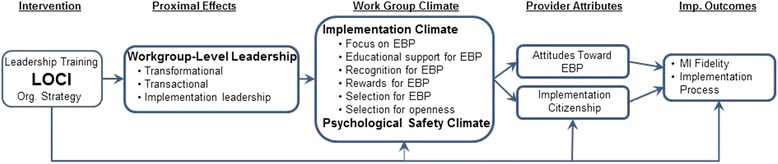
BACKGROUND: Evidence-based practice (EBP) implementation represents a strategic change in organizations that requires effective leadership and alignment of leadership and organizational support across organizational levels. As such, there is a need for combining leadership development with organizational strategies to support organizational climate conducive to EBP implementation. The leadership and organizational change for implementation (LOCI) intervention includes leadership training for workgroup leaders, ongoing implementation leadership coaching, 360° assessment, and strategic planning with top and middle management regarding how they can support workgroup leaders in developing a positive EBP implementation climate. METHODS: This test of the LOCI intervention will take place in conjunction with the implementation of motivational interviewing (MI) in 60 substance use disorder treatment programs in California, USA. Participants will include agency executives, 60 program leaders, and approximately 360 treatment staff. LOCI will be tested using a multiple cohort, cluster randomized trial that randomizes workgroups (i.e., programs) within agency to either LOCI or a webinar leadership training control condition in three consecutive cohorts. The LOCI intervention is 12 months, and the webinar control intervention takes place in months 1, 5, and 8, for each cohort. Web-based surveys of staff and supervisors will be used to collect data on leadership, implementation climate, provider attitudes, and citizenship. Audio recordings of counseling sessions will be coded for MI fidelity. The unit of analysis will be the workgroup, randomized by site within agency and with care taken that co-located workgroups are assigned to the same condition to avoid contamination. Hierarchical linear modeling (HLM) will be used to analyze the data to account for the nested data structure. DISCUSSION: LOCI has been developed to be a feasible and effective approach for organizations to create a positive climate and fertile context for EBP implementation. The approach seeks to cultivate and sustain both effective general and implementation leadership as well as organizational strategies and support that will remain after the study has ended. Development of a positive implementation climate for MI should result in more positive service provider attitudes and behaviors related to the use of MI and, ultimately, higher fidelity in the use of MI. TRIAL REGISTRATION: This study is registered with Clinicaltrials.gov ( NCT03042832 ), 2 February 2017, retrospectively registered.
Overview
The claims and statistics of this paper haven’t been checked yet.
Run the check — free, no account needed. It reads the open-access text and checks the sources it cites.
Integrity signals
Registry
Cites
Statistics
Figures
Verification
Claims the paper makes
The claims and statistics of this paper haven’t been checked yet.
Run the check — free, no account needed. It reads the open-access text and checks the sources it cites.
Claims other papers make about this one
Each is checked against this paper’s own text: does it say what the citing paper says it does?
The source backs part of the claim, not all of it — or backs it for a different population, condition or comparison.
In the citing paper
“Rigorous assessment of implementation leadership is critical to inform implementation research and practice in this domain as recent studies have shown that implementation leadership is a malleable organizational characteristic [28].”
From Leading the charge in the education sector: development and validation of the School Implementation Leadership Scale (SILS) (2022) · cites this paper as [28]
Experimental — accuracy not yet measuredThe cited source says what the claim attributes to it.
In the citing paper
“Existing leadership-focused implementation strategies, such as Leadership and Organizational Change for Implementation (LOCI) [28] or iLead [93] also likely have utility for promoting implementation leadership behaviors among principals and other school building-level leaders.”
From Leading the charge in the education sector: development and validation of the School Implementation Leadership Scale (SILS) (2022) · cites this paper as [28]
In the citing paper
“In addition, to the developed implementation model and implementation strategy, EPIS was used to code qualitative data and select quantitative survey measures.”
From Ten recommendations for using implementation frameworks in research and practice (2020) · cites this paper as [55]
In the citing paper
“The Leadership and Organizational Change for Implementation (LOCI) intervention employed the EPIS framework to select key implementation determinants to test in a large cluster RCT [55].”
From Ten recommendations for using implementation frameworks in research and practice (2020) · cites this paper as [55]
In the citing paper
“In this study, implementation leadership from first-level team leaders/managers, organizational climate and culture, implementation climate, and psychological safety climate were selected as determinants to test their influence on the fidelity of the EBP being implemented.”
From Ten recommendations for using implementation frameworks in research and practice (2020) · cites this paper as [55]
Self-check
Percentages, sums and reported differences re-computed from the paper’s own numbers.
The self-check needs the paper’s full text.
Citations
Cites
Hierarchical Linear Models: Applications and Data Analysis Methods.
Longford, N. T., Bryk, A. S., & Raudenbush, S. W. (1993) · Contemporary Sociology A Journal of Reviews · doi:10.2307/2075823 · Cited by 18,773
Organizational culture and leadership
(1993) · Long Range Planning · doi:10.1016/0024-6301(93)90120-5 · Cited by 16,530
Damschroder, L. J., Aron, D. C., Keith, R. E., Kirsh, S. R., Alexander, J. A., & Lowery, J. C. (2009) · Implementation Science · doi:10.1186/1748-5908-4-50 · Cited by 14,496
Psychological Safety and Learning Behavior in Work Teams
Edmondson, A. (1999) · Administrative Science Quarterly · doi:10.2307/2666999 · Cited by 12,026
Diffusion of Innovations in Service Organizations: Systematic Review and Recommendations
GREENHALGH, T., ROBERT, G., MACFARLANE, F., BATE, P., & KYRIAKIDOU, O. (2004) · The Milbank Quarterly · doi:10.1111/j.0887-378x.2004.00325.x · Cited by 7,448
Motivational interviewing: preparing people for change.
Miller, W. R., & Rollnick, S. (2002) · Cited by 7,002
Introduction to Statistical Mediation Analysis
MacKinnon, D. P. (2012) · doi:10.4324/9780203809556 · Cited by 5,618
Preacher, K. J., Curran, P. J., & Bauer, D. J. (2006) · Journal of Educational and Behavioral Statistics · doi:10.3102/10769986031004437 · Cited by 5,044
Transformational and Transactional Leadership: A Meta-Analytic Test of Their Relative Validity.
Judge, T. A., & Piccolo, R. F. (2004) · Journal of Applied Psychology · doi:10.1037/0021-9010.89.5.755 · Cited by 4,464
Organizational culture and leadership
Tohidi, H., & Jabbari, M. M. (2012) · Procedia - Social and Behavioral Sciences · doi:10.1016/j.sbspro.2011.12.156 · Cited by 4,328
Research works printed but not linked: 4
- Bass BM, Avolio BJ. The implications of transformational and transactional leadership for individual, team, and organizational development. In: Pasmore W, Woodman RW, editors. Research in organizational change and development. Greenwich: JAI Press; 1990. p. 231–72.
- Rogers EM. Diffusions of innovations. 4th ed. New York: The Free Press; 1995.
- Aarons GA, Ehrhart MG, Horowitz JD. Leadership to facilitate evidence-based practice implementation in healthcare organizations. In: Academy of Management Annual Meeting; Montreal. 2010.
- Balas EA, Boren SA. Managing clinical knowledge for healthcare improvements. In: Bemmel J, McCray AT, editors. Yearbook of medical informatics 2000: patient-centered systems. Stuttgart: Schattauer Verlagsgesellschaft; 2000. p. 65–70.
Cited by
Sorted by citations
Systematic review of the Exploration, Preparation, Implementation, Sustainment (EPIS) framework
Moullin, J. C., Dickson, K. S., Stadnick, N. A., Rabin, B., & Aarons, G. A. (2019) · Implementation Science · doi:10.1186/s13012-018-0842-6 · Cited by 1,223
Self-citationTen recommendations for using implementation frameworks in research and practice
Moullin, J. C., Dickson, K. S., Stadnick, N. A., Albers, B., Nilsen, P., Broder-Fingert, S., Mukasa, B., & Aarons, G. A. (2020) · Implementation Science Communications · doi:10.1186/s43058-020-00023-7 · Cited by 488
Self-citationLyon, A. R., Cook, C. R., Brown, E. C., Locke, J., Davis, C., Ehrhart, M., & Aarons, G. A. (2018) · Implementation Science · doi:10.1186/s13012-017-0705-6 · Cited by 199
Self-citationLyon, A. R., & Bruns, E. J. (2019) · School Mental Health · doi:10.1007/s12310-018-09306-w · Cited by 191
Williams, N. J., Wolk, C. B., Becker‐Haimes, E. M., & Beidas, R. S. (2020) · Implementation Science · doi:10.1186/s13012-020-0970-7 · Cited by 158
“The LOCI intervention [30, 98], which targets implementation leadership and EBP implementation climate through training and coaching for first-level leaders along with consultation with executives, has shown promise in pilot research and is currently under Williams et al.”
BackgroundResultInfluentialLewis, C. C., Klasnja, P., Lyon, A. R., Powell, B. J., Lengnick‐Hall, R., Buchanan, G. J. R., Meza, R. D., Chan, M. C., Boynton, M. H., & Weiner, B. J. (2022) · Implementation Science Communications · doi:10.1186/s43058-022-00358-3 · Cited by 139
Locke, J. J., Lawson, G. M., Beidas, R. S., Aarons, G. A., Xie, M., Lyon, A. R., Stahmer, A. C., Seidman, M., Frederick, L., Oh, C., et al. (2019) · Implementation Science · doi:10.1186/s13012-019-0877-3 · Cited by 141
Self-citationLengnick‐Hall, R., Stadnick, N. A., Dickson, K. S., Moullin, J. C., & Aarons, G. A. (2021) · Implementation Science · doi:10.1186/s13012-021-01099-y · Cited by 121
Self-citationDesigning the Future of Children’s Mental Health Services
Lyon, A. R., Dopp, A. R., Brewer, S. K., Kientz, J. A., & Munson, S. A. (2020) · Administration and Policy in Mental Health and Mental Health Services Research · doi:10.1007/s10488-020-01038-x · Cited by 120
Moullin, J. C., Sklar, M., Ehrhart, M. G., Green, A., & Aarons, G. A. (2021) · Implementation Science · doi:10.1186/s13012-021-01152-w · Cited by 82
Self-citationMeza, R. D., Triplett, N. S., Woodard, G. S., Martin, P., Khairuzzaman, A. N., Jamora, G., & Dorsey, S. (2021) · Implementation Science · doi:10.1186/s13012-021-01104-4 · Cited by 76
“Aarons et al. 2017 [45] IL OC N/a Obs MH NI OrgCli of involvement and performance feedback were highest when leaders rated their IL low and providers rated leaders’ IL high.”
BackgroundStirman, S. W., & Beidas, R. S. (2020) · American Psychologist · doi:10.1037/amp0000774 · Cited by 67
“Its typical focus benefits from understanding behavior change, and implementation researchers have applied core findings from psychological science to our understanding of motivation, leadership, and attitudes (Aarons et al., 2009, 2010, 2017; Fishman et al., 2018).”
BackgroundEgeland, K. M., Skar, A. S., Endsjø, M., Laukvik, E. H., Bækkelund, H., Babaii, A., Granly, L., Husebø, G. K., Borge, R. H., Ehrhart, M. G., et al. (2019) · Implementation Science · doi:10.1186/s13012-019-0873-7 · Cited by 55
“, clinic) general leadership and implementation leadership combined with the development, adaptation, and use of organizational strategies to create a positive strategic organizational climate to support EBP implementation and sustainment [6].”
BackgroundMethodInfluentialSelf-citationMoullin, J. C., Ehrhart, M. G., & Aarons, G. A. (2018) · Implementation Science · doi:10.1186/s13012-018-0782-1 · Cited by 50
Self-citationChapman, A., Buccheri, A., Mohotti, D., Shee, A. W., Huggins, C. E., Alston, L. V., Hutchinson, A. M., Yoong, S. L., Beks, H., Namara, K. M., et al. (2025) · BMC Health Services Research · doi:10.1186/s12913-025-12480-8 · Cited by 58
“Regional and rural healthcare services should focus on fostering strong leadership and building internal capacity to drive implementation efforts and ensure that healthcare staff are adequately supported throughout the implementation process [80].”
Suhrheinrich, J., Melgarejo, M., Root, B. V., Aarons, G. A., & Brookman-Frazee, L. I. (2021) · Autism · doi:10.1177/13623613211016729 · Cited by 56
“The LOCI intervention has been used to train leadership in healthcare organizations to create a climate that supports the use of EBPs in healthcare agencies and to improve implementation outcomes (Aarons et al., 2015, 2017).”
MethodSelf-citationCollective leadership to improve professional practice, healthcare outcomes and staff well-being
da Silva, J. A. M., Mininel, V. A., Agreli, H. L. F., Peduzzi, M., Harrison, R., & Xyrichis, A. (2022) · Cochrane Database of Systematic Reviews · doi:10.1002/14651858.cd013850.pub2 · Cited by 53
Skar, A. S., Braathu, N., Peters, N., Bækkelund, H., Endsjø, M., Babaii, A., Borge, R. H., Wentzel‐Larsen, T., Ehrhart, M. G., Sklar, M., et al. (2022) · BMC Health Services Research · doi:10.1186/s12913-022-07539-9 · Cited by 55
Self-citationLyon, A. R., Connors, E. H., Lawson, G. M., Nadeem, E., & Owens, J. S. (2024) · School Mental Health · doi:10.1007/s12310-024-09731-0 · Cited by 53
“…Leadership and Organizational Change for Implementation (LOCI)—a complex implementation strategy to support implementation leadership and climate, developed in mental health and substance use treatment settings (Aarons et al., 2015, 2017)—for elementary school principals (Collins et al., 2024).”
Proctor, E. K., Ramsey, A. T., Brown, M. T., Malone, S. M., Hooley, C., & McKay, V. (2019) · Implementation Science · doi:10.1186/s13012-019-0906-2 · Cited by 51
“Prior research has highlighted two types of programs in particular—substance use disorder treatment programs delivering motivational interviewing and mental health clinics delivering interventions for post-traumatic stress disorder—in which evidence-based programs require effective leadership for implementation [7, 8].”
BackgroundImplementation leadership: A concept analysis
Castiglione, S. A. (2019) · Journal of Nursing Management · doi:10.1111/jonm.12899 · Cited by 46
Beidas, R. S., Ahmedani, B. K., Linn, K. A., Marcus, S. C., Johnson, C., Maye, M. P., Westphal, J. A., Wright, L., Beck, A. L., Buttenheim, A. M., et al. (2021) · Implementation Science · doi:10.1186/s13012-021-01154-8 · Cited by 39
Comparative case studies in integrated care implementation from across the globe: a quest for action
Stadnick, N. A., Sadler, E., Sandall, J., Turienzo, C. F., Bennett, I. M., Borkan, J., Oladeji, B. D., Gureje, O., Aarons, G. A., & Sklar, M. (2019) · BMC Health Services Research · doi:10.1186/s12913-019-4661-5 · Cited by 38
“strengthen alignment across levels of leadership to support integrated care initiatives [66].”
BackgroundSelf-citationLyon, A. R., Corbin, C. M., Brown, E. C., Ehrhart, M. G., Locke, J., Davis, C., Picozzi, E., Aarons, G. A., & Cook, C. R. (2022) · Implementation Science · doi:10.1186/s13012-022-01222-7 · Cited by 41
Self-citationShuman, C. J., Ehrhart, M. G., Torres, E. M., Veliz, P., Kath, L. M., VanAntwerp, K., Banaszak‐Holl, J., Titler, M. G., & Aarons, G. A. (2020) · Worldviews on Evidence-Based Nursing · doi:10.1111/wvn.12402 · Cited by 46
Self-citationNie, J., Shao, H., Fan, Y., Shao, Q., You, H., Preindl, M., & Jiang, X. (2025) · ACM Transactions on Computing for Healthcare · doi:10.1145/3712299 · Cited by 73
“MI is an evidence-based practice for substance use disorders and other addiction issues [6, 12].”
The Role of Leadership in Organizational Implementation and Sustainment in Service Agencies
Moullin, J. C., Ehrhart, M. G., & Aarons, G. A. (2017) · Research on Social Work Practice · doi:10.1177/1049731517718361 · Cited by 44
Self-citationSarkies, M., Robinson, S., Ludwick, T., Braithwaite, J., Nilsén, P., Aarons, G. A., Weiner, B. J., & Moullin, J. C. (2021) · Journal of Health Organization and Management · doi:10.1108/jhom-02-2021-0056 · Cited by 34
Self-citationIdentifying strategies to promote team science in dissemination and implementation research
Aarons, G. A., Reeder, K., Miller, C. J., & Stadnick, N. A. (2019) · Journal of Clinical and Translational Science · doi:10.1017/cts.2019.413 · Cited by 37
“For example, the Leadership and Organizational Change for Implementation intervention, 56 while designed to create a climate for implementation of evidence-based practices, could be adapted to create a climate for team science in academic settings and in community academic partnerships.”
BackgroundSelf-citationSklar, M., Reeder, K., Carandang, K. M., Ehrhart, M. G., & Aarons, G. A. (2021) · Implementation Science Communications · doi:10.1186/s43058-021-00123-y · Cited by 33
“Method Participants and setting Data were collected as part of an ongoing service contract between the UC San Diego and the statewide behavioral health services system in one Midwest state to engage the state and their CMHCs in the Leadership and Organizational Change for Implementation strategy [8, 9].”
MethodSelf-citationWilliams, N. J., Ehrhart, M. G., Aarons, G. A., Esp, S. M., Sklar, M., Carandang, K. M., Vega, N. R., Brookman-Frazee, L. I., & Marcus, S. C. (2024) · Implementation Science · doi:10.1186/s13012-024-01356-w · Cited by 39
Self-citationStadnick, N. A., Meza, R. D., Suhrheinrich, J., Aarons, G. A., Brookman-Frazee, L. I., Lyon, A. R., Mandell, D. S., & Locke, J. J. (2019) · Autism · doi:10.1177/1362361319834398 · Cited by 37
Self-citationBunger, A. C., & Lengnick‐Hall, R. (2019) · Human Services Organizations Management Leadership & Governance · doi:10.1080/23303131.2019.1666765 · Cited by 32
Worum, H., Lillekroken, D., Ahlsen, B., Roaldsen, K. S., & Bergland, A. (2020) · BMC Health Services Research · doi:10.1186/s12913-020-05853-8 · Cited by 30
Leader–member exchange and organizational climate effects on clinician turnover intentions
Aarons, G. A., Conover, K. L., Ehrhart, M. G., Torres, E. M., & Reeder, K. (2020) · Journal of Health Organization and Management · doi:10.1108/jhom-10-2019-0311 · Cited by 37
Self-citationWilliams, N. J., Becker‐Haimes, E. M., Schriger, S. H., & Beidas, R. S. (2022) · Implementation Science Communications · doi:10.1186/s43058-022-00309-y · Cited by 33
Fenwick, K. M., Brimhall, K. C., Hurlburt, M. S., & Aarons, G. A. (2018) · Psychiatric Services · doi:10.1176/appi.ps.201800164 · Cited by 28
“Since ongoing supervisory monitoring and feedback are critical for implementation of EBPs and high quality clinical practice, fostering an environment that encourages openness to feedback is essential (3,10).”
BackgroundMethodInfluentialSelf-citationGrazioli, V. S., Moullin, J. C., Kasztura, M., Allen, M. C., Hügli, O., Griffin, J., Vu, F., Hudon, C., Jackson, Y., Wolff, H. J., et al. (2019) · BMC Health Services Research · doi:10.1186/s12913-018-3852-9 · Cited by 27
Self-citationValidation of the Implementation Climate Scale in Nursing
Ehrhart, M. G., Shuman, C. J., Torres, E. M., Kath, L. M., Prentiss, A. S., Butler, E., & Aarons, G. A. (2021) · Worldviews on Evidence-Based Nursing · doi:10.1111/wvn.12500 · Cited by 25
Self-citationHu, S., Liu, S., Xian-feng, L., Zhao, J., Chen, J., Chen, W., & Hu, J. (2024) · International Nursing Review · doi:10.1111/inr.13054 · Cited by 31
“Moreover, the head nurse’s implementation leadership mutually influences organizational EBP culture (Aarons et al., 2017).”
Hu, J., Gifford, W., Ruan, H., Harrison, D. M., Li, Q., Ehrhart, M. G., & Aarons, G. A. (2019) · Journal of Nursing Management · doi:10.1111/jonm.12768 · Cited by 24
Self-citationLui, J. H. L., Brookman-Frazee, L. I., Lind, T., Le, K., Roesch, S. C., Aarons, G. A., Innes-Gomberg, D., Pesanti, K., & Lau, A. S. (2021) · Implementation Science · doi:10.1186/s13012-021-01149-5 · Cited by 22
Self-citationTriplett, N. S., Munson, S., Mbwayo, A., Mutavi, T., Weiner, B. J., Collins, P., Amanya, C., & Dorsey, S. (2021) · Implementation Science Communications · doi:10.1186/s43058-020-00102-9 · Cited by 30
Szota, K., Thielemann, J. F. B., Christiansen, H., Rye, M., Aarons, G. A., & Barke, A. (2021) · Health Research Policy and Systems · doi:10.1186/s12961-021-00736-8 · Cited by 24
Self-citationAarons, G. A., Sklar, M., Ehrhart, M. G., Roesch, S., Moullin, J. C., & Carandang, K. M. (2024) · Journal of Substance Use and Addiction Treatment · doi:10.1016/j.josat.2024.209437 · Cited by 26
Self-citationOrganization-level variation in therapists’ attitudes toward and use of measurement-based care
Williams, N. J., Vega, N. R., Esp, S. M., Watts, A., & Marcus, S. C. (2022) · Administration and Policy in Mental Health and Mental Health Services Research · doi:10.1007/s10488-022-01206-1 · Cited by 21
“Clinical trials are also underway testing strategies that help leaders and organizations develop climates that support the effective implementation of evidence-based practices (Aarons et al., 2017).”
BackgroundRequired sample size to detect mediation in 3-level implementation studies
Williams, N. J., Preacher, K. J., Allison, P. D., Mandell, D. S., & Marcus, S. C. (2022) · Implementation Science · doi:10.1186/s13012-022-01235-2 · Cited by 23
“Similar to a protocol by Aarons et al. [39], in this example, an organization-level implementation strategy ( X ) at level 3, is designed to influence a patient-level implementation outcome at level 1 ( Y ) through its effects on a level 2 clinician mediator ( M ).”
BackgroundMethodPullmann, M. D., Lucid, L., Harrison, J. P., Martin, P., Deblinger, E., Benjamin, K. S., & Dorsey, S. (2018) · Frontiers in Public Health · doi:10.3389/fpubh.2018.00280 · Cited by 20
“, (67)], and more studies are needed to further unpack the relationship between supervision and implementation climate.”
BackgroundWhy Motivational Interviewing Is a Person-Centered Approach
Miller, W. R., & Rollnick, S. (2024) · SUCHT - Zeitschrift für Wissenschaft und Praxis / Journal of Addiction Research and Practice · doi:10.1024/0939-5911/a000862 · Cited by 21
Lyon, A. R., Stanick, C., & Pullmann, M. D. (2018) · Clinical Psychology Science and Practice · doi:10.1111/cpsp.12265 · Cited by 20
Frazier, S. L., Rusch, D. B., Coxe, S. J., Stout, T. J., Helseth, S. A., Dirks, M. A., Bustamante, E. E., Atkins, M. S., Glisson, C. A., Green, P. D., et al. (2020) · Journal of Clinical Child & Adolescent Psychology · doi:10.1080/15374416.2019.1683849 · Cited by 22
“…documenting associations among social context, service quality and client outcomes, several organizational intervention models have emerged (e.g., Aarons et al., 2017; Glisson & Schoenwald, 2005) to target service provider, organization, and community level variables that influence service…”
BackgroundImplementation readiness for evidence-based autism practices in school systems
Stahmer, A. C., Suhrheinrich, J., Yu, Y., Melgarejo, M., Schetter, P. L., & Young, G. (2023) · Implementation Research and Practice · doi:10.1177/26334895231199465 · Cited by 18
Validating the Implementation Leadership Scale in Chinese nursing context: A cross‐sectional study
Hu, J., Gifford, W., Ruan, H., Harrison, D. M., Li, Q., Ehrhart, M. G., Harrison, M., Barrowman, N., & Aarons, G. A. (2021) · Nursing Open · doi:10.1002/nop2.888 · Cited by 16
“Leadership development interventions have also been developed and studied to strengthen the implementation leadership of nurses and other healthcare providers (Aarons et al., 2017; Gifford et al., 2019; Richter et al., 2016; Välimäki et al., 2018).”
BackgroundSelf-citationSayer, N. A., Bernardy, N. C., Yoder, M. S., Hamblen, J. L., Rosen, C. S., Ackland, P. E., Kehle‐Forbes, S., Clothier, B. A., Schnurr, P. P., Orazem, R. J., et al. (2020) · Administration and Policy in Mental Health and Mental Health Services Research · doi:10.1007/s10488-020-01086-3 · Cited by 18
Egeland, K. M., Borge, R. H., Peters, N., Bækkelund, H., Braathu, N., Sklar, M., Aarons, G. A., & Skar, A. S. (2023) · Implementation Science Communications · doi:10.1186/s43058-023-00459-7 · Cited by 21
Self-citationNaar, S., Chapman, J. E., Cunningham, P. B., Ellis, D. A., MacDonell, K. K., & Todd, L. (2021) · Health Psychology · doi:10.1037/hea0001064 · Cited by 16
Locke, J. J., Corbin, C. M., Collins, V. K., Ehrhart, M. G., Goosey, R., Hatch, K., Espeland, C., Cook, C. R., & Lyon, A. R. (2024) · Implementation Research and Practice · doi:10.1177/26334895241242523 · Cited by 19
“LOCI also has recently been used in mental health and school programs to support therapists and teachers to deliver EBPs for autistic youth (Brookman-Frazee & Stahmer, 2018); however, LOCI was not systematically adapted or iteratively redesigned for use in schools, which is a unique implementation context.”
BackgroundMethodInfluentialSelf-citationEn Route to Implementation Science 3.0
Albers, B., Shlonsky, A., & Mildon, R. L. (2020) · Springer eBooks · doi:10.1007/978-3-030-03874-8_1 · Cited by 18
Peters, N., Borge, R. H., Skar, A. S., & Egeland, K. M. (2022) · BMC Health Services Research · doi:10.1186/s12913-021-07441-w · Cited by 14
“Testing the leadership and organizational change for implementation (LOCI) inter‑ vention in substance abuse treatment: a cluster randomized trial study protocol.”
BackgroundMethodInfluentialSzefler, S. J., Cicutto, L. C., Brewer, S. E., Gleason, M. C., McFarlane, A. E., DeCamp, L. R., Brinton, J. T., & Huebschmann, A. G. (2022) · Journal of Allergy and Clinical Immunology · doi:10.1016/j.jaci.2022.04.029 · Cited by 15
Williams, N. J., & Beidas, R. S. (2018) · PLoS ONE · doi:10.1371/journal.pone.0209745 · Cited by 21
Locke, J. J., Hugh, M. L., Pullmann, M. D., Cook, H., Coifman, J., McRee, E., Joshi, M., Lyon, A. R., & Schwartz, I. S. (2021) · International Journal of Educational Research · doi:10.1016/j.ijer.2021.101779 · Cited by 17
Hatch, M. R., Carandang, K. M., Moullin, J. C., Ehrhart, M. G., & Aarons, G. A. (2021) · Implementation Research and Practice · doi:10.1177/26334895211018400 · Cited by 16
“…evaluation, which used a modified nominal group technique (NGT) and interviews, to identify emergent and persistent barriers that impacted the implementation of an EBP during an effectiveness trial of the Leadership and Organizational Change for Implementation (LOCI) strategy (Aarons et al., 2017).”
BackgroundMethodInfluentialSelf-citationZbukvic, I., Rheinberger, D., Rosebrock, H., Lim, J., McGillivray, L., Mok, K., Stamate, E., McGill, K., Shand, F., Torok, M., et al. (2022) · Implementation Research and Practice · doi:10.1177/26334895211065786 · Cited by 16
“, 2006), for example, developing a positive implementation climate whereby managers and team leaders communicate the value of CAMS, conduct regular progress reviews and supervision in using CAMS and establish structures to review fidelity (Aarons et al., 2017).”
BackgroundSelf-citationBorge, R. H., Egeland, K. M., Aarons, G. A., Ehrhart, M. G., Sklar, M., & Skar, A. S. (2022) · Administration and Policy in Mental Health and Mental Health Services Research · doi:10.1007/s10488-022-01199-x · Cited by 17
Self-citationIwelunmor, J., Tucker, J. D., Ezechi, O., Nwaozuru, U., Obiezu‐Umeh, C., Gbaja-Biamila, T. A., Oladele, D. A., Musa, A. Z., & Airhihenbuwa, C. O. (2023) · Current HIV/AIDS Reports · doi:10.1007/s11904-023-00652-2 · Cited by 12
“In alignment with the tenets of DSF, PLAN seeks to continuously engage key stakeholders to not only increase the fit between the intervention and the local context but also to build the buy-in necessary with relevant people, including the effective leadership, alignment of leadership, and organizational support across…”
BackgroundMeasuring change attitudes in health care organizations
Hower, K. I., Pfaff, H., Kowalski, C., Wensing, M., & Ansmann, L. (2019) · Journal of Health Organization and Management · doi:10.1108/jhom-06-2018-0177 · Cited by 12
Doval, R. V., Gastelurrutia, M. Á., Benrimoj, S. I., Zarzuelo-Romero, M. J., García‐Cárdenas, V., Pérez-Escamilla, B., & Martínez‐Martínez, F. (2020) · BMJ Open · doi:10.1136/bmjopen-2019-036669 · Cited by 12
Watson, D. P., Snow‐Hill, N. L., Saldana, L., Walden, A. L., Staton, M. D., Kong, A., & Donenberg, G. R. (2020) · Implementation Research and Practice · doi:10.1177/2633489520974974 · Cited by 14
“…use of the SIC with either CFIR (Albers et al., 2020; Ford et al., 2018; Kairy et al., 2019; Spoelstra et al., 2019) or EPIS (Aalsma et al., 2019; Aarons et al., 2017; Bowser et al., 2019; Dickson et al., 2020; Hartzler et al., 2017; Nadeem et al., 2018; Stadnick et al., 2019; Willging et al.,…”
MethodSklar, M., Reeder, K., Carandang, K. M., Ehrhart, M. G., & Aarons, G. A. (2020) · Research Square · doi:10.21203/rs.3.rs-48767/v1 · Cited by 12
Self-citationWoodard, G. S., Triplett, N. S., Frank, H. E., Harrison, J. P., Robinson, S., & Dorsey, S. (2021) · Implementation Research and Practice · doi:10.1177/26334895211057883 · Cited by 12
“Interventions aimed at enhancing implementation climate specifically are currently being evaluated (e.g., Aarons et al., 2015; Aarons et al., 2017).”
BackgroundSommerfeld, D. H., Granholm, E. L., Holden, J. L., Seijo, C., Rapoport, C. S., Mueser, K. T., Naqvi, J. B., & Aarons, G. A. (2019) · Psychological Services · doi:10.1037/ser0000335 · Cited by 11
Self-citationStadnick, N. A., Aarons, G. A., Blake, L., Brookman-Frazee, L. I., Dourgnon, P., Engell, T., Jusot, F., Lau, A. S., Prieur, C., Skar, A. S., et al. (2020) · BMC Proceedings · doi:10.1186/s12919-020-00184-2 · Cited by 10
Self-citationByeon, Y. V., Lau, A. S., Lind, T., Hamilton, A. B., & Brookman-Frazee, L. I. (2022) · Implementation Research and Practice · doi:10.1177/26334895221110263 · Cited by 13
“Organizational interventions aimed at improving implementation leadership and climate have also implicated organizational-level psychological safety as an essential mechanism to ready organizational contexts for successful EBP implementation (Aarons et al., 2017; Glisson et al., 2010, 2016).”
BackgroundJenssen, B. P., Schnoll, R. A., Beidas, R. S., Bekelman, J. E., Bauer, A., Scott, C. A., Evers‐Casey, S., Nicoloso, J., Gabriel, P. E., Asch, D. A., et al. (2021) · Implementation Science · doi:10.1186/s13012-021-01139-7 · Cited by 9
Strategic change in the health sector: a literature review and future challenges
Pereira, S. A. F., Ferreira, J. J., Rammal, H. G., & Peris‐Ortiz, M. (2023) · Journal of Organizational Change Management · doi:10.1108/jocm-05-2022-0144 · Cited by 9
Byeon, Y. V., Brookman-Frazee, L. I., Aarons, G. A., & Lau, A. S. (2023) · Administration and Policy in Mental Health and Mental Health Services Research · doi:10.1007/s10488-023-01269-8 · Cited by 10
Self-citationSansbury, G. M., Pence, B. W., Zimba, C. C., Yanguela, J., Landrum, K. R., Matewere, M., Mbota, M., Malava, J., Tikhiwa, H. A., Morrison, A. M., et al. (2023) · BMC Health Services Research · doi:10.1186/s12913-023-10344-7 · Cited by 10
Collins, V. K., Corbin, C. M., Locke, J. J., Cook, C. R., Ehrhart, M. G., Hatch, K., & Lyon, A. R. (2024) · School Mental Health · doi:10.1007/s12310-024-09635-z · Cited by 11
“Although multifaceted and multilevel strategies are common (Aarons et al., 2017; Glisson & Schoenwald, 2005; Kilbourne et al., 2007), implementation strategies vary in complexity (Proctor et al., 2013), and many are bulky, expensive, and/or not usable by implementation practitioners or other…”
InfluentialSelf-citationMeza, R. D., Beidas, R. S., Ehrhart, M. G., Mandell, D. S., Dorsey, S., Frederick, L., Oh, C., & Locke, J. J. (2019) · Administration and Policy in Mental Health and Mental Health Services Research · doi:10.1007/s10488-019-00932-3 · Cited by 9
Self-citationImplementation in Residential Youth Care: Providers Perspectives on Effective Leadership Behavior
Vaskinn, L., Mellblom, A. V., Waaler, P. M., Skagseth, O., Bjørkli, C. A., & Kjøbli, J. (2020) · Residential Treatment for Children & Youth · doi:10.1080/0886571x.2020.1774464 · Cited by 11
“The Leadership and Organizational Change for Implementation (LOCI) is a leadership capacity that aims to improve general and implementation leadership (Aarons et al., 2015, 2017).”
BackgroundSticking with Programs That Do Not Work: The Role of Escalation of Commitment in Schools
Barrett, C. A., Sleesman, D. J., Spear, S. E., Clinkscales, A., & Amin, T. (2023) · Prevention Science · doi:10.1007/s11121-023-01510-8 · Cited by 9
Gustafsson, C., & Dannapfel, P. (2024) · Disability and Rehabilitation Assistive Technology · doi:10.1080/17483107.2024.2352130 · Cited by 15
“Theories in the field of organisation suggest that the implementation climate operates as a mechanism between implementation leadership and implementation outcomes [48,49].”
Corbin, C. M., Zhang, Y., Ehrhart, M. G., Locke, J. J., & Lyon, A. R. (2024) · Prevention Science · doi:10.1007/s11121-024-01722-6 · Cited by 9
“A critical next step will be to test whether the multilevel organizational implementation process leads to changes in implementation outcomes like fidelity (Aarons et al., 2017; Williams et al., 2024).”
InfluentialSelf-citationLocke, J. J., Corbin, C. M., Goosey, R., Collins, V. K., Ehrhart, M. G., Hatch, K., Espeland, C., & Lyon, A. R. (2025) · Implementation Research and Practice · doi:10.1177/26334895241312405 · Cited by 8
Self-citationLasecke, M., Baeza‐Hernandez, K., Dosovitsky, G., DeBellis, A., Bettencourt, B., Park, A. L., & Bunge, E. L. (2022) · Journal of Community Psychology · doi:10.1002/jcop.22788 · Cited by 10
“…factors have been shown to influence successful implementation, openness to organizational change, receptivity to the intervention, and intervention sustainment (Lesson Learned #3; Aarons et al., 2015, 2017; Aarons & Sawitzky, 2006; Mendel et al., 2008; Novins et al., 2013; Williams et al., 2019).”
BackgroundThe Role of Organizational Processes in Dissemination and Implementation Research
Aarons, G. A., Ehrhart, M. G., Lengnick‐Hall, R., & Moullin, J. C. (2023) · Oxford University Press eBooks · doi:10.1093/oso/9780197660690.003.0009 · Cited by 7
Self-citationUncovering determinants of perceived feasibility of TF-CBT through coincidence analysis
Johnson, C. M., AlRasheed, R., Gray, C. L., Triplett, N. S., Mbwayo, A., Weinhold, A., Whetten, K., & Dorsey, S. (2024) · Implementation Research and Practice · doi:10.1177/26334895231220277 · Cited by 8
“…to improve implementation leadership and climate, the leadership and organizational change for implementation strategy (LOCI; Aarons et al., 2015; Aarons, Ehrhart, Moullin, et al., 2017; Skar et al., 2022) and the training in implementation practice leadership (TRIPLE; Proctor et al., 2019)…”
BackgroundBorge, R. H., Skar, A. S., Endsjø, M., & Egeland, K. M. (2021) · Implementation Science Communications · doi:10.1186/s43058-021-00240-8 · Cited by 9
Choi, S. Y., Rusch, A., Lane, A., Liebrecht, C., Bilek, E. L., Eisenberg, D., Andrews, C. M., Perry, M., & Smith, S. N. (2023) · Implementation Research and Practice · doi:10.1177/26334895231159429 · Cited by 5
Naar, S., Chapman, J. E., & Aarons, G. A. (2023) · Journal of Substance Use and Addiction Treatment · doi:10.1016/j.josat.2023.209027 · Cited by 5
Self-citationJerome, G. J., Goldsholl, S., Dalcin, A., Gennusa, J. V., Yuan, C. T., Brown, K. L., Fink, T., Minahan, E., Wang, N., Daumit, G. L., et al. (2023) · JMIR Research Protocols · doi:10.2196/45802 · Cited by 5
“Therefore, to enhance curriculum uptake and increase engagement from site leadership [36], we will hold monthly organizational strategy meetings (30-60 minutes each month).”
Partnering with Schools to Adapt a Team Science Intervention: Processes and Challenges
Kuriyan, A. B., Albright, J., Rushworth, S., Duresso, B., Testa, S. M., Eiraldi, R. B., Marshaleck, E. W., & Wolk, C. B. (2024) · School Mental Health · doi:10.1007/s12310-024-09665-7 · Cited by 9
“The CFIR, synthesized from the health services implementation literature, represents “an overarching typology—a list of constructs to promote theory development and verification about what works where and why across multiple contexts” (Damschroder et al., 2009).”
ResultInfluentialAn evaluation of implementation climate in inpatient maternity care: a cross-sectional survey study
Hamm, R. F., Levine, L. D., Quigley, E. A., & Beidas, R. S. (2023) · The Journal of Maternal-Fetal & Neonatal Medicine · doi:10.1080/14767058.2023.2185119 · Cited by 4
“Importantly, others have evaluated effective interventions for improving and sustaining improvement in implementation [23].”
BackgroundSklar, M., Ehrhart, M. G., Ramirez, N., Carandang, K. M., Kuhn, N., Day, A., Aarons, G. A., & Williams, N. J. (2024) · Implementation Research and Practice · doi:10.1177/26334895241236680 · Cited by 10
“…cluster-randomized hybrid type III effectiveness-implementation trial designed to test the effects of the Leadership and Organizational Change for Implementation (LOCI; Aarons et al., 2015, 2017) strategy on youth-level fi delity and clinical outcomes of digital measurement-based care (R01MH119127).”
BackgroundSelf-citationPromoting mental health equality by investing in organizations: lessons from implementation science
Stanhope, V., Choy-Brown, M., Doherty, M. J., Cohen-Serrins, J., Baslock, D. M., & Raghavan, R. (2025) · Journal of Public Mental Health · doi:10.1108/jpmh-09-2024-0113 · Cited by 4
Naar, S., Fernandez, M. I., Todd, L., Green, S. K. S., Henna Budhwani, P., Carcone, A. I., Coyle, K. K., Aarons, G. A., MacDonell, K. K., & Harper, G. W. (2023) · Implementation Research and Practice · doi:10.1177/26334895231164585 · Cited by 4
“…to ensure a deeper understanding of the EBP; train leadership to be knowledgeable about the EBP and promote an autonomy supportive style (Aarons et al., 2017); identification of an MI champion at each level of leadership including middle management (Birken et al., 2018); and increase…”
BackgroundInfluentialSelf-citationNaar, S., Kimball, D., Cain, D. N., Pooler-Burgess, M., Rambo, S., Chapman, J. E., MacDonell, K. K., & Miller, R. L. (2023) · JAIDS Journal of Acquired Immune Deficiency Syndromes · doi:10.1097/qai.0000000000003291 · Cited by 4
“First, there are several leadership strategies emerging in the implementation science literature such as the leadership and organizational change for implementation 27 and the training for implementation practice leadership.”
BackgroundSubstance Use Decision-Making – Are Clinicians Using the Evidence?
Stokes, J. (2018) · Journal of Social Service Research · doi:10.1080/01488376.2018.1479337 · Cited by 7
Bunger, A. C. (2020) · Routledge eBooks · doi:10.4324/9781003041191-4 · Cited by 4
Metadata
- Authors
- Aarons, G. A., Ehrhart, M. G., Moullin, J. C., Torres, E. M., & Green, A. E.
- Affiliations
- University of California San Diego (US)
- San Diego State University (US)
- Corresponding author
- Aarons, Gregory A.
- Venue
- Implementation Science
- Published
- 2017-03-03
- Volume
- 12
- Issue
- 1
- Pages
- 29-29
- ISSN
- 1748-5908 (ISSN-L)
- PMC
- PMC5335741
- OpenAlex
- W2592610820
- Cited by
- 159
- References
- 102
- Citations by year
- 2026: 8 · 2025: 17 · 2024: 25 · 2023: 18 · 2022: 19 · 2021: 28 · 2020: 19 · 2019: 15 · 2018: 9 · 2017: 1
- FWCI
- 19.50
- Type
- journal article
- Language
- en
- Open access
- gold
- doi.org
- Locations
- Implementation Science (publishedVersion, cc-by)
- PubMed Central (publishedVersion, cc-by)
- PubMed (publishedVersion)
- eScholarship (California Digital Library) (submittedVersion)
- eScholarship (California Digital Library) (submittedVersion, cc-by)
- eSpace (Curtin University) (submittedVersion, cc-by)
- Funders
- National Institute on Drug Abuse (R01DA038466)
- Topics
- Health Sciences › Health Professions › General Health Professions › Health Policy Implementation Science
- Social Sciences › Business, Management and Accounting › Organizational Behavior and Human Resource Management › Organizational Change and Leadership
- Health Sciences › Medicine › Epidemiology › Substance Abuse Treatment and Outcomes
- Keywords
- implementation leadership, organizational change, evidence-based practice implementation, addiction treatment, motivational interviewing, leadership coaching, 360-degree assessment, implementation climate, organizational climate, employee attitudes, organizational support
- MeSH terms
- Attitude of Health Personnel, Diffusion of Innovation, Female, Health Personnel, Humans, Inservice Training, Leadership, Male, Motivation, Organizational Innovation, Substance-Related Disorders, Evidence-Based Practice
About these checks
Registry, retraction, Cites and statistics results are computed, not judged, with one exception: a printed reference that no index lists is read once by a model before it counts as a citation error. Claims are extracted by a model and kept only when their quote appears verbatim in the text; each cited source is then checked, with a model’s help, for whether it says what the claim relies on. Those verdicts can be wrong — read the claim’s quote and the cited source before relying on one.
Statistics and arithmetic are recomputed, not judged.
Confidence bands are shown only for fields calibrated on our annotated test set. None is calibrated yet, so no band is shown.
What counts as a claim ›How we measure confidence ›How we check this ›
Are you an author, or do you see a problem with this page? Request a review
