

Psychometric assessment of three newly developed implementation outcome measures
Open accessThe DOI matches its Crossref record; 35 of the 36 references it cites were found in a registry or an index; 7 of the 26 sources its claims cite were checked for support.
Abstract
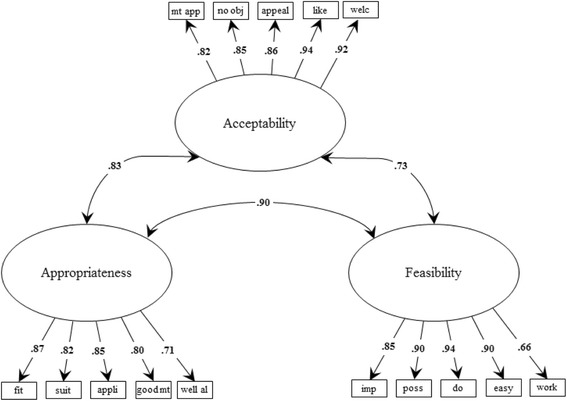
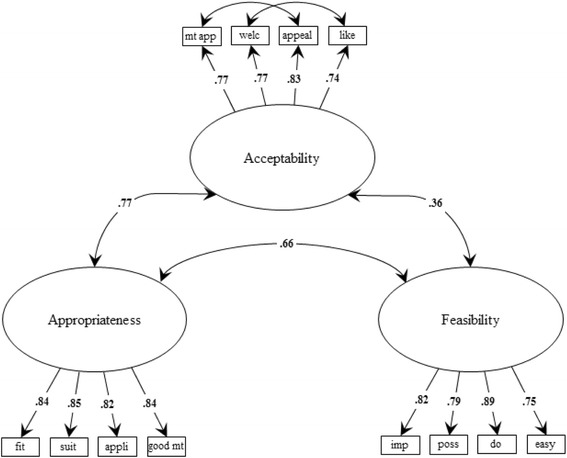
BACKGROUND: Implementation outcome measures are essential for monitoring and evaluating the success of implementation efforts. Yet, currently available measures lack conceptual clarity and have largely unknown reliability and validity. This study developed and psychometrically assessed three new measures: the Acceptability of Intervention Measure (AIM), Intervention Appropriateness Measure (IAM), and Feasibility of Intervention Measure (FIM). METHODS: Thirty-six implementation scientists and 27 mental health professionals assigned 31 items to the constructs and rated their confidence in their assignments. The Wilcoxon one-sample signed rank test was used to assess substantive and discriminant content validity. Exploratory and confirmatory factor analysis (EFA and CFA) and Cronbach alphas were used to assess the validity of the conceptual model. Three hundred twenty-six mental health counselors read one of six randomly assigned vignettes depicting a therapist contemplating adopting an evidence-based practice (EBP). Participants used 15 items to rate the therapist's perceptions of the acceptability, appropriateness, and feasibility of adopting the EBP. CFA and Cronbach alphas were used to refine the scales, assess structural validity, and assess reliability. Analysis of variance (ANOVA) was used to assess known-groups validity. Finally, half of the counselors were randomly assigned to receive the same vignette and the other half the opposite vignette; and all were asked to re-rate acceptability, appropriateness, and feasibility. Pearson correlation coefficients were used to assess test-retest reliability and linear regression to assess sensitivity to change. RESULTS: All but five items exhibited substantive and discriminant content validity. A trimmed CFA with five items per construct exhibited acceptable model fit (CFI = 0.98, RMSEA = 0.08) and high factor loadings (0.79 to 0.94). The alphas for 5-item scales were between 0.87 and 0.89. Scale refinement based on measure-specific CFAs and Cronbach alphas using vignette data produced 4-item scales (α's from 0.85 to 0.91). A three-factor CFA exhibited acceptable fit (CFI = 0.96, RMSEA = 0.08) and high factor loadings (0.75 to 0.89), indicating structural validity. ANOVA showed significant main effects, indicating known-groups validity. Test-retest reliability coefficients ranged from 0.73 to 0.88. Regression analysis indicated each measure was sensitive to change in both directions. CONCLUSIONS: The AIM, IAM, and FIM demonstrate promising psychometric properties. Predictive validity assessment is planned.
Overview
CoChat Summary
## TL;DR
This paper developed and psychometrically tested three new implementation outcome measures: the Acceptability of Intervention Measure (AIM), Intervention Appropriateness Measure (IAM), and Feasibility of Intervention Measure (FIM). Across three studies, the measures showed promising content validity, factor structure, internal consistency, test-retest reliability, and sensitivity to change, though discriminant validity between acceptability and appropriateness remained uncertain.
## Key findings
- In study 1, judges showed high agreement on item assignments: ICC = 0.89 across all 31 items, with construct-specific ICCs of 0.82 for acceptability, 0.94 for appropriateness, and 0.87 for feasibility.
- For content validity, all but five items showed substantive and discriminant content validity; the paper specifically flags items such as “This EBP is good enough,” “This EBP will do,” “This EBP is pretty good,” “This EBP seems right,” and “This EBP seems right on the button” as lacking sufficient discriminant content validity.
- A 3-factor CFA supported the conceptual model: in study 1, fit was CFI = 0.98 and RMSEA = 0.08 with factor loadings from 0.79 to 0.94; in study 2, fit was CFI = 0.96 and RMSEA = 0.08 with factor loadings from 0.75 to 0.89.
- The final short scales were 4-item measures with good reliability: Cronbach alphas were 0.85, 0.91, and 0.89 in study 2 for acceptability, appropriateness, and feasibility, respectively; test-retest coefficients in study 3 were 0.80, 0.73, and 0.88.
- Known-groups validity was supported by ANOVA: the manipulated construct explained 42% of variance for acceptability, 37% for appropriateness, and 42% for feasibility; regression models explained 41%, 42%, and 46% of the variance in change scores, respectively.
## Methods
- The paper reports three studies: study 1 assessed substantive and discriminant content validity with implementation scientists and mental health professionals; study 2 tested structural validity, reliability, and known-groups validity in a vignette experiment; study 3 re-administered the vignette experiment weeks later to assess test-retest reliability and sensitivity to change.
- Study 1 included 36 implementation scientists and 27 mental health professionals who assigned 31 items to constructs and rated confidence; study 2 included 326 mental health counselors who rated 15 items across six randomly assigned vignettes; study 3 followed up with 192 respondents from study 2, with 95 used for test-retest and 97 for sensitivity analyses.
- Analyses included Wilcoxon one-sample signed rank tests, ICCs, EFA, CFA, Cronbach alphas, ANOVA, Pearson correlations corrected for attenuation, and linear regression.
## Limitations
- The paper states that correlations among acceptability, appropriateness, and feasibility were sometimes fairly high, and discriminant validity was not fully tested because of a survey design error.
- The study also states that replication is needed in samples with different backgrounds and characteristics, and with different methods or materials.
- Evident from the text: the vignette design was incomplete because two of the eight possible vignettes were not fielded, which limited the exploration of discriminant validity and interaction effects, especially between acceptability and appropriateness.
Model-written summary. Check it against the paper before relying on it.
Integrity signals
Registry
Cites
Statistics
Figures
Verification
Claims the paper makes
5 Valid · 0 Not valid · 13 Not checked · 88 Own results and interpretations
Every source the paper cites for this claim was checked and supports it.
In the paper
“Despite their importance, existing measures of implementation outcomes have largely unknown psychometric and pragmatic qualities [2].”
§ Psychometric assessment of three newly developed implementation outcome measures > Background
What the sources say
- Supportedcites [2] Lewis CC Fischer S Weiner BJ Stanick C Kim M Martinez RG Outcomes for implementation science: an enhanced systematic review of instruments using evidence-based rating criteria Implement Sci 2015 10 155 10.1186/s13012-015-0342-x 26537706 PMC4634818 source
The Results section 'Evidence-based assessment rating' states directly that 'availability of information on the psychometric and pragmatic properties across all 104 instruments was limited and variable,' with 46% missing data on four or more of six EBA criteria and reliability, structural validity, predictive validity and responsiveness unavailable for 51%, 74%, 82% and 96% of instruments respectively. The Background frames the same point as 'the quality of existing implementation outcome instruments remains unclear and perhaps one of the most critical gaps in the literature,' and the Discussion notes usability — the only pragmatic criterion, rated for all instruments via item count — is 'a crude metric for characterizing the pragmatic properties,' so the paper does not treat that universal coverage as making pragmatic qualities known. The citing sentence's 'despite their importance' also matches the Background's claim that implementation outcomes are 'perhaps the most critical factor in implementation science.' (LLM, conf=0.88)
plain- Asserted: passes — The authors put it forward as true.
- Checkable: passes — It can be checked against evidence.
- Load-bearing: passes — The paper’s conclusions depend on it.
- Based: passes — The paper gives a reason why it holds.
- Supported
The cited sources support only part of this claim — read each source’s verdict below.
In the paper
“few if any have been assessed for other measurement properties that are of key importance to implementation researchers and other implementation stakeholders (e.g., intermediaries, policymakers, practice leaders), such as stability, responsiveness, and predictive validity [2–4].”
§ Psychometric assessment of three newly developed implementation outcome measures > Background
What the sources say
- Partly supportedcites [2] Lewis CC Fischer S Weiner BJ Stanick C Kim M Martinez RG Outcomes for implementation science: an enhanced systematic review of instruments using evidence-based rating criteria Implement Sci 2015 10 155 10.1186/s13012-015-0342-x 26537706 PMC4634818 sourceExperimental — accuracy not yet measured
The Abstract Results and Discussion report that most of the 104 implementation outcome instruments lacked information on responsiveness or predictive validity, supporting that part of the claim. The paper does not report an assessment of stability; its reliability ratings concern internal consistency, so it does not establish the claim about stability. (LLM, conf=0.84)
- Partly supportedcites [3] Martinez RG Lewis CC Weiner BJ Instrumentation issues in implementation science Implement Sci 2014 9 118 10.1186/s13012-014-0118-8 25185799 PMC4164742 sourceExperimental — accuracy not yet measured
The Discussion’s recommendations for validity reporting say there is a dearth of literature on instruments’ predictive validity. Its reliability recommendations discuss test–retest reliability, and its Language section says measures should be sensitive to change, but neither establishes that few, if any, implementation outcome measures have been assessed for stability or responsiveness. No page numbers are available in our copy. (LLM, conf=0.84)
- Partly supportedcites [4] Lewis CC Weiner BJ Stanick C Fischer SM Advancing implementation science through measure development and evaluation: a study protocol Implement Sci 2015 10 102 10.1186/s13012-015-0287-0 26197880 PMC4511441 sourceExperimental — accuracy not yet measured
The Introduction reports that, among 104 implementation outcome measures, 82% lacked information on predictive validity and 96% on responsiveness. It does not establish how many had been assessed for stability; the Methods/design section instead proposes test-retest reliability testing for new measures. The claim is therefore supported for two of the three named properties. (LLM, conf=0.84)
plain- Asserted: passes — The authors put it forward as true.
- Checkable: passes — It can be checked against evidence.
- Load-bearing: passes — The paper’s conclusions depend on it.
- Based: passes — The paper gives a reason why it holds.
- Partly supported
Every source the paper cites for this claim was checked and supports it.
In the paper
“These concerns extend to the measurement of implementation outcomes, as, despite their centrality to understanding the extent to which implementation is successful, valid and reliable measures are lacking [2].”
§ Psychometric assessment of three newly developed implementation outcome measures > Discussion > Contributions to implementation science and practice This study contributes to the literature by developing valid and reliable measures of important implementation outcomes [1]. The field of implementation science has been deemed a Tower of Babel given the lack of conceptual clarity and consistency in its terminology [26], and concerns about the state of measurement in the field have been well documented [3, 27, 28]. These concerns extend to the measurement of implementation outcomes, as, despite their centrality to understanding the extent to which implementation is successful, valid and reliable measures are lacking [2]. This study fills that gap by developing valid and reliable measures of three implementation outcomes that are salient to a wide range of implementation studies as well as a wide range of pilot, efficacy, and effectiveness studies. Indeed, with an increasing focus on designing for dissemination and implementation [29], and some going as far as to say that all effectiveness studies be Hybrid I effectiveness-implementation studies [30, 31], measuring constructs such as acceptability, appropriateness, and feasibility will be a ubiquitous need. These outcomes are relevant to assessing stakeholders’ perceptions of clinical and public health interventions, as well as assessing perceptions of implementation strategies, which are often complex interventions in and of themselves [1, 32, 33]. Assessing these outcomes early in the research process may ensure that interventions and implementation strategies are optimized and fit with end-users’ preferences. In addition to the need for valid and reliable measures of implementation-related constructs, there is a need for pragmatic measures [11]. Implementation stakeholders are unlikely to use measures unless they possess these qualities, which may include broad domains such as being (1) useful in informing decision-making, (2) compatible with the settings in which they are employed, (3) easy to use, and (4) acceptable [34]. Pragmatic measures are particularly important for low-resource settings [35]. There are several examples of recent efforts to develop pragmatic measures for implementation constructs such as organizational readiness for change [36], implementation leadership [37], and implementation climate [38, 39]. We sought to ensure that our measures were pragmatic, and we believe that we have accomplished that in three ways. First, we sought to develop measures that were brief. We began by developing 12 or fewer items for each construct, and our psychometric testing resulted in final measures with only four items per construct. Second, we made each item as general as possible by not specifying a specific context or clinical problem within the items. For example, the appropriateness items did not specify a purpose (e.g., “for treating depression”), person (e.g., “for my patients”), or situation (e.g., “for my organization”); those wishing to use these measures could add such referents to explore specific aspects of appropriateness (i.e., social or technical fit). Third, we purposefully made the measures “open access” to ensure that the scales are freely available to all who might wish to use them. Our hope is that developing a measure that is free, brief, easy to use and not context- or treatment-specific will increase the chances of its use broadly in implementation research and practice. One of the unfortunate realities in implementation science is that, to date, the majority of current measures are developed for the purpose of a single study (usually with minimal conceptual clarity and psychometric testing) and then never used again. This state of affairs precludes our ability to develop generalizable knowledge in implementation science and, more specifically, knowledge about how current measures perform across a wide range of contexts. Of course, whether these measures ultimately demonstrate predictive validity within the field of mental health and other clinical settings is yet to be determined. Finally, we have laid out a systematic process for measure development and testing that we believe is both replicable and feasible. In doing so, we stress the importance of clearly defining constructs and engaging in domain delineation processes that ensure that constructs are sufficiently differentiated from similar constructs. We also stress careful psychometric testing, and lay out a process for establishing substantive validity, discriminate validity, structural validity, discriminant validity, known-groups validity, test-retest reliability, and sensitivity to change. The measurement development and testing process took 15 months, suggesting that the process could be completed within the period of a grant-funded implementation study. We encourage other teams to replicate this methodology and suggest further refinements that may enhance the efficiency and effectiveness of this process.
What the sources say
- Supportedcites [2] Lewis CC Fischer S Weiner BJ Stanick C Kim M Martinez RG Outcomes for implementation science: an enhanced systematic review of instruments using evidence-based rating criteria Implement Sci 2015 10 155 10.1186/s13012-015-0342-x 26537706 PMC4634818 source
The paper's Conclusions state that 'the majority of implementation outcomes are underdeveloped, yielding few instruments or those without evidence of psychometric strength' and that 'Without high-quality instruments, it will be difficult to determine predictors, moderators, and mediators of implementation success' (Conclusions), matching both halves of the claim — centrality to understanding implementation success and the lack of valid/reliable measures. The Abstract Conclusions repeat that 'Implementation outcomes instrumentation is underdeveloped with respect to both the sheer number of available instruments and the psychometric quality of existing instruments', and the Background frames implementation outcomes as 'perhaps the most critical factor in implementation science' with instrument quality 'one of the most critical gaps'. The Results quantify the shortfall (only 47% good/excellent for reliability, 17% structural validity, 9% predictive validity; Discussion notes 46% of 104 instruments missing data on four or more psychometric properties). (LLM, conf=0.90)
plain- Asserted: passes — The authors put it forward as true.
- Checkable: passes — It can be checked against evidence.
- Load-bearing: passes — The paper’s conclusions depend on it.
- Based: passes — The paper gives a reason why it holds.
- Supported
A result the paper reports from its own data — it cites no other source for it, so there is none to check. The quote shows it is in the paper.
In the paper
“The ICC for all participants for each construct was as follows: 0.82 (95% CI 0.63–0.94) for acceptability, 0.94 (95% CI 0.86–0.98) for appropriateness, and 0.87 (95% CI 0.72–0.96) for feasibility.”
§ Psychometric assessment of three newly developed implementation outcome measures > Study 1 > Results
plain- Asserted: passes — The authors put it forward as true.
- Checkable: passes — It can be checked against evidence.
- Load-bearing: passes — The paper’s conclusions depend on it.
- Based: passes — The paper gives a reason why it holds.
A result the paper reports from its own data — it cites no other source for it, so there is none to check. The quote shows it is in the paper.
In the paper
“The correlations among the three factors were high, ranging from 0.77 to 0.91.”
§ Psychometric assessment of three newly developed implementation outcome measures > Study 1 > Results
plainstates an association- Asserted: passes — The authors put it forward as true.
- Checkable: passes — It can be checked against evidence.
- Load-bearing: passes — The paper’s conclusions depend on it.
- Based: passes — The paper gives a reason why it holds.
48 more claims
Create a free account to see all 106 claims and to verify the 19 references still open.
- It may state two separate claims as one. 35
- The quote only partly states this claim. 1
- Probably not a substantial claim. 24
Claims other papers make about this one
Each is checked against this paper’s own text: does it say what the citing paper says it does?
The cited source says what the claim attributes to it.
In the citing paper
“Among therapists, acceptability of MAST-V was assessed using four-item validated measures of intervention acceptability and appropriateness (α = .90, 92; Weiner et al., 2017).”
From Brief modular anxiety intervention for primary care: Hybrid I pilot randomized controlled trial of feasibility, acceptability, effectiveness, and implementation potential (2024) · cites this paper as Weiner et al., 2017
The cited source says what the claim attributes to it.
In the citing paper
“These measures have been reported to have good psychometric properties [30].”
The cited source says what the claim attributes to it.
In the citing paper
“Weiner and colleagues’ study of the psychometric properties for measures of three key implementation outcomes [12].”
From Ten years of implementation outcomes research: a scoping review (2023) · cites this paper as [12]
The cited source says what the claim attributes to it.
In the citing paper
“Survey questions are based on AIM, IAM, and FIM outcome measures to assess the acceptability, appropriateness, and feasibility of the ICU-PAUSE implementation along a 5-point Likert scale (Table 1) [21].”
From Improving Communication in Intensive Care Unit to Ward Transitions: Protocol for Multisite National Implementation of the ICU-PAUSE Handoff Tool (2023) · cites this paper as [21]
In the citing paper
“The 12-item quantitative survey consisted of three validated scales (Acceptability of Intervention Measure, Intervention Appropriateness Measure, Feasibility of Intervention Measure)(Weiner et al., 2017) measured on a 5-point Likert scale (1 = completely disagree, 5 = completely agree).”
From Mobile technology and task shifting to improve access to alcohol treatment services in Mozambique (2022) · cites this paper as Weiner et al., 2017
Citations
Cites
Hu, L., & Bentler, P. M. (1999) · Structural Equation Modeling A Multidisciplinary Journal · doi:10.1080/10705519909540118 · Cited by 108,788
Damschroder, L. J., Aron, D. C., Keith, R. E., Kirsh, S. R., Alexander, J. A., & Lowery, J. C. (2009) · Implementation Science · doi:10.1186/1748-5908-4-50 · Cited by 14,496 · cited 3×
“We employed a deductive approach to item generation [9], whereby we used the definitions and conceptual framework described above to ascertain whether items from existing measures, obtained through the Society for Implementation Research Collaboration [12] and literature searches, adequately capture the theoretical co…”
Power analysis and determination of sample size for covariance structure modeling.
MacCallum, R. C., Browne, M. W., & Sugawara, H. M. (1996) · Psychological Methods · doi:10.1037/1082-989x.1.2.130 · Cited by 10,418
Proctor, E., Silmere, H., Raghavan, R., Hovmand, P., Aarons, G., Bunger, A., Griffey, R., & Hensley, M. (2011) · Administration and Policy in Mental Health and Mental Health Services Research · doi:10.1007/s10488-010-0319-7 · Cited by 8,721 · cited 8×
“This study contributes to the literature by developing valid and reliable measures of important implementation outcomes [1].”
BackgroundMethodInfluentialThe proof and measurement of association between two things
Spearman, C. (1904) · The American Journal of Psychology · doi:10.2307/1412159 · Cited by 8,039
Reporting Structural Equation Modeling and Confirmatory Factor Analysis Results: A Review
Schreiber, J. B., Nora, A., Stage, F. K., Barlow, E. A., & King, J. (2006) · The Journal of Educational Research · doi:10.3200/joer.99.6.323-338 · Cited by 6,937
Powell, B. J., Waltz, T. J., Chinman, M. J., Damschroder, L. J., Smith, J. L., Matthieu, M. M., Proctor, E. K., & Kirchner, J. E. (2015) · Implementation Science · doi:10.1186/s13012-015-0209-1 · Cited by 4,963 · cited 1×
“These outcomes are relevant to assessing stakeholders’ perceptions of clinical and public health interventions, as well as assessing perceptions of implementation strategies, which are often complex interventions in and of themselves [1, 32, 33].”
BackgroundSelf-citationA sharper Bonferroni procedure for multiple tests of significance
HOCHBERG, Y. (1988) · Biometrika · doi:10.1093/biomet/75.4.800 · Cited by 4,829
Messick, S. (1995) · American Psychologist · doi:10.1037/0003-066x.50.9.741 · Cited by 4,198
A Brief Tutorial on the Development of Measures for Use in Survey Questionnaires
Hinkin, T. R. (1998) · Organizational Research Methods · doi:10.1177/109442819800100106 · Cited by 4,095 · cited 2×
“We employed a deductive approach to item generation [9], whereby we used the definitions and conceptual framework described above to ascertain whether items from existing measures, obtained through the Society for Implementation Research Collaboration [12] and literature searches, adequately capture the theoretical co…”
BackgroundMethod
Research works printed but not linked: 5
- Muthén LK Muthén BO Mplus user’s guide. seventh edition ed 2012 Muthén & Muthén Los Angeles
- Cohen J Statistical power analysis for the behavioral sciences. Second edition ed 1988 Lawrence Earlbaum Associates Hillsdale
- WMK T JP D. The research methods knowledge base 2006 3 Cincinnati Atomic Dog Publishing
- Proctor EK Powell BJ Feely M Measurement in dissemination and implementation science. In: Kendall RSBPC, editor. Dissemination and implementation of evidence-based practices in child and adolescent mental health 2014 New York Oxford University Press 22 43
- Powell BJ Weiner BJ Stanick CF Halko H Dorsey C Lewis CC Stakeholders’ perceptions of criteria for pragmatic measurement in implementation: a concept mapping approach (oral presentation). 9th Annual Conference on the Science of Dissemination & Implementation 2016 Washington, D. C Academy Health and the National Institutes of Health
Cited by
Items 201–300 of 1,006
Andrade, R. M. R., Leiva, V. A. L., Varela, J. J., García, P. S., Álvarez, J. P., & Ramirez, M. T. (2024) · Frontiers in Psychology · doi:10.3389/fpsyg.2024.1395990 · Cited by 24
Li, Y., Qin, C., Qiu, S., He, Y., Pang, L., Xu, X., Yim, V. W.-C., Tang, S., Du, H., Gong, W., et al. (2023) · BMC Public Health · doi:10.1186/s12889-022-14947-3 · Cited by 24
Garcia, A. E., & Atento, R. G. (2026) · Journal of Enterprise Strategy and Management Innovation · doi:10.65166/jev58v44 · Cited by 25
McGuier, E. A., Aarons, G. A., Byrne, K. A., Campbell, K. A., Keeshin, B., Rothenberger, S. D., Weingart, L. R., Salas, E., & Kolko, D. J. (2023) · Implementation Science Communications · doi:10.1186/s43058-023-00393-8 · Cited by 23
“Acceptability, appropriateness, and feasibility of the CPM‐PTS Participants were provided a brief description of the CPM-PTS and rated its acceptability (4 items), appropriateness (4 items), and feasibility (4 items) on a 5-point scale from 1 “completely disagree” to 5 “completely agree” [64].”
BackgroundEmbedding Caregiver Support within Adult Day Services: Outcomes of a Multi-site Trial
Gitlin, L. N., Roth, D. L., Marx, K., Parker, L. J., Koeuth, S., Dabelko-Schoeny, H., Anderson, K., & Gaugler, J. E. (2023) · The Gerontologist · doi:10.1093/geront/gnad107 · Cited by 23
Poulos, A., & Kulinna, P. H. (2022) · BMC Public Health · doi:10.1186/s12889-022-13991-3 · Cited by 23
Lane-Fall, M. B., Christakos, A., Russell, G. C., Hose, B., Dauer, E. D., Greilich, P. E., Mershon, B. H., Potestio, C. P., Pukenas, E., Kimberly, J. R., et al. (2021) · Implementation Science · doi:10.1186/s13012-021-01131-1 · Cited by 23
Adrian, M. C., Blossom, J. B., Chu, P. V., Jobes, D. A., & McCauley, E. (2022) · Practice Innovations · doi:10.1037/pri0000156 · Cited by 23
Mohr, D. C., Silverman, A. L., Youn, S. J., Areán, P. A., Bertagnolli, A., Carl, J. R., Carlton, T., Chaudhary, N., Cooper, D. E., DeVito, S., et al. (2025) · Frontiers in Digital Health · doi:10.3389/fdgth.2025.1509387 · Cited by 23
Cancelliere, C., Sutton, D. A., Côté, P., French, S. D., Taylor-Vaisey, A. L., & Mior, S. A. (2019) · Implementation Science · doi:10.1186/s13012-019-0931-1 · Cited by 23
Hollis, J., Seward, K., Kocanda, L., Collins, C. E., Tully, B., Brett, K., Hunter, M., Foureur, M. J., Schumacher, T. L., Lawrence, W. T., et al. (2022) · Patient Education and Counseling · doi:10.1016/j.pec.2022.06.011 · Cited by 23
Motivating older adults through immersive virtual exercise (MOTIVE): A randomized pilot study
Drazich, B. F., Anokye, D., Zhu, S., Teleb, J., Galik, E. M., Colloca, L., & Resnick, B. M. (2023) · Geriatric Nursing · doi:10.1016/j.gerinurse.2023.09.019 · Cited by 23
Evaluating blinatumomab implementation in low- and middle-income countries: a study protocol
Duffy, C., Santana, V. M., Inaba, H., Jeha, S., Pauley, J. L., Sniderman, E., Ghara, N., Mushtaq, N., Narula, G., Bhakta, N. H., et al. (2022) · Implementation Science Communications · doi:10.1186/s43058-022-00310-5 · Cited by 23
Alexander, P. M. A., Nardo, M. D., Combes, A., Vogel, A. M., Antonini, M. V., Barrett, N. A., Benedetti, G. M., Bettencourt, A. P., Brodie, D., Gómez-Gutiérrez, R., et al. (2024) · The Lancet Child & Adolescent Health · doi:10.1016/s2352-4642(24)00132-9 · Cited by 23
Edward, J., Northrip, K. D., Rayens, M. K., Welker, A., O’Farrell, R., Knuf, J., Fariduddin, H., Costich, J. F., & D'Orazio, J. A. (2024) · JNCI Cancer Spectrum · doi:10.1093/jncics/pkae025 · Cited by 23
Komolafe, A. O., Ijarotimi, O. A., Adetutu, O. M., Okunola, O. A., Ojo, T. O., Oyinlola, F. F., Olorunmoteni, O. E., Olodu, M. D., Agunbiade, O. M., & Otuyemi, O. D. (2022) · Nigerian Postgraduate Medical Journal · doi:10.4103/npmj.npmj_167_22 · Cited by 23
Ekelöf, K., Sæther, E., Santesson, A. H. E., Wilander, M., Patriksson, K., Hesselman, S., Thies‐Lagergren, L., Rabe, H., & Andersson, O. (2022) · BMC Pregnancy and Childbirth · doi:10.1186/s12884-022-04915-5 · Cited by 22
Fehlberg, Z., Stark, Z., Klaic, M., & Best, S. (2024) · Implementation Science Communications · doi:10.1186/s43058-024-00675-9 · Cited by 22
Zhang, A. (2021) · Research on Social Work Practice · doi:10.1177/10497315211062508 · Cited by 22
Li, Z., Lei, Y., Bui, Q. V. P., DePaul, O., Nicol, G. E., Mohr, D. C., Lee, S. I., Fong, M. W. M., Metts, C. L., Tomazin, S. E., et al. (2024) · JMIR Rehabilitation and Assistive Technologies · doi:10.2196/50863 · Cited by 22
Sarfan, L. D., Agnew, E. R., Diaz, M., Dong, L., Fisher, K., Spencer, J. M., Howlett, S. A., Hache, R. E., Callaway, C. A., Kilbourne, A. M., et al. (2023) · Trials · doi:10.1186/s13063-023-07148-9 · Cited by 22
Engell, T., Løvstad, A. M., Kirkøen, B., Ogden, T., & Hagen, K. A. (2021) · Children and Youth Services Review · doi:10.1016/j.childyouth.2021.106180 · Cited by 22
Sibley, M. H., Bickman, L., Atkins, D. C., Tanana, M., Coxe, S. J., Ortiz, M., Martin, P., King, J., Monroy, J. M., Ponce, T., et al. (2023) · Cognitive and Behavioral Practice · doi:10.1016/j.cbpra.2023.02.001 · Cited by 22
Bonafide, C. P., Xiao, R., Schondelmeyer, A. C., Pettit, A. R., Brady, P. W., Landrigan, C. P., Wolk, C. B., Cidav, Z., Ruppel, H., Muthu, N., et al. (2022) · Implementation Science · doi:10.1186/s13012-022-01246-z · Cited by 22
Lynch, E. B., Tangney, C., Ruppar, T. M., Zimmermann, L., Williams, J. L., Jenkins, L., Epting, S., Avery, E., Olinger, T., Berumen, T., et al. (2023) · Prevention Science · doi:10.1007/s11121-023-01553-x · Cited by 22
Corbin, C. M., Hugh, M. L., Ehrhart, M. G., Locke, J. J., Davis, C. J., Brown, E. C., Cook, C. R., & Lyon, A. R. (2022) · School Mental Health · doi:10.1007/s12310-022-09528-z · Cited by 22
Basinska, K., Zúñiga, F., Simon, M., Geest, S. D., Guerbaaï, R.-A., Wellens, N. I. H., Nicca, D., & Brunkert, T. (2022) · BMC Geriatrics · doi:10.1186/s12877-022-02878-y · Cited by 22
Zanoni, B. C., Archary, M., Sibaya, T., Goldstein, M. H., Bergam, S. J., Denton, D., Cordero, V., Peng, C., Psaros, C., Marconi, V. C., et al. (2022) · JMIR Research Protocols · doi:10.2196/35455 · Cited by 22
Jang, Y., Hepburn, K. W., Park, J., Haley, W. E., & Kim, M. T. (2022) · BMC Geriatrics · doi:10.1186/s12877-022-03611-5 · Cited by 22
Khan, D. Z., Newall, N., Koh, C. H., Das, A., Aapan, S., Horsfall, H. L., Baldeweg, S. E., Bano, S., Borg, A., Chari, A., et al. (2024) · World Neurosurgery · doi:10.1016/j.wneu.2024.07.219 · Cited by 22
Iterative redesign of a caregiver-mediated intervention for use in educational settings
Bearss, K. E., Tagavi, D. M., Lyon, A. R., & Locke, J. J. (2022) · Autism · doi:10.1177/13623613211066644 · Cited by 22
Scheidmeir, M., Kubiak, T., Łuszczyńska, A., Wendt, J., Scheller, D. A., Meshkovska, B., Mueller‐Stierlin, A. S., Forberger, S., Łobczowska, K., Neumann‐Podczaska, A., et al. (2022) · European Journal of Public Health · doi:10.1093/eurpub/ckac053 · Cited by 22
Lai-Kwon, J. E., Kelly, B., Lane, S., Biviano, R., Bartula, I., Brennan, F., Kivikoski, I., Thompson, J., Dhillon, H. M., Menzies, A. M., et al. (2022) · Supportive Care in Cancer · doi:10.1007/s00520-022-07360-4 · Cited by 22
Tamplin, J., Haines, S. J., Baker, F. A., Sousa, T. V., Thompson, Z., Crouch, H., Dunn, S. P., Tull, V., Vogel, A. P., & Morris, M. E. (2023) · Neurorehabilitation and neural repair · doi:10.1177/15459683231219269 · Cited by 22
Feasibility of Implementation Mapping for Integrative Medical Group Visits
Roth, I., Tiedt, M., Barnhill, J. L., Karvelas, K. R., Faurot, K. R., Gaylord, S. A., Gardiner, P. M., Miller, V. E., & Leeman, J. (2021) · The Journal of Alternative and Complementary Medicine · doi:10.1089/acm.2020.0393 · Cited by 22
Adrian, M. C., Coifman, J., Pullmann, M. D., Blossom, J. B., Chandler, C., Coppersmith, G., Thompson, P., & Lyon, A. R. (2020) · JMIR Mental Health · doi:10.2196/16338 · Cited by 22
Amudhan, S., Jangam, K. V., Mani, K., Murugappan, N. P., Sharma, E., Mahapatra, P., Burma, A. D., Tiwari, H. K., Ashok, A., Vaggar, S., et al. (2021) · BMC Public Health · doi:10.1186/s12889-021-12086-9 · Cited by 22
Abamecha, F., Midaksa, G., Sudhakar, M., Abebe, L., Kebede, Y., Alemayehu, G., & Birhanu, Z. (2021) · BMC Public Health · doi:10.1186/s12889-021-11216-7 · Cited by 22
Feasibility of a Centralized, Pharmacy-Led Penicillin Allergy Delabeling Program
Antoon, J. W., Grijalva, C. G., Grisso, A. G., Stone, C. A., Johnson, J. A., Stassun, J. C., Norton, A. E., Kripalani, S. B., & Williams, D. J. (2022) · Hospital Pediatrics · doi:10.1542/hpeds.2021-006369 · Cited by 22
Livorsi, D. J., Abdel-Massih, R. C., Crnich, C. J., Dodds‐Ashley, E., Evans, C. T., Goedken, C. C., Echevarria, K. L., Kelly, A. A., Spires, S. S., Veillette, J. J., et al. (2022) · Open Forum Infectious Diseases · doi:10.1093/ofid/ofac588 · Cited by 22
Dickson, K. S., Aarons, G. A., Anthony, L. G., Kenworthy, L. E., Crandal, B. R., Williams, K. N., & Brookman-Frazee, L. I. (2020) · Pilot and Feasibility Studies · doi:10.1186/s40814-020-00593-2 · Cited by 21
Barnes, C., Grady, A., Nathan, N., Wolfenden, L., Pond, N., McFayden, T., Ward, D. S., Vaughn, A., & Yoong, S. L. (2020) · Pilot and Feasibility Studies · doi:10.1186/s40814-020-00707-w · Cited by 21
Leyenaar, J. K., Arakelyan, M., Acquilano, S. C., Gilbert, T., Craig, J. T., Lee, C. N., Kodak, S. G., Ignatova, E., Mudge, L. A., House, S. A., et al. (2023) · Journal of Adolescent Health · doi:10.1016/j.jadohealth.2023.01.015 · Cited by 21
Lyon, A. R., Stanick, C., & Pullmann, M. D. (2018) · Clinical Psychology Science and Practice · doi:10.1111/cpsp.12265 · Cited by 21
Self-citationAdapting Safety Check as a Universal Suicide Prevention Strategy in Pediatric Primary Care
Davis, M., Johnson, C., Pettit, A. R., Barkin, S. L., Hoffman, B. D., Jager‐Hyman, S., King, C. A., Lieberman, A., Massey, L. S., Rivara, F. P., et al. (2021) · Academic Pediatrics · doi:10.1016/j.acap.2021.04.012 · Cited by 21
Chugani, C. D., Fuhrman, B. J., Abebe, K. Z., Talis, J. M., Miller, E. P., & Coulter, R. W. S. (2020) · BMJ Open · doi:10.1136/bmjopen-2020-036833 · Cited by 21
Walker, T. J., Kohl, H. W., Bartholomew, J. B., Green, C., & Fernández, M. E. (2022) · Implementation Science Communications · doi:10.1186/s43058-022-00271-9 · Cited by 21
Houghtaling, B., Balis, L. E., Minaker, L. M., Kheshaifaty, K. H., Morgan, R. L., & Shanks, C. B. (2022) · Preventive Medicine Reports · doi:10.1016/j.pmedr.2022.101760 · Cited by 21
Dissemination and Implementation Science in Cardiothoracic Surgery: A Review and Case Study
Heiden, B. T., Tetteh, E., Robbins, K. J., Tabak, R. G., Nava, R. G., Marklin, G. F., Kreisel, D., Meyers, B. F., Kozower, B. D., McKay, V., et al. (2021) · The Annals of Thoracic Surgery · doi:10.1016/j.athoracsur.2021.08.007 · Cited by 21
Collister, D., Song, C., & Ruzycki, S. M. (2024) · BMJ Medicine · doi:10.1136/bmjmed-2024-000984 · Cited by 21
Williams, N. J., Candon, M. K., Stewart, R. E., Byeon, Y. V., Bewtra, M., Buttenheim, A. M., Zentgraf, K. A., Comeau, C., Shoyinka, S., & Beidas, R. S. (2021) · BMC Psychiatry · doi:10.1186/s12888-021-03072-x · Cited by 21
Obesity prevention practices in early care and education settings: an adaptive implementation trial
Swindle, T., Rutledge, J. M., Selig, J. P., Painter, J. T., Zhang, D., Martin, J., Johnson, S. L., Whiteside-Mansell, L., Almirall, D., McElwee, T. M. B., et al. (2022) · Implementation Science · doi:10.1186/s13012-021-01185-1 · Cited by 20
McLean, C. P., Betsworth, D., Bihday, C. M., Daman, M. C., Davis, C. A., Kaysen, D. L., Rosen, C. S., Saxby, D., Smith, A. E., Spinelli, S., et al. (2023) · Workplace Health & Safety · doi:10.1177/21650799221148650 · Cited by 21
Palermo, E. H., Young, A. V., Deswert, S., Brown, A., Goldberg, M., Sultanik, E. A., Tan, J., Mazefsky, C. A., Brookman-Frazee, L. I., McPartland, J. C., et al. (2023) · JMIR Research Protocols · doi:10.2196/45852 · Cited by 21
Jurczuk, M., Bidwell, P., Martinez, D., Silverton, L. I., van der Meulen, J., Wolstenholme, D., Thakar, R., Gurol‐Urganci, I., & Sevdalis, N. (2021) · Implementation Science · doi:10.1186/s13012-021-01125-z · Cited by 21
Keating, R., Ahern, S., Bisgood, L., Mernagh, K., Nicolson, G. H., & Barrett, E. M. (2022) · Journal of American College Health · doi:10.1080/07448481.2020.1847119 · Cited by 20
“The utilization of a preexisting implementation questionnaire, which was concise and simple to administer, enabled us to determine three measures of implementation success without undue burden on participants.(27) Although the validity and reliability of the questionnaire were established using a cohort of implementat…”
BackgroundMethodInfluentialBernhardsson, S., Boman, C., Lundqvist, S., Arvidsson, D., Börjesson, M., Larsson, M. E. H., Lundh, H., Melin, K., Nilsén, P., & Lauruschkus, K. (2022) · Pilot and Feasibility Studies · doi:10.1186/s40814-022-01075-3 · Cited by 20
Bhattacharya, A., Nagar, R., Jenness, J. L., Munson, S. A., & Kientz, J. A. (2021) · JMIR Formative Research · doi:10.2196/20969 · Cited by 20
Turner, K. L., Weinberger, M., Renfro, C. P., Powell, B. J., Ferreri, S. P., Trodgon, J. G., Mark, N., Trygstad, T. K., & Shea, C. M. (2019) · Medical Care Research and Review · doi:10.1177/1077558719841159 · Cited by 20
Self-citationAbraham, J., Holzer, K. J., Lenard, E. M., Freedland, K. E., Pennington, B. R. T., Wolfe, R. C., Cordner, T., Baumann, A. A., Politi, M. C., Avidan, M. S., et al. (2022) · BMJ Open · doi:10.1136/bmjopen-2022-062398 · Cited by 20
Guerbaaï, R.-A., Geest, S. D., Popejoy, L., Simon, M., Wellens, N. I. H., Denhaerynck, K., & Zúñiga, F. (2023) · BMC Health Services Research · doi:10.1186/s12913-023-09146-8 · Cited by 20
Mitchell, A. D., Martin, L. E., Baldwin, A. S., & Levens, S. M. (2021) · Frontiers in Psychology · doi:10.3389/fpsyg.2021.742989 · Cited by 20
Sharkey, J. D., Mullin, A. C., Felix, E. D., Maier, D., & Fedders, A. (2024) · School Mental Health · doi:10.1007/s12310-024-09667-5 · Cited by 20
Allen, C. G., Judge, D. P., Levin, E., Sterba, K. R., Hunt, K. J., Ramos, P. S., Melvin, C. L., Wager, K. A., Catchpole, K., Clinton, C., et al. (2022) · Implementation Science Communications · doi:10.1186/s43058-022-00286-2 · Cited by 20
Acceptability and Feasibility of Perioperative Music Listening: A Rapid Qualitative Inquiry Approach
Polascik, B. A., Tan, D. J. A., Raghunathan, K., Kee, H. M., Lee, A., Sng, B. L., & Belden, C. M. (2020) · Journal of Music Therapy · doi:10.1093/jmt/thaa014 · Cited by 20
Wong, A., Fong, M. W. M., Munsell, E. G. S., Metts, C. L., Lee, S. I., Nicol, G. E., DePaul, O., Tomazin, S. E., Kaufman, K. J., & Mohr, D. C. (2023) · JMIR Human Factors · doi:10.2196/45099 · Cited by 20
Eilayyan, O., Thomas, A., Hallé, M., Ahmed, S., Tibbles, A. C., Jacobs, C. L., Mior, S. A., Davis, C., Evans, R., Schneider, M., et al. (2019) · Chiropractic & Manual Therapies · doi:10.1186/s12998-019-0267-6 · Cited by 20
Galea, J. T., Vasquez, D. H., Rupani, N., Gordon, M. B., Tapia, M., Greene, K. Y., Kolevic, L., Franke, M. F., & Contreras, C. C. (2024) · JMIR Research Protocols · doi:10.2196/55559 · Cited by 20
The Role of Treatment Perceptions in Intervention Evaluation: A Review
Sidani, S., & Fox, M. T. (2020) · Science of Nursing and Health Practices · doi:10.31770/2561-7516.1079 · Cited by 20
Abbott, K. H., Heppner, A., Hicks, N. M., Hermesch, A., & Haitsma, K. S. V. (2021) · Clinical Gerontologist · doi:10.1080/07317115.2021.1929632 · Cited by 20
Perceived communication effectiveness in implementation strategies: a measurement scale
Zhao, X., Toronjo, H., Shaw, C. C., Murphy, A., & Taxman, F. S. (2022) · Implementation Science Communications · doi:10.1186/s43058-022-00284-4 · Cited by 20
Nguyen, M. X. B., Chu, A. V., Powell, B. J., Tran, H. V., Nguyen, L. H., Dao, A. T. M., Pham, M. D., Vo, S. H., Bui, N. H., Dowdy, D. W., et al. (2020) · Implementation Science · doi:10.1186/s13012-020-01020-z · Cited by 19
Self-citationMalone, S. M., McKay, V., Krucylak, C., Powell, B. J., Liu, J., Terrill, C. M., Saito, J. M., Rangel, S. J., & Newland, J. G. (2021) · Implementation Science · doi:10.1186/s13012-021-01096-1 · Cited by 20
Self-citationSeward, N., Murdoch, J., Hanlon, C., Araya, R., Gao, W., Harding, R., Lund, C., Hinrichs, S., Mayston, R., Kartha, M. R., et al. (2021) · BMJ Open · doi:10.1136/bmjopen-2021-048742 · Cited by 19
Lantta, T., Duxbury, J. A., Haines‐Delmont, A., Björkdahl, A., Husum, T. L., Lickiewicz, J., Douzenis, A., Craig, E., Goodall, K., Bora, C., et al. (2023) · Frontiers in Psychiatry · doi:10.3389/fpsyt.2023.1158145 · Cited by 19
Pearson, N., Finch, M., Sutherland, R., Kingsland, M., Wolfenden, L., Wedesweiler, T., Herrmann, V., & Yoong, S. L. (2022) · Journal of Medical Internet Research · doi:10.2196/27760 · Cited by 19
Use of telemedicine to support neonatal resuscitation
Fang, J. L. (2021) · Seminars in Perinatology · doi:10.1016/j.semperi.2021.151423 · Cited by 19
Skime, M. K., Puspitasari, A. J., Gentry, M. T., Heredia, D., Sawchuk, C. N., Moore, W. R., Taylor-Desir, M. J., & Schak, K. M. (2022) · JMIR Mental Health · doi:10.2196/30204 · Cited by 19
Abamecha, F., Midaksa, G., Sudhakar, M., Abebe, L., Kebede, Y., Mamo, A., Alemayehu, G., & Birhanu, Z. (2021) · BMC Public Health · doi:10.1186/s12889-021-11995-z · Cited by 19
Beneciuk, J. M., Osborne, R., Hagist, M. B., Crittenden, J., Buzzanca-Fried, K. E., Gao, H., & Wu, S. S. (2022) · Journal of Orthopaedic and Sports Physical Therapy · doi:10.2519/jospt.2022.10545 · Cited by 19
Kwan, B. M., Luke, D. A., Adsul, P., Koorts, H., Morrato, E. H., & Glasgow, R. E. (2023) · Oxford University Press eBooks · doi:10.1093/oso/9780197660690.003.0027 · Cited by 19
Schroeck, F. R., Grubb, R. L., MacKenzie, T. A., Ismail, A. A. O., Jensen, L., Tsongalis, G. J., & Lotan, Y. (2024) · European Urology Open Science · doi:10.1016/j.euros.2024.02.018 · Cited by 19
Gmuca, S., Weiss, P. F., McGill, M., Xiao, R., Ward, M., Nelson, M. N., Sherry, D. D., Cronholm, P. F., Gerber, J. S., Palermo, T. M., et al. (2022) · Children · doi:10.3390/children9101432 · Cited by 19
Wood, K. C., Pergolotti, M., Marshall, T., Leach, H. J., Sharp, J. L., Campbell, G. B., Williams, G. R., Fu, J. B., Kendig, T., Howe, N. L., et al. (2022) · Supportive Care in Cancer · doi:10.1007/s00520-022-07164-6 · Cited by 19
Improving Postoperative Rescue Through a Multifaceted Approach
Ghaferi, A. A., & Wells, E. E. (2020) · Surgical Clinics of North America · doi:10.1016/j.suc.2020.09.004 · Cited by 19
Hamm, R. F., Levine, L. D., Szymczak, J. E., Parry, S. I., Srinivas, S. K., & Beidas, R. S. (2023) · BMC Medical Research Methodology · doi:10.1186/s12874-023-02010-7 · Cited by 19
Langevin, R., Berry, A. B. L., Zhang, J., Fockele, C. E., Anderson, L., Hsieh, D. T., Hartzler, A. L., Duber, H. C., & Hsieh, G. (2023) · Applied Clinical Informatics · doi:10.1055/a-2035-5342 · Cited by 18
mHealth to improve implementation of TB contact investigation: a case study from Uganda
Gupta, A. J., Turimumahoro, P., Ochom, E., Ggita, J. M., Babirye, D., Ayakaka, I., Mark, D., Okello, D. A., Cattamanchi, A., Dowdy, D. W., et al. (2023) · Implementation Science Communications · doi:10.1186/s43058-023-00448-w · Cited by 18
Nosè, M., Muriago, G., Turrini, G., Tedeschi, F., Forlani, O., Sartori, R., Badino, M., & Barbui, C. (2025) · Journal of Medical Internet Research · doi:10.2196/69031 · Cited by 18
Moskowitz, J. T., Jackson, K., Cummings, P., Addington, E. L., Freedman, M. E., Bannon, J., Lee, C., Vu, T. T., Wallia, A., Hirschhorn, L. R., et al. (2024) · PLoS ONE · doi:10.1371/journal.pone.0305172 · Cited by 18
Patel, Z. S., Becker, S. J., Olson, M. B., Rinella, H., & Scott, K. (2024) · Implementation Science Communications · doi:10.1186/s43058-024-00549-0 · Cited by 18
Beames, J. R., Lingam, R., Boydell, K., Calear, A. L., Torok, M. H., Maston, K., Zbukvic, I., Huckvale, K., Batterham, P. J., Christensen, H. M., et al. (2021) · BMJ Open · doi:10.1136/bmjopen-2020-042133 · Cited by 18
Sichel, C. E., & Connors, E. H. (2022) · Implementation Science Communications · doi:10.1186/s43058-022-00356-5 · Cited by 18
Liu, X., Grace, S. L., Ghisi, G. L. D. M., Shi, W., Shen, C., OH, P. I., & Zhang, Y. (2022) · Health Education Research · doi:10.1093/her/cyac022 · Cited by 18
Kaur, I., Kamel, R., Sultanik, E. A., Tan, J., Mazefsky, C. A., Brookman-Frazee, L. I., McPartland, J. C., Goodwin, M. S., Pennington, J. W., Beidas, R. S., et al. (2024) · Journal of Pediatric Psychology · doi:10.1093/jpepsy/jsae078 · Cited by 18
“Pathways”: A hope‐enhancing intervention for patients undergoing treatment for advanced lung cancer
McLouth, L. E. S., Shelton, B. J., Bursac, V., Burris, J. L., Cheavens, J. S., Weyman, K. M., Peterman, A. H., Corum, L., Studts, J. L., & Arnold, S. M. (2024) · Psycho-Oncology · doi:10.1002/pon.6316 · Cited by 18
A user-friendly clinical practice guideline summary for managing low back pain in South Africa
Stander, J., Grimmer, K. A., & Brink, Y. (2020) · South African Journal of Physiotherapy · doi:10.4102/sajp.v76i1.1366 · Cited by 18
Griffin, S. B., PALMER, M. A., Strodl, E. S., Lai, R., Chuah, T., Burstow, M. J., & ROSS, L. J. (2024) · British Journal Of Nutrition · doi:10.1017/s0007114524000114 · Cited by 18
Bell‐Brown, A., Chew, L. D., Weiner, B. J., Strate, L. L., Balmadrid, B. L., Lewis, C. C., Hannon, P. A., Inadomi, J. M., Ramsey, S. D., & Issaka, R. B. (2022) · Frontiers in Health Services · doi:10.3389/frhs.2021.799816 · Cited by 18
Self-citationFarooq, H. Z., Apea, V., Kasadha, B., Ullah, S., Hilton-Smith, G., Haley, A. S., Scherzer, J., Hand, J., Paparini, S., Phillips, R., et al. (2023) · BMJ Open · doi:10.1136/bmjopen-2022-070666 · Cited by 18
Metadata
- Authors
- Weiner, B. J., Lewis, C. C., Stanick, C., Powell, B. J., Dorsey, C. N., Clary, A. S., Boynton, M. H., & Halko, H.
- Affiliations
- University of Washington (US)
- Kaiser Permanente Washington Health Research Institute (US)
- University of North Carolina at Chapel Hill (US)
- University of Montana (US)
- Corresponding author
- Weiner, Bryan J.
- ORCID
- Venue
- Implementation Science
- Published
- 2017-08-29
- Volume
- 12
- Issue
- 1
- Pages
- 108-108
- ISSN
- 1748-5908 (ISSN-L)
- PMC
- PMC5576104
- OpenAlex
- W2750615195
- Cited by
- 2,819
- References
- 36
- Citations by year
- 2026: 549 · 2025: 655 · 2024: 548 · 2023: 376 · 2022: 298 · 2021: 229 · 2020: 98 · 2019: 45 · 2018: 14 · 2017: 2
- FWCI
- 69.79
- Type
- journal article
- Language
- en
- Open access
- gold
- doi.org
- Licence
- cc-by
- creativecommons.org/licenses/by/4.0/ (tdm)
- creativecommons.org/licenses/by/4.0/ (vor)
- Locations
- Implementation Science (publishedVersion, cc-by)
- Europe PMC (PubMed Central) (publishedVersion, cc-by)
- PubMed Central (publishedVersion, cc-by)
- PubMed (publishedVersion)
- Open Scholarship Institutional Repository (Washington University in St. Louis) (submittedVersion, other-oa)
- DOAJ (DOAJ: Directory of Open Access Journals) (submittedVersion)
- Funders
- National Institute of Mental Health (R01MH106510)
- Topics
- Health Sciences › Health Professions › General Health Professions › Health Policy Implementation Science
- Health Sciences › Nursing › Research and Theory › Health Education and Validation
- Social Sciences › Decision Sciences › Management Science and Operations Research › Psychometric Methodologies and Testing
- Keywords
- acceptability, appropriateness, feasibility, evidence-based practice adoption, mental health counselors, scale development, content validity, structural validity, known-groups validity, test-retest reliability, sensitivity to change, vignettes, psychometric properties, reliability and validity, mental health services
- MeSH terms
- Factor Analysis, Statistical, Feasibility Studies, Female, Health Plan Implementation, Humans, Male, Psychometrics, Surveys and Questionnaires, Reproducibility of Results, Outcome Assessment, Health Care
About these checks
Registry, retraction, Cites and statistics results are computed, not judged, with one exception: a printed reference that no index lists is read once by a model before it counts as a citation error. Claims are extracted by a model and kept only when their quote appears verbatim in the text; each cited source is then checked, with a model’s help, for whether it says what the claim relies on. Those verdicts can be wrong — read the claim’s quote and the cited source before relying on one.
The claim verdicts this report counts are experimental: their accuracy is not yet measured.
A language model drew the claims from the paper on 2026-10-11, under version 3 of the claim definition (model deepseek-v4.1-flash, prompt extract-v3).
A second model labelled each claim on 2026-10-11 (model jev-1.13-20260917, definition revision gold-guideline-v0.2).
Cited sources are checked with a language model’s help (qwen3.8-omni-flash and gpt-6-sol).
Statistics and arithmetic are recomputed, not judged.
Confidence bands are shown only for fields calibrated on our annotated test set. None is calibrated yet, so no band is shown.
What counts as a claim ›How we measure confidence ›How we check this ›
Are you an author, or do you see a problem with this page? Request a review
Data sources
Bibliographic data: Semantic Scholar, OpenAlex, Crossref.
Contains information from the Semantic Scholar Academic Graph Datasets, made available under the ODC Attribution License (ODC-BY 1.0).
Semantic Scholar’s data is described in: Kinney, R., et al. (2023). The Semantic Scholar Open Data Platform. arXiv:2301.10140.
