

Measurement Training and Feedback System for Implementation of family-based services for adolescent substance use: protocol for a cluster randomized trial of two implementation strategies
Open accessThe DOI matches its Crossref record; 66 of the 66 references it cites were found in a registry or an index.
Abstract
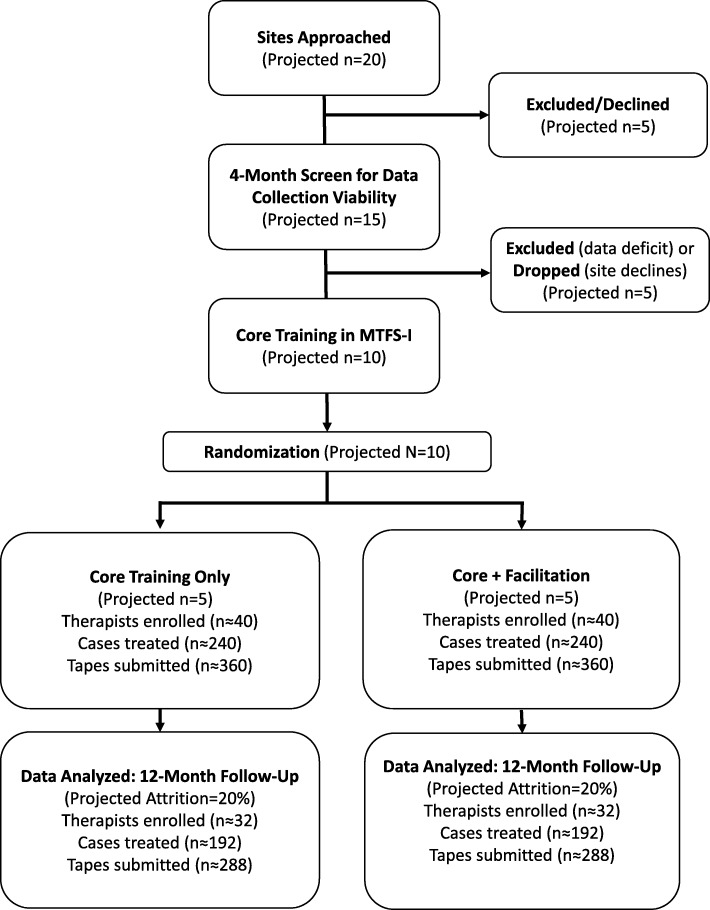
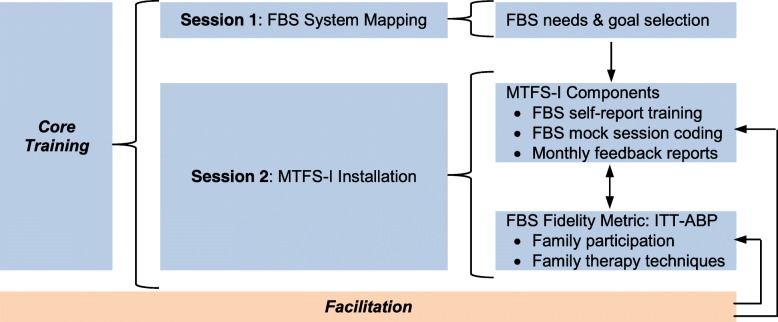
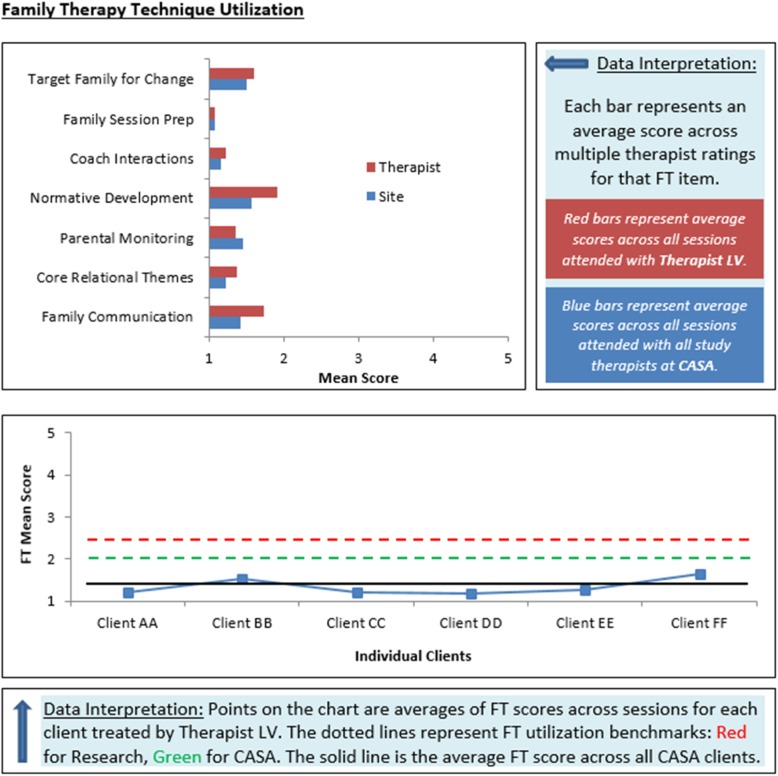
BACKGROUND: This article describes a study protocol for testing the Measurement Training and Feedback System for Implementation (MTFS-I) and comparing two implementation strategies for MTFS-I delivery. MTFS-I is a web-based treatment quality improvement system designed to increase the delivery of evidence-based interventions for behavioral health problems in routine care settings. This version of MTFS-I focuses on family-based services (FBS) for adolescent substance use. FBS, comprising both family participation in treatment and family therapy technique use, have achieved the strongest evidence base for adolescent substance use and are a prime candidate for upgrading treatment quality in outpatient care. For FBS to fulfill their potential for widespread dissemination, FBS implementation must be bolstered by effective quality procedures that support sustainable delivery in usual care. METHODS/DESIGN: Adapted from measurement feedback systems for client outcomes, MTFS-I contains three synergistic components: (a) weekly reporter training modules to instruct therapists in reliable post-session self-reporting on FBS utilization; (b) weekly mock session videos of FBS interventions (5-8 min) for supportive training in, and practice coding of, high-quality FBS; and (c) monthly feedback reports to therapists and supervisors displaying aggregated data on therapist-reported FBS use. MTFS-I is hosted online and requires approximately 20 min per week to complete. The study will experimentally compare two well-established implementation strategies designed to foster ongoing MTFS-I usage: Core Training, consisting of two 3-h training sessions focused on FBS site mapping, selecting FBS improvement goals, and sustaining MTFS-I, followed by routine remote technical assistance; and Core + Facilitation, which boosts Core Training sessions with collaborative phone-based clinical consultation and on-site facilitation meetings for 1 year to promote FBS goal achievement. The study design is a cluster randomized trial testing Core Training versus Core + Facilitation in ten substance use treatment clinics. Study aims will compare conditions on MTFS-I uptake, FBS delivery (based on therapist-report and observational data), and 1-year client outcomes. DISCUSSION: Study contributions to implementation science and considerations of MTFS-I sustainability are discussed. TRIAL REGISTRATION: ClinicalTrials.gov NCT03342872 . Registered 10 November 2017.
Overview
The claims and statistics of this paper haven’t been checked yet.
Free: it reads the open-access text and checks the first 5 claims that cite a source we can check. Create a free account to check every claim.
Integrity signals
Registry
Cites
Statistics
Figures
Verification
Claims the paper makes
The claims and statistics of this paper haven’t been checked yet.
Free: it reads the open-access text and checks the first 5 claims that cite a source we can check. Create a free account to check every claim.
Claims other papers make about this one
Each is checked against this paper’s own text: does it say what the citing paper says it does?
The source backs part of the claim, not all of it — or backs it for a different population, condition or comparison.
In the citing paper
“Site clinicians will be trained for 6 hours. The session will feature video-based training [117,118] in Fam-AID modules and techniques. Thereafter, consultation at each site will include bimonthly live consultation with a protocol expert focused on equipoise between protocol fidelity and case tailoring, along with continuous feedback from therapist- and observer-report fidelity data, which is ema”
From Family Support Protocol for Adolescent Internalizing Disorders: Protocol for a Pre-Post Quantitative Treatment Development Study (2024) · cites this paper as [117]
Experimental — accuracy not yet measured
Self-check
Percentages, sums and reported differences re-computed from the paper’s own numbers.
The self-check needs the paper’s full text.
Citations
Cites
Intraclass correlations: Uses in assessing rater reliability.
Shrout, P. E., & Fleiss, J. L. (1979) · Psychological Bulletin · doi:10.1037/0033-2909.86.2.420 · Cited by 24,532
Introducing Multilevel Modeling
Kreft, I., & de Leeuw, J. (1998) · doi:10.4135/9781849209366 · Cited by 2,997
Beidas, R. S., & Kendall, P. C. (2010) · Clinical Psychology: Science and Practice · doi:10.1111/j.1468-2850.2009.01187.x · Cited by 1,085
The improvement guide : a practical approach to enhancing organizational performance
Langley, G. J. (1996) · Jossey-Bass Publishers eBooks · Cited by 875
Weisz, J. R. (2012) · Archives of General Psychiatry · doi:10.1001/archgenpsychiatry.2011.147 · Cited by 827 · cited 1×
“As previously discussed, the core elements approach can mitigate many of these barriers, and so far it has accumulated an impressive research base in comparison to disorder-specific treatment manuals and usual care for youth mental health problems [64, 65].”
BackgroundChorpita, B. F., Daleiden, E. L., & Weisz, J. R. (2005) · Mental Health Services Research · doi:10.1007/s11020-005-1962-6 · Cited by 717
Shimokawa, K., Lambert, M. J., & Smart, D. W. (2010) · Journal of Consulting and Clinical Psychology · doi:10.1037/a0019247 · Cited by 657 · cited 1×
“MFS has led to impressive gains in treatment outcomes across diverse clinical samples [32], including substance users (e.”
BackgroundStatistical analysis and optimal design for cluster randomized trials.
Raudenbush, S. W. (1997) · Psychological Methods · doi:10.1037/1082-989x.2.2.173 · Cited by 636 · cited 2×
“Cluster randomized trials are appropriate when interventions are allocated randomly to organizational units (in this case, treatment sites) rather than to individuals to enhance ecological validity [42].”
BackgroundStatistical power and optimal design for multisite randomized trials.
Raudenbush, S. W., & Liu, X. (2000) · Psychological Methods · doi:10.1037/1082-989x.5.2.199 · Cited by 593
Bickman, L., Kelley, S. D., Breda, C., de Andrade, A. R., & Riemer, M. (2011) · Psychiatric Services · doi:10.1176/appi.ps.002052011 · Cited by 421 · cited 1×
“These reports will spur direct comparison between therapist self-reports of FBS fidelity versus agency-specified benchmarks, precipitating data-driven self-correction responses that motivate movement toward fidelity goals [53].”
BackgroundTanner-Smith, E. E., Wilson, S. J., & Lipsey, M. W. (2013) · Journal of Substance Abuse Treatment · doi:10.1016/j.jsat.2012.05.006 · Cited by 331
Glasgow, R. E., & Riley, W. T. (2013) · American Journal of Preventive Medicine · doi:10.1016/j.amepre.2013.03.010 · Cited by 318 · cited 1×
“First, it meets key criteria for being a pragmatic measure [18]: relevance to stakeholders, low burden, broad applicability, strong psychometrics, and useful for data-driven decision-making (i.”
BackgroundAarons, G. A., Research Network on Youth Mental Health, Glisson, C., Hoagwood, K., Kelleher, K., Landsverk, J., & Cafri, G. (2010) · Psychological Assessment · doi:10.1037/a0019188 · Cited by 316
Chambers, D. A., Feero, W. G., & Khoury, M. J. (2016) · JAMA · doi:10.1001/jama.2016.3867 · Cited by 313 · cited 1×
“In the behavioral treatment arena, learning systems of this kind consist of treatment quality procedures in which EBI implementation activities are carried out incrementally, implementation and sustainability data are regularly collected and reviewed, and continuous EBI modifications are made to increase fit and/or fe…”
BackgroundAarons, G. A., Wells, R. S., Zagursky, K., Fettes, D. L., & Palinkas, L. A. (2009) · American Journal of Public Health · doi:10.2105/ajph.2009.161711 · Cited by 299 · cited 1×
“Both strategies are innovation diffusion approaches that complement quality methods commonly employed in behavioral care [40].”
BackgroundBorntrager, C. F., Chorpita, B. F., Higa-McMillan, C., & Weisz, J. R. (2009) · Psychiatric Services · doi:10.1176/ps.2009.60.5.677 · Cited by 277
The Effects of Family Therapies for Adolescent Delinquency and Substance Abuse: A Meta‐analysis
Baldwin, S. A., Christian, S., Berkeljon, A., & Shadish, W. R. (2012) · Journal of Marital and Family Therapy · doi:10.1111/j.1752-0606.2011.00248.x · Cited by 244 · cited 1×
“, aggression, conduct disorder, delinquency) [10, 11], and many FBS studies report significant reductions in anxiety and depression symptoms as well as gains in prosocial functioning [9–11].”
BackgroundGlisson, C., & Green, P. (2006) · Administration and Policy in Mental Health and Mental Health Services Research · doi:10.1007/s10488-005-0016-0 · Cited by 216
The Network for the Improvement of Addiction Treatment (NIATx): Enhancing access and retention
McCarty, D., Gustafson, D. H., Wisdom, J. P., Ford, J., Choi, D., Molfenter, T., Capoccia, V., & Cotter, F. (2007) · Drug and Alcohol Dependence · doi:10.1016/j.drugalcdep.2006.10.009 · Cited by 210
Chorpita, B. F., Daleiden, E. L., Park, A. L., Ward, A. M., Levy, M. C., Cromley, T., Chiu, A. W., Letamendi, A. M., Tsai, K. H., & Krull, J. L. (2017) · Journal of Consulting and Clinical Psychology · doi:10.1037/ccp0000133 · Cited by 210 · cited 1×
“As previously discussed, the core elements approach can mitigate many of these barriers, and so far it has accumulated an impressive research base in comparison to disorder-specific treatment manuals and usual care for youth mental health problems [64, 65].”
BackgroundOne size cannot fit all: A stage model for psychotherapy manual development.
Carroll, K. M., & Nuro, K. F. (2002) · Clinical Psychology: Science and Practice · doi:10.1093/clipsy.9.4.396 · Cited by 204
Show Me, Don’t Tell Me: Behavioral Rehearsal as a Training and Analogue Fidelity Tool
Beidas, R. S., Cross, W., & Dorsey, S. (2014) · Cognitive and Behavioral Practice · doi:10.1016/j.cbpra.2013.04.002 · Cited by 171
Martino, S., Ball, S., Nich, C., Frankforter, T. L., & Carroll, K. M. (2009) · Psychotherapy Research · doi:10.1080/10503300802688460 · Cited by 164
Belenko, S., Knight, D., Wasserman, G. A., Dennis, M. L., Wiley, T., Taxman, F. S., Oser, C., Dembo, R., Robertson, A. A., & Sales, J. (2017) · Journal of Substance Abuse Treatment · doi:10.1016/j.jsat.2016.12.012 · Cited by 162
Hogue, A., Henderson, C. E., Ozechowski, T. J., & Robbins, M. S. (2014) · Journal of Clinical Child & Adolescent Psychology · doi:10.1080/15374416.2014.915550 · Cited by 150
Self-citationTreatment adherence process research in family therapy: A rationale and some practical guidelines.
Hogue, A., Liddle, H. A., & Rowe, C. (1996) · Psychotherapy: Theory, Research, Practice, Training · doi:10.1037/0033-3204.33.2.332 · Cited by 143
Self-citationChorpita, B. F., Bernstein, A., & Daleiden, E. L. (2007) · Administration and Policy in Mental Health and Mental Health Services Research · doi:10.1007/s10488-007-0151-x · Cited by 126
Child and Family Therapy Process: Concordance of Therapist and Observational Perspectives
Hurlburt, M. S., Garland, A. F., Nguyen, K., & Brookman-Frazee, L. (2010) · Administration and Policy in Mental Health and Mental Health Services Research · doi:10.1007/s10488-009-0251-x · Cited by 124
Hogue, A., Dauber, S., Lichvar, E., Bobek, M., & Henderson, C. E. (2015) · Administration and Policy in Mental Health and Mental Health Services Research · doi:10.1007/s10488-014-0548-2 · Cited by 122
Self-citationMcLeod, B. D., Southam-Gerow, M. A., Tully, C. B., Rodríguez, A., & Smith, M. M. (2013) · Clinical Psychology: Science and Practice · doi:10.1111/cpsp.12020 · Cited by 117
Damberg, C. L., Sorbero, M. E. S., Lovejoy, S. L., Martsolf, G. R., Raaen, L., & Mandel, D. (2014) · Rand health quarterly · doi:10.7249/rhq-04-03-09 · Cited by 115
Hogue, A., & Liddle, H. A. (2009) · Journal of Family Therapy · doi:10.1111/j.1467-6427.2009.00459.x · Cited by 112
Self-citationWeingardt, K. R., Cucciare, M. A., Bellotti, C., & Lai, W. P. (2009) · Journal of Substance Abuse Treatment · doi:10.1016/j.jsat.2009.01.002 · Cited by 103
Cooperative, T. J.-T., Knight, D. K., Belenko, S., Wiley, T., Robertson, A. A., Arrigona, N., Dennis, M., Bartkowski, J. P., McReynolds, L. S., Becan, J. E., et al. (2015) · Implementation Science · doi:10.1186/s13012-016-0423-5 · Cited by 100
Birken, S. A., DiMartino, L. D., Kirk, M. A., Lee, S.-Y. D., McClelland, M., & Albert, N. M. (2015) · Implementation Science · doi:10.1186/s13012-015-0362-6 · Cited by 99
Weingardt, K. R. (2004) · Clinical Psychology: Science and Practice · doi:10.1093/clipsy.bph087 · Cited by 92 · cited 2×
“The approach most likely to succeed is online training, wherein reporter training content can be presented in a pragmatic, user-tailored manner [29].”
BackgroundGleacher, A. A., Olin, S. S., Nadeem, E., Pollock, M., Ringle, V., Bickman, L., Douglas, S., & Hoagwood, K. (2016) · Administration and Policy in Mental Health and Mental Health Services Research · doi:10.1007/s10488-015-0642-0 · Cited by 91
Carroll, K. M., Nich, C., & Rounsaville, B. J. (1998) · Psychotherapy Research · doi:10.1080/10503309812331332407 · Cited by 89
Adolescent Substance Use: America's #1 Public Health Problem
Mack, A. H. (2012) · Yearbook of Psychiatry and Applied Mental Health · doi:10.1016/j.ypsy.2011.09.030 · Cited by 83
Wain, R. M., Kutner, B. A., Smith, J. L., Carpenter, K. M., Hu, M., Amrhein, P. C., & Nunes, E. V. (2015) · Journal of Substance Abuse Treatment · doi:10.1016/j.jsat.2015.04.006 · Cited by 77
Crits-Christoph, P., Ring-Kurtz, S., Hamilton, J. L., Lambert, M. J., Gallop, R., McClure, B., Kulaga, A., & Rotrosen, J. (2012) · Journal of Substance Abuse Treatment · doi:10.1016/j.jsat.2011.09.003 · Cited by 73
Dimeff, L. A., Harned, M. S., Woodcock, E. A., Skutch, J. M., Koerner, K., & Linehan, M. M. (2015) · Behavior Therapy · doi:10.1016/j.beth.2015.01.001 · Cited by 70
Methodological Challenges of Characterizing Usual Care Psychotherapeutic Practice
Garland, A. F., Hurlburt, M. S., Brookman-Frazee, L., Taylor, R. M., & Accurso, E. C. (2010) · Administration and Policy in Mental Health and Mental Health Services Research · doi:10.1007/s10488-009-0237-8 · Cited by 69
National Quality Measures for Child Mental Health Care: Background, Progress, and Next Steps
Zima, B. T., Murphy, J. M., Scholle, S. H., Hoagwood, K. E., Sachdeva, R. C., Mangione-Smith, R., Woods, D., Kamin, H. S., & Jellinek, M. (2013) · Pediatrics · doi:10.1542/peds.2012-1427e · Cited by 64
Stirman, S. W., Bhar, S. S., Spokas, M., Brown, G. K., Creed, T. A., Perivoliotis, D., Farabaugh, D. T., Grant, P. M., & Beck, A. T. (2010) · Professional Psychology: Research and Practice · doi:10.1037/a0018099 · Cited by 63
Hogue, A., Ozechowski, T. J., Robbins, M. S., & Waldron, H. B. (2013) · Clinical Psychology: Science and Practice · doi:10.1111/cpsp.12023 · Cited by 62 · cited 5×
“pists in our previous studies [26] that has proven feasible in usual care for youth behavioral health [6, 27].”
BackgroundMethodInfluentialSelf-citationHogue, A., Bobek, M., Dauber, S., Henderson, C. E., McLeod, B. D., & Southam-Gerow, M. A. (2017) · Journal of Child & Adolescent Substance Abuse · doi:10.1080/1067828x.2017.1322020 · Cited by 61 · cited 2×
“sions) and therapist use of core family therapy techniques [19]: family engagement and goal setting, relational reframing, family skills building, and coaching family interactions.”
BackgroundSelf-citationAdolescent Substance Use: America's #1 Public Health Problem
(2011) · PsycEXTRA Dataset · doi:10.1037/e541172013-001 · Cited by 56
Adolescent-only substance abuse treatment: Availability and adoption of components of quality
Knudsen, H. K. (2009) · Journal of Substance Abuse Treatment · doi:10.1016/j.jsat.2008.06.002 · Cited by 55
Welsh, W. N., Knudsen, H. K., Knight, K. K., Ducharme, L. J., Pankow, J., Urbine, T. F., Lindsey, A. C., Abdel-Salam, S., Wood, J. D., Monico, L. B., et al. (2015) · Administration and Policy in Mental Health and Mental Health Services Research · doi:10.1007/s10488-014-0623-8 · Cited by 52
Hogue, A., Dauber, S., Henderson, C. E., Bobek, M., Johnson, C., Lichvar, E., & Morgenstern, J. (2015) · Journal of Clinical Child & Adolescent Psychology · doi:10.1080/15374416.2014.963857 · Cited by 48 · cited 2×
“pists in our previous studies [26] that has proven feasible in usual care for youth behavioral health [6, 27].”
Self-citationImproving Quality of Care in Substance Abuse Treatment Using Five key Process Improvement Principles
Hoffman, K. A., Green, C. A., Ford, J. H., Wisdom, J. P., Gustafson, D. H., & McCarty, D. W. (2012) · The Journal of Behavioral Health Services & Research · doi:10.1007/s11414-011-9270-y · Cited by 46
How do components of evidence-based psychological treatment cluster in practice?
Gifford, E. V., Tavakoli, S., Weingardt, K. R., Finney, J. W., Pierson, H. M., Rosen, C. S., Hagedorn, H., Cook, J. M., & Curran, G. M. (2011) · Journal of Substance Abuse Treatment · doi:10.1016/j.jsat.2011.07.008 · Cited by 39
Use of effective and efficient quality control methods to implement psychosocial interventions.
Garland, A. F., & Schoenwald, S. K. (2013) · Clinical Psychology Science and Practice · doi:10.1111/cpsp.12021 · Cited by 39
Lyon, A. R., & Lewis, C. C. (2016) · Administration and Policy in Mental Health and Mental Health Services Research · doi:10.1007/s10488-015-0704-3 · Cited by 39
Measuring Success in Health Care Value-Based Purchasing Programs
Damberg, C. L., Sorbero, M. E. S., Lovejoy, S. L., Martsolf, G. R., Raaen, L., & Mandel, D. (2014) · Cited by 35
Glisson, C., Williams, N. J., Hemmelgarn, A., Proctor, E., & Green, P. (2016) · Behaviour Research and Therapy · doi:10.1016/j.brat.2015.11.008 · Cited by 29
Ehrenreich, J. T., Dimeff, L. A., Woodcock, E. A., Queen, A. H., Kelly, T. B., Contreras, I., Rash, B., Kelley-Brimer, A., Hauschildt, J., Danner, S., et al. (2016) · Evidence-Based Practice in Child and Adolescent Mental Health · doi:10.1080/23794925.2016.1245116 · Cited by 29
Chorpita, B. F., Daleiden, E. L., & Bernstein, A. (2015) · Administration and Policy in Mental Health and Mental Health Services Research · doi:10.1007/s10488-015-0702-5 · Cited by 28
Hogue, A., Dauber, S., & Henderson, C. E. (2017) · Administration and Policy in Mental Health and Mental Health Services Research · doi:10.1007/s10488-016-0769-7 · Cited by 26
Self-citationHogue, A., Dauber, S., & Henderson, C. E. (2014) · Administration and Policy in Mental Health and Mental Health Services Research · doi:10.1007/s10488-012-0442-8 · Cited by 25 · cited 3×
“Therapist Self-Reported EBI Proficiency [15] averages therapists’ own judgments about their degree of allegiance to, and their perceived technical skill in, multiple EBIs including family therapy.”
BackgroundSelf-citationTherapist Attitudes Towards Computer-Based Trainings
Becker, E. M., & Jensen‐Doss, A. (2013) · Administration and Policy in Mental Health and Mental Health Services Research · doi:10.1007/s10488-013-0522-4 · Cited by 16
Self-citationPsychometric considerations in self-monitoring assessment.
Jackson, J. L. (1999) · Psychological Assessment · doi:10.1037//1040-3590.11.4.439 · Cited by 15
Henderson, C. E., Hogue, A., & Dauber, S. (2019) · Journal of Consulting and Clinical Psychology · doi:10.1037/ccp0000376 · Cited by 15
Self-citationEdbrooke-Childs, J. H., Wolpert, M., & Deighton, J. (2016) · Administration and Policy in Mental Health and Mental Health Services Research · doi:10.1007/s10488-016-0726-5 · Cited by 10
Research works printed but not linked: 2
- Drug Strategies Treating teens: a guide to adolescent drug programs 2003 Washington, DC D. Strategies
- Lyon AR Lewis CC Feedback systems to support implementation of measurement-based care Behav Ther 2017 7 241 247
Cited by
Hogue, A., Bobek, M., MacLean, A., Miranda, R., Wolff, J. C., & Jensen‐Doss, A. (2020) · Cognitive and Behavioral Practice · doi:10.1016/j.cbpra.2019.12.002 · Cited by 32
Self-citationWelsh, J. W., Dopp, A. R., Durham, R. M., Sitar, S. I., Passetti, L. L., Hunter, S. B., Godley, M. D., & Winters, K. C. (2025) · Journal of the American Academy of Child & Adolescent Psychiatry · doi:10.1016/j.jaac.2024.03.010 · Cited by 21
Hogue, A., Porter, N., Bobek, M., MacLean, A., Bruynesteyn, L., Jensen‐Doss, A., Dauber, S. E., & Henderson, C. E. (2021) · Administration and Policy in Mental Health and Mental Health Services Research · doi:10.1007/s10488-021-01152-4 · Cited by 17
Self-citationHogue, A., MacLean, A., Bobek, M., Porter, N., Bruynesteyn, L., Jensen‐Doss, A., & Henderson, C. E. (2022) · Journal of Clinical Child & Adolescent Psychology · doi:10.1080/15374416.2022.2051529 · Cited by 13
Self-citationHogue, A., Bobek, M., MacLean, A., Porter, N., Jensen-Doss, A., & Henderson, C. E. (2019) · Trials · doi:10.1186/s13063-019-3783-8 · Cited by 9
Self-citation
Metadata
- Authors
- Hogue, A., Dauber, S., Bobek, M., Jensen-Doss, A., & Henderson, C. E.
- Affiliations
- Sam Houston State University (US)
- Corresponding author
- Hogue, Aaron
- Venue
- Implementation Science
- Published
- 2019-03-11
- Volume
- 14
- Issue
- 1
- Pages
- 25-25
- ISSN
- 1748-5908 (ISSN-L)
- PMC
- PMC6416843
- OpenAlex
- W2920877788
- Cited by
- 11
- References
- 66
- Citations by year
- 2024: 2 · 2023: 3 · 2022: 1 · 2021: 2 · 2020: 2 · 2019: 1
- FWCI
- 2.04
- Type
- journal article
- Language
- en
- Open access
- gold
- doi.org
- Licence
- cc-by
- creativecommons.org/licenses/by/4.0/ (tdm)
- creativecommons.org/licenses/by/4.0/ (vor)
- Locations
- Implementation Science (publishedVersion, cc-by)
- Europe PMC (PubMed Central) (publishedVersion, cc-by)
- PubMed Central (publishedVersion, cc-by)
- PubMed (publishedVersion)
- DOAJ (DOAJ: Directory of Open Access Journals) (submittedVersion, cc-by-sa)
- Funders
- National Institute on Drug Abuse (5R34DA044740-02)
- Topics
- Health Sciences › Health Professions › General Health Professions › Health Policy Implementation Science
- Health Sciences › Medicine › Epidemiology › Substance Abuse Treatment and Outcomes
- Social Sciences › Psychology › Clinical Psychology › Psychotherapy Techniques and Applications
- Keywords
- family-based services, adolescent substance use, implementation strategies, family therapy, therapist training, implementation sustainability, quality improvement, usual care
- MeSH terms
- Implementation Science, Adolescent, Ambulatory Care, Clinical Trials as Topic, Delivery of Health Care, Family Therapy, Feedback, Health Personnel, Humans, Inservice Training, Psychotherapy, Teaching Materials, Multicenter Studies as Topic, Cluster Analysis, Sample Size, Substance-Related Disorders, Quality Improvement
About these checks
Registry, retraction, Cites and statistics results are computed, not judged, with one exception: a printed reference that no index lists is read once by a model before it counts as a citation error. Claims are extracted by a model and kept only when their quote appears verbatim in the text; each cited source is then checked, with a model’s help, for whether it says what the claim relies on. Those verdicts can be wrong — read the claim’s quote and the cited source before relying on one.
Statistics and arithmetic are recomputed, not judged.
Confidence bands are shown only for fields calibrated on our annotated test set. None is calibrated yet, so no band is shown.
What counts as a claim ›How we measure confidence ›How we check this ›
Are you an author, or do you see a problem with this page? Request a review
Data sources
Bibliographic data: Semantic Scholar, OpenAlex, Crossref.
Contains information from the Semantic Scholar Academic Graph Datasets, made available under the ODC Attribution License (ODC-BY 1.0).
Semantic Scholar’s data is described in: Kinney, R., et al. (2023). The Semantic Scholar Open Data Platform. arXiv:2301.10140.
