

The DOI matches its Crossref record; 65 of the 66 references it cites were found in a registry or an index.
Evidence-based intervention sustainability strategies: a systematic review
Open accessAbstract
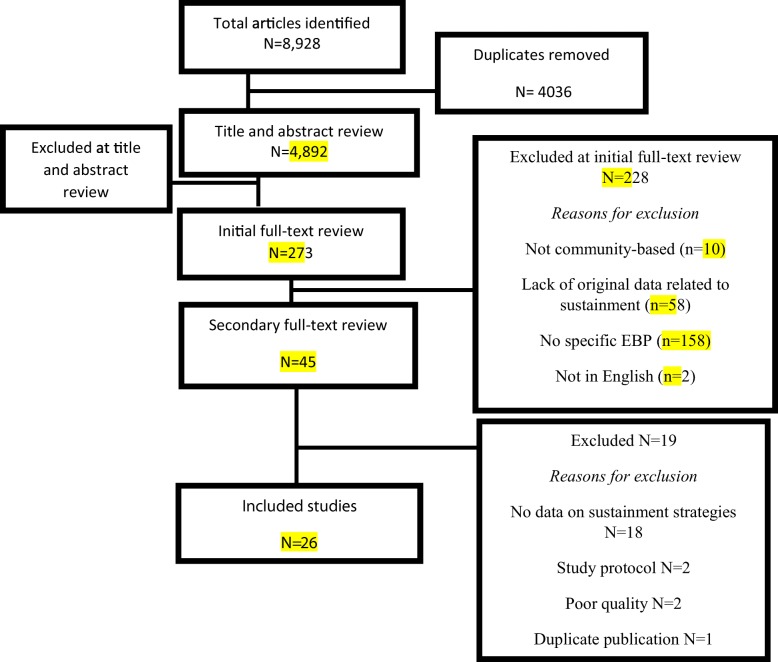
BACKGROUND: Sustainability of evidence-based interventions (EBI) remains a challenge for public health community-based institutions. The conceptual definition of sustainment is not universally agreed upon by researchers and practitioners, and strategies utilized to facilitate sustainment of EBI are not consistently reported in published literature. Given these limitations in the field, a systematic review was conducted to summarize the existing evidence supporting discrete sustainment strategies for public health EBIs and facilitating and hindering factors of sustainment. METHODS: We searched PsychINFO, Embase, ProQuest, PubMed, and Google Scholar. The initial search was run in March 2017 and an update was done in March 2019. Study eligibility criteria included (a) public health evidence-based interventions, (b) conducted in the community or community-based settings, and (c) reported outcomes related to EBI sustainment. Details characterizing the study setting, design, target population, and type of EBI sustained were extracted. RESULTS: A total of 26 articles published from 2004 to 2019 were eligible for data extraction. Overall, the importance of sustainability was acknowledged across all of the studies. However, only seven studies presented a conceptual definition of sustainment explicitly within the text. Six of the included studies reported specific sustainment strategies that were used to facilitate the sustainment of EBI. Only three of the studies reported their activities related to sustainment by referencing a sustainment framework. Multiple facilitators (i.e., adaptation/alignment, funding) and barriers (i.e., limited funding, limited resources) were identified as influencing EBI sustainment. The majority (n = 20) of the studies were conducted in high-income countries. Studies from low-income countries were mostly naturalistic. All of the studies from low-income countries reported lack of funding as a hindrance to sustainment. IMPLICATION FOR DISSEMINATION AND IMPLEMENTATION RESEARCH: Literature focused on sustainment of public health EBIs should present an explicit definition of the concept. Better reporting of the framework utilized, steps followed, and adaptations made to sustain the intervention might contribute to standardizing and developing the concept. Moreover, encouraging longitudinal dissemination and implementation (D&I) research especially in low-income countries might help strengthen D&I research capacity in public health settings.
Overview
The claims and statistics of this paper haven’t been checked yet.
Run the check — free, no account needed. It reads the open-access text and checks the sources it cites.
Integrity signals
Registry
Cites
Statistics
Figures
Verification
Claims the paper makes
The claims and statistics of this paper haven’t been checked yet.
Run the check — free, no account needed. It reads the open-access text and checks the sources it cites.
Claims other papers make about this one
Each is checked against this paper’s own text: does it say what the citing paper says it does?
The source backs part of the claim, not all of it — or backs it for a different population, condition or comparison.
In the citing paper
“However, the health benefits of the intervention may not last over an extended period after the intervention is terminated, raising concerns about sustainability [63].”
From Effectiveness of an Internet-Based Acceptance and Commitment Therapy Intervention for Reducing Psychological Distress in Health Care Professionals: Randomized Controlled Trial (2024) · cites this paper as [63]
Experimental — accuracy not yet measuredThe source backs part of the claim, not all of it — or backs it for a different population, condition or comparison.
In the citing paper
“Extensive implementation research suggests that even when the challenges of implementing EBPs with fidelity have been surmounted, it is difficult to maintain consistent use, as well as intended effects, over longer periods of time (56).”
From The Renfrew Unified Treatment for Eating Disorders and Comorbidity: Long-Term Effects of an Evidence-Based Practice Implementation in Residential Treatment (2021) · cites this paper as [56]
Experimental — accuracy not yet measuredIn the citing paper
“Reported influences on sustainability include characteristics of the innovation and the individuals involved, leadership, capacity, processes, and context [2, 9, 13, 14].”
From Factors influencing sustainability and scale-up of rural primary healthcare memory clinics: perspectives of clinic team members (2022) · cites this paper as [9]
Self-check
Percentages, sums and reported differences re-computed from the paper’s own numbers.
The self-check needs the paper’s full text.
Citations
Cites
Liberati, A., Altman, D. G., Tetzlaff, J., Mulrow, C., Gøtzsche, P. C., Ioannidis, J. P. A., Clarke, M., Devereaux, P. J., Kleijnen, J., & Moher, D. (2009) · PLoS Medicine · doi:10.1371/journal.pmed.1000100 · Cited by 28,164
von Elm, E., Altman, D. G., Egger, M., Pocock, S. J., Gøtzsche, P. C., Vandenbroucke, J. P., & Initiative, F. T. S. (2007) · PLoS Medicine · doi:10.1371/journal.pmed.0040296 · Cited by 23,020
Damschroder, L. J., Aron, D. C., Keith, R. E., Kirsh, S. R., Alexander, J. A., & Lowery, J. C. (2009) · Implementation Science · doi:10.1186/1748-5908-4-50 · Cited by 14,496
CONSORT 2010 Statement: updated guidelines for reporting parallel group randomised trials
the CONSORT Group, Schulz, K. F., Altman, D. G., & Moher, D. (2010) · BMC Medicine · doi:10.1186/1741-7015-8-18 · Cited by 13,371
Evaluating the public health impact of health promotion interventions: the RE-AIM framework.
Glasgow, R. E., Vogt, T. M., & Boles, S. M. (1999) · American Journal of Public Health · doi:10.2105/ajph.89.9.1322 · Cited by 7,217
Durlak, J. A., & DuPre, E. P. (2008) · American Journal of Community Psychology · doi:10.1007/s10464-008-9165-0 · Cited by 5,304
(2005) · Cited by 3,748
Advancing a Conceptual Model of Evidence-Based Practice Implementation in Public Service Sectors
Aarons, G. A., Hurlburt, M., & Horwitz, S. M. (2011) · Administration and Policy in Mental Health and Mental Health Services Research · doi:10.1007/s10488-010-0327-7 · Cited by 3,240
Knowledge translation of research findings
Grimshaw, J. M., Eccles, M. P., Lavis, J. N., Hill, S. J., & Squires, J. E. (2012) · Implementation Science · doi:10.1186/1748-5908-7-50 · Cited by 2,407
Glasgow, R. E., Lichtenstein, E., & Marcus, A. C. (2003) · American Journal of Public Health · doi:10.2105/ajph.93.8.1261 · Cited by 1,836
Research works printed but not linked: 2
- Qualtrics L. Qualtrics: online survey software & insight platform; 2014.
- Inc S. SPSS Base 14.0 user’s guide: Prentice Hall; 2005.
Cited by
Sorted by citations
Items 101–200 of 398
Ghag, K., Bahl, R., Winter, C., Lynch, M., Bautista, N., Ilagan, R., Ellis, M., de Salis, I. O. C., & Draycott, T. (2021) · BMC Health Services Research · doi:10.1186/s12913-021-06385-5 · Cited by 11
Zhang, L., Huang, S., Liu, S., Huang, Y., Chen, S., Hu, J., & Xu, M. (2024) · Journal of Medical Internet Research · doi:10.2196/59093 · Cited by 9
Atujuna, M., Tucker, J. D., Crooks, N. K., Zanoni, B. C., & Donenberg, G. R. (2022) · AIDS and Behavior · doi:10.1007/s10461-022-03794-3 · Cited by 9
Fahim, C., Prashad, A., Silveira, K., Chandraraj, A., Thombs, B. D., Tonelli, M. A., Thériault, G., Grad, R. M., Riva, J. J., Colquhoun, H. L., et al. (2023) · CMAJ Open · doi:10.9778/cmajo.20220121 · Cited by 9
Pino, A. F. S., Ruiz, P. H., Mon, A., & Collazos, C. A. (2024) · Internet of Things · doi:10.1016/j.iot.2024.101100 · Cited by 11
Implementation of Health IT for Cancer Screening in US Primary Care: Scoping Review
Owens-Jasey, C., Chen, J., Xu, R., Angier, H. E., Huebschmann, A. G., Fukunaga, M. I., Chaiyachati, K. H., Rendle, K. A. S., Robien, K., DiMartino, L., et al. (2024) · JMIR Cancer · doi:10.2196/49002 · Cited by 10
The Compromise-COMET Method for Identifying an Adaptive Multi-Criteria Decision Model
Kizielewicz, B., Shekhovtsov, A., Więckowski, J., Wątróbski, J., & Sałabun, W. (2024) · IEEE Access · doi:10.1109/access.2024.3485798 · Cited by 10
Chapman, A., Gaskin, C. J., Beks, H., Wright, C., Marshall, S., Johnston, E. A., Bergin, R. J., Riva, S., Crawford-Williams, F. M., Short, C. E., et al. (2025) · The Lancet Regional Health - Western Pacific · doi:10.1016/j.lanwpc.2025.101732 · Cited by 9
Lee, R. E., Parker, N. H., Hallett, A. M., Kao, D., Modelska, M. J., Rifai, H. S., Soltero, E. G., & O’Connor, D. P. (2020) · Translational Behavioral Medicine · doi:10.1093/tbm/ibaa058 · Cited by 11
Caton, L., Yuan, M., Louie, D., Gallo, C. G., Abram, K. M., Palinkas, L. A., Brown, C. H., & McGovern, M. P. (2020) · Substance Abuse Treatment Prevention and Policy · doi:10.1186/s13011-020-00326-x · Cited by 10
Sustainment Rates and Factors for Multidimensional Family Therapy in Europe and North America
Dakof, G. A., Ricardo, M. M., Rowe, C. L., Henderson, C. E., Rigter, H., & Liddle, H. A. (2022) · Global Implementation Research and Applications · doi:10.1007/s43477-022-00043-6 · Cited by 10
Latin American Attachment studies: A narrative review
Fourment, K., Espinoza, C., Ribeiro, A. C. L., & Mesman, J. (2022) · Infant Mental Health Journal · doi:10.1002/imhj.21995 · Cited by 9
Understanding How Newly Implemented Rehabilitation Best Practices Are Sustained: A Realist Review
Ataman, R., Ahmed, S., Zidan, A., & Thomas, A. (2022) · Archives of Physical Medicine and Rehabilitation · doi:10.1016/j.apmr.2022.05.016 · Cited by 12
Love, P., Laws, R., Taki, S., West, M. L., Hesketh, K. D., & Campbell, K. J. (2022) · Frontiers in Health Services · doi:10.3389/frhs.2022.1031628 · Cited by 9
Shani, M., de Lede, S., Richters, S., Kleuker, M., Middendorf, W. M., Liedtke, J., Witolla, S., & van Zalk, M. H. W. (2023) · International Journal of Developmental Science · doi:10.3233/dev-230342 · Cited by 10
Christie, L., Rendell, R., Fearn, N., Descallar, J., McCluskey, A., Pearce, A. M., Wong, L., & Lovarini, M. (2023) · Disability and Rehabilitation · doi:10.1080/09638288.2023.2290687 · Cited by 9
Binagwaho, A., VanderZanden, A., Garcia, P. J., Huda, F. A., Maskey, M. K., Sall, M., Sayinzoga, F., Subedi, R. K., Teklu, A. M., Donahoe, K. B., et al. (2024) · BMC Pediatrics · doi:10.1186/s12887-023-03906-5 · Cited by 9
Implementing a Clinical Pathway for Needs Assessment and Supportive Care Interventions
Stout, N. L., Alfano, C. M., Liu, R., Dixit, N., & Jefford, M. (2024) · JCO Oncology Practice · doi:10.1200/op.23.00482 · Cited by 9
Takaoka, A., Tam, B., Vanstone, M. G., Clarke, F. J., Hoad, N., Swinton, M. E., Toledo, F., Boyle, A., Woods, A., Duan, E. H., et al. (2021) · BMC Health Services Research · doi:10.1186/s12913-021-06241-6 · Cited by 10
Jia, J., Burgun, R., Reilly, A., Sonnenblick, R. M., Fiechtner, L. G., Zack, R. M., Porneala, B., & Thorndike, A. N. (2023) · BMC Public Health · doi:10.1186/s12889-023-15243-4 · Cited by 9
Gallo, C. G., Abram, K. M., Hannah, N. D., Caton, L., Cimaglio, B., McGovern, M. P., & Brown, C. H. (2021) · PLoS ONE · doi:10.1371/journal.pone.0245920 · Cited by 9
Colecraft, E. K., Marquis, G. S., & Pinto, C. (2022) · Current Developments in Nutrition · doi:10.1093/cdn/nzac124 · Cited by 8
Cabilan, C. J., McRae, J., Ganzon, K., Appo, C., Rogers, S., O’Sullivan, M., Eley, R. M., Snoswell, C. L., & Johnston, A. N. B. (2023) · Journal of Emergency Nursing · doi:10.1016/j.jen.2023.01.007 · Cited by 9
Cornelissen, M., Kemler, E., Baan, A., & van Nassau, F. (2023) · BMJ Open Sport & Exercise Medicine · doi:10.1136/bmjsem-2022-001456 · Cited by 8
Sustaining health obesity prevention programs: Lessons from real-world population settings
Crane, M. A., Lee, K., Bohn-Goldbaum, E. E., Nathan, N., & Bauman, A. E. (2024) · Evaluation and Program Planning · doi:10.1016/j.evalprogplan.2024.102404 · Cited by 8
The Perniciousness and Promise of School-Based Mental Health Service Delivery for Youth
Kearney, C. A. (2024) · Research on Child and Adolescent Psychopathology · doi:10.1007/s10802-024-01253-2 · Cited by 8
Estrada, Y. A., Lozano, A., Boga, D. J., Tapia, M. I., Perrino, T., Velázquez, M. R., Forster, L., Torres, N. S., Morales, C. V., Gwynn, L. A., et al. (2023) · PLoS ONE · doi:10.1371/journal.pone.0283987 · Cited by 9
Chicoine, G., & Straus, S. E. (2025) · International Journal of Evidence-Based Healthcare · doi:10.1097/xeb.0000000000000496 · Cited by 7
Exit strategies for health interventions in low- and middle-income countries: a systematic review
Milenova, M., Thusini, S., Gronholm, P. C., & Salisbury, T. T. (2025) · BMC Global and Public Health · doi:10.1186/s44263-025-00182-6 · Cited by 7
Improving Nursing Home Disaster Readiness Through Implementation Science
Bell, S. A., Inloes, J. B., Donnelly, J., Wasserman, M., & Wyte‐Lake, T. (2023) · Journal of the American Medical Directors Association · doi:10.1016/j.jamda.2023.02.004 · Cited by 11
Ssegujja, E., Namakula, J., Kabagenyi, A., Kyozira, C., Musila, T., Zakumumpa, H., & Ssengooba, F. (2023) · Globalization and Health · doi:10.1186/s12992-023-00945-6 · Cited by 8
Hall, A. E., Wolfenden, L., Gardner, C., McEvoy, B., Lane, C., Shelton, R. C., McFadyen, T., Lee, D. C. W., Shoesmith, A., Austin, K., et al. (2023) · Public Health in Practice · doi:10.1016/j.puhip.2023.100444 · Cited by 7
Huang, L.-Y., Fan, J., LeMoult, J., Chi, P.-L., Zhao, Y., & Chi, X.-L. (2024) · Research on social work practice · doi:10.1177/10497315241267248 · Cited by 6
How Do Academic Otolaryngologists Decide to Implement New Procedures Into Practice?
Powers, B. R., Smith, C. D., Arroyo, N., Francis, D. O., & Fernandes‐Taylor, S. (2021) · Otolaryngology · doi:10.1177/01945998211047434 · Cited by 7
EBP champion responsibilities and sustainability
Ferren, M. D., Ah, D. M. V., & Menachemi, N. (2022) · Nursing Management · doi:10.1097/01.numa.0000853152.64293.46 · Cited by 7
Snider, M. D. H., Taylor, R. M., Bills, L. J., Hutchison, S. L., Steinman, S. A., & Herschell, A. D. (2023) · Community Mental Health Journal · doi:10.1007/s10597-022-01072-z · Cited by 7
Aging with Pride: Innovations in Dementia Empowerment and Action (IDEA)
Fredriksen‐Goldsen, K. I., Jones, B. R., Hoy‐Ellis, C. P., Kim, H., Emlet, C. A., LaFazia, D. M., McKenzie, G. L., Petros, R., & Teri, L. L. (2023) · Contemporary Clinical Trials Communications · doi:10.1016/j.conctc.2023.101169 · Cited by 7
Hansen, A. B. G., Hansen, M. L., Golubovic, S., Bloch, P., Lorenzen, J. K., Almdal, T., Ried‐Larsen, M., & Thorsen, I. K. (2023) · Research Involvement and Engagement · doi:10.1186/s40900-023-00495-6 · Cited by 7
Pradhan, P., Sharman, A. R., Palme, C. E., Elliott, M. S., Clark, J. R., & Venchiarutti, R. L. (2024) · Journal of Cancer Survivorship · doi:10.1007/s11764-024-01643-x · Cited by 6
Matheny, M. E., Carpenter-Song, E. A., Ricket, I. M., Solomon, R., Stabler, M. E., Davis, S. E., Zubkoff, L., Westerman, D. M., Dorn, C. A., Cox, K. C., et al. (2025) · Journal of the American Heart Association · doi:10.1161/jaha.124.038920 · Cited by 8
A 5-year examination of CAPABLE implementation using RE-AIM and CFIR frameworks
Paone, D. L., Schuller, J. W., Smith, M. L., Gitlin, L. N., & Szanton, S. L. (2025) · Frontiers in Public Health · doi:10.3389/fpubh.2025.1569320 · Cited by 6
Harlan, M. D., Skrovanek, E., Torgerson, S., Perpetua, Z., O’Loughlin, V. D., Hudack, C., Yen, A., Ren, D., & Sherwood, P. R. (2025) · Nurse Educator · doi:10.1097/nne.0000000000001915 · Cited by 6
Financing And Funding A Simulation Center
Senvisky, J. M., McKenna, R., & Okuda, Y. (2021) · StatPearls · Cited by 6
Cunningham-Sabo, L. D., Lohse, B., Clifford, J., Burg, A., & Nigg, C. R. (2023) · Journal of Nutrition Education and Behavior · doi:10.1016/j.jneb.2022.08.001 · Cited by 6
Ramanadhan, S., Cruz, J. L., Weese, M., Naveed, N., Kirk, S., Rivard, M. K., Kirk, J., Whitaker, A., Peterson, K., & Eisenkraft, A. (2023) · Implementation Science Communications · doi:10.1186/s43058-023-00472-w · Cited by 6
Goddard‐Eckrich, D., Gatanaga, O. S., Thomas, B. V., Liu, Y., Downey, D. L., Dsouza, N., Medley, B., Hunt, T., Wu, E., Johnson, K. A., et al. (2023) · Social Work in Health Care · doi:10.1080/00981389.2023.2278781 · Cited by 6
Krismanuel, H., & Tjhin, P. (2025) · PLoS ONE · doi:10.1371/journal.pone.0325653 · Cited by 5
Adewuya, A. O., Ola, B. A., Abímbọ́lá, Ṣ., & Abdulmalik, J. O. (2025) · Journal of Global Health · doi:10.7189/jogh.15.04305 · Cited by 5
Review of Large Language Models for Patient and Caregiver Support in Cancer Care Delivery
Kouzy, R., Cha, E. E., Rosen, A., & Bitterman, D. S. (2025) · JCO Clinical Cancer Informatics · doi:10.1200/cci-25-00044 · Cited by 10
Sustained Effects of a Systems-Based Strategy for Tobacco Cessation Assistance
Bailey, S. R., Albert, E. L., Seeholzer, E. L., Lewis, S. A., & Flocke, S. A. (2022) · American Journal of Preventive Medicine · doi:10.1016/j.amepre.2022.09.020 · Cited by 5
Åhlfeldt, E., Isaksson, D., & Winblad, U. (2023) · Health & Social Care in the Community · doi:10.1155/2023/1458305 · Cited by 20
Multiple-Baseline Design Study of Deliberate Practice for Learning Psychotherapeutic Techniques
Young, J. N., Schruff, M. A., Humphrey, C., & Pavlacic, J. M. (2023) · Evidence-Based Practice in Child and Adolescent Mental Health · doi:10.1080/23794925.2023.2272949 · Cited by 5
Sustainability of an outcome measure in outpatient stroke rehabilitation: A realist evaluation
Ataman, R., Ahmed, S., Berta, W. B., & Thomas, A. (2024) · Journal of Evaluation in Clinical Practice · doi:10.1111/jep.13972 · Cited by 5
Imad, N., Hall, A. E., Nathan, N., Shoesmith, A., Pearson, N., Lum, M., Grady, A., Nolan, E., & Yoong, S. (2025) · International Journal of Behavioral Nutrition and Physical Activity · doi:10.1186/s12966-024-01699-z · Cited by 7
Schieber, E., Deveaux, L., Cotrell, L., Li, X., Lemon, S. C., Ash, A. S., MacDonell, K. K., Ghosh, S., Poitier, M., Rolle, G., et al. (2023) · Prevention Science · doi:10.1007/s11121-023-01614-1 · Cited by 6
Successful Implementation Isn’t Enough: One Intermediary Organization’s Focus on Sustainment
Margolies, P. J., Patel, S. R., Covell, N. H., Broadway-Wilson, K., Gregory, R., Jewell, T. C., Scannevin, G., & Dixon, L. B. (2023) · Global Implementation Research and Applications · doi:10.1007/s43477-023-00110-6 · Cited by 6
Assessing the Sustainability and Resilience of Urban Transit: The Case of Kochi Water Metro
Joseph, G. G., & Elias, A. A. (2024) · Emerald Group Publishing Limited eBooks · doi:10.1108/s1479-359820240000012012 · Cited by 5
Evaluation of Green Design Strategies Adopted by Architects for Public Buildings in Nigeria
Adewale, B. A., Ogunbayo, B. F., Aigbavboa, C. O., & Ene, V. O. (2024) · International Conference on Industrial, Manufacturing, and Process Engineering (ICIMP) · doi:10.3390/engproc2024076024 · Cited by 5
Advancing Public Health Entrepreneurship to Foster Innovation and Impact
Huang, T. T. ‐., Ciari, A., Costa, S. A., & Chahine, T. (2022) · Frontiers in Public Health · doi:10.3389/fpubh.2022.923764 · Cited by 5
Washington‐Nortey, M., Granger, K. L., Sutherland, K. S., Conroy, M. A., Kaur, N., & Hetrick, A. A. (2022) · School Mental Health · doi:10.1007/s12310-022-09561-y · Cited by 7
Sustainable Healthcare to Provide Quality Care in the Surgical Industry in the United Kingdom
Mubarak, F. S. (2023) · Cureus · doi:10.7759/cureus.38156 · Cited by 5
Onsite training-mentoring intervention improves data quality: an implementation research
Gobena, T., Enyew, D. B., Kenay, A., & Wondirad, Y. (2024) · BMC Public Health · doi:10.1186/s12889-024-20609-3 · Cited by 4
Riley-Gibson, E., Hall, A. E., Shoesmith, A., Wolfenden, L., Shelton, R. C., Pascoe, W., Peden, B., Doherty, E. L., Pollock, E. R., Booth, D., et al. (2024) · Translational Behavioral Medicine · doi:10.1093/tbm/ibae070 · Cited by 5
Self-citationZhao, J., Chen, W., Bai, W., Zhang, X., Hui, R., Chen, S., Fontaine, G., Wei, X., Zhang, N., & Graham, I. D. (2025) · Systematic Reviews · doi:10.1186/s13643-025-02786-3 · Cited by 7
Tolle, H., Wachinger, J., Castro, M. D. M., Morales, I., & Denkinger, C. M. (2025) · PLoS ONE · doi:10.1371/journal.pone.0307621 · Cited by 5
Bjerk, M., Pripp, A. H., Skyrud, K. D., Foy, R., Helbostad, J. L., Skelton, D. A., Close, J., Øien, H., Linnerud, S., Brovold, T., et al. (2025) · Age and Ageing · doi:10.1093/ageing/afaf312 · Cited by 4
Complexities and challenges in preventive audiology: An African perspective
Casoojee, A., Maluleke, N. P., Sebothoma, B., Moroe, N., Ntlhakana, L., Mophosho, M., Masuku, K. P., Pillay, D., Moola, N., & Serooe, T. (2022) · doi:10.4102/aosis.2022.bk311 · Cited by 4
Collective Prevention of Non-Communicable Diseases in an Ageing Population with Community Care
Kuppen, R., de Leede-Brunsveld, M., Lindenberg, J., & van Bodegom, D. (2023) · International Journal of Environmental Research and Public Health · doi:10.3390/ijerph20043134 · Cited by 6
McKay, V., Chen, Y., Prewitt, K., Malone, S. M., Puerto‐Torres, M., Acuña, C., Alfonso, Y., Alvarez-Arellano, S. Y., Andrade-Sarmiento, L. A., Arce‐Cabrera, D., et al. (2023) · Global Implementation Research and Applications · doi:10.1007/s43477-023-00106-2 · Cited by 5
Ouyang, M., González, F., Montalbano, M., Pruski, A., Jan, S., Wang, X., Johnson, B., Summers, D., Khatri, P., Malavera, A., et al. (2024) · Cerebrovascular Diseases · doi:10.1159/000538136 · Cited by 5
Shoesmith, A., Nathan, N., Lum, M., Yoong, S., Nolan, E., Wolfenden, L., Shelton, R. C., Cooper, B. R., Lane, C., Grady, A., et al. (2024) · Implementation Science · doi:10.1186/s13012-024-01372-w · Cited by 4
Linnerud, S., Bjerk, M., Olsen, N. R., Taraldsen, K., Brovold, T., & Kvæl, L. A. H. (2024) · Frontiers in Health Services · doi:10.3389/frhs.2024.1456028 · Cited by 4
Staton, M. D., Bell, J. S., McGuire, A. B., Taylor, L. D., & Watson, D. P. (2024) · Journal of Substance Use and Addiction Treatment · doi:10.1016/j.josat.2024.209540 · Cited by 4
Metje, A., Shaw, S., Mugo, C., Awuor, M., Dollah, A., Moraa, H., Kundu, C., Wamalwa, D. C., John-Stewart, G. C., Beima‐Sofie, K., et al. (2025) · PLOS Global Public Health · doi:10.1371/journal.pgph.0004111 · Cited by 4
Zetterlund, J., Hasson, H., Schwarz, U. V. T., Neher, M., & Wahlström, E. (2025) · Implementation Research and Practice · doi:10.1177/26334895251334552 · Cited by 4
Lee, R. E., Kao, D., Parker, N. H., Hallett, A. M., Kochi, C., Modelska, M. J., Rifai, H. S., & O’Connor, D. P. (2020) · Archives of Public Health · doi:10.1186/s13690-020-0397-2 · Cited by 4
Müller‐Mahn, D., Gebreyes, M. G., Allouche, J., & Debarry, A. (2022) · Frontiers in Water · doi:10.3389/frwa.2022.787589 · Cited by 6
Reid, N., Liu, W., Morrissey, S. A., Page, M., McDonald, T., Hawkins, E., Wood, A. P., Parker-Tomlin, M., Myatt, G., Webster, H. H. J., et al. (2022) · Australian Journal of Primary Health · doi:10.1071/py21293 · Cited by 4
Garcia, A. K. A., Conchon, M. F., Pierotti, I., & Fonseca, L. F. (2023) · Texto & Contexto - Enfermagem · doi:10.1590/1980-265x-tce-2022-0032en · Cited by 4
Cassidy, C. E., Flynn, R., Campbell, A., Dobson, L., Langley, J. E., McNeil, D. A., Milne, E., Zanoni, P., Churchill, M., & Benzies, K. (2024) · BMC Nursing · doi:10.1186/s12912-024-01777-4 · Cited by 4
Scale-up and Sustainment of Effective Interventions
Wolfenden, L., Sutherland, R., Shelton, R. C., Yoong, S. L., & Nathan, N. (2023) · Oxford University Press eBooks · doi:10.1093/oso/9780197660690.003.0029 · Cited by 4
Riley-Gibson, E., Hall, A. E., Shoesmith, A., Wolfenden, L., Shelton, R. C., Doherty, E. L., Pollock, E. R., Booth, D., Salloum, R. G., Laur, C. V., et al. (2024) · Systematic Reviews · doi:10.1186/s13643-024-02541-0 · Cited by 6
Self-citationMcCabe, L. A., Ruberti, M. R., & Endres, T. (2022) · Evaluation and Program Planning · doi:10.1016/j.evalprogplan.2022.102049 · Cited by 6
Toward sustainable interventions for enhancing vigilance: A scoping review
Prendez, D. M., Li, J., Higgins, E. A., & Kim, J.-E. (2025) · Applied Ergonomics · doi:10.1016/j.apergo.2025.104628 · Cited by 3
van de Water, B. J., & Mann, J. (2025) · BMC Global and Public Health · doi:10.1186/s44263-025-00225-y · Cited by 3
Bhandari, A. K. C., Lwin, K. S., Nguyen, P. T., Htay, Z. W., Shrestha, D., Saito, J., Yaguchi‐Saito, A., Ota, E., & Shimazu, T. (2026) · Frontiers in Public Health · doi:10.3389/fpubh.2026.1750114 · Cited by 3
Busse, A., Kashino, W., Suhartono, S., Narotama, N., Campello, G., Irwanto, I., Pelupessy, D. C., Piercy, F. P., & Essau, C. A. (2021) · Addictive Behaviors Reports · doi:10.1016/j.abrep.2021.100363 · Cited by 3
Chasanah, N., Gunawan, I., & Baroudi, B. (2023) · Systems Research and Behavioral Science · doi:10.1002/sres.2967 · Cited by 3
Kerker, B. D., Milian, J., Clark, M. R., Weiss, D., Lewis, K. D. C., & Willheim, E. (2024) · Journal of Child and Family Studies · doi:10.1007/s10826-023-02771-1 · Cited by 3
Benzies, K. M., Zanoni, P., & McNeil, D. A. (2024) · Implementation Science Communications · doi:10.1186/s43058-024-00644-2 · Cited by 4
Process and practice in New Zealand Enviroschool implementation
Proctor, R., Garrett, J. K., Stratford, R., Wyatt, K. M., Williams, A. J., & Guell, C. (2024) · Wellbeing Space and Society · doi:10.1016/j.wss.2024.100226 · Cited by 3
Ramanadhan, S., Cruz, J. L., Weese, M., Kirk, S., Rivard, M. K., Eisenkraft, A., Peterson, K., Kirk, J., Whitaker, A., Nwamuo, C., et al. (2024) · Translational Behavioral Medicine · doi:10.1093/tbm/ibae051 · Cited by 3
Ragmoun, W., & Alfalih, A. A. (2024) · International Journal of Renewable Energy Development · doi:10.61435/ijred.2025.60767 · Cited by 3
Montgomery, B. W., Maschino, L. D., Felton, J. W., Young, K. S., Furr-Holden, D., & Stoddard, S. A. (2022) · The Journal of Behavioral Health Services & Research · doi:10.1007/s11414-022-09801-8 · Cited by 3
Self-citationDocumenting the Implementation Gap: Pre-implementation Supports
Kerns, S. E. U., Mitchell, C., Rolls-Reutz, J., & Sedivy, J. A. (2023) · Global Implementation Research and Applications · doi:10.1007/s43477-023-00081-8 · Cited by 3
Still WALKing-FOR: 2-year sustainability of the ‘WALK FOR’ intervention
Gil, E., Zisberg, A., Shadmi, E., Gur‐Yaish, N., Shulyaev, K., Chayat, Y., & Agmon, M. (2023) · Age and Ageing · doi:10.1093/ageing/afad115 · Cited by 4
Ishii, K., Takemura, Y., & Ichikawa, N. (2023) · Journal of Nursing Management · doi:10.1155/2023/8584029 · Cited by 4
McKay, V., Carothers, B. J., Graetz, D. E., Malone, S. M., Puerto‐Torres, M., Prewitt, K., Cárdenas, A., Chen, Y., Devidas, M., Luke, D. A., et al. (2023) · Implementation Science Communications · doi:10.1186/s43058-023-00519-y · Cited by 4
Exploring factors influencing the microfinance program sustainability
Gunawan, I., & Nurchasanah (2024) · SN Business & Economics · doi:10.1007/s43546-024-00701-x · Cited by 5
LaRocco–Cockburn, A., Jakupcak, M., Bauer, A. M., Bowen, D. J., Bechtel, J. M., Koconis, N., & Fortney, J. C. (2022) · General Hospital Psychiatry · doi:10.1016/j.genhosppsych.2022.03.004 · Cited by 3
Metadata
- Authors
- Hailemariam, M., Bustos, T., Montgomery, B., Barajas, R., Evans, L. B., & Drahota, A.
- Affiliations
- Michigan State University (US)
- Corresponding author
- Hailemariam, Maji
- Venue
- Implementation Science
- Published
- 2019-06-06
- Volume
- 14
- Issue
- 1
- Pages
- 57-57
- ISSN
- 1748-5908 (ISSN-L)
- PMC
- PMC6554955
- OpenAlex
- W2948464760
- Cited by
- 398
- References
- 66
- Citations by year
- 2026: 43 · 2025: 70 · 2024: 72 · 2023: 73 · 2022: 59 · 2021: 47 · 2020: 25 · 2019: 5
- FWCI
- 6.25
- Type
- journal article
- Language
- en
- Open access
- gold
- doi.org
- Locations
- Implementation Science (publishedVersion, cc-by)
- PubMed Central (publishedVersion, cc-by)
- PubMed (publishedVersion)
- DOAJ (DOAJ: Directory of Open Access Journals) (submittedVersion, cc-by-sa)
- Funders
- National Institute on Minority Health and Health Disparities (U54MD011227)
- Topics
- Health Sciences › Health Professions › General Health Professions › Health Policy Implementation Science
- Health Sciences › Medicine › Public Health, Environmental and Occupational Health › Public Health Policies and Education
- Health Sciences › Medicine › Public Health, Environmental and Occupational Health › Community Health and Development
- Keywords
- evidence-based interventions, intervention sustainability, public health interventions, community-based intervention, barriers and facilitators, financial constraints, low-income countries, dissemination and implementation research
- MeSH terms
- Health Plan Implementation, Humans, Public Health, Evidence-Based Medicine
About these checks
Registry, retraction, Cites and statistics results are computed, not judged, with one exception: a printed reference that no index lists is read once by a model before it counts as a citation error. Claims are extracted by a model and kept only when their quote appears verbatim in the text; each cited source is then checked, with a model’s help, for whether it says what the claim relies on. Those verdicts can be wrong — read the claim’s quote and the cited source before relying on one.
Statistics and arithmetic are recomputed, not judged.
Confidence bands are shown only for fields calibrated on our annotated test set. None is calibrated yet, so no band is shown.
What counts as a claim ›How we measure confidence ›How we check this ›
Are you an author, or do you see a problem with this page? Request a review
