

Ten years of implementation outcomes research: a scoping review
Open accessThe DOI matches its Crossref record; 70 of the 70 references it cites were found in a registry or an index; 60 of the 63 sources its claims cite were checked for support.
Abstract
Scoping review of 10 years of implementation outcomes research based on Proctor et al.'s 2011 taxonomy of 8 implementation outcomes (acceptability, adoption, appropriateness, feasibility, fidelity, implementation cost, penetration, sustainability) showing the necessity of separating implementation outcomes from clinical and service system outcomes.
Overview
CoChat Summary
TL;DR
This scoping review maps 400 empirical manuscripts published through October 2020 that cited Proctor et al.’s 2011 implementation outcomes taxonomy. It finds growth in descriptive implementation outcomes research but limited theory-building, few tests of implementation strategies as determinants of outcomes, and almost no attention to equity.
Key findings
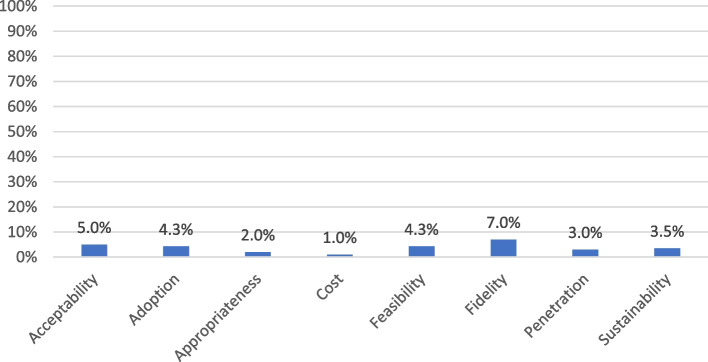
- Acceptability was the most studied implementation outcome (52.1%), followed by fidelity (39.3%), feasibility (38.6%), adoption (26.5%), and appropriateness (21.8%); penetration (16.0%), sustainability (15.8%), and cost (7.8%) were less frequently examined.
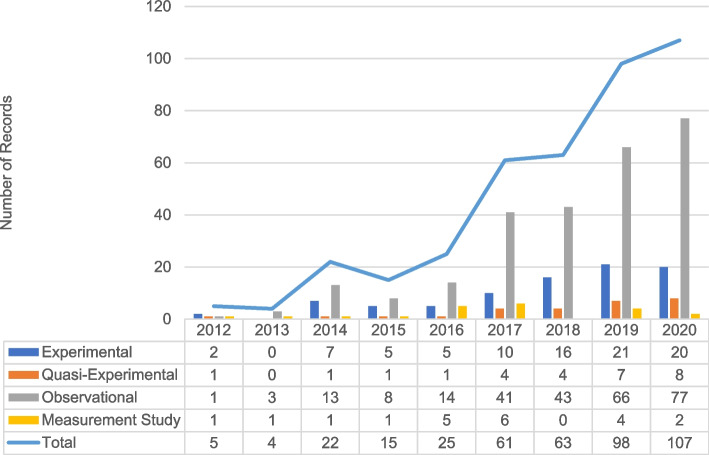
- Most studies were observational (66.5%), with fewer experimental (21.5%) or quasi-experimental (6.8%) designs; 32 manuscripts (8%) identified implementation outcomes not in the original taxonomy.
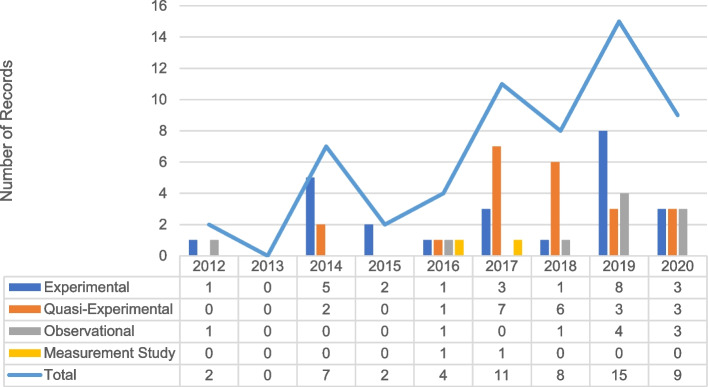
- Only 56 manuscripts (14.0%) examined implementation outcomes in relation to implementation strategies, and only 21 (5.0%) tested relationships among different implementation outcomes.
- Most studies occurred in healthcare (45.8%) or behavioral health (22.5%) organizations; no articles examined the role of implementation outcomes in relation to equity.
Methods
- Arksey and O’Malley’s scoping review framework guided the review, using forward citation tracing of literature citing the 2011 Proctor et al. paper.
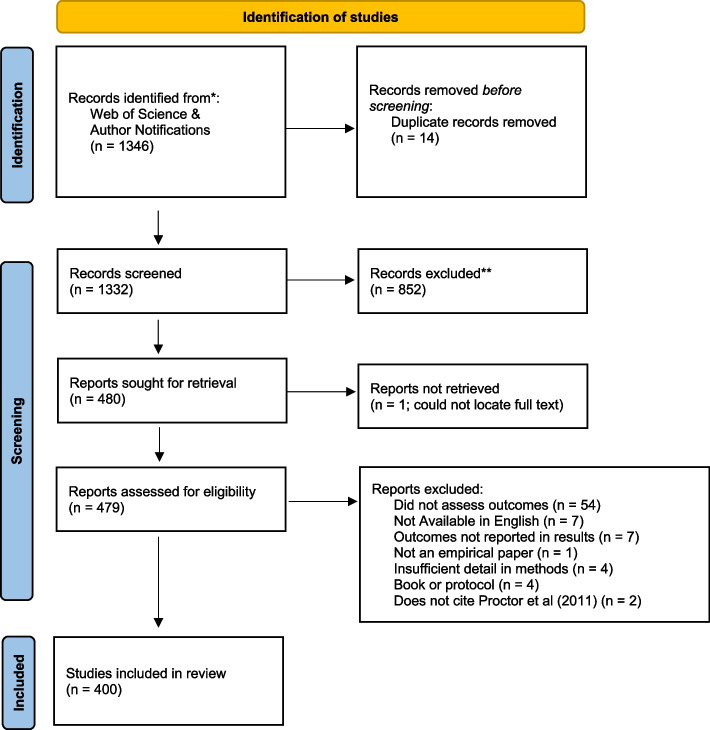
- Searches were conducted in Web of Science, supplemented by publisher citation alerts, covering October 2010 to October 30, 2020; 1346 abstracts were screened, yielding 400 included manuscripts that empirically assessed at least one implementation outcome.
- Data were charted with a customized Google Form; analyses calculated frequencies, averages, and trends over time, including implementation outcomes’ roles as correlates, dependent variables, and relationships with service and clinical outcomes.
Limitations
- The paper states that including only articles citing the 2011 Proctor et al. paper likely underestimates advances anchored in alternative theories or taxonomies, such as RE-AIM, especially in adjacent disciplines.
- The paper states that coding challenges, particularly around precision of reporting, could have introduced errors during data charting.
- Evident from the text: the review’s findings on equity are constrained by the near-total absence of equity-focused studies in the included sample, limiting conclusions about implementation outcomes and disparities.
Model-written summary. Check it against the paper before relying on it.
Integrity signals
Registry
Cites
Statistics
Figures
Verification
Claims the paper makes
36 Valid · 4 Not valid · 6 Not checked · 109 Own results and interpretations
Some cited sources support this claim and some don’t — read each source’s verdict below.
In the paper
“For example, there has been widespread attention to scale-up [44–49].”
§ Ten years of implementation outcomes research: a scoping review > Discussion > How has research on implementation outcomes advanced over the past 10 years?
What the sources say
- Supportedcites [44] Goldberg E Conte K Loblay V Groen S Persson L Innes-Hughes C Scale-up of prevention programmes: sustained state-wide use of programme delivery software is explained by normalised self-organised adoption and non-adoption Implement Sci 2022 17 5 35033154 PMC8760884 source
The Introduction says that efforts to implement effective interventions at scale have increased over the last two decades. That supports the citing sentence’s broad point that scale-up has received widespread attention. (LLM, conf=0.87)
- Supportedcites [45] Mugwanya KK Irungu E Bukusi E Mugo NR Odoyo J Wamoni E Scale up of PrEP integrated in public health HIV care clinics: a protocol for a stepped-wedge cluster-randomized rollout in Kenya Implement Sci 2018 13 118 30180860 PMC6123996 source
This paper is an example of attention to scale-up: the Design section describes a staged rollout of PrEP delivery across 24 Kenyan clinics, and the Discussion says the project aims to catalyze scaled implementation. As one of several citations attached to the sentence, it supports the example rather than establishing the breadth of attention on its own. (LLM, conf=0.88)
- Supportedcites [46] Sherr K Ásbjörnsdóttir K Crocker J Coutinho J de Fatima CM Tavede E Scaling-up the Systems Analysis and Improvement Approach for prevention of mother-to-child HIV transmission in Mozambique (SAIA-SCALE): a stepped-wedge cluster randomized trial Implement Sci 2019 14 41 31029171 PMC6487047 source
The Background describes significant investments to scale up Option B+ and a need to study how improvement strategies can be scaled up. The paper itself is a trial protocol focused on scale-up, so it serves as an example of attention to the topic. (LLM, conf=0.85)
- Supportedcites [47] Nguyen MXB Chu A v. Powell BJ Tran H v. Nguyen LH Dao ATM Comparing a standard and tailored approach to scaling up an evidence-based intervention for antiretroviral therapy for people who inject drugs in Vietnam: study protocol for a cluster randomized hybrid type III trial Implementation Sci. 2020 15 64 PMC7414564 32771017 source
The Background treats scale-up as an active area of work, describing a need to evaluate systematic approaches and noting that many countries have scaled up HIV services. The Discussion also identifies scaling up the intervention as a priority in implementation science. These passages support the broad statement that scale-up has received widespread attention. (LLM, conf=0.86)
- Disputedcites [48] Ilott I Gerrish K Pownall S Eltringham S Booth A Exploring scale-up, spread, and sustainability: an instrumental case study tracing an innovation to enhance dysphagia care Implement Sci 2013 8 128 24168667 PMC3874792 sourceExperimental — accuracy not yet measured
The Background calls scale-up, spread, and related concepts “under-theorised, and little-researched.” The Discussion describes scale-up, spread, and sustainability as “relatively neglected aspects of implementation,” contrary to the claim of widespread attention. Page numbers are not available in our copy. (LLM, conf=0.86)
Checked by a reasoning model — may be wrong.
- Supportedcites [49] Williams CR Bogdewic S Owen MD Srofenyoh EK Ramaswamy R A protocol for evaluating a multi-level implementation theory to scale-up obstetric triage in referral hospitals in Ghana Implement Sci 2020 15 31 32398109 PMC7218616 source
The Plain language summary (page not specified) describes a project to scale up obstetric triage in six additional hospitals. As one of several citations offered to illustrate attention to scale-up, this paper is a relevant example. (LLM, conf=0.84)
plain- Asserted: passes — The authors put it forward as true.
- Checkable: passes — It can be checked against evidence.
- Load-bearing: unclear — It is unclear whether the paper’s conclusions depend on it.
- Based: passes — The paper gives a reason why it holds.
- Supported
Every source the paper cites for this claim was checked and supports it.
In the paper
“Third, the taxonomy raised widespread awareness around the lack of tools, instruments, and designs (e.g., hybrids II and III [5, 6]) that support the measurement of implementation outcomes either as standalone research aims or in conjunction with other outcomes and/or variables capturing contextual determinants.”
§ Ten years of implementation outcomes research: a scoping review > Background > Impact of the 2011 implementation outcomes paper
What the sources say
- Supportedcites [5] Curran GM, Bauer M, Mittman B, Pyne JM, Stetler C. Effectiveness-implementation hybrid designs. Med Care. 2012;50.3(2011):217. PMC3731143 22310560 source
The citation is attached to “hybrids II and III” as examples of designs, not to the sentence’s claim that the taxonomy raised widespread awareness. The Defining Terminology section describes hybrid designs that assess implementation alongside clinical outcomes, and the Hybrid Type 2 and Type 3 sections describe the cited design types specifically (page numbers unavailable). (LLM, conf=0.90)
- Supportedcites [6] Curran GM, Landes SJ, McBain SA, Pyne JM, Smith JD, Fernandez ME, et al. Reflections on 10 years of effectiveness-implementation hybrid studies. Front Health Serv. 2022;2:125. PMC10012680 36925811 source
The citation is attached to the examples ‘hybrids II and III,’ rather than to the citing authors’ broader assertion about widespread awareness. In ‘Which research design should I use for my hybrid type?’ (page unavailable), the source identifies Types 2 and 3 as hybrid approaches in which implementation outcomes are typically measured. (LLM, conf=0.88)
plainstates a cause- Asserted: passes — The authors put it forward as true.
- Checkable: passes — It can be checked against evidence.
- Load-bearing: unclear — It is unclear whether the paper’s conclusions depend on it.
- Based: passes — The paper gives a reason why it holds.
- Supported
Every source the paper cites for this claim was checked and supports it.
In the paper
“Moullin and colleagues further refined pragmatic measurement via the PRESS measure for provider-rated sustainment in inner contexts [13]”
§ Ten years of implementation outcomes research: a scoping review > Background > The 2011 call for advances in the conceptualization and measurement
What the sources say
- Supportedcites [13] Moullin JC, Sklar M, Ehrhart MG, Green A, Aarons GA. Provider REport of Sustainment Scale (PRESS): development and validation of a brief measure of inner context sustainment. Implement Sci. 2021;16.1L:1–10. PMC8404332 34461948 source
The Contributions to the literature section describes PRESS as a brief, pragmatic sustainment measure completed by frontline providers on behalf of a clinic, team, or agency. The Discussion says it was developed and tested for providers delivering evidence-based practices in the inner context of clinics, teams, and organizations. (LLM, conf=0.93)
plainstates a cause- Asserted: passes — The authors put it forward as true.
- Checkable: passes — It can be checked against evidence.
- Load-bearing: unclear — It is unclear whether the paper’s conclusions depend on it.
- Based: passes — The paper gives a reason why it holds.
- Supported
The cited sources support only part of this claim — read each source’s verdict below.
In the paper
“This finding echoes recent reflections on the promises and pitfalls of implementation science [54] and suggests that our field has yet to empirically demonstrate the value of implementation science for improving health and healthcare quality.”
§ Ten years of implementation outcomes research: a scoping review > Discussion > More theory-building work and more experimental studies are needed
What the sources say
- Partly supportedcites [54] Beidas RS Dorsey S Lewis CC Lyon AR Powell BJ Purtle J Promises and pitfalls in implementation science from the perspective of US-based researchers: learning from a pre-mortem Implement Sci 2022 17 55 35964095 PMC9375077 sourceExperimental — accuracy not yet measured
In Theme 1 (page not provided), the paper says the literature has only a few examples of broad impact and calls for more empirical evidence linking implementation outcomes to health outcomes. That supports the concern about insufficient demonstration of value, but “has yet to empirically demonstrate” overstates the paper’s position by implying there are no examples. (LLM, conf=0.82)
hedged- Asserted: passes — The authors put it forward as true.
- Checkable: passes — It can be checked against evidence.
- Load-bearing: passes — The paper’s conclusions depend on it.
- Based: passes — The paper gives a reason why it holds.
- Partly supported
Every source the paper cites for this claim was checked and supports it.
In the paper
“The Implementation Outcomes Framework joined the ever-growing list of implementation research frameworks [3, 4], with unique contributions.”
§ Ten years of implementation outcomes research: a scoping review > Background > Impact of the 2011 implementation outcomes paper
What the sources say
- Supportedcites [3] Damschroder LJ, Aron DC, Keith RE, Kirsh SR, Alexander JA, Lowery JC. Fostering implementation of health services research findings into practice: a consolidated framework for advancing implementation science. Implement Sci. 2009;4.1(2009):1–15. PMC2736161 19664226 source
The Background describes many existing implementation theories, and the paper presents CFIR as an implementation research framework. This supports the citation’s role as an example of the frameworks whose ranks the Implementation Outcomes Framework joined; it does not attribute the Implementation Outcomes Framework itself to this paper. (LLM, conf=0.86)
- Supportedcites [4] Aarons GA, Hurlburt M, Horwitz SM. Advancing a conceptual model of evidence-based practice implementation in public service sectors. Administration and Policy in Mental Health and Mental Health Services Research. 2011;38(2011):4–23. PMC3025110 21197565 source
The Introduction (page unavailable) describes multiple implementation models and says that different models emphasize distinct factors. It also identifies this paper’s contribution as another implementation framework, supporting the cited background point that the field contains a growing range of frameworks. (LLM, conf=0.88)
plain- Asserted: passes — The authors put it forward as true.
- Checkable: passes — It can be checked against evidence.
- Load-bearing: unclear — It is unclear whether the paper’s conclusions depend on it.
- Based: passes — The paper gives a reason why it holds.
- Supported
97 more claims · 6 with their cited sources checked
Create a free account to see all 155 claims and to verify the 1 reference still open.
- Probably not a substantial claim. 37
- It may state two separate claims as one. 23
Claims other papers make about this one
Each is checked against this paper’s own text: does it say what the citing paper says it does?
In the citing paper
“Similarly, because implementation outcomes were often inconsistently defined and poorly reported [28–30], we broadened our scope to include studies that identified team constructs as implementation determinants (i.e., barriers/facilitators) without explicitly defining and measuring an implementation outcome.”
From Teamwork and implementation of innovations in healthcare and human service settings: a systematic review (2024) · cites this paper as [29]
In the citing paper
“There was also poor measurement and reporting of implementation outcomes in many studies, consistent with a recent review of research on implementation outcomes [28, 29].”
From Teamwork and implementation of innovations in healthcare and human service settings: a systematic review (2024) · cites this paper as [29]
Self-check
Percentages, sums and reported differences re-computed from the paper’s own numbers.
Each contradiction between two passages listed here was confirmed by an independent check.
Rated minor: it would not touch a result — a value no result rests on, a p-value that stays on the same side of the significance level, or a conflict that is clerical, resolved elsewhere in the paper, or outside its own findings.
In the paper
“Only 5.0% (n = 21) tested relationships among different implementation outcomes.”
§ Ten years of implementation outcomes research: a scoping review > Results > Question 5: What interrelationships between implementation outcomes have been studied empirically? This theory-building question includes relationships among implementation outcomes and other outcome types, specifically service and clinical outcomes
Reported 5 · recomputed 5.25
Rated minor: it would not touch a result — a value no result rests on, a p-value that stays on the same side of the significance level, or a conflict that is clerical, resolved elsewhere in the paper, or outside its own findings.
In the paper
§ Ten years of implementation outcomes research: a scoping review > Abstract > Methods
“Initial abstract screening yielded 480 manuscripts, and full-text review yielded 400 manuscripts that met inclusion criteria”
§ Ten years of implementation outcomes research: a scoping review > Results
“Our identification process generated 1346 abstracts for screening, which yielded 479 manuscripts for full-text review.”
Rated minor: it would not touch a result — a value no result rests on, a p-value that stays on the same side of the significance level, or a conflict that is clerical, resolved elsewhere in the paper, or outside its own findings.
In the paper
§ Ten years of implementation outcomes research: a scoping review > Results > Question 1: To what extent has each of the eight implementation outcomes been examined empirically in the literature? What additional implementation outcomes were identified?
“followed by fidelity (38.8%), feasibility (36.9%), adoption (24.0%), and appropriateness (20.1%). Penetration (15.4%), sustainability (15.1%), and cost (7.5%) were examined less frequently (Table 2).”
§ Ten years of implementation outcomes research: a scoping review > Results > Question 1: To what extent has each of the eight implementation outcomes been examined empirically in the literature? What additional implementation outcomes were identified?
“| % of included studies | 100.0% | 52.1% | 26.5% | 21.8% | 7.8% | 38.6% | 39.3% | 16.0% | 15.8% |”
Rated minor: it would not touch a result — a value no result rests on, a p-value that stays on the same side of the significance level, or a conflict that is clerical, resolved elsewhere in the paper, or outside its own findings.
In the paper
§ Ten years of implementation outcomes research: a scoping review > Results > Question 5: What interrelationships between implementation outcomes have been studied empirically? This theory-building question includes relationships among implementation outcomes and other outcome types, specifically service and clinical outcomes
“only 23 manuscripts (5.8%) examined implementation outcomes in relation to service outcomes.”
§ Ten years of implementation outcomes research: a scoping review > Results > Question 5: What interrelationships between implementation outcomes have been studied empirically? This theory-building question includes relationships among implementation outcomes and other outcome types, specifically service and clinical outcomes
“Table: Table 7 Implementation outcomes and service system outcomes (n = 22)”
Rated minor: it would not touch a result — a value no result rests on, a p-value that stays on the same side of the significance level, or a conflict that is clerical, resolved elsewhere in the paper, or outside its own findings.
In the paper
“| Service system | 4.8% | 1.9% | 3.8% | 0.0% | 16.1% | 4.5% | 4.5% | 4.7% | 6.3% |”
§ Ten years of implementation outcomes research: a scoping review > Results > Question 5: What interrelationships between implementation outcomes have been studied empirically? This theory-building question includes relationships among implementation outcomes and other outcome types, specifically service and clinical outcomes
Reported 4.8 · recomputed 5.75
Citations
Cites
Scoping studies: towards a methodological framework
Arksey, H., & O'Malley, L. (2005) · International Journal of Social Research Methodology · doi:10.1080/1364557032000119616 · Cited by 36,742
Damschroder, L. J., Aron, D. C., Keith, R. E., Kirsh, S. R., Alexander, J. A., & Lowery, J. C. (2009) · Implementation Science · doi:10.1186/1748-5908-4-50 · Cited by 14,496
Proctor, E., Silmere, H., Raghavan, R., Hovmand, P., Aarons, G., Bunger, A., Griffey, R., & Hensley, M. (2011) · Administration and Policy in Mental Health and Mental Health Services Research · doi:10.1007/s10488-010-0319-7 · Cited by 8,721
Self-citationCurran, G. M., Bauer, M., Mittman, B., Pyne, J. M., & Stetler, C. (2012) · Medical Care · doi:10.1097/mlr.0b013e3182408812 · Cited by 4,058
Advancing a Conceptual Model of Evidence-Based Practice Implementation in Public Service Sectors
Aarons, G. A., Hurlburt, M., & Horwitz, S. M. (2011) · Administration and Policy in Mental Health and Mental Health Services Research · doi:10.1007/s10488-010-0327-7 · Cited by 3,240 · cited 1×
“The Implementation Outcomes Framework joined the ever-growing list of implementation research frameworks [3, 4], with unique contributions.”
MethodPsychometric assessment of three newly developed implementation outcome measures
Weiner, B. J., Lewis, C. C., Stanick, C., Powell, B. J., Dorsey, C. N., Clary, A. S., Boynton, M. H., & Halko, H. (2017) · Implementation Science · doi:10.1186/s13012-017-0635-3 · Cited by 2,819 · cited 1×
“Weiner and colleagues’ study of the psychometric properties for measures of three key implementation outcomes [12].”
BackgroundRE-AIM Planning and Evaluation Framework: Adapting to New Science and Practice With a 20-Year Review
Glasgow, R. E., Harden, S. M., Gaglio, B., Rabin, B., Smith, M. L., Porter, G. C., Ory, M. G., & Estabrooks, P. A. (2019) · Frontiers in Public Health · doi:10.3389/fpubh.2019.00064 · Cited by 2,528 · cited 1×
“…and sustainment of evidence-based care to the entirety of a system’s service recipients or a community’s under-resourced populations can serve as measurable indicators of equitable access and reach [63, 64], consistent with calls to prioritize structural racism in contextual analyses [65].”
BackgroundProctor, E. K., Landsverk, J., Aarons, G., Chambers, D., Glisson, C., & Mittman, B. (2009) · Administration and Policy in Mental Health and Mental Health Services Research · doi:10.1007/s10488-008-0197-4 · Cited by 1,894 · cited 1×
“Equity is a key service system outcome [1, 62].”
BackgroundSelf-citationWaltz, T. J., Powell, B. J., Fernández, M. E., Abadie, B., & Damschroder, L. J. (2019) · Implementation Science · doi:10.1186/s13012-019-0892-4 · Cited by 1,136
Nilsen, P., & Bernhardsson, S. (2019) · BMC Health Services Research · doi:10.1186/s12913-019-4015-3 · Cited by 1,014
Research works printed but not linked: 1
- Society for Implementation Research Collaboration. The SIRC Instrument Review Project (IRP) [Internet]. [cited 2022 Sep 12]. https://societyforimplementationresearchcollaboration.org/sirc-instrument-project/.
Cited by
Ashcraft, L. E., Goodrich, D. E., Hero, J., Phares, A., Bachrach, R. L., Quinn, D. A., Qureshi, N., Ernecoff, N. C., Lederer, L. G., Scheunemann, L. P., et al. (2024) · Implementation Science · doi:10.1186/s13012-024-01369-5 · Cited by 89
“…“implementation strateg*” OR “implementation intervention*” OR “implementation bundl*” OR “implementation support*. ” The search, conducted on September 20, 2022, was limited to English language and publication between 2010 and 2022, similar to other recent implementation science reviews [22].”
BackgroundResultCurrent Implementation of Digital Health in Chronic Disease Management: Scoping Review
Pong, C. Y., Tseng, R. M. W. W., Tham, Y. C., & Lum, E. (2024) · Journal of Medical Internet Research · doi:10.2196/53576 · Cited by 126
“In addition, we agree with Proctor et al [302] that future studies testing the relationships between implementation strategies and implementation, service, and patient outcomes are needed.”
InfluentialMcGuier, E. A., Kolko, D. J., Aarons, G. A., Schachter, A., Klem, M. L., Diabes, M. A., Weingart, L. R., Salas, E., & Wolk, C. B. (2024) · Implementation Science · doi:10.1186/s13012-024-01381-9 · Cited by 70
“There was also poor measurement and reporting of implementation outcomes in many studies, consistent with a recent review of research on implementation outcomes [28, 29].”
BackgroundResultAl-Omary, H., Soltani, A., Stewart, D. C., & Nazar, Z. J. (2024) · BMC Medical Education · doi:10.1186/s12909-024-06016-7 · Cited by 109
“The Consolidated Framework for Implementation Research is specifically designed to systematically assess barriers and facilitators in implementation within local settings and can guide decisions regarding the needs within a local context [73].”
BackgroundCorrection: Ten years of implementation outcomes research: a scoping review
Proctor, E. K., Bunger, A. C., Lengnick-Hall, R., Gerke, D. R., Martin, J. K., Phillips, R. J., & Swanson, J. C. (2023) · Implementation Science · doi:10.1186/s13012-023-01313-z · Cited by 53
Self-citationFlynn, R., Cassidy, C. E., Dobson, L., Al-Rassi, J., Langley, J. E., Swindle, J., Graham, I. D., & Scott, S. D. (2023) · Implementation Science · doi:10.1186/s13012-023-01320-0 · Cited by 61
Bridges and Mechanisms: Integrating Systems Science Thinking into Implementation Research
Luke, D. A., Powell, B. J., & Paniagua-Ávila, A. (2023) · Annual Review of Public Health · doi:10.1146/annurev-publhealth-060922-040205 · Cited by 61
Lyon, A. R., Connors, E. H., Lawson, G. M., Nadeem, E., & Owens, J. S. (2024) · School Mental Health · doi:10.1007/s12310-024-09731-0 · Cited by 60
“However, testing the impact of implementation strategies on implementation outcomes has been relatively slow to advance across sectors (Proctor et al., 2023) and the impact of this work will be limited if the strategies developed and studied are not practical in real-world school settings.”
Bunger, A. C., Chuang, E., Girth, A. M., Lancaster, K. E., Smith, R., Phillips, R. J., Martin, J. K., Gadel, F., Willauer, T., Himmeger, M., et al. (2024) · Implementation Science · doi:10.1186/s13012-024-01335-1 · Cited by 48
“…of action generated from our expert panel explained how different cross-system collaboration strategies might be targeted to specific implementation challenges that affect implementation and service system outcomes, and respond to calls for more theory-building work in implementation [86].”
BackgroundSelf-citationMa, A. S., O’Shea, R., Wedd, L., Wong, C. M. Y., Jamieson, R. V., & Rankin, N. M. (2024) · European Journal of Human Genetics · doi:10.1038/s41431-024-01555-5 · Cited by 50
“These are well-used constructs in the implementation science literature since 2011, in over 400 papers as a standard measure of implementation outcomes [19].”
MethodFirm, yet flexible: a fidelity debate paper with two case examples
Albers, B., Verweij, L., Blum, K., Oesch, S., Schultes, M.-T., Clack, L., & Naef, R. (2024) · Implementation Science · doi:10.1186/s13012-024-01406-3 · Cited by 37
“Fidelity has traditionally been defined as “ the degree to which (…) program providers implement programs as intended by the program developers ” [1] (p.240) and is the most frequently assessed process outcome in intervention and implementation research [2].”
Human-Centered Design to Enhance Implementation and Impact in Health
Lyon, A. R., Aung, T., Bruzios, K. E., & Munson, S. A. (2024) · Annual Review of Public Health · doi:10.1146/annurev-publhealth-071823-122337 · Cited by 55
Ball, H., Eisner, E., Nicholas, J., Wilson, P. M., & Bucci, S. (2025) · BMC Public Health · doi:10.1186/s12889-025-22189-2 · Cited by 29
“Thus, the majority of implementation outcome research in this area to date has provided information about the degree to which stakeholders like, or find usable, the DHI and related practices: this can help to refine interventions, support initial uptake, and improve patient centredness [73].”
Chiang, J., Chua, Z. Y., Chan, J. Y., Sule, A. A., Loke, W. H., Lum, E., Ong, M. E. H., Graves, N., & Ngeow, J. Y. Y. (2024) · npj Genomic Medicine · doi:10.1038/s41525-024-00412-0 · Cited by 26
del Pozo, B., Belenko, S. R., Pivovarova, E., Ray, B. R., Martins, K. F., & Taxman, F. S. (2024) · Police Quarterly · doi:10.1177/10986111241265290 · Cited by 30
“Through all of this, it is critical to reiterate that rigorous IS about two things: methodical implementation, and testing the relationship between given implementation strategies and implementation outcomes (Proctor et al., 2023).”
Barry, S. M., & Davies, C. (2025) · Future Healthcare Journal · doi:10.1016/j.fhj.2025.100452 · Cited by 30
Fidelity, not adaptation, is essential for implementation
Fixsen, D. L. (2025) · Frontiers in Health Services · doi:10.3389/frhs.2025.1575179 · Cited by 19
Akhtar, S., Rabbani, F., Nafis, J., Siddiqui, A., & Merali, Z. (2025) · BMC Psychiatry · doi:10.1186/s12888-024-06459-8 · Cited by 24
“This paper advances the concept of “implementation outcomes” and works through the lens of RE-AIM framework [37, 40] to report on acceptability, adoption, and appropriateness of the proposed intervention prior to implementation [41].”
Buccini, G., Gubert, M. B., Palmeira, P. D. A., Godoi, L. P. D. S., dos Santos, L. D., Esteves, G., Venâncio, S. I., & Pérez‐Escamilla, R. (2024) · The Lancet Regional Health - Americas · doi:10.1016/j.lana.2023.100665 · Cited by 32
“Because adoption can be a function of appropriateness (i.e., perceived fi t) and feasibility (i.e., actual fi t), 42 we hypothesise that large municipalities have a complex structure, which requires adaptations to the PCF protocols to improve its actual fi t; however, the national and state technical…”
BackgroundUsing Implementation Science to Implement Evidence‐Based Practice: A Discursive Paper
Chays‐Amania, A., Schwingrouber, J., & Colson, S. (2024) · Journal of Advanced Nursing · doi:10.1111/jan.16571 · Cited by 29
Fehlberg, Z., Stark, Z., Klaic, M., & Best, S. (2024) · Implementation Science Communications · doi:10.1186/s43058-024-00675-9 · Cited by 22
“However, there remains a dearth of evidence that links the outcomes to successful implementation strategies or to actual adoption or implementation [6].”
InfluentialKemp, C. G., Edwards, A., White, L. A., Kore, G., Thurman, P. J., Gaines, T., King, P. T., Cole, M., & Orellana, E. R. (2024) · Current HIV/AIDS Reports · doi:10.1007/s11904-024-00706-z · Cited by 15
“However, in alignment with most other implementation research, few studies measured later-stage implementation outcomes like fidelity, cost, or sustainability [61–64].”
ResultRabbani, F., Nafis, J., Akhtar, S., Khan, M. S., Sayani, S., Siddiqui, A., Siddiqi, S., & Merali, Z. (2024) · JMIR Research Protocols · doi:10.2196/54272 · Cited by 15
“The framework provides a thorough implementation research structure and focuses on several outcomes like acceptability, appropriateness, adoption, feasibility, and so forth [34].”
BackgroundSalleh, H., Avoi, R., Karim, H. A., Osman, S. B., Kaur, N. J., & Dhanaraj, P. S. (2023) · PLoS ONE · doi:10.1371/journal.pone.0294238 · Cited by 17
Stadnick, N. A., Laurent, L. C., Cain, K. L., Seifert, M., Burola, M. L., Salgin, L., Watson, P., Oswald, W., Munoz, F. A., Velasquez, S., et al. (2023) · Implementation Science · doi:10.1186/s13012-023-01306-y · Cited by 15
“In addition, this study will advance the call for action [25] to explicitly examine the role of implementation vis-à-vis implementation strategies and other health outcomes.”
BackgroundWilson, P. M., Aarons, G. A., Sales, A. E., Xu, D. R., Wensing, M., Hutchinson, A. M., Beidas, R. S., & Geng, E. (2024) · Implementation Science · doi:10.1186/s13012-024-01399-z · Cited by 13
Allen, C. G., Sterba, K. R., Norman, S., Jackson, A., Hunt, K. J., McMahon, L. L., & Judge, D. P. (2023) · Implementation Science Communications · doi:10.1186/s43058-023-00500-9 · Cited by 13
“Our future work will be able to assess both the impact of the strategies on implementation team member’s perceptions of the program and actual outcomes [27].”
Backgrounddel Pozo, B., Nevill, R. E. A., Cepeda, J., Adams, I. T., Whiteside, A., & Thompson, E. (2024) · Police Practice and Research · doi:10.1080/15614263.2025.2512806 · Cited by 19
“…factors that influence an innovation’s feasibility, acceptability, adoption, penetration, cost, and sustainability (E. Proctor et al., 2011; E. K. Proctor et al., 2023), with an emphasis on identifying the strategies and techniques that maximize the potential for success across these dimensions.”
Fisher, G., Smith, C. L., Pagano, L., Spanos, S., Zurynski, Y. A., & Braithwaite, J. (2025) · The Lancet Planetary Health · doi:10.1016/s2542-5196(25)00056-7 · Cited by 12
Implementation strategies of fall prevention interventions in hospitals: a systematic review
Spoon, D., de Legé, T., Oudshoorn, C., van Dijk, M., & Ista, E. (2024) · BMJ Open Quality · doi:10.1136/bmjoq-2024-003006 · Cited by 30
“89”
Oesch, S., Verweij, L., Riguzzi, M., Finch, T. L., & Naef, R. (2024) · Journal of Advanced Nursing · doi:10.1111/jan.16544 · Cited by 15
“Feasibility captures KPs' perceptions on the extent to which the FSI can be successfully used or implemented in their ICUs (Proctor et al. 2023).”
InfluentialSmith, N., Levy, D. E., Falbe, J., Purtle, J., & Chriqui, J. F. (2024) · Frontiers in Health Services · doi:10.3389/frhs.2024.1322702 · Cited by 17
Faro, E. Z., Taber, P. A., Seaman, A. T., Rubinstein, E. B., Fix, G. M., Healy, H. S., & Reisinger, H. S. (2024) · Implementation Science · doi:10.1186/s13012-024-01344-0 · Cited by 14
“As implementation science has become an established, methodologically rigorous, and theoretically informed field in its own right, there has been increasing interest in unpacking what goes into good implementation science [1, 2].”
BackgroundWeight, C., Vinette, B., Laritz, R., Mooney, M., Castiglione, S. A., Maheu‐Cadotte, M., Argiropoulos, N., Konnyu, K. J., Cassidy, C. E., Collins, S. E., et al. (2025) · Implementation Science · doi:10.1186/s13012-025-01442-7 · Cited by 14
Harnessing Implementation Science in Clinical Psychology: Past, Present, and Future
Beidas, R. S., Boyd, M. R., Casline, E. P., Scott, K., Patel, Z. S., Mills, C., Mustanski, B. S., Schriger, S. H., Williams, F. S., Waller, C., et al. (2025) · Annual Review of Clinical Psychology · doi:10.1146/annurev-clinpsy-081423-021727 · Cited by 14
Messiha, K., Thomas, N., Brayne, C., Agnello, D. M., Delfmann, L. R., Giné‐Garriga, M., Lippke, S., & Downey, J. (2025) · BMC Medical Research Methodology · doi:10.1186/s12874-025-02577-3 · Cited by 12
“This mirrors the findings from a scoping review looking at the improvements in implementation strategies in primary research over the last decade, which suggests that implementation success is unlikely with current approaches [53].”
Crawshaw, J., Callum, J. L., CHARGÉ, S. B. P., Lorencatto, F., Presseau, J., Raza, S., Relke, N., Wolfe, A., & Stanworth, S. J. (2025) · Transfusion · doi:10.1111/trf.18234 · Cited by 12
“69,70 Additionally, where possible, it is advised to utilize existing routinely collected data sources/indicators (potentially identified during environmental scanning) or ensure that process and outcome data are added where possible to enable evaluation of uptake and variation in care.”
Implementing the Eat, Sleep, Console Model of Care: A Scoping Review
Gallant, S. M., DeCoste, K. L., Norris, N., McConnell, E., Al-Rassi, J., Churchill, M., Higgins, A., Rothfus, M. A., Mann, C., Benoit, B., et al. (2025) · Hospital Pediatrics · doi:10.1542/hpeds.2024-008078 · Cited by 11
Dopp, A. R., Hunter, S. B., Godley, M. D., González, I. E., Bongard, M., Han, B., Cantor, J., Hindmarch, G., Lindquist, K. M., Wright, B., et al. (2023) · Implementation Science · doi:10.1186/s13012-023-01305-z · Cited by 7
“…or client level, but it is equally important to understand provider-level reach—i.e., the proportion of eligible clinicians and/or supervisors who start using an EBP (sometimes called “penetration” [22]), since implementation strategies often target organizations or providers (e.g., training).”
BackgroundMethodLarsson, I., Siira, E., Nygren, J., Petersson, L., Svedberg, P., Nilsén, P., & Neher, M. (2025) · BMC Family Practice · doi:10.1186/s12875-025-03057-9 · Cited by 16
“The outcome of an implementation process is often described as a complex of implementation outcomes, service outcomes and client outcomes [48, 61].”
Decolonising implementation science: a call for methodological pluralism
Hafez, S., Pacho, A., Ponsford, R., Ranganathan, M., Gafos, M., & Soremekun, S. (2026) · The Lancet Global Health · doi:10.1016/s2214-109x(25)00477-2 · Cited by 9
Navigating qualitative methods choices in dissemination and implementation research
Holtrop, J. S., Holliman, B. D., & Hamilton, A. B. (2025) · Implementation Science · doi:10.1186/s13012-025-01476-x · Cited by 12
“D&I research examines not only clinical or health outcomes but also implementation outcomes such as feasibility, acceptability, adoption, penetration, and sustainability [11, 12].”
Kossinna, C., Lau, C. L., Mayr, H. L., Wilkinson, S. A., Young, A., Meloncelli, N. J. L., Cameron, A. E., Rigby, R. R., & Hickman, I. J. (2025) · Nutrition in Clinical Practice · doi:10.1002/ncp.70016 · Cited by 15
“Longer ‐ term implementation outcomes such as sustainability are often poorly reported in the literature 48 and yet are crucial for successful knowledge translation.”
Chays‐Amania, A., Schwingrouber, J., Melnyk, B. M., Haller, P. H., Soler, J., & Colson, S. (2025) · Worldviews on Evidence-Based Nursing · doi:10.1111/wvn.70050 · Cited by 10
“The under-use of Proctor's taxonomy is in line with the results of the scoping review (Proctor et al. 2023).”
User journey method: a case study for improving digital intervention use measurement
Lukka, L., Vesterinen, M., Salonen, A., Bergman, V.-R., Torkki, P. M., Palva, S., & Palva, J. M. (2025) · BMC Health Services Research · doi:10.1186/s12913-025-12641-9 · Cited by 9
“Thus, user journey can complement existing implementation frameworks [104–106] and outcome indicators [107], and facilitate digital interventions reaching real-world impact.”
Interventions for improving critical care in low- and middle-income countries: a systematic review
Wagstaff, D., Arfin, S., Korver, A., Chappel, P., Rashan, A., Haniffa, R., & Beane, A. (2024) · Intensive Care Medicine · doi:10.1007/s00134-024-07377-9 · Cited by 11
Vincenzo, J. L., Bergen, G., Casey, C. M., & Eckstrom, E. (2024) · The Gerontologist · doi:10.1093/geront/gnae035 · Cited by 10
Kehoe, M., Whitehead, R., de Boer, K., Meyer, D., Hopkins, L., & Nedeljkovic, M. (2024) · Health Expectations · doi:10.1111/hex.13989 · Cited by 7
“19,20 A major recommendation of the commission was to embed codesign into mental health interventions and treatment programmes.”
BackgroundThe wide-angle lens of implementation science to improve health outcomes in criminal legal settings
Taxman, F. S., & Belenko, S. R. (2025) · Health & Justice · doi:10.1186/s40352-025-00323-x · Cited by 7
“A recent scoping review (Proctor et al., 2023) revealed that in the past decade after this model was specified, implementation studies have been conducted in a variety of settings with varied populations and various outcomes.”
Konlan, K. D., Ibrahim, Z. A., Lee, J., & Lee, H. (2025) · Digital Health · doi:10.1177/20552076251330194 · Cited by 8
“11,45 For instance, one study reported consistently assessing feasibility, 27 yet failed to specify concrete measurement criteria.”
InfluentialRaghavan, R., Fitzsimmons‐Craft, E. E., Welch, R. R., Jo, B., Proctor, E. K., Wilson, G. T., Agras, W. S., & Wilfley, D. E. (2024) · Implementation Science · doi:10.1186/s13012-024-01388-2 · Cited by 9
“The literature seemingly provides little guidance – a recent review [7] identified only 31 studies out of 400 that examined costs as an implementation outcome, and largely during the preparation phase, not in relation to other implementation outcomes.”
BackgroundSelf-citationComber, E. R., Keogh, S. J., Nguyen, L. N., Byrnes, J., & Ullman, A. J. (2024) · Journal of Advanced Nursing · doi:10.1111/jan.16268 · Cited by 11
“Proctor et al.'s ( 2023 ) scoping review identified minimal evidence in the current literature regarding the testing of relationships between implementation strategies and implementation outcomes (Proctor et al., 2023 ).”
Luce, C., Palazzo, L. G., Anderson, M. L., Carter‐Harris, L., Gao, H., Green, B. B., Ralston, J. D., Rogers, K., Su, Y., Tuzzio, L., et al. (2024) · Contemporary Clinical Trials · doi:10.1016/j.cct.2024.107495 · Cited by 9
Emmons, K. M., Brownson, R. C., & Luke, D. A. (2024) · Journal of Clinical and Translational Science · doi:10.1017/cts.2024.582 · Cited by 9
Xames, M. D., Topcu, T. G., Parker, S. H., Zagarese, V., & Epling, J. W. (2025) · Frontiers in Digital Health · doi:10.3389/fdgth.2025.1611225 · Cited by 9
“Within the field of implementation science, there have been calls to “specify and test mechanistic pathways… about drivers, moderators and mediators of implementation outcomes” and provide “finer-grained identification” of variables that influence and precede implementation outcomes (33).”
Gudzak, V., Logeman, C., Crown, N., Ilersich, A. N. T., Folinas, M., McMurtry, C. M., Bucci, L. M., Shea, C., Shah, V. S., Boon, H. S., et al. (2025) · Human Vaccines & Immunotherapeutics · doi:10.1080/21645515.2025.2509484 · Cited by 13
“12”
InfluentialFehlberg, Z., Klaic, M., Croy, S., & Best, S. (2025) · Bundesgesundheitsblatt - Gesundheitsforschung - Gesundheitsschutz · doi:10.1007/s00103-025-04057-x · Cited by 8
Screening for comprehensive social needs in patients with cancer: a narrative review
Arana, I., Liu, R., Kushi, L. H., Hahn, E. E., & Ragavan, M. V. (2025) · JNCI Cancer Spectrum · doi:10.1093/jncics/pkaf012 · Cited by 8
“…to implement tools, including emailing or messaging the tool to the patient online, 14,15,35,38,39 screening via a research or health-care staff member on the phone or in-person, 15,25,26,33,40,41 or point-of-care tools given to patients to complete during visits to the health-care facility.”
Examining implementation outcomes in health information exchange systems: A scoping review
Lum, B., Weerasinghe, N., Chu, C. H., Perri, D., & Cranley, L. A. (2025) · Journal of Biomedical Informatics · doi:10.1016/j.jbi.2025.104782 · Cited by 14
Development and psychometric evaluation of the Implementation Support Competencies Assessment
Jensen, T. M., Metz, A. J. R., & Albers, B. (2024) · Implementation Science · doi:10.1186/s13012-024-01390-8 · Cited by 8
McNett, M., Tucker, S., Juckett, L., & Bunger, A. C. (2024) · Global Implementation Research and Applications · doi:10.1007/s43477-024-00122-w · Cited by 9
“While formal definitions of these measures have been proposed and widely used by implementation scientists (Lengnick-Hall et al., 2022; Proctor et al., 2023 ), they are not routinely integrated by clinical teams seeking to imple - ment a practice change.”
Self-citationSpence, T., Gibbs, J., Wong, G., Howarth, A., Copas, A. J., Crundwell, D., Jackson, L., Mercer, C. H., Mohammed, H. P., Apea, V., et al. (2025) · Journal of Medical Internet Research · doi:10.2196/72812 · Cited by 7
“However, there are fewer studies that have considered the sustainability of their implementation, and this evidence gap has been noted specifically in relation to OPSS and other remote testing services for STI or BBVs [3,19].”
Neshteruk, C. D., Luecking, C. T., Kracht, C. L., Burkart, S. A., Melnick, E. M., Anderson, R. E., & Lane, H. (2025) · Implementation Science Communications · doi:10.1186/s43058-025-00718-9 · Cited by 7
Malik, K., Annapally, S. R., Shilla, Y. A., Khanna, A., Kaurr, R., & Boban, A. (2025) · PLoS ONE · doi:10.1371/journal.pone.0317351 · Cited by 11
“There has been a paucity of attention towards the acceptability, feasibility and other implementation outcomes, which are important to fully understand the success of an intervention [22,23].”
Contributions from the Implementation Science Field to Clinical Trial Design for Kidney Research
Cervantes, L., Jolles, M. P., Rizzolo, K. M., Golestaneh, L., & Glasgow, R. E. (2024) · Journal of the American Society of Nephrology · doi:10.1681/asn.0000000596 · Cited by 7
Hyzak, K. A., Riccardi, J. S., Kinney, A. R., Esterov, D., Bogdanova, Y., & Bogner, J. A. (2024) · Journal of Head Trauma Rehabilitation · doi:10.1097/htr.0000000000000990 · Cited by 11
“54 Notably, only 4 articles in this review focused on reach as an implementation outcome, and only one investigated the cost-effectiveness of implementing the innovation.”
InfluentialBartels, S. L., Stephens, N. A., D’Andrea, F., Handley, M., Markaryan, M., Bernal, A. N., den Block, L. V., de Bruin, S. R., Windle, K., Roes, M., et al. (2024) · Frontiers in Dementia · doi:10.3389/frdem.2024.1458023 · Cited by 10
Austin, J. D., Rutten, L. J. F., Fischer, K. J., Ridgeway, J. L., Minteer, S. A., Griffin, J. M., Pachman, D. R., Ruddy, K. J., & Cheville, A. L. (2024) · JCO Oncology Practice · doi:10.1200/op.24.00280 · Cited by 6
Purgato, M., Bartucz, M. B., Turrini, G., Compri, B., Prina, E., Patania, F., Kucukozkan, E., Zubachova, A., Mňahončak, M., Čavojská, K., et al. (2024) · Cambridge Prisms Global Mental Health · doi:10.1017/gmh.2024.113 · Cited by 9
“First, to identify and structure the implementation barriers reported by service providers to in-person and digital MHPSS using the socio-ecological and implementation models (Bronfenbrenner, 1979; Proctor et al., 2023).”
Chen, K., Rogers, K., Haberkorn, W. J., Lew, M., Kanegan, J., Nam, H., Chantra, J., Asch, S. M., & Lee, G. M. (2026) · BMJ Quality & Safety · doi:10.1136/bmjqs-2025-019495 · Cited by 9
Maximizing researcher–policymaker engagement in global public health
Miranda, J. J., Beran, D., Nugent, R. A., Diez‐Canseco, F., Sargent, J. L., Madise, N., Hennig, B. J., Jiménez, M. M., Legido‐Quigley, H., Mendoza, W., et al. (2025) · Nature Medicine · doi:10.1038/s41591-025-04015-9 · Cited by 6
“This imperative aligns with Article 15 of the International Covenant on Economic, Social and Cultural Rights, which recognizes everyone’s right to enjoy the benefits of scientific progress and its applications 12 .”
Molle, J., Agnel, J., Colson, S., & Chays‐Amania, A. (2025) · International Journal of Nursing Studies Advances · doi:10.1016/j.ijnsa.2025.100414 · Cited by 14
Evaluating learning health systems: a jurisdictional scan
Panesar, B., Whitmore, C., Vanderhout, S. M., & Bird, M. (2025) · SSM - Health Systems · doi:10.1016/j.ssmhs.2025.100117 · Cited by 6
Balis, L. E., Palmer, S., Isack, M., & Yaroch, A. L. (2025) · Health Promotion Practice · doi:10.1177/15248399251362163 · Cited by 6
“…robust evaluation and dissemination practices may lead to improved intervention scale-up (i.e., to additional populations or delivery systems; Aarons et al., 2017)—which has recently been recognized as a potential implementation outcome to add to existing taxonomies (Proctor et al., 2023).”
Fabrizio, C. D., Gonçalves, J., & Martins, M. D. R. O. (2025) · Social Science & Medicine · doi:10.1016/j.socscimed.2025.118470 · Cited by 8
Hinrichsen, C., Kirk, J. W., & Broholm-Jørgensen, M. (2025) · Evaluation · doi:10.1177/13563890251346772 · Cited by 5
“…systems outcomes (e.g. efficiency, safety, effectiveness, and equity), and client outcomes (e.g. health and social outcomes and satisfaction), which has gained increasing attention since Proctor et al. (2011) first introduced their taxonomy on implementation outcomes in 2011 (Proctor et al., 2023).”
Examining the use of implementation science in autism intervention research: A scoping review
Lee, J. D., Terol, A. K., Tschida, J. E., Pomales‐Ramos, A., McEathron, S. R., Wallisch, A. M., & Boyd, B. A. (2025) · Autism · doi:10.1177/13623613251351344 · Cited by 8
“This reflects current trends in the field, where implementation outcomes are often underreported (Proctor et al., 2023).”
Adsul, P., Pergolotti, M., & Schmitz, K. H. (2025) · American Society of Clinical Oncology Educational Book · doi:10.1200/edbk-25-472854 · Cited by 8
Social Network as an Engagement Approach in Child Maltreatment Prevention Programs: A Scoping Review
Zhang, Y., Chen, J., Yuan, S., Cao, Q., Cruce, A., Gu, H., Xiao, X., & Chen, W. (2025) · Research on Social Work Practice · doi:10.1177/10497315251338478 · Cited by 4
“Implementation science in social work has emerged as a distinct fi eld over the past two decades (Cabassa, 2016), and the conceptualization of engagement as a core component of implementation in social work is similarly recent (Goodman & Thompson, 2017; Proctor et al., 2023).”
Ikemeh, C., Adeyemi, A., Frerichs, L., Shea, C. M., & Trogdon, J. G. (2025) · BMC Global and Public Health · doi:10.1186/s44263-025-00164-8 · Cited by 4
“We used two Proctor outcomes––penetration and fidelity––which are conceptualized as observable behavioral implementation outcomes in implementation science [22, 23].”
Pettersson, K., Millroth, P., Giannotta, F., Liedgren, P., Lyon, A. R., Hasson, H., & Schwarz, U. V. T. (2025) · Implementation Science · doi:10.1186/s13012-025-01421-y · Cited by 6
Zetterlund, J., Hasson, H., Schwarz, U. V. T., Neher, M., & Wahlström, E. (2025) · Implementation Research and Practice · doi:10.1177/26334895251334552 · Cited by 4
“There is a balancing act between fi delity (the degree to which an intervention was implemented as prescribed or intended; Proctor et al., 2023) and adaptation (any addition, subtraction, or modi fi cation made to the original method; Moore et al., 2013), when maintaining EBIs in practice (Rabin et…”
Toll, K., Robinson, S., Andrew, S., Williams, A., Yeung, J., Varhol, R., & Moullin, J. C. (2025) · BMC Health Services Research · doi:10.1186/s12913-025-12335-2 · Cited by 7
Sustainable implementation efforts in physio- and occupational therapy: a scoping review
Fritz, J., Stridsberg, S. L., & Holopainen, R. (2024) · Implementation Science Communications · doi:10.1186/s43058-024-00676-8 · Cited by 8
“There is little evidence concerning the relationship between implementation support strategies and implementation outcomes [8].”
InfluentialSantos, P. M. G., Silverwood, S., Suneja, G., Ford, E. C., Thaker, N. G., Ostroff, J. S., Weiner, B. J., & Gillespie, E. F. (2024) · International Journal of Radiation Oncology*Biology*Physics · doi:10.1016/j.ijrobp.2024.11.101 · Cited by 6
Exploring Perspectives on Stroke Standard Set Data Collection: A Qualitative Descriptive Study
McIntyre, A., Fueta, O., Janzen, S. E., et al. (2024) · Journal of Neuroscience Nursing · doi:10.1097/jnn.0000000000000791 · Cited by 4
Implementation of Evidence-Based Practice in Long-Term Care: A Scoping Review
McGough, E. L., & Thompson, H. J. (2024) · Journal of the American Medical Directors Association · doi:10.1016/j.jamda.2024.105026 · Cited by 8
Birkenhead, K. L., SULLIVAN, D. R., Trumble, C., Spinks, C., Srinivasan, S., Partington, A., Elias, L., Hespe, C. M., Fleming, G., Li, S., et al. (2024) · BMJ Open · doi:10.1136/bmjopen-2023-082699 · Cited by 8
Toll, K., Moullin, J. C., Andrew, S., Williams, A., Varhol, R., Carey, T. A., & Robinson, S. (2024) · Digital Health · doi:10.1177/20552076241242790 · Cited by 8
Effectiveness of prolonged exposure (PE) after implementation at a crime victim support centre
Saito, A., Tsuruta, N., Arai, Y., Okamoto, K., Narisawa, T., Nozaki, M., Konno, N., & Asukai, N. (2024) · European Journal of Psychotraumatology · doi:10.1080/20008066.2024.2302703 · Cited by 6
“Fifth, the study did not use a scale to measure implementation outcomes, such as acceptability, adoption, appropriateness, feasibility, fidelity, implementation cost, penetration, and sustainability (Proctor et al., 2011; 2023).”
BackgroundSchultes, M.-T., Baenziger, J., Nyantakyi, E., Wu, C. X., Ferrari, G., Sieswerda, E., van Werkhoven, C. H., Minotti, C., Wolfensberger, A., Tediosi, F., et al. (2026) · Implementation Science · doi:10.1186/s13012-026-01488-1 · Cited by 3
“Feasibility is “the extent to which an implementation target can be successfully used or deployed within a given setting” [53], meaning that sites are able to perform the intervention and implementation strategies in the way these are intended.”
Rödlund, A., Toropova, A., Lengnick‐Hall, R., Powell, B. J., Elinder, L. S., Björklund, C., & Kwak, L. (2025) · Implementation Science Communications · doi:10.1186/s43058-025-00821-x · Cited by 3
“This study addresses the research agenda for implementation outcomes research 2022–2023 [41] and issues related to the measurement and assessment of fidelity as an implementation outcome [44, 45].”
Self-citationPangalangan, J. M. L., Frates, E. P., Tollefson, M., Farewell, C. V., Brooks‐Russell, A., & Puma, J. E. (2025) · American Journal of Lifestyle Medicine · doi:10.1177/15598276251388439 · Cited by 5
Two Studies Assessing Early Intervention Fit of Independent Living Services in Sweden
Karlsson, M., Skoog, T., Bergström, M., Kajic, D., & Olsson, T. M. (2025) · Research on Social Work Practice · doi:10.1177/10497315251379394 · Cited by 4
Feasibility in Community Mental Health Research: A Scoping Review
Johnson, C. M., Valero-Martínez, C., Lu, C., Kiche, S. W., AlRasheed, R., Dahiya, P., Triplett, N. S., Smith‐LeCavalier, K. N., Testorf, A., & Dorsey, S. (2025) · Administration and Policy in Mental Health and Mental Health Services Research · doi:10.1007/s10488-025-01457-8 · Cited by 4
“As such, Proctor et al. (2023) found that within the past ten years of implementation outcome research, feasibility was the third most frequently studied implementation outcome—third only to fidelity and accept - ability.”
InfluentialMolldrem, S., Luft, H., Farroni, J. S., Lyons, E., & Wooten, K. C. (2025) · Journal of Clinical and Translational Science · doi:10.1017/cts.2025.22 · Cited by 4
“One aim of D&I Science is determining when to prioritize specific implementation outcomes [42,43].”
Buccini, G., Cardoso, K., Godoi, L. P. D. S., Dunne, R., & Pérez‐Escamilla, R. (2024) · Global Implementation Research and Applications · doi:10.1007/s43477-024-00141-7 · Cited by 3
“The lack of specific, measurable, achievable, relevant, and time-bound (SMART) implementation outcomes challenges monitoring the progress toward success of efforts to implement programs (Proctor et al., 2011, 2023).”
Use of Implementation Science Concepts in the Study of Misinformation: A Scoping Review
Bang, C., Carroll, K. A., Mistry, N. B., Presseau, J., Hudek, N., Yanikomeroglu, S., & Brehaut, J. (2024) · Health Education & Behavior · doi:10.1177/10901981241303871 · Cited by 2
“…(Presseau et al., 2019; Skivington et al., 2021; Squires et al., 2023); (g) different outcomes that may be affected by misinformation (Proctor et al., 2011, 2023; Skivington et al., 2021); (h) different types of producers/spreaders of misinformation; (i) different types of…”
Chen, R., Qu, D., Liu, B., Zhang, X., Cai, C., Chen, D., Liu, D., Wen, X., Wu, Z., An, J., et al. (2024) · Research Square · doi:10.21203/rs.3.rs-4540562/v1 · Cited by 5
Dodds, E., Redsell, S. A., Timmons, S., & Manning, J. C. (2024) · Implementation Science · doi:10.1186/s13012-024-01378-4 · Cited by 6
“As such, measuring implementation outcomes can identify success in implementing new EBP into practice [2].”
BackgroundResultInfluential
Metadata
- Authors
- Proctor, E. K., Bunger, A. C., Lengnick-Hall, R., Gerke, D. R., Martin, J. K., Phillips, R. J., & Swanson, J. C.
- Affiliations
- Washington University in St. Louis (US)
- The Ohio State University (US)
- University of Alabama at Birmingham (US)
- Western Oregon University (US)
- Corresponding author
- Proctor, Enola K.
- Venue
- Implementation Science
- Published
- 2023-07-25
- Volume
- 18
- Issue
- 1
- Pages
- 31-31
- ISSN
- 1748-5908 (ISSN-L)
- PMC
- PMC10367273
- OpenAlex
- W4385241407
- Semantic Scholar
- ef343c640431d5d3345bf81e80dce8e3338971b2
- Cited by
- 424
- References
- 70
- Citations by year
- 2026: 160 · 2025: 158 · 2024: 96 · 2023: 10
- FWCI
- 21.67
- Type
- journal article
- Language
- en
- Update notices
- Open access
- gold
- doi.org
- Licence
- cc-by
- creativecommons.org/licenses/by/4.0 (tdm)
- creativecommons.org/licenses/by/4.0 (vor)
- Locations
- Implementation Science (publishedVersion, cc-by)
- PubMed Central (publishedVersion, cc-by)
- PubMed (publishedVersion)
- DOAJ (DOAJ: Directory of Open Access Journals) (submittedVersion, cc-by-sa)
- Funders
- National Institute of Mental Health (R25MH080916, P50MH113660, P50MH113662)
- National Cancer Institute (P50CA19006)
- National Institute on Drug Abuse (R34DA046913)
- Topics
- Health Sciences › Health Professions › General Health Professions › Health Policy Implementation Science
- Health Sciences › Health Professions › General Health Professions › Health Sciences Research and Education
- Health Sciences › Medicine › Public Health, Environmental and Occupational Health › Clinical practice guidelines implementation
- Keywords
- implementation outcomes, acceptability, fidelity, feasibility, adoption, appropriateness, penetration, sustainability, cost, implementation strategies, research agenda, healthcare organizations, behavioral health organizations
- MeSH terms
- Delivery of Health Care, Humans, Outcome Assessment, Health Care
About these checks
Registry, retraction, Cites and statistics results are computed, not judged, with one exception: a printed reference that no index lists is read once by a model before it counts as a citation error. Claims are extracted by a model and kept only when their quote appears verbatim in the text; each cited source is then checked, with a model’s help, for whether it says what the claim relies on. Those verdicts can be wrong — read the claim’s quote and the cited source before relying on one.
The claim verdicts this report counts are experimental: their accuracy is not yet measured.
A language model drew the claims from the paper on 2026-10-10, under version 3 of the claim definition (model deepseek-v4.1-flash, prompt extract-v3).
A second model labelled each claim on 2026-10-10 (model jev-1.13-20260917, definition revision gold-guideline-v0.2).
Cited sources are checked with a language model’s help (gpt-6-sol).
Statistics and arithmetic are recomputed, not judged.
Confidence bands are shown only for fields calibrated on our annotated test set. None is calibrated yet, so no band is shown.
What counts as a claim ›How we measure confidence ›How we check this ›
Are you an author, or do you see a problem with this page? Request a review
Data sources
Bibliographic data: Semantic Scholar, OpenAlex, Crossref.
Contains information from the Semantic Scholar Academic Graph Datasets, made available under the ODC Attribution License (ODC-BY 1.0).
Semantic Scholar’s data is described in: Kinney, R., et al. (2023). The Semantic Scholar Open Data Platform. arXiv:2301.10140.
