

Ten years of implementation outcomes research: a scoping review
Open accessThe DOI matches its Crossref record; 70 of the 70 references it cites were found in a registry or an index; 60 of the 63 sources its claims cite were checked for support.
Abstract
Scoping review of 10 years of implementation outcomes research based on Proctor et al.'s 2011 taxonomy of 8 implementation outcomes (acceptability, adoption, appropriateness, feasibility, fidelity, implementation cost, penetration, sustainability) showing the necessity of separating implementation outcomes from clinical and service system outcomes.
Overview
CoChat Summary
TL;DR
This scoping review maps 400 empirical manuscripts published through October 2020 that cited Proctor et al.’s 2011 implementation outcomes taxonomy. It finds growth in descriptive implementation outcomes research but limited theory-building, few tests of implementation strategies as determinants of outcomes, and almost no attention to equity.
Key findings
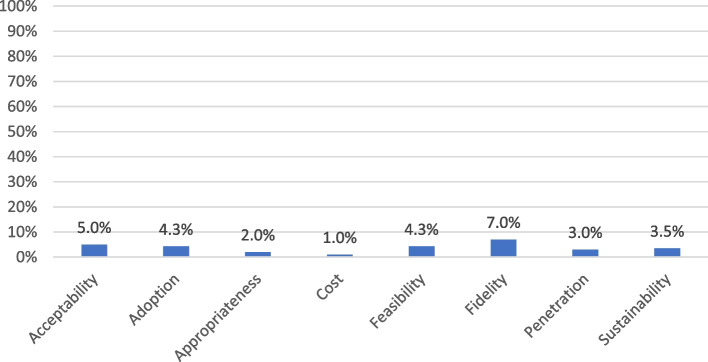
- Acceptability was the most studied implementation outcome (52.1%), followed by fidelity (39.3%), feasibility (38.6%), adoption (26.5%), and appropriateness (21.8%); penetration (16.0%), sustainability (15.8%), and cost (7.8%) were less frequently examined.
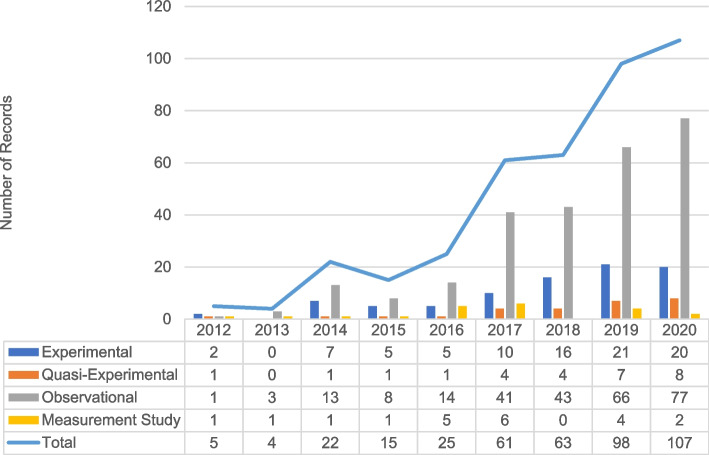
- Most studies were observational (66.5%), with fewer experimental (21.5%) or quasi-experimental (6.8%) designs; 32 manuscripts (8%) identified implementation outcomes not in the original taxonomy.
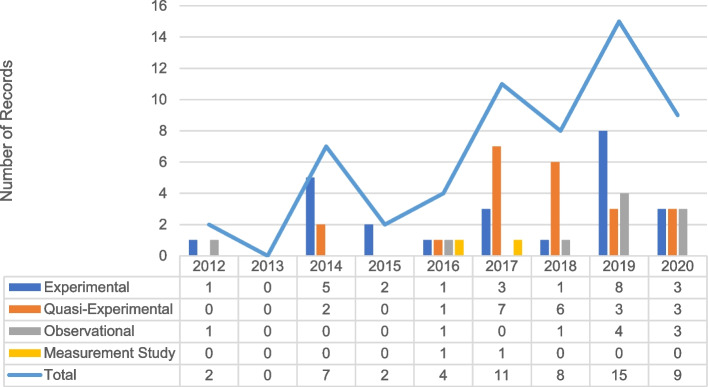
- Only 56 manuscripts (14.0%) examined implementation outcomes in relation to implementation strategies, and only 21 (5.0%) tested relationships among different implementation outcomes.
- Most studies occurred in healthcare (45.8%) or behavioral health (22.5%) organizations; no articles examined the role of implementation outcomes in relation to equity.
Methods
- Arksey and O’Malley’s scoping review framework guided the review, using forward citation tracing of literature citing the 2011 Proctor et al. paper.
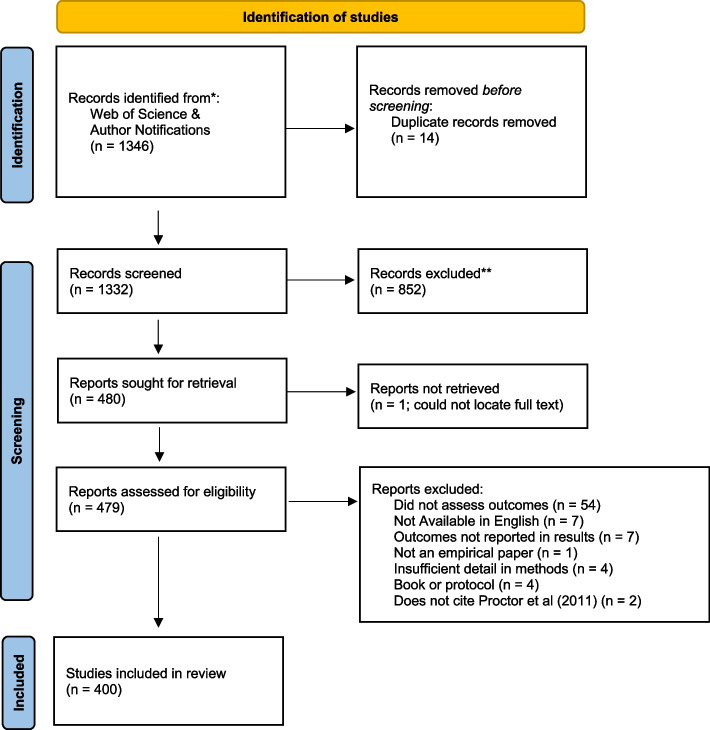
- Searches were conducted in Web of Science, supplemented by publisher citation alerts, covering October 2010 to October 30, 2020; 1346 abstracts were screened, yielding 400 included manuscripts that empirically assessed at least one implementation outcome.
- Data were charted with a customized Google Form; analyses calculated frequencies, averages, and trends over time, including implementation outcomes’ roles as correlates, dependent variables, and relationships with service and clinical outcomes.
Limitations
- The paper states that including only articles citing the 2011 Proctor et al. paper likely underestimates advances anchored in alternative theories or taxonomies, such as RE-AIM, especially in adjacent disciplines.
- The paper states that coding challenges, particularly around precision of reporting, could have introduced errors during data charting.
- Evident from the text: the review’s findings on equity are constrained by the near-total absence of equity-focused studies in the included sample, limiting conclusions about implementation outcomes and disparities.
Model-written summary. Check it against the paper before relying on it.
Integrity signals
Registry
Cites
Statistics
Figures
Verification
Claims the paper makes
36 Valid · 4 Not valid · 6 Not checked · 109 Own results and interpretations
Some cited sources support this claim and some don’t — read each source’s verdict below.
In the paper
“For example, there has been widespread attention to scale-up [44–49].”
§ Ten years of implementation outcomes research: a scoping review > Discussion > How has research on implementation outcomes advanced over the past 10 years?
What the sources say
- Supportedcites [44] Goldberg E Conte K Loblay V Groen S Persson L Innes-Hughes C Scale-up of prevention programmes: sustained state-wide use of programme delivery software is explained by normalised self-organised adoption and non-adoption Implement Sci 2022 17 5 35033154 PMC8760884 source
The Introduction says that efforts to implement effective interventions at scale have increased over the last two decades. That supports the citing sentence’s broad point that scale-up has received widespread attention. (LLM, conf=0.87)
- Supportedcites [45] Mugwanya KK Irungu E Bukusi E Mugo NR Odoyo J Wamoni E Scale up of PrEP integrated in public health HIV care clinics: a protocol for a stepped-wedge cluster-randomized rollout in Kenya Implement Sci 2018 13 118 30180860 PMC6123996 source
This paper is an example of attention to scale-up: the Design section describes a staged rollout of PrEP delivery across 24 Kenyan clinics, and the Discussion says the project aims to catalyze scaled implementation. As one of several citations attached to the sentence, it supports the example rather than establishing the breadth of attention on its own. (LLM, conf=0.88)
- Supportedcites [46] Sherr K Ásbjörnsdóttir K Crocker J Coutinho J de Fatima CM Tavede E Scaling-up the Systems Analysis and Improvement Approach for prevention of mother-to-child HIV transmission in Mozambique (SAIA-SCALE): a stepped-wedge cluster randomized trial Implement Sci 2019 14 41 31029171 PMC6487047 source
The Background describes significant investments to scale up Option B+ and a need to study how improvement strategies can be scaled up. The paper itself is a trial protocol focused on scale-up, so it serves as an example of attention to the topic. (LLM, conf=0.85)
- Supportedcites [47] Nguyen MXB Chu A v. Powell BJ Tran H v. Nguyen LH Dao ATM Comparing a standard and tailored approach to scaling up an evidence-based intervention for antiretroviral therapy for people who inject drugs in Vietnam: study protocol for a cluster randomized hybrid type III trial Implementation Sci. 2020 15 64 PMC7414564 32771017 source
The Background treats scale-up as an active area of work, describing a need to evaluate systematic approaches and noting that many countries have scaled up HIV services. The Discussion also identifies scaling up the intervention as a priority in implementation science. These passages support the broad statement that scale-up has received widespread attention. (LLM, conf=0.86)
- Disputedcites [48] Ilott I Gerrish K Pownall S Eltringham S Booth A Exploring scale-up, spread, and sustainability: an instrumental case study tracing an innovation to enhance dysphagia care Implement Sci 2013 8 128 24168667 PMC3874792 sourceExperimental — accuracy not yet measured
The Background calls scale-up, spread, and related concepts “under-theorised, and little-researched.” The Discussion describes scale-up, spread, and sustainability as “relatively neglected aspects of implementation,” contrary to the claim of widespread attention. Page numbers are not available in our copy. (LLM, conf=0.86)
Checked by a reasoning model — may be wrong.
- Supportedcites [49] Williams CR Bogdewic S Owen MD Srofenyoh EK Ramaswamy R A protocol for evaluating a multi-level implementation theory to scale-up obstetric triage in referral hospitals in Ghana Implement Sci 2020 15 31 32398109 PMC7218616 source
The Plain language summary (page not specified) describes a project to scale up obstetric triage in six additional hospitals. As one of several citations offered to illustrate attention to scale-up, this paper is a relevant example. (LLM, conf=0.84)
plain- Asserted: passes — The authors put it forward as true.
- Checkable: passes — It can be checked against evidence.
- Load-bearing: unclear — It is unclear whether the paper’s conclusions depend on it.
- Based: passes — The paper gives a reason why it holds.
- Supported
Every source the paper cites for this claim was checked and supports it.
In the paper
“Third, the taxonomy raised widespread awareness around the lack of tools, instruments, and designs (e.g., hybrids II and III [5, 6]) that support the measurement of implementation outcomes either as standalone research aims or in conjunction with other outcomes and/or variables capturing contextual determinants.”
§ Ten years of implementation outcomes research: a scoping review > Background > Impact of the 2011 implementation outcomes paper
What the sources say
- Supportedcites [5] Curran GM, Bauer M, Mittman B, Pyne JM, Stetler C. Effectiveness-implementation hybrid designs. Med Care. 2012;50.3(2011):217. PMC3731143 22310560 source
The citation is attached to “hybrids II and III” as examples of designs, not to the sentence’s claim that the taxonomy raised widespread awareness. The Defining Terminology section describes hybrid designs that assess implementation alongside clinical outcomes, and the Hybrid Type 2 and Type 3 sections describe the cited design types specifically (page numbers unavailable). (LLM, conf=0.90)
- Supportedcites [6] Curran GM, Landes SJ, McBain SA, Pyne JM, Smith JD, Fernandez ME, et al. Reflections on 10 years of effectiveness-implementation hybrid studies. Front Health Serv. 2022;2:125. PMC10012680 36925811 source
The citation is attached to the examples ‘hybrids II and III,’ rather than to the citing authors’ broader assertion about widespread awareness. In ‘Which research design should I use for my hybrid type?’ (page unavailable), the source identifies Types 2 and 3 as hybrid approaches in which implementation outcomes are typically measured. (LLM, conf=0.88)
plainstates a cause- Asserted: passes — The authors put it forward as true.
- Checkable: passes — It can be checked against evidence.
- Load-bearing: unclear — It is unclear whether the paper’s conclusions depend on it.
- Based: passes — The paper gives a reason why it holds.
- Supported
Every source the paper cites for this claim was checked and supports it.
In the paper
“Moullin and colleagues further refined pragmatic measurement via the PRESS measure for provider-rated sustainment in inner contexts [13]”
§ Ten years of implementation outcomes research: a scoping review > Background > The 2011 call for advances in the conceptualization and measurement
What the sources say
- Supportedcites [13] Moullin JC, Sklar M, Ehrhart MG, Green A, Aarons GA. Provider REport of Sustainment Scale (PRESS): development and validation of a brief measure of inner context sustainment. Implement Sci. 2021;16.1L:1–10. PMC8404332 34461948 source
The Contributions to the literature section describes PRESS as a brief, pragmatic sustainment measure completed by frontline providers on behalf of a clinic, team, or agency. The Discussion says it was developed and tested for providers delivering evidence-based practices in the inner context of clinics, teams, and organizations. (LLM, conf=0.93)
plainstates a cause- Asserted: passes — The authors put it forward as true.
- Checkable: passes — It can be checked against evidence.
- Load-bearing: unclear — It is unclear whether the paper’s conclusions depend on it.
- Based: passes — The paper gives a reason why it holds.
- Supported
The cited sources support only part of this claim — read each source’s verdict below.
In the paper
“This finding echoes recent reflections on the promises and pitfalls of implementation science [54] and suggests that our field has yet to empirically demonstrate the value of implementation science for improving health and healthcare quality.”
§ Ten years of implementation outcomes research: a scoping review > Discussion > More theory-building work and more experimental studies are needed
What the sources say
- Partly supportedcites [54] Beidas RS Dorsey S Lewis CC Lyon AR Powell BJ Purtle J Promises and pitfalls in implementation science from the perspective of US-based researchers: learning from a pre-mortem Implement Sci 2022 17 55 35964095 PMC9375077 sourceExperimental — accuracy not yet measured
In Theme 1 (page not provided), the paper says the literature has only a few examples of broad impact and calls for more empirical evidence linking implementation outcomes to health outcomes. That supports the concern about insufficient demonstration of value, but “has yet to empirically demonstrate” overstates the paper’s position by implying there are no examples. (LLM, conf=0.82)
hedged- Asserted: passes — The authors put it forward as true.
- Checkable: passes — It can be checked against evidence.
- Load-bearing: passes — The paper’s conclusions depend on it.
- Based: passes — The paper gives a reason why it holds.
- Partly supported
Every source the paper cites for this claim was checked and supports it.
In the paper
“The Implementation Outcomes Framework joined the ever-growing list of implementation research frameworks [3, 4], with unique contributions.”
§ Ten years of implementation outcomes research: a scoping review > Background > Impact of the 2011 implementation outcomes paper
What the sources say
- Supportedcites [3] Damschroder LJ, Aron DC, Keith RE, Kirsh SR, Alexander JA, Lowery JC. Fostering implementation of health services research findings into practice: a consolidated framework for advancing implementation science. Implement Sci. 2009;4.1(2009):1–15. PMC2736161 19664226 source
The Background describes many existing implementation theories, and the paper presents CFIR as an implementation research framework. This supports the citation’s role as an example of the frameworks whose ranks the Implementation Outcomes Framework joined; it does not attribute the Implementation Outcomes Framework itself to this paper. (LLM, conf=0.86)
- Supportedcites [4] Aarons GA, Hurlburt M, Horwitz SM. Advancing a conceptual model of evidence-based practice implementation in public service sectors. Administration and Policy in Mental Health and Mental Health Services Research. 2011;38(2011):4–23. PMC3025110 21197565 source
The Introduction (page unavailable) describes multiple implementation models and says that different models emphasize distinct factors. It also identifies this paper’s contribution as another implementation framework, supporting the cited background point that the field contains a growing range of frameworks. (LLM, conf=0.88)
plain- Asserted: passes — The authors put it forward as true.
- Checkable: passes — It can be checked against evidence.
- Load-bearing: unclear — It is unclear whether the paper’s conclusions depend on it.
- Based: passes — The paper gives a reason why it holds.
- Supported
97 more claims · 6 with their cited sources checked
Create a free account to see all 155 claims and every source verdict.
- Probably not a substantial claim. 37
- It may state two separate claims as one. 23
Claims other papers make about this one
Each is checked against this paper’s own text: does it say what the citing paper says it does?
In the citing paper
“Similarly, because implementation outcomes were often inconsistently defined and poorly reported [28–30], we broadened our scope to include studies that identified team constructs as implementation determinants (i.e., barriers/facilitators) without explicitly defining and measuring an implementation outcome.”
From Teamwork and implementation of innovations in healthcare and human service settings: a systematic review (2024) · cites this paper as [29]
In the citing paper
“There was also poor measurement and reporting of implementation outcomes in many studies, consistent with a recent review of research on implementation outcomes [28, 29].”
From Teamwork and implementation of innovations in healthcare and human service settings: a systematic review (2024) · cites this paper as [29]
Self-check
Percentages, sums and reported differences re-computed from the paper’s own numbers.
Each contradiction between two passages listed here was confirmed by an independent check.
Rated minor: it would not touch a result — a value no result rests on, a p-value that stays on the same side of the significance level, or a conflict that is clerical, resolved elsewhere in the paper, or outside its own findings.
In the paper
“Only 5.0% (n = 21) tested relationships among different implementation outcomes.”
§ Ten years of implementation outcomes research: a scoping review > Results > Question 5: What interrelationships between implementation outcomes have been studied empirically? This theory-building question includes relationships among implementation outcomes and other outcome types, specifically service and clinical outcomes
Reported 5 · recomputed 5.25
Rated minor: it would not touch a result — a value no result rests on, a p-value that stays on the same side of the significance level, or a conflict that is clerical, resolved elsewhere in the paper, or outside its own findings.
In the paper
§ Ten years of implementation outcomes research: a scoping review > Abstract > Methods
“Initial abstract screening yielded 480 manuscripts, and full-text review yielded 400 manuscripts that met inclusion criteria”
§ Ten years of implementation outcomes research: a scoping review > Results
“Our identification process generated 1346 abstracts for screening, which yielded 479 manuscripts for full-text review.”
Rated minor: it would not touch a result — a value no result rests on, a p-value that stays on the same side of the significance level, or a conflict that is clerical, resolved elsewhere in the paper, or outside its own findings.
In the paper
§ Ten years of implementation outcomes research: a scoping review > Results > Question 1: To what extent has each of the eight implementation outcomes been examined empirically in the literature? What additional implementation outcomes were identified?
“followed by fidelity (38.8%), feasibility (36.9%), adoption (24.0%), and appropriateness (20.1%). Penetration (15.4%), sustainability (15.1%), and cost (7.5%) were examined less frequently (Table 2).”
§ Ten years of implementation outcomes research: a scoping review > Results > Question 1: To what extent has each of the eight implementation outcomes been examined empirically in the literature? What additional implementation outcomes were identified?
“| % of included studies | 100.0% | 52.1% | 26.5% | 21.8% | 7.8% | 38.6% | 39.3% | 16.0% | 15.8% |”
Rated minor: it would not touch a result — a value no result rests on, a p-value that stays on the same side of the significance level, or a conflict that is clerical, resolved elsewhere in the paper, or outside its own findings.
In the paper
§ Ten years of implementation outcomes research: a scoping review > Results > Question 5: What interrelationships between implementation outcomes have been studied empirically? This theory-building question includes relationships among implementation outcomes and other outcome types, specifically service and clinical outcomes
“only 23 manuscripts (5.8%) examined implementation outcomes in relation to service outcomes.”
§ Ten years of implementation outcomes research: a scoping review > Results > Question 5: What interrelationships between implementation outcomes have been studied empirically? This theory-building question includes relationships among implementation outcomes and other outcome types, specifically service and clinical outcomes
“Table: Table 7 Implementation outcomes and service system outcomes (n = 22)”
Rated minor: it would not touch a result — a value no result rests on, a p-value that stays on the same side of the significance level, or a conflict that is clerical, resolved elsewhere in the paper, or outside its own findings.
In the paper
“| Service system | 4.8% | 1.9% | 3.8% | 0.0% | 16.1% | 4.5% | 4.5% | 4.7% | 6.3% |”
§ Ten years of implementation outcomes research: a scoping review > Results > Question 5: What interrelationships between implementation outcomes have been studied empirically? This theory-building question includes relationships among implementation outcomes and other outcome types, specifically service and clinical outcomes
Reported 4.8 · recomputed 5.75
Citations
Cites
Scoping studies: towards a methodological framework
Arksey, H., & O'Malley, L. (2005) · International Journal of Social Research Methodology · doi:10.1080/1364557032000119616 · Cited by 36,742
Damschroder, L. J., Aron, D. C., Keith, R. E., Kirsh, S. R., Alexander, J. A., & Lowery, J. C. (2009) · Implementation Science · doi:10.1186/1748-5908-4-50 · Cited by 14,496
Proctor, E., Silmere, H., Raghavan, R., Hovmand, P., Aarons, G., Bunger, A., Griffey, R., & Hensley, M. (2011) · Administration and Policy in Mental Health and Mental Health Services Research · doi:10.1007/s10488-010-0319-7 · Cited by 8,721
Self-citationCurran, G. M., Bauer, M., Mittman, B., Pyne, J. M., & Stetler, C. (2012) · Medical Care · doi:10.1097/mlr.0b013e3182408812 · Cited by 4,058
Advancing a Conceptual Model of Evidence-Based Practice Implementation in Public Service Sectors
Aarons, G. A., Hurlburt, M., & Horwitz, S. M. (2011) · Administration and Policy in Mental Health and Mental Health Services Research · doi:10.1007/s10488-010-0327-7 · Cited by 3,240 · cited 1×
“The Implementation Outcomes Framework joined the ever-growing list of implementation research frameworks [3, 4], with unique contributions.”
MethodPsychometric assessment of three newly developed implementation outcome measures
Weiner, B. J., Lewis, C. C., Stanick, C., Powell, B. J., Dorsey, C. N., Clary, A. S., Boynton, M. H., & Halko, H. (2017) · Implementation Science · doi:10.1186/s13012-017-0635-3 · Cited by 2,819 · cited 1×
“Weiner and colleagues’ study of the psychometric properties for measures of three key implementation outcomes [12].”
BackgroundRE-AIM Planning and Evaluation Framework: Adapting to New Science and Practice With a 20-Year Review
Glasgow, R. E., Harden, S. M., Gaglio, B., Rabin, B., Smith, M. L., Porter, G. C., Ory, M. G., & Estabrooks, P. A. (2019) · Frontiers in Public Health · doi:10.3389/fpubh.2019.00064 · Cited by 2,528 · cited 1×
“…and sustainment of evidence-based care to the entirety of a system’s service recipients or a community’s under-resourced populations can serve as measurable indicators of equitable access and reach [63, 64], consistent with calls to prioritize structural racism in contextual analyses [65].”
BackgroundProctor, E. K., Landsverk, J., Aarons, G., Chambers, D., Glisson, C., & Mittman, B. (2009) · Administration and Policy in Mental Health and Mental Health Services Research · doi:10.1007/s10488-008-0197-4 · Cited by 1,894 · cited 1×
“Equity is a key service system outcome [1, 62].”
BackgroundSelf-citationWaltz, T. J., Powell, B. J., Fernández, M. E., Abadie, B., & Damschroder, L. J. (2019) · Implementation Science · doi:10.1186/s13012-019-0892-4 · Cited by 1,136
Nilsen, P., & Bernhardsson, S. (2019) · BMC Health Services Research · doi:10.1186/s12913-019-4015-3 · Cited by 1,014
U.S. Department of Health and Human (2015) · Journal of Pain & Palliative Care Pharmacotherapy · doi:10.3109/15360288.2015.1037530 · Cited by 891
Damschroder, L. J., Reardon, C. M., Opra Widerquist, M. A., & Lowery, J. (2022) · Implementation Science · doi:10.1186/s13012-021-01181-5 · Cited by 784
Lewis, C. C., Klasnja, P., Powell, B. J., Lyon, A. R., Tuzzio, L., Jones, S., Walsh-Bailey, C., & Weiner, B. (2018) · Frontiers in Public Health · doi:10.3389/fpubh.2018.00136 · Cited by 588
Implementation science should give higher priority to health equity
Brownson, R. C., Kumanyika, S. K., Kreuter, M. W., & Haire-Joshu, D. (2021) · Implementation Science · doi:10.1186/s13012-021-01097-0 · Cited by 551
Woodward, E. N., Matthieu, M. M., Uchendu, U. S., Rogal, S., & Kirchner, J. E. (2019) · Implementation Science · doi:10.1186/s13012-019-0861-y · Cited by 470 · cited 1×
“Such inquiry is critical in work to reduce health disparities [40, 57–61].”
Reframing implementation science to address inequities in healthcare delivery
Baumann, A. A., & Cabassa, L. J. (2020) · BMC Health Services Research · doi:10.1186/s12913-020-4975-3 · Cited by 461 · cited 1×
“Such inquiry is critical in work to reduce health disparities [40, 57–61].”
BackgroundShelton, R. C., Chambers, D. A., & Glasgow, R. E. (2020) · Frontiers in Public Health · doi:10.3389/fpubh.2020.00134 · Cited by 448 · cited 2×
“We hypothesize the following: [63–65].”
BackgroundLewis, C. C., Fischer, S., Weiner, B. J., Stanick, C., Kim, M., & Martinez, R. G. (2015) · Implementation Science · doi:10.1186/s13012-015-0342-x · Cited by 430
Action, actor, context, target, time (AACTT): a framework for specifying behaviour
Presseau, J., McCleary, N., Lorencatto, F., Patey, A. M., Grimshaw, J. M., & Francis, J. J. (2019) · Implementation Science · doi:10.1186/s13012-019-0951-x · Cited by 411 · cited 1×
“This call for hypothesis testing in implementation outcomes research has been echoed by a number of recent papers [21–24].”
MethodA systematic review of empirical studies examining mechanisms of implementation in health
Lewis, C. C., Boyd, M. R., Walsh-Bailey, C., Lyon, A. R., Beidas, R., Mittman, B., Aarons, G. A., Weiner, B. J., & Chambers, D. A. (2020) · Implementation Science · doi:10.1186/s13012-020-00983-3 · Cited by 363
Finch, T. L., Girling, M., May, C. R., Mair, F. S., Murray, E., Treweek, S., McColl, E., Steen, I. N., Cook, C., Vernazza, C. R., et al. (2018) · BMC Medical Research Methodology · doi:10.1186/s12874-018-0591-x · Cited by 337
Reflections on 10 years of effectiveness-implementation hybrid studies
Curran, G. M., Landes, S. J., McBain, S. A., Pyne, J. M., Smith, J. D., Fernandez, M. E., Chambers, D. A., & Mittman, B. S. (2022) · Frontiers in Health Services · doi:10.3389/frhs.2022.1053496 · Cited by 299
Designing and undertaking randomised implementation trials: guide for researchers
Wolfenden, L., Foy, R., Presseau, J., Grimshaw, J. M., Ivers, N. M., Powell, B. J., Taljaard, M., Wiggers, J., Sutherland, R., Nathan, N., et al. (2021) · BMJ · doi:10.1136/bmj.m3721 · Cited by 270 · cited 1×
“Although some have questioned testing implementation outcomes as dependent variables [55], rigorous trials of implementation strategies are important for learning how to achieve acceptability, feasibility, adoption, and sustainment.”
BackgroundBeidas, R. S., Dorsey, S., Lewis, C. C., Lyon, A. R., Powell, B. J., Purtle, J., Saldana, L., Shelton, R. C., Stirman, S. W., & Lane-Fall, M. B. (2022) · Implementation Science · doi:10.1186/s13012-022-01226-3 · Cited by 230 · cited 2×
“This finding echoes recent reflections on the promises and pitfalls of implementation science [54] and suggests that our field has yet to empirically demonstrate the value of implementation science for improving health and health-care quality.”
BackgroundLyon, A. R., & Bruns, E. J. (2019) · JAMA Psychiatry · doi:10.1001/jamapsychiatry.2018.3060 · Cited by 178
Writing implementation research grant proposals: ten key ingredients
Proctor, E. K., Powell, B. J., Baumann, A. A., Hamilton, A. M., & Santens, R. L. (2012) · Implementation Science · doi:10.1186/1748-5908-7-96 · Cited by 169 · cited 1×
“…several types of hypotheses related to how implementation outcomes are associated with each other, how the attainment of implementation outcomes influences service system and clinical outcomes, and how the effectiveness of implementation strategies affects implementation outcome attainment [20].”
BackgroundSelf-citationShelton, R. C., Adsul, P., Oh, A., Moise, N., & Griffith, D. M. (2021) · Implementation Research and Practice · doi:10.1177/26334895211049482 · Cited by 168 · cited 1×
“Similarly, penetration and sustainment of evidencebased care to the entirety of a system’s service recipients or a community’s under-resourced populations can serve as measurable indicators of equitable access and reach [63, 64], consistent with calls to prioritize structural racism in contextual analyses [65].”
BackgroundImplementation Research Methodologies for Achieving Scientific Equity and Health Equity
McNulty, M., Smith, J. D., Villamar, J. A., Burnett‐Zeigler, I., Vermeer, W., Benbow, N., Gallo, C. G., Wilensky, U. J., Hjorth, A., Mustanski, B. S., et al. (2019) · Ethnicity & Disease · doi:10.18865/ed.29.s1.83 · Cited by 165 · cited 1×
“Such inquiry is critical in work to reduce health disparities [40, 57–61].”
BackgroundWilliams, N. J. (2016) · Administration and Policy in Mental Health and Mental Health Services Research · doi:10.1007/s10488-015-0693-2 · Cited by 164 · cited 1×
“Current literature also reflects an increasing number of studies testing the effectiveness of implementation strategies and the mechanisms that explain how these strategies may influence implementation outcomes [25–31].”
BackgroundQuantitative measures of health policy implementation determinants and outcomes: a systematic review
Allen, P., Pilar, M., Walsh-Bailey, C., Hooley, C., Mazzucca, S., Lewis, C. C., Mettert, K. D., Dorsey, C. N., Purtle, J., Kepper, M. M., et al. (2020) · Implementation Science · doi:10.1186/s13012-020-01007-w · Cited by 164 · cited 2×
“We now have systematic reviews of implementation outcomes [15] and their measurement properties in behavioral health [16], public policy [17], stroke care [7], and physical healthcare [18].”
BackgroundMeasuring implementation outcomes: An updated systematic review of measures’ psychometric properties
Mettert, K., Lewis, C., Dorsey, C., Halko, H., & Weiner, B. (2020) · Implementation Research and Practice · doi:10.1177/2633489520936644 · Cited by 162
Rudd, B. N., Davis, M., & Beidas, R. S. (2020) · Implementation Science · doi:10.1186/s13012-020-01060-5 · Cited by 157
Kerkhoff, A. D., Farrand, E., Marquez, C., Cattamanchi, A., & Handley, M. A. (2022) · Implementation Science · doi:10.1186/s13012-022-01189-5 · Cited by 140
Importance and feasibility of an adapted set of implementation strategies in schools
Lyon, A. R., Cook, C. R., Locke, J., Davis, C., Powell, B. J., & Waltz, T. J. (2019) · Journal of School Psychology · doi:10.1016/j.jsp.2019.07.014 · Cited by 135
Becan, J. E., Bartkowski, J. P., Knight, D. K., Wiley, T. R. A., DiClemente, R., Ducharme, L., Welsh, W. N., Bowser, D., McCollister, K., Hiller, M., et al. (2018) · Health & Justice · doi:10.1186/s40352-018-0068-3 · Cited by 119
FAST: A Framework to Assess Speed of Translation of Health Innovations to Practice and Policy
Proctor, E., Ramsey, A. T., Saldana, L., Maddox, T. M., Chambers, D. A., & Brownson, R. C. (2022) · Global Implementation Research and Applications · doi:10.1007/s43477-022-00045-4 · Cited by 95
Self-citationImplementation outcome instruments for use in physical healthcare settings: a systematic review
Khadjesari, Z., Boufkhed, S., Vitoratou, S., Schatte, L., Ziemann, A., Daskalopoulou, C., Uglik-Marucha, E., Sevdalis, N., & Hull, L. (2020) · Implementation Science · doi:10.1186/s13012-020-01027-6 · Cited by 92 · cited 1×
“We now have systematic reviews of implementation outcomes [15] and their measurement properties in behavioral health [16], public policy [17], stroke care [7], and physical healthcare [18].”
BackgroundSix practical recommendations for improved implementation outcomes reporting
Lengnick-Hall, R., Gerke, D. R., Proctor, E. K., Bunger, A. C., Phillips, R. J., Martin, J. K., & Swanson, J. C. (2022) · Implementation Science · doi:10.1186/s13012-021-01183-3 · Cited by 86 · cited 2×
“See Lengnick-Hall et al. [67] for detail on the coding challenges we encountered, along with recommendations to improve reporting.”
BackgroundSelf-citationMoullin, J. C., Sklar, M., Ehrhart, M. G., Green, A., & Aarons, G. A. (2021) · Implementation Science · doi:10.1186/s13012-021-01152-w · Cited by 82
Meza, R. D., Triplett, N. S., Woodard, G. S., Martin, P., Khairuzzaman, A. N., Jamora, G., & Dorsey, S. (2021) · Implementation Science · doi:10.1186/s13012-021-01104-4 · Cited by 76 · cited 2×
“This call for hypothesis testing in implementation outcomes research has been echoed by a number of recent papers [21–24].”
BackgroundMethodKilbourne, A. M., Geng, E., Eshun-Wilson, I., Sweeney, S., Shelley, D., Cohen, D. J., Kirchner, J. E., Fernandez, M. E., & Parchman, M. L. (2023) · Implementation Science Communications · doi:10.1186/s43058-023-00435-1 · Cited by 75 · cited 1×
“We hope this can be improved as methods such as causal pathway diagrams, causal loop diagrams, and directed acyclic graphs gain traction in mechanistic implementation research [19, 30, 50–53].”
MethodMurrell, J. E., Pisegna, J. L., & Juckett, L. A. (2021) · Implementation Science · doi:10.1186/s13012-021-01178-0 · Cited by 60
Zielinski, M. J., Allison, M. K., Brinkley‐Rubinstein, L., Curran, G. M., Zaller, N. D., & Kirchner, J. A. E. (2020) · Health & Justice · doi:10.1186/s40352-020-00122-6 · Cited by 56 · cited 1×
“Similar research is needed in less frequently studied settings where health and other social care interventions are delivered (e.g., schools, social service organizations, and home-based services) [37–42] to diverse communities and consumers with a range of intersecting needs.”
Ilott, I., Gerrish, K., Pownall, S., Eltringham, S., & Booth, A. (2013) · Implementation Science · doi:10.1186/1748-5908-8-128 · Cited by 50
Closing the health equity gap: A role for implementation science?
Odeny, B. (2021) · PLoS Medicine · doi:10.1371/journal.pmed.1003762 · Cited by 48
Moser, R. P., Hesse, B. W., Shaikh, A. R., Courtney, P., Morgan, G., Augustson, E., Kobrin, S., Levin, K. Y., Helba, C., Garner, D., et al. (2011) · American Journal of Preventive Medicine · doi:10.1016/j.amepre.2011.01.004 · Cited by 44 · cited 1×
“The Grid-Ena-bled Measures Project [10] and The Society for Implementation Research Collaborative (SIRC) Instrument Review Project [11] are organized around the Proctor 2011 taxonomy.”
MethodReadiness as a precursor of early implementation outcomes: an exploratory study in specialty clinics
Livet, M., Blanchard, C., & Richard, C. (2022) · Implementation Science Communications · doi:10.1186/s43058-022-00336-9 · Cited by 41
Juckett, L., Bunger, A. C., Jarrott, S. E., Dabelko‐Schoeny, H., Krok‐Schoen, J. L., Poling, R. M., Mion, L. C., & Tucker, S. (2020) · The Gerontologist · doi:10.1093/geront/gnaa133 · Cited by 38
Self-citationWensing, M., Sales, A. E., Aarons, G. A., Xu, D. R., & Wilson, P. M. (2022) · Implementation Science · doi:10.1186/s13012-022-01249-w · Cited by 36 · cited 1×
“To describe the context in which implementation outcomes have been studied, we captured study settings and populations, the innovations (implementation objects [36]) studied, and the health conditions addressed by the study (Table 4).”
Bunger, A. C., & Lengnick‐Hall, R. (2019) · Human Services Organizations Management Leadership & Governance · doi:10.1080/23303131.2019.1666765 · Cited by 35
Self-citationfor the Partners Scale Up Team, Mugwanya, K. K., Irungu, E., Bukusi, E., Mugo, N. R., Odoyo, J., Wamoni, E., Ngure, K., Morton, J. F., Peebles, K., et al. (2018) · Implementation Science · doi:10.1186/s13012-018-0809-7 · Cited by 34
Sherr, K., Ásbjörnsdóttir, K., Crocker, J., Coutinho, J., de Fatima Cuembelo, M., Tavede, E., Manaca, N., Ronen, K., Murgorgo, F., Barnabas, R., et al. (2019) · Implementation Science · doi:10.1186/s13012-019-0889-z · Cited by 33
Sheldrick, R. C., Breuer, D. J., Hassan, R., Chan, K., Polk, D. E., & Benneyan, J. C. (2016) · Implementation Science · doi:10.1186/s13012-016-0517-0 · Cited by 33
Lyon, A. R., Liu, F. F., Connors, E. H., King, K. M., Coifman, J. I., Cook, H., McRee, E., Ludwig, K., Law, A., Dorsey, S., et al. (2022) · Implementation Science Communications · doi:10.1186/s43058-022-00325-y · Cited by 28
Patient-centred care for addiction treatment: a scoping review protocol
Marchand, K., Beaumont, S., Westfall, J., MacDonald, S., Harrison, S., Marsh, D. C., Schechter, M. T., & Oviedo-Joekes, E. (2018) · BMJ Open · doi:10.1136/bmjopen-2018-024588 · Cited by 28
Lee, H., Hall, A. E., Nathan, N., Reilly, K., Seward, K., Williams, C. M., Yoong, S. L., Finch, M., Wiggers, J., & Wolfenden, L. (2018) · Implementation Science · doi:10.1186/s13012-018-0734-9 · Cited by 26 · cited 1×
“We hope this can be improved as methods such as causal pathway diagrams, causal loop diagrams, and directed acyclic graphs gain traction in mechanistic implementation research [19, 30, 50–53].”
MethodWensing, M., Sales, A., Wilson, P., Armstrong, R., Kislov, R., Rankin, N. M., Ramaswamy, R., & Xu, D. (2021) · Implementation Science · doi:10.1186/s13012-021-01175-3 · Cited by 23 · cited 3×
“…and measurement positions researchers to move from asking descriptive questions about implementation outcomes to causal mechanistic ones [9], which is essential for building testable theory that describes, explains, and predicts how and why the implementation process worked (or not).”
BackgroundInfluentialApplying concepts from “rapid” and “agile” implementation to advance implementation research
Quanbeck, A., Garza, R. H., & Park, L. (2022) · Implementation Science Communications · doi:10.1186/s43058-022-00366-3 · Cited by 23 · cited 1×
“Testing hypothesized sequencing, impact, and efficiency of attaining implementation outcomes via strategies is essential to understanding and accelerating implementation processes [68, 69].”
BackgroundSpringer, M. V., Sales, A. E., Islam, N., McBride, A. C., Landis-Lewis, Z., Tupper, M., Corches, C. L., Robles, M. C., & Skolarus, L. E. (2021) · Implementation Science · doi:10.1186/s13012-021-01102-6 · Cited by 22 · cited 1×
“Current literature also reflects an increasing number of studies testing the effectiveness of implementation strategies and the mechanisms that explain how these strategies may influence implementation outcomes [25–31].”
BackgroundNguyen, M. X. B., Chu, A. V., Powell, B. J., Tran, H. V., Nguyen, L. H., Dao, A. T. M., Pham, M. D., Vo, S. H., Bui, N. H., Dowdy, D. W., et al. (2020) · Implementation Science · doi:10.1186/s13012-020-01020-z · Cited by 19
Motamedi, M., Lau, A. S., Lind, T., Lui, J. H., Rodriguez, A., Smith, A., & Brookman-Frazee, L. (2021) · Implementation Research and Practice · doi:10.1177/2633489520982903 · Cited by 17
Vejnoska, S., Mettert, K. D., & Lewis, C. C. (2022) · Implementation Research and Practice · doi:10.1177/26334895221086271 · Cited by 15 · cited 1×
“We hope this can be improved as methods such as causal pathway diagrams, causal loop diagrams, and directed acyclic graphs gain traction in mechanistic implementation research [19, 30, 50–53].”
MethodTen years of implementation outcome research: a scoping review protocol
Lengnick-Hall, R., Proctor, E. K., Bunger, A. C., & Gerke, D. R. (2021) · BMJ Open · doi:10.1136/bmjopen-2021-049339 · Cited by 14
Self-citationSullivan, J. L., Nooraie, R. Y., D'Arcy, D., Levine, A. A., Zimmerman, L., Shin, M. H., Franzosa, E. C., Hung, W. W., & Intrator, O. K. (2022) · Implementation Science Communications · doi:10.1186/s43058-022-00338-7 · Cited by 12
Hyzak, K. A., Bunger, A. C., Bogner, J. A., Davis, A. K., & Corrigan, J. D. (2022) · Implementation Science Communications · doi:10.1186/s43058-022-00261-x · Cited by 11 · cited 1×
“For instance, clinician perceptions about the acceptability, appropriateness, and feasibility of an intervention might predict adoption [56].”
BackgroundSelf-citationWilliams, C. R., Bogdewic, S., Owen, M. D., Srofenyoh, E. K., & Ramaswamy, R. (2020) · Implementation Science · doi:10.1186/s13012-020-00992-2 · Cited by 10
Measurement of unnecessary psychiatric readmissions: a scoping review protocol
Kim, B., Weatherly, C., Wolk, C. B., & Proctor, E. K. (2019) · BMJ Open · doi:10.1136/bmjopen-2019-030696 · Cited by 9 · cited 1×
“We also replicated the iterative and reflexive approach modeled by Marchand et al. [33] and Kim et al. [34] during each step of our scoping review process.”
MethodSelf-citationGoldberg, E., Conte, K., Loblay, V., Groen, S., Persson, L., Innes-Hughes, C., Mitchell, J., Milat, A., Williams, M., Green, A., et al. (2022) · Implementation Science · doi:10.1186/s13012-021-01184-2 · Cited by 4 · cited 1×
“For example, there has been widespread attention to scale-up [44–49].”
BackgroundBunger, A. C. (2020) · Routledge eBooks · doi:10.4324/9781003041191-4 · Cited by 4
Self-citationAarons, G. A. (2022) · Implementation Science · doi:10.1186/s13012-022-01198-4 · Cited by 2 · cited 1×
“Our paper complies with recommendations that review articles in implementation science be rigorous, comprehensive of the questions being asked, and provide accurate attributions [66].”
Research works printed but not linked: 1
- Society for Implementation Research Collaboration. The SIRC Instrument Review Project (IRP) [Internet]. [cited 2022 Sep 12]. https://societyforimplementationresearchcollaboration.org/sirc-instrument-project/.
Cited by
Ashcraft, L. E., Goodrich, D. E., Hero, J., Phares, A., Bachrach, R. L., Quinn, D. A., Qureshi, N., Ernecoff, N. C., Lederer, L. G., Scheunemann, L. P., et al. (2024) · Implementation Science · doi:10.1186/s13012-024-01369-5 · Cited by 89
“…“implementation strateg*” OR “implementation intervention*” OR “implementation bundl*” OR “implementation support*. ” The search, conducted on September 20, 2022, was limited to English language and publication between 2010 and 2022, similar to other recent implementation science reviews [22].”
BackgroundResultCurrent Implementation of Digital Health in Chronic Disease Management: Scoping Review
Pong, C. Y., Tseng, R. M. W. W., Tham, Y. C., & Lum, E. (2024) · Journal of Medical Internet Research · doi:10.2196/53576 · Cited by 126
“In addition, we agree with Proctor et al [302] that future studies testing the relationships between implementation strategies and implementation, service, and patient outcomes are needed.”
InfluentialMcGuier, E. A., Kolko, D. J., Aarons, G. A., Schachter, A., Klem, M. L., Diabes, M. A., Weingart, L. R., Salas, E., & Wolk, C. B. (2024) · Implementation Science · doi:10.1186/s13012-024-01381-9 · Cited by 70
“There was also poor measurement and reporting of implementation outcomes in many studies, consistent with a recent review of research on implementation outcomes [28, 29].”
BackgroundResultAl-Omary, H., Soltani, A., Stewart, D. C., & Nazar, Z. J. (2024) · BMC Medical Education · doi:10.1186/s12909-024-06016-7 · Cited by 109
“The Consolidated Framework for Implementation Research is specifically designed to systematically assess barriers and facilitators in implementation within local settings and can guide decisions regarding the needs within a local context [73].”
BackgroundCorrection: Ten years of implementation outcomes research: a scoping review
Proctor, E. K., Bunger, A. C., Lengnick-Hall, R., Gerke, D. R., Martin, J. K., Phillips, R. J., & Swanson, J. C. (2023) · Implementation Science · doi:10.1186/s13012-023-01313-z · Cited by 53
Self-citation
Metadata
- Authors
- Proctor, E. K., Bunger, A. C., Lengnick-Hall, R., Gerke, D. R., Martin, J. K., Phillips, R. J., & Swanson, J. C.
- Affiliations
- Washington University in St. Louis (US)
- The Ohio State University (US)
- University of Alabama at Birmingham (US)
- Western Oregon University (US)
- Corresponding author
- Proctor, Enola K.
- Venue
- Implementation Science
- Published
- 2023-07-25
- Volume
- 18
- Issue
- 1
- Pages
- 31-31
- ISSN
- 1748-5908 (ISSN-L)
- PMC
- PMC10367273
- OpenAlex
- W4385241407
- Cited by
- 424
- References
- 70
- Citations by year
- 2026: 160 · 2025: 158 · 2024: 96 · 2023: 10
- FWCI
- 21.67
- Type
- journal article
- Language
- en
- Update notices
- Open access
- gold
- doi.org
- Licence
- cc-by
- creativecommons.org/licenses/by/4.0 (tdm)
- creativecommons.org/licenses/by/4.0 (vor)
- Locations
- Implementation Science (publishedVersion, cc-by)
- PubMed Central (publishedVersion, cc-by)
- PubMed (publishedVersion)
- DOAJ (DOAJ: Directory of Open Access Journals) (submittedVersion, cc-by-sa)
- Funders
- National Institute of Mental Health (R25MH080916, P50MH113660, P50MH113662)
- National Cancer Institute (P50CA19006)
- National Institute on Drug Abuse (R34DA046913)
- Topics
- Health Sciences › Health Professions › General Health Professions › Health Policy Implementation Science
- Health Sciences › Health Professions › General Health Professions › Health Sciences Research and Education
- Health Sciences › Medicine › Public Health, Environmental and Occupational Health › Clinical practice guidelines implementation
- Keywords
- implementation outcomes, acceptability, fidelity, feasibility, adoption, appropriateness, penetration, sustainability, cost, implementation strategies, research agenda, healthcare organizations, behavioral health organizations
- MeSH terms
- Delivery of Health Care, Humans, Outcome Assessment, Health Care
About these checks
Registry, retraction, Cites and statistics results are computed, not judged, with one exception: a printed reference that no index lists is read once by a model before it counts as a citation error. Claims are extracted by a model and kept only when their quote appears verbatim in the text; each cited source is then checked, with a model’s help, for whether it says what the claim relies on. Those verdicts can be wrong — read the claim’s quote and the cited source before relying on one.
The claim verdicts this report counts are experimental: their accuracy is not yet measured.
A language model drew the claims from the paper on 2026-10-10, under version 3 of the claim definition (model deepseek-v4.1-flash, prompt extract-v3).
A second model labelled each claim on 2026-10-10 (model jev-1.13-20260917, definition revision gold-guideline-v0.2).
Cited sources are checked with a language model’s help (gpt-6-sol).
Statistics and arithmetic are recomputed, not judged.
Confidence bands are shown only for fields calibrated on our annotated test set. None is calibrated yet, so no band is shown.
What counts as a claim ›How we measure confidence ›How we check this ›
Are you an author, or do you see a problem with this page? Request a review
Data sources
Bibliographic data: Semantic Scholar, OpenAlex, Crossref.
Contains information from the Semantic Scholar Academic Graph Datasets, made available under the ODC Attribution License (ODC-BY 1.0).
Semantic Scholar’s data is described in: Kinney, R., et al. (2023). The Semantic Scholar Open Data Platform. arXiv:2301.10140.
