

Quality of life in patients with locked-in syndrome: Evolution over a 6-year period
Open accessThe DOI matches its Crossref record; 45 of the 47 references it cites were found in a registry or an index.
Abstract
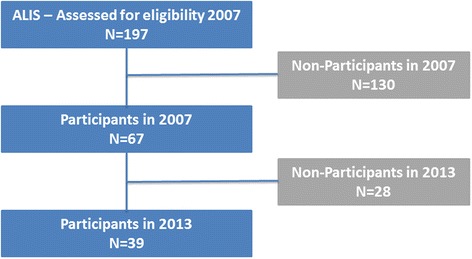
BACKGROUND: Improved knowledge of the quality of life (QoL) of locked-in syndrome (LIS) patients have implications for managing their care, and assists clinicians in choosing the most appropriate interventions. We performed a survey of a population of LIS patients to describe the course of the QoL of LIS patients over a 6-year period and to determine the potential predictive factors of QoL changes over time. METHOD: This is a study performed over a 6-year period in patients with a LIS diagnosis. Questionnaires were sent in 2007 and 2013. The following data were recorded: i) sociodemographic data; ii) clinical data related to LIS, physical/handicap status, psychological status; iii) self-reported QoL: Anamnestic Comparative Self-Assessment (ACSA); iv) Integration in life: French Reintegration to Normal Living Index (RNLI). RESULTS: Among the 67 patients included in 2007, 39 (58 %) patients returned their questionnaire in 2013. The LIS etiology was stroke in 51 individuals. The QoL of the patients was relatively satisfactory compared to populations in other severe conditions. Twenty-one (70 %) individuals reported a stable/improved QoL between 2007 and 2013. The physical/handicap statuses in 2007 and 2013 were not related to the QoL 6 years later, with the exception of one communication parameter: the individuals who used yes-no code reported significantly lower QoL levels than those who did not in 2013. DISCUSSION: In opposition to a widespread opinion, LIS persons report a relatively satisfactory QoL level that stays stable over time, suggesting that life with LIS is worth living. Preservation of autonomy and communication may help them to live as normal life as possible.
Overview
The claims and statistics of this paper haven’t been checked yet.
Free: it reads the open-access text and checks the first 5 claims that cite a source we can check. Create a free account to check every claim.
Integrity signals
Registry
Cites
Statistics
Figures
Verification
Claims the paper makes
The claims and statistics of this paper haven’t been checked yet.
Free: it reads the open-access text and checks the first 5 claims that cite a source we can check. Create a free account to check every claim.
Claims other papers make about this one
Each is checked against this paper’s own text: does it say what the citing paper says it does?
The source backs part of the claim, not all of it — or backs it for a different population, condition or comparison.
In the citing paper
“Faster, more accurate, and more natural communication are among the most desired needs of people who have lost the ability to speak after severe paralysis2,38–40.”
From A high-performance neuroprosthesis for speech decoding and avatar control (2023) · cites this paper as [38]
Experimental — accuracy not yet measured
Self-check
Percentages, sums and reported differences re-computed from the paper’s own numbers.
The self-check needs the paper’s full text.
Citations
Cites
Integrating response shift into health-related quality of life research: a theoretical model
Sprangers, M. A. G., & Schwartz, C. E. (1999) · Social Science & Medicine · doi:10.1016/s0277-9536(99)00045-3 · Cited by 2,228 · cited 1×
“This lack of association between objective health/handicap change and QoL could also be explained by the presence of the well-known ‘response shift phenomena’ [34].”
BackgroundThe disability paradox: high quality of life against all odds
Albrecht, G. L., & Devlieger, P. J. (1999) · Social Science & Medicine · doi:10.1016/s0277-9536(98)00411-0 · Cited by 2,064 · cited 2×
“has been previously observed that patients’ subjective QoL is not related to physical impairments; this observation agrees with previous studies of different motor neuron disorders [4, 11, 15, 22, 27–32] and illustrates the “disability paradox” reported by Albrecht and Devlieger [33].”
ResultThe Diagnosis of Stupor and Coma.
(1967) · Annals of Internal Medicine · doi:10.7326/0003-4819-66-1-244 · Cited by 1,152
The Diagnosis of Stupor and Coma
Poser, C. M. (1981) · JAMA: The Journal of the American Medical Association · doi:10.1001/jama.1981.03310320080042 · Cited by 544
Varieties of the locked-in syndrome
Bauer, G., Gerstenbrand, F., & Rumpl, E. (1979) · Journal of Neurology · doi:10.1007/bf00313105 · Cited by 504 · cited 1×
“The following data were recorded: i) sociodemographic data, including gender, age, living status, marital status, children, educational level, income, and religious status; ii) clinical data, including the type of LIS (total, classical, or partial) according to Bauer’s classification [18], disease duration, etiology (…”
MethodThe locked-in syndrome : what is it like to be conscious but paralyzed and voiceless?
Laureys, S., Pellas, F., Van Eeckhout, P., Ghorbel, S., Schnakers, C., Perrin, F., Berré, J., Faymonville, M.-E., Pantke, K.-H., Damas, F., et al. (2005) · Progress in Brain Research · doi:10.1016/s0079-6123(05)50034-7 · Cited by 477 · cited 1×
“Disease duration Median [IQR] 8 [4;9] 7 [4;9] 14 [10;15]”
Randt, C. (1967) · Archives of Neurology · doi:10.1001/archneur.1967.00470190115018 · Cited by 455
Smith, E., & Delargy, M. (2005) · BMJ · doi:10.1136/bmj.330.7488.406 · Cited by 437
Locked-in syndrome: a review of 139 cases.
Patterson, J. R., & Grabois, M. (1986) · Stroke · doi:10.1161/01.str.17.4.758 · Cited by 303
Medicine, A. C. O. R. (1995) · Archives of Physical Medicine and Rehabilitation · doi:10.1016/s0003-9993(95)80031-x · Cited by 283
Cited by
Items 101–110 of 110
Semantic decoding of natural speech production from sEEG via deep learning
Zanuccoli, A. (2023) · AMS Degree Thesis (University of Bologna)
Pain and nociception assessment and management in patients with severe brain injuries
Bonin, E. (2022) · ORBi (University of Liège)
Evaluation de la conscience de soi et de l'environnement chez des patients non répondant
Séguin, P. (2024) · theses.fr (ABES) · doi:10.70675/385644f3zf67bz412aza1bdzd06ab4394b67
Reconstruction of overt speech from Electrocorticographic (ECoG) data using deep neural networks
Ticha, M. B. B. (2025) · theses.fr (ABES) · doi:10.70675/12c589a0z38bdz4a87zbe17zc60eac7a3e60
Alzahrani, S. I., Alomari, N., Alkilani, S., Alghamdi, L., & Melhem, B. M. (2026) · Sensors · doi:10.3390/s26082425
“The condition of individuals with LIS typically stabilizes within the first year, and life expectancy may extend over several years [7].”
Dementia Caregiver Support: Offering Spiritual and Emotional Guidance to Loved Ones Filling the Gap
Bishop, W. R. (2026) · Scholars Crossing (Liberty University)
Erkrankungen des Zentralnervensystems
Groß, S., Schäbitz, J., Ohla, V., Stulken, M., Rilling, E., Mantz-Clemens, M., Stefanakaki, A., Hagen, S., Hauer, L., Hauer, A., et al. (2026) · Springer eBooks · doi:10.1007/978-3-662-72944-1_6
Zhang, Q., Tian, W., Xinyu, M., Chi, K., Chen, Z., Li, X., Liu, W., Liu, Z., & Duan, X. (2026) · Frontiers in Human Neuroscience · doi:10.3389/fnhum.2026.1844573
“Studies have shown that persistent impairment of motor function and communication in individuals with LIS would significantly decrease the quality of life (Rousseau et al., 2015).”
Praveen, N., & Pathak, R. (2026) · Advanced International Journal for Research · doi:10.63363/aijfr.2026.v07i05.8503
“Rousseau et al. found that quality of life remained stable over a six-year follow-up period in LIS patients, and was primarily determined by psychological rather than physical factors [12, 13].”
Bonin, E. A. C., Lejeune, N., Szymkowicz, E., Bonhomme, V., Martial, C., Gosseries, O., Laureys, S., & Thibaut, A. (2023) · doi:10.3389/fnsys.2023.1112206.s001
Metadata
- Authors
- Rousseau, M.-C., Baumstarck, K., Alessandrini, M., Blandin, V., Billette de Villemeur, T., & Auquier, P.
- Affiliations
- Aix-Marseille Université (FR)
- Corresponding author
- Rousseau, Marie-Christine
- Venue
- Orphanet Journal of Rare Diseases
- Published
- 2015-07-19
- Volume
- 10
- Issue
- 1
- Pages
- 88-88
- ISSN
- 1750-1172 (ISSN-L)
- PMC
- PMC4506615
- OpenAlex
- W1554341681
- Semantic Scholar
- c8e6ec9da0f26d6e969e2e7796ceecae3143335e
- Cited by
- 93
- References
- 47
- Citations by year
- 2026: 5 · 2025: 7 · 2024: 17 · 2023: 13 · 2022: 5 · 2021: 9 · 2020: 8 · 2019: 12 · 2018: 8 · 2017: 5 · 2016: 3 · 2015: 1
- FWCI
- 5.71
- Type
- journal article
- Language
- en
- Open access
- gold
- doi.org
- Locations
- Orphanet Journal of Rare Diseases (publishedVersion, cc-by)
- PubMed Central (publishedVersion, cc-by)
- PubMed (publishedVersion)
- HAL (submittedVersion, other-oa)
- Topics
- Health Sciences › Medicine › Rehabilitation › Stroke Rehabilitation and Recovery
- Health Sciences › Health Professions › Physical Therapy, Sports Therapy and Rehabilitation › Medical Practices and Rehabilitation
- Health Sciences › Medicine › Clinical Neurology › Traumatic Brain Injury Research
- Keywords
- locked-in syndrome, quality of life, longitudinal change in quality of life, stroke, communication aids, autonomy, Reintegration to Normal Living Index, physical disability
- MeSH terms
- Adult, Female, Health Status Indicators, Health Surveys, Humans, Male, Middle Aged, Quadriplegia, Quality of Life, Surveys and Questionnaires, Socioeconomic Factors, Sickness Impact Profile, Value of Life, Self Report
About these checks
Registry, retraction, Cites and statistics results are computed, not judged, with one exception: a printed reference that no index lists is read once by a model before it counts as a citation error. Claims are extracted by a model and kept only when their quote appears verbatim in the text; each cited source is then checked, with a model’s help, for whether it says what the claim relies on. Those verdicts can be wrong — read the claim’s quote and the cited source before relying on one.
Statistics and arithmetic are recomputed, not judged.
Confidence bands are shown only for fields calibrated on our annotated test set. None is calibrated yet, so no band is shown.
What counts as a claim ›How we measure confidence ›How we check this ›
Are you an author, or do you see a problem with this page? Request a review
Data sources
Bibliographic data: Semantic Scholar, OpenAlex, Crossref.
Contains information from the Semantic Scholar Academic Graph Datasets, made available under the ODC Attribution License (ODC-BY 1.0).
Semantic Scholar’s data is described in: Kinney, R., et al. (2023). The Semantic Scholar Open Data Platform. arXiv:2301.10140.
