

Connect-ROD – development and qualitative evaluation of a community-based group intervention to support well-being in patients with a rare or orphan disease
Open accessPublished version of a preprint
The DOI matches its Crossref record; 47 of the 47 references it cites were found in a registry or an index; 14 of the 37 sources its claims cite were checked for support.
Abstract
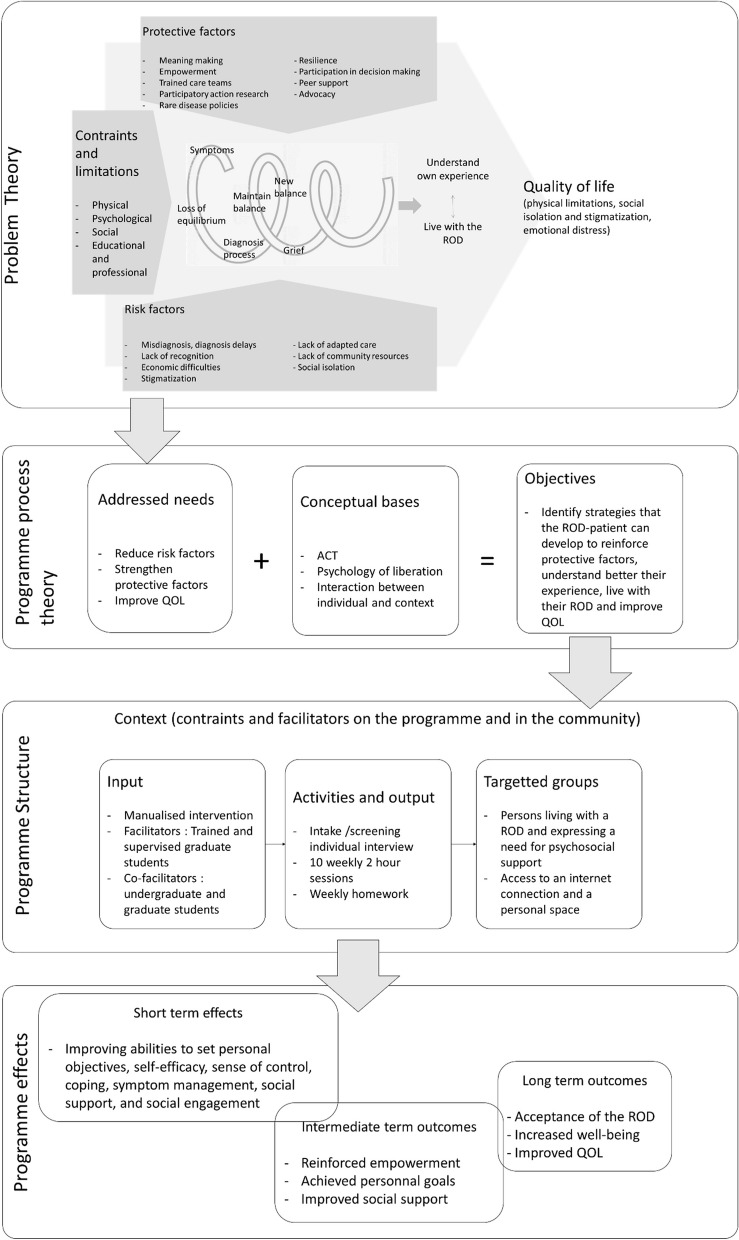
Background: Patients living with various rare or orphan diseases (ROD) experience common psychosocial difficulties. Those need emerge from a combination of factors, such as the large variety of patients and the rarity of resources, as well as concentrated efforts on physical health needs that yielded increases in life expectancy and quality in patients. A gap is therefore rising in the consideration of psychosocial needs of patients, such as coping with the impacts of physical limitations, reducing social isolation and distress. To contribute to address this gap, we developed, pilot-tested and evaluated the acceptability, feasibility, implementation, and short-term effects of Connect-ROD, an online group intervention to support adult patients with a ROD (AP-ROD), which aims to improve coping mechanisms, reinforce sense of control, and support personal goals of AP-ROD. A qualitative study comprising of in-depth pretests, post-test interviews and standardized questionnaires, was conducted with 14 participants in two consecutive intervention groups. Results: The Connect-ROD intervention is strongly anchored in acceptance and commitment therapy as well as community psychology approaches. A pilot test allowed us to improve on the initial structure and to produce a manualized 10-week program delivered online, made up of 2-h sessions comprising formal activities, exchanges and homework. The evaluation showed satisfactory acceptability and accessibility, compliant delivery by facilitators, and promising short-term effects on personal objectives, sense of control, coping mechanisms, symptom management, acceptance of the emotions associated with the disease, distress, self-efficacy, social support and connectedness. The program did not show short-term effects on overall quality of life. Conclusion: It is recommended that Connect-ROD is evaluated on a larger scale. It seems promising to support various AP-ROD who live with the complex psychosocial consequences of their disease. © The Author(s) 2024.
Overview
CoChat Summary
TL;DR
Connect-ROD is a manualized 10-week online group intervention for adults living with rare or orphan diseases, built from ACT and community psychology and tested in a small qualitative study. The program was feasible and acceptable, with promising short-term effects on several psychosocial outcomes, but not on overall quality of life.
Key findings
- The pilot test led to concrete changes: the program was expanded from 8 to 10 sessions and put more emphasis on participant sharing.
- In the evaluation phase, 14 participants from Groups 2 and 3 were assessed; the paper reports low attrition during the program (18.7%) and study protocol attrition of 0%.
- The intervention showed “promising short-term effects” on personal objectives, sense of control, coping mechanisms, symptom management, acceptance of emotions associated with the disease, distress, self-efficacy, social support and connectedness; it did not show short-term effects on overall quality of life.
- Among program completers (N = 11) versus non-completers (N = 3), completers generally had better scores and improved more on measures including mental health, depressive symptoms, and worry; 7/14 participants reported suicidal ideation at pretest, and no additional participant reported suicidal ideation at post-test.
Methods
- Longitudinal qualitative design with two phases: a pilot test (Group 1, N = 4, one attrition due to medical reasons) and an evaluation of two subsequent groups (Groups 2 and 3; 14 participants out of 16 in the evaluation sample).
- Data collection included pretest interviews and questionnaires, post-test interviews, and follow-up questionnaires; interviews were semi-structured and lasted 90–120 minutes.
- Analysis used thematic analysis in NVivo 12, combining deductive and inductive coding; standardized questionnaires were summarized descriptively with t-tests/Wilcoxon tests and effect sizes, though the paper notes the sample was too small for significant statistical analyses.
Limitations
- The paper explicitly states it was a small-scale, short-term pilot project with a convenience sample of 14 participants, limiting generalization.
- It explicitly notes the absence of a control group, and that statistical analyses were not appropriate to assess impact; therefore the authors prioritized qualitative analysis.
- Evident from the text: participants had 13 different rare/orphan diseases, varied disease stages, and fluctuating life circumstances, which the paper itself says made effects hard to isolate and may have introduced heterogeneity into group experiences.
Model-written summary. Check it against the paper before relying on it.
Integrity signals
Registry
Cites
Statistics
Figures
Verification
Claims the paper makes
6 Valid · 1 Not valid · 15 Not checked · 153 Own results and interpretations
The sources with a verdict support this claim; the rest weren’t checked yet, have no full text we could read, or their verdicts aren’t rated yet.
In the paper
“Despite major differences in symptoms, limitations, treatments and medical needs, patients with rare or orphan diseases (ROD) experience many of the same realities including limited access to services and psychological difficulties rarely acknowledged in services [2, 3].”
§ Connect-ROD – development and qualitative evaluation of a community-based group intervention to support well-being in patients with a rare or orphan disease > Background
What the sources say
- Not checked — no full text of the sourcecites [2] Caputo A Exploring quality of life in Italian patients with rare disease: a computer-aided content analysis of illness stories Psychol Health Med 2014 19 211 221 10.1080/13548506.2013.793372 23651424 source
- Supportedcites [3] von der Lippe C Diesen PS Feragen KB Living with a rare disorder: a systematic review of the qualitative literature Molecular Genetics & Genomic Medicine 2017 758 773 PMC5702559 29178638 source
The Results section describes depression, anxiety, emotional distress and difficulties with social support among people with rare disorders. The Discussion and Results also link distress to health professionals’ lack of understanding and describe denial of social services, supporting the citing sentence’s examples of shared difficulties. (LLM, conf=0.90)
plain- Asserted: passes — The authors put it forward as true.
- Checkable: passes — It can be checked against evidence.
- Load-bearing: passes — The paper’s conclusions depend on it.
- Based: passes — The paper gives a reason why it holds.
The cited sources support only part of this claim — read each source’s verdict below.
In the paper
“Both physical activity and psychoeducation programs seem to help reduce distress in AP-ROD [23, 24].”
§ Connect-ROD – development and qualitative evaluation of a community-based group intervention to support well-being in patients with a rare or orphan disease > Background > Evidence for combined programs to support well-being in AP-ROD
What the sources say
- Not checked — no full text of the sourcecites [23] Poole JL Bradford JD Siegel P Effectiveness of occupational therapy interventions for adults with systemic lupus erythematosus: a systematic review Am J Occup Ther. 2019 73 4 7304205020p1 7304205020p21 10.5014/ajot.2019.030619 31318666 source
- Partly supportedcites [24] Korownyk CS Lignes directrices simplifiées de PEER sur la douleur chronique: Gestion de la douleur chronique lombaire, arthrosique et neuropathique en première ligne Can Fam Physician 2022 68 3 e63 e76 10.46747/cfp.6803e63 35292469 PMC9833183 sourceExperimental — accuracy not yet measured
The Activité physique section reports that exercise relieves chronic osteoarthritis and low-back pain, while Interventions psychologiques reports pain reduction with cognitive behavioural therapy and mindfulness-based stress reduction. The paper does not establish that physical activity or psychoeducation programs reduce distress in AP-ROD; its reported outcome is pain, and it does not identify that population. (LLM, conf=0.79)
hedgedstates a possible cause- Asserted: passes — The authors put it forward as true.
- Checkable: passes — It can be checked against evidence.
- Load-bearing: passes — The paper’s conclusions depend on it.
- Based: passes — The paper gives a reason why it holds.
A result the paper reports from its own data — it cites no other source for it, so there is none to check. The quote shows it is in the paper.
In the paper
“However, holding the group online was problematic for one participant who did not have a private space in her home and therefore was reluctant to discuss sensitive topics for fear of family members overhearing her.”
§ Connect-ROD – development and qualitative evaluation of a community-based group intervention to support well-being in patients with a rare or orphan disease > Results > Acceptability and feasibility of the program and online delivery
plainstates a causeSingle case- Asserted: passes — The authors put it forward as true.
- Checkable: passes — It can be checked against evidence.
- Load-bearing: unclear — It is unclear whether the paper’s conclusions depend on it.
- Based: passes — The paper gives a reason why it holds.
A result the paper reports from its own data — it cites no other source for it, so there is none to check. The quote shows it is in the paper.
In the paper
“Sharing videos by email or during the sessions was also successful.”
§ Connect-ROD – development and qualitative evaluation of a community-based group intervention to support well-being in patients with a rare or orphan disease > Results > Acceptability and feasibility of the program and online delivery
plain- Asserted: passes — The authors put it forward as true.
- Checkable: passes — It can be checked against evidence.
- Load-bearing: unclear — It is unclear whether the paper’s conclusions depend on it.
- Based: passes — The paper gives a reason why it holds.
A result the paper reports from its own data — it cites no other source for it, so there is none to check. The quote shows it is in the paper.
In the paper
“Once enrolled in the program, participants felt they had easy access to the clinical and communication tools available to them.”
§ Connect-ROD – development and qualitative evaluation of a community-based group intervention to support well-being in patients with a rare or orphan disease > Results > Acceptability and feasibility of the program and online delivery
plain- Asserted: passes — The authors put it forward as true.
- Checkable: passes — It can be checked against evidence.
- Load-bearing: unclear — It is unclear whether the paper’s conclusions depend on it.
- Based: passes — The paper gives a reason why it holds.
64 more claims
Create a free account to see all 175 claims and to verify the 2 references still open.
- It may state two separate claims as one. 86
- Probably not a substantial claim. 32
Citations
Cites
[Multidimensional assessment of coping: validation of the Brief COPE among French population].
Muller, L., & Spitz, É. (2003) · PubMed · Cited by 484
Cognitive behavioural therapy for tinnitus
Martinez-Devesa, P., Perera, R., Theodoulou, M., & Waddell, A. (2010) · Cochrane Database of Systematic Reviews · doi:10.1002/14651858.cd005233.pub3 · Cited by 477
Living with a rare disorder: a systematic review of the qualitative literature
von der Lippe, C., Diesen, P. S., & Feragen, K. B. (2017) · Molecular Genetics & Genomic Medicine · doi:10.1002/mgg3.315 · Cited by 378 · cited 6×
“A choice was made to include patients dealing with various ROD in the group, because they share common psychosocial needs [3, 46] and experience a lack of resources adapted to their situation [47].”
BackgroundInfluentialChen, H.-T. (2005) · doi:10.4135/9781412985444 · Cited by 365
Practical Program Evaluation: Theory-Driven Evaluation and the Integrated Evaluation Perspective
Chen, H. T. (2015) · Sage eBooks · doi:10.4135/9781071909850 · Cited by 288
Cognitive behavioural therapy for tinnitus
Fuller, T., Cima, R., Langguth, B., Mazurek, B., Vlaeyen, J. W., & Hoare, D. J. (2020) · Cochrane Database of Systematic Reviews · doi:10.1002/14651858.cd012614.pub2 · Cited by 212
Psychology of liberation: Theory and applications.
Montero, M., & Sonn, C. C. (2009) · Cited by 194
Health-related quality of life among adults with diverse rare disorders
Bogart, K. R., & Irvin, V. L. (2017) · Orphanet Journal of Rare Diseases · doi:10.1186/s13023-017-0730-1 · Cited by 171 · cited 1×
“…areas: physical limitations (movements, pain, sleep problems, attention or concentration problems that affect daily life), [3–9], social isolation and stigmatization [3, 7, 9–13], and emotional distress (anger, depression, anxiety, hopelessness, loss, lack of control, abandonment) [3, 5, 8, 14–17].”
BackgroundAn Online Self-help CBT Intervention for Chronic Lower Back Pain
Carpenter, K. M., Stoner, S. A., Mundt, J. M., & Stoelb, B. (2012) · The Clinical Journal of Pain · doi:10.1097/ajp.0b013e31822363db · Cited by 157 · cited 1×
“Programs based on a CBT approach seem to help reduce distress symptoms and cognitive dysfunctions, improve pain management, and increase well-being [19–21].”
BackgroundUne validation de la forme abrégée de l’Échelle de provisions sociales : l’ÉPS-10 items
Caron, J. (2013) · Santé mentale au Québec · doi:10.7202/1019198ar · Cited by 137
Research works printed but not linked: 5
- Rioux ME Bardon C Pilon N Les besoins psychosociaux communs des patients atteints de MRO au Québec et de leurs proches 2019 Montréal, QC CRISE, CERMO-FC 52
- Hayes SC, Strosahl KD, Wilson KG. Acceptance and commitment therapy: The process and practice of mindful change. New-York: Guilford Press; 2011.
- Gosselin P Évaluation des inquiétudes: validation d’une traduction française du Penn State Worry Questionnaire L’encéphale 2001 27 5 475 484 11760697
- Muller L Spitz E Évaluation multidimensionnelle du coping: Validation du Brief COPE sur une population française Encéphale 2003 29 6 507 518 15029085
- Chrivoli JA Lester N Common Themes and Characteristics of Trauma in the Healthcare Experiences of Patients with Rare Disease: A Literature Analysis 2019
Cited by
Sigurðardóttir, S., Johannessen, T. J., Stenberg, U., Systad, S., Duinker, I. L., Bogart, K. R., & Feragen, K. B. (2026) · Research Square · doi:10.21203/rs.3.rs-8975124/v1
Metadata
- Authors
- Bardon, C., Rioux, M.-É., Rivard, M., Viquez Porras, F.-M., & Zaky, J.
- Affiliations
- Université du Québec à Montréal (CA)
- Corresponding author
- Bardon, Cécile
- Venue
- Orphanet Journal of Rare Diseases
- Published
- 2024-07-05
- Volume
- 19
- Issue
- 1
- Pages
- 254-254
- ISSN
- 1750-1172 (ISSN-L)
- PMC
- PMC11225341
- OpenAlex
- W4400339985
- Semantic Scholar
- 3b76874de28048180167c21558e6dbd7d4adefcf
- Cited by
- 1
- References
- 47
- Citations by year
- 2026: 1
- FWCI
- 0.40
- Type
- journal article
- Language
- en
- Open access
- gold
- doi.org
- Licence
- cc-by
- creativecommons.org/licenses/by/4.0 (tdm)
- creativecommons.org/licenses/by/4.0 (vor)
- Locations
- Orphanet Journal of Rare Diseases (publishedVersion, cc-by)
- Research Square (acceptedVersion, cc-by)
- PubMed Central (publishedVersion, cc-by)
- PubMed (publishedVersion)
- DOAJ (DOAJ: Directory of Open Access Journals) (submittedVersion)
- Funders
- Fondation du Grand défi Pierre Lavoie
- Topics
- Social Sciences › Psychology › Applied Psychology › Digital Mental Health Interventions
- Social Sciences › Psychology › Clinical Psychology › Mindfulness and Compassion Interventions
- Health Sciences › Medicine › Public Health, Environmental and Occupational Health › Telemedicine and Telehealth Implementation
- Keywords
- online group intervention, community-based intervention, psychosocial needs, coping strategies, perceived control, acceptance and commitment therapy, community psychology, social isolation, distress, self-efficacy, social support, quality of life, adult patients
- MeSH terms
- Adaptation, Psychological, Adult, Female, Humans, Male, Middle Aged, Quality of Life, Surveys and Questionnaires, Social Support, Rare Diseases, Qualitative Research
About these checks
Registry, retraction, Cites and statistics results are computed, not judged, with one exception: a printed reference that no index lists is read once by a model before it counts as a citation error. Claims are extracted by a model and kept only when their quote appears verbatim in the text; each cited source is then checked, with a model’s help, for whether it says what the claim relies on. Those verdicts can be wrong — read the claim’s quote and the cited source before relying on one.
The claim verdicts this report counts are experimental: their accuracy is not yet measured.
A language model drew the claims from the paper on 2026-10-11, under version 3 of the claim definition (model deepseek-v4.1-flash, prompt extract-v3).
A second model labelled each claim on 2026-10-11 (model jev-1.13-20260917, definition revision gold-guideline-v0.2).
Cited sources are checked with a language model’s help (gpt-6-sol).
Statistics and arithmetic are recomputed, not judged.
Confidence bands are shown only for fields calibrated on our annotated test set. None is calibrated yet, so no band is shown.
What counts as a claim ›How we measure confidence ›How we check this ›
Are you an author, or do you see a problem with this page? Request a review
How to cite
Cite CoChat for the checks on this page, and the paper for its own findings.
- This page
- CoChat. (2026). Citation check: Connect-ROD – development and qualitative evaluation of a community-based group intervention to support well-being in patients with a rare or orphan disease. https://app.cochat.ai/papers/10.1186/s13023-024-03252-4
- The paper
- Bardon, C., Rioux, M.-É., Rivard, M., Viquez Porras, F.-M., & Zaky, J. (2024). Connect-ROD – development and qualitative evaluation of a community-based group intervention to support well-being in patients with a rare or orphan disease. Orphanet Journal of Rare Diseases. https://doi.org/10.1186/s13023-024-03252-4
Data sources
Bibliographic data: Semantic Scholar, OpenAlex, Crossref.
Contains information from the Semantic Scholar Academic Graph Datasets, made available under the ODC Attribution License (ODC-BY 1.0).
Semantic Scholar’s data is described in: Kinney, R., et al. (2023). The Semantic Scholar Open Data Platform. arXiv:2301.10140.
