

The Trem2 R47H variant confers loss-of-function-like phenotypes in Alzheimer's disease
Open accessThe DOI matches its Crossref record; 35 of the 35 references it cites were found in a registry or an index.
Abstract
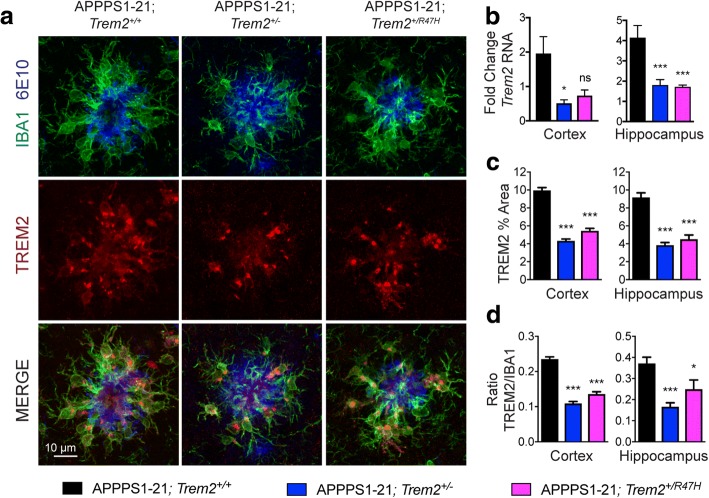
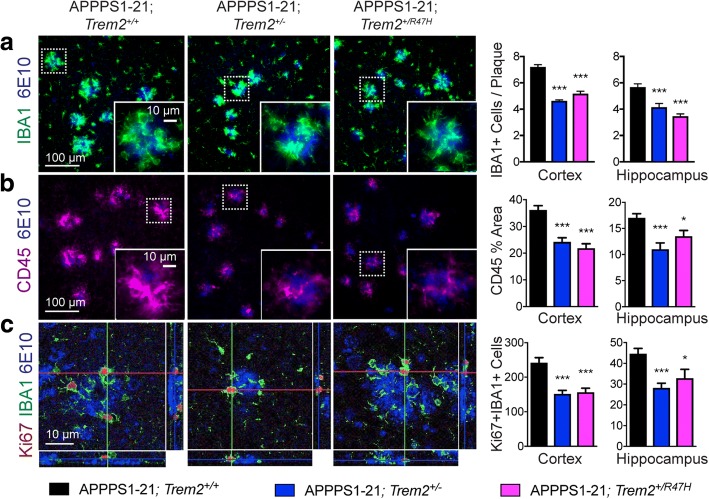
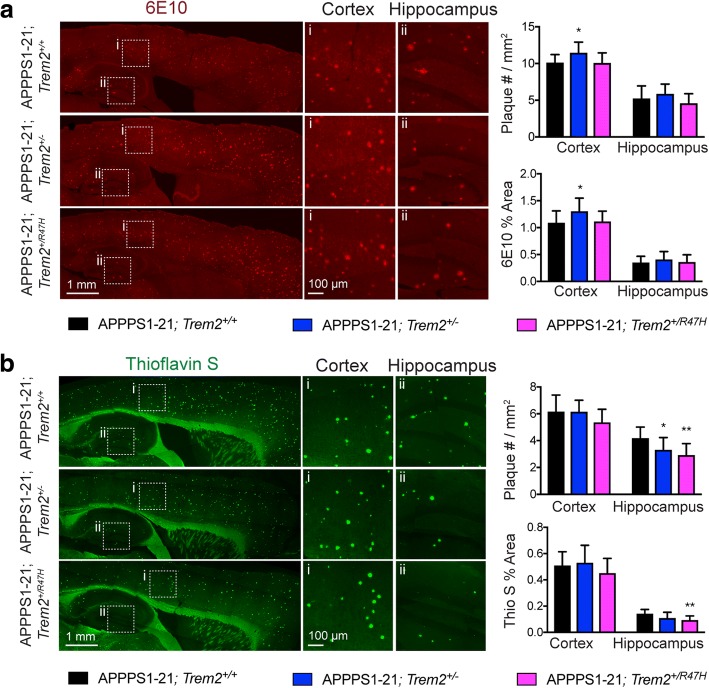
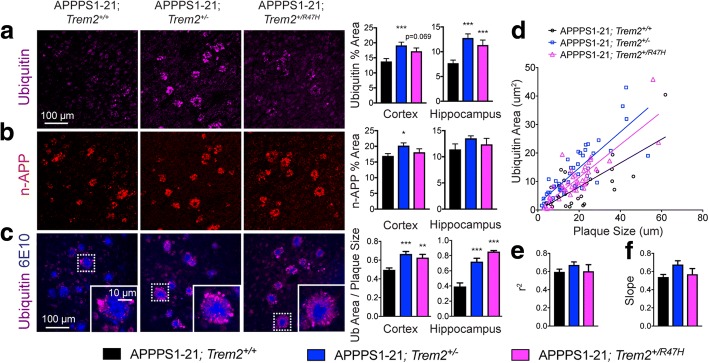
BACKGROUND: The R47H variant of Triggering Receptor Expressed on Myeloid cells 2 (TREM2) confers greatly increased risk for Alzheimer's disease (AD), reflective of a central role for myeloid cells in neurodegeneration. Understanding how this variant confers AD risk promises to provide important insights into how myeloid cells contribute to AD pathogenesis and progression. METHODS: In order to investigate this mechanism, CRISPR/Cas9 was used to generate a mouse model of AD harboring one copy of the single nucleotide polymorphism (SNP) encoding the R47H variant in murine Trem2. TREM2 expression, myeloid cell responses to amyloid deposition, plaque burden, and neuritic dystrophy were assessed at 4 months of age. RESULTS: AD mice heterozygous for the Trem2 R47H allele exhibited reduced total Trem2 mRNA expression, reduced TREM2 expression around plaques, and reduced association of myeloid cells with plaques. These results were comparable to AD mice lacking one copy of Trem2. AD mice heterozygous for the Trem2 R47H allele also showed reduced myeloid cell responses to amyloid deposition, including a reduction in proliferation and a reduction in CD45 expression around plaques. Expression of the Trem2 R47H variant also reduced dense core plaque number but increased plaque-associated neuritic dystrophy. CONCLUSIONS: These data suggest that the AD-associated TREM2 R47H variant increases risk for AD by conferring a loss of TREM2 function and enhancing neuritic dystrophy around plaques.
Overview
The claims and statistics of this paper haven’t been checked yet.
Free: it reads the open-access text and checks the first 5 claims that cite a source we can check. Create a free account to check every claim.
Integrity signals
Registry
Cites
Statistics
Figures
Verification
Claims the paper makes
The claims and statistics of this paper haven’t been checked yet.
Free: it reads the open-access text and checks the first 5 claims that cite a source we can check. Create a free account to check every claim.
Claims other papers make about this one
Each is checked against this paper’s own text: does it say what the citing paper says it does?
The source backs part of the claim, not all of it — or backs it for a different population, condition or comparison.
In the citing paper
“and identified that its expression was strongly increased by amyloid deposition in APP transgenic mice (Guerreiro et al., 2013; Matarin et al., 2015; Cheng-Hathaway et al., 2018; Song et al., 2018).”
From Genetic variability in response to amyloid beta deposition influences Alzheimer’s disease risk (2019) · cites this paper as Cheng-Hathaway et al., 2018
Experimental — accuracy not yet measuredThe source backs part of the claim, not all of it — or backs it for a different population, condition or comparison.
In the citing paper
“TREM2 plays a key and enigmatic role in the progression of AD, acting to drive microglial phagocytosis, survival, lipid homeostasis, and metabolism.”
From PLCG2 modulates TREM2 expression and signaling in response to Alzheimer's disease pathology (2025) · cites this paper as [36]
Experimental — accuracy not yet measuredThe source backs part of the claim, not all of it — or backs it for a different population, condition or comparison.
In the citing paper
“In AD, amyloid pathology induces the expression of TREM2 in microglia. 36 , 37 , 38 , 39 , 40 , 41 , 60”
From PLCG2 modulates TREM2 expression and signaling in response to Alzheimer's disease pathology (2025) · cites this paper as [36]
Experimental — accuracy not yet measuredThe source backs part of the claim, not all of it — or backs it for a different population, condition or comparison.
In the citing paper
“The most characterised variant of TREM2 (p.R47H) shows defects in ligand binding [6, 37, 38, 97], which impacts the ability of TREM2 to recognise damage, and induce microglial changes, resulting in a dampened response to pathological insults such as Aβ deposition.”
From TREM2/PLCγ2 signalling in immune cells: function, structural insight, and potential therapeutic modulation (2021) · cites this paper as [37]
Experimental — accuracy not yet measuredThe cited source says what the claim attributes to it.
In the citing paper
“This effect has been described by Cheng-Hathaway et al. (37) and Xiang et al. (36) studying the same mouse line used here from the Jackson Laboratory, and an independent Trem2 R47H KI mouse line.”
From Trem2 promotes anti-inflammatory responses in microglia and is suppressed under pro-inflammatory conditions (2020) · cites this paper as [37]
5 more claims about this paper
Create a free account to see every claim other papers make about this one.
Self-check
Percentages, sums and reported differences re-computed from the paper’s own numbers.
The self-check needs the paper’s full text.
Citations
Cites
Neuroinflammation in Alzheimer's disease
Heneka, M. T., Carson, M. J., Khoury, J. E., Landreth, G. E., Brosseron, F., Feinstein, D. L., Jacobs, A. H., Wyss-Coray, T., Vitorica, J., Ransohoff, R. M., et al. (2015) · The Lancet Neurology · doi:10.1016/s1474-4422(15)70016-5 · Cited by 6,226 · cited 1×
“Alzheimer’s disease (AD) is accompanied by a robust inflammatory response [1].”
BackgroundSelf-citationA Unique Microglia Type Associated with Restricting Development of Alzheimer’s Disease
Keren-Shaul, H., Spinrad, A., Weiner, A., Matcovitch-Natan, O., Dvir-Szternfeld, R., Ulland, T. K., David, E., Baruch, K., Lara-Astaiso, D., Toth, B., et al. (2017) · Cell · doi:10.1016/j.cell.2017.05.018 · Cited by 5,493 · cited 1×
“Recent work suggests that TREM2 is required for the myeloid cell-mediated inflammatory response in AD [28, 31].”
BackgroundNeuropathological alterations in Alzheimer disease
Serrano-Pozo, A., Frosch, M. P., Masliah, E., & Hyman, B. T. (2011) · Cold Spring Harbor Perspectives in Medicine · doi:10.1101/cshperspect.a006189 · Cited by 3,345 · cited 1×
“Damage to axons and dendrites in the vicinity of plaques, termed neuritic dystrophy, is thought to contribute to cognitive impairment in AD [32] and is reported to be enhanced in AD mice lacking Trem2 and humans carrying an R47H allele [9, 12].”
BackgroundTREM2 Variants in Alzheimer's Disease
Guerreiro, R., Wojtas, A., Bras, J., Carrasquillo, M., Rogaeva, E., Majounie, E., Cruchaga, C., Sassi, C., Kauwe, J. S. K., Younkin, S., et al. (2013) · New England Journal of Medicine · doi:10.1056/nejmoa1211851 · Cited by 3,020 · cited 1×
“The TREM2 R47H variant not only constitutes one of the strongest single allele genetic risk factors for AD [3, 4], but also confers elevated risk for Parkinson’s disease, amyotrophic lateral sclerosis, and frontotemporal dementia [5].”
BackgroundKrasemann, S., Madore, C., Cialic, R., Baufeld, C., Calcagno, N., El Fatimy, R., Beckers, L., O’Loughlin, E., Xu, Y., Fanek, Z., et al. (2017) · Immunity · doi:10.1016/j.immuni.2017.08.008 · Cited by 2,979
Variant of TREM2 Associated with the Risk of Alzheimer's Disease
Jonsson, T., Stefansson, H., Steinberg, S., Jonsdottir, I., Jonsson, P. V., Snaedal, J., Bjornsson, S., Huttenlocher, J., Levey, A. I., Lah, J. J., et al. (2013) · New England Journal of Medicine · doi:10.1056/nejmoa1211103 · Cited by 2,558 · cited 1×
“The TREM2 R47H variant not only constitutes one of the strongest single allele genetic risk factors for AD [3, 4], but also confers elevated risk for Parkinson’s disease, amyotrophic lateral sclerosis, and frontotemporal dementia [5].”
BackgroundHaeussler, M., Schönig, K., Eckert, H., Eschstruth, A., Mianné, J., Renaud, J.-B., Schneider-Maunoury, S., Shkumatava, A., Teboul, L., Kent, J., et al. (2016) · Genome biology · doi:10.1186/s13059-016-1012-2 · Cited by 1,756 · cited 1×
“net) was used to determine potential off-target genes in exonic regions of chromosome 17 [23].”
MethodTREM2 Lipid Sensing Sustains the Microglial Response in an Alzheimer’s Disease Model
Wang, Y., Cella, M., Mallinson, K., Ulrich, J. D., Young, K. L., Robinette, M. L., Gilfillan, S., Krishnan, G. M., Sudhakar, S., Zinselmeyer, B. H., et al. (2015) · Cell · doi:10.1016/j.cell.2015.01.049 · Cited by 1,736
Alzheimer’s Disease Risk Genes and Mechanisms of Disease Pathogenesis
Karch, C. M., & Goate, A. M. (2015) · Biological Psychiatry · doi:10.1016/j.biopsych.2014.05.006 · Cited by 1,357 · cited 1×
“Recent Genome Wide Association Studies have linked single nucleotide polymorphisms (SNPs) in inflammation-related genes to increased AD risk [2], including a SNP encoding the R47H variant in Triggering Receptor Expressed on Myeloid cells 2 (TREM2).”
BackgroundAβ42‐driven cerebral amyloidosis in transgenic mice reveals early and robust pathology
Radde, R., Bolmont, T., Kaeser, S. A., Coomaraswamy, J., Lindau, D., Stoltze, L., Calhoun, M. E., Jäggi, F., Wolburg, H., Gengler, S., et al. (2006) · The EMBO Reports · doi:10.1038/sj.embor.7400784 · Cited by 986 · cited 2×
“Founder lines positive for the SNP were crossed to the APPPS1–21 AD mouse model [26], generating APPPS1–21;Trem2 mice.”
BackgroundMethodYeh, F. L., Wang, Y., Tom, I., Gonzalez, L. C., & Sheng, M. (2016) · Neuron · doi:10.1016/j.neuron.2016.06.015 · Cited by 943
TREM2-mediated early microglial response limits diffusion and toxicity of amyloid plaques
Wang, Y., Ulland, T. K., Ulrich, J. D., Song, W., Tzaferis, J. A., Hole, J. T., Yuan, P., Mahan, T. E., Shi, Y., Gilfillan, S., et al. (2016) · Journal of Experimental Medicine · doi:10.1084/jem.20151948 · Cited by 840 · cited 2×
“In support of this hypothesis, Trem2 deficient AD mice exhibit enhanced amyloid pathology at late stages in disease [10, 11] accompanied by increased plaque-associated neuritic dystrophy [9, 11, 12].”
BackgroundYuan, P., Condello, C., Keene, C. D., Wang, Y., Bird, T. D., Paul, S. M., Luo, W., Colonna, M., Baddeley, D., & Grutzendler, J. (2016) · Neuron · doi:10.1016/j.neuron.2016.05.003 · Cited by 817 · cited 20×
“A central question arising from this work is how the changes observed in our study relate to the approximate three-fold elevation in AD risk in heterozygous carriers of the TREM2 R47H variant.”
BackgroundResultInfluentialMicroglia constitute a barrier that prevents neurotoxic protofibrillar Aβ42 hotspots around plaques
Condello, C., Yuan, P., Schain, A., & Grutzendler, J. (2015) · Nature Communications · doi:10.1038/ncomms7176 · Cited by 718 · cited 1×
“from damaging Aβ species [35], leading to the prediction that impaired association of myeloid cells with plaques”
BackgroundTREMs in the immune system and beyond
Colonna, M. (2003) · Nature Reviews Immunology · doi:10.1038/nri1106 · Cited by 701 · cited 1×
“loid cells [7, 8] and has been implicated in a diverse range of myeloid cell functions [5].”
BackgroundSedgwick, J. D., Schwender, S., Imrich, H., Dörries, R., Butcher, G. W., & ter Meulen, V (1991) · Proceedings of the National Academy of Sciences · doi:10.1073/pnas.88.16.7438 · Cited by 698 · cited 1×
“used to identify peripherally derived myeloid cells [30], though we cannot exclude the possibility that these cells represent a phenotypically distinct subset of reactive microglia.”
MethodPaloneva, J., Manninen, T., Christman, G., Hovanes, K., Mandelin, J., Adolfsson, R., Bianchin, M., Bird, T., Miranda, R., Salmaggi, A., et al. (2002) · The American Journal of Human Genetics · doi:10.1086/342259 · Cited by 683 · cited 1×
“Furthermore, homozygous TREM2 variants cause Nasu-Hakola disease, which is characterized by extensive white matter loss and frontotemporal-like dementia [6].”
BackgroundJay, T. R., Miller, C. M., Cheng, P. J., Graham, L. C., Bemiller, S., Broihier, M. L., Xu, G., Margevicius, D., Karlo, J. C., Sousa, G. L., et al. (2015) · Journal of Experimental Medicine · doi:10.1084/jem.20142322 · Cited by 682 · cited 7×
“in preferential loss of CD45-expressing myeloid cells around plaques [10, 13].”
BackgroundResultInfluentialSelf-citationApolipoprotein E Is a Ligand for Triggering Receptor Expressed on Myeloid Cells 2 (TREM2)
Atagi, Y., Liu, C.-C., Painter, M. M., Chen, X.-F., Verbeeck, C., Zheng, H., Li, X., Rademakers, R., Kang, S. S., Xu, H., et al. (2015) · Journal of Biological Chemistry · doi:10.1074/jbc.m115.679043 · Cited by 587
Disease Progression-Dependent Effects of TREM2 Deficiency in a Mouse Model of Alzheimer's Disease
Jay, T. R., Hirsch, A. M., Broihier, M. L., Miller, C. M., Neilson, L. E., Ransohoff, R. M., Lamb, B. T., & Landreth, G. E. (2017) · The Journal of Neuroscience · doi:10.1523/jneurosci.2110-16.2016 · Cited by 457 · cited 6×
“in preferential loss of CD45-expressing myeloid cells around plaques [10, 13].”
BackgroundInfluentialSelf-citationTREM2 in Neurodegenerative Diseases
Jay, T. R., von Saucken, V. E., & Landreth, G. E. (2017) · Molecular Neurodegeneration · doi:10.1186/s13024-017-0197-5 · Cited by 427 · cited 3×
“These findings suggest that TREM2 may be involved in other mechanisms of dystrophic neurite formation, or perhaps more likely, given its demonstrated role of phagocytosis in vitro, in the clearance of these dystrophic neurites [5].”
BackgroundSelf-citationSchmid, C. D., Sautkulis, L. N., Danielson, P. E., Cooper, J., Hasel, K. W., Hilbush, B. S., Sutcliffe, J. G., & Carson, M. J. (2002) · Journal of Neurochemistry · doi:10.1046/j.1471-4159.2002.01243.x · Cited by 351 · cited 1×
“loid cells [7, 8] and has been implicated in a diverse range of myeloid cell functions [5].”
BackgroundTREM2 deficiency impairs chemotaxis and microglial responses to neuronal injury
Mazaheri, F., Snaidero, N., Kleinberger, G., Madore, C., Daria, A., Werner, G., Krasemann, S., Capell, A., Trümbach, D., Wurst, W., et al. (2017) · The EMBO Reports · doi:10.15252/embr.201743922 · Cited by 351 · cited 1×
“Other possible mechanisms may also contribute to the reduction of myeloid cells around plaques in mice expressing the Trem2 R47H variant, including deficits in myeloid cell migration [34] and survival [11].”
BackgroundJiang, T., Tan, L., Zhu, X.-C., Zhang, Q.-Q., Cao, L., Tan, M.-S., Gu, L.-Z., Wang, H.-F., Ding, Z.-Z., Zhang, Y.-D., et al. (2014) · Neuropsychopharmacology · doi:10.1038/npp.2014.164 · Cited by 320 · cited 1×
“In addition, these mice expressed eight copies of the TREM2 gene and, because TREM2 overexpression has previously been associated with changes in microglial function and pathology [22], it is difficult to determine which phenotypes observed in this study were due to the TREM2 R47H variant or overexpression of the TREM…”
BackgroundHumanized TREM2 mice reveal microglia-intrinsic and -extrinsic effects of R47H polymorphism
Song, W. M., Joshita, S., Zhou, Y., Ulland, T. K., Gilfillan, S., & Colonna, M. (2018) · Journal of Experimental Medicine · doi:10.1084/jem.20171529 · Cited by 305 · cited 2×
“expressed the human TREM2 R47H variant using a bacterial artificial chromosome (BAC) transgenic and found that the R47H variant could not rescue aspects of TREM2 function in AD mice lacking endogenous Trem2 expression [21].”
MethodThe Triggering Receptor Expressed on Myeloid Cells 2 Binds Apolipoprotein E
Bailey, C. C., DeVaux, L. B., & Farzan, M. (2015) · Journal of Biological Chemistry · doi:10.1074/jbc.m115.677286 · Cited by 303
Altered microglial response to Aβ plaques in APPPS1-21 mice heterozygous for TREM2
Ulrich, J. D., Finn, M. B., Wang, Y., Shen, A., Mahan, T. E., Jiang, H., Stewart, F. R., Piccio, L., Colonna, M., & Holtzman, D. M. (2014) · Molecular Neurodegeneration · doi:10.1186/1750-1326-9-20 · Cited by 302
Song, W., Hooli, B., Mullin, K., Jin, S. C., Cella, M., Ulland, T. K., Wang, Y., Tanzi, R. E., & Colonna, M. (2017) · Alzheimer's & Dementia · doi:10.1016/j.jalz.2016.07.004 · Cited by 297
Kober, D. L., Alexander-Brett, J. M., Karch, C. M., Cruchaga, C., Colonna, M., Holtzman, M. J., & Brett, T. J. (2016) · eLife · doi:10.7554/elife.20391 · Cited by 238
Off-target mutations are rare in Cas9-modified mice
Iyer, V., Shen, B., Zhang, W., Hodgkins, A., Keane, T., Huang, X., & Skarnes, W. C. (2015) · Nature Methods · doi:10.1038/nmeth.3408 · Cited by 185 · cited 1×
“ent with the low rate of expected off-target mutations due to CRISPR/Cas9 targeting [25].”
BackgroundZheng, H., Liu, C.-C., Atagi, Y., Chen, X.-F., Jia, L., Yang, L., He, W., Zhang, X., Kang, S. S., Rosenberry, T. L., et al. (2016) · Neurobiology of Aging · doi:10.1016/j.neurobiolaging.2016.03.004 · Cited by 110 · cited 1×
“within 5 kb of the Trem2 locus that may affect myeloid cell function [24], mutations were also assessed in”
BackgroundPark, J., Ji, I. J., An, H. J., Kang, M., Kang, S., Kim, D., & Yoon, S. (2015) · Traffic · doi:10.1111/tra.12264 · Cited by 87 · cited 1×
“In vitro studies have demonstrated that the TREM2 R47H variant reduces affinity for TREM2 ligand binding [9, 11, 14–18], and alters glycosylation [19, 20], leading to speculation that the TREM2 R47H variant may result in a loss of TREM2 function.”
BackgroundMa, L., Allen, M., Sakae, N., Ertekin-Taner, N., Graff-Radford, N. R., Dickson, D. W., Younkin, S. G., & Sevlever, D. (2016) · Molecular Neurodegeneration · doi:10.1186/s13024-016-0137-9 · Cited by 70 · cited 1×
“This finding differs from a previous study that found no changes in TREM2 expression in postmortem tissue from human AD patients heterozygous for the TREM2 R47H variant [33].”
Park, J.-S., Ji, I. J., Kim, D.-H., An, H. J., & Yoon, S.-Y. (2017) · Frontiers in Neuroscience · doi:10.3389/fnins.2016.00618 · Cited by 47
Aβ Extraction from Murine Brain Homogenates
Casali, B., & Landreth, G. (2016) · BIO-PROTOCOL · doi:10.21769/bioprotoc.1787 · Cited by 39 · cited 1×
“Aβ1–40 and Aβ1–42 ELISAs Extraction of Aβ species was conducted as described previously [27].”
Self-citation
Cited by
Loss of TREM2 function increases amyloid seeding but reduces plaque-associated ApoE
Parhizkar, S., Arzberger, T., Brendel, M., Kleinberger, G., Deussing, M., Focke, C., Nuscher, B., Xiong, M., Ghasemigharagoz, A., Katzmarski, N., et al. (2019) · Nature Neuroscience · doi:10.1038/s41593-018-0296-9 · Cited by 555
New insights into the role of TREM2 in Alzheimer’s disease
Gratuze, M., Leyns, C. E. G., & Holtzman, D. M. (2018) · Molecular Neurodegeneration · doi:10.1186/s13024-018-0298-9 · Cited by 489
Crosstalk Between Astrocytes and Microglia: An Overview
Matejuk, A., & Ransohoff, R. M. (2020) · Frontiers in Immunology · doi:10.3389/fimmu.2020.01416 · Cited by 445
Self-citationMcQuade, A., Kang, Y. J., Hasselmann, J., Jairaman, A., Sotelo, A., Coburn, M., Shabestari, S. K., Chadarevian, J. P., Fote, G., Tu, C. H., et al. (2020) · Nature Communications · doi:10.1038/s41467-020-19227-5 · Cited by 361
Loss of TREM2 function increases amyloid seeding but reduces plaque-associated ApoE
Parhizkar, S., Arzberger, T., Brendel, M., Kleinberger, G., Deußing, M., Focke, C., Nuscher, B., Xiong, M., Ghasemigharagoz, A., Katzmarski, N., et al. (2019) · doi:10.7892/boris.125653 · Cited by 352
Metadata
- Authors
- Cheng-Hathaway, P. J., Reed-Geaghan, E. G., Jay, T. R., Casali, B. T., Bemiller, S. M., Puntambekar, S. S., von Saucken, V. E., Williams, R. Y., Karlo, J. C., Moutinho, M., Xu, G., Ransohoff, R. M., Lamb, B. T., & Landreth, G. E.
- Affiliations
- Indiana University Indianapolis (US)
- Case Western Reserve University (US)
- Indiana University School of Medicine (US)
- Cleveland Clinic Research (US)
- Corresponding author
- Landreth, Gary E.
- ORCID
- Venue
- Molecular Neurodegeneration
- Published
- 2018-06-01
- Volume
- 13
- Issue
- 1
- Pages
- 29-29
- ISSN
- 1750-1326 (ISSN-L)
- PMC
- PMC5984804
- OpenAlex
- W2807252917
- Cited by
- 252
- References
- 35
- Citations by year
- 2026: 27 · 2025: 24 · 2024: 24 · 2023: 45 · 2022: 21 · 2021: 29 · 2020: 48 · 2019: 22 · 2018: 11
- FWCI
- 19.54
- Type
- journal article
- Language
- en
- Open access
- gold
- doi.org
- Licence
- cc-by
- creativecommons.org/licenses/by/4.0/ (tdm)
- creativecommons.org/licenses/by/4.0/ (vor)
- Locations
- Molecular Neurodegeneration (publishedVersion, cc-by)
- Europe PMC (PubMed Central) (publishedVersion, other-oa)
- PubMed Central (publishedVersion, cc-by)
- PubMed (publishedVersion)
- DOAJ (DOAJ: Directory of Open Access Journals) (submittedVersion, cc-by-sa)
- IUScholarWorks (Indiana University) (submittedVersion, cc-by)
- Funders
- Alzheimer's Association
- Case Western Reserve University (T32 NS077888, T32 GM725039)
- National Institute on Aging (F30 AG055261, F31 AG048704, R01 AG051495, R01 AG050597)
- Jane & Lee Seidman Fund
- Chet & Jane Scholtz
- Dave & Susan Roberts
- Topics
- Life Sciences › Neuroscience › Cellular and Molecular Neuroscience › Alzheimer's disease research and treatments
- Life Sciences › Neuroscience › Neurology › Neuroinflammation and Neurodegeneration Mechanisms
- Health Sciences › Medicine › Psychiatry and Mental health › Dementia and Cognitive Impairment Research
- Keywords
- TREM2, Alzheimer's disease, loss of function, myeloid cells, amyloid plaques, neuritic dystrophy, CD45, amyloid deposition, mouse model, genetic risk
- MeSH terms
- Alzheimer Disease, Animals, Brain, Membrane Glycoproteins, Phenotype, Receptors, Immunologic, Polymorphism, Single Nucleotide, Mice
About these checks
Registry, retraction, Cites and statistics results are computed, not judged, with one exception: a printed reference that no index lists is read once by a model before it counts as a citation error. Claims are extracted by a model and kept only when their quote appears verbatim in the text; each cited source is then checked, with a model’s help, for whether it says what the claim relies on. Those verdicts can be wrong — read the claim’s quote and the cited source before relying on one.
Statistics and arithmetic are recomputed, not judged.
Confidence bands are shown only for fields calibrated on our annotated test set. None is calibrated yet, so no band is shown.
What counts as a claim ›How we measure confidence ›How we check this ›
Are you an author, or do you see a problem with this page? Request a review
Data sources
Bibliographic data: Semantic Scholar, OpenAlex, Crossref.
Contains information from the Semantic Scholar Academic Graph Datasets, made available under the ODC Attribution License (ODC-BY 1.0).
Semantic Scholar’s data is described in: Kinney, R., et al. (2023). The Semantic Scholar Open Data Platform. arXiv:2301.10140.
