

LILRB2-mediated TREM2 signaling inhibition suppresses microglia functions
Open accessThe DOI matches its Crossref record; 88 of the 88 references it cites were found in a registry or an index.
Abstract
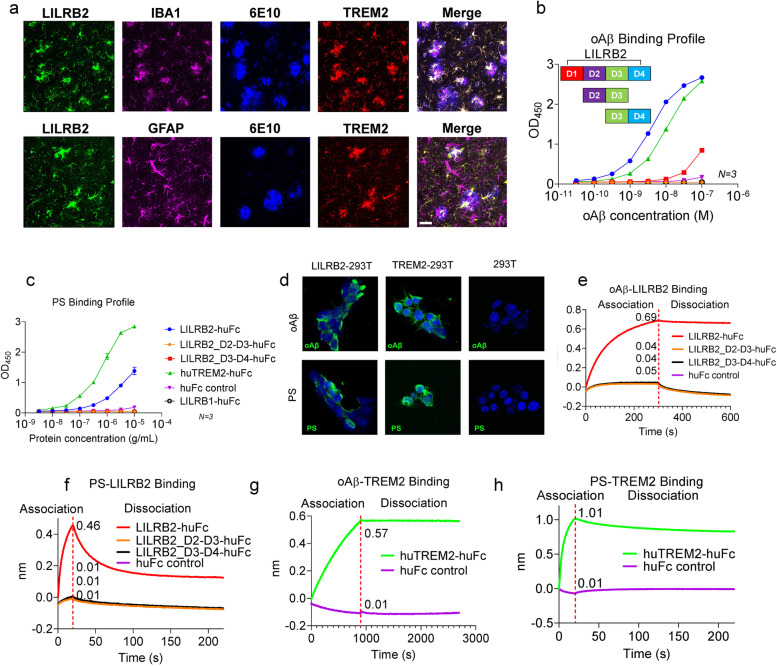
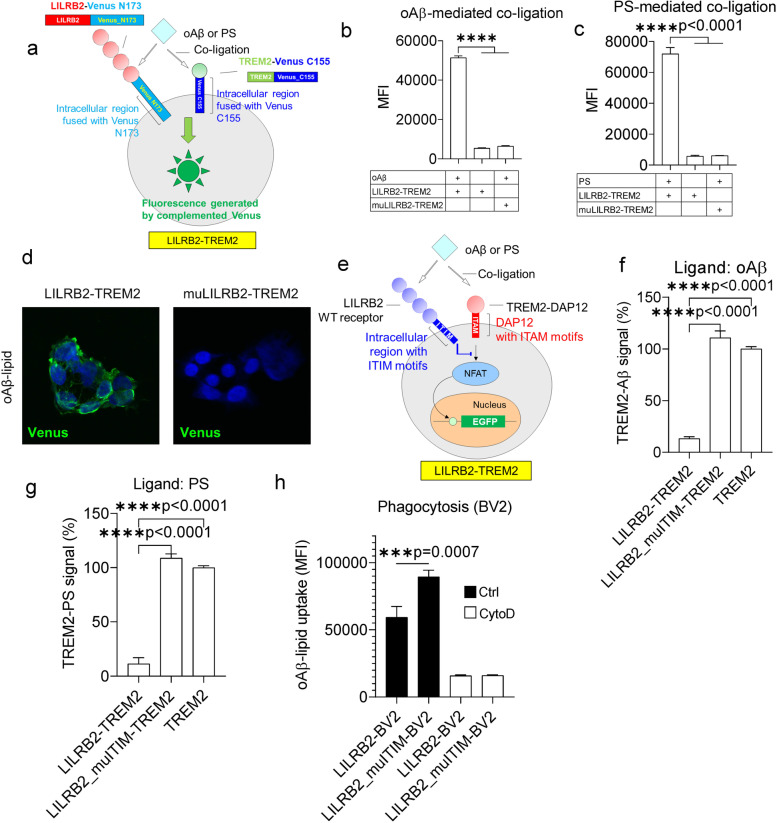
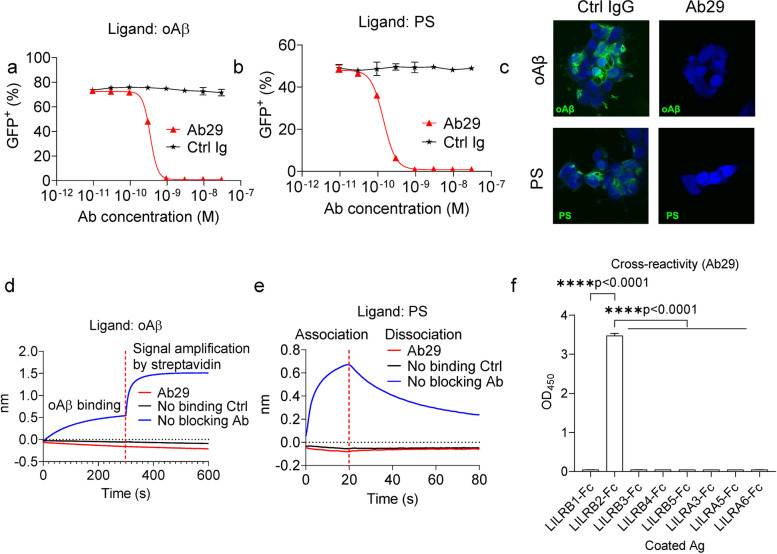
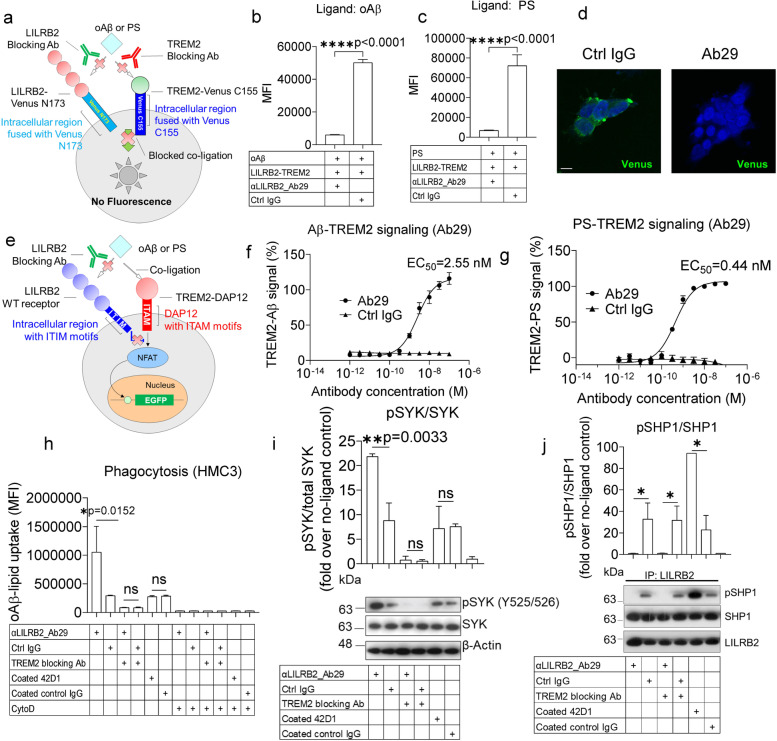
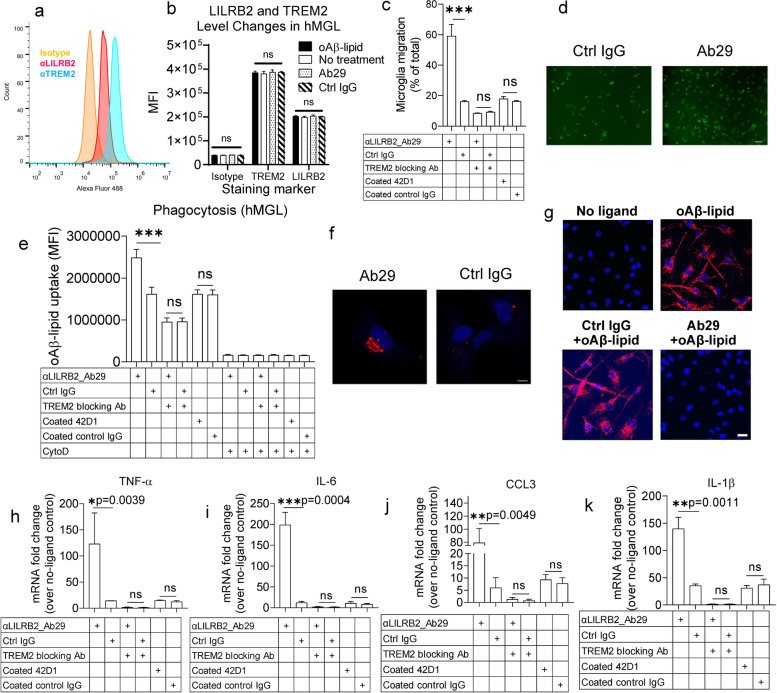
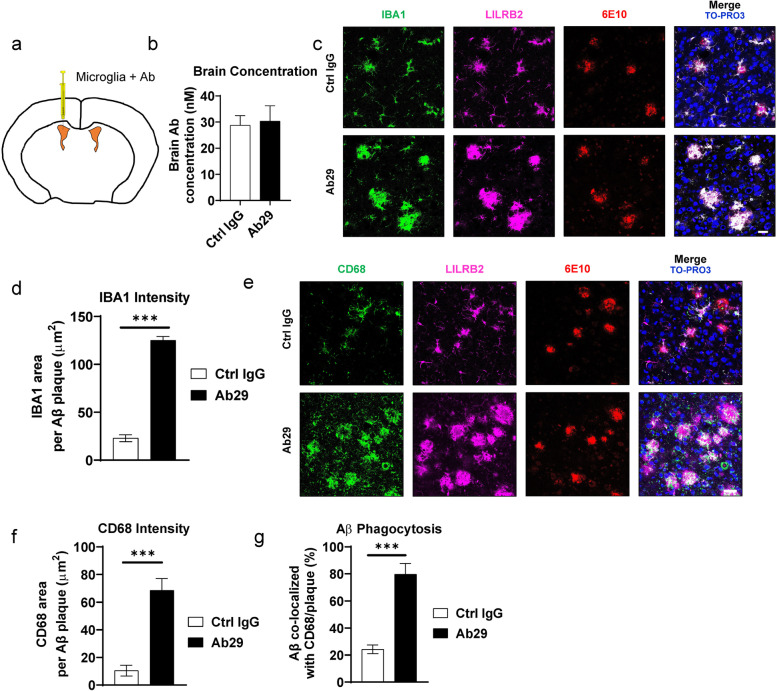
Background: Microglia plays crucial roles in Alzheimer’s disease (AD) development. Triggering receptor expressed on myeloid cells 2 (TREM2) in association with DAP12 mediates signaling affecting microglia function. Here we study the negative regulation of TREM2 functions by leukocyte immunoglobulin-like receptor subfamily B member 2 (LILRB2), an inhibitory receptor bearing ITIM motifs. Methods: To specifically interrogate LILRB2-ligand (oAβ and PS) interactions and microglia functions, we generated potent antagonistic LILRB2 antibodies with sub-nanomolar level activities. The biological effects of LILRB2 antagonist antibody (Ab29) were studied in human induced pluripotent stem cell (iPSC)–derived microglia (hMGLs) for migration, oAβ phagocytosis, and upregulation of inflammatory cytokines. Effects of the LILRB2 antagonist antibody on microglial responses to amyloid plaques were further studied in vivo using stereotaxic grafted microglia in 5XFAD mice. Results: We confirmed the expression of both LILRB2 and TREM2 in human brain microglia using immunofluorescence. Upon co-ligation of the LILRB2 and TREM2 by shared ligands oAβ or PS, TREM2 signaling was significantly inhibited. We identified a monoclonal antibody (Ab29) that blocks LILRB2/ligand interactions and prevents TREM2 signaling inhibition mediated by LILRB2. Further, Ab29 enhanced microglia phagocytosis, TREM2 signaling, migration, and cytokine responses to the oAβ-lipoprotein complex in hMGL and microglia cell line HMC3. In vivo studies showed significantly enhanced clustering of microglia around plaques with a prominent increase in microglial amyloid plaque phagocytosis when 5XFAD mice were treated with Ab29. Conclusions: This study revealed for the first time the molecular mechanisms of LILRB2-mediated inhibition of TREM2 signaling in microglia and demonstrated a novel approach of enhancing TREM2-mediated microglia functions by blocking LILRB2-ligand interactions. Translationally, a LILRB2 antagonist antibody completely rescued the inhibition of TREM2 signaling by LILRB2, suggesting a novel therapeutic strategy for improving microglial functions.
Overview
The claims and statistics of this paper haven’t been checked yet.
Free: it reads the open-access text and checks the first 5 claims that cite a source we can check. Create a free account to check every claim.
Integrity signals
Registry
Cites
Statistics
Figures
Verification
Claims the paper makes
The claims and statistics of this paper haven’t been checked yet.
Free: it reads the open-access text and checks the first 5 claims that cite a source we can check. Create a free account to check every claim.
Claims other papers make about this one
Each is checked against this paper’s own text: does it say what the citing paper says it does?
The source backs part of the claim, not all of it — or backs it for a different population, condition or comparison.
In the citing paper
“For example, Aβ can interact with the leukocyte immunoglobulin-like receptor B2 (LilrB2) and negatively mediate synapses and memory.585”
From Recent advances in Alzheimer's disease: Mechanisms, clinical trials and new drug development strategies. (2024) · cites this paper as [585]
Experimental — accuracy not yet measured
Self-check
Percentages, sums and reported differences re-computed from the paper’s own numbers.
The self-check needs the paper’s full text.
Citations
Cites
Deciphering key features in protein structures with the new ENDscript server
Robert, X., & Gouet, P. (2014) · Nucleic Acids Research · doi:10.1093/nar/gku316 · Cited by 7,053
Alzheimer Disease: An Update on Pathobiology and Treatment Strategies
Long, J. M., & Holtzman, D. M. (2019) · Cell · doi:10.1016/j.cell.2019.09.001 · Cited by 3,204 · cited 1×
“Background Alzheimer’s disease (AD), the main cause of dementia, is a neurodegenerative disorder with limited treatment options [1, 2].”
BackgroundKrasemann, S., Madore, C., Cialic, R., Baufeld, C., Calcagno, N., El Fatimy, R., Beckers, L., O’Loughlin, E., Xu, Y., Fanek, Z., et al. (2017) · Immunity · doi:10.1016/j.immuni.2017.08.008 · Cited by 2,979 · cited 1×
“This stage-dependent effect of LILRB2 in AD is consistent with the perplexing roles that TREM2 plays in AD [85, 86].”
ResultSelf-citationMicroglia and macrophages in brain homeostasis and disease
Li, Q., & Barres, B. A. (2018) · Nature Reviews Immunology · doi:10.1038/nri.2017.125 · Cited by 1,999 · cited 1×
“Microglia, brain-resident myeloid cells, play pivotal roles in AD development by regulating brain homeostasis [8] and neuroinflammation [9], promoting Aβ plaque phagocytic clearance [10], and clustering and limiting diffusion of Aβ plaques [11] and tau tangles [12].”
BackgroundTREM2 Lipid Sensing Sustains the Microglial Response in an Alzheimer’s Disease Model
Wang, Y., Cella, M., Mallinson, K., Ulrich, J. D., Young, K. L., Robinette, M. L., Gilfillan, S., Krishnan, G. M., Sudhakar, S., Zinselmeyer, B. H., et al. (2015) · Cell · doi:10.1016/j.cell.2015.01.049 · Cited by 1,736
A review on Alzheimer's disease pathophysiology and its management: an update
Kumar, A., Singh, A., & Ekavali (2015) · Pharmacological Reports · doi:10.1016/j.pharep.2014.09.004 · Cited by 1,578 · cited 1×
“Background Alzheimer’s disease (AD), the main cause of dementia, is a neurodegenerative disorder with limited treatment options [1, 2].”
BackgroundDisease-Associated Microglia: A Universal Immune Sensor of Neurodegeneration
Deczkowska, A., Keren-Shaul, H., Weiner, A., Colonna, M., Schwartz, M., & Amit, I. (2018) · Cell · doi:10.1016/j.cell.2018.05.003 · Cited by 1,474 · cited 1×
“Since disease-associated-microglia (DAM) gene studies currently reported mostly involve AD mouse models, 5XFAD and APPPS1, and mice have no LILRB2, we are not able to confirm whether LILRB2 is one of the DAM genes [60].”
BackgroundTREM2 Maintains Microglial Metabolic Fitness in Alzheimer’s Disease
Ulland, T. K., Song, W. M., Huang, S. C.-C., Ulrich, J. D., Sergushichev, A., Beatty, W. L., Loboda, A. A., Zhou, Y., Cairns, N. J., Kambal, A., et al. (2017) · Cell · doi:10.1016/j.cell.2017.07.023 · Cited by 1,263 · cited 2×
“In addition, TREM2 deficiency curtails anabolic and energetic metabolism demonstrated by ER stress, defective mTOR signaling, reduced ATP levels, and biosynthesis pathways [71].”
BackgroundChemnitz, J. M., Parry, R. V., Nichols, K. E., June, C. H., & Riley, J. L. (2004) · The Journal of Immunology · doi:10.4049/jimmunol.173.2.945 · Cited by 1,246 · cited 2×
“The immunoreceptor tyrosinebased switch motifs (ITSMs) in PD-1 play crucial roles in mediating the inhibition of CD3 as demonstrated by mutation studies [69].”
BackgroundDirect Recognition of Cytomegalovirus by Activating and Inhibitory NK Cell Receptors
Arase, H., Mocarski, E. S., Campbell, A. E., Hill, A. B., & Lanier, L. L. (2002) · Science · doi:10.1126/science.1070884 · Cited by 1,230 · cited 2×
“Association with DAP12 allows ligands to trigger NFAT signaling and induce GFP expression by binding to extracellular LILRB2 [43, 44] (Supplementary Fig.”
BackgroundSelf-citation
Research works printed but not linked: 1
- 84. Walker DG Defining activation states of microglia in human brain tissue: an unresolved issue for Alzheimer’s disease Neuroimmunol Neuroinflammation 2020 7 3 194 214
Cited by
Zhang, J., Zhang, Y., Wang, J., Xia, Y., Zhang, J., & Chen, L. (2024) · Signal Transduction and Targeted Therapy · doi:10.1038/s41392-024-01911-3 · Cited by 1,138
Tijms, B. M., Vromen, E. M., Mjaavatten, O., Holstege, H., Reus, L. M., van der Lee, S., Wesenhagen, K. E. J., Lorenzini, L., Vermunt, L., Venkatraghavan, V., et al. (2024) · Nature Aging · doi:10.1038/s43587-023-00550-7 · Cited by 202
“Together with the decreased levels of BACE1 and amyloid-β 40 in this subtype compared to controls (Table 1), suggesting decreased amyloid metabolism, these genetic factors suggests that impaired clearance mechanisms contribute to AD pathogenesis in subtype 4.”
BackgroundZhao, P., Xu, Y., Jiang, L., Fan, X., Li, L., Li, X., Arase, H., Zhao, Y., Cao, W., Zheng, H., et al. (2022) · Science Translational Medicine · doi:10.1126/scitranslmed.abq0095 · Cited by 141
Self-citationMicroglia as hunters or gatherers of brain synapses
Pereira‐Iglesias, M., Maldonado-Teixidó, J., Melero, A., Piriz, J., Galea, E., Ransohoff, R. M., & Sierra, A. (2024) · Nature Neuroscience · doi:10.1038/s41593-024-01818-w · Cited by 89
“On the other hand, microglial process motility occurs in the minute range, as they move 1.0–1.5 μm min −1 in awake mice 42 .”
InfluentialTherapeutic modulation of APP-CD74 axis can activate phagocytosis of TAMs in GBM
Ma, C., Chen, J., Ji, J., Zheng, Y., Liu, Y., Wang, J., Chen, T., Chen, H., Chen, Z., Zhou, Q., et al. (2024) · Biochimica et Biophysica Acta (BBA) - Molecular Basis of Disease · doi:10.1016/j.bbadis.2024.167449 · Cited by 54
Hou, J., Chen, Y., Cai, Z., Heo, G. S., Yuede, C. M., Wang, Z., Lin, K., Saadi, F., Tršan, T., Nguyen, A. T., et al. (2024) · Science Translational Medicine · doi:10.1126/scitranslmed.adj9052 · Cited by 45
“Another study proposed that LILRB2 and TREM2 are cross-linked through shared ligands like oligomeric A β and phosphatidylserine ( 30 ) and that antibody-mediated blockade of LILRB2 enhances TREM2 signaling.”
BackgroundLipid and lipoprotein metabolism in microglia: Alzheimer’s disease mechanisms and interventions
Sprenger, K. G., Lietzke, E. E., Melchior, J. T., & Bruce, K. D. (2025) · Journal of Lipid Research · doi:10.1016/j.jlr.2025.100872 · Cited by 42
Microglial phagocytosis in Alzheimer disease
Brown, G. C., St George-Hyslop, P., Paolicelli, R. C., & Lemke, G. (2026) · Nature Reviews Neurology · doi:10.1038/s41582-025-01162-y · Cited by 36
Etxeberria, A., Shen, Y.-A. A., Vito, S., Silverman, S. M., Imperio, J., Lalehzadeh, G., Soung, A. L., Du, C., Xie, L., Choy, M. K., et al. (2024) · The Journal of Neuroscience · doi:10.1523/jneurosci.2347-23.2024 · Cited by 35
Liu, Y., Tan, Y., Zhang, Z., Li, H., Yi, M., Zhang, Z., Hui, S., & Peng, W. (2022) · Ageing Research Reviews · doi:10.1016/j.arr.2022.101831 · Cited by 37
Roles of TREM2 in Alzheimer’s disease
Qi, X., Zhu, K., Ke, W., Wang, J., Mao, S., & Chen, G. (2025) · Translational Neurodegeneration · doi:10.1186/s40035-025-00515-3 · Cited by 42
“LILRB2 inhibits TREM2 signaling in an ITIM-dependent manner, through LILRB2-TREM2 co-ligation by shared ligands (e.g., oAβ and PS) [67].”
Li, L., He, Y., Xu, N., Wang, X., Song, B., Tang, B.-Q., & Lee, S. M. (2024) · Redox Biology · doi:10.1016/j.redox.2024.103057 · Cited by 31
“The triggering receptor expressed on myeloid cell-2 (TREM2) is a major endogenous trans-membrane receptor highly expressed on microglia that regulates the inflammatory response [4].”
BackgroundSelf-citationBispecific brain-penetrant antibodies for treatment of Alzheimer’s disease
Sehlin, D., Hultqvist, G., Michno, W., Aguilar, X., Dahlén, A. D., Cerilli, E., Bucher, N. M., van den Broek, S. L., & Syvänen, S. (2025) · The Journal of Prevention of Alzheimer s Disease · doi:10.1016/j.tjpad.2025.100214 · Cited by 38
Yu, H., Zhang, L., Song, B., Ren, K., Chen, X., Dai, Y., Yang, Y., Xu, Y., & Wei, Z. (2025) · Journal of Translational Medicine · doi:10.1186/s12967-025-06799-3 · Cited by 38
“Additionally, leukocyte immunoglobulin-like receptor B2 (LILRB2) negatively regulates TREM2 function [157].”
Self-citationTherapeutic Candidates for Alzheimer’s Disease: Saponins
Zhang, R., Zeng, M., Zhang, X., Zheng, Y., Lv, N., Wang, L., Gan, J., Li, Y., Jiang, X., & Yang, L. (2023) · International Journal of Molecular Sciences · doi:10.3390/ijms241310505 · Cited by 37
Immune dysfunction in Alzheimer disease
Butovsky, O., Rosenzweig, N., Kleemann, K. L., Jorfi, M., Kuchroo, V. K., Tanzi, R. E., & Weiner, H. L. (2025) · Nature reviews. Neuroscience · doi:10.1038/s41583-025-00997-0 · Cited by 48
Brain resident microglia in Alzheimer’s disease: foe or friends
Kaur, S., Malleshwari, K., Sharma, A., Giridharan, V. V., & Dandekar, M. P. (2024) · Inflammopharmacology · doi:10.1007/s10787-024-01550-8 · Cited by 27
“5xFAD animals treated with Ab29 has shown the notable increase in the aggregation of microglia around the plaques, along with considerable enhancement of amyloid plaque phagocytosis (Zhao et al. 2022).”
Zhang, X., Chen, X., Zhang, L., Sun, Y., Liang, Y., Li, H., & Zhang, Y. (2023) · Neurochemistry International · doi:10.1016/j.neuint.2023.105639 · Cited by 23
Zhao, Y., Guo, Q., Tian, J., Liu, W., & Wang, X. (2024) · Ageing Research Reviews · doi:10.1016/j.arr.2024.102596 · Cited by 26
Self-citationDecoding TREM2 Signaling Pathways: Linking Macrophage Glycolysis to Inflammatory Diseases in the CNS
Che, Y., Yu, Z., Ji, S., & Yang, D. (2026) · Neurology Neuroimmunology & Neuroinflammation · doi:10.1212/nxi.0000000000200527 · Cited by 29
Chen, X., Yuan, M., Zhong, T., Wang, M., Wu, F., Lu, J., Sun, D., Xiao, C., Sun, Y., Hu, Y., et al. (2024) · Cancer Letters · doi:10.1016/j.canlet.2024.216930 · Cited by 25
The role of inhibitory immune checkpoint receptors in the pathogenesis of Alzheimer’s disease
Salminen, A. (2024) · Journal of Molecular Medicine · doi:10.1007/s00109-024-02504-x · Cited by 17
Wang, T., Liu, X., Wang, X., Hua, F., & Yan, L. (2026) · Frontiers in Immunology · doi:10.3389/fimmu.2026.1739875 · Cited by 14
Self-citationImmunity in Alzheimer’s disease: From mechanisms to therapies
Chen, X., Holtzman, D. M., & Colonna, M. (2026) · Immunity · doi:10.1016/j.immuni.2026.02.004 · Cited by 23
Moaddel, R., Farmer, C., Yavi, M., Kadriu, B., Zhu, M., Fan, J., Chen, Q., Lehrmann, E., Fantoni, G., De, S., et al. (2023) · iScience · doi:10.1016/j.isci.2023.108527 · Cited by 18
Tijms, B. M., Vromen, E. M., Mjaavatten, O., Holstege, H., Reus, L. M., van der Lee, S., Wesenhagen, K. E., Lorenzini, L., Vermunt, L., Venkatraghavan, V., et al. (2023) · doi:10.1101/2023.05.10.23289793 · Cited by 10
“Amyloid- (1-42), Total Tau, and Phosphorylated Tau as Cerebrospinal Fluid Biomarkers for the Diagnosis of Alzheimer Disease.”
BackgroundInterrogation of human microglial phagocytosis by CRISPR genome editing
Chang, J. C.-Y., Wang, C., & Lin, S. (2023) · Frontiers in Immunology · doi:10.3389/fimmu.2023.1169725 · Cited by 10
“The higher the score (1-100) indicates the higher predicted efficiency (B) The % of CD40-negative cells and viability were measured by flow cytometry, and the % of insertion-deletion (indel) was determined by Sanger DNA sequencing and ICE analysis.”
MethodYang, F., Chen, M., Liu, Y., Hu, Y., Chen, Y., Yu, Y., & Deng, L. (2024) · Journal of Cellular and Molecular Medicine · doi:10.1111/jcmm.18280 · Cited by 10
“22 TREM2 is a widely expressed pattern-recognition receptor on macrophages, dendritic cells, and microglia and is considered an important therapeutic target for neurodegenera - tive diseases, infectious disorders, and tumour immunotherapy.”
BackgroundThe cGAS–STING Pathway in Dementia: An Emerging Mechanism of Neuroinflammation
Min, Y., Lee, Y.-S., Lee, J.-W., Keum, D.-Y., Gwag, J.-Y., Jeon, S., Jo, H., & Kang, S.-U. (2025) · Brain Sciences · doi:10.3390/brainsci15111241 · Cited by 8
Wei, Z., Pan, X., Cui, X., Zhang, J., Dai, X., Zeng, Y., & Chen, X. (2025) · Frontiers in Aging Neuroscience · doi:10.3389/fnagi.2025.1537388 · Cited by 7
Zhang, Y., Xu, Y., Wu, Q., Fu, X., Li, Y., & Li, A. (2025) · Theranostics · doi:10.7150/thno.116951 · Cited by 10
“Additionally, microglia contributed to AD progression through LILRB2-TREM2 interactions, which inhibited TREM2 signaling and compromised microglial function [292].”
Self-citationAli, M., Timsina, J., Xu, Y., Chen, Y., Gong, K., Western, D., Heo, G., Liu, M., Budde, J., Pottier, C. P., et al. (2026) · Neuron · doi:10.1016/j.neuron.2026.02.035 · Cited by 13
Self-citationMei, J., Xu, W., Gao, W., Wang, C., Guan, Y., Ahmad, S., & Ai, H. (2023) · Physical Chemistry Chemical Physics · doi:10.1039/d3cp02746e · Cited by 8
Role of PI3Kγ in the polarization, migration, and phagocytosis of microglia
Liang, X., Hu, Y., Li, X., Xu, X., Chen, Z., Han, Y., Han, Y., & Lang, G.-P. (2024) · Neurochemistry International · doi:10.1016/j.neuint.2024.105917 · Cited by 5
Shen, Y., Leng, L., & Hu, Y. (2025) · Journal of Inflammation Research · doi:10.2147/jir.s448900 · Cited by 5
Modulating Amyloid Pathology–Neural Hyperexcitability Crosstalk for Alzheimer’s Disease Therapy
Wang, Y., Li, J., Zhang, D., Feng, Y., Zhou, M., Zhou, C., Wang, D., Qiu, G., Dai, W., Yang, Z., et al. (2025) · ACS Nano · doi:10.1021/acsnano.5c08317 · Cited by 6
Self-citationMissense and loss‐of‐function variants at GWAS loci in familial Alzheimer's disease
Gunasekaran, T. I., Reyes‐Dumeyer, D., Faber, K. M., Goate, A., Boeve, B. F., Cruchaga, C., Pericak‐Vance, M. A., Haines, J. L., Rosenberg, R. N., Tsuang, D. W., et al. (2024) · Alzheimer s & Dementia · doi:10.1002/alz.14221 · Cited by 4
Hou, K., An, Z., Xu, Y., Wang, J., Zhou, M., Liu, Y., Zhu, X., & Wei, J. (2026) · npj Parkinson's Disease · doi:10.1038/s41531-025-01247-x · Cited by 6
“ThisreviewfocusesontheDAP12-coupledTREM2 – SYKaxisas theprincipaldriverofCNSmicroglialresponsesinneuroin fl ammation,and discusses DAP10-dependent inputs where relevant 49,53 .”
Self-citationAntibody therapeutics for epithelial ovarian cancer
Ruiz, M., Zhang, N., Sood, A. K., & An, Z. (2022) · Expert Opinion on Biological Therapy · doi:10.1080/14712598.2022.2141565 · Cited by 6
“source of therapeutic monoclonal antibodies is panning of phage-displayed human antibody libraries [64].”
BackgroundSelf-citationHow Many Alzheimer–Perusini’s Atypical Forms Do We Still Have to Discover?
Donato, L., Mordà, D., Scimone, C., Alibrandi, S., D’Angelo, R., & Sidoti, A. (2023) · Biomedicines · doi:10.3390/biomedicines11072035 · Cited by 3
USP53 promotes NOTCH2-induced neuroinflammation in Alzheimer's disease
He, D., Zhao, H., Zhu, Y., Kou, Y., Liu, T., Huang, H., Yang, H., Zhang, L., Deng, J., Xu, F., et al. (2025) · Neurochemistry International · doi:10.1016/j.neuint.2025.106109 · Cited by 3
The role of DAP12 in immune-related inflammatory diseases
Lu, J., Shi, L., Jin, G., Yang, Y., Zhu, F., & Zhou, G. (2026) · Inflammation Research · doi:10.1007/s00011-026-02256-z · Cited by 3
Geng, X., Yang, H., Wang, Z., Chen, Z., Chen, J., & Yang, M. (2025) · Pathogens · doi:10.3390/pathogens14111105 · Cited by 1
“The native signal peptide was replaced with the mouse immunoglobulin κ light chain leader sequence, and a FLAG tag was added at the N-terminus of Trem2 for detection [30].”
Microglial ITAM & ITIM Signaling in Neurodegenerative Disease and Brain Aging
Mangalmurti, A., Bonheur, A., & Lukens, J. R. (2026) · Journal of Molecular Biology · doi:10.1016/j.jmb.2026.169910 · Cited by 2
Mei, H., & Yan, N. (2025) · In Vitro Cellular & Developmental Biology - Animal · doi:10.1007/s11626-025-01139-7
Catalano, M., & Limatola, C. (2026) · Elsevier eBooks · doi:10.1016/b978-0-443-27340-7.00004-8
Yang, T., Gao, M., Sun, Y., Li, Z., Xie, Z., Zou, M., & Deng, M. (2026) · Antibody Therapeutics · doi:10.1093/abt/tbag010
“Our previous work demonstrated that the ITIM-containing receptor LILRB2 can directly inhibit ITAM-mediated signaling of TREM2, thereby suppressing microglial activation through the DAP12 adaptor complex [22].”
Self-citationZhao, Y., Wang, W., Li, S., Li, M. T., Zhang, W., Lu, T., Wang, L., Han, T., & Ren, W. (2026) · Frontiers in Immunology · doi:10.3389/fimmu.2026.1856481
“Notably, LILRB2-mediated inhibition of TREM2 signaling provides an additional layer of regulatory control over microglial functions (144).”
Self-citationZhang, A.-Y., Xie, C.-Y., Song, X., Guo, Z.-H., Shi, Y.-R., Wang, S.-Y., Yang, G.-H., Liu, Y., & Xu, T.-C. (2026) · World Journal of Biological Chemistry · doi:10.4331/wjbc.v17.i2.118705
“…is subject to multi-level negative regulation, for instance, through inhibitory receptor leukocyte immunoglobulin-like receptor subfamily B member 2, which can antagonize TREM2 activation signals by recruiting phosphatases via its intracellular immunoreceptor tyrosine-based inhibitory motif[19].”
Geng, X., Lu, Y., Zhou, X., Xu, X., Liu, Y., Zhang, J., & Chen, J. (2026) · Frontiers in Cellular and Infection Microbiology · doi:10.3389/fcimb.2026.1897580
Targeting Microglial Receptors for Alzheimer’s Disease: Translational Barriers from Bench to Bedside
Tang, X., Hasan, I., & Xu, J. (2026) · Neuropharmacology and Therapy · doi:10.15212/npt-2026-0008
TREM2-directed therapy in Alzheimer’s disease: from therapeutic window to clinical translation
Kuang, Q., Li, S., Huang, W., Kuang, N., Liu, T., Huang, N., Luo, Y., & Huang, J. (2026) · Frontiers in Aging Neuroscience · doi:10.3389/fnagi.2026.1938062
Zheng, H., Meng, W., Han, J., Muhetaer, M., Cao, Q., & Xue, X. (2026) · Acta Biomaterialia · doi:10.1016/j.actbio.2026.10.024
Metadata
- Authors
- Zhao, P., Xu, Y., Jiang, L.-L., Fan, X., Ku, Z., Li, L., Liu, X., Deng, M., Arase, H., Zhu, J.-J., Huang, T. Y., Zhao, Y., Zhang, C., Xu, H., Tong, Q., Zhang, N., & An, Z.
- Affiliations
- Brown Foundation Institute of Molecular Medicine for the Prevention of Human Diseases (US)
- Sanford Burnham Prebys Medical Discovery Institute (US)
- The University of Texas Southwestern Medical Center (US)
- Research Institute for Microbial Diseases, The University of Osaka (JP)
- Memorial Hermann (US)
- Xiamen University (CN)
- Corresponding author
- Zhang, Ningyan
- An, Zhiqiang
- ORCID
- Venue
- Molecular Neurodegeneration
- Published
- 2022-06-18
- Volume
- 17
- Issue
- 1
- Pages
- 44-44
- ISSN
- 1750-1326 (ISSN-L)
- PMC
- PMC9206387
- OpenAlex
- W4283069055
- Cited by
- 54
- References
- 88
- Citations by year
- 2026: 15 · 2025: 14 · 2024: 15 · 2023: 7 · 2022: 3
- FWCI
- 3.42
- Type
- journal article
- Language
- en
- Open access
- gold
- doi.org
- Licence
- cc-by
- creativecommons.org/licenses/by/4.0 (tdm)
- creativecommons.org/licenses/by/4.0 (vor)
- Locations
- Molecular Neurodegeneration (publishedVersion, cc-by)
- PubMed Central (publishedVersion, cc-by)
- PubMed (publishedVersion)
- Digital Commons-TMC (Texas Medical Center) (submittedVersion)
- DOAJ (DOAJ: Directory of Open Access Journals) (submittedVersion, cc-by-sa)
- Funders
- Cancer Prevention and Research Institute of Texas (RP150551 and RP190561)
- Welch Foundation (AU-0042-20030616)
- Topics
- Life Sciences › Neuroscience › Neurology › Neuroinflammation and Neurodegeneration Mechanisms
- Life Sciences › Neuroscience › Cellular and Molecular Neuroscience › Alzheimer's disease research and treatments
- Life Sciences › Immunology and Microbiology › Immunology › Phagocytosis and Immune Regulation
- Keywords
- LILRB2, TREM2, microglia, Alzheimer's disease, inhibitory receptors, ITIM, amyloid-beta, phosphatidylserine, microglial phagocytosis, microglial migration, inflammatory cytokines, amyloid plaques, 5xFAD mice, iPSC-derived microglia, DAP12
- MeSH terms
- Alzheimer Disease, Animals, Brain, Humans, Ligands, Membrane Glycoproteins, Receptors, Immunologic, Microglia, Mice, Induced Pluripotent Stem Cells, Plaque, Amyloid
About these checks
Registry, retraction, Cites and statistics results are computed, not judged, with one exception: a printed reference that no index lists is read once by a model before it counts as a citation error. Claims are extracted by a model and kept only when their quote appears verbatim in the text; each cited source is then checked, with a model’s help, for whether it says what the claim relies on. Those verdicts can be wrong — read the claim’s quote and the cited source before relying on one.
Statistics and arithmetic are recomputed, not judged.
Confidence bands are shown only for fields calibrated on our annotated test set. None is calibrated yet, so no band is shown.
What counts as a claim ›How we measure confidence ›How we check this ›
Are you an author, or do you see a problem with this page? Request a review
Data sources
Bibliographic data: Semantic Scholar, OpenAlex, Crossref.
Contains information from the Semantic Scholar Academic Graph Datasets, made available under the ODC Attribution License (ODC-BY 1.0).
Semantic Scholar’s data is described in: Kinney, R., et al. (2023). The Semantic Scholar Open Data Platform. arXiv:2301.10140.
