

The relation between mindfulness and the fatigue of women with breast cancer: path analysis
Open accessThe DOI matches its Crossref record; 43 of the 43 references it cites were found in a registry or an index.
Abstract
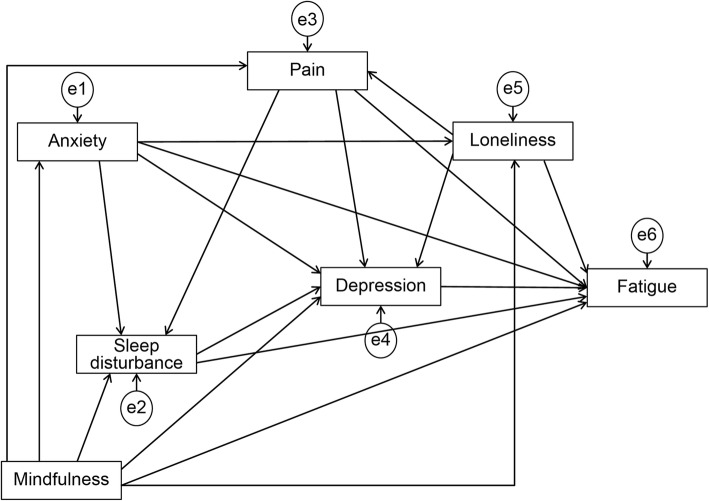
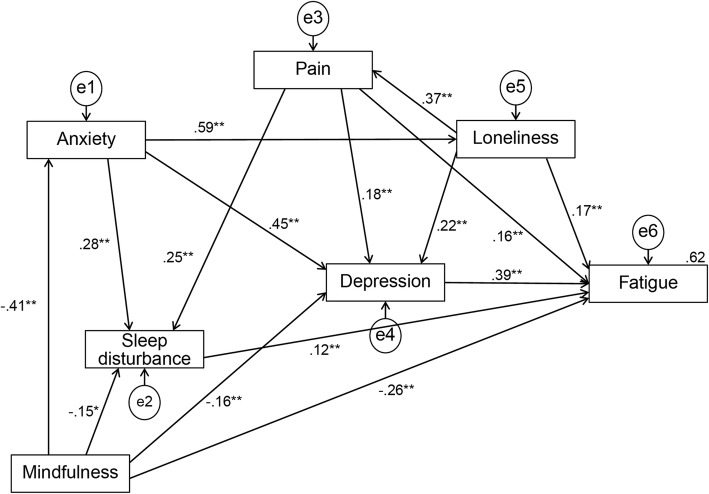
Background: Although fatigue is a common and distressing symptom in cancer survivors, the mechanism of fatigue is not fully understood. Therefore, this study aims to investigate the relation between the fatigue and mindfulness of breast cancer survivors using anxiety, depression, pain, loneliness, and sleep disturbance as mediators. Methods: Path analysis was performed to examine direct and indirect associations between mindfulness and fatigue. Participants were breast cancer survivors who visited a breast surgery department at a university hospital in Japan for hormonal therapy or regular check-ups after treatment. The questionnaire measured cancer-related-fatigue, mindfulness, anxiety, depression, pain, loneliness, and sleep disturbance. Demographic and clinical characteristics were collected from medical records. Results: Two-hundred and seventy-nine breast cancer survivors were registered, of which 259 answered the questionnaire. Ten respondents with incomplete questionnaire data were excluded, resulting in 249 participants for the analyses. Our final model fit the data well (goodness of fit index = .993; adjusted goodness of fit index = .966; comparative fit index = .999; root mean square error of approximation = .016). Mindfulness, anxiety, depression, pain, loneliness, and sleep disturbance were related to fatigue, and mindfulness had the most influence on fatigue (β = − .52). Mindfulness affected fatigue not only directly but also indirectly through anxiety, depression, pain, loneliness, and sleep disturbance. Conclusions: The study model helps to explain the process by which mindfulness affects fatigue. Our results suggest that mindfulness has both direct and indirect effects on the fatigue of breast cancer survivors and that mindfulness can be used to more effectively reduce their fatigue. It also suggests that health care professionals should be aware of factors such as anxiety, depression, pain, loneliness, and sleep disturbance in their care for fatigue of breast cancer survivors. Trial registration: This study was registered in the University Hospital Medical Information Network Clinical Trials Registry (UMIN number. 000027720) on June 12, 2017.
Overview
The claims and statistics of this paper haven’t been checked yet.
Free: it reads the open-access text and checks the first 5 claims that cite a source we can check. Create a free account to check every claim.
Integrity signals
Registry
Cites
Statistics
Figures
Verification
Claims the paper makes
The claims and statistics of this paper haven’t been checked yet.
Free: it reads the open-access text and checks the first 5 claims that cite a source we can check. Create a free account to check every claim.
Claims other papers make about this one
Each is checked against this paper’s own text: does it say what the citing paper says it does?
The cited source says what the claim attributes to it.
In the citing paper
“Increased mindfulness has been associated with lower physical and psychological symptoms in breast cancer survivors [14] and less distress in survivors of various cancer types [7, 15, 44].”
From Symptom experiences in post-treatment cancer survivors: associations with acceptance and commitment therapy constructs. (2021) · cites this paper as [14]
The cited source says what the claim attributes to it.
In the citing paper
“To date, a few studies have associated greater psychological flexibility and mindfulness with reduced distress in post-treatment survivors [13–15], and one study linked greater mindfulness to reduced physical symptoms in breast cancer survivors [14].”
From Symptom experiences in post-treatment cancer survivors: associations with acceptance and commitment therapy constructs. (2021) · cites this paper as [14]
Self-check
Percentages, sums and reported differences re-computed from the paper’s own numbers.
The self-check needs the paper’s full text.
Citations
Cites
The Hospital Anxiety and Depression Scale
Zigmond, A. S., & Snaith, R. P. (1983) · Acta Psychiatrica Scandinavica · doi:10.1111/j.1600-0447.1983.tb09716.x · Cited by 47,139
The National Comprehensive Cancer Network: Present and future directions
McGivney, W. T. (1998) · Cancer · doi:10.1002/(sici)1097-0142(19980515)82:10+<2057::aid-cncr14>3.0.co;2-a · Cited by 16,766
Depression and quality of life in older persons: A review
Sivertsen, H., Bjørkløf, G. H., Engedal, K., Selbæk, G., & Helvik, A.-S. (2015) · Dementia and Geriatric Cognitive Disorders · doi:10.1159/000437299 · Cited by 14,152
The benefits of being present: Mindfulness and its role in psychological well-being
Brown, K. W., & Ryan, R. M. (2003) · Journal of Personality and Social Psychology · doi:10.1037/0022-3514.84.4.822 · Cited by 13,448
Structural Equation Modelling: Guidelines for Determining Model Fit
Hooper, D., Coughlan, J., & Mullen, M. R. (2008) · Dublin Institute of Technology · doi:10.21427/d7cf7r · Cited by 8,746
Garnefski, N., Kraaij, V., Schroevers, M. J., & Somsen, G. A. (2008) · Journal of Clinical Psychology in Medical Settings · doi:10.1007/s10880-008-9136-5 · Cited by 2,479
Anxiety and depression after cancer diagnosis: Prevalence rates by cancer type, gender, and age
Linden, W., Vodermaier, A., MacKenzie, R., & Greig, D. (2012) · Journal of Affective Disorders · doi:10.1016/j.jad.2012.03.025 · Cited by 1,245
Speca, M., Carlson, L. E., Goodey, E., & Angen, M. (2000) · Psychosomatic Medicine · doi:10.1097/00006842-200009000-00004 · Cited by 1,082
Carlson, L. E., Speca, M., Patel, K. D., & Goodey, E. (2003) · Psychosomatic Medicine · doi:10.1097/01.psy.0000074003.35911.41 · Cited by 773
Symptom Clusters: Concept Analysis and Clinical Implications for Cancer Nursing
Kim, H.-J., McGuire, D. B., Tulman, L., & Barsevick, A. M. (2005) · Cancer Nursing · doi:10.1097/00002820-200507000-00005 · Cited by 598 · cited 1×
“A symptom cluster is defined as “two or more symptoms that are related to each other that occur together,” and it is believed that “relationships among symptoms within a cluster should be stronger than relationships among symptoms across different clusters” [16].”
BackgroundNCCN Guidelines Insights: Breast Cancer, Version 1.2017
Gradishar, W. J., Anderson, B. O., Balassanian, R., Blair, S. L., Burstein, H. J., Cyr, A., Elias, A. D., Farrar, W. B., Forero, A., Giordano, S. H., et al. (2017) · Journal of the National Comprehensive Cancer Network · doi:10.6004/jnccn.2017.0044 · Cited by 529
Development and Validation of the Cancer Fatigue Scale
Okuyama, T., Akechi, T., Kugaya, A., Okamura, H., Shima, Y., Maruguchi, M., Hosaka, T., & Uchitomi, Y. (2000) · Journal of Pain and Symptom Management · doi:10.1016/s0885-3924(99)00138-4 · Cited by 400
Hoffman, C. J., Ersser, S. J., Hopkinson, J. B., Nicholls, P. G., Harrington, J. E., & Thomas, P. W. (2012) · Journal of Clinical Oncology · doi:10.1200/jco.2010.34.0331 · Cited by 398
Abrahams, H. J. G., Gielissen, M. F. M., Schmits, I. C., Verhagen, C. A. H. H. V. M., Rovers, M. M., & Knoop, H. (2016) · Annals of Oncology · doi:10.1093/annonc/mdw099 · Cited by 383
Screening for Psychological Distress in Japanese Cancer Patients
Kugaya, A., Akechi, T., Okuyama, T., Okamura, H., & Uchitomi, Y. (1998) · Japanese Journal of Clinical Oncology · doi:10.1093/jjco/28.5.333 · Cited by 365
Pain, depression, and fatigue: Loneliness as a longitudinal risk factor.
Jaremka, L. M., Andridge, R. R., Fagundes, C. P., Alfano, C. M., Povoski, S. P., Lipari, A. M., Agnese, D. M., Arnold, M. W., Farrar, W. B., Yee, L. D., et al. (2014) · Health Psychology · doi:10.1037/a0034012 · Cited by 346
Mindfulness Research Update: 2008
Greeson, J. M. (2009) · Complementary health practice review · doi:10.1177/1533210108329862 · Cited by 320
The Mindful Way through Depression: Freeing Yourself from Chronic Unhappiness
Williams, J. M. G. (2012) · Cited by 309
The effect of symptom clusters on functional status and quality of life in women with breast cancer
Dodd, M. J., Cho, M. H., Cooper, B. A., & Miaskowski, C. (2010) · European Journal of Oncology Nursing · doi:10.1016/j.ejon.2009.09.005 · Cited by 290
Haller, H., Winkler, M. M., Klose, P., Dobos, G., Kümmel, S., & Cramer, H. (2017) · Acta Oncologica · doi:10.1080/0284186x.2017.1342862 · Cited by 277
Lengacher, C. A., Reich, R. R., Paterson, C. L., Ramesar, S., Park, J. Y., Alinat, C., Johnson-Mallard, V., Moscoso, M., Budhrani-Shani, P., Miladinovic, B., et al. (2016) · Journal of Clinical Oncology · doi:10.1200/jco.2015.65.7874 · Cited by 255
Impact of Adjuvant Breast Cancer Chemotherapy on Fatigue, Other Symptoms, and Quality of Life
Byar, K. L., Berger, A. M., Bakken, S. L., & Cetak, M. A. (2006) · Oncology Nursing Forum · doi:10.1188/06.onf.e18-e26 · Cited by 241
How common is fatigue in disease-free breast cancer survivors? A systematic review of the literature
Minton, O., & Stone, P. (2008) · Breast Cancer Research and Treatment · doi:10.1007/s10549-007-9831-1 · Cited by 192
Predictors and course of chronic fatigue in long-term breast cancer survivors
Reinertsen, K. V., Cvancarova, M., Loge, J. H., Edvardsen, H., Wist, E., & Fosså, S. D. (2010) · Journal of Cancer Survivorship · doi:10.1007/s11764-010-0145-7 · Cited by 192
Thornton, L. M., Andersen, B. L., & Blakely, W. P. (2010) · Health Psychology · doi:10.1037/a0018836 · Cited by 188
Berger, A. M., Farr, L. A., Kuhn, B. R., Fischer, P., & Agrawal, S. (2007) · Journal of Pain and Symptom Management · doi:10.1016/j.jpainsymman.2006.09.022 · Cited by 180
Fatigue and quality of life in breast cancer survivors: temporal courses and long-term pattern
Schmidt, M. E., Chang-Claude, J., Vrieling, A., Heinz, J., Flesch-Janys, D., & Steindorf, K. (2012) · Journal of Cancer Survivorship · doi:10.1007/s11764-011-0197-3 · Cited by 179
Lengacher, C. A., Reich, R. R., Post-White, J., Moscoso, M., Shelton, M. M., Barta, M., Le, N., & Budhrani, P. (2012) · Journal of Behavioral Medicine · doi:10.1007/s10865-011-9346-4 · Cited by 170
Ho, S.-Y., Rohan, K. J., Parent, J., Tager, F. A., & McKinley, P. S. (2015) · Journal of Pain and Symptom Management · doi:10.1016/j.jpainsymman.2014.09.009 · Cited by 166
Abrahams, H. J. G., Gielissen, M. F. M., Verhagen, C. A. H. H. V. M., & Knoop, H. (2018) · Clinical Psychology Review · doi:10.1016/j.cpr.2018.05.004 · Cited by 165
Fatigue in Ambulatory Patients with Advanced Lung Cancer
Okuyama, T., Tanaka, K., Akechi, T., Kugaya, A., Okamura, H., Nishiwaki, Y., Hosaka, T., & Uchitomi, Y. (2001) · Journal of Pain and Symptom Management · doi:10.1016/s0885-3924(01)00305-0 · Cited by 158
Zhang, J., Xu, R., Wang, B., & Wang, J. (2016) · Complementary Therapies in Medicine · doi:10.1016/j.ctim.2016.02.012 · Cited by 130
Quality of Life, Anxiety, and Oncological Factors: A Follow-Up Study of Breast Cancer Patients
Härtl, K., Schennach, R., Müller, M., Engel, J., Reinecker, H. S., Sommer, H. L., & Friese, K. (2010) · Psychosomatics · doi:10.1016/s0033-3182(10)70671-x · Cited by 119
Kieviet-Stijnen, A., Visser, A. P., Garssen, B., & Hudig, W. (2008) · Patient Education and Counseling · doi:10.1016/j.pec.2008.05.015 · Cited by 104
Poulin, P. A., Romanow, H. C., Rahbari, N., Small, R., Smyth, C. E., Hatchard, T., Solomon, B. K., Song, X., Harris, C. A., Kowal, J., et al. (2016) · Supportive Care in Cancer · doi:10.1007/s00520-016-3243-x · Cited by 89
Adams, R. N., Mosher, C. E., Winger, J. G., Abonour, R., & Kroenke, K. (2017) · Journal of Behavioral Medicine · doi:10.1007/s10865-017-9892-5 · Cited by 74
Web-based individual Mindfulness-Based Cognitive Therapy for cancer-related fatigue — A pilot study
Bruggeman Everts, F. Z., van der Lee, M. L., & de Jager Meezenbroek, E. (2015) · Internet Interventions · doi:10.1016/j.invent.2015.03.004 · Cited by 60
Fujino, M., Kajimura, S., & Nomura, M. (2015) · The Japanese Journal of Personality · doi:10.2132/personality.24.61 · Cited by 53
Reliance on God's Help, Depression and Fatigue in Female Cancer Patients
Büssing, A., Fischer, J., Ostermann, T., & Matthiessen, P. F. (2008) · The International Journal of Psychiatry in Medicine · doi:10.2190/pm.38.3.j · Cited by 49
Mindfulness-Based Stress Reduction on breast cancer symptoms: systematic review and meta-analysis
Castanhel, F. D., & Liberali, R. (2018) · Einstein (São Paulo) · doi:10.31744/einstein_journal/2018rw4383 · Cited by 43
Miura, K., Ando, S., & Imai, T. (2014) · Breast Cancer · doi:10.1007/s12282-014-0578-3 · Cited by 24
Benedek, E. P. (2010) · Bulletin of the Menninger Clinic · doi:10.1521/bumc.2010.74.3.249 · Cited by 3
Analysis of a Factor that Influences Cancer Outpatient Fatigue
Kogure, M., Hosokawa, M., Takagai, J., Ishida, K., Kano, T., & Kanda, K. (2008) · The Kitakanto Medical Journal · doi:10.2974/kmj.58.63 · Cited by 2
Cited by
McCloy, K., Hughes, C., Dunwoody, L., Marley, J., & Gracey, J. (2022) · Psycho-Oncology · doi:10.1002/pon.6046 · Cited by 44
“This interrelation of symptoms on CRF was also demonstrated in a mindfulness intervention of 249 women with breast cancer.(70) Within this study, mindfulness had the biggest effect on CRF directly but also indirectly by relieving or preventing anxiety, depression and sleep disturbance.”
MethodUslu, A., & Arslan, S. (2023) · Seminars in Oncology Nursing · doi:10.1016/j.soncn.2023.151503 · Cited by 40
Zarantonello, L., Grappi, S., & Formisano, M. (2023) · Psychology and Marketing · doi:10.1002/mar.21925 · Cited by 44
Lewson, A. B., Johns, S. A., Krueger, E., Chinh, K., Kidwell, K. M., & Mosher, C. E. (2021) · Supportive Care in Cancer · doi:10.1007/s00520-020-05854-7 · Cited by 27
Amaya, Y., Abe, T., Kanbara, K., Shizuma, H., Akiyama, Y., & Fukunaga, M. (2021) · BMC Sports Science Medicine and Rehabilitation · doi:10.1186/s13102-021-00332-x · Cited by 34
Metadata
- Authors
- Ikeuchi, K., Ishiguro, H., Nakamura, Y., Izawa, T., Shinkura, N., & Nin, K.
- Affiliations
- Kyoto University (JP)
- International University of Health and Welfare Hospital (JP)
- Waseda University (JP)
- Corresponding author
- Nin, Kazuko
- Venue
- BioPsychoSocial Medicine
- Published
- 2020-02-10
- Volume
- 14
- Issue
- 1
- Pages
- 1-1
- ISSN
- 1751-0759 (ISSN-L)
- PMC
- PMC7011601
- OpenAlex
- W3011179036
- Cited by
- 23
- References
- 43
- Citations by year
- 2026: 3 · 2025: 3 · 2024: 4 · 2023: 7 · 2022: 4 · 2021: 1 · 2020: 1
- FWCI
- 1.17
- Type
- journal article
- Language
- en
- Open access
- gold
- doi.org
- Licence
- cc-by
- creativecommons.org/licenses/by/4.0/ (tdm)
- creativecommons.org/licenses/by/4.0/ (vor)
- Locations
- BioPsychoSocial Medicine (publishedVersion, cc-by)
- Europe PMC (PubMed Central) (publishedVersion, cc-by)
- PubMed Central (publishedVersion, cc-by)
- PubMed (publishedVersion)
- Institutional Repositories DataBase (IRDB) (submittedVersion, cc-by)
- DOAJ (DOAJ: Directory of Open Access Journals) (submittedVersion, cc-by-sa)
- Kyoto University Research Information Repository (Kyoto University) (submittedVersion)
- Kyoto University Research Information Repository (Kyoto University) (submittedVersion, cc-by)
- Topics
- Health Sciences › Medicine › Oncology › Cancer survivorship and care
- Social Sciences › Psychology › Clinical Psychology › Mindfulness and Compassion Interventions
- Health Sciences › Medicine › Oncology › Cancer-related cognitive impairment studies
- Keywords
- mindfulness, cancer-related fatigue, breast cancer survivors, anxiety, depression, pain, loneliness, sleep disorders, mediation, psychological distress
About these checks
Registry, retraction, Cites and statistics results are computed, not judged, with one exception: a printed reference that no index lists is read once by a model before it counts as a citation error. Claims are extracted by a model and kept only when their quote appears verbatim in the text; each cited source is then checked, with a model’s help, for whether it says what the claim relies on. Those verdicts can be wrong — read the claim’s quote and the cited source before relying on one.
Statistics and arithmetic are recomputed, not judged.
Confidence bands are shown only for fields calibrated on our annotated test set. None is calibrated yet, so no band is shown.
What counts as a claim ›How we measure confidence ›How we check this ›
Are you an author, or do you see a problem with this page? Request a review
Data sources
Bibliographic data: Semantic Scholar, OpenAlex, Crossref.
Contains information from the Semantic Scholar Academic Graph Datasets, made available under the ODC Attribution License (ODC-BY 1.0).
Semantic Scholar’s data is described in: Kinney, R., et al. (2023). The Semantic Scholar Open Data Platform. arXiv:2301.10140.
