

Health needs of older populations affected by humanitarian crises in low- and middle-income countries: a systematic review
Open accessThe DOI matches its Crossref record; 61 of the 61 references it cites were found in a registry or an index.
Abstract
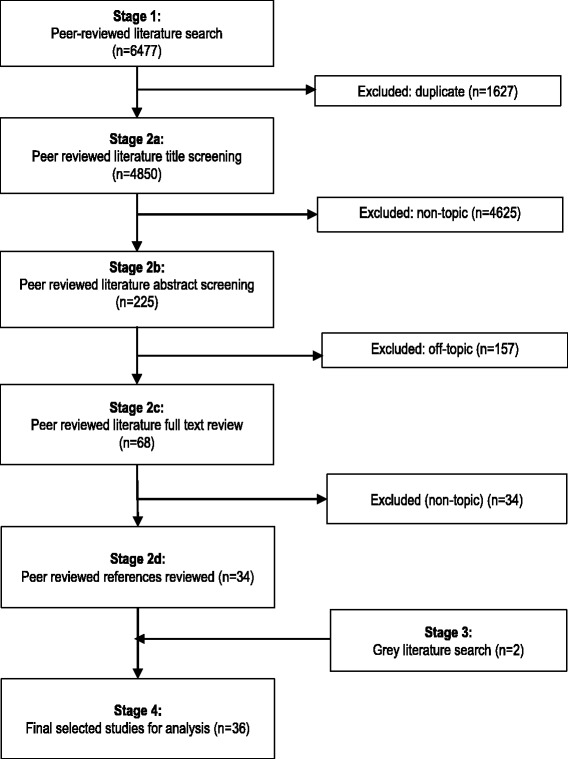
BACKGROUND: The combination of global demographic changes and a growing number of humanitarian crises in middle-income countries that have a higher life expectancy has led to an increase in the number of older populations affected by humanitarian crises. The aim of this review was to systematically examine evidence on the health needs of older populations in humanitarian crises, including both armed conflicts and natural disasters, in low- and middle-income countries (LMICs). METHODS: A systematic review methodology was used. The search strategy used terms related to older populations and humanitarian crises in LMICs. Five bibliographic databases were used, along with relevant grey literature sources. Descriptive analysis was used, and a quality assessment conducted using the Newcastle-Ottawa Scale and CASP instruments. RESULTS: A total of 36 studies were eligible for review. The majority of the studies were cross-sectional, three were cohort studies, and four used qualitative methodologies. The main health outcomes were mental health, physical health, functioning, and nutrition. Vulnerability factors included older age, female gender, being widowed, increased exposure to traumatic events, prior mental health problems, low income and education, and rural residency. Ten studies addressed the responsiveness of health systems and access to such services. The quality of the included studies was generally low. CONCLUSIONS: There is an urgent need to strengthen the evidence base on the health needs of older populations in humanitarian crises.
Overview
The claims and statistics of this paper haven’t been checked yet.
Free: it reads the open-access text and checks the first 5 claims that cite a source we can check. Create a free account to check every claim.
Integrity signals
Registry
Cites
Statistics
Figures
Verification
Claims the paper makes
The claims and statistics of this paper haven’t been checked yet.
Free: it reads the open-access text and checks the first 5 claims that cite a source we can check. Create a free account to check every claim.
Claims other papers make about this one
Each is checked against this paper’s own text: does it say what the citing paper says it does?
The source backs part of the claim, not all of it — or backs it for a different population, condition or comparison.
In the citing paper
“Furthermore, aging in contexts of conflict, displacement, economic instability, and environmental change appears to have received limited attention in the identified literature, despite these being the specific social challenges the country has been facing for years [111,112].”
From Toward Holistic Aging in Lebanon: A Mapping of Gerontology and Geriatrics Research Trends, Gaps, and Future Directions (2026) · cites this paper as [111]
Experimental — accuracy not yet measured
Self-check
Percentages, sums and reported differences re-computed from the paper’s own numbers.
The self-check needs the paper’s full text.
Citations
Cites
Preferred Reporting Items for Systematic Reviews and Meta-Analyses: the PRISMA statement
Moher, D., Liberati, A., Tetzlaff, J., Altman, D. G., & for the PRISMA Group (2009) · BMJ · doi:10.1136/bmj.b2535 · Cited by 83,823
Preferred reporting items for systematic reviews and meta-analyses: the PRISMA Statement.
(2009) · PubMed Central · Cited by 44,859
Preferred Reporting Items for Systematic Reviews and Meta-Analyses: The PRISMA Statement
Moher, D., Liberati, A., Tetzlaff, J., & Altman, D. G. (2009) · Journal of Clinical Epidemiology · doi:10.1016/j.jclinepi.2009.06.005 · Cited by 19,575
(2014) · Medical Entomology and Zoology · Cited by 17,633
World Population Prospects The 2006 Revision
Zlotnik, H. (2007) · United Nations eBooks · Cited by 7,971
Meta-analysis of risk factors for posttraumatic stress disorder in trauma-exposed adults
Brewin, C. R., Andrews, B., & Valentine, J. D. (2000) · Journal of Consulting and Clinical Psychology · doi:10.1037/0022-006x.68.5.748 · Cited by 5,243
Porter, M., & Haslam, N. (2005) · JAMA · doi:10.1001/jama.294.5.602 · Cited by 1,793
Herzog, R., Álvarez-Pasquin, M. J., Díaz, C., Del Barrio, J. L., Estrada, J. M., & Gil, Á. (2013) · BMC Public Health · doi:10.1186/1471-2458-13-154 · Cited by 1,652 · cited 1×
“with cohort studies given a score of 1–9, and cross-sectional studies given a score of 1–10 (using a modified NOS version for cross-sectional studies) [21].”
MethodMiller, K. E., & Rasmussen, A. (2010) · Social Science & Medicine · doi:10.1016/j.socscimed.2009.09.029 · Cited by 1,524
Seedat, S., Scott, K. M., Angermeyer, M. C., Berglund, P., Bromet, E. J., Brugha, T. S., Demyttenaere, K., de Girolamo, G., Haro, J. M., Jin, R., et al. (2009) · Archives of General Psychiatry · doi:10.1001/archgenpsychiatry.2009.36 · Cited by 1,518
(2021) · Croatian Medical Journal · doi:10.3325/cmj · Cited by 400
Frail Elderly as Disaster Victims: Emergency Management Strategies
Fernandez, L. S., Byard, D., Lin, C.-C., Benson, S., & Barbera, J. A. (2002) · Prehospital and Disaster Medicine · doi:10.1017/s1049023x00000200 · Cited by 386
Posttraumatic stress disorder in elderly and younger adults after the 1988 earthquake in Armenia
(1994) · American Journal of Psychiatry · doi:10.1176/ajp.151.6.895 · Cited by 332 · cited 10×
“Three studies with earthquake and Tsunami survivors in Sri Lanka, Thailand, and China reported the effects of loss, disability or injury of a family member on PTSD, [44]. depression, [48] psychological distress, [29] and quality of life [59].”
BackgroundInfluentialThe Human Cost Of Natural Disasters: A global perspective
Unisdr, C. (2015) · Cited by 298
Pirlich, M., & Lochs, H. (2001) · Best Practice & Research Clinical Gastroenterology · doi:10.1053/bega.2001.0246 · Cited by 291
When Disasters and Age Collide: Reviewing Vulnerability of the Elderly
Ngo, E. B. (2001) · Natural Hazards Review · doi:10.1061/(asce)1527-6988(2001)2:2(80 · Cited by 289
State of World Population 2010: From Conflict and Crisis to Renewal - Generations of Change
Fund, U. N. P. (2011) · State of World Population · doi:10.18356/7d4bbbc8-en · Cited by 287
Evidence on public health interventions in humanitarian crises
Blanchet, K., Ramesh, A., Frison, S., Warren, E., Hossain, M., Smith, J., Knight, A., Post, N., Lewis, C., Woodward, A., et al. (2017) · The Lancet · doi:10.1016/s0140-6736(16)30768-1 · Cited by 280
Self-citationJia, Z., Tian, W., Liu, W., Cao, Y., Yan, J., & Shun, Z. (2010) · BMC Public Health · doi:10.1186/1471-2458-10-172 · Cited by 211 · cited 4×
“worse psychological quality of life, [26, 56, 59] psychological distress, [37, 39] symptoms suggestive of psychosomatic disorders, [38] and adjustment disorder [53].”
BackgroundInfluentialByles, J. (2017) · International Perspectives on Aging · doi:10.1007/978-1-4939-6466-6_5 · Cited by 183
The association between nutritional status and handgrip strength in older Rwandan refugees
Pieterse, S., Manandhar, M., & Ismail, S. (2002) · European Journal of Clinical Nutrition · doi:10.1038/sj.ejcn.1601443 · Cited by 167 · cited 1×
“The study with Rwandan refugees in Tanzania reported that malnutrition had a negative effect on physical functioning in terms of handgrip strength [46].”
BackgroundHealth status and health needs of older refugees from Syria in Lebanon
Strong, J., Varady, C., Chahda, N., Doocy, S., & Burnham, G. (2015) · Conflict and Health · doi:10.1186/s13031-014-0029-y · Cited by 156 · cited 10×
“Low education was associated with PTSD [33] and psychological distress [29], but was protective against depression among refugees in Lebanon [52].”
BackgroundInfluentialRoberts, B., & Browne, J. (2011) · Global Public Health · doi:10.1080/17441692.2010.511625 · Cited by 137
Self-citationOlder people in emergencies : considerations for action and policy development
Hutton, D. (2008) · Virtual Defense Library (Ministerio de Defensa) · Cited by 131
The impact of forced migration on the mental health of the elderly: a scoping review
Virgincar, A., Doherty, S., & Siriwardhana, C. (2016) · International Psychogeriatrics · doi:10.1017/s1041610216000193 · Cited by 120
Chaaya, M., Sibai, A. M., Fayad, R., & El-Roueiheb, Z. (2007) · Aging & Mental Health · doi:10.1080/13607860600735812 · Cited by 102 · cited 19×
“Chaaya M, et al. Religiosity and depression in older people: evidence from underprivileged refugee and non-refugee communities in Lebanon.”
BackgroundInfluentialChan, E. Y. Y., & Griffiths, S. M. (2009) · Prehospital and Disaster Medicine · doi:10.1017/s1049023x00007159 · Cited by 101 · cited 10×
“A study of survivors of the 2005 Kashmir earthquake in Pakistan observed a higher prevalence in rural areas than urban areas of dental, visual, eating, and hearing problems, headache, dizziness, muscle and joint pains, and of established yet untreated medical problems [31].”
InfluentialOlder refugees in humanitarian emergencies
Burton, A., & Breen, C. (2002) · The Lancet · doi:10.1016/s0140-6736(02)11819-8 · Cited by 100 · cited 1×
“While older populations are recognised as a vulnerable group in humanitarian crises, [11, 12] the particular needs of older populations in humanitarian crises appear poorly understood [13].”
BackgroundKohn, R., Levav, I., Garcia, I. D., Machuca, M. E., & Tamashiro, R. (2005) · International Journal of Geriatric Psychiatry · doi:10.1002/gps.1369 · Cited by 98 · cited 10×
“Three studies with earthquake and Tsunami survivors in Sri Lanka, Thailand, and China reported the effects of loss, disability or injury of a family member on PTSD, [44]. depression, [48] psychological distress, [29] and quality of life [59].”
BackgroundInfluentialThe impact of natural disasters on the elderly
Cherniack, M. (2008) · American Journal of Disaster Medicine · doi:10.5055/ajdm.2008.0018 · Cited by 96 · cited 1×
“These collective vulnerabilities put older populations at a higher risk during humanitarian crises when health risks are increased and support networks and existing social infrastructure compromised [8].”
BackgroundGender Differences in Factors Associated with Nutritional Status of Older Medical Patients
Castel, H., Shahar, D., & Harman-Boehm, I. (2006) · Journal of the American College of Nutrition · doi:10.1080/07315724.2006.10719523 · Cited by 82
Ardalan, A., Mazaheri, M., VanRooyen, M. J., Mowafi, H. O., Nedjat, S., Naieni, K. H., & Russel, M. (2010) · Ageing and Society · doi:10.1017/s0144686x10000772 · Cited by 80 · cited 11×
“PTSD, [41] depression, [30, 41] alcohol disorder, [41] poor psychological quality of life, [26, 56, 59] and psychological distress [29].”
BackgroundInfluentialWu, J., Xiao, J., Li, T., Li, X. A., Sun, H., Chow, E. P. F., Lu, Y., Tian, T., Li, X., Wang, Q., et al. (2015) · BMC Public Health · doi:10.1186/s12889-015-1402-5 · Cited by 74 · cited 20×
“Three studies with earthquake and Tsunami survivors in Sri Lanka, Thailand, and China reported the effects of loss, disability or injury of a family member on PTSD, [44]. depression, [48] psychological distress, [29] and quality of life [59].”
BackgroundInfluentialZhang, Z., Shi, Z., Wang, L., & Liu, M. (2012) · Stress and Health · doi:10.1002/smi.1403 · Cited by 65
Zhang, L., Fu, P., Wang, L., Cai, G., Zhang, L., Chen, D., Guo, D., Sun, X., Chen, F., Bi, W., et al. (2010) · Injury · doi:10.1016/j.injury.2010.11.036 · Cited by 65 · cited 3×
“Three studies assessed PTSD levels at 1 year, [58] 15 months, [39] and 3 years [33] after the Wenchuan earthquake in China, and observed PTSD remained high many months and years after the earthquake.”
BackgroundArdalan, A., Mazaheri, M., Naieni, K. H., Rezaie, M., Teimoori, F., & Pourmalek, F. (2009) · Ageing and Society · doi:10.1017/s0144686x09990122 · Cited by 58
Sibai, A. M. (2001) · American Journal of Epidemiology · doi:10.1093/aje/154.2.128 · Cited by 57 · cited 4×
“Two were qualitative, [25, 34] two used mixed methodologies, [40, 47] three were cohort studies, [50, 51, 55].”
BackgroundMethodInfluentialLi, Y., Sun, F., He, X., & Chan, K. S. (2011) · Journal of Community Psychology · doi:10.1002/jcop.20469 · Cited by 56 · cited 2×
“Reduced social support was associated with PTSD, [33] depressive symptoms, [42] quality of life, [59] (all in China) and anxiety (refugees in Lebanon), [52] as was a reduced sense of community with depressive symptoms (China) [42].”
BackgroundThree Steps to Improve Management of Noncommunicable Diseases in Humanitarian Crises
Jobanputra, K., Boulle, P., Roberts, B., & Perel, P. (2016) · PLOS Medicine · doi:10.1371/journal.pmed.1002180 · Cited by 54
Self-citationChen, G., Shen, H., & Chen, G. (2012) · The Canadian Journal of Psychiatry · doi:10.1177/070674371205700905 · Cited by 45 · cited 13×
“Three studies with earthquake and Tsunami survivors in Sri Lanka, Thailand, and China reported the effects of loss, disability or injury of a family member on PTSD, [44]. depression, [48] psychological distress, [29] and quality of life [59].”
BackgroundInfluentialSibai, A. M., Yount, K. M., & FLETCHER, A. E. (2006) · Social Science & Medicine · doi:10.1016/j.socscimed.2006.08.006 · Cited by 38 · cited 18×
“Chaaya M, et al. Religiosity and depression in older people: evidence from underprivileged refugee and non-refugee communities in Lebanon.”
BackgroundMethodInfluentialPsychological Impact of the Tsunami on Elderly Survivors
Viswanath, B., Maroky, A. S., Math, S. B., John, J. P., Benegal, V., Hamza, A., & Chaturvedi, S. K. (2012) · American Journal of Geriatric Psychiatry · doi:10.1097/jgp.0b013e318246b7e9 · Cited by 36 · cited 8×
“Demographic and socio-economic factors Twelve studies observed associations between older age and post-traumatic stress disorder (PTSD), [33, 36, 39, 44, 53], depression, [38, 48, 52].”
BackgroundInfluentialHidden victims of the Syrian crisis: disabled, injured and older refugees
(2016) · Human Rights Documents online · doi:10.1163/2210-7975_hrd-9997-2014040 · Cited by 36
Andre, M. B., Dumavibhat, N., Ngatu, N. R., Eitoku, M., Hirota, R., & Suganuma, N. (2012) · Geriatrics and gerontology international/Geriatrics & gerontology international · doi:10.1111/j.1447-0594.2012.00852.x · Cited by 35 · cited 3×
“Health-related factors One study in the Democratic Republic of Congo observed that taking no physical exercise, taking multiple prescription drugs, and limited mobility and functioning were associated with malnutrition [24].”
BackgroundThe nutritional status of older Rwandan refugees
Pieterse, S., Manandhar, M., & Ismail, S. (1998) · Public Health Nutrition · doi:10.1079/phn19980042 · Cited by 34 · cited 2×
“Sibai AM, Fletcher A, Armenian HK. Variations in the impact of long-term wartime stressors on mortality among the middle-aged and older population in Beirut, Lebanon, 1983–1993.”
BackgroundPerceptions of older people on disaster response and preparedness
Duggan, S., Deeny, P., Spelman, R., & Vitale, C. T. (2010) · International Journal of Older People Nursing · doi:10.1111/j.1748-3743.2009.00203.x · Cited by 33 · cited 6×
“Three studies with earthquake and Tsunami survivors in Sri Lanka, Thailand, and China reported the effects of loss, disability or injury of a family member on PTSD, [44]. depression, [48] psychological distress, [29] and quality of life [59].”
BackgroundMethodInfluentialNutritional Risk Factors for Older Refugees
Pieterse, S., & Ismail, S. (2003) · Disasters · doi:10.1111/1467-7717.00217 · Cited by 30
Ardalan, A., Mazaheri, M., Mowafi, H. O., VanRooyen, M. J., Teimoori, F., & Abbasi, R. (2011) · Prehospital and Disaster Medicine · doi:10.1017/s1049023x11000045 · Cited by 23 · cited 12×
“A qualitative study in Iran found that older populations experienced a significant amount of emotional distress years after the Bam Earthquake, and they found it difficult to move on from the earlier crisis events [25].”
BackgroundInfluentialGodfrey, N., & Kalache, A. (1989) · Social Science & Medicine · doi:10.1016/0277-9536(89)90218-9 · Cited by 20
People affected by conflict 2013 - Humanitarian needs in numbers
Heudtlass, P., Hosten, E., Kayouli, E., Altare, C., & Guha‐Sapir, D. (2014) · Cited by 19
Chan, E. Y. Y. (2009) · American Journal of Disaster Medicine · doi:10.5055/ajdm.2009.0016 · Cited by 17 · cited 7×
“However, rural residents were more likely than urban residents to report sleeplessness and a feeling of depression or helplessness after the 2005 Kashmir earthquake in Pakistan [31].”
BackgroundInfluentialLutala, P. M., Kwalya, T. M., Kasagila, E. K., Watongoka, L. H., & Mupenda, B. (2010) · African Journal of Primary Health Care & Family Medicine · doi:10.4102/phcfm.v2i1.108 · Cited by 17 · cited 2×
“Health service access and responsiveness Ten studies examined aspects of health service access and responsiveness for older populations (Table 3) [25, 27, 31, 32, 34, 39, 40, 43, 52, 56].”
BackgroundWong, E. G., Trelles, M., Dominguez, L. B., Mupenda, J., Kasonga, C., Saqeb, S., Hazrati, K. U. R., Gupta, S., Burnham, G. M., & Kushner, A. L. (2014) · World Journal of Surgery · doi:10.1007/s00268-014-2855-x · Cited by 16 · cited 4×
“Twenty-one studies reported on populations affected by natural disasters, [25–29, 31–34, 36, 39, 41, 42, 44, 48, 53, 54, 56–59] 14 by armed conflict, [24, 30, 35, 37, 38, 40, 43, 45–47, 49–52], and one for both crisis types [55].”
BackgroundMethodInfluentialArlappa, N., Venkaiah, K., Rao, K. M., Reddy, C. G., Kumar, S. S., Ravindranath, M., Brahmam, G. N. V., & Vijayaraghavan, K. (2009) · Journal of Nutrition for the Elderly · doi:10.1080/01639360903140338 · Cited by 16 · cited 6×
“Forced displacement and dissatisfaction with current living conditions after a crisis was related to worse psychological quality of life [26] and psychological distress [29] among earthquake survivors in Iran and China respectively, [26, 29] and anxiety disorder among Tsunami survivors in India [53].”
BackgroundInfluentialCao, X., Jiang, X., Pang, S., Li, S., Cheng, Y., & Tian, L. (2013) · Australian Journal on Ageing · doi:10.1111/ajag.12039 · Cited by 15 · cited 4×
“Forced displacement and dissatisfaction with current living conditions after a crisis was related to worse psychological quality of life [26] and psychological distress [29] among earthquake survivors in Iran and China respectively, [26, 29] and anxiety disorder among Tsunami survivors in India [53].”
BackgroundInfluentialForan, S., Swaine, A., & Burns, K. (2012) · Gender & Development · doi:10.1080/13552074.2012.687221 · Cited by 15
Biopsychosocial impacts on the elderly from a tsunami-affected community in southern Thailand.
Prueksaritanond, S., & Kongsakol, R. (2007) · PubMed · Cited by 13
Post-Traumatic Stress Disorder Among Senior Victims of Tsunami-Affected Areas in Southern Sri Lanka
Nomura, A., Honda, S., Hayakawa, H., Amarasinghe, S., & Aoyagi, K. (2010) · Institutional Repositories DataBase (IRDB) · doi:10.11343/amn.55.41 · Cited by 9 · cited 11×
“Three studies with earthquake and Tsunami survivors in Sri Lanka, Thailand, and China reported the effects of loss, disability or injury of a family member on PTSD, [44]. depression, [48] psychological distress, [29] and quality of life [59].”
BackgroundInfluentialdu Cros, P., Venis, S., & Karunakara, U. K. (2013) · Transactions of the Royal Society of Tropical Medicine and Hygiene · doi:10.1093/trstmh/trt085 · Cited by 7
Wen, J., Yang, C.-L., Shi, Y., Li, Y., Ji, Y., & Liu, J. (2010) · International journal of gerontology · doi:10.1016/s1873-9598(10)70034-x · Cited by 5 · cited 3×
“Three studies assessed PTSD levels at 1 year, [58] 15 months, [39] and 3 years [33] after the Wenchuan earthquake in China, and observed PTSD remained high many months and years after the earthquake.”
BackgroundXiuli, F. (2012) · Xiandai yufang yixue · Cited by 2
Research works printed but not linked: 5
- IASC Humanitarian action and older persons 2008 Geneva Inter-Agency Standing Committee
- WHO, Older persons in emergencies An active ageing perspective 2008 Geneva World Health Organization
- Ramji S Thoner G Nutritional status of displaced Mozambican elderly living in Mozambique and Zimbabwe. Surveyed in June-July 1987 Naringsforskning 1991 35 1 24 31
- Kinsella K Wan H An Aging World: 2008, in International Population Reports 2009 DC U.S. Census Bureau: Washington
- UNHCR UNHCR Age, Gender and Diversity Accountability Report 2015 2016 Geneva UNHCR
Cited by
Armed conflict and public health: into the 21st century
Garry, S., & Checchi, F. (2020) · Journal of Public Health · doi:10.1093/pubmed/fdz095 · Cited by 288
Older people’s needs in urban disaster response: A systematic literature review
Phraknoi, N., Sutanto, J., Hu, Y., Goh, Y. S., & Lee, C. E. C. (2023) · International Journal of Disaster Risk Reduction · doi:10.1016/j.ijdrr.2023.103809 · Cited by 92
Jaung, M., Willis, R., Sharma, P., Perone, S. A., Frederiksen, S., Truppa, C. T., Roberts, B., Perel, P., Blanchet, K., & Ansbro, É. (2021) · Health Policy and Planning · doi:10.1093/heapol/czab007 · Cited by 59
“Humanitarian actors are now increasing their focus on NCDs, an area until recently neglected compared to other emergency health policies and measures (Amara and Aljunid, 2014; Massey et al., 2017; Slama et al., 2017).”
BackgroundSelf-citationEkezie, W. C., Adaji, E. E., & Murray, R. L. (2020) · Health Promotion Perspectives · doi:10.15171/hpp.2020.06 · Cited by 56
Keasley, J., Oyebode, O. O., Shantikumar, S., Proto, W., McGranahan, M., Sabouni, A., & Kidy, F. (2020) · BMJ Global Health · doi:10.1136/bmjgh-2020-002440 · Cited by 43
Metadata
- Authors
- Massey, E., Smith, J., & Roberts, B.
- Affiliations
- London School of Hygiene & Tropical Medicine (GB)
- Corresponding author
- Roberts, Bayard
- Venue
- Conflict and Health
- Published
- 2017-12
- Volume
- 11
- Issue
- 1
- Pages
- 29-29
- ISSN
- 1752-1505 (ISSN-L)
- PMC
- PMC5724338
- OpenAlex
- W2766117671
- Cited by
- 47
- References
- 61
- Citations by year
- 2026: 6 · 2025: 9 · 2024: 10 · 2023: 6 · 2022: 6 · 2021: 6 · 2020: 2 · 2019: 2
- FWCI
- 0.19
- Type
- journal article
- Language
- en
- Open access
- gold
- doi.org
- Licence
- cc-by
- Locations
- Conflict and Health (publishedVersion, cc-by)
- Europe PMC (PubMed Central) (publishedVersion, cc-by)
- PubMed Central (publishedVersion, cc-by)
- PubMed (publishedVersion)
- LSHTM Research Online (London School of Hygiene and Tropical Medicine) (acceptedVersion)
- DOAJ (DOAJ: Directory of Open Access Journals) (submittedVersion, cc-by-sa)
- Topics
- Health Sciences › Health Professions › General Health Professions › Health and Conflict Studies
- Health Sciences › Health Professions › Emergency Medical Services › Disaster Response and Management
- Social Sciences › Sociology and Political Science › Disaster Management and Resilience
- Keywords
- older adults, humanitarian crisis, armed conflict, natural disasters, health needs, mental health, physical health, functioning, nutrition, vulnerability factors, health system responsiveness, health care access, low- and middle-income countries
About these checks
Registry, retraction, Cites and statistics results are computed, not judged, with one exception: a printed reference that no index lists is read once by a model before it counts as a citation error. Claims are extracted by a model and kept only when their quote appears verbatim in the text; each cited source is then checked, with a model’s help, for whether it says what the claim relies on. Those verdicts can be wrong — read the claim’s quote and the cited source before relying on one.
Statistics and arithmetic are recomputed, not judged.
Confidence bands are shown only for fields calibrated on our annotated test set. None is calibrated yet, so no band is shown.
What counts as a claim ›How we measure confidence ›How we check this ›
Are you an author, or do you see a problem with this page? Request a review
Data sources
Bibliographic data: Semantic Scholar, OpenAlex, Crossref.
Contains information from the Semantic Scholar Academic Graph Datasets, made available under the ODC Attribution License (ODC-BY 1.0).
Semantic Scholar’s data is described in: Kinney, R., et al. (2023). The Semantic Scholar Open Data Platform. arXiv:2301.10140.
