

Implementation outcomes of cognitive behavioural therapy delivered by non-specialists for common mental disorders and substance-use disorders in low- and middle-income countries: a systematic review
Open accessThe DOI matches its Crossref record; 47 of the 49 references it cites were found in a registry or an index.
Abstract
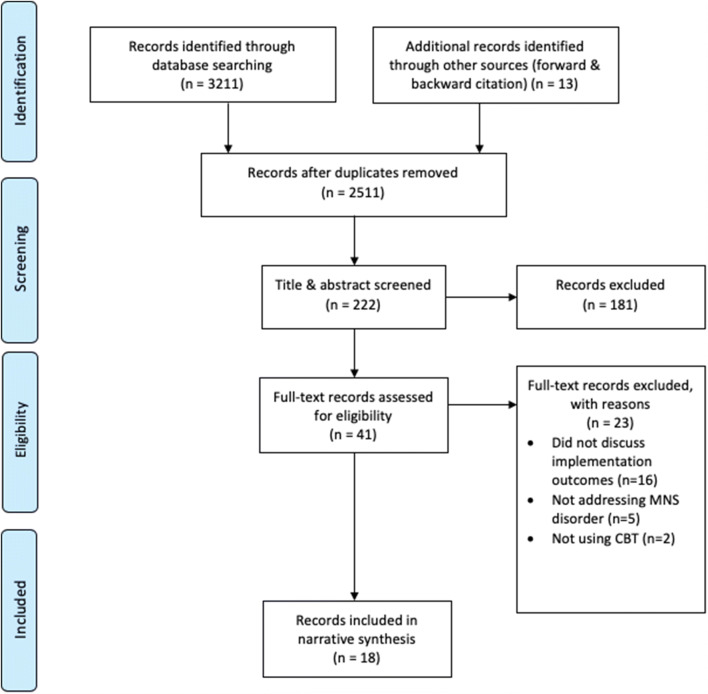
Due to severe shortages of specialist mental health personnel in low- and middle-income countries (LMICs), psychological therapies are increasingly being delivered by non-specialist health workers (NSHWs). Previous reviews have investigated the effectiveness of NSHW-delivered psychological therapies, including cognitive behavioural therapy (CBT), in LMIC settings. This systematic review aims to synthesise findings on the implementation outcomes of NSHW-delivered CBT interventions addressing common mental disorders and substance-use disorders in LMICs. Four databases were searched, yielding 3211 records, 18 of which met all inclusion criteria. We extracted and synthesised qualitative and quantitative data across eight implementation outcomes: acceptability, adoption, appropriateness, feasibility, fidelity, implementation cost, penetration and sustainability. Findings suggest that delivery of CBT-based interventions by NSHWs can be acceptable, appropriate and feasible in LMIC settings. However, more research is needed to better evaluate these and other under-reported implementation outcomes.
Overview
The claims and statistics of this paper haven’t been checked yet.
Free: it reads the open-access text and checks the first 5 claims that cite a source we can check. Create a free account to check every claim.
Integrity signals
Registry
Cites
Statistics
Figures
Verification
Claims the paper makes
The claims and statistics of this paper haven’t been checked yet.
Free: it reads the open-access text and checks the first 5 claims that cite a source we can check. Create a free account to check every claim.
Claims other papers make about this one
Each is checked against this paper’s own text: does it say what the citing paper says it does?
The source backs part of the claim, not all of it — or backs it for a different population, condition or comparison.
In the citing paper
“The results of such efforts to improve the uptake of these EBPs in VHA and similar clinical settings have not been systematically reviewed using implementation science frameworks.19”
From Evaluation of Implementation Strategies for Cognitive Behavioral Therapy (CBT), Acceptance and Commitment Therapy (ACT), and Mindfulness-Based Stress Reduction (MBSR): a Systematic Review (2023) · cites this paper as [19]
Experimental — accuracy not yet measured
Self-check
Percentages, sums and reported differences re-computed from the paper’s own numbers.
The self-check needs the paper’s full text.
Citations
Cites
Cochrane Handbook for Systematic Reviews of Interventions: Cochrane Book Series
(2008) · doi:10.1002/9780470712184 · Cited by 25,048
ROBINS-I: a tool for assessing risk of bias in non-randomised studies of interventions
Sterne, J. A., Hernán, M. A., Reeves, B. C., Savović, J., Berkman, N. D., Viswanathan, M., Henry, D., Altman, D. G., Ansari, M. T., Boutron, I., et al. (2016) · BMJ · doi:10.1136/bmj.i4919 · Cited by 20,329 · cited 2×
“Nonrandomised studies were assessed with the Cochrane Risk Of Bias in Non-randomised Studies-of Interventions (ROBINS-I) [13, 41].”
MethodDamschroder, L. J., Aron, D. C., Keith, R. E., Kirsh, S. R., Alexander, J. A., & Lowery, J. C. (2009) · Implementation Science · doi:10.1186/1748-5908-4-50 · Cited by 14,496 · cited 1×
“Evaluating these implementation outcomes can provide important insights into how a treatment achieves (or fails to achieve) its effects, including the barriers and facilitators to effective service delivery [9, 15].”
BackgroundProctor, E., Silmere, H., Raghavan, R., Hovmand, P., Aarons, G., Bunger, A., Griffey, R., & Hensley, M. (2011) · Administration and Policy in Mental Health and Mental Health Services Research · doi:10.1007/s10488-010-0319-7 · Cited by 8,721 · cited 6×
“The definitions of the implementation outcomes were based on Proctor’s model [37] (see Table 4 for definitions); however, these outcomes were assessed using a variety of methods.”
BackgroundMethodInfluentialCochrane Handbook for Systematic Reviews of Interventions
Higgins, J. P. T., Green, S., & Ben Van Den, A. (2020) · International Coaching Psychology Review · doi:10.53841/bpsicpr.2020.15.2.123 · Cited by 5,670
Critical appraisal skills programme
Singh, J. (2013) · Journal of Pharmacology and Pharmacotherapeutics · doi:10.4103/0976-500x.107697 · Cited by 2,556
Popay, J., Roberts, H., Sowden, A., Petticrew, M., Arai, L., Rodgers, M., Britten, N., Roen, K., & Duffy, S. (2006) · Lancaster University · doi:10.13140/2.1.1018.4643 · Cited by 2,070
Poverty and common mental disorders in low and middle income countries: A systematic review
Lund, C., Breen, A., Flisher, A. J., Kakuma, R., Corrigall, J., Joska, J. A., Swartz, L., & Patel, V. (2010) · Social Science & Medicine · doi:10.1016/j.socscimed.2010.04.027 · Cited by 1,375
Psychological Treatments for the World: Lessons from Low- and Middle-Income Countries
Singla, D. R., Kohrt, B. A., Murray, L. K., Anand, A., Chorpita, B. F., & Patel, V. (2017) · Annual Review of Clinical Psychology · doi:10.1146/annurev-clinpsy-032816-045217 · Cited by 913 · cited 1×
“For example, a systematic review and meta-analysis of randomised controlled trials (RCTs) conducted in LMICs concluded that NSHW-delivered psychological interventions are effective in reducing symptoms of anxiety, depression and post-traumatic stress disorder [39].”
BackgroundIs cognitive–behavioral therapy more effective than other therapies?
Tolin, D. F. (2010) · Clinical Psychology Review · doi:10.1016/j.cpr.2010.05.003 · Cited by 645 · cited 2×
“Based on Tolin’s [43] recent review, CBT-based interventions were defined as psychological interventions involving one or more of the following CBT components: relaxation training, behavioural rehearsal (including problem solving), exposure therapy, cognitive restructuring and/or operant procedures (including behaviou…”
BackgroundMethod
Cited by
Magill, M., Kiluk, B. D., & Ray, L. A. (2023) · Substance Abuse and Rehabilitation · doi:10.2147/sar.s362864 · Cited by 50
Coales, K., Jennings, H. M., Afaq, S., Arsh, A., Bhatti, M. M., Siddiqui, F., & Siddiqi, N. (2023) · Global Health Action · doi:10.1080/16549716.2023.2228112 · Cited by 73
“…and under SHW supervision NSHWs can effectively undertake a wide range of task shifted healthcare tasks, from health screening and prescribing medications to undertaking simple, surgical procedures and delivering specific treatment interventions such as brief psychological therapies [10,12–14].”
BackgroundNwaozuru, U., Obiezu‐Umeh, C., Shato, T., Uzoaru, F., Mason, S., Carter, V., Manu, S., Modi, K., Parker, J., Ezechi, O., et al. (2021) · Implementation Science Communications · doi:10.1186/s43058-021-00230-w · Cited by 51
“These gaps are in congruence with reviews of interventions in LMICs, which calls for more robust and consistent measurement of adoption [41, 42, 56] and fidelity [42].”
ResultAurizki, G. E., & Wilson, I. (2022) · International Journal of Nursing Practice · doi:10.1111/ijn.13046 · Cited by 54
Goldsmith, E. S., Koffel, E., Ackland, P. E., Hill, J., Landsteiner, A., Miller, W., Stroebel, B., Ullman, K., Wilt, T. J., & Duan-Porter, W. (2023) · Journal of General Internal Medicine · doi:10.1007/s11606-023-08140-4 · Cited by 38
Ryan, G. K., Bauer, A., Endale, T., Qureshi, O., Doukani, A., Pashoja, A. C., Brar, S. K., Eaton, J., & Bass, J. (2021) · Conflict and Health · doi:10.1186/s13031-021-00363-8 · Cited by 41
“Further, implementation research generally found lay-delivered talk therapies to be acceptable, appropriate and feasible to implement [77– 89, 92, 93], echoing findings from a recent review of implementation outcomes of non-specialist-delivered CBT in LMICs (though the authors note the variable quality of this researc…”
BackgroundSelf-citationMagidson, J. F., Kleinman, M. B., Bradley, V. D., Anvari, M. S., Abidogun, T. M., Belcher, A. M., Greenblatt, A. D., Dean, D., Hines, A. C., Seitz‐Brown, C. J., et al. (2022) · International Journal of Drug Policy · doi:10.1016/j.drugpo.2022.103813 · Cited by 36
Self-citationGoldsmith, E. S., Miller, W., Koffel, E., Ullman, K. E., Landsteiner, A. M. K., STROEBEL, B. M., Hill, J., Ackland, P. E., Wilt, T. J., & Duan‐Porter, W. (2023) · Journal of Pain · doi:10.1016/j.jpain.2023.02.026 · Cited by 38
Smith, L., Shin, J. I., Butler, L., Barnett, Y., Oh, H. Y., Jacob, L., Kostev, K., Veronese, N., Soysal, P., Tully, M. A., et al. (2022) · Depression and Anxiety · doi:10.1002/da.23250 · Cited by 33
“…al., 2021; Friedland & McColl, 1992; Gan et al., 2016; Hoebel et al., 2017; Mikkelsen et al., 2010; Nakad et al., 2020; Pathirana & Jackson, 2018; Robb et al., 2020; Schuch et al., 2017; Sheng et al., 2017; Sindi et al., 2020; Stickley et al., 2019; Vancampfort et al., 2017; Wiegner et al., 2015).”
Bunn, M., Gonzalez, N., Falek, I., Weine, S. M., & Acri, M. C. (2021) · Intervention · doi:10.4103/intv.intv_47_20 · Cited by 41
“…traits, inter-personal skills and shared life experience, some of which were thought to facilitate greater integration, acceptability and trust with target populations (e.g. Huang et al., 2018; Javadi et al., 2017; Munodawafa et al., 2018; Padmanathan & De Silva, 2013; Verhey et al., 2020).”
BackgroundTriece, P., Massazza, A., & Fuhr, D. C. (2022) · Social Psychiatry and Psychiatric Epidemiology · doi:10.1007/s00127-022-02294-y · Cited by 30
“High levels of PC fidelity could be due to the comprehensive training procedures followed (which ranged across a few days [42, 46, 47, 59, 61, 62, 64] to 6 weeks [48, 49]) and rigorous, ongoing supervision models [35, 36, 39, 40, 42].”
BackgroundBaumgartner, J. N., Ali, M., Gallis, J. A., Lillie, M., Owusu, R. K., Abubakr-Bibilazu, S., Adam, H., Aborigo, R., McEwan, E., Zhou, Y., et al. (2021) · Cambridge Prisms Global Mental Health · doi:10.1017/gmh.2021.15 · Cited by 31
Boisits, S., Abrahams, Z., Schneider, M., Honikman, S., Kaminer, D., & Lund, C. (2021) · International Journal of Mental Health Systems · doi:10.1186/s13033-021-00443-5 · Cited by 26
“Adjunct treatments The following adjunct treatments, informed by findings from phase one (manual review) were included to promote resilience: mindfulness and relaxation breathing techniques, helpful thinking techniques adapted from CBT [38, 47] and enhancing social support [18].”
BackgroundAnvari, M. S., Belus, J. M., Kleinman, M. B., Seitz‐Brown, C. J., Felton, J. W., Dean, D., Ciya, N., & Magidson, J. F. (2022) · Translational Issues in Psychological Science · doi:10.1037/tps0000305 · Cited by 24
Self-citation“Not shifting, but sharing”: stakeholders' perspectives on mental health task-shifting in Indonesia
Efendi, F., Aurizki, G. E., Yusuf, A., & McKenna, L. (2022) · BMC Nursing · doi:10.1186/s12912-022-00945-8 · Cited by 34
Zeying, M. D., Ashcroft, T., Kulkarni, D., Sawrikar, V., & Jackson, C. (2022) · Journal of Global Health · doi:10.7189/jogh.12.04049 · Cited by 27
Davies, T., Lund, C., & Schneider, M. (2021) · SSM - Mental Health · doi:10.1016/j.ssmmh.2021.100056 · Cited by 26
“Critically, the findings emphasise the importance of adequate training, supervision, and monitoring of quality, in interventions using CHWs to provide psychological therapy (Barnett et al., 2018; Verhey et al., 2020).”
BackgroundThabet, A., Ghandi, S., Barker, E. K., Rutherford, G., & Malekinejad, M. (2023) · BMJ Global Health · doi:10.1136/bmjgh-2021-007320 · Cited by 23
Rose, A. L., Belus, J. M., Hines, A. C., Barrie, I., Regenauer, K. S., Andersen, L. S., Joska, J. A., Ciya, N., Ndamase, S., MYERS, B. J., et al. (2022) · Cambridge Prisms Global Mental Health · doi:10.1017/gmh.2022.47 · Cited by 15
“There is other evidence in support of the implementation outcomes of BA in LMICs; a recent systematic review reported good acceptability, appropriateness, and feasibility of cognitive behavioral therapy, including BA, across ten countries (Verhey et al., 2020).”
Self-citationhAnrachtaigh, É. Ó., Brown, G. P., Beck, A. F., Conway, R., Jones, H. G., & Angelakis, I. (2024) · Depression and Anxiety · doi:10.1155/2024/5037662 · Cited by 17
“Universally applied therapeutic principles Encompass speci fi c “ schools ” of psychotherapy, such as cognitive-behavioral [34] and psychodynamic therapy [35], which apply certain key techniques across a range of psychopathologies, using a “ top down ” approach.”
BackgroundResultRose, A. L., Jack, H. E., Wan, C., Toloza, E., Bhattiprolu, K., Ragunathan, M., Schwartz, K. T. G., & Magidson, J. F. (2022) · Journal of Clinical Child & Adolescent Psychology · doi:10.1080/15374416.2022.2151450 · Cited by 17
“Because the goal of task-sharing research is ultimately to lead to changes in actual practice in low-resource health systems, better understanding cost and sustainability is critical, which other reviews have also concluded (Verhey et al., 2020).”
Self-citationWang, T., Tzeng, Y., Teng, Y., Pai, L., & Yeh, T. (2021) · Midwifery · doi:10.1016/j.midw.2021.103160 · Cited by 24
Bizouerne, C., Dozio, E., Dlasso, E., Letzelter, A., Abuzeid, A., Roch, K. L., & Farrell, D. P. (2023) · European Journal of Trauma & Dissociation · doi:10.1016/j.ejtd.2023.100362 · Cited by 17
Forchuk, C., Gyamfi, S., Martin, M., Corring, D., Srivastava, R., & Harerimana, B. (2020) · International Journal of Mental Health Nursing · doi:10.1111/inm.12821 · Cited by 9
Ceccarelli, C., Prina, E., Alkasaby, M. A., Cadorin, C., Gandhi, Y., Cristofalo, D., Jamei, Y. A., Muneghina, O., Barbui, C., Jordans, M. J. D., et al. (2023) · Clinical Psychology Review · doi:10.1016/j.cpr.2023.102371 · Cited by 12
Ryan, N., Vieira, D. L., Goffman, D., Bloch, E. M., Akaba, G. O., Dmello, B. S., Egekeze, C. O., Snyder, A., Lyimo, M. A., Nnodu, O. E., et al. (2020) · Health Policy and Planning · doi:10.1093/heapol/czaa074 · Cited by 13
Chukwuorji, J. C., Ezeonu, N. A., Ude, N., Itanyi, I. U., Eboreime, E., Kung, J. Y. C., Dennett, L., Olawepo, J. O., Iheanacho, T., Ogidi, A. G., et al. (2023) · AIDS Care · doi:10.1080/09540121.2023.2176428 · Cited by 7
“…helping people with other mental health conditions such as posttraumatic stress disorder, generalized anxiety, insomnia, obsessive-compulsive disorder, panic disorder, eating disorders, and substance use disorders (David et al., 2018; Hofmann et al., 2012; McHugh et al., 2010; Verhey et al., 2020).”
Pallikkuth, R., Kumar, T. M., Manickam, L. S. S., Cherian, A. V., Bunders, J., & Regeer, B. J. (2021) · Indian Journal of Social Psychiatry · doi:10.4103/ijsp.ijsp_126_19 · Cited by 7
Saleem, M., Zafar, S., Klein, T., Koesters, M., Bashir, A., Fuhr, D. C., Sikander, S., & Zeeb, H. (2025) · JMIR Formative Research · doi:10.2196/59414 · Cited by 5
“The Disease Control Priorities (DCP3) report endorses such scalable models as effective affordable solutions that bolster mental health care capacity in LMICs [6,7].”
Carvalho, F., Tonon, A. C., Hidalgo, M. P., Martins Costa, M., & Mengue, S. S. (2024) · Frontiers in Pharmacology · doi:10.3389/fphar.2024.1405838 · Cited by 4
Sarfraz, Z., Sarfraz, A., & Amin, S. Z. (2024) · Archives of Women s Mental Health · doi:10.1007/s00737-024-01428-2 · Cited by 28
“The nature of the intervention may be influenced by the gender of the providers and influences the cultural issues, safety, and confidentiality level (Verhey et al. 2020).”
Gronholm, P. C., Makhmud, A., Barbui, C., Brohan, E., & Chowdhary, N. (2023) · BMJ Mental Health · doi:10.1136/bmjment-2023-300755 · Cited by 8
Ahmed, C. V., Pelt, A. E. V., Buttenheim, A. M., Poku, O. B., Brawner, B. M., Lowenthal, E. D., & Brooks, M. J. (2024) · Global Implementation Research and Applications · doi:10.1007/s43477-024-00126-6 · Cited by 5
“Similar research evaluating lay-delivered psychological interventions suggest that counselor motivations are important indicators of successful delivery and sustainability (Shahmalak et al., 2019; Verhey et al., 2020).”
Kiburi, S. K., Kwobah, E., Paruk, S., & Chiliza, B. (2023) · BMC Digital Health · doi:10.1186/s44247-023-00014-3 · Cited by 6
Freeman, J., O’Connor, E., Herren, J. A., Benito, K., Righi, G., Milgram, L., Cain, G. H., Sheehan, K. G., & Kemp, J. J. (2024) · Evidence-Based Practice in Child and Adolescent Mental Health · doi:10.1080/23794925.2023.2297873 · Cited by 4
“…provider and all other weeks of the month with non-licensed staff (under supervision of the licensed provider) is an innovative service design with the potential to radically expand treatment capacity, while maintaining quality (Barnett et al., 2018; Shahmalak et al., 2019; Verhey et al., 2020).”
Marwat, A. R., Rizvi, S., Ip, V., Rodak, T., Saleem, H., Liang, R., Khan, M. A., Husain, N., Hankir, A. K., Farooq, S., et al. (2025) · International Journal of Cognitive Behavioral Therapy · doi:10.1007/s41811-025-00251-6 · Cited by 4
“Additionally, CBT-based interventions are effective for common mental disorders and substance use disorders in low-and middle-income countries when delivered by non-specialist healthcare workers (Verhey et al., 2020).”
Touhami, D., Ryan, R., Engeda, E. H., Arienti, C., Atkinson-Graham, M., Bakaa, N., Battel, I., Capodaglio, P., Cordani, C., Côté, P., et al. (2026) · Cochrane Database of Systematic Reviews · doi:10.1002/14651858.cd016324 · Cited by 6
Non-pharmacological interventions for depression in Kenya: a scoping review
Otanga, H., Nyaga, J., March, A., & Khan, F. F. (2024) · Discover Psychology · doi:10.1007/s44202-024-00186-7 · Cited by 3
Shimizu, E., Sato, D., Hirano, Y., Ebisu, H., Kagayama, Y., & Hanaoka, H. (2024) · BMJ Open · doi:10.1136/bmjopen-2023-081205 · Cited by 3
Freeman, J. B., Kemp, J. J., O’Connor, E., Herren, J. A., Georgiadis, C., Righi, G., & Benito, K. (2024) · JAACAP Open · doi:10.1016/j.jaacop.2024.06.005 · Cited by 3
Bell, J. S., Tillson, M. D., Anvari, M. S., Blonigen, D. M., McGovern, M. P., & Magidson, J. F. (2025) · Administration and Policy in Mental Health and Mental Health Services Research · doi:10.1007/s10488-025-01470-x · Cited by 4
“These findings paral - lel those of a systematic review on the implementation of task-shared cognitive-behavioral therapy in LMICs which identified similar facilitators and barriers to implementation (Verhey et al., 2020 ).”
Self-citationFuria, M. J. D., Minozzi, S., Battel, I., Cordani, C., Arienti, C., Atkinson-Graham, M., Bakaa, N., Capodaglio, P., Côté, P., Décary, S., et al. (2026) · Cochrane Database of Systematic Reviews · doi:10.1002/14651858.cd016348 · Cited by 4
Adishabri, A. K., & Suryoadji, K. A. (2022) · Cermin Dunia Kedokteran · doi:10.55175/cdk.v49i11.320
Rose, A. L., Jack, H. E., Rasheed, M. A., & Magidson, J. F. (2024) · The International Journal of Health Planning and Management · doi:10.1002/hpm.3788 · Cited by 1
Self-citationStatus of Evidence-based Mental Healthcare Counseling System in Pakistan
Khan, A., Madihie, A., & Khan, R. U. (2024) · BENTHAM SCIENCE PUBLISHERS eBooks · doi:10.2174/9789815274257124010010
Priya, S., Rajini, G., & Karthikeyan, V. S. (2025) · IGI Global eBooks · doi:10.4018/979-8-3693-4014-1.ch006
Shoesmith, W. D., Kamu, A., & Pang, N. T. P. (2025) · Journal of Contextual Behavioral Science · doi:10.1016/j.jcbs.2025.100918
Feasibility of a Social Worker–Teacher Model for Chinese Children with Anxiety Symptoms
Li, J., Wang, J., Li, X., & Qu, Z. (2025) · Research on Social Work Practice · doi:10.1177/10497315251392526
Valle, R., Velez, C., & Iyer, S. N. (2025) · medRxiv · doi:10.1101/2025.11.11.25340030
Atkinson-Graham, M., Mior, S. A., Bakaa, N., Konstantinidis, T., Wong, J. J., Arienti, C., Battel, I., Capodaglio, P., Cordani, C., Décary, S., et al. (2025) · Cochrane Database of Systematic Reviews · doi:10.1002/14651858.cd016309 · Cited by 4
Ryan, G. K., Bauer, A., Endale, T., Qureshi, O., Doukani, A., Pashoja, A. C., Brar, S. K., Eaton, J., & Bass, J. K. (2021) · Figshare · doi:10.6084/m9.figshare.14478527
Self-citationRyan, G. K., Bauer, A., Endale, T., Qureshi, O., Doukani, A., Pashoja, A. C., Brar, S. K., Eaton, J., & Bass, J. K. (2021) · Figshare · doi:10.6084/m9.figshare.14478521
Self-citationRyan, G. K., Bauer, A., Endale, T., Qureshi, O., Doukani, A., Pashoja, A. C., Brar, S. K., Eaton, J., & Bass, J. K. (2021) · Figshare · doi:10.6084/m9.figshare.14478530
Self-citationRyan, G. K., Bauer, A., Endale, T., Qureshi, O., Doukani, A., Pashoja, A. C., Brar, S. K., Eaton, J., & Bass, J. K. (2021) · Figshare · doi:10.6084/m9.figshare.14478524
Self-citationRyan, G. K., Bauer, A., Endale, T., Qureshi, O., Doukani, A., Pashoja, A. C., Brar, S. K., Eaton, J., & Bass, J. K. (2021) · Figshare · doi:10.6084/m9.figshare.14478533
Self-citationSaleem, H. T., Atkins, K., Skavenski, S. V. W., Nonyane, B. A., Chitamwebwa, F., Mtaita, S., Mwansa, D., Luswetula, A., Murray, L. K., & Likindikoki, S. L. (2026) · BMJ Open · doi:10.1136/bmjopen-2025-114522
Gimigliano, F., Liguori, S., Arienti, C., Paoletta, M., Butzbach, O., Iolascon, G., Atkinson-Graham, M., Bakaa, N., Battel, I., Capodaglio, P., et al. (2026) · Cochrane Database of Systematic Reviews · doi:10.1002/14651858.cd016327 · Cited by 4
Zhang, X., Wei, J., & Xiu, T. (2026) · Frontiers in Psychology · doi:10.3389/fpsyg.2026.1738619
Valle, R., Velez, C., & Iyer, S. N. (2026) · PLOS Global Public Health · doi:10.1371/journal.pgph.0005531
“Strategies, such as task sharing and task shifting, have already been successful in scaling mental health interventions in LMICs [60,61].”
Bridging the gap by improving access to psychological services in low resource settings
Reddy, C., Godinho, J. D., & Kumar, A. R. P. (2026) · Discover Public Health · doi:10.1186/s12982-026-01835-z · Cited by 1
Omari, S. K., Mosses, L. I., & Mwanjali, H. H. (2026) · Health Science Reports · doi:10.1002/hsr2.72604 · Cited by 1
Das, M., Eadon, A., Lapelyte, T., Baiden, E., Morozevych, A., McLaughlan, D., Clinton-Tarestad, P., & Matcham, F. (2026) · doi:10.2196/preprints.111133
Chironda, G., Mselema, C. T., Rezaeianjam, M., Lopatka, A. R., Mwalweni, C., Huynh, W., Malunga, S. S., Mkwinda, E., & de Oliveira, C. R. (2026) · Frontiers in Medicine · doi:10.3389/fmed.2026.1950277
“The Perinatal Mental Health Project in South Africa and similar task-sharing models in India, Pakistan, Ghana, and Indonesia demonstrate that embedding MMH content within PHC systems enhances provider capacity and facilitates direct translation of skills into clinical practice (52, 53).”
Metadata
- Authors
- Verhey, I. J., Ryan, G. K., Scherer, N., & Magidson, J. F.
- Affiliations
- London School of Hygiene & Tropical Medicine (GB)
- University of Maryland, College Park (US)
- Corresponding author
- Verhey, Ibone J.
- Venue
- International Journal of Mental Health Systems
- Published
- 2020-05-29
- Volume
- 14
- Issue
- 1
- Pages
- 40-40
- ISSN
- 1752-4458 (ISSN-L)
- PMC
- PMC7260765
- OpenAlex
- W3031961742
- Cited by
- 63
- References
- 49
- Citations by year
- 2026: 10 · 2025: 8 · 2024: 10 · 2023: 10 · 2022: 10 · 2021: 13 · 2020: 2
- FWCI
- 1.66
- Type
- journal article
- Language
- en
- Open access
- gold
- doi.org
- Licence
- cc-by
- creativecommons.org/licenses/by/4.0 (tdm)
- creativecommons.org/licenses/by/4.0 (vor)
- Locations
- International Journal of Mental Health Systems (publishedVersion, cc-by)
- PubMed Central (publishedVersion, cc-by)
- PubMed (publishedVersion)
- LSHTM Research Online (London School of Hygiene and Tropical Medicine) (acceptedVersion)
- DOAJ (DOAJ: Directory of Open Access Journals) (submittedVersion, cc-by-sa)
- Funders
- National Institute on Drug Abuse (K23DA041901)
- Topics
- Health Sciences › Health Professions › General Health Professions › Health Policy Implementation Science
- Health Sciences › Medicine › Psychiatry and Mental health › Mental Health Treatment and Access
- Social Sciences › Psychology › Applied Psychology › Digital Mental Health Interventions
- Keywords
- cognitive behavioral therapy, non-specialist health workers, implementation outcomes, common mental disorders, substance use disorders, low- and middle-income countries, mental health workforce shortage, acceptability, fidelity, implementation costs, sustainability
About these checks
Registry, retraction, Cites and statistics results are computed, not judged, with one exception: a printed reference that no index lists is read once by a model before it counts as a citation error. Claims are extracted by a model and kept only when their quote appears verbatim in the text; each cited source is then checked, with a model’s help, for whether it says what the claim relies on. Those verdicts can be wrong — read the claim’s quote and the cited source before relying on one.
Statistics and arithmetic are recomputed, not judged.
Confidence bands are shown only for fields calibrated on our annotated test set. None is calibrated yet, so no band is shown.
What counts as a claim ›How we measure confidence ›How we check this ›
Are you an author, or do you see a problem with this page? Request a review
Data sources
Bibliographic data: Semantic Scholar, OpenAlex, Crossref.
Contains information from the Semantic Scholar Academic Graph Datasets, made available under the ODC Attribution License (ODC-BY 1.0).
Semantic Scholar’s data is described in: Kinney, R., et al. (2023). The Semantic Scholar Open Data Platform. arXiv:2301.10140.
