

Implementation outcomes of cognitive behavioural therapy delivered by non-specialists for common mental disorders and substance-use disorders in low- and middle-income countries: a systematic review
Open accessThe DOI matches its Crossref record; 47 of the 49 references it cites were found in a registry or an index.
Abstract
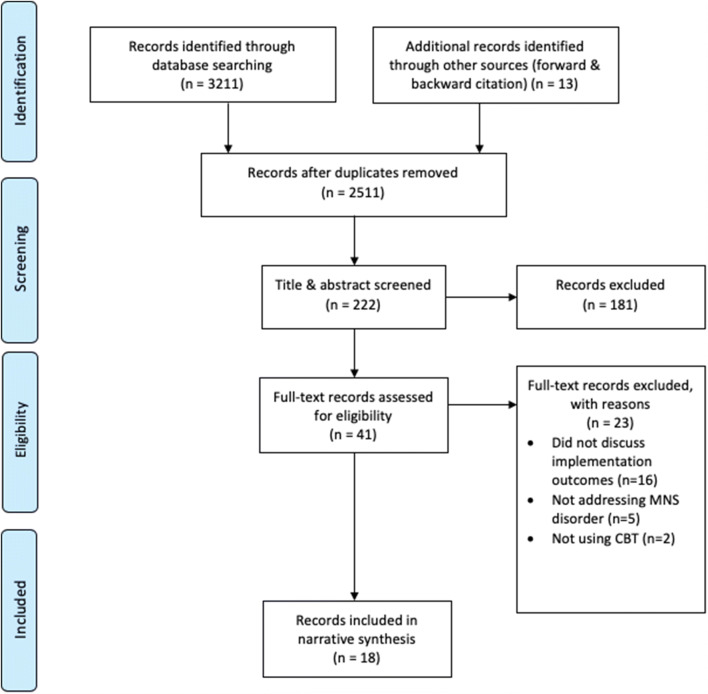
Due to severe shortages of specialist mental health personnel in low- and middle-income countries (LMICs), psychological therapies are increasingly being delivered by non-specialist health workers (NSHWs). Previous reviews have investigated the effectiveness of NSHW-delivered psychological therapies, including cognitive behavioural therapy (CBT), in LMIC settings. This systematic review aims to synthesise findings on the implementation outcomes of NSHW-delivered CBT interventions addressing common mental disorders and substance-use disorders in LMICs. Four databases were searched, yielding 3211 records, 18 of which met all inclusion criteria. We extracted and synthesised qualitative and quantitative data across eight implementation outcomes: acceptability, adoption, appropriateness, feasibility, fidelity, implementation cost, penetration and sustainability. Findings suggest that delivery of CBT-based interventions by NSHWs can be acceptable, appropriate and feasible in LMIC settings. However, more research is needed to better evaluate these and other under-reported implementation outcomes.
Overview
The claims and statistics of this paper haven’t been checked yet.
Free: it reads the open-access text and checks the first 5 claims that cite a source we can check. Create a free account to check every claim.
Integrity signals
Registry
Cites
Statistics
Figures
Verification
Claims the paper makes
The claims and statistics of this paper haven’t been checked yet.
Free: it reads the open-access text and checks the first 5 claims that cite a source we can check. Create a free account to check every claim.
Claims other papers make about this one
Each is checked against this paper’s own text: does it say what the citing paper says it does?
The source backs part of the claim, not all of it — or backs it for a different population, condition or comparison.
In the citing paper
“The results of such efforts to improve the uptake of these EBPs in VHA and similar clinical settings have not been systematically reviewed using implementation science frameworks.19”
From Evaluation of Implementation Strategies for Cognitive Behavioral Therapy (CBT), Acceptance and Commitment Therapy (ACT), and Mindfulness-Based Stress Reduction (MBSR): a Systematic Review (2023) · cites this paper as [19]
Experimental — accuracy not yet measured
Self-check
Percentages, sums and reported differences re-computed from the paper’s own numbers.
The self-check needs the paper’s full text.
Citations
Cites
Cochrane Handbook for Systematic Reviews of Interventions: Cochrane Book Series
(2008) · doi:10.1002/9780470712184 · Cited by 25,048
ROBINS-I: a tool for assessing risk of bias in non-randomised studies of interventions
Sterne, J. A., Hernán, M. A., Reeves, B. C., Savović, J., Berkman, N. D., Viswanathan, M., Henry, D., Altman, D. G., Ansari, M. T., Boutron, I., et al. (2016) · BMJ · doi:10.1136/bmj.i4919 · Cited by 20,329 · cited 2×
“Nonrandomised studies were assessed with the Cochrane Risk Of Bias in Non-randomised Studies-of Interventions (ROBINS-I) [13, 41].”
MethodDamschroder, L. J., Aron, D. C., Keith, R. E., Kirsh, S. R., Alexander, J. A., & Lowery, J. C. (2009) · Implementation Science · doi:10.1186/1748-5908-4-50 · Cited by 14,496 · cited 1×
“Evaluating these implementation outcomes can provide important insights into how a treatment achieves (or fails to achieve) its effects, including the barriers and facilitators to effective service delivery [9, 15].”
BackgroundProctor, E., Silmere, H., Raghavan, R., Hovmand, P., Aarons, G., Bunger, A., Griffey, R., & Hensley, M. (2011) · Administration and Policy in Mental Health and Mental Health Services Research · doi:10.1007/s10488-010-0319-7 · Cited by 8,721 · cited 6×
“The definitions of the implementation outcomes were based on Proctor’s model [37] (see Table 4 for definitions); however, these outcomes were assessed using a variety of methods.”
BackgroundMethodInfluentialCochrane Handbook for Systematic Reviews of Interventions
Higgins, J. P. T., Green, S., & Ben Van Den, A. (2020) · International Coaching Psychology Review · doi:10.53841/bpsicpr.2020.15.2.123 · Cited by 5,670
Critical appraisal skills programme
Singh, J. (2013) · Journal of Pharmacology and Pharmacotherapeutics · doi:10.4103/0976-500x.107697 · Cited by 2,556
Popay, J., Roberts, H., Sowden, A., Petticrew, M., Arai, L., Rodgers, M., Britten, N., Roen, K., & Duffy, S. (2006) · Lancaster University · doi:10.13140/2.1.1018.4643 · Cited by 2,070
Guidance on the conduct of narrative synthesis in sytematic reviews
Popay, J., Roberts, H. M., Sowden, A. J., Petticrew, M. P., Arai, L., Rodgers, M., & Britten, N. (2006) · Cited by 1,378
Poverty and common mental disorders in low and middle income countries: A systematic review
Lund, C., Breen, A., Flisher, A. J., Kakuma, R., Corrigall, J., Joska, J. A., Swartz, L., & Patel, V. (2010) · Social Science & Medicine · doi:10.1016/j.socscimed.2010.04.027 · Cited by 1,375
Psychological Treatments for the World: Lessons from Low- and Middle-Income Countries
Singla, D. R., Kohrt, B. A., Murray, L. K., Anand, A., Chorpita, B. F., & Patel, V. (2017) · Annual Review of Clinical Psychology · doi:10.1146/annurev-clinpsy-032816-045217 · Cited by 913 · cited 1×
“For example, a systematic review and meta-analysis of randomised controlled trials (RCTs) conducted in LMICs concluded that NSHW-delivered psychological interventions are effective in reducing symptoms of anxiety, depression and post-traumatic stress disorder [39].”
BackgroundIs cognitive–behavioral therapy more effective than other therapies?
Tolin, D. F. (2010) · Clinical Psychology Review · doi:10.1016/j.cpr.2010.05.003 · Cited by 645 · cited 2×
“Based on Tolin’s [43] recent review, CBT-based interventions were defined as psychological interventions involving one or more of the following CBT components: relaxation training, behavioural rehearsal (including problem solving), exposure therapy, cognitive restructuring and/or operant procedures (including behaviou…”
BackgroundMethodHoeft, T. J., Fortney, J. C., Patel, V., & Unützer, J. (2018) · The Journal of Rural Health · doi:10.1111/jrh.12229 · Cited by 619
Chambers, D. A., & Norton, W. E. (2016) · American Journal of Preventive Medicine · doi:10.1016/j.amepre.2016.05.011 · Cited by 581 · cited 1×
“Evaluating these implementation outcomes can provide important insights into how a treatment achieves (or fails to achieve) its effects, including the barriers and facilitators to effective service delivery [9, 15].”
Backgroundvan Ginneken, N., Tharyan, P., Lewin, S., Rao, G. N., Meera, S., Pian, J., Chandrashekar, S., & Patel, V. (2013) · Cochrane Database of Systematic Reviews · doi:10.1002/14651858.cd009149.pub2 · Cited by 575 · cited 4×
“Methods The search strategy was developed following a brief scoping review to identify key domains and sources of literature used in previous reviews on similar topics [4, 17, 22, 29, 38, 44, 45].”
InfluentialChibanda, D., Weiss, H. A., Verhey, R., Simms, V., Munjoma, R., Rusakaniko, S., Chingono, A., Munetsi, E., Bere, T., Manda, E., et al. (2016) · JAMA · doi:10.1001/jama.2016.19102 · Cited by 502
Araya, R., Rojas, G., Fritsch, R., Gaete, J., Rojas, M., Simon, G., & Peters, T. J. (2003) · The Lancet · doi:10.1016/s0140-6736(03)12825-5 · Cited by 450
Controlled trial of psychotherapy for Congolese survivors of sexual violence
Bass, J. K., Annan, J., McIvor Murray, S., Kaysen, D., Griffiths, S., Cetinoglu, T., Wachter, K., Murray, L. K., & Bolton, P. A. (2013) · New England Journal of Medicine · doi:10.1056/nejmoa1211853 · Cited by 423 · cited 1×
“Seven studies reported that clear manuals, training and weekly supervision were ways to increase fidelity to the intervention by providing opportunities for feedback and supporting with difficult cases [2, 5, 7, 12, 16, 24, 27].”
BackgroundBaron, E. C., Davies, T., & Lund, C. (2017) · BMC Psychiatry · doi:10.1186/s12888-016-1178-x · Cited by 332
Murray, L. K., Dorsey, S., Bolton, P., Jordans, M. J., Rahman, A., Bass, J., & Verdeli, H. (2011) · International Journal of Mental Health Systems · doi:10.1186/1752-4458-5-30 · Cited by 326
Bolton, P., Lee, C., Haroz, E. E., Murray, L., Dorsey, S., Robinson, C., Ugueto, A. M., & Bass, J. (2014) · PLoS Medicine · doi:10.1371/journal.pmed.1001757 · Cited by 319 · cited 10×
“Seven studies reported that clear manuals, training and weekly supervision were ways to increase fidelity to the intervention by providing opportunities for feedback and supporting with difficult cases [2, 5, 7, 12, 16, 24, 27].”
BackgroundMethodInfluentialCabassa, L. J., & Baumann, A. A. (2013) · Implementation Science · doi:10.1186/1748-5908-8-90 · Cited by 290 · cited 7×
“A suitable training method was found to be important in order to engage stakeholders, maintain fidelity and facilitate recruitment and retention of NSHWs [2, 7, 8, 12, 27].”
BackgroundMethodInfluentialTol, W. A., Komproe, I. H., Susanty, D., Jordans, M. J. D., Macy, R. D., & De Jong, J. T. V. M. (2008) · JAMA · doi:10.1001/jama.300.6.655 · Cited by 286
Critical Appraisal of Qualitative Research
Hannes, K. (2011) · Lirias · Cited by 199
Nadkarni, A., Weobong, B., Weiss, H. A., McCambridge, J., Bhat, B., Katti, B., Murthy, P., King, M., McDaid, D., Park, A.-L., et al. (2017) · The Lancet · doi:10.1016/s0140-6736(16)31590-2 · Cited by 187 · cited 8×
“Acceptability Five studies reported that acceptable interventions contained beneficial information and skills for the service user and the community [2, 3, 11, 12, 24, 31].”
BackgroundInfluentialChowdhary, N., Anand, A., Dimidjian, S., Shinde, S., Weobong, B., Balaji, M., Hollon, S. D., Rahman, A., Wilson, G. T., Verdeli, H., et al. (2016) · British Journal of Psychiatry · doi:10.1192/bjp.bp.114.161075 · Cited by 167 · cited 10×
“Acceptability Five studies reported that acceptable interventions contained beneficial information and skills for the service user and the community [2, 3, 11, 12, 24, 31].”
BackgroundMethodInfluentialMutamba, B. B., van Ginneken, N., Smith Paintain, L., Wandiembe, S., & Schellenberg, D. (2013) · BMC Health Services Research · doi:10.1186/1472-6963-13-412 · Cited by 143 · cited 1×
“Methods The search strategy was developed following a brief scoping review to identify key domains and sources of literature used in previous reviews on similar topics [4, 17, 22, 29, 38, 44, 45].”
MethodHigginbottom, G. M., Morgan, M., Alexandre, M., Chiu, Y., Forgeron, J., Kocay, D., & Barolia, R. (2015) · Systematic Reviews · doi:10.1186/2046-4053-4-13 · Cited by 134 · cited 1×
“To allow for the inclusion of heterogenous studies, methods of narrative synthesis were selected [19, 36].”
MethodGroup psychological therapies for depression in the community: systematic review and meta-analysis
Huntley, A. L., Araya, R., & Salisbury, C. (2012) · British Journal of Psychiatry · doi:10.1192/bjp.bp.111.092049 · Cited by 132 · cited 1×
“Methods The search strategy was developed following a brief scoping review to identify key domains and sources of literature used in previous reviews on similar topics [4, 17, 22, 29, 38, 44, 45].”
MethodPapas, R. K., Sidle, J. E., Gakinya, B. N., Baliddawa, J. B., Martino, S., Mwaniki, M. M., Songole, R., Omolo, O. E., Kamanda, A. M., Ayuku, D. O., et al. (2011) · Addiction · doi:10.1111/j.1360-0443.2011.03518.x · Cited by 111 · cited 6×
“Paraprofessionals were found have moderate to high fidelity when supported by a specifically adapted manual [8, 34, 35, 42].”
BackgroundMethodInfluentialAtif, N., Krishna, R. N., Sikander, S., Lazarus, A., Nisar, A., Ahmad, I., Raman, R., Fuhr, D. C., Patel, V., & Rahman, A. (2017) · BMC Psychiatry · doi:10.1186/s12888-017-1244-z · Cited by 100 · cited 9×
“Acceptability Five studies reported that acceptable interventions contained beneficial information and skills for the service user and the community [2, 3, 11, 12, 24, 31].”
BackgroundMethodInfluentialAtif, N., Lovell, K., Husain, N., Sikander, S., Patel, V., & Rahman, A. (2016) · International Journal of Mental Health Systems · doi:10.1186/s13033-016-0055-9 · Cited by 96 · cited 10×
“Acceptability Five studies reported that acceptable interventions contained beneficial information and skills for the service user and the community [2, 3, 11, 12, 24, 31].”
BackgroundMethodInfluentialKhan, M. N., Hamdani, S. U., Chiumento, A., Dawson, K., Bryant, R. A., Sijbrandij, M., Nazir, H., Akhtar, P., Masood, A., Wang, D., et al. (2019) · Epidemiology and Psychiatric Sciences · doi:10.1017/s2045796017000336 · Cited by 82 · cited 10×
“Acceptability Five studies reported that acceptable interventions contained beneficial information and skills for the service user and the community [2, 3, 11, 12, 24, 31].”
BackgroundMethodInfluentialNaeem, F., Waheed, W., Gobbi, M., Ayub, M., & Kingdon, D. (2011) · Behavioural and Cognitive Psychotherapy · doi:10.1017/s1352465810000822 · Cited by 79 · cited 1×
“In low- and middle-income countries (LMICs), where specialist mental health care providers are often scarce, there has recently been a focus on developing CBTbased interventions for delivery by non-specialist health workers (NSHWs) [1, 6, 23, 32].”
BackgroundChibanda, D., Cowan, F. M., Verhey, R., Machando, D., Abas, M., & Lund, C. (2016) · Community Mental Health Journal · doi:10.1007/s10597-016-0018-2 · Cited by 77 · cited 10×
“Feasibility The use of CBT components was shown to be feasible for NSHW delivery by seven studies [2, 3, 7, 10, 12, 24, 27, 30, 33, 40].”
BackgroundMethodInfluentialPapas, R. K., Sidle, J. E., Martino, S., Baliddawa, J. B., Songole, R., Omolo, O. E., Gakinya, B. N., Mwaniki, M. M., Adina, J. O., Nafula, T., et al. (2010) · AIDS and Behavior · doi:10.1007/s10461-009-9647-6 · Cited by 72 · cited 5×
“As NSHWs rarely have prior experience of working in mental health, the intervention should be brief and straightforward, and CBT may be a particularly good fit given its structured format for training and delivery [35].”
BackgroundMethodInfluential“Someone like us”: Delivering maternal mental health through peers in two South Asian contexts
Singla, D., Lazarus, A., Atif, N., Sikander, S., Bhatia, U., Ahmad, I., Nisar, A., Khan, S., Fuhr, D., Patel, V., et al. (2014) · Journal of Affective Disorders · doi:10.1016/j.jad.2014.07.017 · Cited by 71 · cited 10×
“Lay health workers were employed by the government as part of a formal health workforce [2, 11, 24], which was both a benefit due to the strong links to the local health system and high fidelity of delivery, and a challenge due to potential overburdening [2, 40].”
BackgroundMethodInfluentialNadkarni, A., Velleman, R., Dabholkar, H., Shinde, S., Bhat, B., McCambridge, J., Murthy, P., Wilson, T., Weobong, B., & Patel, V. (2015) · Alcoholism: Clinical and Experimental Research · doi:10.1111/acer.12653 · Cited by 59 · cited 7×
“[30] targeted only men, as alcohol use disorders have been identified as a leading cause of disease burden among this service user group (WHO, 2014), however, mixed gender providers were trained to deliver it.”
BackgroundMethodInfluentialDawson, K., Joscelyne, A., Meijer, C., Steel, Z., Silove, D., & Bryant, R. A. (2018) · Australian & New Zealand Journal of Psychiatry · doi:10.1177/0004867417714333 · Cited by 56
Nyatsanza, M., Schneider, M., Davies, T., & Lund, C. (2016) · BMC Psychiatry · doi:10.1186/s12888-016-0873-y · Cited by 49
Mukdarut, B., Chiumento, A., Dickson, K., & Felix, L. (2017) · doi:10.21201/2017.8937 · Cited by 40 · cited 1×
“Methods The search strategy was developed following a brief scoping review to identify key domains and sources of literature used in previous reviews on similar topics [4, 17, 22, 29, 38, 44, 45].”
MethodBeck, A. F., Nadkarni, A., Calam, R. M., Naeem, F., & Husain, N. (2015) · Asian Journal of Psychiatry · doi:10.1016/j.ajp.2015.10.008 · Cited by 38 · cited 1×
“In low- and middle-income countries (LMICs), where specialist mental health care providers are often scarce, there has recently been a focus on developing CBTbased interventions for delivery by non-specialist health workers (NSHWs) [1, 6, 23, 32].”
BackgroundWeiss, W. M., Uguento, A. M., Mahmooth, Z., Murray, L. K., Hall, B. J., Nadison, M., Rasmussen, A., Lee, J. S., Vazzano, A., Bass, J., et al. (2018) · Torture Journal · doi:10.7146/torture.v26i1.108061 · Cited by 36 · cited 1×
“Methods The search strategy was developed following a brief scoping review to identify key domains and sources of literature used in previous reviews on similar topics [4, 17, 22, 29, 38, 44, 45].”
MethodMunodawafa, M., Lund, C., & Schneider, M. (2017) · BMC Psychiatry · doi:10.1186/s12888-017-1397-9 · Cited by 35 · cited 10×
“Seven studies reported that clear manuals, training and weekly supervision were ways to increase fidelity to the intervention by providing opportunities for feedback and supporting with difficult cases [2, 5, 7, 12, 16, 24, 27].”
BackgroundMethodInfluentialDossa, N. I., & Hatem, M. (2012) · The Scientific World Journal · doi:10.1100/2012/181847 · Cited by 32 · cited 1×
“Methods The search strategy was developed following a brief scoping review to identify key domains and sources of literature used in previous reviews on similar topics [4, 17, 22, 29, 38, 44, 45].”
MethodHusain, M. O., Chaudhry, I. B., Mehmood, N., Rehman, R. U., Kazmi, A., Hamirani, M. M., Kiran, T., Khoso, A. B., Bassett, P., Husain, M. I., et al. (2017) · BMC Health Services Research · doi:10.1186/s12913-017-2740-z · Cited by 29 · cited 2×
“Basing adaptations on the setting is especially relevant for interventions, like CBT, that were originally developed for specialist-delivery in high-income countries [7, 23, 26].”
BackgroundMagidson, J. F., Gouse, H., Psaros, C., Remmert, J. E., O’Cleirigh, C. M., & Safren, S. A. (2016) · Springer eBooks · doi:10.1007/978-3-319-29294-6_14 · Cited by 26 · cited 3×
“Basing adaptations on the setting is especially relevant for interventions, like CBT, that were originally developed for specialist-delivery in high-income countries [7, 23, 26].”
BackgroundSelf-citationRyan, G. K., Bauer, A., Bass, J., & Eaton, J. (2018) · BMJ Open · doi:10.1136/bmjopen-2017-018193 · Cited by 18 · cited 3×
“Methods The search strategy was developed following a brief scoping review to identify key domains and sources of literature used in previous reviews on similar topics [4, 17, 22, 29, 38, 44, 45].”
BackgroundMethodSelf-citation
Cited by
Magill, M., Kiluk, B. D., & Ray, L. A. (2023) · Substance Abuse and Rehabilitation · doi:10.2147/sar.s362864 · Cited by 50
Coales, K., Jennings, H. M., Afaq, S., Arsh, A., Bhatti, M. M., Siddiqui, F., & Siddiqi, N. (2023) · Global Health Action · doi:10.1080/16549716.2023.2228112 · Cited by 73
“…and under SHW supervision NSHWs can effectively undertake a wide range of task shifted healthcare tasks, from health screening and prescribing medications to undertaking simple, surgical procedures and delivering specific treatment interventions such as brief psychological therapies [10,12–14].”
BackgroundNwaozuru, U., Obiezu‐Umeh, C., Shato, T., Uzoaru, F., Mason, S., Carter, V., Manu, S., Modi, K., Parker, J., Ezechi, O., et al. (2021) · Implementation Science Communications · doi:10.1186/s43058-021-00230-w · Cited by 51
“These gaps are in congruence with reviews of interventions in LMICs, which calls for more robust and consistent measurement of adoption [41, 42, 56] and fidelity [42].”
ResultAurizki, G. E., & Wilson, I. (2022) · International Journal of Nursing Practice · doi:10.1111/ijn.13046 · Cited by 54
Goldsmith, E. S., Koffel, E., Ackland, P. E., Hill, J., Landsteiner, A., Miller, W., Stroebel, B., Ullman, K., Wilt, T. J., & Duan-Porter, W. (2023) · Journal of General Internal Medicine · doi:10.1007/s11606-023-08140-4 · Cited by 38
Metadata
- Authors
- Verhey, I. J., Ryan, G. K., Scherer, N., & Magidson, J. F.
- Affiliations
- London School of Hygiene & Tropical Medicine (GB)
- University of Maryland, College Park (US)
- Corresponding author
- Verhey, Ibone J.
- Venue
- International Journal of Mental Health Systems
- Published
- 2020-05-29
- Volume
- 14
- Issue
- 1
- Pages
- 40-40
- ISSN
- 1752-4458 (ISSN-L)
- PMC
- PMC7260765
- OpenAlex
- W3031961742
- Cited by
- 63
- References
- 49
- Citations by year
- 2026: 10 · 2025: 8 · 2024: 10 · 2023: 10 · 2022: 10 · 2021: 13 · 2020: 2
- FWCI
- 1.66
- Type
- journal article
- Language
- en
- Open access
- gold
- doi.org
- Licence
- cc-by
- creativecommons.org/licenses/by/4.0 (tdm)
- creativecommons.org/licenses/by/4.0 (vor)
- Locations
- International Journal of Mental Health Systems (publishedVersion, cc-by)
- PubMed Central (publishedVersion, cc-by)
- PubMed (publishedVersion)
- LSHTM Research Online (London School of Hygiene and Tropical Medicine) (acceptedVersion)
- DOAJ (DOAJ: Directory of Open Access Journals) (submittedVersion, cc-by-sa)
- Funders
- National Institute on Drug Abuse (K23DA041901)
- Topics
- Health Sciences › Health Professions › General Health Professions › Health Policy Implementation Science
- Health Sciences › Medicine › Psychiatry and Mental health › Mental Health Treatment and Access
- Social Sciences › Psychology › Applied Psychology › Digital Mental Health Interventions
- Keywords
- cognitive behavioral therapy, non-specialist health workers, implementation outcomes, common mental disorders, substance use disorders, low- and middle-income countries, mental health workforce shortage, acceptability, fidelity, implementation costs, sustainability
About these checks
Registry, retraction, Cites and statistics results are computed, not judged, with one exception: a printed reference that no index lists is read once by a model before it counts as a citation error. Claims are extracted by a model and kept only when their quote appears verbatim in the text; each cited source is then checked, with a model’s help, for whether it says what the claim relies on. Those verdicts can be wrong — read the claim’s quote and the cited source before relying on one.
Statistics and arithmetic are recomputed, not judged.
Confidence bands are shown only for fields calibrated on our annotated test set. None is calibrated yet, so no band is shown.
What counts as a claim ›How we measure confidence ›How we check this ›
Are you an author, or do you see a problem with this page? Request a review
Data sources
Bibliographic data: Semantic Scholar, OpenAlex, Crossref.
Contains information from the Semantic Scholar Academic Graph Datasets, made available under the ODC Attribution License (ODC-BY 1.0).
Semantic Scholar’s data is described in: Kinney, R., et al. (2023). The Semantic Scholar Open Data Platform. arXiv:2301.10140.
