

Reduced pain perception in children and adolescents with ADHD is normalized by methylphenidate
Open accessThe DOI matches its Crossref record; 58 of the 59 references it cites were found in a registry or an index.
Abstract
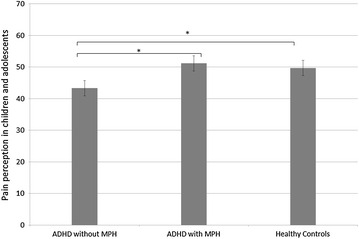
BACKGROUND: The present study examined pain perception in children and adolescents with ADHD and the interaction between pain perception and the administration of methylphenidate (MPH) in order to generate hypotheses for further research that will help to clarify the association between ADHD diagnosis, MPH treatment and pain perception. METHODS: We included 260 children and adolescents of the "German Health Interview and Examination Survey for Children and Adolescents" (KiGGS) and analyzed parent's assessments of children's pain distribution and pain perception, as well as the influence of MPH administration on pain perception in affected children and adolescents. RESULTS: Pain perception was associated with ADHD and MPH administration, indicating that children and adolescents suffering from ADHD without MPH treatment were reported to have lower pain perception compared to both, healthy controls (HC) and ADHD patients medicated with MPH. CONCLUSION: We suggest that reduced pain perception in children and adolescents with ADHD not medicated with MPH may lead to higher risk tolerance by misjudgments of dangerous situations, expanding the importance of MPH administration in affected children and adolescents.
Overview
The claims and statistics of this paper haven’t been checked yet.
Free: it reads the open-access text and checks the first 5 claims that cite a source we can check. Create a free account to check every claim.
Integrity signals
Registry
Cites
Statistics
Figures
Verification
Claims the paper makes
The claims and statistics of this paper haven’t been checked yet.
Free: it reads the open-access text and checks the first 5 claims that cite a source we can check. Create a free account to check every claim.
Claims other papers make about this one
Each is checked against this paper’s own text: does it say what the citing paper says it does?
The cited source says what the claim attributes to it.
In the citing paper
“Since pain perception is associated with ADHD and methylphenidate administration,27”
Self-check
Percentages, sums and reported differences re-computed from the paper’s own numbers.
The self-check needs the paper’s full text.
Citations
Cites
Bundesgesundheitsblatt - Gesundheitsforschung - Gesundheitsschutz
(2013) · Bundesgesundheitsblatt - Gesundheitsforschung - Gesundheitsschutz · doi:10.1007/103.1437-1588 · Cited by 11,796
Calamita, E., Schmid, M., Kunz, M., Ndebele-Murisa, M. R., Magadza, C. H. D., Nyambe, I., & Wehrli, B. (2019) · Figshare · doi:10.26181/6153922fe919c · Cited by 4,222
Sex, gender, and pain: a review of recent clinical and experimental findings
Fillingim, R. B., King, C. D., Ribeiro-Dasilva, M. C., Rahim-Williams, B., & Riley, J. L. (2009) · The Journal of Pain · doi:10.1016/j.jpain.2008.12.001 · Cited by 2,766 · cited 1×
“Furthermore, given evidence that age and gender have an impact on pain perception [31–33], we also tested the effects of these two variables on potential group differences.”
BackgroundSex differences in pain: a brief review of clinical and experimental findings
Bartley, E. J., & Fillingim, R. B. (2013) · British Journal of Anaesthesia · doi:10.1093/bja/aet127 · Cited by 2,168
Berridge, K. C., & Kringelbach, M. L. (2015) · Neuron · doi:10.1016/j.neuron.2015.02.018 · Cited by 1,730 · cited 2×
“perception as well as reward and motivation [17].”
BackgroundValidity of DSM-IV attention deficit/hyperactivity disorder symptom dimensions and subtypes.
Willcutt, E. G., Nigg, J. T., Pennington, B. F., Solanto, M. V., Rohde, L. A., Tannock, R., Loo, S. K., Carlson, C. L., McBurnett, K., & Lahey, B. B. (2012) · Journal of Abnormal Psychology · doi:10.1037/a0027347 · Cited by 887 · cited 1×
“Finally, although a clarified subtype specification, like in DSM IV [36, 37] into a predominantly hyperactiveimpulsive type (ADHD-H), predominantly inattentive type (ADHD-I), and combined type (ADHD-C) took not place, parents of ADHD children were asked to specify whether ADHD or ADD was diagnosed.”
BackgroundAttention deficit hyperactivity disorder adults: Comorbidities and adaptive impairments
Murphy, K., & Barkley, R. A. (1996) · Comprehensive Psychiatry · doi:10.1016/s0010-440x(96)90022-x · Cited by 700 · cited 1×
“In addition, adults with ADHD have shown further characteristics, such as reduced educational performance, reduced attainment in workplace functioning as well as in the occupational attainment, increased risk for substance dependence and abuse, driving risks and irregularities in marital and interpersonal relations [4…”
BackgroundBerridge, C. W., Devilbiss, D. M., Andrzejewski, M. E., Arnsten, A. F. T., Kelley, A. E., Schmeichel, B., Hamilton, C., & Spencer, R. C. (2006) · Biological Psychiatry · doi:10.1016/j.biopsych.2006.04.022 · Cited by 617
Nigg, J. T. (2005) · Biological Psychiatry · doi:10.1016/j.biopsych.2004.11.011 · Cited by 513 · cited 1×
“Neural pathways underlying these deficits point to deficits within frontal-subcortical catecholaminergic networks, involving dopaminergic and noradrenergic innervation [1, 5].”
BackgroundKurth, B.-M., Kamtsiuris, P., Hölling, H., Schlaud, M., Dölle, R., Ellert, U., Kahl, H., Knopf, H., Lange, M., Mensink, G. B., et al. (2008) · BMC Public Health · doi:10.1186/1471-2458-8-196 · Cited by 502
Self-citation
Research works printed but not linked: 1
- Autism Clarke C Disorder Spectrum Pain Amplified Case Rep Psychiatry. 2015 2015 1 4
Cited by
Kindgren, E., Quiñones Perez, A., & Knez, R. (2021) · Neuropsychiatric Disease and Treatment · doi:10.2147/ndt.s290494 · Cited by 59
Kerekes, N., Sánchez‐Pérez, A. M., & Landry, M. (2021) · Medical Hypotheses · doi:10.1016/j.mehy.2021.110717 · Cited by 59
Medical Therapies for Children With Autism Spectrum Disorder—An Update
Edwin Williamson, M. D., Sathe, N. A., & Andrews, J. C. (2017) · doi:10.23970/ahrqepccer189 · Cited by 50
Leisman, G., & Melillo, R. J. (2022) · Frontiers in Neuroanatomy · doi:10.3389/fnana.2022.936025 · Cited by 43
“Additionally, not only is there a reported decrease in pain perception (Wolff et al., 2016) as well as sensory perception to tactile (Puts et al.”
BackgroundInfluence of Cognitive Orientation and Attentional Focus on Pain Perception
Diotaiuti, P., Corrado, S., Mancone, S., Falese, L., Rodio, A., Siqueira, T. C., & Andrade, A. (2021) · International Journal of Environmental Research and Public Health · doi:10.3390/ijerph18137176 · Cited by 40
“A substantial body of research shows that people with low self-efficacy do not tolerate pain well, report greater pain intensity, and experience more interference because of pain [37,38].”
BackgroundPain hypersensitivity in a pharmacological mouse model of attention-deficit/hyperactivity disorder
Bouchatta, O., Aby, F., Sifeddine, W., Bouali‐Benazzouz, R., Brochoire, L., Manouze, H., Fossat, P., Ba-M’hamed, S., Bennis, M., & Landry, M. (2022) · Proceedings of the National Academy of Sciences · doi:10.1073/pnas.2114094119 · Cited by 40
“Clinical studies in children with ADHD have described both hypo- and hyperresponsiveness to sensory stimuli (43, 44) and point to an increased prevalence of generalized pain in adults with ADHD as compared to a control population (15).”
BackgroundBattison, E., Brown, P. C. M., Holley, A. L., & Wilson, A. C. (2023) · Children · doi:10.3390/children10010142 · Cited by 37
“[50] found that youth with ADHD had reduced pain perception.”
BackgroundInfluentialChildhood risk factors for personality disorder symptoms related to violence
Reising, K., Farrington, D. P., Ttofi, M. M., Piquero, A. R., & Coid, J. (2019) · Aggression and Violent Behavior · doi:10.1016/j.avb.2019.07.010 · Cited by 35
Grossman, A., & Avital, A. (2023) · Frontiers in Behavioral Neuroscience · doi:10.3389/fnbeh.2023.1118937 · Cited by 28
“Regarding sensory dysregulation, pain perception in children and adolescents with ADHD is regulated with chronic MPH application (Wolff et al., 2016).”
BackgroundBuchanan, D. M., Amare, S., Gaumond, G., D’Angiulli, A., & Robaey, P. (2023) · Journal of Clinical Medicine · doi:10.3390/jcm12134346 · Cited by 23
“Similarly, clinical subjects such as those with attention deficit hyperactivity disorder (ADHD) have been shown to be at a greater risk for side effects due to aberrant pain perception [34,35].”
BackgroundWiwe Lipsker, C., von Heijne, M., Bölte, S., & Wicksell, R. K. (2018) · Acta Paediatrica · doi:10.1111/apa.14220 · Cited by 22
“Dental and Abbreviations ADHD, Attention deficit hyperactivity disorder; ASD, Autism spectrum Disorder; CBT, Cognitive Behavioural Therapy.”
BackgroundInfluentialMeseguer-Beltrán, M., Sánchez‐Sarasúa, S., Landry, M., Kerekes, N., & Sánchez‐Pérez, A. M. (2023) · Cells · doi:10.3390/cells12030465 · Cited by 21
“There is evidence of an association between higher pain sensitivity and ADHD in boys [77], and adults with ADHD [35,36,78], however, other studies reported the opposite [79].”
ResultJamali, Z., Ghaffari, P., Aminabadi, N. A., Norouzi, S., & Shirazi, S. (2021) · Special Care in Dentistry · doi:10.1111/scd.12563 · Cited by 21
Defining Growing Pains: A Scoping Review
O’Keeffe, M., Kamper, S. J., Montgomery, L. R. C., Williams, A. J., Martiniuk, A. L. C., Lucas, B. R., Dario, A. B., Rathleff, M. S., Hestbæk, L., & Williams, C. M. (2022) · PEDIATRICS · doi:10.1542/peds.2021-052578 · Cited by 20
Zain, E., Sugimoto, A., Egawa, J., & Someya, T. (2023) · Frontiers in Psychiatry · doi:10.3389/fpsyt.2023.1091399 · Cited by 15
“Previous reports have discussed the association between MPH and pain (10, 11, 21, 28).”
BackgroundEffect of atomoxetine on ADHD-pain hypersensitization comorbidity in 6-OHDA lesioned mice
Sifeddine, W., Ba-M’hamed, S., Landry, M., & Bennis, M. (2023) · Pharmacological Reports · doi:10.1007/s43440-023-00459-3 · Cited by 12
“These findings showing that lesioned mice have an increased sensitivity to pain are in line with results from several earlier clinical and preclinical studies [16, 18, 19, 28].”
BackgroundResultBozkurt, A., & Balta, S. (2023) · Child and Adolescent Psychiatry and Mental Health · doi:10.1186/s13034-023-00667-y · Cited by 11
“A different study evaluating the effect of MPH treatment on pain perception found that children and adolescents with ADHD without MPH treatment exhibited lower pain perception compared to both healthy controls and ADHD patients treated with MPH [39].”
ResultShirazi, E., Sayyahfar, S., Motamed, M., & Alaghband‐Rad, J. (2018) · The Journal of Nervous and Mental Disease · doi:10.1097/nmd.0000000000000785 · Cited by 9
Brown, P. C. M., Ewing, S. W. F., & Wilson, A. C. (2024) · Child Care Health and Development · doi:10.1111/cch.70016 · Cited by 8
Pain and development: interacting phenomena
Boerner, K. E., Schechter, N. L., & Oberlander, T. F. (2024) · Pain · doi:10.1097/j.pain.0000000000003304 · Cited by 7
Effects of Gestational Exercise on Nociception, BDNF, and Irisin Levels in an Animal Model of ADHD
Tosta, A., Fonseca, A. S., Jardim-Messeder, D., Ferreira, S. T., Lourenco, M. V., & Pandolfo, P. (2024) · Neuroscience · doi:10.1016/j.neuroscience.2024.02.008 · Cited by 6
Meseguer-Beltrán, M., Sánchez‐Sarasúa, S., Kerekes, N., Landry, M., Real‐López, M., & Sánchez‐Pérez, A. M. (2025) · Journal of Neuroimmune Pharmacology · doi:10.1007/s11481-025-10186-6 · Cited by 6
“Another symptom associated with ADHD is hypersensitivity to various stimuli, which is more common in girls (Wolff et al. 2016) and women (Asztély et al. 2019).”
Lundqvist, S., & Kerekes, N. (2023) · The European Journal of Psychiatry · doi:10.1016/j.ejpsy.2023.100228 · Cited by 6
“18 In the case of children with ADHD who experience sleep problems after receiving methylphenidate treatment, melatonin may offer a potentially effective and safe solution, regardless of factors such as gender, age, and comorbidities.”
BackgroundRecarey-Rama, S., Zubizarreta, S. C.-P., Brenlla, C., Gerpe-Rieiro, E., Gil-Rodríguez, A., Tubío-Fungueiriño, M., Pozo-Rodríguez, M., Carracedo, Á., Maroñas, O., & Fernández‐Prieto, M. (2025) · Journal of Psychiatric Research · doi:10.1016/j.jpsychires.2025.09.002 · Cited by 4
Truncal blocks and teenager postoperative pain perception after laparoscopic surgical procedures
Visoiu, M., Chelly, J. E., & Kenkre, T. S. (2019) · PAIN Reports · doi:10.1097/pr9.0000000000000763 · Cited by 3
“found a reduced pain perception in children and adolescents with ADHD who do not medicate with methylphenidate.(23) We investigated whether a history of ADHD/ADD predicts postoperative pain in teenage patients, and we found weak evidence for a difference (P 5 0.”
BackgroundSifeddine, W., Ba-M’hamed, S., Lefranc, B., Leprince, J., Boukhzar, L., Anouar, Y., & Bennis, M. (2024) · Experimental and Molecular Pathology · doi:10.1016/j.yexmp.2024.104905 · Cited by 2
Adverse childhood experiences, brain efficiency, and the development of pain symptoms in youth
Miller, S. N., Cobos, K. L., Rasic, N. F., Long, X., Lebel, C. A., Bar, N., Noel, M. E., Kopala‐Sibley, D. C., Mychasiuk, R., & Miller, J. V. (2024) · European Journal of Pain · doi:10.1002/ejp.4702 · Cited by 2
Bouchatta, O., Aby, F., Sifeddine, W., Rabia, B.-B., Brochoire, L., Manouze, H., Fossat, P., Ba-M’hamed, S., Bennis, M., & Landry, M. (2021) · Research Square · doi:10.21203/rs.3.rs-403164/v1 · Cited by 2
ADHS macht weniger empfindlich gegen Schmerz
Stollhoff, K. (2016) · Pädiatrie · doi:10.1007/s15014-016-0861-1
Goldsmith, C. (2021) · Archives in Neurology & Neuroscience · doi:10.33552/ann.2021.10.000727
Rodrigues, C. Y. D. S., & de Figueiredo, P. A. C. (2017) · Entretextos (en línea, León, Gto.)/Entretextos · doi:10.59057/iberoleon.20075316.201725325
Animal models of attention-deficit/hyperactivity disorder: Diversity and validity
Nehme, S. B. S., Sánchez‐Sarasúa, S., Medrano, M., Bouchatta, O., Bitar, T., Alameddine, A., Galineau, L., Brunault, P., Kerekes, N., Sánchez‐Pérez, A. M., et al. (2025) · Pharmacological Reviews · doi:10.1016/j.pharmr.2025.100108
Painful perspectives: exploring perception & decision dynamics
Berman, T. (2024) · eScholarship@McGill (McGill) · doi:10.82308/51098
Bouchatta, O. (2018) · theses.fr (ABES) · doi:10.70675/5acdd85dz1833z429eza36az308928086d39
Muzio, M. R., Vittori, A., Capitello, T. G., Esposito, D., Bruno, M. P., Cerrone, V., & Cascella, M. (2026) · In Vivo · doi:10.21873/invivo.14285
Ruptured appendicitis in pediatric patients with autism, ADHD, and depression: Communication is key
Rosenberg, M., Mixer, M., Coulter, A. M. P., Pepper, V. K., Banever, G. T., Tashjian, D. B., Moriarty, K. P., & Tirabassi, M. V. (2026) · Journal of Pediatric Surgery · doi:10.1016/j.jpedsurg.2026.163463
Metadata
- Authors
- Wolff, N., Rubia, K., Knopf, H., Hölling, H., Martini, J., Ehrlich, S., & Roessner, V.
- Affiliations
- Technische Universität Dresden (DE)
- King's College London (GB)
- Robert Koch Institute (DE)
- Corresponding author
- Wolff, Nicole
- Venue
- Child and Adolescent Psychiatry and Mental Health
- Published
- 2016-07-22
- Volume
- 10
- Issue
- 1
- Pages
- 24-24
- ISSN
- 1753-2000 (ISSN-L)
- PMC
- PMC4957360
- OpenAlex
- W2504758733
- Cited by
- 35
- References
- 59
- Citations by year
- 2026: 1 · 2025: 3 · 2024: 6 · 2023: 9 · 2022: 3 · 2021: 6 · 2019: 2 · 2018: 3 · 2017: 1 · 2016: 1
- FWCI
- 2.07
- Type
- journal article
- Language
- en
- Open access
- gold
- doi.org
- Licence
- cc-by
- Locations
- Child and Adolescent Psychiatry and Mental Health (publishedVersion, cc-by)
- PubMed Central (publishedVersion, cc-by)
- PubMed (publishedVersion)
- Research Portal (King's College London) (publishedVersion, cc-by)
- Publication server of the Robert Koch Institute (Robert Kock Institute) (submittedVersion)
- Pure Amsterdam UMC (submittedVersion, other-oa)
- Amsterdam UMC (VU Amsterdam) - Institutional Repository (submittedVersion, other-oa)
- Data Archiving and Networked Services (DANS) (submittedVersion, other-oa)
- Robert-Koch-Institut (RKI)
- Funders
- Deutsche Forschungsgemeinschaft
- Topics
- Health Sciences › Medicine › Psychiatry and Mental health › Attention Deficit Hyperactivity Disorder
- Health Sciences › Medicine › Pediatrics, Perinatology and Child Health › Pediatric Pain Management Techniques
- Social Sciences › Psychology › Neuropsychology and Physiological Psychology › Developmental and Educational Neuropsychology
- Keywords
- attention deficit hyperactivity disorder, pain perception, methylphenidate, children and adolescents, risk tolerance, pain distribution, stimulant medication, KiGGS
About these checks
Registry, retraction, Cites and statistics results are computed, not judged, with one exception: a printed reference that no index lists is read once by a model before it counts as a citation error. Claims are extracted by a model and kept only when their quote appears verbatim in the text; each cited source is then checked, with a model’s help, for whether it says what the claim relies on. Those verdicts can be wrong — read the claim’s quote and the cited source before relying on one.
Statistics and arithmetic are recomputed, not judged.
Confidence bands are shown only for fields calibrated on our annotated test set. None is calibrated yet, so no band is shown.
What counts as a claim ›How we measure confidence ›How we check this ›
Are you an author, or do you see a problem with this page? Request a review
Data sources
Bibliographic data: Semantic Scholar, OpenAlex, Crossref.
Contains information from the Semantic Scholar Academic Graph Datasets, made available under the ODC Attribution License (ODC-BY 1.0).
Semantic Scholar’s data is described in: Kinney, R., et al. (2023). The Semantic Scholar Open Data Platform. arXiv:2301.10140.
