

Reduced pain perception in children and adolescents with ADHD is normalized by methylphenidate
Open accessThe DOI matches its Crossref record; 58 of the 59 references it cites were found in a registry or an index.
Abstract
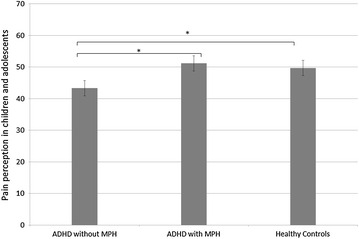
BACKGROUND: The present study examined pain perception in children and adolescents with ADHD and the interaction between pain perception and the administration of methylphenidate (MPH) in order to generate hypotheses for further research that will help to clarify the association between ADHD diagnosis, MPH treatment and pain perception. METHODS: We included 260 children and adolescents of the "German Health Interview and Examination Survey for Children and Adolescents" (KiGGS) and analyzed parent's assessments of children's pain distribution and pain perception, as well as the influence of MPH administration on pain perception in affected children and adolescents. RESULTS: Pain perception was associated with ADHD and MPH administration, indicating that children and adolescents suffering from ADHD without MPH treatment were reported to have lower pain perception compared to both, healthy controls (HC) and ADHD patients medicated with MPH. CONCLUSION: We suggest that reduced pain perception in children and adolescents with ADHD not medicated with MPH may lead to higher risk tolerance by misjudgments of dangerous situations, expanding the importance of MPH administration in affected children and adolescents.
Overview
The claims and statistics of this paper haven’t been checked yet.
Free: it reads the open-access text and checks the first 5 claims that cite a source we can check. Create a free account to check every claim.
Integrity signals
Registry
Cites
Statistics
Figures
Verification
Claims the paper makes
The claims and statistics of this paper haven’t been checked yet.
Free: it reads the open-access text and checks the first 5 claims that cite a source we can check. Create a free account to check every claim.
Claims other papers make about this one
Each is checked against this paper’s own text: does it say what the citing paper says it does?
The cited source says what the claim attributes to it.
In the citing paper
“Since pain perception is associated with ADHD and methylphenidate administration,27”
Self-check
Percentages, sums and reported differences re-computed from the paper’s own numbers.
The self-check needs the paper’s full text.
Citations
Cites
Bundesgesundheitsblatt - Gesundheitsforschung - Gesundheitsschutz
(2013) · Bundesgesundheitsblatt - Gesundheitsforschung - Gesundheitsschutz · doi:10.1007/103.1437-1588 · Cited by 11,796
Calamita, E., Schmid, M., Kunz, M., Ndebele-Murisa, M. R., Magadza, C. H. D., Nyambe, I., & Wehrli, B. (2019) · Figshare · doi:10.26181/6153922fe919c · Cited by 4,222
Sex, gender, and pain: a review of recent clinical and experimental findings
Fillingim, R. B., King, C. D., Ribeiro-Dasilva, M. C., Rahim-Williams, B., & Riley, J. L. (2009) · The Journal of Pain · doi:10.1016/j.jpain.2008.12.001 · Cited by 2,766 · cited 1×
“Furthermore, given evidence that age and gender have an impact on pain perception [31–33], we also tested the effects of these two variables on potential group differences.”
BackgroundSex differences in pain: a brief review of clinical and experimental findings
Bartley, E. J., & Fillingim, R. B. (2013) · British Journal of Anaesthesia · doi:10.1093/bja/aet127 · Cited by 2,168
Berridge, K. C., & Kringelbach, M. L. (2015) · Neuron · doi:10.1016/j.neuron.2015.02.018 · Cited by 1,730 · cited 2×
“perception as well as reward and motivation [17].”
BackgroundValidity of DSM-IV attention deficit/hyperactivity disorder symptom dimensions and subtypes.
Willcutt, E. G., Nigg, J. T., Pennington, B. F., Solanto, M. V., Rohde, L. A., Tannock, R., Loo, S. K., Carlson, C. L., McBurnett, K., & Lahey, B. B. (2012) · Journal of Abnormal Psychology · doi:10.1037/a0027347 · Cited by 887 · cited 1×
“Finally, although a clarified subtype specification, like in DSM IV [36, 37] into a predominantly hyperactiveimpulsive type (ADHD-H), predominantly inattentive type (ADHD-I), and combined type (ADHD-C) took not place, parents of ADHD children were asked to specify whether ADHD or ADD was diagnosed.”
BackgroundAttention deficit hyperactivity disorder adults: Comorbidities and adaptive impairments
Murphy, K., & Barkley, R. A. (1996) · Comprehensive Psychiatry · doi:10.1016/s0010-440x(96)90022-x · Cited by 700 · cited 1×
“In addition, adults with ADHD have shown further characteristics, such as reduced educational performance, reduced attainment in workplace functioning as well as in the occupational attainment, increased risk for substance dependence and abuse, driving risks and irregularities in marital and interpersonal relations [4…”
BackgroundBerridge, C. W., Devilbiss, D. M., Andrzejewski, M. E., Arnsten, A. F. T., Kelley, A. E., Schmeichel, B., Hamilton, C., & Spencer, R. C. (2006) · Biological Psychiatry · doi:10.1016/j.biopsych.2006.04.022 · Cited by 617
Nigg, J. T. (2005) · Biological Psychiatry · doi:10.1016/j.biopsych.2004.11.011 · Cited by 513 · cited 1×
“Neural pathways underlying these deficits point to deficits within frontal-subcortical catecholaminergic networks, involving dopaminergic and noradrenergic innervation [1, 5].”
BackgroundKurth, B.-M., Kamtsiuris, P., Hölling, H., Schlaud, M., Dölle, R., Ellert, U., Kahl, H., Knopf, H., Lange, M., Mensink, G. B., et al. (2008) · BMC Public Health · doi:10.1186/1471-2458-8-196 · Cited by 502
Self-citationMarzbani, H., Marateb, H., & Mansourian, M. (2016) · Basic and Clinical Neuroscience Journal · doi:10.15412/j.bcn.03070208 · Cited by 484
Gibson, S. J., & Farrell, M. (2004) · The Clinical Journal of Pain · doi:10.1097/00002508-200407000-00004 · Cited by 479
Noreika, V., Falter, C. M., & Rubia, K. (2013) · Neuropsychologia · doi:10.1016/j.neuropsychologia.2012.09.036 · Cited by 339
Self-citationRubia, K., Halari, R., Christakou, A., & Taylor, E. (2009) · Philosophical Transactions of the Royal Society B: Biological Sciences · doi:10.1098/rstb.2009.0014 · Cited by 310
Self-citationMcGrath, P. A. (1987) · Pain · doi:10.1016/0304-3959(87)90033-9 · Cited by 258 · cited 1×
“Still, measures of induced pain perception may potentially be more objective and sensitive than external ratings of someone else’s pain [42].”
BackgroundGRAETZ, B. W., SAWYER, M. G., HAZELL, P. L., ARNEY, F., & BAGHURST, P. (2001) · Journal of the American Academy of Child & Adolescent Psychiatry · doi:10.1097/00004583-200112000-00011 · Cited by 239
Manne, S. L., Jacobsen, P. B., & Redd, W. H. (1992) · Pain · doi:10.1016/0304-3959(92)90130-4 · Cited by 227 · cited 1×
“In addition, external ratings (parent ratings) of the child’s pain may not be accurate given that pain is a subjectively felt perception and difficult to rate externally [40, 41].”
BackgroundSchlack, R., Hölling, H., Kurth, B.-M., & Huss, M. (2007) · Bundesgesundheitsblatt - Gesundheitsforschung - Gesundheitsschutz · doi:10.1007/s00103-007-0246-2 · Cited by 188
Self-citationRubia, K., Noorloos, J., Smith, A., Gunning, B., & Sergeant, J. (2003) · Journal of Abnormal Child Psychology · doi:10.1023/a:1023233630774 · Cited by 170 · cited 1×
“Growing evidence suggests that dopamine is involved not only in ADHD core symptoms but also in other perceptive deficits, such as color perception [13], time perception [6, 14, 15] and pain perception [16].”
BackgroundSelf-citationColasanti, A., Searle, G. E., Long, C. J., Hill, S. P., Reiley, R. R., Quelch, D. R., Erritzøe, D., Tziortzi, A. C., Reed, L. J., Lingford-Hughes, A. R., et al. (2012) · Biological Psychiatry · doi:10.1016/j.biopsych.2012.01.027 · Cited by 152
Dopaminergic and Noradrenergic Contributions to Functionality in ADHD: The Role of Methylphenidate
Engert, V., & Pruessner, J. (2008) · Current Neuropharmacology · doi:10.2174/157015908787386069 · Cited by 146 · cited 3×
“Background Attention deficit hyperactivity disorder (ADHD) is characterized by the core symptoms of inattention, hyperactivity and impulsivity [1] and has a higher prevalence (OR = 4.”
BackgroundImaging the ADHD brain: disorder-specificity, medication effects and clinical translation
Rubia, K., Alegria, A., & Brinson, H. (2014) · Expert Review of Neurotherapeutics · doi:10.1586/14737175.2014.907526 · Cited by 146
Self-citationEffects of Stimulant Medication on Learning in Children with ADHD
Swanson, J. M., Cantwell, D., Lerner, M., McBurnett, K., & Hanna, G. (1991) · Journal of Learning Disabilities · doi:10.1177/002221949102400406 · Cited by 129 · cited 1×
“MPH has been shown to substantially reduce core symptoms of inattention, hyperactivity and impulsivity in up to 70 % of affected children [8, 9].”
BackgroundKhin Hla, T., Hegarty, M., Russell, P., Drake‐Brockman, T. F., Ramgolam, A., & von Ungern‐Sternberg, B. S. (2014) · Pediatric Anesthesia · doi:10.1111/pan.12484 · Cited by 121
Sundblad, G. M. B., Saartok, T., Engström, L. T., & In collaboration with University College of Physical Education and Sports, S. (2007) · European Journal of Pain · doi:10.1016/j.ejpain.2006.02.006 · Cited by 119
Injury risk factors in children with attention deficit hyperactivity disorder.
Farmer, J. E., & Peterson, L. (1995) · Health Psychology · doi:10.1037//0278-6133.14.4.325 · Cited by 117 · cited 1×
“We suggest that in addition to cognitive factors, including lower expectations of personal risk in hazardous situations and less ability to generate prevention strategies and safety rules [53], reduced pain perception in children and adolescents with ADHD may also lead to higher risk tolerance by unfavorable effects o…”
BackgroundÖhlund, C., Eek, C., Palmblad, S., Areskoug, B., & Nachemson, A. (1996) · Spine · doi:10.1097/00007632-199605010-00005 · Cited by 115
Methylphenidate and the risk of trauma
Man, K. K. C., Chan, E. W., Coghill, D., Douglas, I., Ip, P., Leung, L.-P., Tsui, M. S. H., Wong, W. H. S., & Wong, I. C. K. (2015) · Pediatrics · doi:10.1542/peds.2014-1738 · Cited by 108
Some Children with Growing Pains May Actually Have Restless Legs Syndrome
(2004) · Sleep · doi:10.1093/sleep/27.4.767 · Cited by 103 · cited 1×
“For example, an association between growing pain and childhood restless leg syndrome was observed, and it was shown that this effect was more often observed in children with ADHD as compared to controls [22].”
BackgroundMick, I., Myers, J., Stokes, P. R. A., Erritzoe, D., Colasanti, A., Bowden-Jones, H., Clark, L., Gunn, R. N., Rabiner, E. A., Searle, G. E., et al. (2014) · The International Journal of Neuropsychopharmacology · doi:10.1017/s1461145714000704 · Cited by 100
Love, T. M., Stohler, C. S., & Zubieta, J.-K. (2009) · Archives of General Psychiatry · doi:10.1001/archgenpsychiatry.2009.134 · Cited by 99
Endogenous Opioid Blockade and Impulsive Responding in Alcoholics and Healthy Controls
Mitchell, J., Tavares, V. C., Fields, H. L., D’Esposito, M., & Boettiger, C. A. (2006) · Neuropsychopharmacology · doi:10.1038/sj.npp.1301226 · Cited by 96
Treister, R., Eisenberg, E., Demeter, N., & Pud, D. (2015) · Pain Practice · doi:10.1111/papr.12129 · Cited by 92
IRONSIDE, S., DAVIDSON, F., & CORKUM, P. (2010) · Journal of Sleep Research · doi:10.1111/j.1365-2869.2010.00845.x · Cited by 84 · cited 1×
“some authors found MPH treatment associated sleep-onset difficulties in patients with ADHD of all ages [10, 11].”
BackgroundGreenhill, L., Beyer, D. H., Finkleson, J., Shaffer, D., Biederman, J., Conners, C. K., Gillberg, C., Huss, M., Jensen, P., Kennedy, J. L., et al. (2002) · Journal of Attention Disorders · doi:10.1177/070674370200601s11 · Cited by 80 · cited 1×
“MPH has been shown to substantially reduce core symptoms of inattention, hyperactivity and impulsivity in up to 70 % of affected children [8, 9].”
BackgroundBoettiger, C. A., Kelley, E. A., Mitchell, J. M., D'Esposito, M., & Fields, H. L. (2009) · Pharmacology Biochemistry and Behavior · doi:10.1016/j.pbb.2009.02.008 · Cited by 77
Schlack, R., Hölling, H., Kurth, B., & Huss, M. (2007) · Publication server of the Robert Koch Institute (Robert Kock Institute) · doi:10.25646/356 · Cited by 75
Self-citationPain perceived in a national community sample of German children and adolescents
Dul, Y., Knopf, H. C., Zhuang, W., & Ellert, U. (2011) · European Journal of Pain · doi:10.1016/j.ejpain.2010.11.009 · Cited by 75 · cited 1×
“For more information on the measurement of pain via the KiGGS Data please refer to [39].”
MethodSelf-citationIannaccone, R., Hauser, T. U., Ball, J., Brandeis, D., Walitza, S., & Brem, S. (2015) · European Child & Adolescent Psychiatry · doi:10.1007/s00787-015-0678-4 · Cited by 74
Knopf, H., Hölling, H., Huss, M., & Schlack, R. (2012) · BMJ Open · doi:10.1136/bmjopen-2011-000477 · Cited by 67
Self-citationKnopf, H. C. (2007) · Bundesgesundheitsblatt - Gesundheitsforschung - Gesundheitsschutz · doi:10.1007/s00103-007-0249-z · Cited by 62
Self-citationStray, L., Stray, T., Iversen, S., Ruud, A., Ellertsen, B., & Tønnessen, F. (2009) · Behavioral and Brain Functions · doi:10.1186/1744-9081-5-22 · Cited by 55
(2013) · PubMed · Cited by 50
Somatosensory functioning and experienced pain in ADHD-families: A pilot study
Scherder, E., Rommelse, N. N. J., Bröring, T., Faraone, S. V., & Sergeant, J. A. (2008) · European Journal of Paediatric Neurology · doi:10.1016/j.ejpn.2007.11.004 · Cited by 50
Accident Proneness in Children and Adolescents Affected by ADHD and the Impact of Medication
Lange, H., Buse, J., Bender, S., Siegert, J., Knopf, H., & Roessner, V. (2016) · Journal of Attention Disorders · doi:10.1177/1087054713518237 · Cited by 49
Self-citationAmphetamine-induced dopamine release and neurocognitive function in treatment-naive adults with ADHD
Cherkasova, M. V., Faridi, N., Casey, K. F., O'Driscoll, G. A., Hechtman, L., Joober, R., Baker, G. B., Palmer, J., Dagher, A., Leyton, M., et al. (2014) · Neuropsychopharmacology · doi:10.1038/npp.2013.349 · Cited by 49
Roessner, V., Banaschewski, T., Fillmer-Otte, A., Becker, A., Albrecht, B., Uebel, H., Sergeant, J. A., Tannock, R., & Rothenberger, A. (2007) · Journal of Neural Transmission · doi:10.1007/s00702-007-0817-2 · Cited by 47
Self-citationChronic pain in individuals with previously undiagnosed Autistic Spectrum Disorders
Bursch, B., Ingman, K., Vitti, L., Hyman, P., & Zeltzer, L. K. (2004) · The Journal of Pain · doi:10.1016/j.jpain.2004.04.004 · Cited by 45
Are Motivation Deficits Underestimated in Patients With ADHD? A Review of the Literature
Modesto-Lowe, V., Chaplin, M., Soovajian, V., & Meyer, A. (2013) · Postgraduate Medicine · doi:10.3810/pgm.2013.07.2677 · Cited by 41 · cited 2×
“The opioid and dopamine systems interact closely in their mediation of reward and motivation, which have been shown to be abnormal in ADHD [18].”
BackgroundKnopf, H. C. (2007) · Publication server of the Robert Koch Institute (Robert Kock Institute) · doi:10.25646/360 · Cited by 41
Self-citationDoes mindfulness meditation improve attention in attention deficit hyperactivity disorder?
Modesto‐Lowe, V., Farahmand, P., Chaplin, M., & Sarro, L. (2015) · World Journal of Psychiatry · doi:10.5498/wjp.v5.i4.397 · Cited by 41
Sex Differences in Pain: A Brief Review of Clinical and Experimental Findings
Bartley, E. J., & Fillingim, R. B. (2016) · Survey of Anesthesiology · doi:10.1097/01.sa.0000484819.20819.8b · Cited by 41
May, B., & Bos, J. (2000) · Journal of Personality Assessment · doi:10.1207/s15327752jpa7502_5 · Cited by 40 · cited 1×
“These specifics in combination with increased scores on avoidant, histrionic, narcissistic, negativistic, and self-defeating personality scales [44] may also explain the increased pain perception found in adults with ADHD.”
BackgroundNorthover, C., Thapar, A., Langley, K., & van Goozen, S. H. M. (2015) · PLoS ONE · doi:10.1371/journal.pone.0134417 · Cited by 29
Editorial Perspective: How to optimise frequency band neurofeedback for ADHD
Bluschke, A., Roessner, V., & Beste, C. (2016) · Journal of Child Psychology and Psychiatry · doi:10.1111/jcpp.12521 · Cited by 29 · cited 2×
“In summary, pain perception seems to be altered in ADHD and to be influenced by the administration of MPH. Interestingly, although direct associations have not been investigated at this point, it can also be assumed that alterations in pain perception in ADHD may also be treated by the help of Neurofeedback [27, 28].”
BackgroundSelf-citationADHS bei Kindern: Risikofaktoren, Schutzfaktoren, Versorgung, Lebensqualität
Huß, M. (2008) · Bundesgesundheitsblatt - Gesundheitsforschung - Gesundheitsschutz · doi:10.1007/s00103-008-0538-1 · Cited by 20
Frölich, J., Banaschewski, T., Spanagel, R., Döpfner, M., & Lehmkuhl, G. (2012) · Zeitschrift für Kinder- und Jugendpsychiatrie und Psychotherapie · doi:10.1024/1422-4917/a000185 · Cited by 10
Snitselaar, M. A., Smits, M. G., van der Heijden, K. B., Smit, A., & Spijker, J. (2013) · Sleep and Biological Rhythms · doi:10.1111/sbr.12033 · Cited by 7
Research works printed but not linked: 1
- Autism Clarke C Disorder Spectrum Pain Amplified Case Rep Psychiatry. 2015 2015 1 4
Cited by
Kindgren, E., Quiñones Perez, A., & Knez, R. (2021) · Neuropsychiatric Disease and Treatment · doi:10.2147/ndt.s290494 · Cited by 59
Kerekes, N., Sánchez‐Pérez, A. M., & Landry, M. (2021) · Medical Hypotheses · doi:10.1016/j.mehy.2021.110717 · Cited by 59
Medical Therapies for Children With Autism Spectrum Disorder—An Update
Edwin Williamson, M. D., Sathe, N. A., & Andrews, J. C. (2017) · doi:10.23970/ahrqepccer189 · Cited by 50
Leisman, G., & Melillo, R. J. (2022) · Frontiers in Neuroanatomy · doi:10.3389/fnana.2022.936025 · Cited by 43
“Additionally, not only is there a reported decrease in pain perception (Wolff et al., 2016) as well as sensory perception to tactile (Puts et al.”
BackgroundInfluence of Cognitive Orientation and Attentional Focus on Pain Perception
Diotaiuti, P., Corrado, S., Mancone, S., Falese, L., Rodio, A., Siqueira, T. C., & Andrade, A. (2021) · International Journal of Environmental Research and Public Health · doi:10.3390/ijerph18137176 · Cited by 40
“A substantial body of research shows that people with low self-efficacy do not tolerate pain well, report greater pain intensity, and experience more interference because of pain [37,38].”
Background
Metadata
- Authors
- Wolff, N., Rubia, K., Knopf, H., Hölling, H., Martini, J., Ehrlich, S., & Roessner, V.
- Affiliations
- Technische Universität Dresden (DE)
- King's College London (GB)
- Robert Koch Institute (DE)
- Corresponding author
- Wolff, Nicole
- Venue
- Child and Adolescent Psychiatry and Mental Health
- Published
- 2016-07-22
- Volume
- 10
- Issue
- 1
- Pages
- 24-24
- ISSN
- 1753-2000 (ISSN-L)
- PMC
- PMC4957360
- OpenAlex
- W2504758733
- Cited by
- 35
- References
- 59
- Citations by year
- 2026: 1 · 2025: 3 · 2024: 6 · 2023: 9 · 2022: 3 · 2021: 6 · 2019: 2 · 2018: 3 · 2017: 1 · 2016: 1
- FWCI
- 2.07
- Type
- journal article
- Language
- en
- Open access
- gold
- doi.org
- Licence
- cc-by
- Locations
- Child and Adolescent Psychiatry and Mental Health (publishedVersion, cc-by)
- PubMed Central (publishedVersion, cc-by)
- PubMed (publishedVersion)
- Research Portal (King's College London) (publishedVersion, cc-by)
- Publication server of the Robert Koch Institute (Robert Kock Institute) (submittedVersion)
- Pure Amsterdam UMC (submittedVersion, other-oa)
- Amsterdam UMC (VU Amsterdam) - Institutional Repository (submittedVersion, other-oa)
- Data Archiving and Networked Services (DANS) (submittedVersion, other-oa)
- Robert-Koch-Institut (RKI)
- Funders
- Deutsche Forschungsgemeinschaft
- Topics
- Health Sciences › Medicine › Psychiatry and Mental health › Attention Deficit Hyperactivity Disorder
- Health Sciences › Medicine › Pediatrics, Perinatology and Child Health › Pediatric Pain Management Techniques
- Social Sciences › Psychology › Neuropsychology and Physiological Psychology › Developmental and Educational Neuropsychology
- Keywords
- attention deficit hyperactivity disorder, pain perception, methylphenidate, children and adolescents, risk tolerance, pain distribution, stimulant medication, KiGGS
About these checks
Registry, retraction, Cites and statistics results are computed, not judged, with one exception: a printed reference that no index lists is read once by a model before it counts as a citation error. Claims are extracted by a model and kept only when their quote appears verbatim in the text; each cited source is then checked, with a model’s help, for whether it says what the claim relies on. Those verdicts can be wrong — read the claim’s quote and the cited source before relying on one.
Statistics and arithmetic are recomputed, not judged.
Confidence bands are shown only for fields calibrated on our annotated test set. None is calibrated yet, so no band is shown.
What counts as a claim ›How we measure confidence ›How we check this ›
Are you an author, or do you see a problem with this page? Request a review
Data sources
Bibliographic data: Semantic Scholar, OpenAlex, Crossref.
Contains information from the Semantic Scholar Academic Graph Datasets, made available under the ODC Attribution License (ODC-BY 1.0).
Semantic Scholar’s data is described in: Kinney, R., et al. (2023). The Semantic Scholar Open Data Platform. arXiv:2301.10140.
