

The DOI matches its Crossref record; 190 of the 190 references it cites were found in a registry or an index.
The role of 5-HT receptors in depression
Open accessAbstract
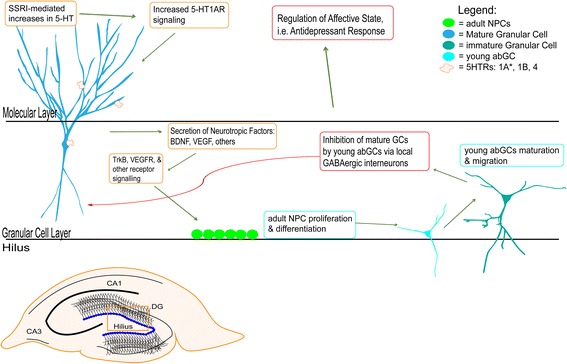
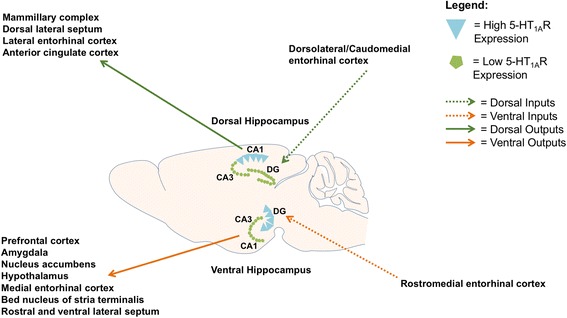
Depression is a polygenic and highly complex psychiatric disorder that remains a major burden on society. Antidepressants, such as selective serotonin reuptake inhibitors (SSRIs), are some of the most commonly prescribed drugs worldwide. In this review, we will discuss the evidence that links serotonin and serotonin receptors to the etiology of depression and the mechanisms underlying response to antidepressant treatment. We will then revisit the role of serotonin in three distinct hypotheses that have been proposed over the last several decades to explain the pathophysiology of depression: the monoamine, neurotrophic, and neurogenic hypotheses. Finally, we will discuss how recent studies into serotonin receptors have implicated specific neural circuitry in mediating the antidepressant response, with a focus being placed on the hippocampus.
Overview
The claims and statistics of this paper haven’t been checked yet.
Run the check — free, no account needed. It reads the open-access text and checks the sources it cites.
Integrity signals
Registry
Cites
Statistics
Figures
Verification
Claims the paper makes
The claims and statistics of this paper haven’t been checked yet.
Run the check — free, no account needed. It reads the open-access text and checks the sources it cites.
Claims other papers make about this one
Each is checked against this paper’s own text: does it say what the citing paper says it does?
The cited source says what the claim attributes to it.
In the citing paper
“the effects of serotonin receptors have been linked to antidepressant effects(Yohn et al., 2017)”
From Efficacy, acceptability and side-effects of oral versus long-acting- injectables antipsychotics: Systematic review and network meta-analysis (2024) · cites this paper as Yohn et al., 2017
Self-check
Percentages, sums and reported differences re-computed from the paper’s own numbers.
The self-check needs the paper’s full text.
Citations
Cites
Molecular Mechanisms of Depression: Perspectives on New Treatment Strategies
Lang, U. E., & Borgwardt, S. (2013) · Cellular Physiology and Biochemistry · doi:10.1159/000350094 · Cited by 8,526
Influence of life stress on depression: moderation by a polymorphism in the 5-HTT gene
Caspi, A., Sugden, K., Moffitt, T. E., Taylor, A., Craig, I. W., Harrington, H., McClay, J., Mill, J., Martin, J., Braithwaite, A., et al. (2003) · Science · doi:10.1126/science.1083968 · Cited by 8,120
Rush, A. J., Trivedi, M. H., Wisniewski, S. R., Nierenberg, A. A., Stewart, J. W., Warden, D., Niederehe, G., Thase, M. E., Lavori, P. W., Lebowitz, B. D., et al. (2006) · American Journal of Psychiatry · doi:10.1176/ajp.2006.163.11.1905 · Cited by 5,643
Lesch, K.-P., Bengel, D., Heils, A., Sabol, S. Z., Greenberg, B. D., Petri, S., Benjamin, J., Müller, C. R., Hamer, D. H., & Murphy, D. L. (1996) · Science · doi:10.1126/science.274.5292.1527 · Cited by 5,162
Requirement of hippocampal neurogenesis for the behavioral effects of antidepressants
Santarelli, L., Saxe, M., Gross, C., Surget, A., Battaglia, F., Dulawa, S., Weisstaub, N., Lee, J., Duman, R., Arancio, O., et al. (2003) · Science · doi:10.1126/science.1083328 · Cited by 4,321
da Luz, A. C. D. D. S., Dias, G. P., Bevilaqua, M. C. D. N., Cocks, G. D., Gardino, P. F., Thuret, S., & Nardi, A. E. (2013) · Neuropsychobiology · doi:10.1159/000353269 · Cited by 4,015
Antidepressant effects of ketamine in depressed patients
Berman, R. M., Cappiello, A., Anand, A., Oren, D. A., Heninger, G. R., Charney, D. S., & Krystal, J. H. (2000) · Biological Psychiatry · doi:10.1016/s0006-3223(99)00230-9 · Cited by 3,856
A randomized trial of an N-methyl-D-aspartate antagonist in treatment-resistant major depression.
Zarate, C. A., Singh, J. B., Carlson, P. J., Brutsche, N. E., Ameli, R., Luckenbaugh, D. A., Charney, D. S., & Manji, H. K. (2006) · Archives of General Psychiatry · doi:10.1001/archpsyc.63.8.856 · Cited by 3,766
The Neuroendocrinology of Stress: A Never Ending Story
Lightman, S. L. (2008) · Journal of Neuroendocrinology · doi:10.1111/j.1365-2826.2008.01711.x · Cited by 3,588
A Neurotrophic Model for Stress-Related Mood Disorders
Duman, R. S., & Monteggia, L. M. (2006) · Biological Psychiatry · doi:10.1016/j.biopsych.2006.02.013 · Cited by 3,375
Research works printed but not linked: 1
- Feighner JP, Boyer WF. Selective serotonin reuptake inhibitors, 2nd edition: advances in basic research and clinical practice. Chichester: Wiley; 1996.
Cited by
Sorted by citations
The serotonin theory of depression: a systematic umbrella review of the evidence
Moncrieff, J., Cooper, R. E., Stockmann, T., Amendola, S., Hengartner, M. P., & Horowitz, M. A. (2023) · Molecular Psychiatry · doi:10.1038/s41380-022-01661-0 · Cited by 960
Biological, Psychological, and Social Determinants of Depression: A Review of Recent Literature
Remes, O., Mendes, J. F., & Templeton, P. (2021) · Brain Sciences · doi:10.3390/brainsci11121633 · Cited by 482
The emerging role of exosomes in mental disorders
Saeedi, S., Israel, S. A., Nagy, C., & Turecki, G. (2019) · Translational Psychiatry · doi:10.1038/s41398-019-0459-9 · Cited by 373
Zheng, Z.-H., Tu, J., Li, X., Hua, Q., Liu, W.-Z., Liu, Y., Pan, B., Hu, P., & Zhang, W. (2020) · Brain Behavior and Immunity · doi:10.1016/j.bbi.2020.11.007 · Cited by 319
Psychedelics in Psychiatry: Neuroplastic, Immunomodulatory, and Neurotransmitter Mechanisms
Inserra, A., De Gregorio, D., & Gobbi, G. (2021) · Pharmacological Reviews · doi:10.1124/pharmrev.120.000056 · Cited by 232
Metadata
- Authors
- Yohn, C. N., Gergues, M. M., & Samuels, B. A.
- Affiliations
- Rutgers, The State University of New Jersey (US)
- Corresponding author
- Samuels, Benjamin Adam
- Venue
- Molecular Brain
- Published
- 2017-06-24
- Volume
- 10
- Issue
- 1
- Pages
- 28-28
- ISSN
- 1756-6606 (ISSN-L)
- PMC
- PMC5483313
- OpenAlex
- W2695471189
- Cited by
- 485
- References
- 190
- Citations by year
- 2026: 28 · 2025: 53 · 2024: 69 · 2023: 72 · 2022: 60 · 2021: 75 · 2020: 59 · 2019: 38 · 2018: 26 · 2017: 5
- FWCI
- 4.44
- Type
- journal article
- Language
- en
- Open access
- gold
- doi.org
- Locations
- Molecular Brain (publishedVersion, cc-by)
- Europe PMC (PubMed Central) (publishedVersion, cc-by)
- PubMed Central (publishedVersion, cc-by)
- PubMed (publishedVersion)
- Rutgers University Community Repository (Rutgers University) (submittedVersion, cc-by)
- DOAJ (DOAJ: Directory of Open Access Journals) (submittedVersion)
- Funders
- Brain and Behavior Research Foundation (NARSAD Young Investigator)
- National Institute of Mental Health (R01 MH112861)
- Topics
- Health Sciences › Medicine › Pharmacology (medical) › Treatment of Major Depression
- Life Sciences › Neuroscience › Cellular and Molecular Neuroscience › Neurotransmitter Receptor Influence on Behavior
- Life Sciences › Neuroscience › Biological Psychiatry › Tryptophan and brain disorders
- Keywords
- depression, serotonin receptors, serotonin, selective serotonin reuptake inhibitors, antidepressant response, monoamine hypothesis, neurotrophic hypothesis, hippocampus, neural circuits, depression pathophysiology
- MeSH terms
- Animals, Depression, Hippocampus, Humans, Models, Biological, Receptors, Serotonin, Serotonin, Neurogenesis
About these checks
Registry, retraction, Cites and statistics results are computed, not judged, with one exception: a printed reference that no index lists is read once by a model before it counts as a citation error. Claims are extracted by a model and kept only when their quote appears verbatim in the text; each cited source is then checked, with a model’s help, for whether it says what the claim relies on. Those verdicts can be wrong — read the claim’s quote and the cited source before relying on one.
Statistics and arithmetic are recomputed, not judged.
Confidence bands are shown only for fields calibrated on our annotated test set. None is calibrated yet, so no band is shown.
What counts as a claim ›How we measure confidence ›How we check this ›
Are you an author, or do you see a problem with this page? Request a review
