

The DOI matches its Crossref record; 95 of the 96 references it cites were found in a registry or an index.
Hypothyroidism in the older population
Open accessAbstract
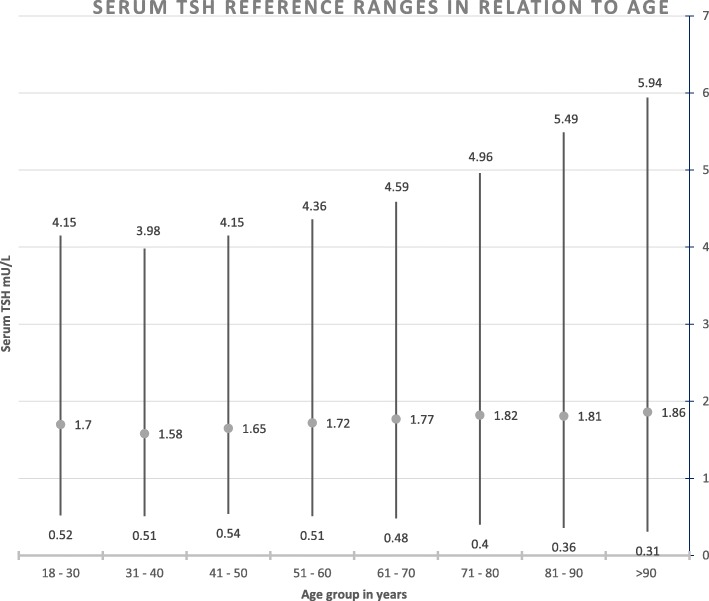
BACKGROUND: Both overt hypothyroidism as well as minor elevations of serum thyrotropin (TSH) levels associated with thyroid hormones within their respective reference ranges (termed subclinical hypothyroidism) are relatively common in older individuals. There is growing evidence that treatment of subclinical hypothyroidism may not be beneficial, particularly in an older person. These findings are relevant at a time when treatment with thyroid hormones is increasing and more than 10-15% of people aged over 80 years are prescribed levothyroxine replacement therapy. MAIN BODY: The prevalence of hypothyroidism increases with age. However, the reference range for TSH also rises with age, as the population distribution of TSH concentration progressively rises with age. Furthermore, there is evidence to suggest that minor TSH elevations are not associated with important outcomes such as impaired quality of life, symptoms, cognition, cardiovascular events and mortality in older individuals. There is also evidence that treatment of mild subclinical hypothyroidism may not benefit quality of life and/or symptoms in older people. It is unknown whether treatment targets should be reset depending on the age of the patient. It is likely that some older patients with non-specific symptoms and incidental mild subclinical hypothyroidism may be treated with thyroid hormones and could potentially be harmed as a result. This article reviews the current literature pertaining to hypothyroidism with a special emphasis on the older individual and assesses the risk/benefit impact of contemporary management on outcomes in this age group. CONCLUSIONS: Current evidence suggests that threshold for treating mild subclinical hypothyroidism in older people should be high. It is reasonable to aim for a higher TSH target in treated older hypothyroid patients as their thyroid hormone requirements may be lower. In addition, age-appropriate TSH reference ranges should be considered in the diagnostic pathway of identifying individuals at risk of developing hypothyroidism. Appropriately designed and powered randomised controlled trials are required to confirm risk/benefit of treatment of subclinical hypothyroidism in older people. Until the results of such RCTs are available to guide clinical management international guidelines should be followed that advocate a conservative policy in the management of mild subclinical hypothyroidism in older individuals.
Overview
The claims and statistics of this paper haven’t been checked yet.
Run the check — free, no account needed. It reads the open-access text and checks the sources it cites.
Integrity signals
Registry
Cites
Statistics
Figures
Verification
Claims the paper makes
The claims and statistics of this paper haven’t been checked yet.
Run the check — free, no account needed. It reads the open-access text and checks the sources it cites.
Claims other papers make about this one
Each is checked against this paper’s own text: does it say what the citing paper says it does?
In the citing paper
“The prevalence of hypothyroidism increases with age and subclinical hypothyroidism affects up to 15% of adults 65 years of age or older, when non-age-specific TSH reference ranges are used (9, 12–14).”
From Levothyroxine therapy in elderly patients with hypothyroidism (2021) · cites this paper as [14]
Self-check
Percentages, sums and reported differences re-computed from the paper’s own numbers.
The self-check needs the paper’s full text.
Citations
Cites
Hollowell, J. G., Staehling, N. W., Flanders, W. D., Hannon, W. H., Gunter, E. W., Spencer, C. A., & Braverman, L. E. (2002) · The Journal of Clinical Endocrinology & Metabolism · doi:10.1210/jc.87.2.489 · Cited by 4,279 · cited 1×
“[36] This large study (n = 16,088), designed to be representative of the US general population, analysed the median and lower and upper reference limits of serum TSH in carefully selected euthyroid individuals using current immunoassays.”
The Colorado Thyroid Disease Prevalence Study
Canaris, G. J., Manowitz, N. R., Mayor, G., & Ridgway, E. C. (2000) · Archives of Internal Medicine · doi:10.1001/archinte.160.4.526 · Cited by 2,824
THE SPECTRUM OF THYROID DISEASE IN A COMMUNITY: THE WHICKHAM SURVEY
Tunbridge, W. M. G., Evered, D. C., Hall, R., Appleton, D. R., BREWIS, M., CLARK, F., Evans, J. G., Young, E. T., Bird, T., & Smith, P. (1977) · Clinical Endocrinology · doi:10.1111/j.1365-2265.1977.tb01340.x · Cited by 2,665
The incidence of thyroid disorders in the community: a twenty-year follow-up of the Whickham Survey
Vanderpump, M. P. J., Tunbrldge, W. M. G., French, J. M., Appleton, D., Bates, D., Clark, F., Evans, J. G., Hasan, D. M., Rodgers, H., Tunbridge, F., et al. (1995) · Clinical Endocrinology · doi:10.1111/j.1365-2265.1995.tb01894.x · Cited by 2,432
Garber, J. R., Cobin, R. H., Gharib, H., Hennessey, J. V., Klein, I., Mechanick, J. I., Pessah-Pollack, R., Singer, P. A., & Woeber, K. A. (2012) · Endocrine Practice · doi:10.4158/ep12280.gl · Cited by 1,567
The Clinical Significance of Subclinical Thyroid Dysfunction
Biondi, B., & Cooper, D. S. (2008) · Endocrine Reviews · doi:10.1210/er.2006-0043 · Cited by 1,418
Low Serum Thyrotropin Concentrations as a Risk Factor for Atrial Fibrillation in Older Persons
Sawin, C. T., Geller, A., Wolf, P. A., Belanger, A. J., Baker, E., Bacharach, P., Wilson, P., Benjamin, E. J., & D'Agostino, R. B. (1994) · New England Journal of Medicine · doi:10.1056/nejm199411103311901 · Cited by 1,259
Laboratory Support for the Diagnosis and Monitoring of Thyroid Disease
(2003) · Thyroid · doi:10.1089/105072503321086962 · Cited by 1,212 · cited 1×
“[28] In addition, TSH secretion has a diurnal variation with a peak late at night/early hours of morning, and, therefore, sample timing and shift work should also be considered when defining the TSH reference range.”
BackgroundGarber, J. R., Cobin, R. H., Gharib, H., Hennessey, J. V., Klein, I., Mechanick, J. I., Pessah-Pollack, R., Singer, P. A., & Woeber for the American Association, K. A. (2012) · Thyroid · doi:10.1089/thy.2012.0205 · Cited by 1,053
Thyroid Status, Disability and Cognitive Function, and Survival in Old Age
Gussekloo, J. (2004) · JAMA · doi:10.1001/jama.292.21.2591 · Cited by 899
Cited by
Sorted by citations
Hashimotos' thyroiditis: epidemiology, pathogenesis, clinic and therapy
Ragusa, F., Fallahi, P., Elia, G., Gonnella, D., Paparo, S. R., Giusti, C., Churilov, L. P., Ferrari, S. M., & Antonelli, A. (2019) · Best Practice & Research Clinical Endocrinology & Metabolism · doi:10.1016/j.beem.2019.101367 · Cited by 655
“Therefore for older people it would be necessary to carry out randomized studies to understand the relationship between risk and benefit in the treatment of subclinical hypothyroidism in these patients (58,59).”
Diagnosis and treatment of hypothyroidism in the elderly
Duntas, L. H., & Yen, P. M. (2019) · Endocrine · doi:10.1007/s12020-019-02067-9 · Cited by 65
Levothyroxine therapy in elderly patients with hypothyroidism
Effraimidis, G., Watt, T., & Feldt-Rasmussen, U. (2021) · Frontiers in Endocrinology · doi:10.3389/fendo.2021.641560 · Cited by 60
“, has been conducted in patients with overt disease; even well-designed descriptive longitudinal studies exploring the effect of L-T4 treatment on quality of life among elderly are lacking (14).”
BackgroundMahdavi, M., Amouzegar, A., Mehran, L., Madreseh, E., Tohidi, M., & Azizi, F. (2021) · BMC Endocrine Disorders · doi:10.1186/s12902-021-00743-4 · Cited by 65
Low awareness and under-diagnosis of hypothyroidism
Gottwald‐Hostalek, U., & Schulte, B. (2021) · Current Medical Research and Opinion · doi:10.1080/03007995.2021.1997258 · Cited by 43
Metadata
- Authors
- Leng, O., & Razvi, S.
- Affiliations
- Newcastle upon Tyne Hospitals NHS Foundation Trust (GB)
- Gateshead Health NHS Foundation Trust (GB)
- Corresponding author
- Razvi, Salman
- ORCID
- Razvi, Salman
- Venue
- Thyroid Research
- Published
- 2019-02-08
- Volume
- 12
- Issue
- 1
- Pages
- 2-2
- ISSN
- 1756-6614 (ISSN-L)
- PMC
- PMC6367787
- OpenAlex
- W2921761178
- Cited by
- 112
- References
- 96
- Citations by year
- 2026: 6 · 2025: 14 · 2024: 21 · 2023: 16 · 2022: 12 · 2021: 22 · 2020: 15 · 2019: 6
- FWCI
- 2.12
- Type
- journal article
- Language
- en
- Open access
- gold
- doi.org
- Licence
- Locations
- Thyroid Research (publishedVersion, cc-by)
- Europe PMC (PubMed Central) (publishedVersion, cc-by)
- PubMed Central (publishedVersion, cc-by)
- PubMed (publishedVersion)
- DOAJ (DOAJ: Directory of Open Access Journals) (submittedVersion, cc-by-sa)
- Newcastle University ePrints (Newcastle Univesity) (cc-by)
- Topics
- Health Sciences › Medicine › Endocrinology, Diabetes and Metabolism › Thyroid Disorders and Treatments
- Health Sciences › Medicine › Surgery › Thyroid and Parathyroid Surgery
- Health Sciences › Medicine › Endocrinology, Diabetes and Metabolism › Hormonal and reproductive studies
- Keywords
- subclinical hypothyroidism, hypothyroidism, older adults, levothyroxine, TSH reference range, overt hypothyroidism, treatment thresholds, quality of life, cognitive outcomes, cardiovascular outcomes, mortality
About these checks
Registry, retraction, Cites and statistics results are computed, not judged, with one exception: a printed reference that no index lists is read once by a model before it counts as a citation error. Claims are extracted by a model and kept only when their quote appears verbatim in the text; each cited source is then checked, with a model’s help, for whether it says what the claim relies on. Those verdicts can be wrong — read the claim’s quote and the cited source before relying on one.
Statistics and arithmetic are recomputed, not judged.
Confidence bands are shown only for fields calibrated on our annotated test set. None is calibrated yet, so no band is shown.
What counts as a claim ›How we measure confidence ›How we check this ›
Are you an author, or do you see a problem with this page? Request a review
